Form 10-K for the Year Ended December 31, 2022
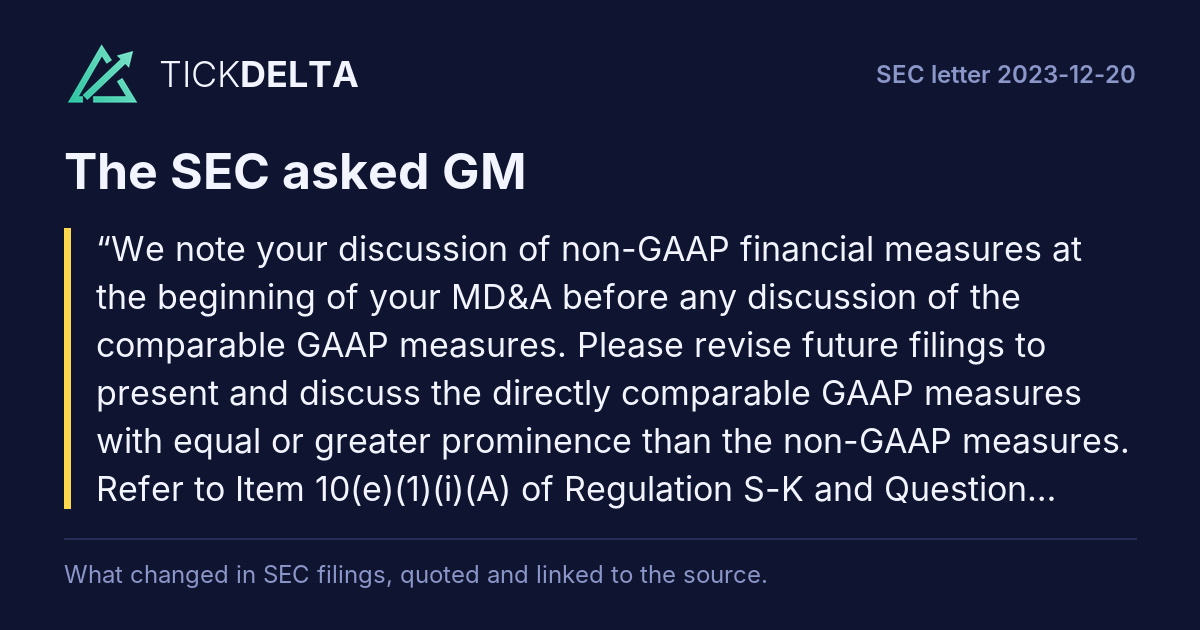
We note your discussion of non-GAAP financial measures at the beginning of your MD&A before any discussion of the comparable GAAP measures. Please revise future filings to present and discuss the directly comparable GAAP measures with equal or greater prominence than the non-GAAP measures.Rest of the question
Refer to Item 10(e)(1)(i)(A) of Regulation S-K and Question 102.10 of the Compliance and Disclosure Interpretations on Non-GAAP Financial Measures. Your Form 8-K earnings releases should be similarly revised.
to the Staff’s comment, we will ensure that the Company’s disclosures in future filings with the Commission (including any documents furnished therewith) will present and discuss the directly comparable GAAP measures with equal or greater prominence to any non-GAAP financial measures. Specifically, within the Form 10-K, we will place the “Non-GAAP Measures” subsection of the Company’s “Management’s Discussion and Analysis of Financial Condition and Results of
Operations” (“MD&A”) after the “Critical Accounting Estimates” subsection but before the “Forward-Looking Statements” subsection ofRead in the reply ↗Rest of the answer
the Company’s MD&A. Similarly, in the Company’s earnings release, we will move the discussion of non-GAAP measures to follow the cash flow information.
First report after the company's reply of 2024-01-11: 10-K filed 2024-01-30 ↗, against the 10-K filed 2023-01-31 ↗.
Tickdelta does not hold the text of both reports, so they are not compared here.
We note that you separately present and discuss operating, investing, and financing cash flows at the Automotive, GM Financial, and Cruise segment levels without a corresponding discussion at the consolidated level. Please tell us how your presentation complies with the requirement of Item 303(b) of Regulation S-K to discuss your business as a whole with segment information provided as necessary.
Our current Liquidity and Capital Resources discussion focuses on Automotive cash flows, GM Cruise cash flows and General Motors Financial
Company, Inc. (“GM Financial”) cash flows because cash flows from these components of our operations are the key drivers of our consolidated cash flow results as a whole. This presentation aligns with the fact that the Company’s
Automotive operations, GM Cruise and GM Financial operations are fundamentally different businesses.Read in the reply ↗Rest of the answer
Accordingly, we believe investors and analysts primarily focus on these sector cash flow amounts as opposed to the consolidated amounts to understand the Company’s cash flow activity and overall liquidity. We believe that the Company’s current disclosure, which excludes a discussion of the consolidated statement of cash flow amounts, represents a clearer and more concise presentation and discussion of the key drivers of the Company’s overall cash flows and liquidity for investors and is consistent with how the users of the Company’s financial statements assess its results. We further believe the addition of consolidated information will not benefit the users of the Company’s financial statements as it will not provide additional insight into the key drivers of the Company’s consolidated cash flow results or its overall liquidity. Rather, the discussion on a consolidated basis will be repetitive of the information already provided on a sector basis, and we believe the inclusion of the consolidated information may obscure the more granular information provided on a sector basis. In addition, we believe adequate disclosure exists throughout the filing pertaining to the inter-sector activities, including the disclosure of outstanding balances at period end between the sectors. We also provide the following disclosure in the
Liquidity and Capital Resources section of the MD&A to provide users of our quarterly and annual financial reports with a clear understanding of the impact of inter-sector activity on our consolidated cash flows:
Cash flows that occur amongst our Automotive, Cruise and GM Financial operations are eliminated when we consolidate our cash flows. Such eliminations include, among other things, collections by Automotive on wholesale accounts receivables financed by dealers through GM Financial, payments between Automotive and GM Financial for accounts receivables transferred by Automotive to GM
Financial, loans to Automotive and Cruise from GM Financial, dividends issued by GM Financial to Automotive, tax payments by GM Financial to Automotive and Automotive cash injections in Cruise. The presentation of Automotive liquidity, Cruise liquidity and GM Financial liquidity presented below includes the impact of cash transactions amongst the sectors that are ultimately eliminated in consolidation.
As such, we respectfully advise the Staff that we do not believe any revisions are warranted in response to its comment.
First report after the company's reply of 2024-01-11: 10-K filed 2024-01-30 ↗, against the 10-K filed 2023-01-31 ↗.
Tickdelta does not hold the text of both reports, so they are not compared here.
Please tell us the nature of all items included within the "Purchases of finance receivables, net" and "Purchase of leased vehicles, net" line items and identify the parties from which you purchase the applicable assets. In doing so, clarify if the balances include any material offsetting amounts and how you determined net presentation was appropriate.
to the Staff’s comment, in future filings we will revise the line items to remove the word “net” to provide better clarity to the reader of our financial statements. The Company provides automotive financing services through GM Financial, our global provider of automobile finance solutions. GM Financial provides retail loan and lease lending across the credit spectrum to support vehicle sales.Read in the reply ↗Rest of the answer
Dealerships originate the retail loans and leases with the consumers and GM Financial subsequently purchases the retail loans and the vehicles subject to the underlying lease contracts from the dealerships. In conjunction with originating the retail loans or lease contracts, the dealerships collect from the retail consumers the down payments, first month rents on leases and certain fees that are not financed. These amounts are collected and retained by the dealership. Upon acquisition of the retail loans or the vehicles subject to the lease contracts, GM Financial subtracts from the amount paid to the dealerships the amounts already collected by the dealership from the retail consumers (i.e., the fees, lease down payments, and first month rents). Thus, historically, we have referenced the cost to purchase the retail loans and vehicles subject to the lease contracts as being
“net”. However, the dealerships do not remit to GM Financial the amounts collected upfront from the retail consumer and GM Financial only remits a single amount to the dealerships at the time of acquisition. In addition, a portion of the payment to the dealership is applied to the sales incentive (i.e., “subvention”) that is accrued by the Company’s automotive segment at the time of the vehicle sale. Applying a portion of the payment to the sales incentive accrued at the time of sales has historically been referred to as “netting” the subvention payment against the cost of purchasing the retail loans and vehicles subject to the lease contracts. However, no “netting” is occurring; rather, the payment is being bifurcated into the amount paid to acquire the retail loans or vehicles subject to the lease contracts and the sales incentives accrued when the vehicles were sold. Because the dealerships do not remit the amounts they collect upon origination of the retail loans or lease contracts, no offsetting is occurring within the “Purchases of finance receivables, net” and “Purchases of leased vehicles, net” line items within the Company’s Consolidated
Statements of Cash Flows.
First report after the company's reply of 2024-01-11: 10-K filed 2024-01-30 ↗, against the 10-K filed 2023-01-31 ↗.
Tickdelta does not hold the text of both reports, so they are not compared here.
We note your revenue recognition disclosures related to remarketing obligations at the top of page 58. Please explain to us the specific nature of the arrangements and transactions involved and the specific accounting guidance followed, including how you applied or considered the repurchase agreement guidance in ASC 606-10-55-66 through -78.Rest of the question
In doing so, clarify if you account for any arrangements with daily rental companies as leases or financing arrangements due to repurchase agreements and provide us with illustrative journal entries to assist our understanding.
None of our vehicle transfers to rental car companies are accounted for as operating leases under ASC 606 because none of the Company’s contracts with the rental car companies contain provisions whereby ownership of the vehicle automatically transfers to the Company at the time the vehicles are delivered by the rental car companies to the auction site. Instead, the Company’s contracts with the rental car companies that include a repurchase feature have only a conditional repurchase obligation.Read in the reply ↗Rest of the answer
Under these arrangements, if a vehicle delivered to the auction site by the rental car company sells within 90 days (or 120 days in certain markets), the Company’s repurchase obligation is not exercised, and ownership never reverts to the Company. We administer the remarketing of the Company’s rental car programs such that substantially all rental car vehicles delivered to the auction site are sold before ownership transfers back to the Company. As such, we view the conditional repurchase obligation to be non-substantive.
Since implementing certain administrative changes to the Company’s remarketing procedures in 2017, ownership of the vehicles returned for auction in the U.S., which is the Company’s largest market, has transferred back to the Company typically less than 5 percent of the time. Return rates in other relevant markets are even lower. Over this timeframe, the percentage of vehicles whose ownership transferred back to the Company has never exceeded ten percent.
The accounting conclusions related to conditional repurchases from rental car companies was the subject of a preclearance submission with the
SEC’s Office of the Chief Accountant resulting in a confirming letter dated March 3, 2017. As stated in our preclearance submission, if we observe a demonstrated pattern that creates the expectation that more than 90 percent of vehicles transferred to the rental car companies will sell prior to ownership transferring back to the Company, we deem the repurchase option to be non-substantive and the original transfer is accounted for as a sale. Since January 1, 2018, which was the date the Company’s administrative remarketing procedures in 2017 demonstrated that the conditional repurchase obligation was not substantive and transfers to rental car companies with conditional repurchase features began to be accounted for as sales, we believe the Company’s remarketing experience has demonstrated that the conditional repurchase feature is non-substantive. Thus, the
Company accounts for all transfers to rental car companies with conditional repurchase features as sales.
In accordance with the terms of the Company’s agreements with the rental car companies that contain a guaranteed resale price, the rental car companies can choose to deliver vehicles to an auction location any time after a predetermined minimum in-service period (typically five to six months) and before the maximum in-service period (typically twelve months from the date of purchase). Under the agreements with these rental car companies, the Company is required to remarket the vehicle on behalf of the rental car company and pay the rental car company the difference between the auction proceeds and the guaranteed resale price. The auction companies are contracted by the Company, and the Company has the authority to oversee or manage all aspects of the remarketing process. The remarketing process used to remarket vehicles for the rental car companies is also used to sell GM corporate-owned vehicles
(i.e., vehicles provided to employees), as well as vehicles that are returned off lease at GM Financial. Most of the vehicles are ultimately sold to GM dealers.
The rental car companies pay GM the full purchase price for the vehicles at the time they are transferred. Under the terms of the agreements, both the vehicle and the remarketing services represent separate performance obligations in accordance with the guidance of paragraphs
606-10-25-14 through 25-22. The guaranteed resale price meets the definition of a guarantee. Because guarantees are specifically scoped out of ASC 606, the guaranteed resale price is accounted for in accordance with ASC 460, as described by paragraph BC61 to ASC 606, with part of the transaction price being allocated to the guarantee at inception of the arrangement. The following are a summary of the entries recorded to account for the transfer of a vehicle to a rental car company and the subsequent remarketing of the vehicle:
Transfer of Vehicle to the Rental Car Company
To record the transfer of a vehicle as a sale:
Accounts receivable/cash
$
XX
To record GM’s ongoing obligations (including its guaranteed resale obligation):
Deferred revenue – remarketing obligation
Residual value guarantee
To record the estimated loss on the guaranteed residual value (i.e., the ASC 450 obligation for the guarantee, which is the difference between the guaranteed resale price and the estimated residual value of the vehicle at the time it is delivered to the auction):
Revenue – loss on guaranteed residual value
Guarantee resale price payable
To record cost of goods sold:
Cost of goods sold
Inventory
Period Vehicle is Used by the Rental Car Company
To record updates to the residual value guarantee loss (if necessary):
Note: The guarantee resale price payable is adjusted to reflect the difference between the guaranteed resale price and the updated estimated residual value of the vehicle at the time it is delivered to the auction site at each period end.
Remarketing of the Vehicle by GM
Vehicle is returned to an auction site:
No accounting because the vehicle is not owned by GM and the auction house pays the rental car company the residual value when vehicle sells at auction.
To settle the guarantee resale price payable upon remarketing:
Payable to rental car company/cash
Note: The fair value of the residual value guarantee on day-one is maintained and released upon completion of the remarketing process to represent GM’s release from its ongoing stand-ready obligation.
To record revenue upon remarketing the vehicle:
First report after the company's reply of 2024-01-11: 10-K filed 2024-01-30 ↗, against the 10-K filed 2023-01-31 ↗.
Tickdelta does not hold the text of both reports, so they are not compared here.
As required by ASC 330-10-50-1, please disclose the basis of stating inventories, such as FIFO, LIFO or estimated average cost. If LIFO or estimated average cost per unit is used, provide the additional disclosures required by Rule 5-02(6)(b)-(c) of Regulation S-X.
to the Staff’s comment, we will disclose in future filings that cost is determined on a first-in, first-out (“FIFO”) basis.
Stock Incentive Plans, Read in the reply ↗
We note your disclosure that compensation cost is "recorded on stock issued to settle awards based on the fair value of Cruise's common stock until such time that the stock has been issued for more than six months." Please clarify what this statement means and how it complies with ASC 718.
Once shares are issued to settle vested awards, the holders of the Cruise Class B Common Shares (“shares”) issued to settle vested non-option awards can tender their shares during quarterly tender offers. We refer the Staff to Note 22. Stock Incentive Plans, page 93, for additional information on our Cruise Stock Incentive Awards and the intent to hold quarterly tender offers. Paragraph 718-10-25-9 indicates a share must be held for a period of six months or more for the shareholder to bear the risks and rewards normally associated with equity ownership.Read in the reply ↗Rest of the answer
The lack of a required six-month holding period (i.e., the ability for immature shares to be put back to the
Company in a tender offer) results in the awards and shares issued upon settlement being liability classified. Paragraph
718-30-35-1 indicates “[t]he fair value of liabilities incurred in share-based payment transactions shall be remeasured at the end of each reporting period through settlement.” As such, the Company continues to record compensation expense associated with the change in the fair value of the shares issued to settle the awards until such time that the shares have been outstanding for six months. Once the shares have been outstanding for six months, the criteria in paragraph 718-10-25-9 are no longer met and the shares are reclassified to temporary equity. Once the shares have been reclassified to temporary equity, recognition of compensation costs ceases because the Company conducts its routine tenders at the current fair value of the shares.
First report after the company's reply of 2024-01-11: 10-K filed 2024-01-30 ↗, against the 10-K filed 2023-01-31 ↗.
Tickdelta does not hold the text of both reports, so they are not compared here.
ASC 606-10-50-4(a) requires entities to disclose the amount of revenue recognized from contracts with customers under ASC 606 separately from other sources of revenues. Please revise your disclosures, as necessary, to provide distinctions between ASC 606 and non-ASC 606 revenues.
We respectfully advise the Staff that we do not believe any revisions are warranted in response to its comment. The amounts disclosed for
“Vehicle, parts and accessories” and “Used vehicles” are accounted for in accordance with ASC 606. The amounts disclosed for “Leased vehicle income” are accounted for in accordance with ASC 842. The amounts disclosed for “Finance charge income” are accounted for in accordance with ASC 310. The accounting policies applied to these line items are further described in Note 2.Read in the reply ↗Rest of the answer
Significant Accounting Policies of the Company’s Consolidated Financial
Statements.
The “Services and other” caption and the “Other income” amount for GM
Financial contain certain revenue streams that are not accounted for in accordance with ASC 606. Such amounts represent in total less than one percent of the Company’s consolidated revenues and represent income streams that are not core to the
Company’s operations. Because the amounts not recognized under ASC 606 in these two captions are insignificant, with the majority of the amounts disclosed in these captions being subject to ASC 606, we do not believe further disaggregation is warranted. We will continue to monitor our non-ASC 606 revenue amounts and will revise our disclosures accordingly should these amounts become significant.
First report after the company's reply of 2024-01-11: 10-K filed 2024-01-30 ↗, against the 10-K filed 2023-01-31 ↗.
Tickdelta does not hold the text of both reports, so they are not compared here.
We note your response to comment 2 and continue to believe that discussion of your cash flows at the consolidated level should be provided pursuant to Item 303(b) of Regulation S-K. Please tell us how you will revise your disclosures in future filings.
to the Staff’s comment, in future filings we will provide quantitative disclosure of the consolidating adjustments made to our segment cash flows (i.e., Automotive cash flows, GM Cruise cash flows and General Motors Financial Company, Inc. (“GM Financial”) cash flows) to allow readers of the filings to arrive at the Company’s consolidated cash flow amounts. Read in the reply ↗
First report after the company's reply of 2024-01-29: 10-K filed 2024-01-30 ↗, against the 10-K filed 2023-01-31 ↗.
Tickdelta does not hold the text of both reports, so they are not compared here.
We note from your response to comment 4 that none of your vehicle transfers to rental car companies are accounted for as leases, which appears to be a change from the conclusions reached at the time of the 2017 Office of the Chief Account preclearance referenced in your response. Please explain to us in further detail how you determined none of your rental car company transfers currently qualify as leases.Rest of the question
In doing so, expand on the "administrative changes...to the remarking procedures" made during and since 2017, including any material revisions to your remarketing programs, and the reasons for the significant decline in percentage of vehicles transferred back to the company from rental car companies.
As outlined in our preclearance submission with the SEC’s Office of the Chief Accountant dated September 9, 2016, that resulted in a confirming letter dated March 3, 2017, our arrangements with rental car companies either do not contain a guaranteed resale price (“risk sales”) or do contain a guaranteed resale price. At that time, the arrangements containing a guaranteed resale price came in one of two forms, referred to as Program 1 or Program 2.Read in the reply ↗Rest of the answer
The primary difference between Program 1 and Program 2 relates to whether GM obtains contractual ownership of the vehicle as part of the remarketing process. Under Program 1, contractual ownership transfers to GM immediately upon delivery of the vehicles to the auction sites by the rental car companies. Under Program 2, contractual ownership would transfer to GM only if a vehicle delivered to the auction site by the rental car companies does not sell within 90 days (or 120 days in certain markets). After our preclearance submission, Program 1 was phased out such that currently only risk sales or Program 2 arrangements exist within our contracts with rental car companies.
Prior to 2017, the Company managed its remarketing activities on a pooled basis whereby it did not differentiate between the source of the vehicles being remarketed. As such, vehicles returned under Program 2 were not differentiated from other vehicles being remarketed (e.g., GM corporate-owned vehicles provided to employees and vehicles that were returned off lease to GM Financial). Furthermore, the vehicles subject to Program 2 were not being remarketed on a first-in, first-out basis with regard to other vehicles being remarketed at the same time. In 2017, the Company changed its practices such that vehicles subject to Program 2 are identified and tracked throughout the remarketing process to ensure they are sold before ownership reverts to GM. Since implementing these practices to monitor and track vehicles subject to Program 2 throughout the remarketing process, substantially all of the vehicles have been sold prior to ownership reverting to GM. As such, given that Program
1 has been phased out and the conditional repurchase obligation under Program 2 is not substantive, we are accounting for all transactions with rental car companies as sales.
First report after the company's reply of 2024-01-29: 10-K filed 2024-01-30 ↗, against the 10-K filed 2023-01-31 ↗.
Tickdelta does not hold the text of both reports, so they are not compared here.
Also in this review: closing letter, 2024-02-01