Form 10-K for the Fiscal Year Ended January 30, 2016
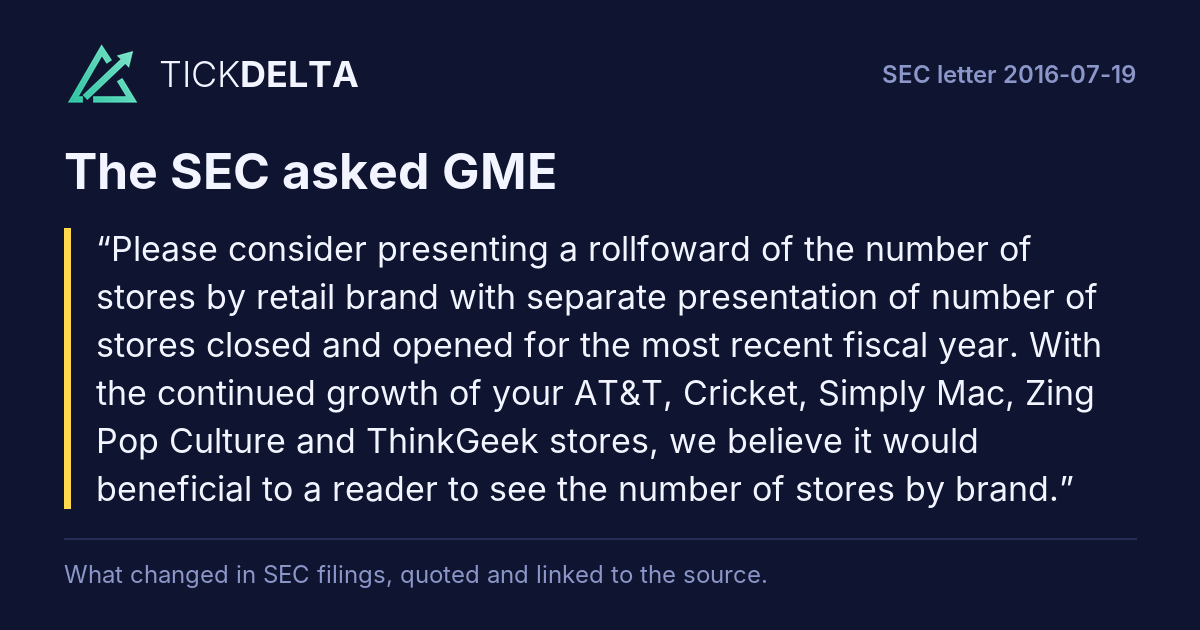
Please consider presenting a rollfoward of the number of stores by retail brand with separate presentation of number of stores closed and opened for the most recent fiscal year. With the continued growth of your AT&T, Cricket, Simply Mac, Zing Pop Culture and ThinkGeek stores, we believe it would beneficial to a reader to see the number of stores by brand.
In future annual filings, we will include a rollforward of the number of stores by retail type with a separate presentation of the number of stores closed and opened in a tabular format for the most recent fiscal year. We will aggregate our Video Game stores, including GameStop, EB Games, and Micromania as they are similar store formats; will combine Zing Pop Culture and ThinkGeek stores as “Collectibles stores” since these two brands are also very similar store formats; and we will reflect AT&T, Cricket and Simply Mac brands separately.
A sample of the Company’s proposed disclosure for theRead in the reply ↗Rest of the answer
fiscal year ending January 30, 2016 is set forth below.
January 31, 2015
Opened/Acquired
Closed
January 30, 2016
Video Game Stores
6,202
(210
)
6,046
Collectibles Stores
Total Video Game Brands
6,206
6,081
Spring Mobile
361
535
(6
890
Cricket
(10
Simply Mac
Total Technology Brands
484
568
(16
1,036
Total Stores
6,690
653
(226
First report after the company's reply of 2016-08-15: 10-Q filed 2016-09-07 ↗, against the 10-Q filed 2016-06-07 ↗.
Tickdelta does not hold the text of both reports, so they are not compared here.
We note your presentation of net sales and gross profit by significant product category here and in your segment disclosures. We further note that your “mobile and consumer electronics” product category consists mainly of your Technology Brand segment through Spring Mobile managed AT&T and Cricket branded stores and Simply Mac stores, but also includes the sale of headphones, accessories and pre-owned smart phonesRest of the question
in your Video Game Brand stores. Given your continued growth of these brands and the vastly different gross margins, please consider separately presenting your Spring Mobile managed AT&T and Cricket stores and your Simply Mac stores as two distinct product categories. We believe investors would benefit from separate presentation to better appreciate the growth and gross margins each delivers. If Spring Mobile and Simply Mac will each be presented separately, please tell us the category in which the mobile and consumer electronics sold in your Video Game Brand stores will be presented.
As noted in our Form 10-K for the fiscal year ended January 30, 2016, and as noted in the Staff’s comment above, the majority of our “mobile and consumer electronics” product category has consisted of our Technology Brands segment since the acquisitions of our Spring Mobile and Simply Mac businesses in 2013.Read in the reply ↗Rest of the answer
For the fiscal years ended January 30, 2016, January 31, 2015, and February 1, 2014, our Technology Brands segment made up 81.8%, 63.3% and 20.7% of mobile and consumer electronics net sales, respectively.
Given the continued growth of our Technology Brands business, we will reflect our net sales and gross profit for our Spring Mobile, Cricket and Simply Mac businesses together as a separate Technology Brands product category beginning with the quarter ending October 29, 2016. We believe that the combined presentation of all three brands within the Technology Brands category is the most meaningful disclosure for investors because our Simply Mac business is not a material part of our operations and has not been a significant component of the growth in our Technology Brands business. For each of the fiscal years ending January 30, 2016 and January 31, 2015, our Simply Mac business represented less than 2% of our total company net sales and only 1% of our total company gross profit, and we do not expect the Simply Mac contribution to our business to significantly increase in the near future.
Additionally, in our future filings, we will include the revenue from mobile and consumer electronics products sold in our Video Game Brands stores under our “other” products category due to immateriality. For the fiscal years ending January 30, 2016, January 31, 2015, and February 1, 2014, mobile and consumer electronics revenue in our Video Game Brands stores represented 1%, 2% and 2% of our total company net sales, respectively.
First report after the company's reply of 2016-08-15: 10-Q filed 2016-09-07 ↗, against the 10-Q filed 2016-06-07 ↗.
Tickdelta does not hold the text of both reports, so they are not compared here.
We note your description on page 3 that your AT&T branded stores sell both pre and post-paid AT&T services, DirecTV service and wireless products. We also note that you earn commission revenue on certain digital products for which you do not take physical possession of or title to inventory. Therefore, it appears to us that you may have both sales of tangible products and revenues from services.Rest of the question
Please tell us how you considered separately presenting net sales from tangible products and revenues from services on the face of your income statement. Refer to Rule 5-03b of Regulation S-X. Notes to Consolidated Financial Statements 1. Nature of Operations and Summary of Significant Accounting Policies
We respectfully acknowledge the Staff’s comment, and advise the Staff that we examined the guidance set forth in Rule 5-03(b) of Regulation S-X, and determined that the Company’s current aggregate revenue presentation is appropriate. The Company derives its revenues primarily from sales of tangible products, including new and pre-owned video game hardware and software, video game accessories, collectible merchandise and mobile and consumer electronics products.Read in the reply ↗Rest of the answer
We determined that these revenue streams are aligned with the guidance of Rule 5-03(b)(1)(a), which requires the presentation of “net sales of tangible products.”
The Company also derives revenues from the sale of “services” per Rule 5-03(b)(1)(d), such as product warranties and from “other” classes of revenue per Rule 5-03(b)(1)(e), such as commission revenues generated from the sale of digital products, the activation of new wireless plans, the activation of enhanced or upgraded features on existing wireless plans and the activation of other services provided by AT&T. However, revenues derived from all sources of revenue other than the sales of tangible products comprised less than 7% of the Company’s revenues in the fiscal years ending January 30, 2016, January 31, 2015, and February 1, 2014. As such, in accordance with Rule 5-03(b)(1), this service revenue and other revenue has not been presented separately on the Company’s statements of operations. To the extent the percentage of our service revenue or other revenue exceeds 10% of total revenue, we will modify the presentation.
Notes to Consolidated Financial Statements
1. Nature of Operations and Summary of Significant Accounting Policies
First report after the company's reply of 2016-08-15: 10-Q filed 2016-09-07 ↗, against the 10-Q filed 2016-06-07 ↗.
Tickdelta does not hold the text of both reports, so they are not compared here.
We note that you earn commissions from the sale of digital products and from the activation of new wireless customers and activation of enhanced or upgraded features on existing wireless customer plans in your Spring Mobile business as an AT&T authorized dealer. We also note that you determined that you are not the primary obligor on the underlying AT&T wireless services contracts.Rest of the question
Please provide us with your gross versus net analysis for revenue recognition related to your digital product sales and your AT&T service contracts. In doing so, please address each of the indicators in ASC 605-45-45. Please also clarify if all sales of digital products are recorded on a net basis. Furthermore, please tell us the different types of products and services sold as an AT&T authorized dealer and whether each of those revenues are recorded gross or net.
Gross versus net analysis
As noted in our Form 10-K for the fiscal year ended January 30, 2016, and as noted in the Staff’s comment above, the Company earns commission revenues from the sale of digital products, the activation of new wireless plans and the activation of enhanced or upgraded features on existing wireless plans. The Company has carefully considered the guidance in ASC 605-45-45 in its decision on whether to recognize these revenues on a gross or net basis.Read in the reply ↗Rest of the answer
The specific indicators that we considered for each of these sales categories are as follows:
Indicator per
ASC 605-45-45
Sale of Digital Products
Activation of Wireless Plans
Comments:
The Company Is the Primary Obligor
Net
In both the sale of digital products and the activation of new wireless plans, the Company is not the primary obligor. For the digital products we sell, our vendors have the ultimate responsibility for delivering the digital products and are responsible for the acceptability of those digital products. For activations of new wireless plans, AT&T has the responsibility for providing the wireless services to the customer and is responsible for the acceptability of the wireless services.
The Company Has General Inventory Risk
The Company does not take inventory risk in either the sale of digital products or the sale of wireless service plans. For most digital products we sell, the Company never takes title to the digital product. The digital product is activated at the time of sale which enables the customer to access the digital product delivered by the publisher or service provider. For wireless service plans, the Company does not purchase the wireless service plans from the service provider for resale to our customers.
The Company Has Latitude in Establishing Price
For the digital products we sell, we have limited ability to establish sales prices. For wireless service plans, we do not have the ability to set price.
The Company Changes the Product or Performs Part of the Service
The Company does not change any part of the digital products we sell nor do we perform any part of the wireless services purchased by our customers. Both the digital products and wireless services are provided to our customers in their original form directly from the digital product vendors and AT&T, respectively.
The Company Has Discretion in Supplier Selection
The Company does not have supplier discretion in either the digital products we provide or the wireless services plans we offer.
The Company Is Involved in the Determination of Product or Service Specifications
The Company is not involved in the determination of product or service specifications for either the digital products we sell or the wireless service plans we offer.
The Company Has Physical Loss Inventory Risk
The risk of inventory loss is not applicable to the digital products or the wireless service plans we sell. Both the digital products and the wireless service plans we sell are activated immediately at the point of sale.
The Company Has Credit Risk
For sales of digital products, the Company does not have credit risk since the full amount of payment is collected at the point of sale. For sales of wireless service plans, the Company does not have credit risk as the customer is billed directly by AT&T for wireless services. In the event of certain wireless service plan or feature cancellations, the Company is only responsible for refunding the commission we earned in the initial sale transactions.
Based on a comprehensive review of all the indicators above, as defined in ASC 605-45-45, we respectfully submit to the Staff that the Company appropriately determined that we are acting as an agent in both our sale of digital products and wireless service plans and as such have appropriately recorded revenues for these products and services on a net basis.
As noted in our Form 10-K for the fiscal year ended January 30, 2016, we do not record all digital product sales on a net basis. For the fiscal year ended January 30, 2016, less than 10% of our digital sales, or less than 1% of total sales, were recorded on a gross basis. We recognize certain digital sales on a gross basis where we are required to pre-purchase unique digital product activation codes from game developers prior to the sale to our customers and bare the risk of loss if we do not sell those codes.
Types of products and services sold as an AT&T authorized dealer
As noted in our Form 10-K for the fiscal year ended January 30, 2016, we sell several different products and services in our AT&T authorized stores. In general, the products and services we sell in these stores and the revenue recognition treatment are outlined below.
Wireless service plans — We sell AT&T wireless service plans for mobile phones and tablets. These sales are recognized on a net basis as described above.
Other services — We sell other services offered by AT&T including digital television subscriptions (DIRECTV) and home automation and security services plans and equipment (AT&T Digital Life). We recognize these sales on a net basis. It should be noted that the ASC 605-45-45 gross versus net analysis for these services is similar to the gross versus net analysis for wireless service plans discussed previously.
Products (including wireless devices and accessories) — We sell wireless devices (phones and tablets) and related accessories. These sales are recognized on a gross basis with the exception of wireless devices sold through AT&T’s NEXT wireless service plan. For the fiscal year ended January 30, 2016, over 95% of wireless devices we activated in our AT&T authorized dealer stores were sold under AT&T’s NEXT plan. This plan allows the customer to activate a wireless service plan for a period of 24 or 30 months and lease a wireless device for the same period from AT&T. In these transactions, we deliver the device to the customer on behalf of AT&T, and AT&T reimburses us for the cost of the device. We determined that these transactions are not sales of consignment inventory, since we take title to and assume risk of ownership of inventory at the time we purchase the devices from AT&T. We do not record a product sale for these transactions.
Warranties — We sell mobile device warranties and protection plans. These sales are recognized on a net basis since we are selling these warranty and protection plans for a commission on behalf of AT&T who is responsible for performing under these warranties and protection plans.
We hereby acknowledge that:
• we are responsible for the adequacy and accuracy of the disclosure in the filing;
Staff comments or changes in disclosure in response to Staff comments do not foreclose the Commission from taking any action with respect to the filing; and we may not assert Staff comments as a defense in any proceeding initiated by the Commission or any person under the federal securities laws of the United States.
First report after the company's reply of 2016-08-15: 10-Q filed 2016-09-07 ↗, against the 10-Q filed 2016-06-07 ↗.
Tickdelta does not hold the text of both reports, so they are not compared here.
Also in this review: request for more time, 2016-07-21, closing letter, 2016-09-06