10 paragraphs in Risk Factors of the 10-K filed Feb 5, 2026
with nothing like them in the 10-K filed Feb 5, 2025. Quoted exactly.
Paragraphs that were only edited are under 10-K change.
Compared with the Risk Factors in the latest 10-K of the other 18 Communication companies:
a paragraph with at least half its words the same at another company is called similar, and the companies are listed under it.
A paragraph most of them have is marked boilerplate. No line means no other company has one like it.
This counts text; it does not say how serious a risk is.
We believe AI is quickly reshaping the advertising industry, including how ads are delivered online, and we and our competitors are constantly adjusting to meet this shift and provide new and evolving advertising formats. There is no assurance that we will adapt effectively and competitively to meet this shift, and that such advertising formats, strategies, and offerings will be successful.
Read in the 10-K ↗
To meet the compute capacity demands of AI training and inference, as well as traditional cloud computing services, we are entering into significant leasing arrangements with third party operators, which may increase costs and operational complexity. We also have a number of large, long-duration commercial agreements, which could increase our liabilities and obligations in the event of nonperformance by us, our counterparties, or vendors. In such nonperformance or an industry downturn, we may incur additional liabilities, have excess capacity that we cannot easily redeploy, and not receive payments from our counterparties or customers.
Read in the 10-K ↗
Our strong brands have significantly contributed to the success of our business. Maintaining and enhancing the brands within Google Services, Google Cloud, and Other Bets increases our ability to enter new categories and launch
Read in the 10-K ↗
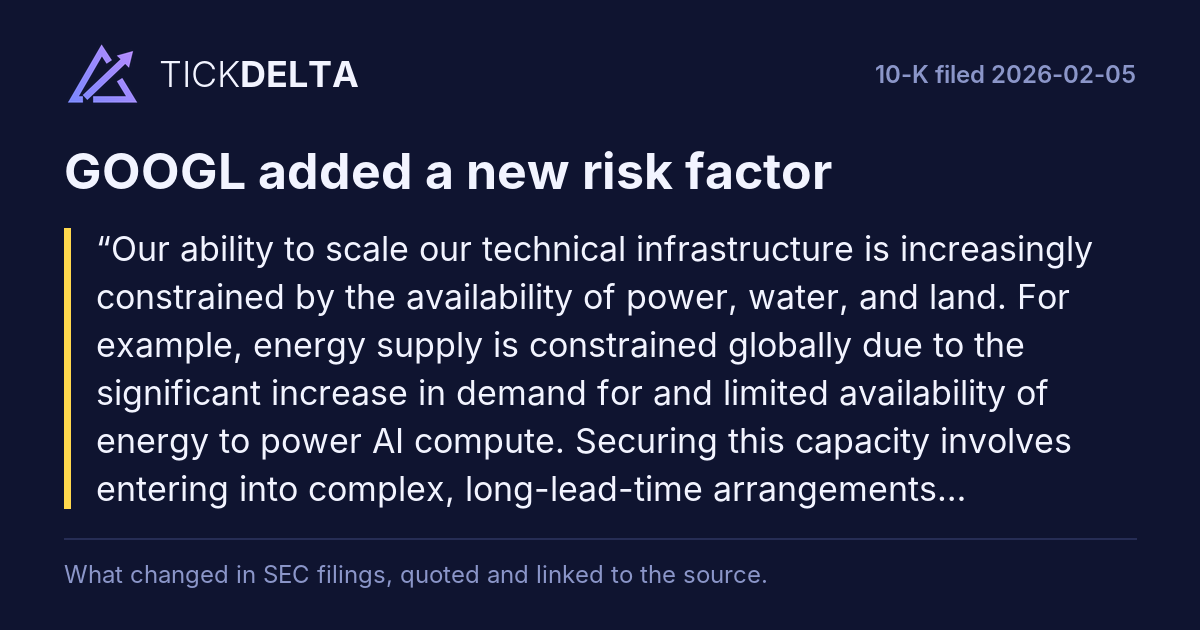
Our ability to scale our technical infrastructure is increasingly constrained by the availability of power, water, and land. For example, energy supply is constrained globally due to the significant increase in demand for and limited availability of energy to power AI compute. Securing this capacity involves entering into complex, long-lead-time arrangements. Additionally, manufacturing and supply of servers and network equipment for our technical infrastructure, particularly for specialized AI chips, is limited to a small number of qualified suppliers. Extended or unforeseen disruptions at these suppliers could impact our ability to meet customer demand. Failure to secure sufficient capacity in a timely manner would limit our ability to train models and serve Cloud customers.
Read in the 10-K ↗
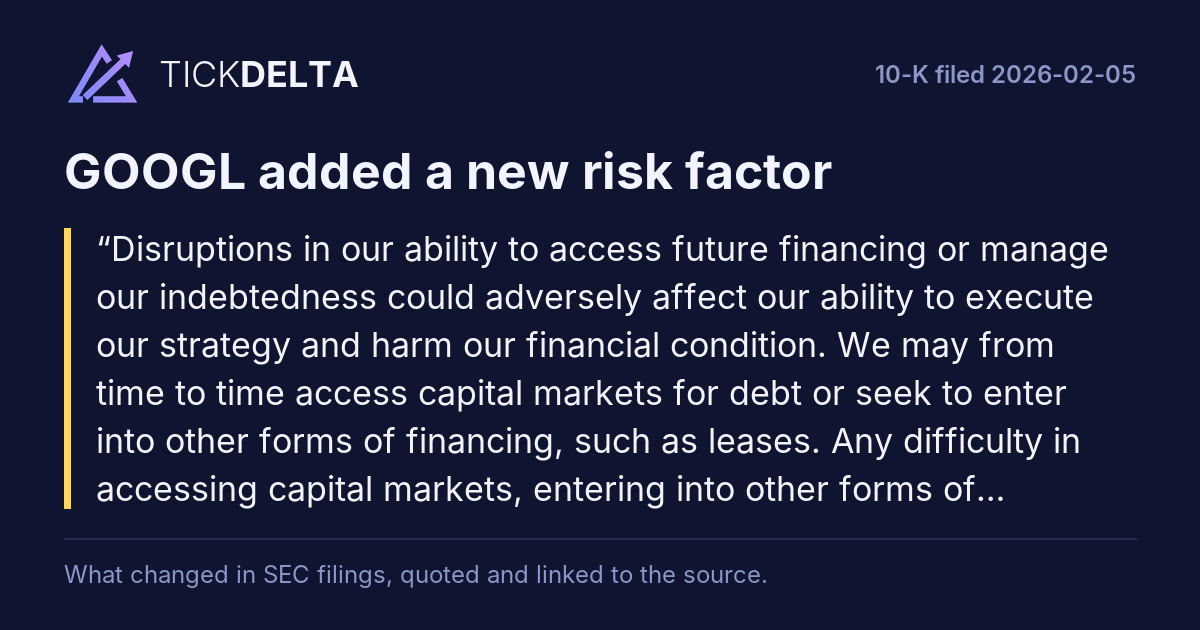
Disruptions in our ability to access future financing or manage our indebtedness could adversely affect our ability to execute our strategy and harm our financial condition.
Similar paragraph at 2 of 18 other Communication companies:
LYV,
TTWOWe may from time to time access capital markets for debt or seek to enter into other forms of financing, such as leases. Any difficulty in accessing capital markets, entering into other forms of financing on favorable terms, or managing our existing indebtedness could increase our costs of financing and restrict our ability to invest in our business. Furthermore, the combination of our current and any future indebtedness, including obligations arising under
leases, backstops, guarantees, and potential liabilities from large commercial agreements, could harm our financial condition and reduce our financial and business flexibility.
Read in the 10-K ↗
regulatory inquiries, which could result in monetary penalties and damages, divert management's time and attention, and lead to enhanced regulatory oversight.
Similar paragraph at 1 of 18 other Communication companies:
ECHO
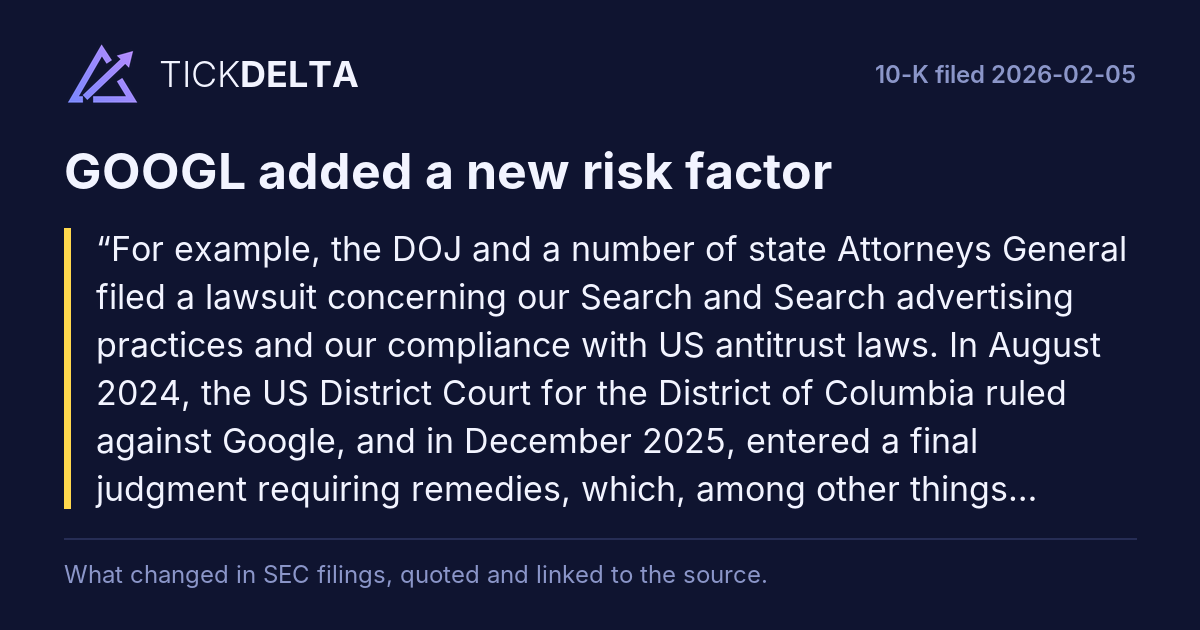
For example, the DOJ and a number of state Attorneys General filed a lawsuit concerning our Search and Search advertising practices and our compliance with US antitrust laws. In August 2024, the US District Court for the District of Columbia ruled against Google, and in December 2025, entered a final judgment requiring remedies, which, among other things, imposes restrictions on how we distribute our services and requires us to share certain search data with and offer syndication services to certain competitors. In January 2026, we appealed the final judgment and moved to pause implementation of certain remedies. In February 2026, the DOJ and state Attorneys General also appealed.
Read in the 10-K ↗
Our Class B stock has 10 votes per share, our Class A stock has one vote per share, and our Class C stock has no voting rights. As of December 31, 2025, Larry Page and Sergey Brin beneficially owned approximately 89.3% of our
Read in the 10-K ↗
New in the latest 10-Q
41 paragraphs in the 10-Q filed Oct 29, 2026 with nothing like
them in the 10-Q filed Jul 23, 2026 (at least half the words must differ; new numbers alone do not count).
Quoted exactly, grouped by the item heading above them. This is text that changed, not a judgement of how serious it is.
Financial statements and notes
In May 2026, we entered into an agreement with Blackstone Inc. ("Blackstone") to form a US-based joint venture entity to provide data center capacity, operations, networking, hardware, and software as a single compute-as-a-service offering. Under the agreement, Blackstone is committed to provide future capital contributions of up to $ 5.0 billion, and we are committed to provide future data center and energy infrastructure backstops in support of agreements the venture may enter into of up to $ 10.0 billion, subject to certain conditions. In the third quarter of 2026, the venture was formally announced as Crux AI, and we entered into a multi-year commercial agreement with the venture which constitutes a related party transaction. We hold a minority interest in the joint venture which is considered a variable interest entity for which we are not the primary beneficiary, and we account for our investment in the venture under the equity method. As of September 30, 2026, the carrying value of our investment in the joint venture was not material. See Note 2 for further details on our revenue backlog associated with the commercial agreement with Crux AI.
Read in the 10-Q ↗
We enter into interest rate swaps to manage interest rate risk associated with certain fixed-rate debt, effectively converting a portion of our fixed-rate debt to floating-rate debt. We designate these swaps as fair value hedges to hedge against changes in the fair value of the fixed-rate debt attributable to changes in the benchmark interest rate. Fair value hedge amounts included in the assessment of hedge effectiveness are recognized in OI&E, along with the offsetting gains and losses of the related hedged items.
Read in the 10-Q ↗
The amounts recorded on the Consolidated Balance Sheets related to cumulative basis adjustments for fair value hedges were as follows (in millions):
Read in the 10-Q ↗
(1) Includes a short-term lease agreement entered into in June 2026, and amended in September 2026, with a remaining non-cancelable commitment of approximately $6.0 billion as of September 30, 2026. We do not recognize right of use assets or lease liabilities on leases with a term of 12 months or less. Short term lease costs are recognized on a straight-line basis over the lease term.
Read in the 10-Q ↗
(3) Includes fair value adjustments for fixed-rate notes in fair value hedge relationships. See Note 3 for further details.
Read in the 10-Q ↗
In October 2026, Waymo entered into a Credit Agreement for a $ 5.0 billion senior secured term loan that matures in October 2032. The term loan bears interest at a rate equal to Term SOFR plus 5.25 % and is secured by certain assets and subsidiaries of Waymo, subject to specified carve-outs. The obligations under the term loan are not guaranteed by Alphabet or any of its other subsidiaries.
Read in the 10-Q ↗
Other comprehensive income (loss) before reclassifications (442) (2,455) 465 (2,432)
Read in the 10-Q ↗
These contractual obligations consist mostly of long-term supply agreements to secure future production capacity for technical infrastructure and inventory components. Contract durations under these long-term supply agreements extend through 2032 and we expect to make the significant majority of the commitment payments through 2031. Certain of our long-term supply agreements contain fixed volume commitments with variable pricing between minimum and maximum rates and/or the ability to partially reduce committed volumes. The amounts disclosed above reflect pricing and volumes at the maximum contractual limits of the current contracts.
Read in the 10-Q ↗
quantities of energy supply and substantive termination fees. Our content licensing agreements have remaining terms extending through 2031.
Read in the 10-Q ↗
In addition, certain contracts require us to repurchase previously sold TPU hardware and embedded software under specified conditions and subject to the assets being returned in working order. As of September 30, 2026, our maximum potential future payments under these guarantees were $ 6.6 billion, and the fair value of these obligations was not material. Based on the extent of the discount on repurchase and other factors, we do not believe counterparties have an economic incentive to exercise their option to require us to repurchase.
Read in the 10-Q ↗
EC decision is now final. In July 2026, we made a cash payment of $ 5.2 billion for the fine plus accrued interest.
Read in the 10-Q ↗
other adverse consequences, all of which could harm our business, reputation, financial condition, and operating results.
Read in the 10-Q ↗
During the three and nine months ended September 30, 2026, we issued 12 million shares of Class A stock for net proceeds of $ 4.3 billion and 24 million shares of Class C stock for net proceeds of $ 8.1 billion. As of September 30, 2026, $ 27.6 billion remained available for future issuance under the ATM Program.
Read in the 10-Q ↗
• During the three months ended September 30, 2026, we issued 12 million shares of Class A stock for net proceeds of $4.3 billion and 24 million shares of Class C stock for net proceeds of $8.1 billion. As of September 30, 2026, $27.6 billion remained available for future issuance under the ATM Program.
Read in the 10-Q ↗
• In October 2026, Waymo entered into a Credit Agreement for a $5.0 billion senior secured term loan that matures in October 2032. The term loan bears interest at a rate equal to Term SOFR plus 5.25% and is secured by certain assets and subsidiaries of Waymo, subject to specified carve-outs. The obligations under the term loan are not guaranteed by Alphabet or any of its other subsidiaries.
Read in the 10-Q ↗
In October 2026, Waymo entered into a Credit Agreement for a $5.0 billion senior secured term loan that matures in October 2032. The term loan bears interest at a rate equal to Term SOFR plus 5.25% and is secured by certain assets and subsidiaries of Waymo, subject to specified carve-outs. The obligations under the term loan are not guaranteed by Alphabet or any of its other subsidiaries.
Read in the 10-Q ↗
During the three and nine months ended September 30, 2026, we issued 12 million shares of Class A stock for net proceeds of $4.3 billion and 24 million shares of Class C stock for net proceeds of $8.1 billion. As of September 30, 2026, $27.6 billion remained available for future issuance under the ATM Program.
Read in the 10-Q ↗
As of September 30, 2026, we have entered into future cash commitments that are not reflected on our balance sheet, subject to counterparties performing on their obligations. These future commitments comprise:
Read in the 10-Q ↗
As of September 30, 2026, we have entered into contingent commitments consisting of:
Read in the 10-Q ↗
• $75.7 billion of financial support in the form of backstop obligations relating to data centers, including data center lease payments and the associated energy costs for certain agreements. Of these obligations, $48.0 billion is executed with third-party data center providers, which are accounted for as credit derivatives. $27.7 billion represents our obligation to put in place future backstops to support data center and energy supply infrastructure, of which $10.0 billion is with Crux AI, a related party.
Read in the 10-Q ↗
• $22.8 billion of financial guarantees, primarily to support counterparty procurement of long-lead time equipment for our future power purchase and energy agreements.
Read in the 10-Q ↗
Risk Factors
Issues in the development and use of AI may result in reputational harm and increased liability exposure.
Read in the 10-Q ↗
Our evolving AI-enabled products and services, including our development and deployment of AI agents, expose us to risks involving harmful content, inaccuracies, discrimination, product liability, intellectual property infringement or misappropriation, rights of publicity claims, defamation, data privacy, cybersecurity, minor protection, and other issues. As a result, deploying AI systems and agents could subject us to competitive harm, regulatory action, legal liability (including under new and proposed regulations), new applications of existing data protection, privacy, intellectual property, and other laws, and brand or reputational harm.
Read in the 10-Q ↗
Some uses of AI will present ethical issues and may have broad effects on society. Although we have already devoted and will continue to invest significant resources to develop and deploy AI responsibly, the probabilistic nature of AI models means we may not be able to anticipate, identify, or resolve all AI-related issues, deficiencies, and failures before they arise. During model testing, we have sometimes observed unexpected behavior, including autonomous agents taking actions outside of their intended scope. Furthermore, as our AI systems increasingly orchestrate multi-step tasks and interact autonomously with third-party tools, applications, and APIs, errors or misalignments in one component may compound across the workflow, potentially leading to operational, technical, or transactional failures, unauthorized actions, or unforeseen liabilities for us or third parties. In the event of an incident, we may be unable to isolate root causes or detect and respond in a timely manner, and we may face difficulties identifying similar incidents in the future, any of which could subject us to heightened regulatory scrutiny, enforcement actions, or litigation. Unintended consequences, misalignment, misuse, abuse, or customization of our AI tools and systems, which we may not be able to prevent or control, could lead to severe or catastrophic security and societal incidents, or negatively affect human rights, privacy, cybersecurity, employment, public health, or other safety, ethical, and societal interests. Any such occurrences may result in litigation, brand or reputational damage, adverse legislation, increased regulatory scrutiny, orders or requirements to withdraw, retrain, or modify deployed models, and operational shutdowns or injunctions, any of which could harm our business, financial condition, and operating results.
Read in the 10-Q ↗
Data privacy and security concerns relating to our technology and our practices could harm our reputation, cause us to incur significant liability, and deter current and potential users or customers from using our products and services. Computer viruses, software bugs or defects, security breaches, and attacks on our systems could result in the improper disclosure and use of user data and interference with our users' and customers' ability to use our products and services, harming our business and reputation.
Read in the 10-Q ↗
Our products and services involve the storage, handling, and transmission of proprietary and other sensitive information. Malicious software such as viruses, software bugs, theft, misuse, defects, vulnerabilities in our products and services, as well as cyber attacks, phishing schemes, and other types of security attacks, which increasingly use AI and AI agents, expose us to a risk of loss or improper use and disclosure of such information, which could result in litigation and other potential liabilities, including regulatory fines and penalties, as well as reputational harm. Our technologies have contained, and are likely in the future to contain, undetected errors, bugs, or vulnerabilities, some of which we may discover only after the code is released. The use of AI to find and exploit vulnerabilities is accelerating timelines on which such vulnerabilities may be discovered and exploited by threat actors. Systems and control failures, security breaches, failure to comply with our data protection policies, and inadvertent disclosure of user data could result in regulatory and legal exposure, harm our reputation and business, and impair our ability to attract and retain users or customers. Such incidents have occurred in the past and may continue to occur, and we expect to continue to expend significant resources to maintain security protections that limit the effect of bugs, theft, misuse, and security vulnerabilities or breaches. Concerns regarding our handling of personal data or other data-privacy-related matters, even if unfounded, could harm our business, reputation, financial condition, and operating results.
Read in the 10-Q ↗
We continue to incorporate AI-based features, including AI agents, into our offerings and internal systems. These technologies may introduce novel and unanticipated security threats as our and the market’s understanding of AI-centric risks evolves. In particular, the deployment of and interaction with AI agents presents heightened cybersecurity risks where AI agents may be exploited by malicious actors to facilitate hacking, data exfiltration, privilege escalation, or lateral movement within our systems or the systems of our partners and customers. AI agents may also be vulnerable to prompt injection, adversarial manipulation, or other novel attack vectors that could cause them to bypass access controls, disclose sensitive data, or take unauthorized actions. Furthermore, agentic AI systems that can take actions autonomously may experience model misalignment, fail to work as intended, malfunction, make unintended decisions, or execute multi-step actions without adequate human review, which could lead to accessing systems or executing actions outside their intended scope, data leakage or loss, operational disruption, erroneous transactions, harm to individuals and businesses, cybersecurity incidents, or noncompliance with laws such as the Computer Fraud and Abuse Act or other legal frameworks. In addition, our increasing internal reliance on AI-driven tools and autonomous agents to assist in writing, testing, and deploying software across our production environments and core infrastructure may introduce undetected vulnerabilities, coding errors, or architectural defects that could degrade system reliability or expose us to heightened cybersecurity risks. Because these risks are inherent in emerging and rapidly evolving technology, our existing security frameworks and controls may not fully anticipate, detect, or address them.
Read in the 10-Q ↗
We experience cyber attacks and other attempts to gain unauthorized access to our systems on a regular basis. These attacks, which increasingly leverage AI to breach systems, target employees, or impersonate senior management, continue to evolve in sophistication and volume and may be difficult to detect. We have also seen, and will continue to see, industry-wide software supply chain vulnerabilities and attacks on telecommunications and other critical infrastructure, as well as by nation-states and state-sponsored actors. These attacks may target us or our customers, particularly our public sector customers (including federal, state, and local governments). Geopolitical tensions or armed conflicts, such as the ongoing conflicts in the Middle East and Ukraine, may increase these risks. Our efforts to prevent security incidents may require significant additional resources and could increase the risk of retaliatory attacks.
Read in the 10-Q ↗
Security and privacy incidents may also arise from employee or insider error or malfeasance, system errors, or vulnerabilities in our or other parties' systems. If partners, service providers, or other third parties with whom we share information fail to implement adequate data-security practices or suffer a security breach, our users’ data may be improperly accessed, used, or disclosed.
Read in the 10-Q ↗
While we may not determine certain issues to be material at the time they occur, there is no guarantee that these issues will not ultimately result in significant legal, financial, and reputational harm, including government inquiries, enforcement actions, litigation, and negative publicity. A series of related issues may be determined to be material in the aggregate at a later date, even if not material individually at the time of their occurrence. Because the techniques used to obtain unauthorized access to, disable, or degrade service provided by or otherwise sabotage systems change frequently and often are not recognized until deployed, we may be unable to anticipate certain
Read in the 10-Q ↗
attacks or implement adequate preventative measures. Any actual or perceived breach, whether of our systems or those of our business partners or service providers, could undermine market confidence in our security measures, result in the loss of users and customers, compromise trade secrets, and expose us to significant legal claims, regulatory actions, fines, and penalties.
Read in the 10-Q ↗
While we have dedicated significant resources to incident response capabilities, including worldwide incident response teams, our response process may not be adequate or fast enough to limit or prevent harm or may fail to accurately assess the severity of or sufficiently remediate an incident. As a result, we may suffer significant legal, reputational, or financial exposure, which could harm our business, financial condition, and operating results.
Read in the 10-Q ↗
For additional information, see also our risk factor on privacy and data protection regulations under 'Risks Related to Laws, Regulations, and Policies' below.
Read in the 10-Q ↗
We are and may continue to be subject to claims, lawsuits, regulatory and government inquiries and investigations, enforcement actions, consent orders, and other forms of regulatory scrutiny and legal liability, including competition matters, that could harm our business, reputation, financial condition, and operating results.
Read in the 10-Q ↗
The US Department of Justice (DOJ), various states, and other plaintiffs have filed, and may continue to file in the future, several antitrust lawsuits about aspects of our business, including our advertising technologies and practices, the operation and distribution of Google Search, and the operation and distribution of Android operating system and Play Store. Adverse rulings in these or related competition proceedings have resulted, and may in the future result, in court-ordered remedies that mandate substantial alterations to our commercial agreements, product integrations and functionality, and business models. These remedies could include prohibitions or restrictions on default distribution arrangements and revenue-sharing agreements, requirements to share or license search data and provide syndication services to rivals, changes to app store billing and distribution practices, or structural relief such as the required divestiture of certain advertising technology assets or other business units. Implementing any such operational changes, product modifications, or structural separations could significantly impair our distribution reach, reduce user engagement and advertising revenues, increase compliance and operating costs, and harm our business, reputation, financial condition, and operating results. For additional information about such lawsuits, see Legal Matters in Note 10 of the Notes to Consolidated Financial Statements included in Part I, Item 1 of this Quarterly Report on Form 10-Q.
Read in the 10-Q ↗
In addition to these regulatory proceedings, private individual and collective actions that overlap with claims pursued by regulators are pending in the US and in several other jurisdictions. Adverse results in these or similar future lawsuits may include awards of monetary damages and remedies that could harm our business, reputation, financial condition, and operating results. Other regulatory agencies in the US and around the world, including competition enforcers, consumer protection agencies, and data protection authorities, have challenged and may continue to challenge our business practices and compliance with laws and regulations. We are cooperating with these investigations and defending litigation or appealing decisions where appropriate.
Read in the 10-Q ↗
We are, and will continue to be, subject to a variety of claims including product warranty, product liability, and consumer protection claims related to alleged inaccuracies or omissions in product, service, or marketing disclosures and product defects, among other litigation. We are also, and will continue to be, subject to claims involving health and safety, hazardous materials usage, other environmental effects, AI training, development, and commercialization, or service disruptions or failures. Claims have been brought, and we expect will continue to be brought, against us for defamation, negligence, breaches of contract, patent, copyright, and trademark infringement, trade secret misappropriation, unfair competition, violation of the Computer Fraud and Abuse Act and similar laws, unlawful activity, torts, product liability, privacy rights violations, fraud, misrepresentations, or other legal theories based on the nature and content of information available on or via our services, the design and effect of our products and services, or due to our involvement in hosting, transmitting, marketing, branding, or providing access to content created by third parties. We are also defending claims and responding to inquiries and suits relating to our platforms and services, including allegations and trials involving youth-related issues, which could result in substantial fines, settlements, or operational restrictions.
Read in the 10-Q ↗
Estimating liabilities for our pending proceedings is a complex, fact-specific, and speculative process that requires significant judgment, and the amounts we are ultimately liable for may differ from our estimates. The resolution of one or more such proceedings has resulted in, and may in the future result in, additional substantial fines, penalties, injunctions, and other sanctions that could harm our business, reputation, financial condition, and operating results.
Read in the 10-Q ↗
Other information
• Ruth M. Porat, President and Chief Investment Officer, adopted a new trading plan on August 11, 2026 (with the first trade under the new plan scheduled for December 1, 2026). The trading plan will be effective until December 1, 2027 to sell 100,149 target shares of Class C Capital Stock (gross, plus any dividend equivalent units) upon the vesting of Ruth's Alphabet Google Stock Units and PSUs during the plan period, as adjusted based on performance, including the potential maximum payout of up to 200% of gross PSUs (shares sold are net of tax withholding).
Read in the 10-Q ↗
• Kent Walker, President, Global Affairs, Chief Legal Officer and Secretary, effected a trading plan modification by terminating a trading plan on August 31, 2026 that was originally adopted on May 5, 2025, and adopting a new trading plan on August 31, 2026 (with the first trade under the new plan scheduled for November 30, 2026). The new trading plan will be effective until February 23, 2029 to sell an aggregate of (i) 9,767 shares of Class C Capital Stock plus (ii) 100% of the (net) shares resulting from the vesting of an additional 230,315 target shares of Class C Capital Stock (gross, plus any dividend equivalent units) upon the vesting of Kent's Alphabet Google Stock Units and PSUs during the plan period, as adjusted based on performance, including the potential maximum payout of up to 200% of gross PSUs (net shares are net of tax withholding).
Read in the 10-Q ↗
Item 6
Pursuant to Regulation S-K, Item 601(b)(4)(iii)(A), certain instruments which define the rights of holders of long-term debt of Alphabet Inc. and its consolidated subsidiaries are not filed herewith, and the company hereby agrees to furnish a copy of any such instrument to the SEC upon request.
Read in the 10-Q ↗
The 10-Q's risk factors against the 10-K
Item 1A of the 10-Q filed Oct 29, 2026 against Item 1A of the 10-K filed Feb 5, 2026.
A 10-Q repeats only the risks that changed, so a 10-K paragraph that is missing from it is not counted as removed.
Added is a paragraph with nothing like it in the 10-K, Reworded a sentence that is in both with several words changed,
Quiet changes a sentence in both where one to four words changed and one is a hedge or a modal
(cut words struck through, new words highlighted and underlined).
Text on the page, not a score; each links to the filing at sec.gov.
What the 10-Q itself says about its risk factors:
Below are material changes to our risk factors since our Annual Report on Form 10-K for the year ended December 31, 2025.
Read in the 10-Q ↗
Added10-Q 2026-10-29 vs 10-K 2026-02-05
Some uses of AI will present ethical issues and may have broad effects on society. Although we have already devoted and will continue to invest significant resources to develop and deploy AI responsibly, the probabilistic nature of AI models means we may not be able to anticipate, identify, or resolve all AI-related issues, deficiencies, and failures before they arise. During model testing, we have sometimes observed unexpected behavior, including autonomous agents taking actions outside of their intended scope. Furthermore, as our AI systems increasingly orchestrate multi-step tasks and interact autonomously with third-party tools, applications, and APIs, errors or misalignments in one component may compound across the workflow, potentially leading to operational, technical, or transactional failures, unauthorized actions, or unforeseen liabilities for us or third parties. In the event of an incident, we may be unable to isolate root causes or detect and respond in a timely manner, and we may face difficulties identifying similar incidents in the future, any of which could subject us to heightened regulatory scrutiny, enforcement actions, or litigation. Unintended consequences, misalignment, misuse, abuse, or customization of our AI tools and systems, which we may not be able to prevent or control, could lead to severe or catastrophic security and societal incidents, or negatively affect human rights, privacy, cybersecurity, employment, public health, or other safety, ethical, and societal interests. Any such occurrences may result in litigation, brand or reputational damage, adverse legislation, increased regulatory scrutiny, orders or requirements to withdraw, retrain, or modify deployed models, and operational shutdowns or injunctions, any of which could harm our business, financial condition, and operating results.
Read it in the 10-Q at sec.gov ↗
Added10-Q 2026-10-29 vs 10-K 2026-02-05
We continue to incorporate AI-based features, including AI agents, into our offerings and internal systems. These technologies may introduce novel and unanticipated security threats as our and the market’s understanding of AI-centric risks evolves. In particular, the deployment of and interaction with AI agents presents heightened cybersecurity risks where AI agents may be exploited by malicious actors to facilitate hacking, data exfiltration, privilege escalation, or lateral movement within our systems or the systems of our partners and customers. AI agents may also be vulnerable to prompt injection, adversarial manipulation, or other novel attack vectors that could cause them to bypass access controls, disclose sensitive data, or take unauthorized actions. Furthermore, agentic AI systems that can take actions autonomously may experience model misalignment, fail to work as intended, malfunction, make unintended decisions, or execute multi-step actions without adequate human review, which could lead to accessing systems or executing actions outside their intended scope, data leakage or loss, operational disruption, erroneous transactions, harm to individuals and businesses, cybersecurity incidents, or noncompliance with laws such as the Computer Fraud and Abuse Act or other legal frameworks. In addition, our increasing internal reliance on AI-driven tools and autonomous agents to assist in writing, testing, and deploying software across our production environments and core infrastructure may introduce undetected vulnerabilities, coding errors, or architectural defects that could degrade system reliability or expose us to heightened cybersecurity risks. Because these risks are inherent in emerging and rapidly evolving technology, our existing security frameworks and controls may not fully anticipate, detect, or address them.
Read it in the 10-Q at sec.gov ↗
Added10-Q 2026-10-29 vs 10-K 2026-02-05
Security and privacy incidents may also arise from employee or insider error or malfeasance, system errors, or vulnerabilities in our or other parties' systems. If partners, service providers, or other third parties with whom we share information fail to implement adequate data-security practices or suffer a security breach, our users’ data may be improperly accessed, used, or disclosed.
Read it in the 10-Q at sec.gov ↗
Added10-Q 2026-10-29 vs 10-K 2026-02-05
attacks or implement adequate preventative measures. Any actual or perceived breach, whether of our systems or those of our business partners or service providers, could undermine market confidence in our security measures, result in the loss of users and customers, compromise trade secrets, and expose us to significant legal claims, regulatory actions, fines, and penalties.
Read it in the 10-Q at sec.gov ↗
Added10-Q 2026-10-29 vs 10-K 2026-02-05
Additional issuances of our Class A stock or Class C stock under our ATM Program, any conversions of our Mandatory Convertible Preferred Stock to Class A stock or Class C stock and any other future sales or other issuances of our Class A stock or Class C stock could dilute our existing stockholders or otherwise depress the market prices of our Class A stock and Class C stock.
Read it in the 10-Q at sec.gov ↗
Added10-Q 2026-10-29 vs 10-K 2026-02-05
In June 2026, we established an ATM Program, pursuant to which we may offer and sell up to $40 billion of shares of our Class A stock and Class C stock to or through sales agents under established limits. Any sales under our ATM Program could have dilutive effects for our existing stockholders over time. In addition, the conversion of some or all of our shares of Mandatory Convertible Preferred Stock and our depositary shares, or any election to settle our contractually required dividend payments on our Mandatory Convertible Preferred Stock in the form of Class A stock or Class C stock, could also have dilutive effects for our existing stockholders over time.
Read it in the 10-Q at sec.gov ↗
Added10-Q 2026-10-29 vs 10-K 2026-02-05
The market prices of our Class A stock or Class C stock are likely to be influenced by any sales under our ATM Program, the issuance of additional Class A stock or Class C stock in connection with the conversion of or dividend payments on our Mandatory Convertible Preferred Stock and our depositary shares, or any other future sales or other issuances of our Class A stock or Class C stock. Market prices could be depressed as a result of: (1) investors’ anticipation of the potential sale or resale, as applicable, under the ATM Program or received upon conversion of our Mandatory Convertible Preferred Stock or our depositary shares; (2) possible sales of our Class A stock or Class C stock by investors who view the Mandatory Convertible Preferred Stock or our depositary shares as a more attractive means of equity participation in us than owning shares of Class A stock or Class C stock; and (3) any hedging or arbitrage trading activity involving the Mandatory Convertible Preferred Stocks or our depositary shares and our Class A stock or Class C stock. There is no assurance that any depression in the market price from such dilution will only be in the short-term or temporary.
Read it in the 10-Q at sec.gov ↗
Added10-Q 2026-10-29 vs 10-K 2026-02-05
We have historically engaged in share repurchases of our Class A stock and Class C stock from time to time in accordance with authorizations from the Board of Directors of Alphabet. Our repurchase program does not have an expiration date and does not obligate Alphabet to repurchase any specific dollar amount or to acquire any specific number of shares and we retain discretion as to whether and when to utilize this program. Although we have an authorized share repurchase program, there can be no assurances that we will make repurchases in the near term or at all. Furthermore, if we are utilizing the repurchase program at the time of any future offerings of our equity securities, including offerings of our Class A stock or Class C stock under our ATM Program, we may be required to suspend share repurchases, which could further exacerbate any decrease in the trading prices of our stock from dilution or otherwise.
Read it in the 10-Q at sec.gov ↗
Added10-Q 2026-10-29 vs 10-K 2026-02-05
Our share repurchases and dividends could affect our share trading prices, increase their volatility, reduce our cash reserves and may be suspended or terminated at any time, which may result in a decrease in the trading prices of our stock.
Read it in the 10-Q at sec.gov ↗
Reworded10-Q 2026-10-29 vs 10-K 2026-02-05
We are also are, and will continue to be, subject to a variety of claims including product warranty, product liability, and consumer protection claims related to alleged inaccuracies or omissions in product, service, or marketing disclosures and product defects, among other litigation, and we may also be subject to claims involving health and safety, hazardous materials usage, other environmental effects, AI training, development, and commercialization, or service disruptions or failures. litigation.
Read it in the 10-Q at sec.gov ↗ · The 10-K sentence ↗
Reworded10-Q 2026-10-29 vs 10-K 2026-02-05
While we have dedicated significant resources to privacy and security incident response capabilities, including dedicated worldwide incident response teams, our response process, particularly during times of a natural disaster or pandemic, process may not be adequate, adequate or fast enough to limit or prevent harm or may fail to accurately assess the severity of an incident, may not be fast enough to prevent or limit harm, or may fail to sufficiently remediate an incident.
Read it in the 10-Q at sec.gov ↗ · The 10-K sentence ↗
Reworded10-Q 2026-10-29 vs 10-K 2026-02-05
Because the techniques used to obtain unauthorized access to, disable, or degrade service provided by or otherwise sabotage systems change frequently and often are not recognized only after being launched against a target, even taking all reasonable precautions, including those required by law, until deployed, we have been unable in the past and may continue to be unable to anticipate or detect certain attacks or vulnerabilities or implement adequate preventative measures.
Read it in the 10-Q at sec.gov ↗ · The 10-K sentence ↗
Reworded10-Q 2026-10-29 vs 10-K 2026-02-05
We are also subject also, and will continue to a variety of claims including product warranty, product liability, and consumer protection claims related to product defects, among other litigation, and we may also be be, subject to claims involving health and safety, hazardous materials usage, other environmental effects, AI training, development, and commercialization, or service disruptions or failures.
Read it in the 10-Q at sec.gov ↗ · The 10-K sentence ↗
Reworded10-Q 2026-10-29 vs 10-K 2026-02-05
Additionally, our products incorporate highly technical and complex technologies, and thus our Our technologies and software have contained, and are likely in the future to contain, undetected errors, bugs, or vulnerabilities. vulnerabilities, some of which we may discover only after the code is released.
Read it in the 10-Q at sec.gov ↗ · The 10-K sentence ↗
Reworded10-Q 2026-10-29 vs 10-K 2026-02-05
We cannot guarantee that any share repurchase program or dividend program will be continuously active or fully consummated or will enhance long-term stockholder value, and Further, share repurchases or dividends could increase the volatility of our stock prices and could diminish our cash reserves.
Read it in the 10-Q at sec.gov ↗ · The 10-K sentence ↗
Reworded10-Q 2026-10-29 vs 10-K 2026-02-05
Our evolving AI-enabled products and services may give rise services, including our development and deployment of AI agents, expose us to risks related to involving harmful content, inaccuracies, discrimination, product liability, intellectual property infringement or misappropriation, violation of rights of publicity, publicity claims, defamation, data privacy, cybersecurity, minor protection, and other issues.
Read it in the 10-Q at sec.gov ↗ · The 10-K sentence ↗
Reworded10-Q 2026-10-29 vs 10-K 2026-02-05
While there is no guarantee that such Such incidents will not cause significant damage, have occurred in the past and may continue to occur, and we expect to continue to expend significant resources to maintain security protections that limit the effect of bugs, theft, misuse, and security vulnerabilities or breaches.
Read it in the 10-Q at sec.gov ↗ · The 10-K sentence ↗
Reworded10-Q 2026-10-29 vs 10-K 2026-02-05
Our operations and financial results are subject to various risks and uncertainties, including but not limited to those described below, in Part I, Item 1A, "Risk Factors" in our Annual Report on Form 10-K for the year ended December 31, 2025, which could harm our business, reputation, financial condition, and operating results, and may affect the trading price and price volatility of our Class A and Class C stock.
Read it in the 10-Q at sec.gov ↗ · The 10-K sentence ↗
Reworded10-Q 2026-10-29 vs 10-K 2026-02-05
In such the event of nonperformance by us, our counterparties, or an vendors, the exercise of repurchase rights, or industry downturn, challenges, we may incur additional liabilities, have excess capacity or inventory that we cannot easily redeploy, and not receive payments from our counterparties or customers.
Read it in the 10-Q at sec.gov ↗ · The 10-K sentence ↗
Reworded10-Q 2026-10-29 vs 10-K 2026-02-05
There is also no guarantee that a A series of related issues may not be determined to be material in the aggregate at a later date in the aggregate, date, even if they may not be material individually at the time of their occurrence.
Read it in the 10-Q at sec.gov ↗ · The 10-K sentence ↗
Reworded10-Q 2026-10-29 vs 10-K 2026-02-05
As a result of these and other challenges associated with innovative technologies, our implementation of result, deploying AI systems and agents could subject us to competitive harm, regulatory action, legal liability (including under new and proposed legislation and regulations), new applications of existing data protection, privacy, intellectual property, and other laws, and brand or reputational harm.
Read it in the 10-Q at sec.gov ↗ · The 10-K sentence ↗
The first 21 of 32 are shown (at most 12 of each type).