Goosehead Insurance, Inc. GSHD
New risk paragraphs, branching off last year
Each branch is a paragraph in Risk Factors with nothing like it in the 10-K filed Mar 3, 2025. A box jumps to the paragraph as filed, below.
Paragraphs with nothing like them in last year's 10-K
21 paragraphs in Risk Factors of the 10-K filed Feb 19, 2026 with nothing like them in the 10-K filed Mar 3, 2025. Quoted exactly. Paragraphs that were only edited are under 10-K change.
frequency, nature, or magnitude of claims for direct or consequential damages or whether our errors and omissions insurance will cover such claims.
technology systems, any such disruption, failure, or breach could adversely affect our business, financial condition, reputation, and results of operations. Any contractual protections we may have from our third-party service providers
and vendors may not be sufficient to adequately protect us from any liabilities or losses, and we may be unable to
enforce any such contractual protections. Moreover, while we generally perform cybersecurity due diligence on our
key service providers and vendors, because we do not control our service providers and vendors and our ability to
monitor their cybersecurity is limited, we cannot ensure the cybersecurity measures they take will be sufficient to
protect any information we share with them. Due to applicable laws, regulations, rules, industry standards or
contractual obligations, we may be held responsible for security breaches, cyberattacks or other similar incidents
attributed to our service providers and vendors as they relate to the information we share with them. This could
cause harm to our reputation, create legal exposure, or subject us to liability under applicable laws, regulations,
rules, industry standards, and contracts, resulting in increased costs or loss of revenue.
employees, service providers or vendors use any third-party AI-powered tools in connection with our business or the
services they provide to us, it may lead to the inadvertent disclosure of our confidential information into publicly
available or other third-party training sets, which may impact our ability to realize the benefit of our confidential
information. Further, any output generated by us using AI may not be subject to copyright protection which may
qualified applicants, difficulty in recruiting new employees, or inadequate resources to train, integrate, and retain qualified employees, our business, financial condition, results of operations and reputation could be materially and adversely affected.
The nature of franchise relationships can give rise to conflict. For example, Franchisees or agents may become dissatisfied with the amount of contractual fees owed under franchise or other applicable arrangements, particularly
Show the other 4
other confidential, personal, and proprietary information being lost or stolen, including those of our clients or employees, which could harm our reputation, competitive position or otherwise adversely affect our business.
litigation, regulatory fines, penalties, or other sanctions, damage to our reputation in the marketplace, and other adverse impacts.
In addition, all 50 U.S. states have laws requiring businesses to provide notice under certain circumstances to individuals whose personal information has been disclosed as a result of a data breach (commonly referred to as “state breach-notification laws”). These laws differ in scope, definitions, timelines, and enforcement regimes, thereby increasing the complexity and cost of ensuring compliance across jurisdictions.
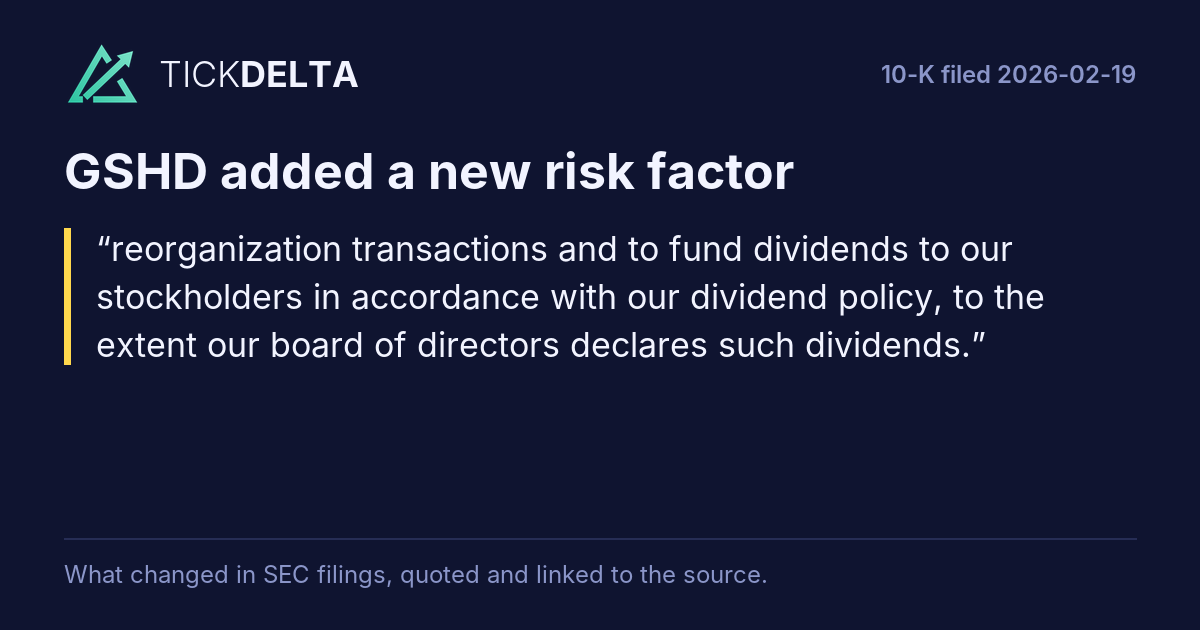
reorganization transactions and to fund dividends to our stockholders in accordance with our dividend policy, to the extent our board of directors declares such dividends.
Paragraphs in the 10-Q filed Jul 23, 2026 that were not in the one before
New in the latest 10-Q
12 paragraphs in the 10-Q filed Jul 23, 2026 with nothing like them in the 10-Q filed Apr 23, 2026 (at least half the words must differ; new numbers alone do not count). Quoted exactly, grouped by the item heading above them. This is text that changed, not a judgement of how serious it is.
10-Q
• Customer Satisfaction Score (CSAT): The average of all client responses to a single survey question asking clients to rate their most recent interaction with us on a scale of 1 to 5, where 5 is most satisfied and 1 is least satisfied.
Read in the 10-Q
Financial statements and notes
Adjustments to reconcile net income to net cash provided by operating activities:
Read in the 10-Q
Net increase (decrease) in cash and cash equivalents, and restricted cash (10,452) 37,649
Read in the 10-Q
Cash and cash equivalents, and restricted cash, beginning of period 37,937 57,973
Read in the 10-Q
The Company may engage in exit or disposal activities that result in costs to terminate a contract or other costs. In accordance with ASC Topic 420 - Exit and Disposal Cost Obligations (“ASC 420”), these exit or disposal costs will be accrued in the period in which a liability is incurred.
Read in the 10-Q
Show the other 7
In October of 2025, following a review of business requirements and usage, the Company identified the need to re-evaluate its Master Service Agreement (“MSA”) for telecommunication services with its then-current provider. During May of 2026, the Company entered into an amendment to modify the end date of the MSA from April 30, 2028, to June 30, 2026.
Read in the 10-Q
Beginning this period, we have adopted Customer Satisfaction Score (CSAT) as our primary client experience metric, replacing Net Promoter Score (NPS). We believe CSAT provides a more direct measure of service quality and the overall client experience, which helps us improve the service we provide.
Read in the 10-Q
CSAT is calculated based on a single question: "How did we do during your most recent interaction, with 5 being the most satisfied and 1 being the least satisfied?" CSAT is the average of all client responses on this 1 to 5 scale. For example, if half of respondents rated their interaction a 5 and half rated it a 4, CSAT would be 4.5. CSAT for the current period reflects all responses from October 1, 2025 through the end of the current period, and will be presented on a trailing twelve-month basis beginning with the period ending September 30, 2026.
Read in the 10-Q
year period due to the release of the constraint on certain variable consideration related to policies placed and made effective in previous periods.
Read in the 10-Q
Cash and cash equivalents, and restricted cash, beginning of period 37,937 57,973 (20,036)
Read in the 10-Q
Cash and cash equivalents, and restricted cash, end of period $ 27,485 $ 95,622 $ (68,137)
Read in the 10-Q
Item 6
§Portions of this exhibit have been omitted in compliance with Regulation S-K, Item 601(a)(6) and/or Item 601(b)(10)(iv).
Read in the 10-Q
The 10-Q's risk factors against the 10-K
Item 1A of the 10-Q filed Jul 23, 2026 against Item 1A of the 10-K filed Feb 19, 2026.
A 10-Q repeats only the risks that changed, so a 10-K paragraph that is missing from it is not counted as removed.
Added is a paragraph with nothing like it in the 10-K, Reworded a sentence that is in both with several words changed,
Quiet changes a sentence in both where one to four words changed and one is a hedge or a modal
(cut words struck through, new words highlighted).
Text on the page, not a score; each links to the filing at sec.gov.
What the 10-Q itself says about its risk factors:There have been no material changes to the risk factors disclosed in the Company's Annual Report on Form 10-K for the fiscal year ended December 31, 2025.
Read in the 10-Q
1 paragraph in the 10-Q's Item 1A, and none of them adds, rewords or quietly edits a paragraph of the 10-K's.
Phrases used for the first time
Two-word phrases in Risk Factors of the 10-K filed Feb 19, 2026 that are in none of the 1 earlier 10-Ks stored, back to Mar 3, 2025
Where each one is used
- central texas: We are exposed to various risks arising out of natural disasters, including earthquakes, hurricanes, fires, floods, landslides, tornadoes, typhoons, tsunamis, hailstorms, explosions, climate events or weather patterns, and pandemic health events, as well as man-made disasters, including acts of terrorism, military...
- severe floods: We are exposed to various risks arising out of natural disasters, including earthquakes, hurricanes, fires, floods, landslides, tornadoes, typhoons, tsunamis, hailstorms, explosions, climate events or weather patterns, and pandemic health events, as well as man-made disasters, including acts of terrorism, military...
- facilities security: •Our business is dependent upon information processing systems and facilities. Security breaches, cyberattacks or other similar incidents with respect to our or our third-party service providers' or vendors' information processing systems or facilities may damage our reputation and negatively impact client...
- effectively apply: •If we are unable to effectively apply technology and related tools to drive value for our clients or gain internal efficiencies and effective internal controls, our operating results, client relationships, growth, and compliance programs could be adversely affected.
- drive value: •If we are unable to effectively apply technology and related tools to drive value for our clients or gain internal efficiencies and effective internal controls, our operating results, client relationships, growth, and compliance programs could be adversely affected.
- retrieve transmit: Our ability to provide insurance services to clients and to create and maintain comprehensive tracking and reporting of client accounts depends on our capacity to store, retrieve, transmit, and otherwise process data, manage significant databases and data hygiene, and expand and periodically upgrade our information...
- contractual protections: technology systems, any such disruption, failure, or breach could adversely affect our business, financial condition, reputation, and results of operations. Any contractual protections we may have from our third-party service providers
- output generated: We utilize artificial intelligence, machine learning, and similar tools and technologies that collect, aggregate, analyze, or generate data or other materials or content (collectively, “AI”) in connection with our business. There are significant risks involved in utilizing AI and no assurance can be provided that...
Used at least twice, small words left out. Counted, not picked: a phrase can be new because the company renamed something.
What was taken out
14 paragraphs of last year's Risk Factors with nothing like them now. The longest are quoted.
Sources
Item 1A of each 10-K and 10-Q on EDGAR, quoted exactly. Each paragraph links to the filing at sec.gov.
Also
10-K change: what was reworded or cut, section by section.
Work with it
Excel workbook · CSV. Google Sheet that stays up to date: paste =IMPORTDATA("https://tickdelta.com/company/GSHD/export.csv") into a cell.