Added10-Q Sep 2, 2026 vs 10-K Mar 17, 2026
• destruction or compromised integrity of data and/or intellectual property; and
Each branch is a paragraph in Risk Factors with nothing like it in the 10-K filed Mar 21, 2025. A box jumps to the paragraph as filed, below.
15 paragraphs in Risk Factors of the 10-K filed Mar 17, 2026 with nothing like them in the 10-K filed Mar 21, 2025. Quoted exactly. Paragraphs that were only edited are under 10-K change.
Because code is executed on our infrastructure on behalf of customers and users, including open source projects hosted on GitLab, we face heightened security risks beyond those of standard SaaS providers. Unlike platforms that primarily store and transmit data, we operate a platform on which code can be executed, which creates additional attack surface and potential for harm.
platforms, services or technologies maintain or achieve greater market acceptance than ours, if they are successful in bringing their products or services to market earlier than ours, or if their products, platforms or services are more technologically capable than ours, then our revenues could be adversely affected.
may be forced to change or abandon our subscription based revenue model in order to compete with our competitors’ offerings.
variables some of which are outside of our and our customers’ control, such as macroeconomic and general economic conditions, including inflation, tariffs, and volatile interest rates.
Some of our AI-powered features, including those offered through the GitLab Duo Agent Platform, are designed to automate elements of the software development lifecycle based on user-defined goals and context. As the prevalence and scrutiny of such agentic AI systems increases, we may face regulatory, litigation, ethical, reputational, and financial risks.
Once our products are deployed, our customers depend on our technical support organization to resolve technical issues. We may be unable to respond quickly enough to accommodate short-term
existing platforms or technologies, could increase our research and development expenses. If we are unable to respond to these changes in a timely or cost-effective manner, our services may become less marketable and less competitive or obsolete, which may result in customer dissatisfaction, and adversely affect our business.
or inability to obtain or maintain trade secret protection or otherwise protect our proprietary rights could adversely affect our business.
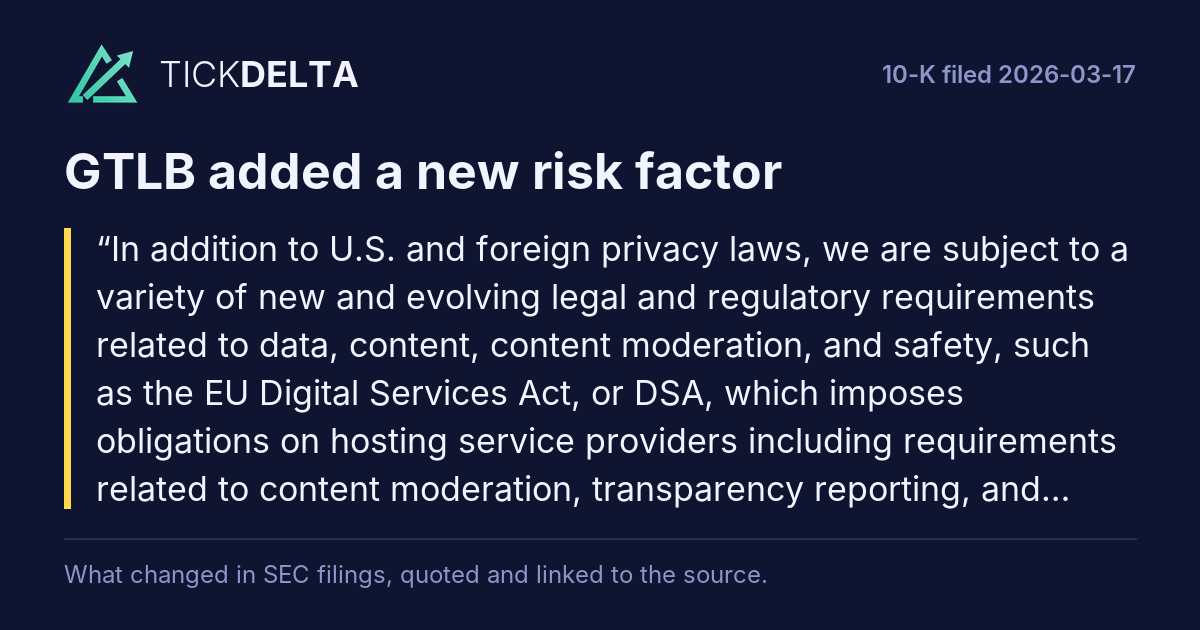
In addition to U.S. and foreign privacy laws, we are subject to a variety of new and evolving legal and regulatory requirements related to data, content, content moderation, and safety, such as the EU Digital Services Act, or DSA, which imposes obligations on hosting service providers including requirements related to content moderation, transparency reporting, and user complaint mechanisms. Similar platform regulations have been enacted in other jurisdictions, including the UK. Compliance with the DSA and similar laws could subject us to increased compliance costs and operational requirements, and includes significant penalties for non-compliance of up to 6% of global annual turnover and provides for the ability of civil society organizations and non-governmental organizations to commence class action lawsuits. The interpretation and enforcement of these requirements remain subject to uncertainty, and failure to comply could result in fines, enforcement actions, or limitations on our ability to operate in affected jurisdictions, which could adversely affect our business, financial condition, and results of operations.
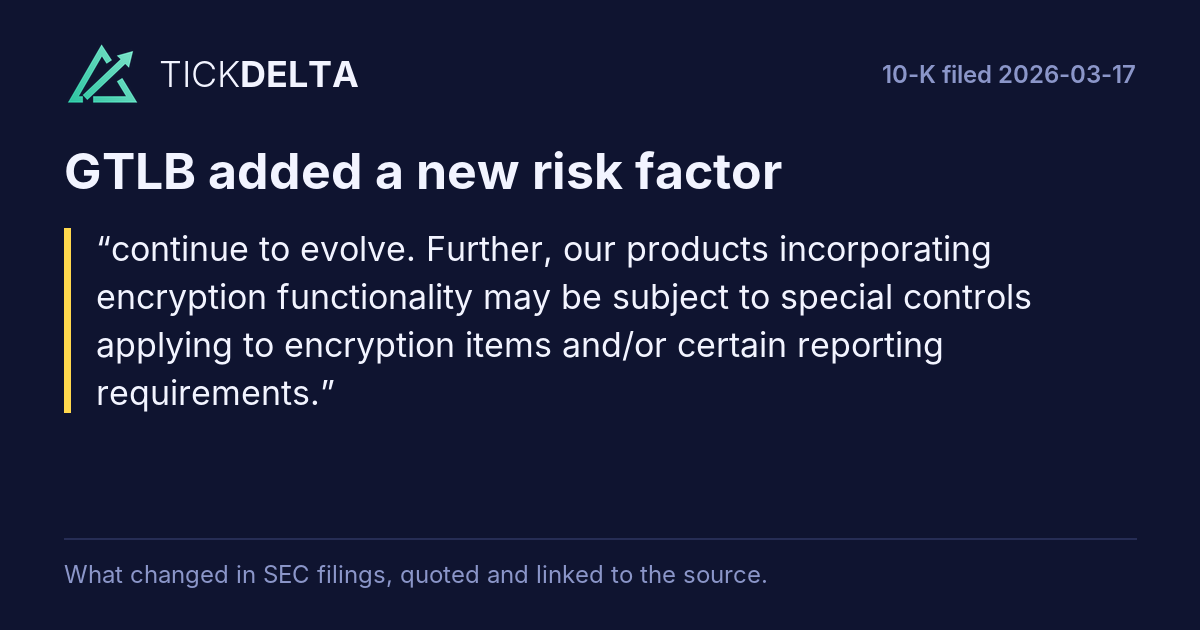
continue to evolve. Further, our products incorporating encryption functionality may be subject to special controls applying to encryption items and/or certain reporting requirements.
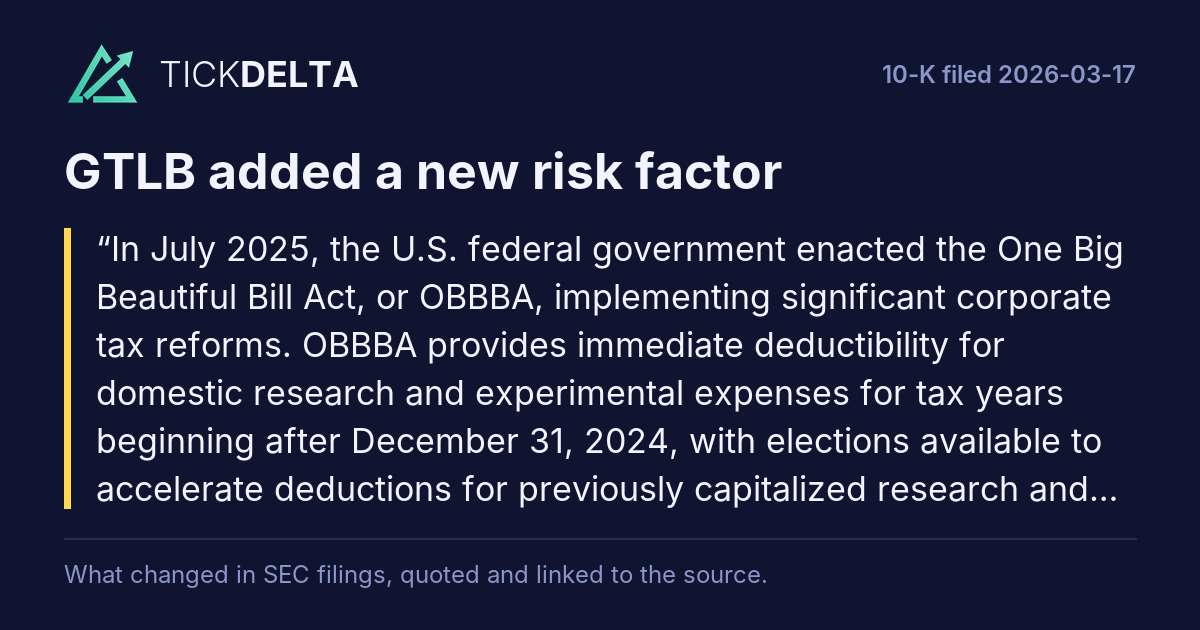
In July 2025, the U.S. federal government enacted the One Big Beautiful Bill Act, or OBBBA, implementing significant corporate tax reforms. OBBBA provides immediate deductibility for domestic research and experimental expenses for tax years beginning after December 31, 2024, with elections available to accelerate deductions for previously capitalized research and experimental expenses from 2022 through 2024. Corporations may deduct remaining unamortized amounts either fully in their first taxable year beginning after December 31, 2024, or ratably over two years. OBBBA increased the tax rate associated with international operations and reduced the tax benefit associated with certain foreign-derived deduction eligible income of United States-domiciled corporations. OBBBA also increased the Base Erosion and Anti-Abuse Tax rate associated with payments from United States corporations to foreign subsidiaries treated as Controlled Foreign Corporations.
The Treasury Department is expected to issue extensive guidance addressing implementation and transition rules. From time to time, the United States Congress may enact technical corrections to OBBBA. The outcome of such guidance and technical corrections and their impact on us is uncertain at this time.
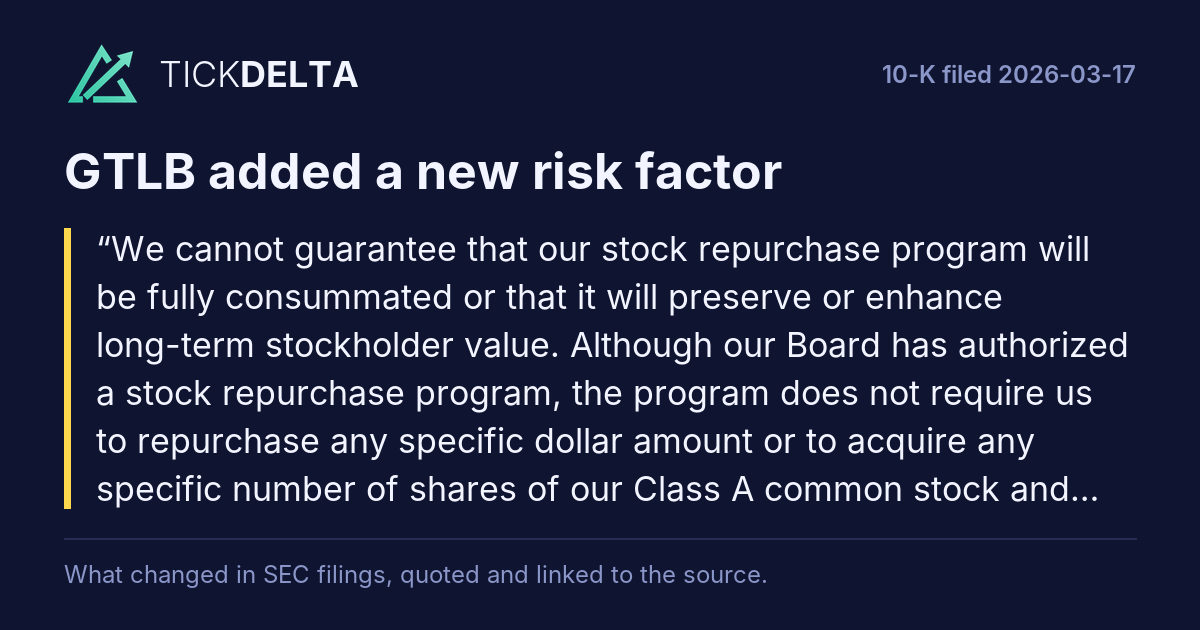
We cannot guarantee that our stock repurchase program will be fully consummated or that it will preserve or enhance long-term stockholder value.
Although our Board has authorized a stock repurchase program, the program does not require us to repurchase any specific dollar amount or to acquire any specific number of shares of our Class A common stock and may be modified, suspended, or terminated at any time. We cannot guarantee that the program will be fully consummated or that it will preserve or enhance long-term stockholder value. Any failure to repurchase stock after we have announced our intention to do so may negatively impact our reputation, investor confidence in us, or our stock price. The program could also affect the trading price of
our Class A common stock, increase volatility, and reduce the market liquidity of our Class A common stock, and any announcement of a termination or change of this program may result in a decrease in the trading price of our Class A common stock. In addition, any repurchases made under this program will reduce the amount of cash we have available to fund working capital, capital expenditures, strategic transactions, and other general corporate requirements.
New in the latest 10-Q
36 paragraphs in the 10-Q filed Sep 2, 2026 with nothing like them in the 10-Q filed Jun 2, 2026 (at least half the words must differ; new numbers alone do not count). Quoted exactly, grouped by the item heading above them. This is text that changed, not a judgement of how serious it is.
Customer advances represent consideration received from customers under GitLab Flex arrangements (“Flex”) in which the customer has not yet selected the specific performance obligation to be delivered. Customer advances are included within deferred revenue and customer advances, current on the condensed consolidated balance sheets. As of July 31, 2026, customer advances were $ 15.0 million.
Read in the 10-Q
products and quantities are determined by the customer at a later date. This $ 40.4 million reflects the total dollar amount customers have committed under Flex contracts entered into through July 31, 2026 that had not yet been provisioned to specific products or services, of which $ 15.0 million had been billed and was reflected in customer advances as of that date, as described above under “Customer Advances.” As of July 31, 2026, excluding non-cancellable Flex customer advances, 65 % is expected to be recognized as revenue over the next 12 months, with the remainder recognized thereafter.
Read in the 10-Q
During the six months ended July 31, 2026, our consolidated joint venture, JiHu purchased and subsequently sold equity securities, with changes in fair value recorded in other income (expense), net. As of July 31, 2026, JiHu held no equity securities.
Read in the 10-Q
During the six months ended July 31, 2026, $ 1.6 million was paid to the two co-founders pursuant to the holdback arrangement. As of July 31, 2026, $ 0.5 million of the founder holdback remained unpaid.
Read in the 10-Q
The following table summarizes the Company’s restricted stock unit (“RSU”) activity:
Read in the 10-Q
During the quarter ended July 31, 2026, the Company’s stock price on the purchase date, May 29, 2026, was lower than the Company’s stock price on the previously applicable offering date. As a result, the offering in effect was reset with the lower stock price becoming the new offering price and rolled over to a new 24-month offering period. The reset was treated as a modification resulting in incremental expense totaling $ 5.9 million, which is being recognized over the remaining requisite service period as of the date of reset.
Read in the 10-Q
The following table summarizes assumptions used in estimating the fair value of the ESPP for the new offering period, which began June 1, 2026, using the Black-Scholes option-pricing model:
Read in the 10-Q
The Company expects total charges under the 2027 Plan to be approximately $ 30 million to $ 35 million, inclusive of amounts recognized to date.
Read in the 10-Q
Restructuring and related charges include severance and termination benefits accounted for under ASC 420, Exit or Disposal Cost Obligations, retention incentives for continuing team members, stock-based compensation charges associated with modified or accelerated awards, and other associated costs. Retention incentives represent bonuses payable to continuing employees contingent upon remaining employed through specified service dates, generally through the first quarter of fiscal year 2028, and are recognized ratably over the requisite service period.
Read in the 10-Q
Severance and Related Team Member Benefits Retention Costs Stock-Based Compensation Other Restructuring Costs Total Cost of revenue $ 973 $ 48 $ 379 $ 2 $1,402 Research and development 7,245 689 1,636 77 9,647 Sales and marketing 4,627 577 1,532 16 6,752 General and administrative 3,403 727 317 1,038 5,485 Total $ 16,248 $ 2,041 $ 3,864 $ 1,133 $23,286
Read in the 10-Q
The following table summarizes the activity in the restructuring liability in accordance with ASC 420 (in thousands). Retention incentives for continuing team members are excluded from the table below, as they are accounted for outside the scope of ASC 420:
Read in the 10-Q
During the three and six months ended July 31, 2026, the Company incurred restructuring expenses that were treated as a discrete item and excluded from the estimated annual effective tax rate calculation, as such costs are significant and infrequent in nature. The associated tax benefit was calculated on a with-and-without basis and recognized in the period incurred, rather than recognized ratably over the fiscal year through the estimated annual effective tax rate. The associated tax benefit was not material, as it was limited to the incremental federal and state current taxes that would have been payable absent the restructuring costs, after utilization of available net operating loss carryforwards and tax credits.
Read in the 10-Q
2026, other than a new $ 10.0 million, one-year agreement with a third-party cloud services provider entered into during the six months ended July 31, 2026.
Read in the 10-Q
On August 21, 2026, all outstanding shares of Class B common stock were automatically converted into shares of Class A common stock on a one -for-one basis (the "Sunset Date"), as the outstanding shares of Class B common stock represented less than 5% of the aggregate outstanding shares of common stock. Following the conversion, GitLab has a single class of common stock outstanding. The conversion had no impact on total stockholders' equity.
Read in the 10-Q
In June 2026, we introduced GitLab Flex (“Flex”), a purchasing model that allows customers to make a single annual dollar commitment and adjust their allocation of that commitment month-to-month across
Read in the 10-Q
platform seats, AI usage, and add-on capabilities without requiring contract amendments. Unprovisioned amounts committed under Flex arrangements are recorded as customer advances and are not classified as deferred revenue until the customer makes an affirmative election to provision specific products or services. See “Remaining Performance Obligations” and “Note 3. Revenues” to our condensed consolidated financial statements for additional information.
Read in the 10-Q
with ARR over $100,000 as of July 31, 2026, increasing from 1,344 customers with ARR over $100,000 as of July 31, 2025.
Read in the 10-Q
Other income, net increased for the three and six months ended July 31, 2026 compared to the three and six months ended July 31, 2025 primarily due to indirect tax benefit related to the final settlement of amounts associated with the formation of JiHu.
Read in the 10-Q
• the timing of recognition of revenues (including from Flex) and impact of usage billing;
Read in the 10-Q
• customer renewal rates and whether customers renew into Flex or consumption-based products;
Read in the 10-Q
cause our operating results to fall below the expectations of securities analysts and investors, resulting in a decline in the price of our common stock.
Read in the 10-Q
may result in enforcement action against us, including fines, and damage to our reputation, any of which may have an adverse effect on our business and operating results.
Read in the 10-Q
ways to deploy our sales and marketing investments or if our sales and marketing programs are not effective, our business and operating results would be adversely affected.
Read in the 10-Q
partner, team member base or contributors in a very short period of time, which could harm our brand and reputation and adversely affect our business.
Read in the 10-Q
These factors and other factors could harm our international operations and, consequently, materially impact our business, operating results, and financial condition. In addition, we implemented a restructuring plan in June 2026, and, as a result, we expect to exit operations in approximately 22 countries. This restructuring, the actual charges for which may exceed estimates, subjects us to additional risks, including risks associated with winding down or transferring local employment arrangements and PEO relationships, potential adverse tax, regulatory, or contractual consequences of exiting these jurisdictions, disruption to customer support and service continuity in affected regions, and operational and reputational risks associated with the transition. The restructuring may take longer than anticipated,
Read in the 10-Q
risk as a result of any negative publicity faced by the joint venture entity. Any such reputational and brand risk can harm our business and operating results.
Read in the 10-Q
We cannot predict what effect, if any, the elimination of our dual class structure will have on the trading market for, or market price of, our common stock. Because we no longer have a dual class structure, we may become eligible for inclusion in certain stock indices from which we were previously excluded or restricted, which could increase demand for our common stock; however, we cannot assure you that any such inclusion will occur, or, if it does occur, that it will have a positive effect on the trading price of our common stock. Conversely, to the extent investors, stockholder advisory firms, or institutional investors continue to view our historical dual class structure, or the concentration of ownership and influence retained by our former Class B stockholders as a result of their historical voting control, unfavorably, this could continue to affect the market price of our common stock or the manner in which such parties evaluate our corporate governance practices.
Read in the 10-Q
On June 25, 2026, Sytse Sijbrandij, Co-Founder and Executive Chair of the Board of Directors of the Company, entered into, through Mr. Sijbrandij’s revocable trust (the “Trust”), a modification of a pre-arranged written stock sale plan in accordance with Rule 10b5-1 under the Exchange Act for the sale of shares of the Company’s Class A common stock owned by Mr. Sijbrandij through the Trust (the “Sijbrandij Plan Modification”). Under Rule 10b5-1, the Sijbrandij Plan Modification constituted a termination of an existing plan (the “Terminated Sijbrandij 10b5-1 Plan”) and an adoption of a new plan (the “New Sijbrandij 10b5-1 Plan”).
Read in the 10-Q
Each of the Terminated Sijbrandij 10b5-1 Plan and the New Sijbrandij 10b5-1 Plan was entered into and, in the case of the Terminated Sijbrandij 10b5-1 Plan, modified or terminated, during an open trading window in accordance with the Company’s policies regarding transactions in the Company’s securities and was or is intended to satisfy the affirmative defense of Rule 10b5-1(c) under the Exchange Act, as applicable. The New Sijbrandij 10b5-1 Plan provides for the potential sale of approximately 6,292,736 shares so long as the market price of the Company’s Class A common stock is higher than certain minimum threshold prices specified in the New Sijbrandij 10b5-1 Plan, between September 24, 2026 and August 18, 2027.
Read in the 10-Q
The New Sijbrandij 10b5-1 Plan includes a representation from Mr. Sijbrandij to the broker administering the plan that he was not in possession of any material nonpublic information regarding the Company or the securities subject to the New Sijbrandij 10b5-1 Plan at the time it was entered into. A similar representation was made to the Company in connection with the adoption of the New Sijbrandij 10b5-1 Plan under the Company’s policies regarding transactions in the Company’s securities. Those representations were made as of the date of adoption of the New Sijbrandij 10b5-1 Plan, and speak only as of such date. In making those representations, there is no assurance with respect to any material nonpublic information of which Mr. Sijbrandij was unaware, or with respect to any material nonpublic information acquired by Mr. Sijbrandij or the Company after the date of the representation.
Read in the 10-Q
On June 30, 2026, Simon Mundy, the Company’s Chief Accounting Officer, entered into a new pre-arranged written stock sale plan in accordance with Rule 10b5-1 (the “New Mundy Rule 10b5-1 Plan”) under the Exchange Act for the sale of shares of the Company’s Class A common stock. The New Mundy Rule 10b5-1 Plan will take effect on October 1, 2026 and on September 30, 2026 Mr. Mundy’s existing Rule 10b5-1 Plan will terminate according to its terms. The New Mundy Rule 10b5-1 Plan was entered into during an open trading window in accordance with the Company’s policies regarding transactions in the Company’s securities and is intended to satisfy the affirmative defense of Rule 10b5-1(c) under the Exchange Act. The New Mundy Rule 10b5-1 Plan provides for the potential sale of shares of the Company’s Class A common stock, including upon the vesting and settlement of restricted stock units, so long as the market price of the Company’s Class A common stock is higher than certain minimum threshold prices specified in the New Mundy Rule 10b5-1 Plan, between October 1, 2026 and September 30, 2027. The aggregate number of shares of Class A common stock that will be available for sale under the New Mundy Rule 10b5-1 Plan is not yet determinable because the shares available will be net of certain shares sold under Mr. Mundy’s prior pre-arranged written stock sale plan (the “Prior Mundy Rule 10b5-1 Plan”) and net of shares sold to satisfy tax withholding obligations that arise in connection with the settlement of such restricted stock unit awards. As such, for purposes of this disclosure, the aggregate number of shares of the Company’s Class A common stock available for sale is approximately 56,647 shares, which reflects the maximum number of shares of Class A common stock held by Mr. Mundy that may be sold under the plan, without excluding certain shares that may be sold under the Prior Mundy Rule 10b5-1 Plan, and the maximum number of shares underlying Mr. Mundy’s restricted stock units which may be sold, without excluding the shares that will be sold to satisfy the tax withholding obligations,
Read in the 10-Q
in each case so long as the market price of the Company’s Class A common stock is higher than certain minimum threshold prices specified in the New Mundy Rule 10b5-1 Plan.
Read in the 10-Q
The New Mundy Rule 10b5-1 Plan includes a representation from Mr. Mundy to the broker administering the plan that he was not in possession of any material nonpublic information regarding the Company or the securities subject to the New Mundy Rule 10b5-1 Plan at the time it was entered into. A similar representation was made to the Company in connection with the adoption of the New Mundy Rule 10b5-1 Plan under the Company’s policies regarding transactions in the Company’s securities. Those representations were made as of the date of adoption of the New Mundy Rule 10b5-1 Plan, and speak only as of such date. In making those representations, there is no assurance with respect to any material nonpublic information of which Mr. Mundy was unaware, or with respect to any material nonpublic information acquired by Mr. Mundy or the Company after the date of the representation.
Read in the 10-Q
On June 29, 2026, Sivaprasad Padisetty, the Company’s Chief Technology Officer, entered into a new pre-arranged written stock sale plan in accordance with Rule 10b5-1 (the “Padisetty Rule 10b5-1 Plan”) under the Exchange Act for the sale of shares of the Company’s Class A common stock, including such shares resulting from the vesting and settlement of restricted stock units. The Padisetty Rule 10b5-1 Plan was entered into during an open trading window in accordance with the Company’s policies regarding transactions in the Company’s securities and is intended to satisfy the affirmative defense of Rule 10b5-1(c) under the Exchange Act. The aggregate number of shares of Class A common stock that will be available for sale under the Padisetty Rule 10b5-1 Plan is not yet determinable because the shares available will be net of shares sold to satisfy tax withholding obligations that arise in connection with the vesting and settlement of such restricted stock unit awards and will include shares to be acquired through the Company’s Employee Stock Purchase Plan (the “ESPP”). As such, for purposes of this disclosure, the aggregate number of shares of Class A common stock available for sale is approximately 351,924 shares, which reflects the aggregate maximum number of shares underlying Mr. Padisetty’s restricted stock units which may be sold, without excluding the shares that will be sold to satisfy the tax withholding obligations or including the shares to be acquired through the ESPP. The Padisetty Rule 10b5-1 Plan provides for an approximate selling start date of September 10, 2026 with an end date of September 30, 2027.
Read in the 10-Q
The Padisetty Rule 10b5-1 Plan includes a representation from Mr. Padisetty to the broker administering the plan that he was not in possession of any material nonpublic information regarding the Company or the securities subject to the Padisetty Rule 10b5-1 Plan at the time it was entered into. A similar representation was made to the Company in connection with the adoption of the Padisetty Rule 10b5-1 Plan under the Company’s policies regarding transactions in the Company’s securities. Those representations were made as of the date of adoption of the Padisetty Rule 10b5-1 Plan, and speak only as of such date. In making those representations, there is no assurance with respect to any material nonpublic information of which Mr. Padisetty was unaware, or with respect to any material nonpublic information acquired by Mr. Padisetty or the Company after the date of the representation.
Read in the 10-Q
Once executed, transactions under each of the New Sijbrandij 10b5-1 Plan, New Mundy Rule 10b5-1 Plan and the Padisetty Rule 10b5-1 Plan will be disclosed publicly through Form 4 and/or Form 144 filings with the Securities and Exchange Commission in accordance with applicable securities laws, rules, and regulations. Except as may be required by law, the Company does not undertake any obligation to update or report any modification, termination, or other activity under current or future Rule 10b5-1 plans that may be adopted by Mr. Sijbrandij, Mr. Mundy, Mr. Padisetty or other officers or directors of the Company.
Read in the 10-Q
Item 1A of the 10-Q filed Sep 2, 2026 against Item 1A of the 10-K filed Mar 17, 2026.
A 10-Q repeats only the risks that changed, so a 10-K paragraph that is missing from it is not counted as removed.
Added is a paragraph with nothing like it in the 10-K, Reworded a sentence that is in both with several words changed,
Quiet changes a sentence in both where one to four words changed and one is a hedge or a modal
(cut words struck through, new words highlighted).
Text on the page, not a score; each links to the filing at sec.gov.
The first 25 of 60 are shown (at most 12 of each type).
Two-word phrases in Risk Factors of the 10-K filed Mar 17, 2026 that are in none of the 1 earlier 10-Ks stored, back to Mar 21, 2025
Used at least twice, small words left out. Counted, not picked: a phrase can be new because the company renamed something.
15 paragraphs of last year's Risk Factors with nothing like them now. The longest are quoted.
Item 1A of each 10-K and 10-Q on EDGAR, quoted exactly. Each paragraph links to the filing at sec.gov.
10-K change: what was reworded or cut, section by section.
Excel workbook · CSV. Google Sheet that stays up to date: paste =IMPORTDATA("https://tickdelta.com/company/GTLB/export.csv") into a cell.