Howard Hughes Holdings Inc. HHH
New risk paragraphs, branching off last year
Each branch is a paragraph in Risk Factors with nothing like it in the 10-K filed Feb 26, 2025. A box jumps to the paragraph as filed, below.
Paragraphs with nothing like them in last year's 10-K
21 paragraphs in Risk Factors of the 10-K filed Feb 19, 2026 with nothing like them in the 10-K filed Feb 26, 2025. Quoted exactly. Paragraphs that were only edited are under 10-K change.
In particular, recent executive actions and trade policies implemented or proposed by the current U.S. administration, including the imposition or threat of significant tariffs on imported goods, including construction materials and other critical
RISKS RELATED TO OUR NEW HOLDING COMPANY STRATEGY AND OUR RELATIONSHIP WITH PERSHING SQUARE
Pershing Square beneficially owns approximately 46.7% of our outstanding common stock as of February 12, 2026. Mr. William Ackman, the Chief Executive Officer of Pershing Square, is the Executive Chairman of our board of directors. Additionally, Mr. Ryan Israel, the Chief Investment Officer of Pershing Square, is our Chief Investment Officer and a member of our board of directors, and Mr. Ben Hakim, the President of Pershing Square, is a member of our board of directors.
On May 5, 2025, HHH entered into a Share Purchase Agreement (Purchase Agreement), by and between HHH and Pershing Square Holdco, L.P. (PS Holdco), pursuant to which HHH sold to PS Holdco 9,000,000 newly issued shares of the Company’s common stock for an aggregate purchase price of $900 million. In connection with the Purchase Agreement, we also entered into several other agreements with Pershing Square, including a Services Agreement and a Shareholder Agreement.
Pursuant to the terms of the Services Agreement, Pershing Square will support the Company’s new diversified holding company strategy by providing services to the Company, such as (i) investment advisory services, (ii) making recommendations with respect to hedging, balance sheet optimization, and capital allocation, (iii) executing transactions, (iv) assisting the Company with business and corporate development functions, (v) making voting recommendations for the Company’s investments, (vi) assisting with and advising on fundraising, (vii) monitoring operations of the Company and its investments, subject to the day-to-day authority and responsibility of management of the Company, (viii) providing recommendations for persons to serve as designees or deputies of the Chief Investment Officer, (ix) engaging and supervising third-party service providers, (x) making dividend payment recommendations, and (xi) providing other services as may be agreed upon. The Services Agreement has an initial ten-year term and will have successive renewal terms of ten years. The Company pays Pershing Square a quarterly base advisory fee of $3.75 million and a quarterly variable advisory fee equal to 0.375% of the excess value of the quarter-end stock price of the Company’s common stock minus
the reference price of $66.15, multiplied by existing share count as of the transaction date, which will not increase with the issuance of new shares of common stock.
Among other things, the Shareholder Agreement provides that, at any meeting of stockholders where directors are to be elected, (a) so long as PS Holdco, Pershing Square and their respective affiliates, including investment funds managed by one or more affiliates (collectively, the Purchaser Group), beneficially own at least 17.5% of the outstanding shares of Common Stock on a fully diluted basis, PS Holdco may nominate for election a number of directors equal to 25% of the total number of members of the Board as constituted after giving effect to such election, rounded up (e.g., three directors in the case of an 11-member Board) (such director, a PS Board Designee), and (b) so long as the Purchaser Group beneficially owns less than 17.5% but at least 10% of the outstanding shares of Common Stock on a fully diluted basis, PS Holdco may nominate for election a number of PS Board Designees equal to 10% of the total number of members of the Board as constituted after giving effect to such election, rounded up (e.g., two directors in the case of an 11-member Board). If the Purchaser Group owns less than 10% of the outstanding shares of Common Stock on a fully diluted basis, PS Holdco no longer has the right to nominate any PS Board Designees. William A. Ackman, Ben Hakim, and Ryan Israel currently serve as the PS Board Designees.
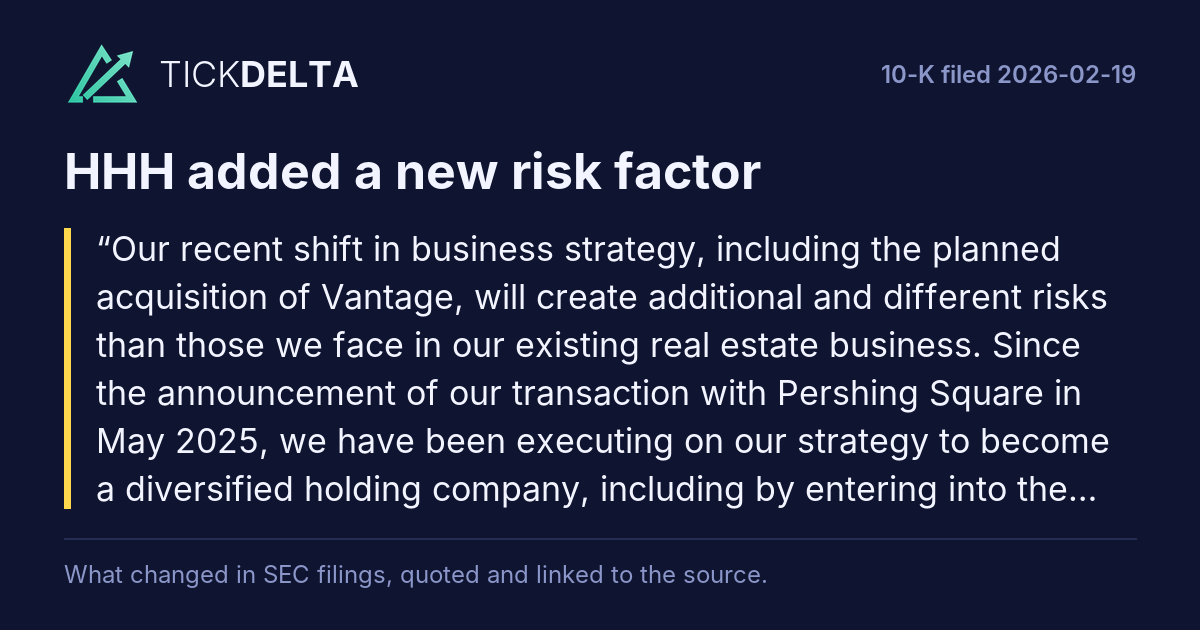
Our recent shift in business strategy, including the planned acquisition of Vantage, will create additional and different risks than those we face in our existing real estate business.
Since the announcement of our transaction with Pershing Square in May 2025, we have been executing on our strategy to become a diversified holding company, including by entering into the Purchase and Sale Agreement with Vantage on December 17, 2025, pursuant to which the Company will acquire Vantage for a purchase price of $2.1 billion (subject to certain adjustments). As part of this strategy, we expect to acquire controlling stakes in high-quality, durable growth public and private operating companies while continuing to invest in and grow our core real estate development and Master Planned Communities business. In embarking on this changed strategy, we are subject to risks such as being unable to identify and consummate transactions (including the Vantage Transaction) as part of the new strategy, as well as risks inherent in acquiring or making investments in operating companies, especially companies in industries unrelated to our existing real estate business. Sources of risk arising from these types of transactions include financial, accounting, tax, and regulatory challenges; difficulties with integration, business retention, execution of strategy, unforeseen liabilities or market conditions; and other managerial or operating risks and challenges. Any future transactions could also subject us to risks such as failure to obtain appropriate value, post-closing claims being levied against us, and disruption to our other businesses during the negotiation or execution process or thereafter. Risk-mitigating provisions that we put in place in the course of negotiating and executing these transactions, such as due diligence efforts and indemnification provisions, may not be sufficient to fully address these risks and contingencies.
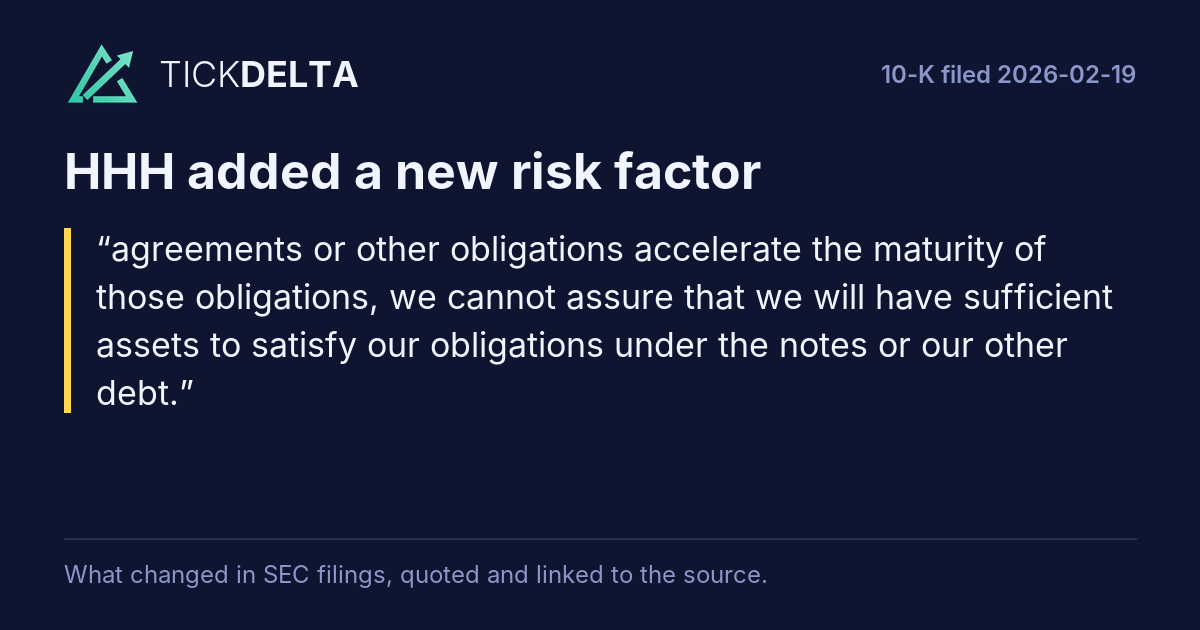
agreements or other obligations accelerate the maturity of those obligations, we cannot assure that we will have sufficient assets to satisfy our obligations under the notes or our other debt.
Show the other 4
Adverse changes in our credit ratings could increase our financing costs and limit market access.
We and certain of our subsidiaries may be evaluated by one or more nationally recognized credit rating agencies. Ratings reflect each agency’s assessment of factors such as liquidity, leverage, capital structure, cash flow stability, asset quality, business profile, corporate governance, and market conditions, and they can be downgraded, placed on negative watch, revised in outlook, or withdrawn at any time. A downgrade or other adverse action, or the announcement of a review, could increase interest rates and fees on new or existing debt; narrow the pool of investors willing or permitted to invest in our securities; require additional collateral, tighter covenants, shorter maturities, or other unfavorable terms; and reduce the trading price and liquidity of our securities. These outcomes could raise our overall cost of capital, constrain access to bank and capital markets, reduce financial flexibility, and impair execution of our strategy and our ability to meet obligations, any of which could materially adversely affect our business, financial condition, results of operations, and cash flows.
We have a substantial amount of indebtedness, a significant portion of which will mature in the coming years. Our strategy assumes continued access to the debt capital markets and other financing sources to refinance existing indebtedness, including property‑level mortgage loans, construction and development facilities, and unsecured or recourse borrowings, often before maturity. Our ability to refinance our indebtedness on favorable terms, or at all, depends on factors beyond our control, including conditions in the credit and capital markets (such as interest rates, spreads, and lender appetite for real estate and construction lending); our leverage, liquidity, interest coverage and credit ratings; the performance and values of properties securing our debt and our broader portfolio; changes in banking and other financial regulations; and broader macroeconomic, geopolitical, and industry developments.
If we cannot refinance maturing indebtedness on acceptable terms, we may be forced to seek alternative financing on less favorable terms, use more of our available liquidity, sell assets, on disadvantageous terms or at unfavorable times in the market, delay or cancel development, redevelopment, or other capital projects, or issue equity or equity‑linked securities that could be dilutive to existing stockholders. Even if refinancing is available, it may be at higher interest rates or subject to more restrictive covenants, which could increase our interest expense, reduce our financial flexibility, and constrain our ability to invest in our existing properties and development pipeline or pursue new investment opportunities. Failure to refinance, repay, or otherwise address maturing indebtedness could lead to defaults, acceleration, foreclosure on collateral, and potential cross defaults or cross accelerations, any of which could materially adversely affect our business, financial condition, results of operations, cash flows, and ability to service our debt.
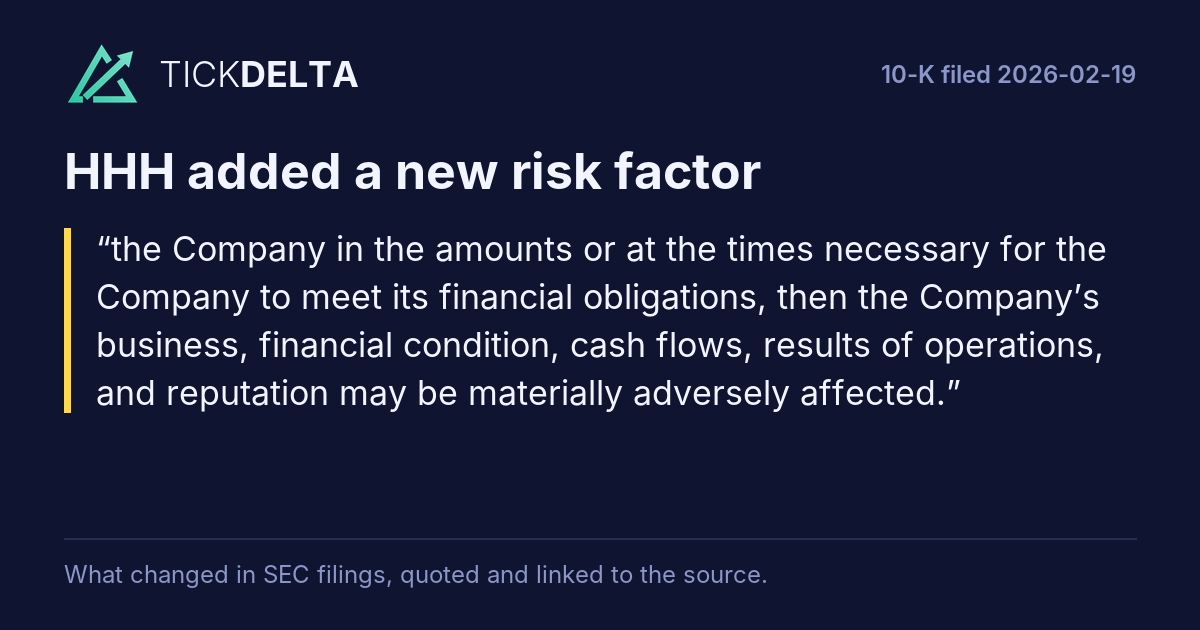
the Company in the amounts or at the times necessary for the Company to meet its financial obligations, then the Company’s business, financial condition, cash flows, results of operations, and reputation may be materially adversely affected.
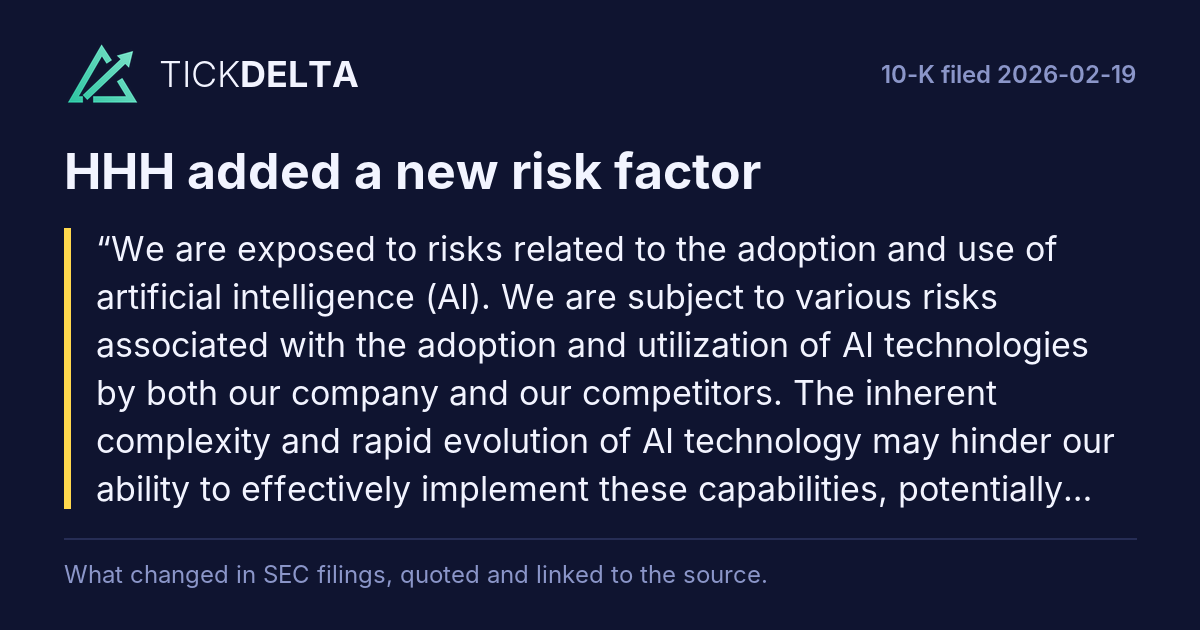
We are exposed to risks related to the adoption and use of artificial intelligence (AI).
We are subject to various risks associated with the adoption and utilization of AI technologies by both our company and our competitors. The inherent complexity and rapid evolution of AI technology may hinder our ability to effectively implement these capabilities, potentially leading to significant costs without corresponding benefits to our business or customer value. Our AI implementations may result in errors or unintended outcomes due to algorithmic flaws, inadequate training data, or inherent biases, which could expose us to liability and reputational damage. Additionally, we face competitive risks if our adoption of AI or other machine learning technologies is not done timely or as effectively as that of our competitors. AI technology also presents unique challenges related to data privacy, cybersecurity, and ethical considerations, which could impact our business operations. The regulatory landscape is continuously evolving, with new laws and regulations being proposed or enacted by various jurisdictions. Compliance with these diverse requirements could increase our operational costs, and any actual or perceived regulatory violations could subject us to enforcement
actions, penalties, and reputational harm. The combined effect of these interrelated risks could materially and adversely affect our business operations, financial condition, and competitive position.
The technologies or models we rely upon may undergo major updates or shifts while our AI features are already live in the market. Such updates could force us to retrain or redeploy our own AI systems at inopportune times, increasing our costs and delaying upgrades or product releases. Furthermore, the vendor might unexpectedly discontinue certain features or stop supporting the version on which our platform depends. Any such mid-deployment disruption could result in downtime, diminished accuracy or usability, and ultimately damage our brand reputation and customer experience.
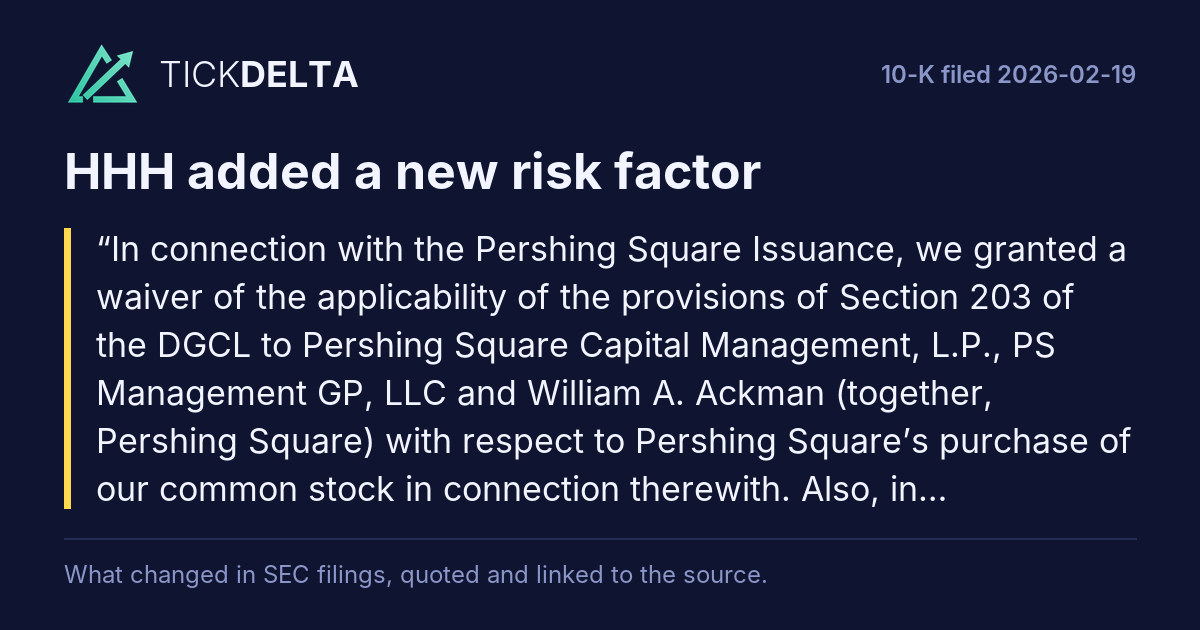
In connection with the Pershing Square Issuance, we granted a waiver of the applicability of the provisions of Section 203 of the DGCL to Pershing Square Capital Management, L.P., PS Management GP, LLC and William A. Ackman (together, Pershing Square) with respect to Pershing Square’s purchase of our common stock in connection therewith. Also, in connection with the Pershing Square Issuance, we also entered into the Standstill Agreement.
Pursuant to the Standstill Agreement, (i) Pershing Square agreed not to acquire beneficial ownership of more than 47.0% of our common stock and (ii) for all matters being voted on at a stockholder meeting or in a consent solicitation that the Board recommends that stockholders approve, the voting power of the shares held by PS Holdco, Pershing Square and their respective affiliates will be limited to 40% of the total voting power of our outstanding common stock (the voting cap), with the excess of any shares held by them over the voting cap (the excess shares) to be voted in proportion to the votes cast by unaffiliated stockholders. The voting cap applies across all matters, except with respect to voting to elect PS Board Designees, for which no voting cap applies. For all matters being voted on at a stockholder meeting or in a consent solicitation that the Board has recommended that stockholders not approve, PS Holdco, Pershing Square and their respective affiliates may vote all of their shares “against” such matter, or it may vote their shares up to the voting cap “for” such matter, with the excess shares to be voted them in proportion to the votes cast by unaffiliated stockholders.
Paragraphs in the 10-Q filed Nov 5, 2026 that were not in the one before
New in the latest 10-Q
45 paragraphs in the 10-Q filed Nov 5, 2026 with nothing like them in the 10-Q filed Aug 5, 2026 (at least half the words must differ; new numbers alone do not count). Quoted exactly, grouped by the item heading above them. This is text that changed, not a judgement of how serious it is.
Financial statements and notes
Municipal District Receivables, net Municipal district receivables, net are development costs that the Company incurs within its MPCs and expects to be reimbursed for by special-purpose political subdivisions. These subdivisions are formed under state law to finance public infrastructure that benefits land within their boundaries. They include Municipal Utility Districts (MUD) in Houston, Texas and Community Facilities Districts (CFD) in Arizona. Each type of district is governed by its own state statute, which defines the infrastructure and costs that qualify for reimbursement. The Company applies a consistent accounting approach to both. The Company typically advances funds to build qualifying public infrastructure, which must be designed, bid, and constructed in accordance with the applicable statute and local requirements. The district Board of Directors authorizes and approves all reimbursable development contracts, and uses bond sale proceeds to reimburse the developer for its construction costs. At the date the expenditures occur, the Company determines the costs it believes will be eligible for reimbursement under the applicable statute and recognizes those costs as municipal district receivables. As of September 30, 2026, following the consolidation of Floreo in July 2026, related CFD receivables are included in the consolidated Municipal district receivables, net balance. Prior to the consolidation of Floreo, the Company did not have consolidated CFD receivables as development has not yet started in Teravalis. See Note 10 - Acquisitions and Dispositions of Real Estate Assets for further discussion of the Floreo consolidation.
Read in the 10-Q
(a) This table includes the initial amounts recognized for each transaction and does not include the impacts of any changes in estimates in future periods. Refer to the below for discussion of the impact of any changes in estimates.
Read in the 10-Q
The Company has interests in various legal entities that represent a VIE. The Company determines if a legal entity is a VIE by performing a qualitative analysis that requires certain subjective decisions, taking into consideration the design of the entity, the variability that the entity was designed to create and pass along to its interest holders, the rights of the parties and the purpose of the arrangement. Upon the occurrence of certain reconsideration events, the Company reassesses its initial determination as to whether the entity is a VIE.
Read in the 10-Q
The Company also performs a qualitative assessment of each VIE to determine if it is the primary beneficiary. The Company is the primary beneficiary and would consolidate the VIE if it has a controlling financial interest where it has both (a) the power to direct the economically significant activities of the entity and (b) the obligation to absorb losses of, or the right to receive benefits from, the entity that could potentially be significant to the VIE.
Read in the 10-Q
Consolidated Real Estate VIEs The Company’s Condensed Consolidated Balance Sheets included the following amounts related to its consolidated real estate VIEs. The assets of these consolidated VIEs may only be used to settle obligations of the respective VIE and are not available to satisfy the obligations of the Company or its other subsidiaries. The liabilities of these consolidated VIEs are non-recourse to the Company and are payable solely from the assets of the respective VIE, with the exception of the Floreo debt obligation which is subject to the guaranty described below.
Read in the 10-Q
Show the other 40
The above balances primarily relate to the following consolidated real estate VIEs:
Read in the 10-Q
- Floreo In July 2026, a reconsideration event occurred related to Floreo, an MPC joint venture currently developing land in the greater Phoenix, Arizona area. Floreo is a VIE that was previously accounted for under the equity method. As a result of the reconsideration event, the Company concluded that it was the primary beneficiary, and Floreo was prospectively consolidated on July 26, 2026. Refer to Note 10 - Acquisitions and Dispositions of Real Estate Assets for additional information on the reconsideration event and the financial statement impact of the consolidation. The Secured Floreo Note, which is included in Mortgages, notes, and loans payable, net following consolidation, has a borrowing capacity of $ 365.0 million, and outstanding borrowings as of September 30, 2026, of $ 276.0 million. Floreo’s creditors only have recourse to the Company through a collateral maintenance obligation, under which a wholly owned subsidiary of the Company must post refundable cash collateral of up to $ 100.0 million if Floreo’s loan-to-value ratio exceeds 50 %. This collateral becomes non refundable if Floreo defaults on the note. As of September 30, 2026, no collateral has been posted.
Read in the 10-Q
(d) Floreo is a VIE that was previously accounted for under the equity method. On July 26, 2026, a reconsideration event occurred, and as a result, the Company concluded that it was the primary beneficiary, and Floreo was prospectively consolidated on July 26, 2026. Prior to consolidation, the Company’s previously held equity method investment in Floreo was remeasured to its fair value as of the acquisition date, resulting in the recognition of a $ 19.4 million loss in Equity in earnings (losses) from unconsolidated ventures. Refer to Note 1 - Presentation of Financial Statements and Significant Accounting Policies for the required consolidated VIE disclosures. Refer to Note 10 - Acquisitions and Dispositions of Real Estate Assets for additional information related to the initial consolidation of Floreo.
Read in the 10-Q
Gateway A10 Holdings In September 2026, the Company contributed a 14.7 -acre parcel of land in Columbia to its Gateway A10 Holdings joint venture with SCG Realty Company LLC to develop a build-to-suit warehouse that will be leased by Saval Foods, LLC. The Company contributed the land at a fair value of $ 10.0 million and received a $ 1.1 million special distribution, retaining a 50 % interest valued at $ 8.9 million. After derecognizing the land’s carrying amount of $ 3.8 million, the Company recognized a gain of $ 6.2 million in Gain on sale or disposal of real estate and other assets, net in the Condensed Consolidated Statements of Operations. Gateway A10 Holdings obtained a construction loan of up to $ 41.7 million to fund the development, with no borrowings outstanding as of September 30, 2026. The remainder of the development cost is expected to be funded by SCG Realty Company LLC.
Read in the 10-Q
Gateway A10 Holdings was determined to be a VIE, however, the Company is not the primary beneficiary as it does not have the ability to control the activities that most impact the economic performance of the venture. Accordingly, the Company does not consolidate Gateway A10 Holdings and accounts for its ownership interest under the equity method. As of September 30, 2026, the Company’s maximum exposure to loss includes the $ 8.9 million carrying value of its investment.
Read in the 10-Q
Secured Floreo Note In July 2026, the Company began consolidating Floreo, an MPC joint venture, which is a VIE that was previously accounted for under the equity method. Therefore, as of September 30, 2026, the Secured Floreo Note is included in Mortgages, notes, and loans payable, net. See Note 10 - Acquisitions and Dispositions of Real Estate Assets for additional information on the consolidation of the Floreo joint venture. The note has a borrowing capacity of $ 365.0 million, an interest rate of 6.75 % at September 30, 2026, and matures in 2029. As of September 30, 2026, outstanding borrowings were $ 276.0 million. The Company provided a guaranty on this financing in the form of a collateral maintenance obligation.
Read in the 10-Q
(b) Net prior period reserve development includes $ 4.0 million of favorable reserve development and $ 2.9 million of amortization expense related to the acquisition-date fair value adjustment to the reserve for claims and claim expenses.
Read in the 10-Q
The transaction was accounted for as a business combination using the acquisition method of accounting. The Company’s previously held equity method investment in Floreo was remeasured to its fair value of $ 51.1 million based upon a valuation of the acquired business as of the acquisition date, resulting in the recognition of a $ 19.4 million loss on initial consolidation in Equity in earnings (losses) from unconsolidated ventures in the Condensed Consolidated Statements of Operations. The fair value of the noncontrolling interest in Floreo as of the acquisition date was $ 40.1 million. The consolidation of Floreo was a noncash investing activity, except for $ 26.2 million of cash and cash equivalents held by Floreo at the acquisition date, which is presented as Cash from consolidation of joint venture in the Condensed Consolidated Statements of Cash Flows.
Read in the 10-Q
The valuation used an income approach based on discounted cash flows over a finite projection period. No terminal value was applied because the projections represent a finite-life MPC development. The Company’s land model forecasts the expected cash flows associated with the development of the MPC, including projected land sales, development costs, and related reimbursement cash flows. As such, the discounted cash flow analysis captures the economics of the underlying MPC asset value in total and the fair value of the MPC assets equals the residual value after separately recognizing the fair values of the other identifiable assets and liabilities.
Read in the 10-Q
Municipal district receivables, which are CFD receivables, were valued using a discounted cash flow method. These receivables represent development costs incurred that were eligible for reimbursement through future CFD bond issuances. The valuation reflected the Company’s expectation that the existing receivables would be reimbursed on a first-in, first-out basis as future CFD proceeds were received. The forecasted proceeds attributable to the existing receivables were discounted based on their expected timing of collection.
Read in the 10-Q
The fair value measurements for the MPC assets and municipal district receivables were based on significant unobservable inputs and are classified as Level 3 fair value measurements. Significant unobservable inputs included projected land sales, development costs, the timing and amount of CFD proceeds and impact fee reimbursements, and discount rates. All other acquired assets and assumed liabilities were recorded at their carrying amounts which were determined to approximate fair value.
Read in the 10-Q
Pro forma financial information assuming the consolidation has occurred as of the beginning of the calendar year prior to consolidation, as well as the Floreo revenues and earnings generated during the period since the acquisition date, are not material for disclosure purposes.
Read in the 10-Q
- our plans to monetize a substantial portion of our real estate assets, transition our real estate business into an asset-light real estate asset management platform, and redeploy the resulting proceeds into Vantage Group Holdings Ltd. (Vantage)
Read in the 10-Q
- our plans regarding our MPCs, including future sales of land bank stakes and any future ongoing long-term contracts and involvement, including but not limited to as a developer, manager and operator
Read in the 10-Q
- our ability to transition our real estate business into an asset-light real estate asset management platform on the time frame we anticipate or at all, including our ability to raise third-party capital on terms that are favorable to us or at all, and our increasing dependence on Vantage
Read in the 10-Q
- our ability to monetize our real estate assets through asset sales and joint ventures at the values, on the terms, and within the time frame we anticipate, or at all, and to redeploy the resulting proceeds into Vantage
Read in the 10-Q
Holding Company Strategy In September 2026, the Company announced its intention to transition HHC from its current real estate model under which it owns substantially all of its assets and primarily funds development with its own capital to an asset-light real estate development and asset management platform. Under this strategy, the Company intends to monetize select real estate assets through asset sales and joint ventures, which may include the sale of interests in certain operating assets and the formation of joint ventures for portions of its residential MPC land holdings. The Company expects HHC to retain operational control of these assets and to continue to serve as developer, manager, and operator under long-term agreements. The Company also intends to raise third-party capital to fund future development, with HHC earning development, asset management, and performance fees, including as general partner of new real estate funds or other third-party capital vehicles. The Company expects to maintain its existing approach for its condominium developments, which are primarily funded through construction financing and buyer deposits.
Read in the 10-Q
The timing, structure, and terms of any such transactions, and the amount of proceeds realized, will depend on market conditions, counterparty interest, and other factors. There can be no assurance that any such transactions will be completed on a timely basis or at all. The ability to complete such transactions, and the net proceeds realized, may also be affected by the terms of HHC's indebtedness, including the indentures governing its senior unsecured notes and the agreements governing its secured mortgages, which contain covenants and other provisions that may restrict the sale or transfer of interests in encumbered assets, require lender consent, or require the repayment of related debt, including any applicable prepayment penalties, yield maintenance premiums, or defeasance costs. In addition, a reduction in the cash flows retained by HHC following any such transactions could affect its ability to comply with the financial and other covenants under its debt agreements.
Read in the 10-Q
(a) Certain amounts related to Floreo previously disclosed under the Teravalis MPC have been recast for all periods presented to reflect Floreo as a separate, comparative line item following the consolidation of Floreo in July 2026. Floreo EBT activity for the periods presented includes the Company’s share of equity earnings prior to consolidation and 100% of Floreo EBT post consolidation. Refer to Note 10 - Acquisitions and Dispositions of Real Estate Assets in the Notes to Condensed Consolidated Financial Statements under Item 1 of this Quarterly Report for additional information.
Read in the 10-Q
- Operating costs increased $11.3 million primarily due to higher real estate taxes in Bridgeland and Summerlin, as well as higher allocated overhead costs, including additional operating expenses following the Floreo consolidation.
Read in the 10-Q
- Equity earnings decreased $18.3 million primarily due to the recognition of a $19.4 million loss upon remeasurement of the Floreo equity method investment to its acquisition-date fair value immediately prior to consolidation.
Read in the 10-Q
- Operating costs increased $10.3 million primarily due to higher real estate taxes in Bridgeland and Summerlin, as well as higher allocated overhead costs, including additional operating expenses following the Floreo consolidation.
Read in the 10-Q
(a) Represents the value of MPC assets acquired through the consolidation of Floreo in July 2026.
Read in the 10-Q
- Gain on sale of assets decreased $5.6 million, primarily due to the gain recognized on our contribution of land to a newly formed joint venture in the current period, compared to the gain recognized for a land swap in The Woodlands and the sale of a land parcel near the Merriweather District in the prior-year period.
Read in the 10-Q
- Corporate interest expense, net increased $12.3 million primarily due to higher interest expense as a result of a higher balance and higher interest rates on the February 2026 Senior Notes.
Read in the 10-Q
(b) Accident year combined ratio is a non-GAAP financial measure that excludes the impact of favorable or unfavorable prior-year development and catastrophe events on its reserves for claims and claim expense. We believe this measure provides investors with a more meaningful understanding of current-year underwriting performance by distinguishing the results of business written in the current period from changes in estimates related to business written in prior periods and from the impact of catastrophe events. Catastrophe events can vary significantly in frequency and severity, result in losses that may be material, and involve complexity and uncertainty in estimating ultimate losses. A reconciliation to the most directly comparable GAAP financial measure, the combined ratio, is included above.
Read in the 10-Q
MANAGEMENT’S DISCUSSION AND ANALYSIS Table of Contents LIQUIDITY AND CAPITAL RESOURCES
Read in the 10-Q
MANAGEMENT’S DISCUSSION AND ANALYSIS Table of Contents LIQUIDITY AND CAPITAL RESOURCES
Read in the 10-Q
To the extent we implement the planned transition of our real estate operations to an asset-light real estate development and asset management platform, cash generated from our Operating Assets and MPC land sales is expected to decrease in relation to any interests sold, while development, asset management, and performance fees may partially offset this decrease over time. We also expect that third-party capital partners may fund a potentially substantial portion of our future development. The amount and timing of any such fees and third-party funding will depend on our ability to attract third-party capital partners and on the performance of the related assets and investment vehicles.
Read in the 10-Q
MANAGEMENT’S DISCUSSION AND ANALYSIS Table of Contents LIQUIDITY AND CAPITAL RESOURCES
Read in the 10-Q
MANAGEMENT’S DISCUSSION AND ANALYSIS Table of Contents LIQUIDITY AND CAPITAL RESOURCES
Read in the 10-Q
MANAGEMENT’S DISCUSSION AND ANALYSIS Table of Contents LIQUIDITY AND CAPITAL RESOURCES
Read in the 10-Q
MANAGEMENT’S DISCUSSION AND ANALYSIS Table of Contents CRITICAL ACCOUNTING ESTIMATES
Read in the 10-Q
MANAGEMENT’S DISCUSSION AND ANALYSIS Table of Contents CRITICAL ACCOUNTING ESTIMATES
Read in the 10-Q
Risk Factors
There have been no material changes to the risk factors previously disclosed in our 2025 Annual Report, except as set forth below and in Part II, Item 1A of the Company's Quarterly Report on Form 10-Q for the period ended June 30, 2026. At our 2026 annual meeting of stockholders, held on September 30, 2026, we announced plans to accelerate our transformation into a diversified holding company by monetizing a substantial portion of the real estate assets of HHC, transitioning HHC into an asset-light real estate asset management platform, and redeploying the resulting proceeds primarily into Vantage, our specialty insurance and reinsurance subsidiary. The following risk factors relate to these plans and should be read in conjunction with the risk factors disclosed in our 2025 Annual Report and in our Quarterly Report on Form 10-Q for the period ended June 30, 2026.
Read in the 10-Q
We may be unable to monetize HHC’s real estate assets at the values, on the terms, or within the time frame we anticipate, or to realize the anticipated benefits of redeploying the proceeds into Vantage.
Read in the 10-Q
Our plans to monetize HHC’s real estate assets are in their early stages, and as of the date of this Quarterly Report, we have not entered into definitive agreements for any transactions related to our real estate monetization strategy. Our ability to sell interests in HHC’s real estate assets and enter into joint ventures, and the proceeds we receive, will depend on factors beyond our control, including investor demand, real estate and capital market conditions, interest rates, and the availability of financing. If the value of any such assets is lower than we expect, we may be unable to monetize those assets on favorable terms or at all. We may also be required to reduce pricing, accept lower returns, or incur additional costs in remarketing or reconfiguring assets. The proceeds of any such transactions may be less than our estimates or the carrying values of the assets, which could result in impairment charges or losses on sale, and many of these transactions will require consents from lenders, joint venture partners, or other third parties. In addition, these proceeds will be received by HHC, and the indentures governing HHC’s senior unsecured notes restrict HHC’s ability to pay dividends and make other distributions to the Company, and require that net proceeds from certain asset sales be used to repay indebtedness or be reinvested in HHC’s business within a specified period or, to the extent not so applied, be used to offer to repurchase such notes at par. As a result, we may be unable to redeploy proceeds into Vantage in the amounts or at the times we intend, and Vantage may be unable to deploy additional capital at attractive returns or at all. We may modify, delay, or discontinue these plans at any time, and the estimates we have presented publicly regarding the value of HHC’s real estate assets and potential returns at Vantage are based on assumptions that may prove to be incorrect.
Read in the 10-Q
Our plans to monetize HHC’s real estate assets and redeploy the proceeds into Vantage will significantly change our business, including by increasing our dependence on Vantage and transitioning HHC to an asset-light real estate asset management platform.
Read in the 10-Q
If implemented as planned, these plans will substantially change the composition of our assets and sources of earnings, and we expect that, following the completion of such transactions, Vantage will represent a substantial majority of our equity value. As a result, our results will depend increasingly on Vantage’s insurance and reinsurance operations and investment portfolio, and our reported results may become more volatile because changes in the fair value of the equity securities in Vantage’s investment portfolio are recognized in net income. In addition, risks related to Vantage’s business and operations will become increasingly significant to us, including but not limited to risks related to its limited operating history, its ability to accurately assess the risks associated with the insurance and reinsurance business it writes and retains, and its ability to collect amounts due from reinsurers. Further, following the sale of interests in its assets, HHC will hold minority interests in those assets, its ability to retain operational control will depend on contractual arrangements with its partners, and its future development activities will depend on its ability to raise third-party capital. HHC has limited experience raising third-party capital or operating as a fee-based asset manager, and the fees it earns may not offset the income we forgo by selling interests in our assets. Any of these factors could adversely affect our business, financial condition, results of operations, and the trading price of our common stock.
Read in the 10-Q
Share sales and buybacks
There were no unregistered sales of equity securities or repurchases of equity securities during the third quarter of 2026.
Read in the 10-Q
The 10-Q's risk factors against the 10-K
Item 1A of the 10-Q filed Nov 5, 2026 against Item 1A of the 10-K filed Feb 19, 2026.
A 10-Q repeats only the risks that changed, so a 10-K paragraph that is missing from it is not counted as removed.
Added is a paragraph with nothing like it in the 10-K, Reworded a sentence that is in both with several words changed,
Quiet changes a sentence in both where one to four words changed and one is a hedge or a modal
(cut words struck through, new words highlighted).
Text on the page, not a score; each links to the filing at sec.gov.
Phrases used for the first time
Two-word phrases in Risk Factors of the 10-K filed Feb 19, 2026 that are in none of the 1 earlier 10-Ks stored, back to Feb 26, 2025
Where each one is used
- senior unsecured: Our indebtedness and changing interest rates could adversely affect our business, prospects, financial condition, or results of operations and prevent us from fulfilling our obligations under our senior unsecured notes and loan agreements.
- unsecured notes: Our indebtedness and changing interest rates could adversely affect our business, prospects, financial condition, or results of operations and prevent us from fulfilling our obligations under our senior unsecured notes and loan agreements.
- voting cap: Pursuant to the Standstill Agreement, (i) Pershing Square agreed not to acquire beneficial ownership of more than 47.0% of our common stock and (ii) for all matters being voted on at a stockholder meeting or in a consent solicitation that the Board recommends that stockholders approve, the voting power of the...
- board designees: Among other things, the Shareholder Agreement provides that, at any meeting of stockholders where directors are to be elected, (a) so long as PS Holdco, Pershing Square and their respective affiliates, including investment funds managed by one or more affiliates (collectively, the Purchaser Group), beneficially own...
- chief investment: Pershing Square beneficially owns approximately 46.7% of our outstanding common stock as of February 12, 2026. Mr. William Ackman, the Chief Executive Officer of Pershing Square, is the Executive Chairman of our board of directors. Additionally, Mr. Ryan Israel, the Chief Investment Officer of Pershing Square, is...
- investment officer: Pershing Square beneficially owns approximately 46.7% of our outstanding common stock as of February 12, 2026. Mr. William Ackman, the Chief Executive Officer of Pershing Square, is the Executive Chairman of our board of directors. Additionally, Mr. Ryan Israel, the Chief Investment Officer of Pershing Square, is...
- purchase agreement: On May 5, 2025, HHH entered into a Share Purchase Agreement (Purchase Agreement), by and between HHH and Pershing Square Holdco, L.P. (PS Holdco), pursuant to which HHH sold to PS Holdco 9,000,000 newly issued shares of the Company’s common stock for an aggregate purchase price of $900 million. In connection with...
- shareholder agreement: On May 5, 2025, HHH entered into a Share Purchase Agreement (Purchase Agreement), by and between HHH and Pershing Square Holdco, L.P. (PS Holdco), pursuant to which HHH sold to PS Holdco 9,000,000 newly issued shares of the Company’s common stock for an aggregate purchase price of $900 million. In connection with...
Used at least twice, small words left out. Counted, not picked: a phrase can be new because the company renamed something.
What was taken out
8 paragraphs of last year's Risk Factors with nothing like them now. The longest are quoted.
Sources
Item 1A of each 10-K and 10-Q on EDGAR, quoted exactly. Each paragraph links to the filing at sec.gov.
Also
10-K change: what was reworded or cut, section by section.
Work with it
Excel workbook · CSV. Google Sheet that stays up to date: paste =IMPORTDATA("https://tickdelta.com/company/HHH/export.csv") into a cell.