Hamilton Lane INC HLNE
New risk paragraphs, branching off last year
Each branch is a paragraph in Risk Factors with nothing like it in the 10-K filed May 30, 2025. A box jumps to the paragraph as filed, below.
Paragraphs with nothing like them in last year's 10-K
30 paragraphs in Risk Factors of the 10-K filed May 21, 2026 with nothing like them in the 10-K filed May 30, 2025. Quoted exactly. Paragraphs that were only edited are under 10-K change.
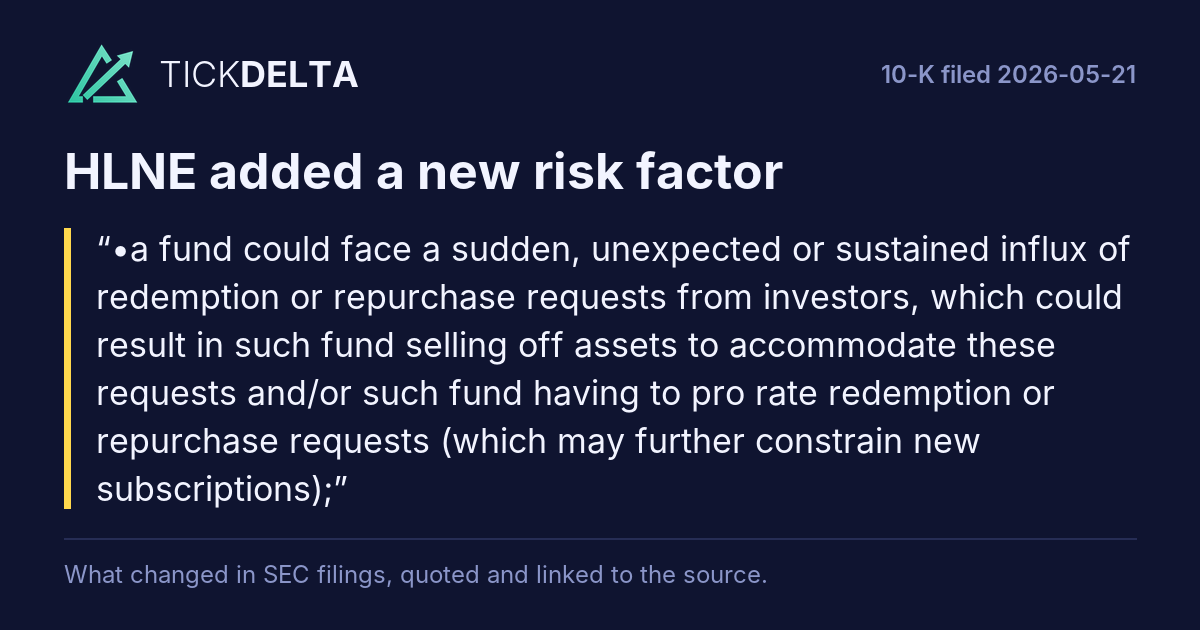
•a fund could face a sudden, unexpected or sustained influx of redemption or repurchase requests from investors, which could result in such fund selling off assets to accommodate these requests and/or such fund having to pro rate redemption or repurchase requests (which may further constrain new subscriptions);
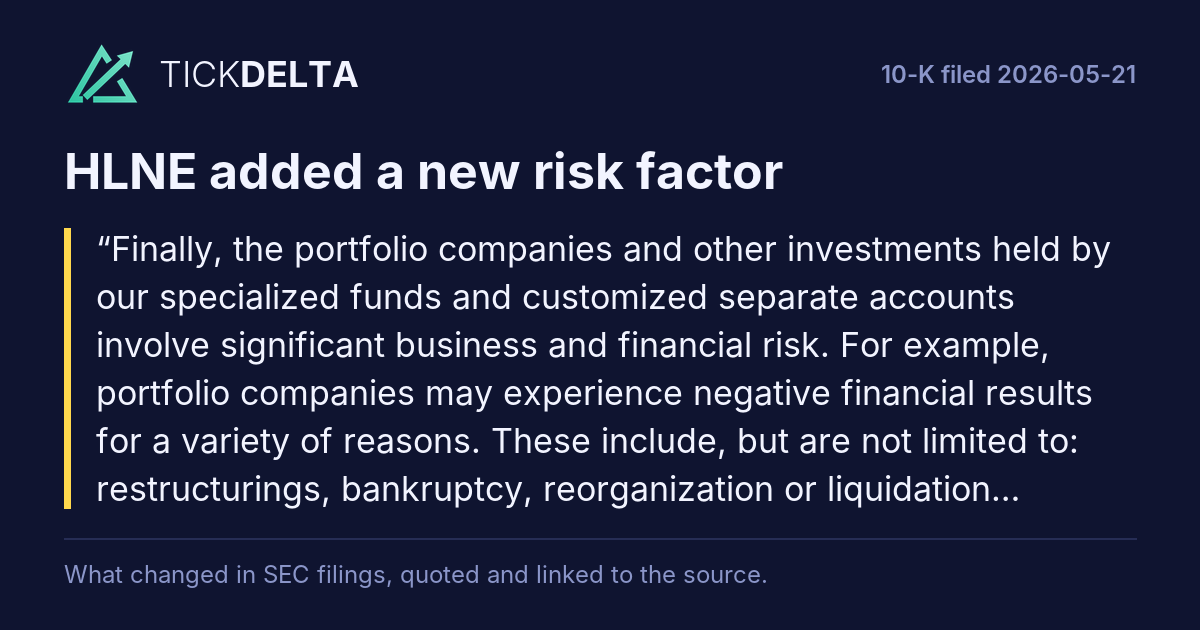
Finally, the portfolio companies and other investments held by our specialized funds and customized separate accounts involve significant business and financial risk. For example, portfolio companies may experience negative financial results for a variety of reasons. These include, but are not limited to: restructurings, bankruptcy, reorganization or liquidation, insolvency or related bankruptcy proceedings due to defaults on indebtedness, mismanagement, litigation, enforcement actions or fraud, which could reduce investment returns realized by our specialized funds and customized separate accounts. Portfolio companies and other investments are also subject to risks associated with general market and geopolitical conditions, such as market downturns, inflation, public health emergencies and regional instability. In addition, a fund may invest in a portfolio company with a limited operating history, and there is no guarantee that the
information or reports provided to the fund’s advisor with respect to the portfolio companies will not be fraudulent, inaccurate or incomplete, which could adversely impact the value of an investment in the fund.
A sudden and/or substantial decrease in price of one of our investments due to, for example, negative performance, could materially impair our specialized fund or customized separate account performance, an outcome that would be amplified in funds or accounts that hold no other or relatively few investments. Such events could negatively affect our operating results and reputation and could result in heightened scrutiny and criticism of our business and investments.
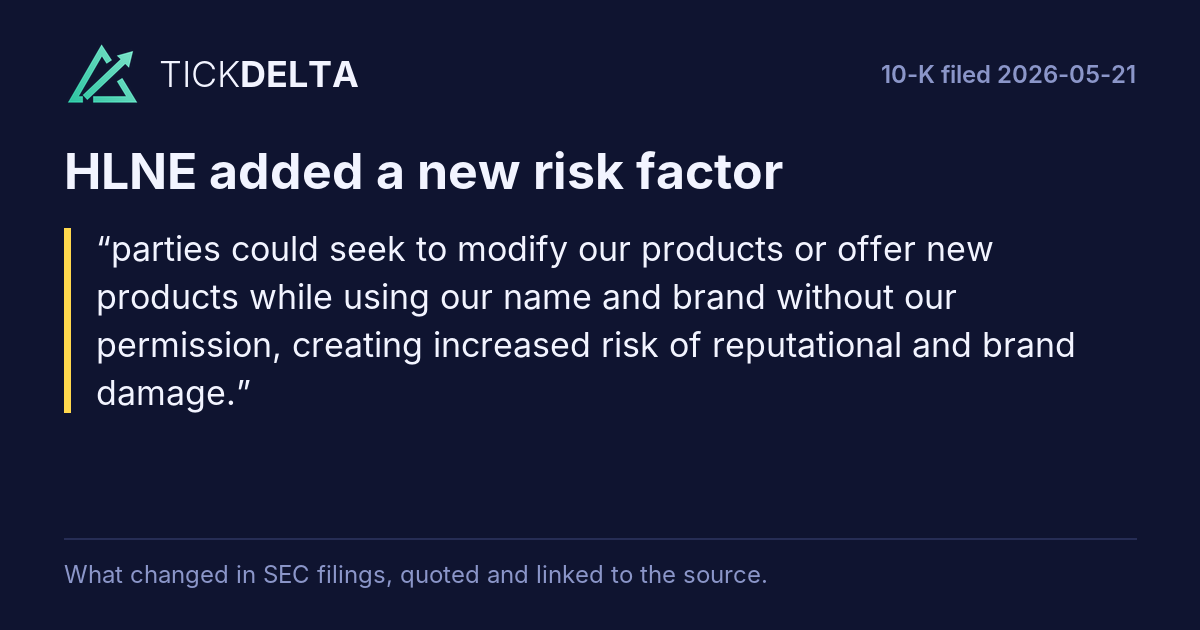
parties could seek to modify our products or offer new products while using our name and brand without our permission, creating increased risk of reputational and brand damage.
which case we will be subject to additional risks and uncertainties in that we may be dependent upon, and subject to liability for, losses or reputational damage relating to, systems, controls and personnel that are not under our control. In addition, if we choose to issue equity to fund an acquisition, our stockholders may experience dilution.
Unlike traditional drawdown funds, which generally do not permit redemptions of fund interests until the liquidation of the fund upon scheduled termination dates, our evergreen funds, including our funds registered under the Investment Company Act, contain investor liquidity features that permit investors to redeem or repurchase their interests from time to time. Our evergreen funds have grown substantially in recent years and now represent a more significant portion of our AUM and our management and revenues. As these products
Show the other 18
The values of our specialized funds’ and discretionary customized separate accounts’ investments are determined in accordance with the firm’s valuation policies and procedures, as then-currently in effect and approved by the operative documents for the particular specialized fund or customized separate account.
Unforeseen market, economic and geopolitical conditions and events could significantly and abruptly impact the valuation of an investment from period to period, and valuation methodologies may change across periods. Because the valuation methodologies described herein generally only occur on a periodic basis, subsequent events that may have a material impact on those valuations may not be reflected until the next periodic valuation date. The impact of factors not accounted for in valuation models and the potential exercise of our subjective judgment in determining valuation might cause some of our investors or regulators to question our valuations or methodologies. There can be no assurance that our policies, or the policies of underlying funds, will address all necessary valuation factors, minimize uncertainty or completely eliminate potential conflicts of interest in such determinations. In addition, as we launch and scale daily-priced interval funds and other evergreen vehicles, we may increasingly rely on quantitative models, regression-based approaches and third-party data inputs to support more frequent NAV calculations. Unlike monthly or quarterly products, for which valuation procedures may be completed over a longer period of time, daily-priced vehicles require that all procedures necessary to strike a NAV be condensed into a shorter window of time, which further increases our exposure to model, data and operational risk.
The portfolio companies in which private markets funds have invested or may invest will sometimes involve a high degree of business and financial risk. These companies may be in an early stage of development, may not have a proven operating history, may be operating at a loss or have significant
Our operation of registered investment companies and compliance with the restrictions of the Investment Company Act or other regulations could adversely affect us.
Our business activities are subject to additional regulatory requirements that could adversely impact profitability. Certain evergreen funds we offer are registered investment companies under the Investment Company Act or are subject to other rules applicable to our evergreen funds, notably those of the Luxembourg supervisory authority, the Commission de Surveillance du Secteur Financier (the “CSSF”) with respect to our evergreen funds domiciled in Luxembourg. The Investment Company Act and the rules thereunder, the rules applicable to our evergreen funds domiciled in Luxembourg as well as applicable European legislation contain detailed parameters for the organization and operation of these evergreen funds. Among other things, the Investment Company Act and the rules thereunder limit or prohibit transactions with affiliates, impose limitations on the issuance of debt and equity securities, prohibit the issuance of stock options and impose certain governance and board independence requirements. In addition, we depend on third parties to assist us in servicing and complying with regulatory obligations with respect to our evergreen funds. These limitations, obligations and reliance on third-party service providers used to assist us in servicing our evergreen funds could materially and adversely affect our business, financial condition and results of operations.
We rely heavily on our and our third-party service providers’ financial, accounting, compliance, monitoring, administration, reporting and other data processing systems and technology platforms, including those of our fund administrators and AIFMs, to conduct our business. If any of these systems do not operate
Further, we allow employees to work on a hybrid schedule or remotely, which introduces operational risks, including heightened cybersecurity risk, as remote working environments can be less secure and more susceptible to hacking attacks. We are aware of unauthorized use of non-approved consumer AI tools by our employees. Such use increases the risk that confidential information, including material non-public information, trade secrets or personally identifiable information, has been or may be input into those tools, which could result in such information becoming part of a dataset that is accessible by third-party applications and users, including our competitors.
We are dependent on the effectiveness of our and our service providers’ information security policies, procedures and capabilities designed to protect our and their computer, network and telecommunications systems, the data such systems contain or transmit and rely on these policies and systems to enable timely escalation of any cyberattack, assessment of materiality and, where required, regulatory and other disclosures. Measures taken to ensure the integrity of our or our third-party service providers’ systems may not provide adequate protection, may not operate as intended and may not be adequate in the face of new or unforeseen threats, including those exploiting vulnerabilities in widely-used software, AI tools or third-party platforms. Our and our third-party service providers’ computer systems, software and networks may be vulnerable to unauthorized access, theft, misuse, computer viruses, bugs, ransomware or other malicious code, employee, vendor or contractor error or malfeasance, and other events that could have a negative impact on the security of our technology systems and data.
A successful cyberattack, intrusion, compromise of credentials, ransomware event, destruction or corruption of data, loss or misuse of sensitive information or other cybersecurity incident affecting us or our service providers could result in, among other things, loss or unauthorized use or disclosure of confidential or proprietary information, operational disruptions, loss of availability or integrity of critical systems or data, inability to timely process transactions or calculate and report NAV, loss of intellectual property, theft or diversion of funds and damage to equipment and systems. Such an incident, or the perception that one has occurred, could subject us to significant costs and liabilities, including incident response, remediation and system hardening costs, restoring data and systems, legal and consulting fees, costs associated with notification to and remediation for affected individuals, responding to regulatory investigations or examinations, litigation and indemnity obligations, increased insurance premiums, coverage limitations or the unavailability of cyber insurance and reputational damage that could adversely affect our ability to attract and retain clients or raise capital for our products.
Additionally, although the prevalence and scope of applications of distributed ledger technology, digital assets, cryptocurrency and similar technologies is growing, the technology is new and may be vulnerable to cyberattacks or have other inherent technological weaknesses. We and the specialized funds and customized separate accounts we manage are exposed to risks, and may become exposed to additional risks, related to distributed ledger technology and the financial products that use it, such as blockchain, cryptocurrencies and other digital assets, or decentralized finance and related applications, including through our offering funds and other products in tokenized formats, our partnering with and reliance on companies that use, develop, or rely on distributed ledger technology and use of distributed ledger technology by third-party vendors, clients, counterparties and other financial intermediaries with who we transact. Market volatility of financial products
using distributed ledger technology may increase these risks and may also expose us to increased compliance risks.
Regulators in a number of jurisdictions, including the EU, the United States and various U.S. states, have begun to adopt or consider laws and regulations governing the development and use of AI systems. These frameworks are evolving and in some cases not yet harmonized, and may impose requirements relating to risk assessment, data governance, transparency, human oversight and recordkeeping. We also face risk that our public disclosures about our use of AI tools, products or strategies could be alleged to be incomplete, inaccurate or misleading, including claims that we have overstated the capabilities or impact of AI in our business, also known as AI-washing. Any regulatory change, investigation or allegation could result in increased compliance costs, delay or limit our use of AI technologies, subject us or our portfolio companies to fines or other penalties, or otherwise adversely affect our business, reputation, financial condition and results of operations.
In recent years, the volume of claims and amount of damages claimed in litigation and regulatory proceedings against financial advisors has been increasing. Our asset management and advisory activities may subject us to the risk of significant legal liabilities to our clients and third parties, including our clients’
• the absence of uniform accounting, auditing, and financial reporting standards, practices, and disclosure requirements and less government supervision and regulation;
Our international investment vehicles are also subject to different reporting requirements. Information pertaining to such vehicles may be disseminated on a different cadence than the information we are required to report to our stockholders, and local regulations may require that such information be available to investors in certain jurisdictions.
our total business, these factors could have a more pronounced effect on our operating results or growth prospects.
We may publish climate-related and stewardship reports that draw on emerging disclosure frameworks in advance of any binding legal requirements. Statements we make regarding these matters may be communicated across multiple channels (including SEC filings, websites, investor presentations, marketing materials, and third-party platforms), and we may face increased risk that such statements are alleged to be inconsistent, incomplete, or misleading when viewed collectively or in hindsight. Our reporting may also be compared against third-party ratings, benchmarks or methodologies that are not uniform, may conflict with one another and may change over time. We cannot control how third parties evaluate or characterize our disclosures or practices, and adverse ratings or assessments could negatively affect our reputation or our ability to attract and retain clients and investors.
We are also affected by natural disasters or catastrophes, such as public health crises, pandemics, epidemics, security events, and weather events, any of which could have an adverse impact on our ability to conduct our business. Such events outside of our control could: limit or even materially prohibit our ability to conduct any operations or investment activities in certain locations; restrict our ability to travel and meet with prospective and current clients in person; impede our ability to market our funds and attract new business
In recent years, the SEC has increased its regulation of the asset management and private equity industries, focusing on private advisors’ fees, allocation of expenses to funds, marketing practices, allocation of fund investment opportunities, disclosures to fund investors, the allocation of broken-deal expenses,
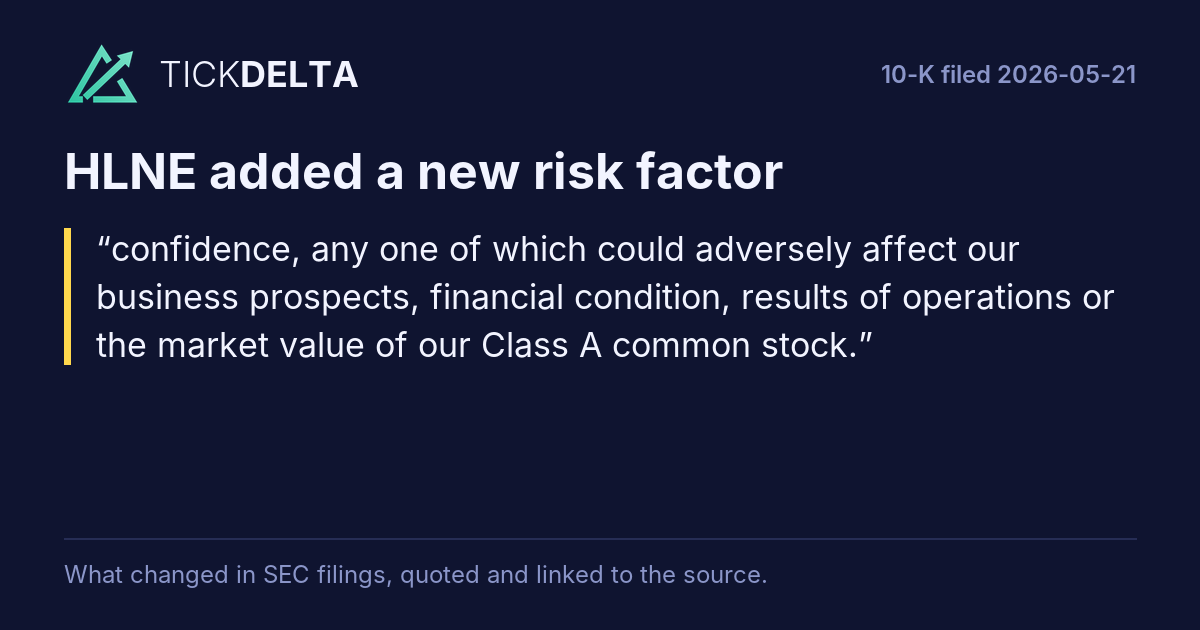
confidence, any one of which could adversely affect our business prospects, financial condition, results of operations or the market value of our Class A common stock.
•Certain investors may condition capital commitments in ways that may constrain our capital deployment opportunities, including by limiting investment opportunities in certain sectors, or taking certain actions, or refraining therefrom. These investor‑driven preferences or constraints may limit the investable universe or the actions we are able to take within a mandate and, as a result, could affect the risk and return profile of the relevant portfolios.
In addition, there is increasing scrutiny of workforce development and management programs in the United States and other jurisdictions, including through legislation, executive orders, regulatory initiatives and private litigation. Governmental authorities and private plaintiffs have signaled a willingness to challenge corporate workforce related initiatives under civil-rights and other statutes. Any such challenge involving us, our funds or portfolio companies, whether or not successful, could result in regulatory inquiries or enforcement, litigation, monetary penalties, adverse judgments or settlements, or harm to our reputation, each of which could adversely affect our business.
Certain portfolio companies in which our specialized funds and customized separate accounts invest operate in sectors that could face risks as a result of a transition to a lower-carbon economy. For certain of
Paragraphs in the 10-Q filed Nov 3, 2026 that were not in the one before
New in the latest 10-Q
30 paragraphs in the 10-Q filed Nov 3, 2026 with nothing like them in the 10-Q filed Aug 4, 2026 (at least half the words must differ; new numbers alone do not count). Quoted exactly, grouped by the item heading above them. This is text that changed, not a judgement of how serious it is.
Financial statements and notes
Proceeds received from issuance of shares under Employee Share Purchase Plan 1,576 1,572
Read in the 10-Q
Payments to related parties, pursuant to tax receivable agreement (15,951) (12,000)
Read in the 10-Q
Contributions from non-controlling interests in Consolidated Funds and Partnerships 250,743 122,095
Read in the 10-Q
Distributions to non-controlling interests in Consolidated Funds and Partnerships (626) (332)
Read in the 10-Q
On November 2, 2025, the Company entered into a long-term strategic partnership (the “Guardian Transaction”) with The Guardian Life Insurance Company of America (“Guardian”). On December 31, 2025, the Company issued a warrant related to a maximum of 400,000 shares of its Class A common stock (the “Warrant”) to Guardian in a private placement transaction. On December 31, 2025, the Company recognized a customer incentive asset of $ 8,367 recorded in other assets in the Consolidated Balance Sheets, associated with the Warrant shares that were vested and exercisable upon issuance, subject to clawback provisions. The asset, along with the remaining grant date fair value of the Warrant, will be recognized as a reduction of management fee revenue over the contract performance period as the Company provides the related asset management services.
Read in the 10-Q
Show the other 25
The valuation methodologies, significant unobservable inputs, range of inputs and the weighted average input determined based upon relative fair value of the investments held by Consolidated Funds used in recurring Level 3 fair value measurements of assets were as follows, as of September 30, 2026:
Read in the 10-Q
For the significant unobservable inputs listed in the table above a significant increase or decrease in the selected market return would result in a significantly higher or lower fair value measurement, respectively.
Read in the 10-Q
In August 2026, the Consolidated Fund held its first close and refinanced the Bridge Facility with a revolving credit facility that is not guaranteed by HLA. This resulted in the Company no longer being the primary beneficiary of the Fund. Accordingly, during the three months ended September 30, 2026, the Company deconsolidated the Fund resulting in the derecognition of the $ 145,000 Bridge Facility and net investments of $ 45,574. The Company did not hold any other interests in the Fund at the time of deconsolidation and there was no gain or loss on derecognition.
Read in the 10-Q
On September 16, 2026, the Company granted Performance Awards that will vest based upon (i) achieving a compound annual growth rate of total shareholder return of at least 8 % as of September 16, 2031 and (ii) continued employment through September 16, 2031.
Read in the 10-Q
Below is a summary of the grant date fair value based on the Monte Carlo simulation valuation model and the significant assumptions used to estimate the grant date fair value of the Performance Awards granted on September 16, 2026.
Read in the 10-Q
Grant Date Fair Value $47.04 Closing share price as of grant date $89.88 Risk Free Rate 4.9% Volatility(1) 37.5% Dividend Yield 2.7%
Read in the 10-Q
(1)The Company estimates expected volatility based on the historic volatility of its own Class A common stock.
Read in the 10-Q
On October 8, 2026, the Company sold its interests in a technology investment for $30,798 in cash, recognizing a realized gain of $17,134.
Read in the 10-Q
On October 8, 2026, we sold our interests in a technology investment for $30.8 million in cash, recognizing a realized gain of $17.1 million.
Read in the 10-Q
Three months ended September 30, 2026 compared to three months ended September 30, 2025
Read in the 10-Q
Six months ended September 30, 2026 compared to six months ended September 30, 2025
Read in the 10-Q
Three months ended September 30, 2026 compared to three months ended September 30, 2025
Read in the 10-Q
Six months ended September 30, 2026 compared to six months ended September 30, 2025
Read in the 10-Q
Three months ended September 30, 2026 compared to three months ended September 30, 2025
Read in the 10-Q
Six months ended September 30, 2026 compared to six months ended September 30, 2025
Read in the 10-Q
Three months ended September 30, 2026 compared to three months ended September 30, 2025
Read in the 10-Q
Six months ended September 30, 2026 compared to six months ended September 30, 2025
Read in the 10-Q
Three months ended September 30, 2026 compared to three months ended September 30, 2025
Read in the 10-Q
Six months ended September 30, 2026 compared to six months ended September 30, 2025
Read in the 10-Q
On June 29, 2026, the Consolidated Fund drew $145.0 million under the Bridge Facility to fund the acquisition of portfolio investments. In August 2026, the Consolidated Fund held its first close and refinanced the Bridge Facility with a revolving credit facility that is not guaranteed by HLA. This resulted in us no longer being the primary beneficiary of the Fund. Accordingly, during the three months ended September 30, 2026, we deconsolidated the Fund resulting in the derecognition of the $145.0 million Bridge Facility. No amounts were paid by HLA under the guaranty.
Read in the 10-Q
We expect to continue to use our balance sheet to support the launch and growth of our specialized funds and customized separate accounts. In addition to funding the capital commitments we have made to certain of our specialized funds and customized separate accounts and providing seed capital to new specialized funds, including our evergreen funds, we may from time to time warehouse investments pending fundraising, make loans to these funds and accounts, invest in structured vehicles that we sponsor, and guarantee or otherwise provide credit support for their obligations, such as credit facilities or equity commitments. The guaranteed obligations are generally secured by uncalled capital commitments to, or investments held by, the applicable fund. We generally expect capital we provide through loans to be returned as third-party capital is raised, and we believe the likelihood of material funding under the guarantees would be remote. However, the timing of any return is uncertain, and we may hold these positions longer than anticipated.
Read in the 10-Q
Share sales and buybacks
(1) Represents shares of Class A common stock tendered by employees as payment of taxes withheld on the vesting of restricted stock granted under HLI’s Amended and Restated 2017 Equity Incentive Plan.
Read in the 10-Q
Other information
As previously disclosed, on October 12, 2026, our board of directors appointed Hartley R. Rogers as the Company’s Co-Chief Executive Officer (“Co-CEO”) to serve alongside Juan Delgado-Moreira. Mr. Rogers will also continue to serve as Chairman of the Board, but will no longer serve as an Executive Co-Chairman (“Executive Co-Chair”) of the Company. In connection with this leadership transition, Erik R. Hirsch has transitioned from his position as Co-CEO to the position of Executive Co-Chair.
Read in the 10-Q
In connection with the foregoing leadership transition, the Company entered into a side letter (the “Side Letter”) with Mr. Hirsch on October 28, 2026, reflecting the following changes to Mr. Hirsch’s compensation arrangements, as approved by our board of directors: (1) in the event of Mr. Hirsch’s termination of employment by the Company without Cause (as defined in the Side Letter) or Mr. Hirsch’s resignation for Good Reason (as defined in the Side Letter), (i) certain of Mr. Hirsch’s outstanding and unvested time-based and performance-based restricted stock awards, carried interest awards and bonus amounts will be deemed fully vested or payable, as applicable, as of his termination date (with any performance goals applicable to his long-term performance-based restricted stock award remaining subject to vesting based on the Company’s actual performance at the end of the applicable performance period) and (ii) any awards that remain ungranted from the Co-CEO Annual Awards described in the Company’s definitive proxy statement for the Company’s 2026 Annual Meeting of Stockholders, filed with the Securities and Exchange Commission on July 23, 2026, will be granted and deemed fully vested as of Mr. Hirsch’s termination date, and (2) the Company will provide Mr. Hirsch with a new cash incentive award in connection with certain of its future strategic technology investments, with a value to be determined by the Board. Such accelerated vesting or payment of awards and additional cash incentive award will be subject to Mr. Hirsch’s execution and non-revocation of a release of claims in favor of the Company.
Read in the 10-Q
The foregoing description does not purport to be complete and is qualified in its entirety by reference to the Side Letter, which is filed as Exhibit 10.1 to this Form 10-Q and is incorporated herein by reference.
Read in the 10-Q
The 10-Q's risk factors against the 10-K
Item 1A of the 10-Q filed Nov 3, 2026 against Item 1A of the 10-K filed May 21, 2026.
A 10-Q repeats only the risks that changed, so a 10-K paragraph that is missing from it is not counted as removed.
Added is a paragraph with nothing like it in the 10-K, Reworded a sentence that is in both with several words changed,
Quiet changes a sentence in both where one to four words changed and one is a hedge or a modal
(cut words struck through, new words highlighted).
Text on the page, not a score; each links to the filing at sec.gov.
What the 10-Q itself says about its risk factors:There have been no material changes from the risk factors previously disclosed in Part I, Item 1A of our 2026 Form 10-K.
Read in the 10-Q
1 paragraph in the 10-Q's Item 1A, and none of them adds, rewords or quietly edits a paragraph of the 10-K's.
Phrases used for the first time
Two-word phrases in Risk Factors of the 10-K filed May 21, 2026 that are in none of the 1 earlier 10-Ks stored, back to May 30, 2025
Where each one is used
- responsible investing: Finally, some matters covered by our due diligence process, such as responsible investing and sustainability considerations, are subject to evolving market and regulatory standards, which we may not accurately or fully anticipate. Our responsible investing and sustainability due diligence framework does not...
- investment advisor: As we expand the scope of our business, as well as the investor channels through which our products are offered, we increasingly confront potential and actual conflicts of interest relating to our advisory and investment management businesses. For example, we may recommend that various advisory clients invest in...
- distributed ledger: Additionally, although the prevalence and scope of applications of distributed ledger technology, digital assets, cryptocurrency and similar technologies is growing, the technology is new and may be vulnerable to cyberattacks or have other inherent technological weaknesses. We and the specialized funds and...
- ledger technology: Additionally, although the prevalence and scope of applications of distributed ledger technology, digital assets, cryptocurrency and similar technologies is growing, the technology is new and may be vulnerable to cyberattacks or have other inherent technological weaknesses. We and the specialized funds and...
- strike nav: Finally, the inclusion of redemption or repurchase rights in our evergreen funds create heightened risk of operational error, including with respect to the calculation of NAV. Any such errors could adversely affect the exercise of redemption rights and could adversely affect our revenues and profitability,...
- elevated interest: Our success largely depends on the identification and availability of suitable investment opportunities for our clients, and in particular the success of funds in which our specialized funds, customized separate accounts and advisory accounts invest. The availability of investment opportunities will be subject to...
- interval funds: We currently generate substantially all of our revenue from asset management and advisory services. However, we have grown, and intend to continue to grow, our business by offering additional products and services, by formulating new business strategies, by entering into, or expanding our presence in, new...
- events outside: We are also affected by natural disasters or catastrophes, such as public health crises, pandemics, epidemics, security events, and weather events, any of which could have an adverse impact on our ability to conduct our business. Such events outside of our control could: limit or even materially prohibit our...
Used at least twice, small words left out. Counted, not picked: a phrase can be new because the company renamed something.
What was taken out
22 paragraphs of last year's Risk Factors with nothing like them now. The longest are quoted.
Sources
Item 1A of each 10-K and 10-Q on EDGAR, quoted exactly. Each paragraph links to the filing at sec.gov.
Also
10-K change: what was reworded or cut, section by section.
Work with it
Excel workbook · CSV. Google Sheet that stays up to date: paste =IMPORTDATA("https://tickdelta.com/company/HLNE/export.csv") into a cell.