Form 10-K for the year ended December 31, 2017
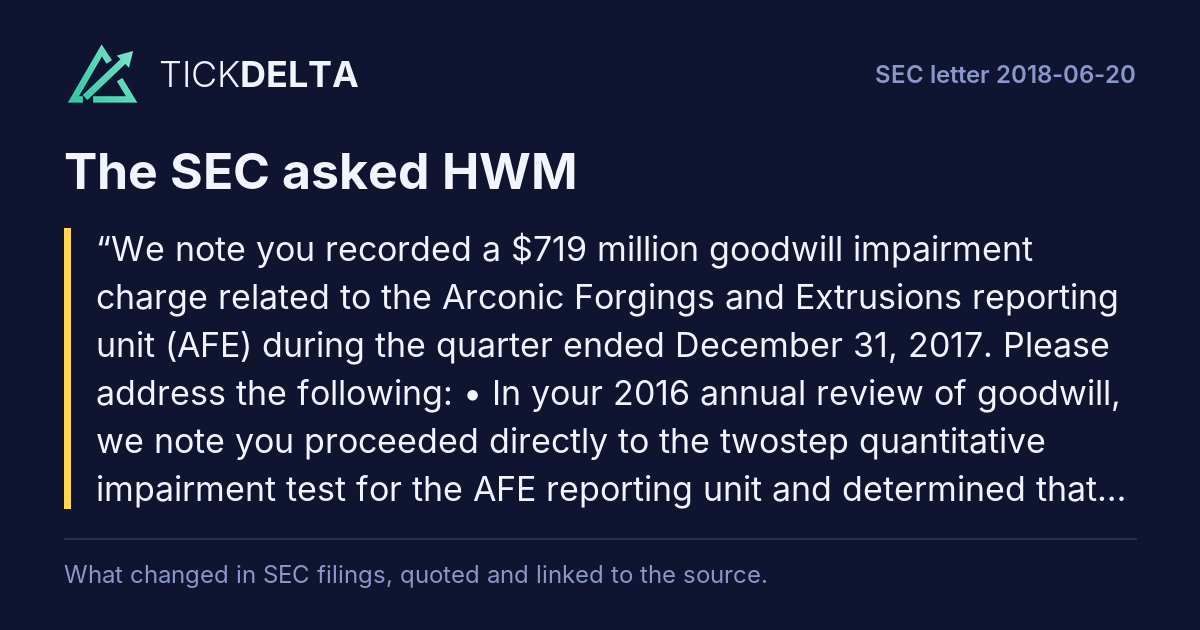
We note you recorded a $719 million goodwill impairment charge related to the Arconic Forgings and Extrusions reporting unit (AFE) during the quarter ended December 31, 2017. Please address the following: • In your 2016 annual review of goodwill, we note you proceeded directly to the twostep quantitative impairment test for the AFE reporting unit and determined that its estimated fair value exceeded its carryingRest of the question
value, resulting in no impairment. Tell us the amount and/or percentage of headroom related to the AFE reporting unit based on your 2016 annual review. To the extent the estimated fair value did not substantially exceed the carrying value in 2016, explain why no additional disclosures were provided; • We note you use a discounted cash flow model to estimate the current fair value of your reporting units, which involves a number of significant assumptions and estimates, including markets and market share, sales volumes and prices, production costs, tax rates, capital spending, discount rate, and working capital changes. We also note your disclosure that the decrease in the AFE fair value in 2017 was primarily due to “unfavorable performance that is impacting operating margins and a higher discount rate due to an increase in the risk-free rate of return, while the carrying value increased compared to prior year.” Tell us the differences between the significant assumptions and estimates you used to determine the AFE fair value in your 2017 and 2016 annual reviews and explain the nature and amount of the increase in the carrying value. In addition, more fully explain the specific reasons for the unfavorable performance of this reporting unit and the specific time periods during which they occurred; • Tell us what cautionary disclosures you provided in your exchange act filings prior to the FY 2017 Form 10-K regarding the potential for a material goodwill impairment charge at the AFE reporting unit. To the extent prior disclosures were not provided, explain why; and • Tell us what disclosures you have provided regarding the expected impact of unfavorable performance related to the AFE reporting unit based on the goodwill impairment.
The Company advises the Staff that during our 2016 annual review of goodwill for potential impairment, the AFE reporting unit’s fair value exceeded its carrying value by approximately $300 million, or 20%. As the fair value was considered substantially in excess of the carrying value, no additional disclosures were deemed necessary.
• We note you use a discounted cash flow model to estimate the current fair value of your reporting units, which involves a number of significant assumptions and estimates, including markets and market share, sales volumes and prices, production costs, tax rates,Read in the reply ↗Rest of the answer
capital spending, discount rate, and working capital changes.
We also note your disclosure that the decrease in the AFE fair value in 2017 was primarily due to “unfavorable performance that is impacting operating margins and a higher discount rate due to an increase in the risk-free rate of return, while the carrying value increased compared to prior year.” Tell us the differences between the significant assumptions and estimates you used to determine the AFE fair value in your 2017 and 2016 annual reviews and explain the nature and amount of the increase in the carrying value. In addition, more fully explain the specific reasons for the unfavorable performance of this reporting unit and the specific time periods during which they occurred;
Response: Arconic reviews goodwill annually for impairment in the fourth quarter. Additionally, the Company analyzes its long-term view in conjunction with the annual budgeting process which occurs in the fourth quarter.
During this review for AFE, revenue forecasts in future years were revised downward in both aerospace and non-aerospace markets due to ramp-up delays or weakening demand for our products. Also, AFE began to face higher raw material costs which it is not able to pass along on certain customer contracts thereby decreasing its gross margin over time.
The changes in significant assumptions and estimates that were used to determine the AFE fair value in the 2017 discounted cash flow model (DCF) versus the
2016 DCF model were as follows:
1) near-term sales growth was forecasted to decrease in the 2017 DCF model due to a decline in forecasted aerospace wide-body business and other non-aerospace business, and the slower ramp-up of a forgings production facility, which resulted in lower than projected share gains assumed in the 2016 DCF model;
First report after the company's reply of 2018-07-13: 10-Q filed 2018-08-02 ↗, against the 10-Q filed 2018-05-01 ↗.
Tickdelta does not hold the text of both reports, so they are not compared here.
In order to provide investors with information to better assess the probability of future goodwill impairment charges, please disclose, if accurate, that the estimated fair values of the reporting units you quantitatively tested for impairment substantially exceeded their carrying values.Rest of the question
For any reporting unit whose estimated fair value did not substantially exceed its carrying value, please provide the following additional disclosures: • The percentage by which fair value exceeded carrying value at the date of the most recent test; • The amount of goodwill allocated to the reporting unit; • A description of key assumptions used and how they were determined; • A discussion of the degree of uncertainty associated with key assumptions and a sensitivity analysis of the impact of changes in key assumptions; and • A description of potential events and/or changes in circumstances that could reasonably be expected to negatively affect key assumptions. Please refer to Item 303(a)(3)(ii) of Regulation S-K and Section V of the Commission's Guidance Regarding Management's Discussion and Analysis of Financial Condition and Results of Operations, SEC Release No. 34-48960.
long-term sales growth rates (in 2020 and beyond) were forecasted to decrease from an average of 4.1% in the 2016 DCF model to 3.0% in the 2017 DCF model relative to the factors noted above; Read in the reply ↗
First report after the company's reply of 2018-07-13: 10-Q filed 2018-08-02 ↗, against the 10-Q filed 2018-05-01 ↗.
Tickdelta does not hold the text of both reports, so they are not compared here.
We note your disclosure that "In January 2018, management changed the organizational structure of the businesses in its Engineered Products and Solutions (EP&S) segment, from four business units to three business units, with a focus on aligning its internal structure to core markets and customers and reducing cost." We also note that your CEO made a statement during your most recent earnings call that the three EP&SRest of the question
business unit Presidents now report directly to him. Based on these changes, please address the following: • If you concluded that these three business units are not operating segments, fully explain to us how you made that determination; and • If you concluded that these three business units are operating segments, demonstrate to us how you determined that aggregating these operating segments into one reportable segment is appropriate.
cost of goods sold excluding depreciation and amortization as a percentage of sales was forecasted to be an average 2.8% points higher in the 2017 DCF model due to: an increase in raw material costs that are not able to be contractually passed to the customer, consisting primarily of aluminum for which prices are highly cyclical and unpredictable, increasing 30% from the 2016 DCF model to the 2017 DCF model; and less favorable expected operating performance challenged by the slower ramp-up of a forgings production facility; and compounded by the lower than expected share gain on some highRead in the reply ↗Rest of the answer
margin business in the latter half of 2017;
First report after the company's reply of 2018-07-13: 10-Q filed 2018-08-02 ↗, against the 10-Q filed 2018-05-01 ↗.
Tickdelta does not hold the text of both reports, so they are not compared here.
Your computation of free cash flow differs from the typical calculation (cash flows from operating activities as presented in the statement of cash flows under GAAP, less capital expenditures). Please see Question 102.07 of the Non-GAAP Compliance and Disclosure Interpretations and revise the title of the non-GAAP measure you present.Rest of the question
In closing, we remind you that the company and its management are responsible for the accuracy and adequacy of their disclosures, notwithstanding any review, comments, action or absence of action by the staff.
capital expenditures as a percentage of sales, which are reviewed in conjunction with the annual budgeting process in the fourth quarter, were forecasted to be an average 0.5% points higher in the 2017 DCF model; Read in the reply ↗
First report after the company's reply of 2018-07-13: 10-Q filed 2018-08-02 ↗, against the 10-Q filed 2018-05-01 ↗.
Tickdelta does not hold the text of both reports, so they are not compared here.
Also in this review: request for more time, 2018-06-26, closing letter, 2018-08-01