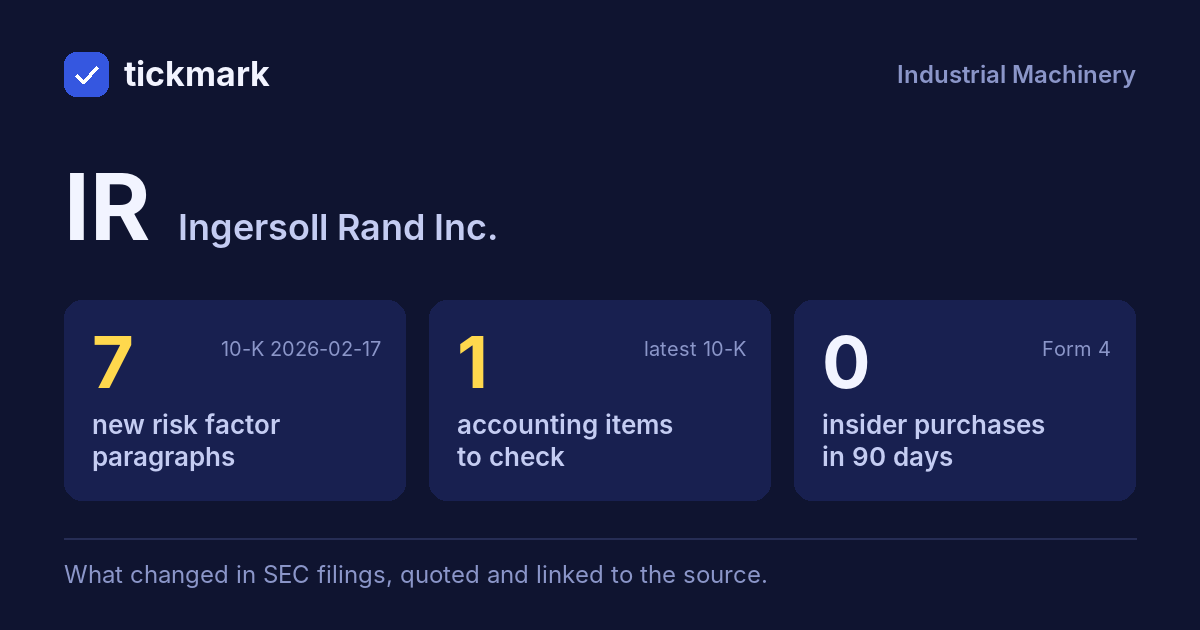
Sentences and paragraphs of IR's Risk Factors and MD&A, 10-K 2026-02-17 against 10-K 2025-02-19.
Each links to the text at sec.gov.
AddedRisk Factors
Russia-Ukraine war and conflicts in the Middle East); shipping products during times of crisis or war; and other factors inherent in foreign operations.
Read it in 10-K 2026-02-17 at sec.gov ↗
AddedRisk Factors
Changes in U.S. tariff policy or reciprocal tariffs by foreign governments, remain uncertain and could impact our financial results.
Read it in 10-K 2026-02-17 at sec.gov ↗
AddedRisk Factors
The current U.S. presidential administration has implemented tariffs on imports from various countries, including tariffs on steel and aluminum products under Section 232 of the Trade Expansion Act of 1962, which also apply to certain derivative steel products used in our operations. Some affected countries have announced or imposed reciprocal tariffs on U.S. goods. These measures have contributed to higher costs for certain materials and components. The extent and duration of these tariffs, and their effect on economic conditions and our business, remain uncertain and depend on factors such as legal challenges, negotiations between the U.S. and other countries, potential relief measures, availability and cost of alternative supply sources, and demand for our products in affected markets. Tariffs may increase costs or reduce demand for our products, which could
Read it in 10-K 2026-02-17 at sec.gov ↗
AddedRisk Factors
affect our financial results. In addition, competitors may experience different levels of exposure or have greater ability to mitigate these impacts.
Read it in 10-K 2026-02-17 at sec.gov ↗
AddedRisk Factors
In addition, the successful development and deployment of AI in our business depends on our ability to timely and effectively upskill our existing workforce and attract and retain personnel with AI‑related skills and experience. Competition for AI‑native talent is intense, and if we are unable to develop or recruit the necessary capabilities, we may be unable to fully realize potential efficiency gains, innovation opportunities or competitive advantages from AI, or to respond effectively to AI‑enabled competitive, technological or regulatory developments.
Read it in 10-K 2026-02-17 at sec.gov ↗
AddedRisk Factors
On July 4, 2025, the One Big Beautiful Bill Act (“OBBBA”) was signed into law by the president of the United States. It includes a broad range of tax reform provisions affecting businesses, including extending and modifying certain key provisions (both U.S. and non-U.S.) of the Tax Cuts & Jobs Act of 2017, and expanding certain Inflation Reduction Act incentives while accelerating the phase-out of others. The impact of the OBBBA is currently reflected on our consolidated financial statements as of December 31, 2025 and we are continuing to assess the impact for future years.
Read it in 10-K 2026-02-17 at sec.gov ↗
AddedRisk Factors
We are also subject to the examination of our tax returns and other tax matters by the U.S. Internal Revenue Service and other tax authorities and governmental bodies. We regularly assess the likelihood of an adverse outcome resulting from these examinations to determine the adequacy of its provision for taxes. The outcome of such examinations is inherently uncertain. If our effective tax rates were to increase, or if the ultimate determination of our taxes owed is for an amount in excess of amounts
Read it in 10-K 2026-02-17 at sec.gov ↗
AddedMD&A
Years Ended December 31, Percent Change (In millions, except percentages) 2025 2024 2025 vs. 2024 Segment Orders $6,119.6 $5,706.6 7.2% Segment Revenues $6,056.4 $5,818.1 4.1% Segment Adjusted EBITDA $1,747.9 $1,754.8 (0.4)% Segment Adjusted EBITDA Margin 28.9% 30.2 % (130) bps
Read it in 10-K 2026-02-17 at sec.gov ↗
Show the other 8
AddedMD&A
Years Ended December 31, Percent Change (In millions, except percentages) 2025 2024 2025 vs. 2024 Segment Orders $1,596.3 $1,398.9 14.1% Segment Revenues $1,594.5 $1,416.9 12.5% Segment Adjusted EBITDA $478.0 $418.8 14.1% Segment Adjusted EBITDA Margin 30.0% 29.6 % 40 bps
Read it in 10-K 2026-02-17 at sec.gov ↗
AddedMD&A
(e)Represents expected non-recoverable costs associated with a cybersecurity event, net of insurance recoveries.
Read it in 10-K 2026-02-17 at sec.gov ↗
AddedMD&A
access, foreign currency translation, and acquisitions. The increase in accounts payable was primarily due to the timing of vendor cash disbursements. The increase in contract liabilities was primarily due to the timing of customer milestone payments for in-process engineered to order contracts.
Read it in 10-K 2026-02-17 at sec.gov ↗
AddedMD&A
(In millions) 2025 2024 Cash flows provided by operating activities $ 1,355.7 $ 1,396.7 Cash flows used in investing activities (660.6) (3,107.7) Cash flows provided by (used in) financing activities (1,053.8) 1,707.5 Free cash flow (1) 1,220.1 1,247.6
Read it in 10-K 2026-02-17 at sec.gov ↗
AddedMD&A
During the second quarter of 2025, certain organizational changes occurred that impacted the composition of all reporting units within our Precision and Science Technologies segment. As a result of these changes, the Company performed an interim goodwill impairment test for all affected reporting units, utilizing a combination of an income and market approach weighted 75% and 25%, respectively, to determine the fair value. In the second quarter of 2025, the Company recognized non-cash impairments of $170.3 million and $59.4 million to reduce the carrying value of goodwill of our Biopharma and Aerospace & Defense reporting units, respectively. Both the Biopharma and Aerospace & Defense reporting units were comprised entirely of businesses acquired in the recent ILC Dover acquisition. After considering the effect of the impairments, the Biopharma and Aerospace & Defense reporting units had goodwill of $816.6 million and $15.9 million, respectively.
Read it in 10-K 2026-02-17 at sec.gov ↗
AddedMD&A
During the second quarter of 2025, due to the reduction in the forecast for Aerospace & Defense and the increase in discount rates, the Company quantitatively tested the relevant indefinite lived tradename for impairment which resulted in a non-cash charge of $36.1 million, within the Precision and Science Technologies segment.
Read it in 10-K 2026-02-17 at sec.gov ↗
AddedMD&A
During the fourth quarter of 2025, the Company retired a tradename and rebranded a business within the Industrial Technologies and Services segment. As a result, the Company recognized an impairment of $7.6 million to reduce the carrying value of the retired tradename.
Read it in 10-K 2026-02-17 at sec.gov ↗
AddedMD&A
We performed our annual impairment test during the fourth quarter and no additional impairments were recorded. Changes in forecasted revenues or any of the other assumptions mentioned above could result in a material non-cash impairment charge in a future period.
Read it in 10-K 2026-02-17 at sec.gov ↗