Paragraphs with nothing like them in last year's 10-K
Quoted exactly
15 paragraphs in Risk Factors of the 10-K filed Nov 12, 2026
with nothing like them in the 10-K filed Nov 14, 2025. Quoted exactly.
Paragraphs that were only edited are under 10-K change.
Compared with the Risk Factors in the latest 10-K of the other 81 Industrials companies:
a paragraph with at least half its words the same at another company is called similar, and the companies are listed under it.
A paragraph most of them have is marked boilerplate. No line means no other company has one like it.
This counts text; it does not say how serious a risk is.
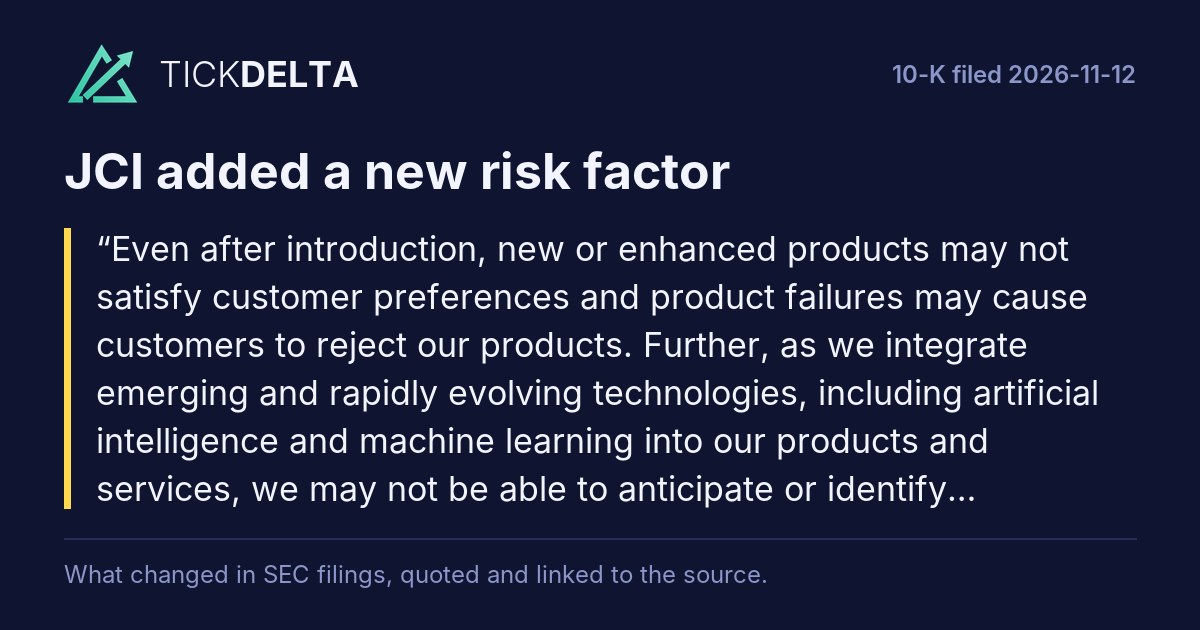
Even after introduction, new or enhanced products may not satisfy customer preferences and product failures may cause customers to reject our products. Further, as we integrate emerging and rapidly evolving technologies, including artificial intelligence and machine learning into our products and services, we may not be able to anticipate or identify vulnerabilities
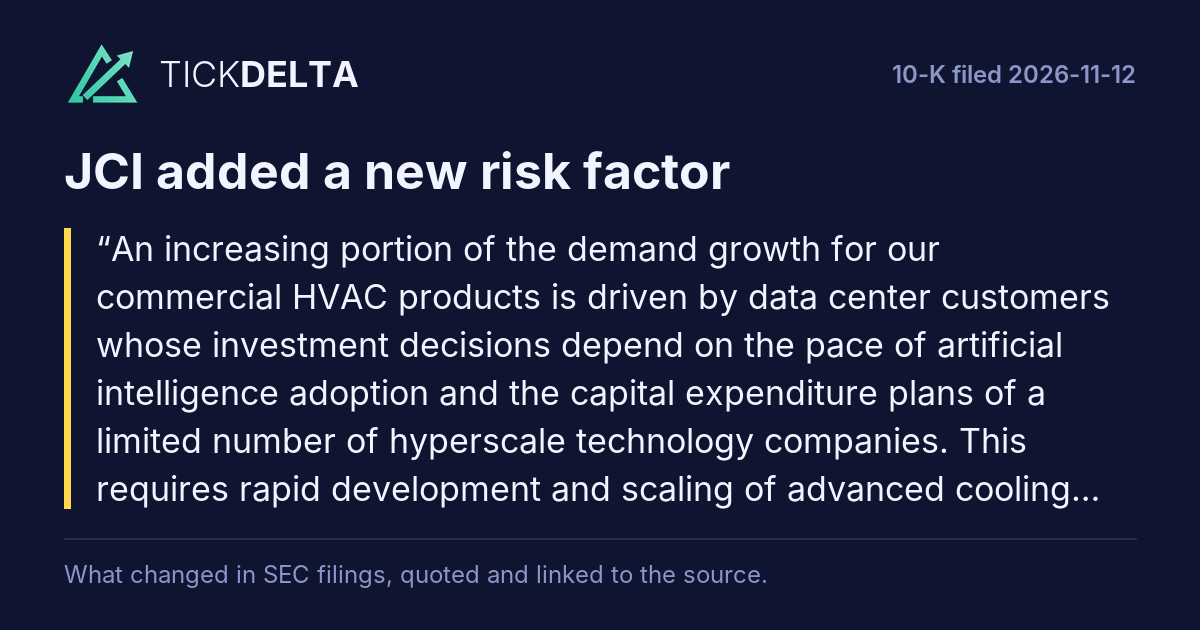
An increasing portion of the demand growth for our commercial HVAC products is driven by data center customers whose investment decisions depend on the pace of artificial intelligence adoption and the capital expenditure plans of a limited number of hyperscale technology companies. This requires rapid development and scaling of advanced cooling technologies, including direct-to-chip liquid cooling, and is subject to intense competition from both traditional HVAC providers and specialized new entrants. As a result, a growing share of our revenue and backlog is concentrated among data center customers, and the loss of, or a significant reduction in orders from, one or more of these customers could have a disproportionate impact on our results of operations. In addition, some data center customers and developers are newer counterparties with limited operating histories, weaker credit profiles or dependence on project financing, which could cause data center orders to be subject to greater uncertainty compared to other sectors . In addition, we have made, and expect to continue to make, significant investments in manufacturing capacity and supply commitments based on forecasted data center demand. If AI-related infrastructure demand does not develop as anticipated, if we are unable to deliver competitive cooling solutions on customer timelines, or if large customers with substantial engineering resources elect to develop proprietary thermal management capabilities, our growth in this segment could be materially adversely affected, we could incur excess capacity, inventory write-downs and asset impairments, and overall customer demand for our product offerings could decrease, which would have an adverse effect on our business, results of operations and financial condition.
Our results of operations and continued growth rely on delivering differentiated solutions in key growth verticals, particularly through our direct channel sales. Failure to grow our installed base of systems and services sales due to competitive factors or demand shifts within mission critical growth verticals could adversely affect our business.
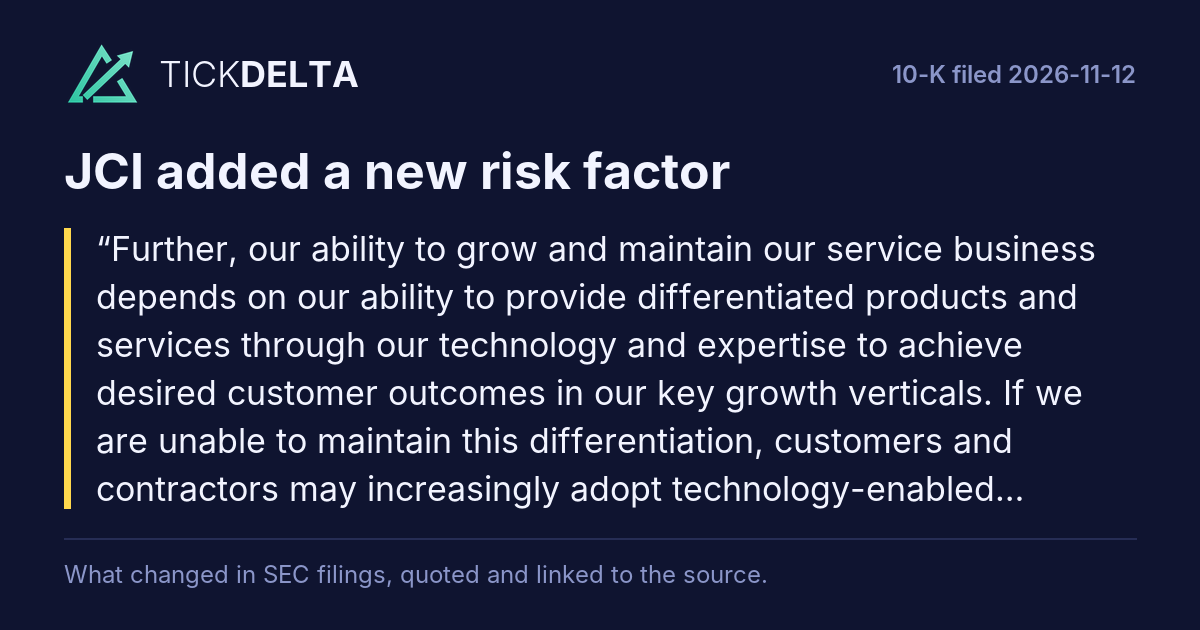
Further, our ability to grow and maintain our service business depends on our ability to provide differentiated products and services through our technology and expertise to achieve desired customer outcomes in our key growth verticals. If we are unable to maintain this differentiation, customers and contractors may increasingly adopt technology-enabled solutions that enable them to self-perform services currently provided by us, which could adversely impact our ability to grow service, monitoring, solutions and retrofit revenue.
system depends on our ability to train our employees on the business system and processes, hire and retain key personnel involved in the implementation, and manage organizational change across a large, geographically dispersed workforce. If we are unable to successfully implement and execute our operating model and deploy our business system, our business, financial condition, results of operations and cash flows could be adversely affected.
margins. We could experience the recurrence of similar or new disruptions in the future, the effect of which will depend on our ability to successfully mitigate the impact of these disruptions. Any such disruption could materially and adversely affect our business, financial condition, results of operations and cash flows.
Show the other 8
Cybersecurity threats range from uncoordinated individual attempts to gain unauthorized access to sophisticated, targeted attacks known as advanced persistent threats. These are directed at us, our products, our customers and our third-party service providers, including cloud providers. AI and machine learning technologies continue to develop rapidly, and the risks and market disruptions they may cause are impossible to predict. Threat actors already use these technologies to build new hacking tools and attack vectors, exploit vulnerabilities, hide their activities and make attacks harder to attribute. New AI tools can find previously undetected vulnerabilities in short time spans and create exposure to zero-day attacks. These developments may enable faster, larger-scale and more sophisticated attacks on us, our products, connected building environments, customers and third-party providers. They also significantly shorten the time we and our third-party service providers have to detect, respond to and fix vulnerabilities. In addition, the vendors we use to support our business and operations have experienced, and will likely continue to experience, these types of threats and incidents, which add to the risks to our IT systems (including our cloud services providers’ systems), internal networks, our customers’ systems and the information stored and processed on such networks and systems. Despite our efforts to deploy countermeasures to deter, prevent, detect, respond to and mitigate cybersecurity threats, we have experienced, and will likely continue to experience, cybersecurity incidents and attacks. Such incidents have remained, and could in the future remain, undetected for an extended period of time, and the losses arising from such incidents could exceed our available insurance coverage for such matters.
Any future cybersecurity incidents or attacks, depending on their nature and scope, may result in the Company incurring significant costs, reputational damage, exposure to legal claims, enforcement actions, audits, investigations and fines levied by governmental organizations, misappropriation, destruction, corruption or unavailability of critical data and confidential or proprietary information (our own or that of third parties), the theft of intellectual property and the diminution in the value of our investment in research, development and engineering, and the disruption of business operations.
Our customers, including the U.S. government, are increasingly requiring cybersecurity protections and mandating cybersecurity standards in our products, and we may incur additional costs to comply with such demands. Evolving cybersecurity laws, standards and customer requirements mandating secure-by-design and lifecycle security controls may increase costs, delay product launches, limit market access, and require us to modify or discontinue offerings that cannot be economically or technically adapted.
different markets, and proposed regulation or deregulation could hurt our competitive position. These factors may affect demand for our products, the obsolescence of our products and our results of operations.
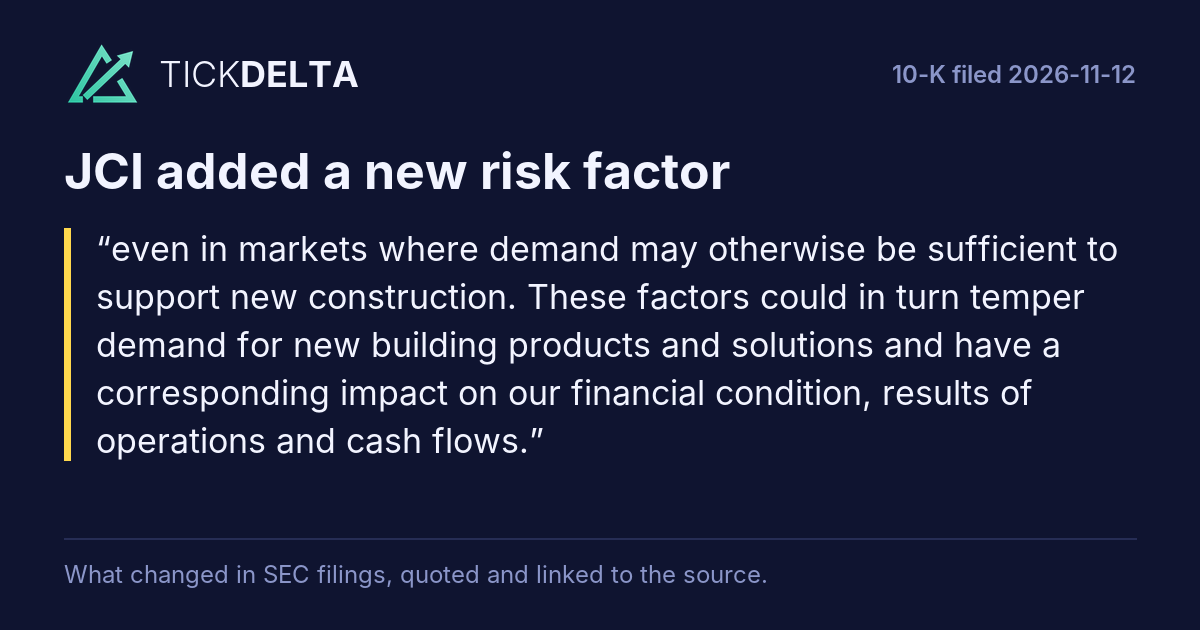
even in markets where demand may otherwise be sufficient to support new construction. These factors could in turn temper demand for new building products and solutions and have a corresponding impact on our financial condition, results of operations and cash flows.
Data center construction, in particular, is influenced by technology-sector capital expenditure cycles and political dynamics that may not correlate with broader construction market conditions, and a reduction in spending by a small number of large technology customers due to business, financial, political or logistical (i.e., electrical power availability, permitting, zoning and regulatory approvals) constraints could disproportionately affect our order pipeline and backlog. In addition, planned or publicly announced data center construction projects could be subject to public and state government push back which could cause the delay or cancellation of projects, which could adversely impact the Company's order pipeline, backlog conversion and results of operations.
The net effect of these actions will depend on our ability to successfully mitigate and offset their impact, which may not be effective.
Legal proceedings in which we are, or may be, a party to may adversely affect us.
In addition, future changes to existing tax treaties, the adoption of new anti-abuse provisions, limitations on treaty benefits, or differing interpretations of treaty provisions by tax authorities could increase withholding taxes, restrict access to treaty benefits, result in double taxation, and adversely affect our effective tax rate and cash tax position.
Paragraphs in the 10-Q filed Jul 29, 2026 that were not in the one before
New in the latest 10-Q
9 paragraphs in the 10-Q filed Jul 29, 2026 with nothing like
them in the 10-Q filed May 6, 2026 (at least half the words must differ; new numbers alone do not count).
Quoted exactly, grouped by the item heading above them. This is text that changed, not a judgement of how serious it is.
Financial statements and notes
During the third quarter of fiscal 2026, the Company closed the acquisitions of Alloy Enterprises and Nantum AI. The total aggregate consideration for the acquisitions, net of cash acquired, was approximately $ 291 million, of which a meaningful component related to Alloy Enterprises. Alloy Enterprises is a thermal, mechanical and materials sciences technology company that designs and manufactures advanced direct liquid cooling components. Nantum AI expands capabilities within the Johnson Controls OpenBlue digital ecosystem. These businesses will be reported within the Americas segment. In connection with the acquisitions, the Company recorded goodwill of $ 193 million, primarily related to the expected synergies from combining the operations into our business, and $ 127 million of definite-lived intangible assets related to developed technology being amortized on a straight-line basis over 15 years.
Read in the 10-Qopen_in_new
Assets and liabilities classified as held for sale are required to be recorded at the lower of carrying value or fair value less costs to sell. As of June 30, 2026, the estimated fair value less costs to sell of the held for sale business exceeded its carrying value, and therefore, no adjustment was necessary.
Read in the 10-Qopen_in_new
Tax Jurisdiction Tax Years Covered Belgium 2016 - 2017; 2019 - 2020 Germany 2007 - 2021 Mexico 2018 - 2021 United Kingdom 2020
Read in the 10-Qopen_in_new
Quebec claiming contamination of well water with PFAS from firefighting training and other activities conducted at Val D’Or airport.
Read in the 10-Qopen_in_new
resilient operating conditions in rapidly expanding industries such as data centers, healthcare, pharmaceuticals, advanced manufacturing, and higher education.
Read in the 10-Qopen_in_new
Show the other 4
current and future trade restrictions and their related impacts. The Company continues to actively monitor and evaluate the development and potential impacts of tariffs, trade restrictions and geopolitical conflicts on its supply chain and results of operations.
Read in the 10-Qopen_in_new
Backlog increased 32%, reflecting sustained orders growth and led by growth in Products and Systems.
Read in the 10-Qopen_in_new
Item 6
10.1 Johnson Controls International plc Value Growth Incentive Program (filed herewith)
Read in the 10-Qopen_in_new
10.2 Johnson Controls International plc Director Double Taxation Policy (filed herewith)
Read in the 10-Qopen_in_new
The 10-Q's risk factors against the 10-K
Item 1A of the 10-Q filed Jul 29, 2026 against Item 1A of the 10-K filed Nov 14, 2025.
A 10-Q repeats only the risks that changed, so a 10-K paragraph that is missing from it is not counted as removed.
Added is a paragraph with nothing like it in the 10-K, Reworded a sentence that is in both with several words changed,
Quiet changes a sentence in both where one to four words changed and one is a hedge or a modal
(cut words struck through, new words highlighted).
Text on the page, not a score; each links to the filing at sec.gov.
What the 10-Q itself says about its risk factors:Except as set forth herein, there have been no material changes to the disclosure regarding risk factors presented in Part I, Item 1A, of the Company’s Annual Report on Form 10-K for the year ended September 30, 2025.
Read in the 10-Qopen_in_new
Added10-Q Jul 29, 2026 vs 10-K Nov 14, 2025
Global cybersecurity threats and incidents can range from uncoordinated individual attempts to gain unauthorized access to IT systems to sophisticated and targeted measures known as advanced persistent threats directed at the company and its products, customers and/or third-party service providers, including cloud providers. Moreover, AI and machine learning technologies continue to develop rapidly, and it is impossible to predict the future risks and market disruptions that may arise from such developments. Threat actors are already leveraging such technologies to develop new hacking tools and attack vectors, exploit vulnerabilities, obscure their activities, and increase the difficulty of threat attribution. For example, powerful new AI tools are finding previously undetected vulnerabilities in short time spans and creating exposures to zero-day attacks, all of which significantly diminish the window for us and our third-party service providers to detect, respond to and protect our IT and data security infrastructure. In addition, the vendors we use to support our business and operations have experienced, and will likely continue to experience, these types of threats and incidents, which add to the risks to our IT systems (including our cloud services providers’ systems), internal networks, our customers’ systems and the information stored and processed on such networks and systems. Despite our efforts to deploy countermeasures to deter, prevent, detect, respond to and mitigate cybersecurity threats, we have experienced, and will likely continue to experience, cybersecurity incidents and attacks. Such incidents have remained, and could in the future remain, undetected for an extended period of time, and the losses arising from such incidents could exceed our available insurance coverage for such matters.
Read it in the 10-Q at sec.govopen_in_new
Added10-Q Jul 29, 2026 vs 10-K Nov 14, 2025
Any future cybersecurity incidents or attacks, depending on their nature and scope, may result in the incurrence of significant costs, reputational damage, exposure to legal claims, enforcement actions, audits, investigations and fines levied by governmental organizations, misappropriation, destruction, corruption or unavailability of critical data and confidential or proprietary information (our own or that of third parties), the theft of intellectual property and the diminution in the value of our investment in research, development and engineering, and the disruption of business operations.
Read it in the 10-Q at sec.govopen_in_new
Reworded10-Q Jul 29, 2026 vs 10-K Nov 14, 2025
Such incidents an event could lead customers to select the products and services of our competitors, harm our reputation, reputation and credibility, cause unfavorable publicity or otherwise adversely affect certain existing and potential customers’ perception of the security and reliability of our services as well as our credibility and reputation, services, all of which could result in lost sales.
Read it in the 10-Q at sec.govopen_in_newThe 10-K sentenceopen_in_new
Reworded10-Q Jul 29, 2026 vs 10-K Nov 14, 2025
The actual or perceived risk of theft, loss, fraudulent use or misuse of customer, employee or other data as a result of the foregoing or any other cybersecurity incident, as well as non-compliance with applicable industry standards or our contractual or other legal obligations or privacy and information security policies regarding such data, could result in litigation and/or regulatory activity and associated fines, damages, costs, awards, or settlements.
Read it in the 10-Q at sec.govopen_in_newThe 10-K sentenceopen_in_new
Reworded10-Q Jul 29, 2026 vs 10-K Nov 14, 2025
The use of AI in the development of our products and services could also cause loss or theft of intellectual property, as well as subject us to risks related to intellectual property infringement or misappropriation, data privacy and cybersecurity.
Read it in the 10-Q at sec.govopen_in_newThe 10-K sentenceopen_in_new
Show the other 3
Reworded10-Q Jul 29, 2026 vs 10-K Nov 14, 2025
If we experience a problem with the functioning of an important IT system as a result of increased burdens placed on our IT infrastructure or a security breach of our IT systems, the resulting disruptions could have a material adverse effect on our business. business, reputation and financial results.
Read it in the 10-Q at sec.govopen_in_newThe 10-K sentenceopen_in_new
Reworded10-Q Jul 29, 2026 vs 10-K Nov 14, 2025
Despite our efforts to protect such data, efforts, our business, data and our products have been and will in the future be vulnerable to security incidents, theft, misplaced or lost data, programming errors, or errors that could potentially lead to the compromise or further compromise of such data, improper use of our products, systems, software solutions or networks, unauthorized access, use, disclosure, modification or destruction of information, defective products, production downtimes and operational disruptions.
Read it in the 10-Q at sec.govopen_in_newThe 10-K sentenceopen_in_new
Reworded10-Q Jul 29, 2026 vs 10-K Nov 14, 2025
The successful assertion of one or more large claims against us that exceeds our available insurance coverage, or results in adverse changes to our insurance policies could have an adverse effect on our business. business and financial results.
Read it in the 10-Q at sec.govopen_in_newThe 10-K sentenceopen_in_new
Global cybersecurity threats and incidents can range from uncoordinated individual attempts to gain unauthorized access to IT systems to sophisticated and targeted measures known as advanced persistent threats directed at the Company, its products, its customers and/or its third-party service providers, including cloud providers. We and third parties utilize vendors to support our business and operations have experienced, and expect to continue to experience, these types of threats and incidents, which add to the risks to our IT systems (including our cloud services providers’ systems),...
In the 10-K filed Nov 14, 2025open_in_new
Our customers, including the U.S. government, are increasingly requiring cybersecurity protections and mandating cybersecurity standards in our products, and we may incur additional costs to comply with such demands. Despite our efforts to deploy countermeasures to deter, prevent, detect, respond to and mitigate cybersecurity threats, we have experienced, and will likely continue to experience, attacks and resulting breaches or breakdowns of our, or our third-party service providers’, databases or systems. Cybersecurity incidents, depending on their nature and scope, have resulted, and may...
In the 10-K filed Nov 14, 2025open_in_new
We are exposed to the risk that third parties to various arrangements who owe us money or goods and services, or who purchase goods and services from us, will not be able to fulfil their obligations or continue to place orders due to insolvency or financial distress. If third parties fail to perform their obligations under arrangements with us, we may be forced to replace the underlying commitment at current or above market prices or on other terms that are less favorable to us. In such events, we may incur losses, or our results of operations, financial condition or liquidity could...
In the 10-K filed Nov 14, 2025open_in_new
On February 17, 2016, the U.S. Treasury released a revised U.S. model income tax convention (the "new model"), which is the baseline text used by the U.S. Treasury to negotiate tax treaties. If any or all of the modifications to the model treaty are adopted in the main jurisdictions in which we do business, they could, among other things, cause double taxation, increase audit risk and substantially increase our worldwide tax liability. We cannot predict the outcome of any specific modifications to the model treaty, and we cannot provide assurance that any such modifications will not apply to us.
In the 10-K filed Nov 14, 2025open_in_new
Sources
Item 1A of each 10-K and 10-Q on EDGAR, quoted exactly. Each paragraph links to the filing at sec.gov.
Also
10-K change: what was reworded or cut, section by section.
Work with it
Excel workbook · CSV. Google Sheet that stays up to date: paste =IMPORTDATA("https://tickdelta.com/company/JCI/export.csv") into a cell.