tickdelta
Sign in

Tickdelta is free for now. Sign up and get Pro free

← Screener

JCIJohnson Controls

Industrials · HVAC Equipment · NYSE
Compare with peers → Embed
SEC comment letters, last 20 years

3 reviews of JCI's filings by SEC staff

UPLOAD and CORRESP
ReviewsRead ↓
3
latest letter 2026-02-26
Questions asked
12
each answered in the company's own letter
No closing letter
0
reviews without a letter saying the staff completed it

When the SEC's staff reviews a filing, it writes to the company with numbered questions, and the company answers each one in a letter. SEC publishes the exchange once the review is over, at least 20 business days later. A question is not an accusation; most reviews end with the company adding detail to its next filing.

Form 10-K for the Fiscal Year Ended September 30, 2025

2026-02-26 to 2026-03-24 · 3 questions · 1 letter from the SEC, 1 from the company
Review closed 2026-03-24
SegmentsResults discussion (MD&A)Non-GAAP measuresRevenue
Management's Discussion and Analysis of Financial Condition and Result of Operations, page
SEC asked (1)
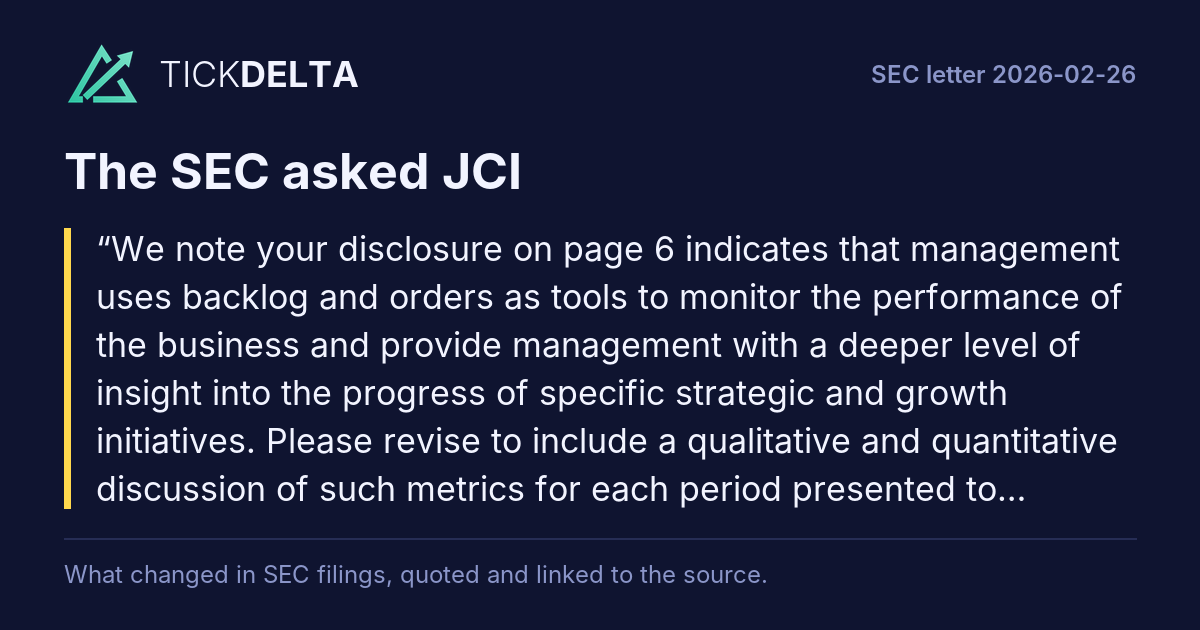
We note your disclosure on page 6 indicates that management uses backlog and orders as tools to monitor the performance of the business and provide management with a deeper level of insight into the progress of specific strategic and growth initiatives.
Rest of the question

Please revise to include a qualitative and quantitative discussion of such metrics for each period presented to enhance a readers understanding of your business similar to slides 9 and 10 of your Fiscal Q4 2025 Earnings Conference Call investor presentation which addresses changes by segment and solution. Refer to SEC Release No. 33-10751. Segment Analysis, page 35

JCI answered
The Company acknowledges the Staff’s comment and hereby confirms to the Staff that it will include in future periodic reports a qualitative and quantitative discussion of orders and backlog similar in scope to the information included in the Company’s Q4 Fiscal Year 2025 earnings presentations. Read in the reply ↗
In its next report

First report after the company's reply of 2026-03-18: 10-Q filed 2026-05-06 ↗, against the 10-Q filed 2026-02-04 ↗.

Item 2, MD&A: 58 paragraphs changed; the 3 closest in words to the question are below.

Reworded

Backlog and orders are additional metrics that are meant to provide management with a deeper level of insight into the progress of specific strategic and growth initiatives. Orders provide management with a signal of customer demand for the Company's products and services, as well as an indication of future revenues and performance. The Company believes backlog is a useful measure for evaluating its operational performance and relationship to total orders. However, the timing and conversion of backlog and orders are subject to numerous uncertainties and risks and are not necessarily indicative of the amount of revenue to be earned in the upcoming fiscal year.

0 words cut, 18 added sec.gov ↗
Reworded

• Segment earnings before interest interest, taxes and taxes ("EBIT") amortization ("Segment EBITA") (non-GAAP) represents Segment EBITA, adding back EBIT, excluding the impact of amortization of intangible assets. Segment EBIT allows EBITA provides the CODM to review profitability, inclusive of with performance comparability across periods and more accurate benchmarking against peer companies that may not have similar historical acquisition activity, by holding constant the impact of significant acquisition activity, informing the CODM of how the business is integrating key strategic initiatives and generating synergies. acquisitions.

30 words cut, 34 added sec.gov ↗
Reworded

• Segment earnings before interest, taxes, interest and amortization (“EBITA”) taxes (“Segment EBIT”) represents segment income from continuing operations, before income taxes and noncontrolling interests, excluding corporate expenses, restructuring and impairment costs, AFFF related settlement costs and insurance recoveries, gains or losses on divestitures, and net mark-to-market gains and losses related to pension and postretirement plans and restricted asbestos investments, net finance charges, and amortization. investments. Segment EBITA EBIT is used as a tool to allow the CODM to evaluate the recurring profitability of the segments, including revenues and expenses that are within the operational control of the segments, and excluding the impact of certain non-cash and non-recurring items. Segment EBITA EBIT also provides the CODM with performance comparability across periods visibility into the integration of key strategic initiatives, such as acquisitions and for more accurate benchmarking against peer companies that may not have similar historical acquisition activity, by holding constant the impact of significant acquisitions. mergers.

47 words cut, 21 added sec.gov ↗

Paragraphs where only numbers, dates or period words changed are not shown. Cut words struck through, new words highlighted and underlined.
Management's Discussion and Analysis of Financial Condition and Result of Operations, page
SEC asked (2)
We note your disclosure of Segment EBITA appears to be an additional segment measure of profit. Please revise to identify this additional measure of segment profit or loss as non-GAAP and provide the disclosures required by Item 10(e)(1)(i) of Regulation S-K. Similar concerns apply to your disclosures in your earnings releases furnished on Form 8-K.
JCI answered
The Company acknowledges the Staff’s comment and hereby confirms that it will include in future periodic reports and disclosures revised disclosure and presentation of Segment EBIT and Segment EBITA that identifies Segment EBITA as non-GAAP and includes the disclosures required by Item 10(e)(1)(i) of Regulation S-K. The Company will also make corresponding revisions to its future earnings releases. Read in the reply ↗
In its next report

First report after the company's reply of 2026-03-18: 10-Q filed 2026-05-06 ↗, against the 10-Q filed 2026-02-04 ↗.

The part of the filing the question names could not be found in both reports. Read them on sec.gov.

Note 18. Segment Information · Geographic Areas, page 100
SEC asked (3)
We note approximately 44% of your revenue was from foreign jurisdictions. Please tell us whether revenue from any individual foreign country is material and if so, how you considered the guidance in ASC 280-10-50-41(a).
JCI answered
The Company acknowledges the Staff’s comment and hereby advises the Staff that, other than the United States, no individual country contributed revenue that was material for the year ended September 30, 2025. In assessing materiality, the Company referenced the 10% tests provided in ASC 280-10-50-12.

We acknowledge that the Company is responsible for the accuracy of its disclosures, that the Commission is not foreclosed from taking action with respect to its filing and that the Company may not use the staff comments as a defense in any proceeding. Read in the reply ↗
In its next report

First report after the company's reply of 2026-03-18: 10-Q filed 2026-05-06 ↗, against the 10-Q filed 2026-02-04 ↗.

Note 18, COMMITMENTS AND CONTINGENCIES: 19 paragraphs changed; the 3 closest in words to the question are below.

Reworded

The Company maintains global operations. The Company has experienced, and could again experience, increased material cost inflation and component shortages, as well as disruptions and delays in its supply chain, as a result of global macroeconomic trends including the imposition of tariffs and other restrictive trade measures. The United States has announced tariffs and reciprocal tariffs on a wide range of products manufactured or produced worldwide, including Canada, China, the European Union, Japan, India and Mexico, among others. others.. Several countries have similarly announced reciprocal or other tariffs impacting products manufactured or produced in the United States. In addition, the United States and other nations have, and may in the future, pause, reimpose, decrease or increase tariffs. Although the Company has been largely able to mitigate the impact of tariffs that have been enacted to date, if additional tariffs and reciprocal tariffs are implemented (whether as currently proposed or otherwise), such actions could negatively impact the Company's revenue growth and margins in future periods through decreased sales and increased cost of goods sold. Further, In February 2026, certain tariffs imposed under the Company International Emergency Economic Powers Act (IEEPA), were invalidated by the U.S. Supreme Court. However, the United States has experienced, and could again experience, increased material cost inflation and component shortages, as well as disruptions and delays in its supply chain, as a result of global macroeconomic trends including the imposition of since imposed new tariffs and duties in their place. The Company is currently evaluating its options to mitigate the impact of prior IEEPA tariffs through participation in the IEEPA refund process. To date, the tariffs enacted by the United States and other restrictive trade measures, as well as geopolitical and economic tensions. The net effect of these events will continue to depend countries have not had a material impact on the Company’s ability to successfully mitigate and offset their impact. Company's financial performance for the periods presented.

65 words cut, 120 added sec.gov ↗
New paragraph

approximately $ 131 million of insurance recoveries related to settlements with its insurance carriers in selling, general and administrative expenses in the consolidated statements of income. The Company is unable to predict the amount and timing of any future recoveries under its insurance policies with the remaining carriers. The insurance litigation involves numerous factual and legal issues. There are numerous factual and legal issues to be resolved in connection with these claims. The Company is presently unable to predict the outcome or ultimate financial exposure beyond the water systems AFFF settlement discussed above, if any, represented by these matters, and there can be no assurance that any such exposure will not be material.

0 words cut, 113 added sec.gov ↗
Reworded

It is not possible to estimate the Company’s ultimate level of liability at many remediation sites due to the large number of other parties that may be involved, the complexity of determining the relative liability among those parties, the financial viability of other potentially responsible parties and third-party indemnitors, the uncertainty as to the nature and scope of the investigations and remediation to be conducted, changes in environmental regulations, changes in permissible levels of specific compounds in soil, groundwater and drinking water sources, or changes in enforcement theories and policies, including efforts to recover natural resource damages, the uncertainty in the application of law and risk assessment, the various choices and costs associated with diverse technologies that may be used in corrective actions at the sites, and the often quite lengthy periods over which eventual remediation may occur. It is possible that technological, regulatory or enforcement developments, the results of additional environmental studies or other factors could change the Company's expectations with respect to future charges and cash outlays, and such changes could be material to the Company's future results of operations, financial condition or cash flows. Nevertheless, the Company does not currently believe that any claims, penalties or costs in addition to the amounts accrued will have a material adverse effect on the Company’s financial position, results of operations or cash flows.

95 words cut, 0 added sec.gov ↗

Paragraphs where only numbers, dates or period words changed are not shown. Cut words struck through, new words highlighted and underlined.

Also in this review: request for more time, 2026-03-02, closing letter, 2026-03-24
Form 10-K for the Fiscal Year Ended September 30, 2024

2025-02-18 to 2025-02-27 · 1 question · 1 letter from the SEC, 0 from the company
Review closed 2025-02-27
RevenueNon-GAAP measuresSegmentsResults discussion (MD&A)Liquidity and cash
SEC letter of 2025-02-18 ↗ no reply letter on EDGAR
Management's Discussion and Analysis of Financial Condition and Results of Operations · Segment Analysis, page 38
SEC asked
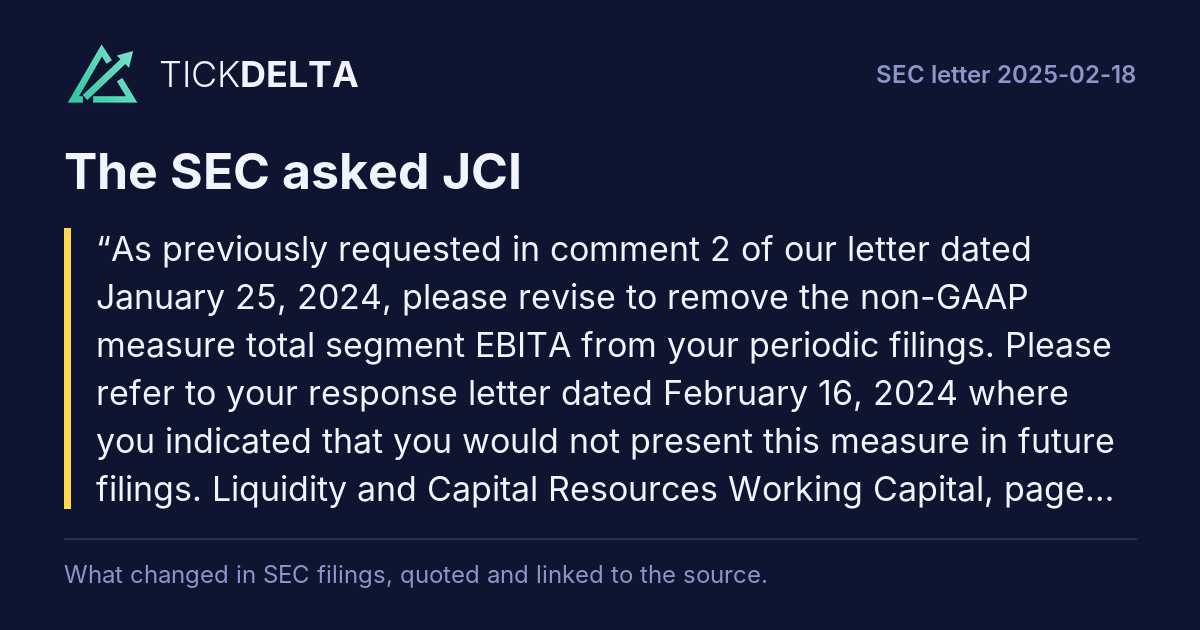
As previously requested in comment 2 of our letter dated January 25, 2024, please revise to remove the non-GAAP measure total segment EBITA from your periodic filings. Please refer to your response letter dated February 16, 2024 where you indicated that you would not present this measure in future filings.
Rest of the question

Liquidity and Capital Resources Working Capital, page 40 In your response letter dated February 16, 2024, you stated you would revise future filings to only include a calculation of working capital as defined in the FASB Codification Master Glossary, however, we note your disclosure of working capital is not consistent with the cited definition and is therefore a non-GAAP measure. Please 2. tell us how your presentation complies with Item 10(e)(1)(ii)(A) of Regulation S-K which prohibits excluding charges or liabilities that required or will require cash settlement from non-GAAP liquidity measures or revise your disclose accordingly. Cash Flow, Free Cash Flow and Free Cash Flow Conversion, page 17 3. You present the measures free cash flow and adjusted free cash flow conversion without presenting the most directly comparable GAAP measure of operating cash flow conversion with equal or greater prominence. Please revise. Refer to Item 10(e)(1)(i)(A) of Regulation S-K and Question 102.10 of the Non-GAAP C&DIs. Statements of Income , page 23 4. We note your presentation of Combined results here and on page 24 which combine the results of continuing and discontinued operations. We also note your references to revenue throughout the filing, including the tables on page 14 and 15 are that of combined revenue and not of GAAP revenue. As the R&LC HVAC business is classified as a discontinued operation and therefore the historical financial results are reflected as a discontinued operation in all periods presented, the combined results presented in your Form 8-K have the effect of changing the principles required to be applied in accordance with GAAP and would be considered individually tailored. Please revise in future filings to remove these presentations. Refer to Question 100.04 of the Non-GAAP C&DIs.

JCI answered

No reply letter found.

In its next report

First report after the SEC's letter of 2025-02-18: 10-Q filed 2025-05-07 ↗, against the 10-Q filed 2025-02-05 ↗.

Tickdelta does not hold the text of both reports, so they are not compared here.

Also in this review: closing letter, 2025-02-27

Form 10-K for the Fiscal Year Ended September 30, 2023

2024-01-25 to 2025-02-26 · 8 questions · 1 letter from the SEC, 2 from the company
Review closed 2024-02-22
Non-GAAP measuresSegmentsLiquidity and cashRevenueResults discussion (MD&A)Debt
Item 7. Management's Discussion and Analysis of Financial Condition and Results of Operations · Fiscal Year 2023 Compared to Fiscal Year 2022, page 32
SEC asked (1)
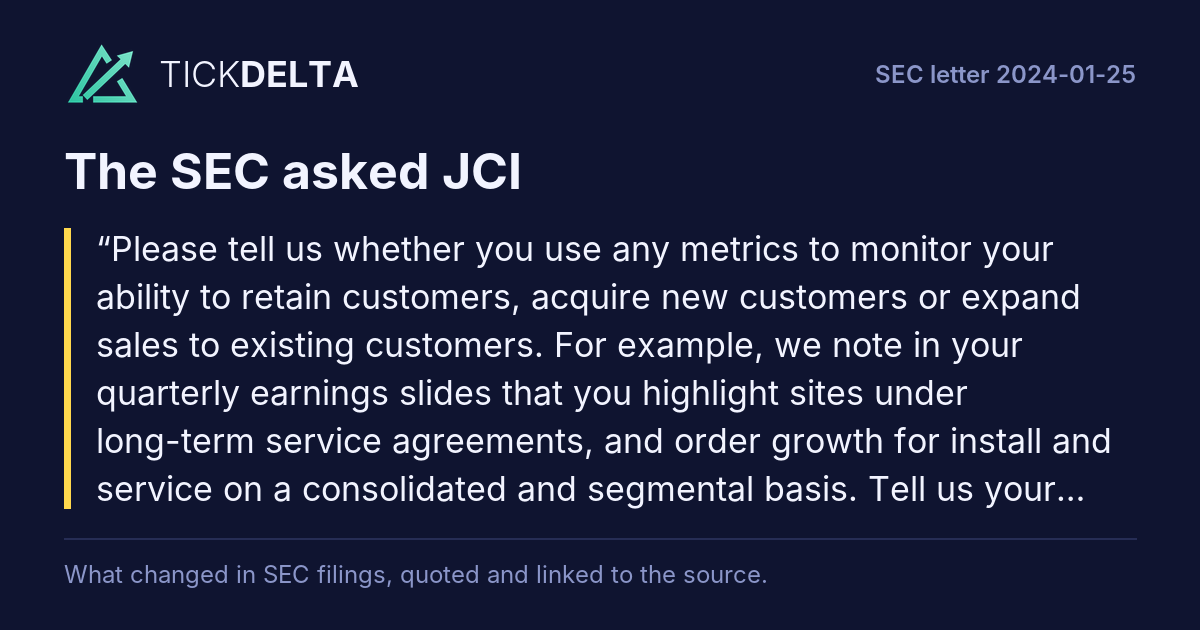
Please tell us whether you use any metrics to monitor your ability to retain customers, acquire new customers or expand sales to existing customers. For example, we note in your quarterly earnings slides that you highlight sites under long-term service agreements, and order growth for install and service on a consolidated and segmental basis.
Rest of the question

Tell us your consideration of disclosing these or other metrics for each period presented and any related trends that affect your revenues or results of operations. We refer you to Item 303(a) of Regulation S-K and SEC Release No. 33-10751.

JCI answered
The Company acknowledges the Staff’s comment and had revised its filings to remove total segment EBITA from its previously filed Quarterly Reports on Form 10-Q for all quarterly periods during fiscal year 2024 and for the most recent quarter ended December 31, 2024. The revisions were inadvertently omitted from the Company’s Annual Report on Form 10-K for the fiscal year ended September 30, 2024. The Company will not present the non-GAAP measure total segment EBITA in future periodic filings. Read in the reply ↗
In its next report

First report after the company's reply of 2025-02-26: 10-Q filed 2025-05-07 ↗, against the 10-Q filed 2023-08-02 ↗.

Tickdelta does not hold the text of both reports, so they are not compared here.

Segment Analysis, page 35
SEC asked (2)
We note that you present total segment EBITA, which is a non-GAAP measure and should be reconciled to the most directly comparable GAAP measure. However, once reconciled it would appear that such measure may include adjustments that are inconsistent with the applicable non-GAAP guidance.
Rest of the question

In this regard, adjusting for “Corporate” expenses" appears to present a non-GAAP measure that excludes normal, recurring, cash operating expenses. Therefore, please revise to remove this measure from your periodic filings, Form 8-K earnings releases, and earnings presentations. Refer to Item 10(e)(1)(i)(B) of Regulation S-K and Questions 100.01 and 104.04 of the non-GAAP C&DIs.

JCI answered
The Company acknowledges the Staff’s comment and had revised its disclosures to only present a calculation of working capital as defined in the FASB Codification Master Glossary in its previously filed Quarterly Reports on Form 10-Q for all quarterly periods during fiscal year 2024 and for the most recent quarter ended December 31, 2024. The revisions were inadvertently omitted from the Company’s Annual Report on Form 10-K for the fiscal year ended September 30, 2024.
Rest of the answer

The Company will only include a calculation of working capital as defined in the FASB Codification Master Glossary in its future periodic filings.

Read in the reply ↗
In its next report

First report after the company's reply of 2025-02-26: 10-Q filed 2025-05-07 ↗, against the 10-Q filed 2023-08-02 ↗.

Tickdelta does not hold the text of both reports, so they are not compared here.

Liquidity and Capital Resources · Working Capital, page 36
SEC asked (3)
We note your disclosure of working capital is not consistent with the definition of working capital in the FASB Codification Master Glossary and is therefore a non- GAAP measure. Please tell us how your presentation complies with Item 10(e)(1)(ii)(A) of Regulation S-K which prohibits excluding charges or liabilities that required or will require cash settlement from non-GAAP liquidity measures.
JCI answered
The Company acknowledges the Staff’s comment and will include a presentation of operating cash flow conversion with equal or greater prominence when also presenting free cash flow and adjusted free cash flow conversion in its future earnings releases furnished on Form 8-K. Read in the reply ↗
In its next report

First report after the company's reply of 2025-02-26: 10-Q filed 2025-05-07 ↗, against the 10-Q filed 2023-08-02 ↗.

Tickdelta does not hold the text of both reports, so they are not compared here.

Capitalization, page 37
SEC asked (4)
We note you present the non-GAAP ratio, net debt as a % of total capitalization without presenting the ratio calculated using the most directly comparable GAAP measure(s) with equal or greater prominence. Please revise future filings accordingly. Refer to Question 102.10(a) of the Non-GAAP C&DIs.
JCI answered
The Company acknowledges the Staff’s comment and will not include presentations of combined continuing and discontinued operations results in future filings.

We acknowledge that the Company is responsible for the accuracy of its disclosures, that the Commission is not foreclosed from taking action with respect to its filing and that the Company may not use the staff comments as a defense in any proceeding. Read in the reply ↗
Form 8-K furnished on December 12, 2023 · Exhibit 99.1, page 1
SEC asked (5)
We note that you discuss the percentage changes in non-GAAP EPS, adjusted net income, EBIT and EBIT margin on page 1 without providing a similar discussion of the percentage changes in the most directly comparable GAAP measure. Also, you disclose EBIT and adjusted EBIT margins without disclosing the comparable GAAP margin.
Rest of the question

Please revise to present and discuss the most directly comparable GAAP measure with equal or greater prominence as required by Item 10(e)(1)(i)(A) of Regulation S-K and Question 102.10(a) of the non-GAAP C&DIs.

JCI answered

No numbered answer found in the reply. Read the reply ↗

In its next report

First report after the company's reply of 2025-02-26: 10-Q filed 2025-05-07 ↗, against the 10-Q filed 2023-08-02 ↗.

Tickdelta does not hold the text of both reports, so they are not compared here.

Form 8-K furnished on December 12, 2023 · Exhibit 99.1, page 1
SEC asked (6)
Please revise to remove the “GAAP” header in the table on page 2 as total segment EBITA and EBIT are non-GAAP measures.
JCI answered

No numbered answer found in the reply. Read the reply ↗

In its next report

First report after the company's reply of 2025-02-26: 10-Q filed 2025-05-07 ↗, against the 10-Q filed 2023-08-02 ↗.

Tickdelta does not hold the text of both reports, so they are not compared here.

Form 8-K furnished on December 12, 2023 · Exhibit 99.1, page 1
SEC asked (7)
Please revise the reconciliations on page 15 to begin with the most directly comparable GAAP measure and reconcile to the non-GAAP. For example, your reconciliation should start with net income and reconcile down to EBIT and Adjusted EBIT. Refer to Question 102.10(b) of the Non-GAAP C&DIs.
JCI answered

No numbered answer found in the reply. Read the reply ↗

In its next report

First report after the company's reply of 2025-02-26: 10-Q filed 2025-05-07 ↗, against the 10-Q filed 2023-08-02 ↗.

Tickdelta does not hold the text of both reports, so they are not compared here.

Form 8-K furnished on December 12, 2023 · Exhibit 99.1, page 1
SEC asked (8)
Please revise the title of your free cash flow measure to adjusted free cash flow or a similar description as your calculation differs from the typical calculation of cash flows from operating activities less capital expenditures. Refer to Question 102.07 of the Non- GAAP C&DIs.
JCI answered

No numbered answer found in the reply. Read the reply ↗

In its next report

First report after the company's reply of 2025-02-26: 10-Q filed 2025-05-07 ↗, against the 10-Q filed 2023-08-02 ↗.

Tickdelta does not hold the text of both reports, so they are not compared here.

Also in this review: request for more time, 2024-01-30, company letter, 2024-02-16, closing letter, 2024-02-22

Other letters

Letters without questions

UPLOAD and CORRESP
2 other letters: notices that a filing will not be reviewed, requests to declare a registration effective, and the like
  • 2018-04-03 · SEC: review completed · Johnson Controls International plc · Form 10-K for the Fiscal Year Ended September 30,...
  • 2018-03-19 · JCI: letter to the SEC · Commission letter dated February 23, 2018 · Commission File No. 001-13836 · Response...

From the SEC's correspondence on EDGAR: staff letters (form UPLOAD) and company letters (form CORRESP), 15 letters filed since 2018-03-19. Questions and answers are matched by their numbers; topics come from words in each question. The reports are compared word for word (same form, before the first SEC letter against the first report after the company's reply). No AI.

Next in Owners and insiders Insider trades →