Form 10-K for the fiscal year ended June 30, 2011
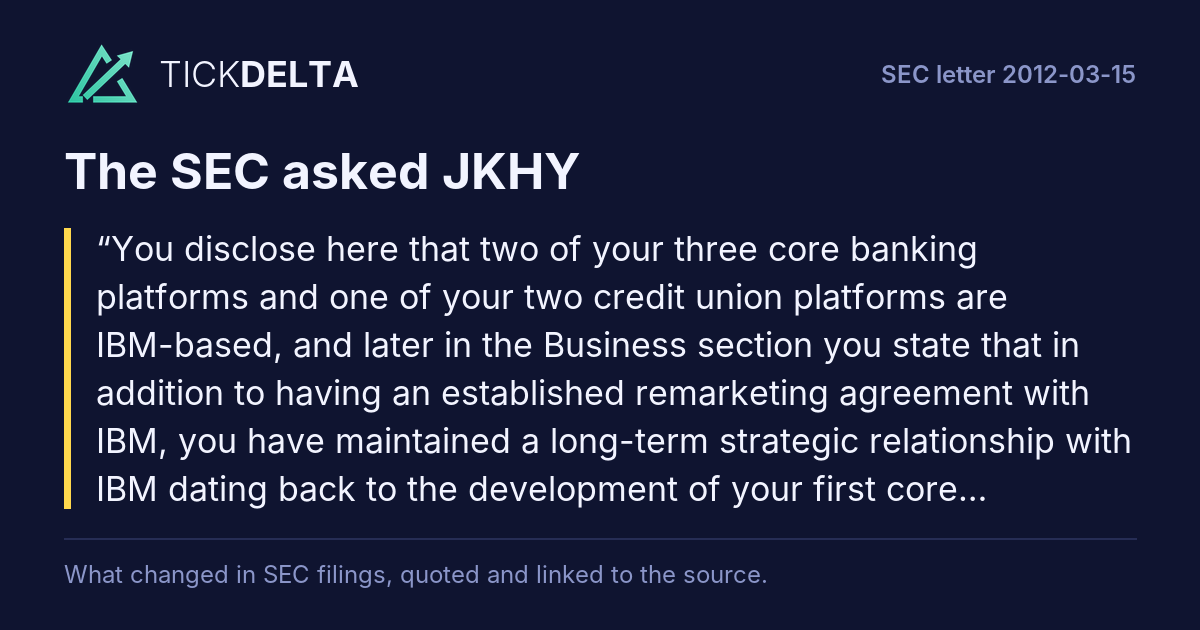
You disclose here that two of your three core banking platforms and one of your two credit union platforms are IBM-based, and later in the Business section you state that in addition to having an established remarketing agreement with IBM, you have maintained a long-term strategic relationship with IBM dating back to the development of your first core software applications over 30 years ago.Rest of the question
We note further your risk factor disclosure stating that if your strategic relationship with IBM were terminated, it could have a negative impact on the continuing success of your business. Given such disclosures, please describe in your response letter your agreements with IBM and the extent of your dependence on them, in quantified terms to the extent possible, and tell us how you determined that they are not required to be filed as exhibits to your Form 10-K pursuant to Item 601(b)(10)(ii)(B) of Regulation S-K.
Item 601(b)(10)(i) of Regulation S-K requires the filing as an exhibit of any material contract “not made in the ordinary course of business which is material to the registrant and is to be performed in whole or in part at or after the filing of the registration statement or report or was entered into not more than two years before such filing.” Item 601(b)(10(ii) provides that "[i]f the contract is such as ordinarily accompanies the kind of business conducted by the registrant and its subsidiaries, it will be deemed to have been made in the ordinary course of business and need not be filedRead in the reply ↗Rest of the answer
unless it falls within one or more of the following categories, in which case it shall be filed except where immaterial in amount or significance." The categories following include the category noted in the Staff's comment, in Item 601(b)(10)(ii)(B): "Any contract upon which the registrant's business is substantially dependent, as in the case of continuing contracts to sell the major part of the registrant's products or services or to purchase the major part of registrant's requirements of goods, services or raw materials or any franchise or license or other agreement to use a patent, formula, trade secret, process or trade name upon which the registrant's business depends to a material extent."
The Company enjoys a long-standing business and strategic relationship with IBM, which as Staff has noted extends back to the development of our initial core systems over 30 years ago. This relationship of cooperation and mutual interest is not embodied in any specific contract, however the Company is a party to a Business Partner Agreement with IBM, which is the remarketing agreement we referred to in our Form 10-K, pursuant to which the Company sells IBM hardware and hardware maintenance services (the "IBM Contract"). While the overall relationship between the Company and IBM remains important to the Company and sales of IBM products and services historically accounted for material portions of the Company's revenue, the Company's business is now not "substantially dependent" on the IBM Contract. In determining that the Company's business is not "substantially dependent" on the IBM Contract, the Company's management considered, among other things, the fact that the Company's revenues resulting directly from the IBM Contract constituted less than 3% of the Company's total revenues in fiscal year 2011 and less than 4% of the Company's total revenues in the preceding two fiscal years.
Item 5. Market for Registrant's Common Equity, Related Stockholder Matters and Issuer Purchases for Equity Securities
First report after the company's reply of 2012-03-29: 10-Q filed 2012-05-04 ↗, against the 10-Q filed 2012-02-06 ↗.
Tickdelta does not hold the text of both reports, so they are not compared here.
Your performance graph disclosure should present dollar amounts for the plot points provided for each of the three graphs reflecting cumulative total return. See Instruction 2.b of the Instructions to Item 201(e) of Regulation S-K. Without the presentation of the dollar amounts for each plot point it is difficult to obtain a meaningful understanding of how your stock price performed against the comparison indices.Rest of the question
You may wish to present the dollar amounts in a table or in another easily accessible manner.
The Company acknowledges the Staff's comment. The Company intends to include a table including the dollar amount information in our future performance graph disclosures. Read in the reply ↗
First report after the company's reply of 2012-03-29: 10-Q filed 2012-05-04 ↗, against the 10-Q filed 2012-02-06 ↗.
Tickdelta does not hold the text of both reports, so they are not compared here.
We note your statement that ASU No. 2009-13 did not have a material impact on your revenue recognition because nearly all of the Company’s revenue arrangements are subject to ASC 985. Clarify your statement that nearly all of your arrangements are within scope of ASC 985 when you sell hardware and related services. Indicate why such deliverables would be subject to the new statement.Rest of the question
Further, we also note that the majority of the Company’s software arrangements are not tangible products with software components. Clarify whether the arrangements that are not in the majority have tangible products with software components and, as such, are not within the scope of ASC 985. Please provide an analysis of the impact of these new standards on your revenue arrangements.
We acknowledge that the hardware components we resell, whether or not those sales can be considered part of a software arrangement, were scoped out of Topic 985 by ASU No. 2009-14. Where our hardware sales are related to a software arrangement, the hardware components simply provide a mechanism to deliver our software to our customer, so we have concluded that our software is not essential to the functionality of the hardware components.Read in the reply ↗Rest of the answer
All non-hardware elements within our software arrangements, including all service elements, relate to the delivery, implementation and maintenance of our software and remain within the scope of Topic 985. As a result, hardware is the only element of these arrangements that does not fall within the scope of Topic 985. Despite this, as a single element, the hardware's revenue recognition would not be impacted by the issuance of ASU No. 2009-13. Both under the current and prior guidance, our hardware revenues are recognized upon delivery. Further, as a reseller of hardware components, the amount of revenue allocated to these components has always been consistent with fair value either specifically, based upon pricing in our reseller agreements, or based on reference to the marketplace as those components are sold by other entities.
While ASU No. 2009-14, did effectively remove all of our hardware revenue from the scope of Topic 985, thus making them subject to other areas of generally accepted accounting principles, this change did not require a change in the timing or extent of our revenue recognition for such hardware components.
First report after the company's reply of 2012-03-29: 10-Q filed 2012-05-04 ↗, against the 10-Q filed 2012-02-06 ↗.
Tickdelta does not hold the text of both reports, so they are not compared here.
You state here that there has been “no change in internal control over financial reporting that has materially affected, or is reasonably likely to affect, the Company’s internal control over financial reporting, except for the integration of iPay which was completed during the fourth quarter of the year ended June 30, 2011….” In your Management’s Annual Report on Internal Control Over Financial Reporting, however,Rest of the question
you state that the integration of iPay completed in the fourth quarter “is not considered to have materially affected, or is reasonably likely to materially affect, the internal control over financial reporting.” It is unclear from these disclosures whether the completion of the iPay integration during your fourth quarter of 2011 constituted a change in your internal control over financial reporting that has materially affected, or is reasonably likely to materially affect, your internal control over financial reporting. Refer to Item 308(c) of Regulation S-K and advise.
The Company acknowledges the Staff's comment. The Company's characterization of the impacts of the iPay integration on its internal controls over financial reporting was unintentionally inconsistent between Management's Annual Report on Internal Control over Financial Reporting and Item 9A. As was disclosed in Management's Annual Report, the Company determined the integration of this material business combination did not represent a material change in our internal controls over financial reporting.Read in the reply ↗Rest of the answer
The disclosure made in Item 9A represented an attempt to inform the readers of the completion of the integration of iPay, even though that integration was not considered to have materially affected the internal controls over financial reporting. Because this integration was completed during the fourth quarter of fiscal 2011, we do not expect to discuss this integration or its impacts to our internal controls over financial reporting in future filings. However, if future material business combinations result in integrations that have the potential to materially impact our internal control over financial reporting, we will present this consistently within future filings.
First report after the company's reply of 2012-03-29: 10-Q filed 2012-05-04 ↗, against the 10-Q filed 2012-02-06 ↗.
Tickdelta does not hold the text of both reports, so they are not compared here.
We note that the proxy card describes the advisory vote to approve executive compensation as follows: “To approve a non-binding advisory vote on the compensation of our named executive officers.” This language appears inconsistent with the applicable requirement set forth in Rule 14a-21 under the Exchange Act.Rest of the question
For guidance, please refer to Question 169.07 of our Exchange Act Rules Compliance and Disclosure Interpretations, and confirm supplementally that in the future your descriptions of the advisory vote will comport with the referenced Rule.
The Company acknowledges the Staff's comment, confirms that it is now aware of the Staff's guidance provided in Question 169.07 of the Exchange Act Rules Compliance and Disclosure Interpretations, and confirms that future proxy card descriptions of the advisory vote to approve executive compensation will comport with Rule 14a-21 under the Exchange Act.
We acknowledge that:
• the company is responsible for the adequacy and accuracy of the disclosure in the filing;
staff comments or changes to disclosure in response to staff comments do not foreclose the Commission from taking any actionRead in the reply ↗Rest of the answer
with respect to the filing; and the company may not assert staff comments as a defense in any proceeding initiated by the Commission or any person under the federal securities laws of the United States.
First report after the company's reply of 2012-03-29: 10-Q filed 2012-05-04 ↗, against the 10-Q filed 2012-02-06 ↗.
Tickdelta does not hold the text of both reports, so they are not compared here.
Also in this review: closing letter, 2012-04-27