Screener / SEC EDGAR /CIK 0001819848 /10-K filed Feb 27, 2026, compared with Feb 27, 2025 /Numbers from the XBRL of the 10-Ks
NYSE Industrials · Aerospace

Joby Aviation, Inc. JOBY

Compare with peers Embed
New in the 10-K 24 paragraphs with nothing like them in the 10-K filed Feb 27, 2025 New in the 10-Q 28 paragraphs not in the 10-Q filed Aug 6, 2026 10-Q against the 10-K 9 risk factor paragraphs and sentences added or reworded

New risk paragraphs, branching off last year

Each branch is a paragraph in Risk Factors with nothing like it in the 10-K filed Feb 27, 2025. A box jumps to the paragraph as filed, below.

24 new

Paragraphs with nothing like them in last year's 10-K

Quoted exactly

24 paragraphs in Risk Factors of the 10-K filed Feb 27, 2026 with nothing like them in the 10-K filed Feb 27, 2025. Quoted exactly. Paragraphs that were only edited are under 10-K change.

Global trade policies, including tariffs, could adversely affect our operations.

The global economy has recently seen a rise in tariffs and other protective trade measures. In 2025, significant new and expanded tariffs were imposed by the United States, and reciprocal tariffs were imposed by other countries. These tariffs

have applied to a wide range of finished goods and raw materials. In some cases, these tariffs were later paused, modified or suspended, making it difficult to plan for or predict the ultimate impact of these tariffs. In response to the U.S. imposed tariffs and other geopolitical events, some countries have imposed or threatened to impose reciprocal tariffs, export restrictions and other protective trade measures. While we manufacture many of the components for our aircraft in the United States, our supply chain depends, in part, on components and raw materials acquired from third-party suppliers across the globe, particularly with respect to batteries and related materials. While tariffs have not had a material impact on our business, financial condition or results of operations to date due to the limited scale of our prototype manufacturing and focus on certification efforts, over time, new tariffs or other restrictions imposed in connection with trade wars or political instability could increase the costs of raw materials and other goods, both for us and our suppliers, and could make it difficult to source certain materials or components on which we rely for our production and certification efforts. This could impact our business, financial condition and prospects, particularly as we begin to scale our manufacturing operations and produce aircraft for commercial use. In addition, the imposition of tariffs and threats of tariffs has contributed to volatility in global equity markets which, we believe, has also impacted and may continue to impact the price of our common stock.

Read in the 10-K

We may not realize the anticipated benefits of our acquisition of Blade, and the acquisition may expose us to integration challenges, additional liabilities and costs, and potential dilution.

Successfully integrating Blade’s business and operations, retaining key personnel, and realizing anticipated benefits will require significant management attention and could divert resources from our core aircraft development, certification and manufacturing efforts. In addition, our acquisition agreement provides for additional payments of up to $45 million that may become payable in the future. We may elect to satisfy all or a portion of these payments in shares of our common stock. Any issuance of shares could be dilutive to our stockholders and could depress our stock price, and any failure to achieve expected benefits from the acquisition could adversely affect our business, financial condition and results of operations.

We may not recognize the expected benefits of our acquisition of the Blade business, including market access, an established customer base, operational expertise, airport relationships and infrastructure across key markets. Following certification of our eVTOL aircraft, we intend to begin integrating that aircraft into our Blade operations over time. If we are unable to integrate and operate the Blade business, this could harm our broader eVTOL commercialization strategy and ultimately impact our business, financial condition and operating results.

We could suffer losses and adverse publicity stemming from accidents involving small aircraft, helicopters, or charter flights generally and, in particular, from any accident or incident involving Blade charter flights.

Aircraft operations are subject to various risks, and demand for air transportation has been and may in the future be impacted by accidents or other safety issues regardless of whether such accidents or issues involve Blade charter flights. Hazards, such as adverse weather conditions, fire or mechanical failures, could result in death or injury to personnel and passengers which could impact passenger confidence and could lead to a reduction in volume, particularly if such accidents were due to a safety issue.

We believe that safety and reliability are two of the primary attributes passengers consider when selecting air transportation services. Our failure, or that of our third-party operators, to maintain standards of safety and reliability that are satisfactory to our customers may adversely impact our ability to retain current customers and attract new customers. We are at risk of adverse publicity stemming from any public incident involving our company, our people, or our brand. Such an incident could involve the actual or alleged behavior of any of our employees or third-party aircraft operators. Further, if our personnel, one of our third-party operators’ aircraft, or one of our third-party operators’ Blade-branded aircraft, is involved in an incident, accident, or regulatory enforcement action, which could be attributed, in part, to a lack of sufficient safety auditing, we could be exposed to significant reputational harm and potential legal liability. Blade-branded aircraft have in the past been involved in accidents and despite our best efforts, there can be no guarantee that such events will not occur in the future. The insurance we carry may be inapplicable or inadequate to cover any such incident or accident, or regulatory action. In the event that our insurance is inapplicable or inadequate, we may be forced to bear substantial losses from an incident or accident. In addition, any such incident, accident, or action involving our employees, one of the Blade-branded aircraft used by us belonging to our third-party operators’ fleet (or personnel and aircraft of our third-party operators), or the same type of aircraft as used by our third-party operators could create an adverse public perception, which could harm our reputation, resulting in current or prospective customers being reluctant to use our services and adversely impacting our business, results of operations, and financial condition. If one or more of our third-party aircraft operators were to suffer an accident or lose the ability to fly certain aircraft due to safety concerns or investigations, we may be required to cancel or delay certain flights until replacement aircraft and personnel are obtained.

The markets for our Blade offerings are still in relatively early stages of growth, and such markets may not continue to grow, or may grow more slowly than we expect.

Blade’s urban air mobility services have grown rapidly, however, our service offerings are still relatively new, and it is uncertain to what extent market acceptance will continue to grow, if at all. We currently operate our Blade offering in a limited number of metropolitan areas. The success of these markets to date and the opportunity for future growth in these markets may not be representative of the potential market for urban air mobility in other metropolitan areas. In new markets, the lack of brand recognition may result in difficulties gaining and retaining customers and building partnerships with local entities. In addition, competition in new markets may be strong, with established companies and new entrants

offering similar services. The potential intense competition and limited brand recognition could make it difficult for us to establish a strong market position and generate profitable returns.

Growth of our Blade offering will require significant investments in our infrastructure, technology, and marketing and sales efforts. Historically, cash flow from Blade operations has not been sufficient to support these needs and additional cash flow required to support the Blade offering could negatively impact our core eVTOL operations. Further, our ability to effectively manage growth and expansion of Blade operations may require us to enhance operational systems, internal controls and infrastructure, human resources policies, and reporting systems, which could require significant capital expenditures and allocation of valuable resources.

Read in the 10-K

To operate our existing and proposed schedule and, where desirable, add service along new or existing routes, we must be able to maintain or obtain space for passenger terminals. As airports and heliports around the world become more congested, it may not be possible for us to ensure that our plans for new service can be implemented in a commercially viable manner, given operating constraints at airports and heliports throughout our network, including those imposed by inadequate facilities at desirable locations. Any limitation on our ability to acquire or maintain space for passenger terminal operations could have a material adverse effect on our business, results of operations, and financial condition.

Blade leases and licenses exclusive passenger terminal infrastructure from airport and heliport operators in key markets. These leases, licenses, and permits vary in term, ranging from month-to-month permits to multi-year use and occupancy agreements that are coterminous with the airport or heliport operator’s underlying lease with the municipality that owns the premises. While our experience with these multi-year use and occupancy agreements have led to long-term uninterrupted usage thus far, certain municipalities, including New York, retain the authority to terminate a heliport operator’s lease upon as short as 30 days’ notice. If a municipality exercised its termination rights, under certain conditions, our agreements with the airport or heliport operator would concurrently terminate. Termination of one or more of our leases could negatively impact our ability to provide services in our existing markets and have a material adverse effect on our business, results of operations, and financial condition.

We rely on our third-party operators to provide and operate aircraft. If such third-party operators do not perform adequately or terminate their relationships with us, our costs may increase.

We rely on third-party contractors to own and operate aircraft. Should we experience complications with any of these third-party contractors or their aircraft, we may need to delay or cancel flights. We have experienced, and may in the future experience, operational complications with our contractors. The ability of our contractors to effectively satisfy our requirements could also be impacted by any such contractor’s financial difficulty or damage to their operations caused by fire, terrorist attack, natural disaster and public health threats. The failure of any contractors to perform to our expectations could result in delayed or canceled flights and harm our business. Our reliance on contractors and our inability to fully control any operational difficulties with our third-party contractors could have a material adverse effect on our business, financial condition, and results of operations.

Illegal, improper, or otherwise inappropriate operation of branded aircraft by our third-party aircraft operators, regardless of whether they are operating aircraft on our behalf, could harm our reputation, business, brand, financial condition, and results of operations.

Some of our third-party aircraft operators operate Blade-branded aircraft on a non-exclusive basis, enabling them to utilize Blade-branded aircraft for flight operations unrelated to Blade. If our third-party aircraft operators were to operate Blade-branded aircraft, regardless of whether such aircraft is flying on our behalf, in an illegal, improper, or otherwise inappropriate manner, such as violating local noise-abatement regulations or ignoring suggested noise-abatement flight paths and procedures, we could be exposed to significant reputational harm. While we have implemented various measures intended to anticipate, identify, and address the risk of these types of activities, these measures may not adequately address or prevent all illegal, improper, or otherwise inappropriate activity by our third-party aircraft operators. Negative publicity related to the foregoing, whether or not such incident occurred while flying on our behalf, could adversely affect our reputation and brand or public perception of the urban air mobility industry as a whole, which could negatively affect demand for platforms like ours and potentially lead to increased regulatory or litigation exposure. Any of the foregoing risks could harm our business, financial condition, and results of operations.

Read in the 10-K

operations for some length of time; and materially adversely affect our business, results of operations, and financial condition.

Read in the 10-K

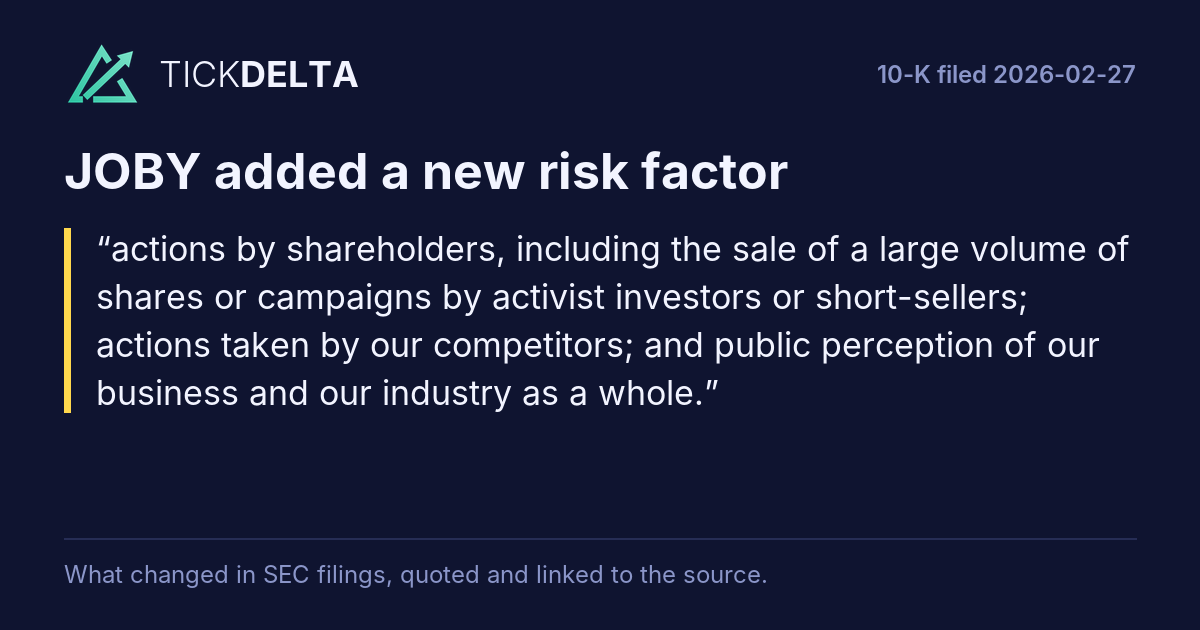
actions by shareholders, including the sale of a large volume of shares or campaigns by activist investors or short-sellers; actions taken by our competitors; and public perception of our business and our industry as a whole.

Read in the 10-K
Show the other 1

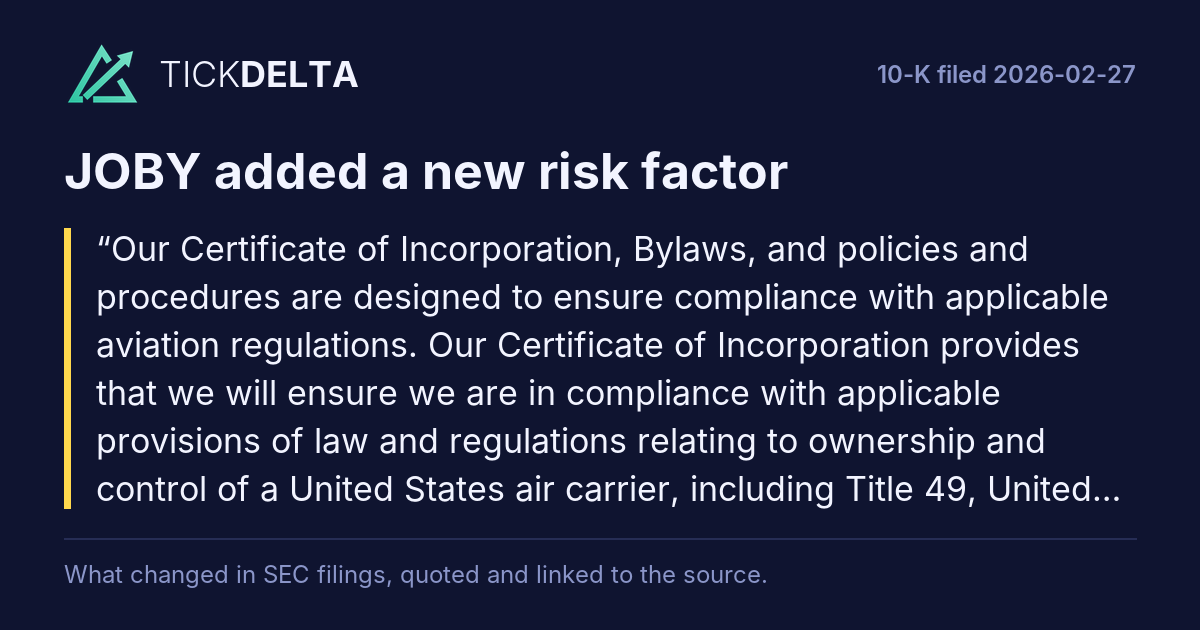
Our Certificate of Incorporation, Bylaws, and policies and procedures are designed to ensure compliance with applicable aviation regulations.

Our Certificate of Incorporation provides that we will ensure we are in compliance with applicable provisions of law and regulations relating to ownership and control of a United States air carrier, including Title 49, United States Code, Section 40102 and interpretations and guidance thereof issued by the United States Department of Transportation or its successor, or as the same may be from time to time amended. Current restrictions imposed by federal law on foreign ownership of United States air transportation operations require that no more than 25% of an air carrier's voting stock be voted, directly or indirectly, by persons who are not U.S. citizens. Our Bylaws contain provisions to ensure United States ownership interest in, and actual control of, the air carrier, free from non-citizen ownership, control, and influence. Pursuant to such provisions, we or a designated transfer agent shall maintain a Foreign Stock Record for registered common stock known to us to be owned and/or controlled by non-U.S. citizens, we will not operate under a Federal Aviation Administration Part 135 air carrier or operating certificate unless in compliance with applicable requirements for such certificate and we will

implement policies and procedures to ensure compliance with these requirements. If we fail to ensure such compliance or do not implement adequate policies and procedures related to voting rights of persons who are not U.S. citizens, we will be unable to operate in the United States as a United States air carrier. Once our aircraft is certified, the inability to operate as a United States air carrier could have a material adverse effect on our business, prospects, financial condition and results of operations.

Read in the 10-K

Paragraphs in the 10-Q filed Nov 5, 2026 that were not in the one before

New in the latest 10-Q

28 paragraphs in the 10-Q filed Nov 5, 2026 with nothing like them in the 10-Q filed Aug 6, 2026 (at least half the words must differ; new numbers alone do not count). Quoted exactly, grouped by the item heading above them. This is text that changed, not a judgement of how serious it is.

Financial statements and notes

Joby Aviation, Inc. (“Joby” or “the Company”) is a next-generation aviation company. Its aircraft, propulsion and autonomy technologies span both commercial aviation and defense applications. Joby also operates Blade, a leading urban air mobility business providing air charter broker and other passenger transportation services in the United States and Europe. Joby intends to operate its fast, quiet and convenient, fully-electric vertical takeoff and landing (“eVTOL”) air taxi service in cities around the world and sell its aircraft to other operators and partners. The Company is headquartered in Santa Cruz, California.

Read in the 10-Q

The measurement period for the Blade acquisition ended on August 29, 2026, and the purchase price allocation is final. The following table summarizes the Company’s final allocation of the purchase consideration, as adjusted for measurement-

Read in the 10-Q

Transfer & Trust Company (“Warrant Agreement”) and the Sponsor Agreement by and among the Company, Sponsor and RTP (“Sponsor Agreement”).

Read in the 10-Q

The significant unobservable inputs used in the fair value measurement of the Earnout Shares Liability are expected volatility and the probability of a change of control, upon which all unvested Earnout Shares would vest. Holding other inputs constant, an increase in expected volatility would result in a higher fair value, and a decrease would result in a lower fair value, because higher volatility increases the likelihood that the stock price thresholds will be achieved. An increase in

Read in the 10-Q

the probability of a change of control would result in a higher fair value. Because the value of the Earnout Shares in a change-of-control scenario is largely insensitive to volatility, a higher probability of a change of control would reduce the effect of changes in expected volatility on fair value. The fair value is also significantly affected by the market price of the Company’s common stock, an observable input; an increase in the stock price would result in a higher fair value.

Read in the 10-Q
Show the other 23

The significant unobservable inputs used in the fair value measurement of the Delta Warrant are expected volatility, the probability and timing of achieving the second-tranche milestone, and the probability of a change of control, upon which a portion of the unvested warrants would vest. Holding other inputs constant, a higher probability of achieving the milestone or an earlier expected achievement date would result in a higher fair value. Because a delay in the expected achievement date would generally coincide with a lower probability of achievement, changes in these inputs would tend to compound, while the change-of-control provision would partially offset the effect of a lower probability of achievement. An increase in expected volatility would generally result in a higher fair value; however, because the value cap limits Delta’s economic gain, the fair value is relatively insensitive to changes in expected volatility within a reasonable range. The fair value is also significantly affected by the market price of the Company’s common stock, an observable input; an increase in the stock price would result in a higher fair value, although the value cap limits the extent of the increase.

Read in the 10-Q

On August 8, 2026, the Company entered into an agreement to acquire Strix Holdings, Inc., which, through its subsidiaries, owns Resonant Sciences, LLC, for a base purchase price of $ 500.0 million, subject to customary adjustments, payable primarily in cash, with approximately $ 50.0 million expected to be payable in shares of the Company's common stock. The closing is subject to customary conditions, including the receipt of specified regulatory and national security approvals. As of September 30, 2026, the acquisition had not closed.

Read in the 10-Q

In July 2026, a wholly-owned subsidiary of the Company entered into an agreement with Integrated Solutions Holdings, LLC, an affiliate of Atoms, to jointly acquire, develop, own and operate vertiport infrastructure in the United States. Under the agreement, the Company has committed to contribute up to $ 50.0 million. Additional contributions are required only to fund investments jointly approved by the parties. As of September 30, 2026, the Company had contributed $ 1.0 million and its remaining unfunded commitment was $ 49.0 million. The timing and amount of any future contributions will depend on the investments approved.

Read in the 10-Q

On September 29, 2026, the court granted the Company’s motion to dismiss Archer’s counterclaims with prejudice. The court also granted in part, with leave to amend, and denied in part, Archer’s motion to dismiss. The Company filed a second amended complaint on October 6, 2026, and on October 20, 2026, Archer and Mr. Kivork filed answers. The Company intends to aggressively pursue its claims against Archer and Mr. Kivork.

Read in the 10-Q

On March 7, 2025, Aerosonic LLC filed a complaint against Joby Aero, Inc. in the U.S. District Court for the Middle District of Florida alleging breach of contract and misappropriation of trade secrets relating to air data probes. On October 2, 2026, the jury returned an adverse verdict awarding Aerosonic $ 116.9 million in damages. The Company strongly disagrees with the verdict, believes it is unsupported by the evidence and inconsistent with applicable law, and intends to vigorously pursue available post-trial and appellate remedies, including motions for judgment as a matter of law. On November 2, 2026, Aerosonic filed a motion seeking injunctive relief.

Read in the 10-Q

Based on the facts and circumstances, including the Company's assessment of its post-trial and appellate remedies through which it intends to challenge both the finding of liability and damages, the Company concluded that a loss was not probable as of September 30, 2026 and, accordingly, has not recorded a liability for this matter. The Company believes that a loss is reasonably possible, but, given the uncertainty surrounding post-trial and appellate motions, cannot reasonably estimate the amount of any ultimate loss, including post-judgment interest and any attorneys' fees or other relief that may be awarded.

Read in the 10-Q

As of September 30, 2026 and 2025, respectively, 5,833,333 and 12,833,333 shares of common stock issuable upon exercise of the Delta Warrant were excluded from the computation of diluted net loss per share and the table of antidilutive securities below because the applicable milestones had not been achieved. In addition, the 13,704,000 Earnout Shares, although legally issued and outstanding, were excluded from the computation of basic and diluted net loss per share because they remained contingently returnable pending achievement of the applicable stock price thresholds. See Note 7 for additional information regarding the terms of the Delta Warrant and the Earnout Shares.

Read in the 10-Q

2026 2025 Common stock warrants — 14,367,942 Unvested restricted stock awards 334,803 780,799 Unvested restricted stock units 54,635,770 40,295,737 Options to purchase common stock 4,899,866 6,900,057 Unvested early exercised common stock options 445,552 796,458 If-converted common stock from 2032 Notes (1) 48,634,374 — Total 108,950,365 63,140,993

Read in the 10-Q

On August 8, 2026, we entered into a stock purchase agreement (the “Resonant Purchase Agreement”) with Strix Holdings, Inc., Strix Parent, LLC, and members of RS Seller Holdco, LLC (such members, the “Management Members”), pursuant to which we agreed to acquire Strix Holdings, Inc., which, through its subsidiaries, owns Resonant Sciences, LLC (together with its subsidiaries, “Resonant Sciences”) for approximately $500.0 million, subject to certain adjustments. Such payment will be made in cash, with the exception of stock consideration payable to the Management Members (as defined in the Resonant Purchase Agreement), which shall be equal to 40% of the purchase price payable to the Management Members and is expected to comprise approximately $50.0 million of the total consideration under the Resonant Purchase Agreement. This stock consideration will be at a per share price equal to $7.4752, which represents the average of the daily volume-weighted average sales price per share on the NYSE for the twenty (20) consecutive trading days ending on and including the trading day that was two (2) trading days before the date of the Resonant Purchase Agreement. The closing of the acquisition is subject to the satisfaction or waiver of a number of conditions, including, among others, the completion of a pre-closing restructuring of Resonant Sciences, the receipt of certain required regulatory approvals, and other customary conditions. Upon closing, Resonant Sciences will become our dedicated defense business and continue to operate under the Resonant Sciences name, led by Co-Founder and CEO J. Micah North. Our existing defense initiatives, which are built on more than a decade of work with defense and intelligence customers, are expected to be combined with

Read in the 10-Q

Resonant Sciences. Housing this work within Resonant Sciences will allow our commercial aviation organization to maintain its primary focus on certifying, manufacturing, and commercializing our electric air taxi.

Read in the 10-Q

In September 2026, we commenced flight operations under the U.S. eVTOL Integration Pilot Program (“eIPP”), in partnership with the Texas Department of Transportation and in coordination with the FAA. Our initial operations in the Dallas-Fort Worth region included piloted vertical takeoff and landing flights. These activities represent an important step in our preparations for commercial service, providing opportunities to develop operational procedures, demonstrate aircraft performance in real-world environments, and advance coordination with regulators and local stakeholders. We expect to expand our activities under the eIPP, subject to applicable regulatory approvals and operational requirements, as we continue pursuing FAA type certification.

Read in the 10-Q

Market risk

Our 2032 Notes bear interest at a fixed rate of 0.75% and our Mortgage Loan bears interest at a fixed rate of 6.784%; therefore, changes in market interest rates do not affect our interest expense or cash flows related to these obligations. The fair values of the 2032 Notes and the Mortgage Loan will generally fluctuate with changes in market interest rates, and the fair value of the 2032 Notes will also fluctuate with changes in the market price of our common stock. Because these obligations are carried at amortized cost on our condensed consolidated balance sheets, changes in their fair values do not affect our financial results. See Note 6 for additional information.

Read in the 10-Q

Our reporting currency is the U.S. dollar. Certain of our subsidiaries, primarily our passenger operations in Southern Europe and our operations in Germany, use the Euro as their functional currency. As a result, we are exposed to foreign currency risk from the translation of these subsidiaries’ results of operations and net assets into U.S. dollars, with translation adjustments recorded in accumulated other comprehensive income (loss). Revenue generated in Europe represented approximately 30% of our total revenue for the three and nine months ended September 30, 2026; however, because the costs of these operations, including payments to aircraft operators, are also largely denominated in Euros, changes in exchange rates have a partially offsetting effect on our results of operations. A hypothetical 10% change in the exchange rate between the U.S. dollar and the Euro would not have had a material impact on our condensed consolidated financial statements. We do not currently hedge our foreign currency exposure.

Read in the 10-Q

Legal proceedings

On September 29, 2026, the court granted our motion to dismiss Archer’s counterclaims with prejudice. The court also granted in part, with leave to amend, and denied in part, Archer’s motion to dismiss. We filed an amended complaint on October 6, 2026, and on October 20, 2026, Archer and Mr. Kivork filed answers. We intend to aggressively pursue our claims against Archer and Mr. Kivork.

Read in the 10-Q

On March 7, 2025, Aerosonic LLC filed a complaint against Joby Aero, Inc. in the U.S. District Court for the Middle District of Florida alleging breach of contract and misappropriation of trade secrets relating to air data probes. On October 2, 2026, the jury returned an adverse verdict awarding Aerosonic $116.9 million in damages. We strongly disagree with the verdict, believe it is unsupported by the evidence and inconsistent with applicable law, and intend to vigorously pursue available post-trial and appellate remedies, including motions for judgment as a matter of law. On November 2, 2026, Aerosonic filed a motion seeking injunctive relief.

Read in the 10-Q

Risk Factors

In addition to the other information set forth in this Form 10-Q, including in the Forward-Looking Statements, MD&A, and the Condensed Consolidated Financial Statements and accompanying notes, we have provided additional risk factors below regarding our pending acquisition of Resonant Sciences, our pending litigation, and the impact they could have on our financial results.

Read in the 10-Q

Our acquisition of Resonant Sciences is subject to closing conditions, some of which are beyond our control, and we cannot guarantee that closing will take place on the timeline currently anticipated or at all. Certain payments related to such acquisition will be made in shares of our common stock, which could cause dilution to our stockholders and otherwise depress our stock price.

Read in the 10-Q

On August 8, 2026, we entered into a stock purchase agreement (the “Resonant Purchase Agreement”) with Strix Holdings, Inc., Strix Parent, LLC, and members of RS Seller Holdco, LLC (such members, the “Management Members”), pursuant to which we will acquire Strix Holdings, Inc., which, through its subsidiaries, owns Resonant Sciences, LLC (together with its subsidiaries, “Resonant Sciences”). The Resonant Purchase Agreement provides, among other things, that we will pay $500.0 million as consideration, subject to certain adjustments. Such payment will be made in cash, with the exception of stock consideration payable to the Management Members, which shall be equal to 40.0% of the purchase price payable to the Management Members and is expected to comprise approximately $50.0 million of the total consideration under the Resonant Purchase Agreement. This stock consideration will be at a per share price equal to $7.4752, which represents the average of the daily volume-weighted average sales price per share on the NYSE for the twenty (20) consecutive trading days ending on and including the trading day that was two (2) trading days before the date of the Resonant Purchase Agreement. Because the purchase price payable to the Management Members is subject to certain adjustments, we are currently unable to determine the aggregate number of shares that may be issued pursuant to the Resonant Purchase Agreement; however, any such issuance of shares of our common stock would be subject to applicable rules and regulations, including the limitations set forth in Section 312.03 of the New York Stock Exchange Listed Company Manual.

Read in the 10-Q

The closing of the acquisition is subject to the satisfaction or waiver of a number of conditions, including, among others, the completion of a pre-closing restructuring of Resonant Sciences, the receipt of certain required regulatory approvals, and other customary conditions. We may experience delays and difficulties in satisfying the conditions for closing, and cannot guarantee that closing will take place on the timeline currently anticipated or at all. Some of the conditions to closing, including the required regulatory approvals, are outside of our control and it is possible that not all of the closing conditions to acquisition will be satisfied. Such adverse developments, including any failure to close, could adversely impact our business, financial condition, results of operations and liquidity.

Read in the 10-Q

Legal proceedings, claims and other disputes could adversely affect our business, financial condition or results of operations.

Read in the 10-Q

We are, and may in the future become, involved in legal proceedings or other disputes. Regardless of outcome or merit, legal proceedings can result in significant legal fees and can divert the attention of management and other resources. An unfavorable outcome in such proceedings could result in substantial monetary judgments against us, injunctive relief that could delay or prevent the use of our technology, or cause us to expend additional resources in connection with an appeal. Any of these impacts could adversely affect our business, financial condition or results of operations. For example, in October 2026, a jury returned an adverse verdict awarding Aerosonic $116.9 million in damages in a trade secret dispute and Aerosonic has moved for injunctive relief. We intend to appeal the verdict, which will likely incur significant additional legal expenses and there is no guarantee that we will be successful in overturning or reducing the amount awarded by the jury.

Read in the 10-Q

Although we are unable to precisely estimate the ultimate dollar amount of exposure to loss in connection with litigation matters, we make accruals as warranted. However, the amounts that we accrue could vary significantly from the amounts we actually pay, due to inherent uncertainties of the estimation process and uncertainties involved in litigation generally. For more information on our pending litigation, see Part II, Item 1, Legal Proceedings of this Quarterly Report.

Read in the 10-Q

Item 6

† The schedules to this exhibit have been omitted pursuant to Item 601(a)(5) of Regulation S-K. The registrant will furnish copies of such schedules to the SEC upon request.

Read in the 10-Q

The 10-Q's risk factors against the 10-K

Item 1A of the 10-Q filed Nov 5, 2026 against Item 1A of the 10-K filed Feb 27, 2026. A 10-Q repeats only the risks that changed, so a 10-K paragraph that is missing from it is not counted as removed. Added is a paragraph with nothing like it in the 10-K, Reworded a sentence that is in both with several words changed, Quiet changes a sentence in both where one to four words changed and one is a hedge or a modal (cut words struck through, new words highlighted). Text on the page, not a score; each links to the filing at sec.gov.

Added10-Q Nov 5, 2026 vs 10-K Feb 27, 2026
Our business, prospects, financial condition, operating results and the price of our common stock may be affected by a number of factors, whether currently known or unknown, including but not limited to those described as risk factors, any one or more of which could, directly or indirectly, cause our actual operating results and financial condition to vary materially from past, or anticipated future, operating results and financial condition. For a more comprehensive discussion of the risks and uncertainties that could impact our business, please see the section entitled “Risk Factors” in this quarterly report and our annual report on Form 10-K for the year ended December 31, 2025, filed with the SEC on February 27, 2026 and our quarterly report on Form 10-Q for the quarter ended March 31, 2026 filed with the SEC on May 6, 2026. Any of these factors, in whole or in part, as well as other risks not currently known to us or that we currently consider immaterial, could materially and adversely affect our business, prospects, financial condition, operating results and the price of our common stock.

Read it in the 10-Q at sec.gov

Added10-Q Nov 5, 2026 vs 10-K Feb 27, 2026
In addition to the other information set forth in this Form 10-Q, including in the Forward-Looking Statements, MD&A, and the Condensed Consolidated Financial Statements and accompanying notes, we have provided additional risk factors below regarding our pending acquisition of Resonant Sciences, our pending litigation, and the impact they could have on our financial results.

Read it in the 10-Q at sec.gov

Added10-Q Nov 5, 2026 vs 10-K Feb 27, 2026
On August 8, 2026, we entered into a stock purchase agreement (the “Resonant Purchase Agreement”) with Strix Holdings, Inc., Strix Parent, LLC, and members of RS Seller Holdco, LLC (such members, the “Management Members”), pursuant to which we will acquire Strix Holdings, Inc., which, through its subsidiaries, owns Resonant Sciences, LLC (together with its subsidiaries, “Resonant Sciences”). The Resonant Purchase Agreement provides, among other things, that we will pay $500.0 million as consideration, subject to certain adjustments. Such payment will be made in cash, with the exception of stock consideration payable to the Management Members, which shall be equal to 40.0% of the purchase price payable to the Management Members and is expected to comprise approximately $50.0 million of the total consideration under the Resonant Purchase Agreement. This stock consideration will be at a per share price equal to $7.4752, which represents the average of the daily volume-weighted average sales price per share on the NYSE for the twenty (20) consecutive trading days ending on and including the trading day that was two (2) trading days before the date of the Resonant Purchase Agreement. Because the purchase price payable to the Management Members is subject to certain adjustments, we are currently unable to determine the aggregate number of shares that may be issued pursuant to the Resonant Purchase Agreement; however, any such issuance of shares of our common stock would be subject to applicable rules and regulations, including the limitations set forth in Section 312.03 of the New York Stock Exchange Listed Company Manual.

Read it in the 10-Q at sec.gov

Added10-Q Nov 5, 2026 vs 10-K Feb 27, 2026
We are, and may in the future become, involved in legal proceedings or other disputes. Regardless of outcome or merit, legal proceedings can result in significant legal fees and can divert the attention of management and other resources. An unfavorable outcome in such proceedings could result in substantial monetary judgments against us, injunctive relief that could delay or prevent the use of our technology, or cause us to expend additional resources in connection with an appeal. Any of these impacts could adversely affect our business, financial condition or results of operations. For example, in October 2026, a jury returned an adverse verdict awarding Aerosonic $116.9 million in damages in a trade secret dispute and Aerosonic has moved for injunctive relief. We intend to appeal the verdict, which will likely incur significant additional legal expenses and there is no guarantee that we will be successful in overturning or reducing the amount awarded by the jury.

Read it in the 10-Q at sec.gov

Added10-Q Nov 5, 2026 vs 10-K Feb 27, 2026
Although we are unable to precisely estimate the ultimate dollar amount of exposure to loss in connection with litigation matters, we make accruals as warranted. However, the amounts that we accrue could vary significantly from the amounts we actually pay, due to inherent uncertainties of the estimation process and uncertainties involved in litigation generally. For more information on our pending litigation, see Part II, Item 1, Legal Proceedings of this Quarterly Report.

Read it in the 10-Q at sec.gov

Show the other 4
Reworded10-Q Nov 5, 2026 vs 10-K Feb 27, 2026
Some of the conditions to closing closing, including the required regulatory approvals, are outside of our control and it is possible that not all of the closing conditions to the Toyota Investment acquisition will be satisfied or that we will not receive the entire amount of expected proceeds on the timeline currently anticipated or at all. satisfied.

Read it in the 10-Q at sec.govThe 10-K sentence

Reworded10-Q Nov 5, 2026 vs 10-K Feb 27, 2026
The Toyota Investment Our acquisition of Resonant Sciences is subject to closing conditions, including conditions some of which are beyond our control, and no assurance can be given we cannot guarantee that the second tranche closing will take place on the timeline currently anticipated or at all.

Read it in the 10-Q at sec.govThe 10-K sentence

Reworded10-Q Nov 5, 2026 vs 10-K Feb 27, 2026
We may experience delays and difficulties in satisfying the conditions for closing the second tranche of the Toyota Investment, closing, and no assurance can be given cannot guarantee that closing will take place on the timeline currently anticipated or at all.

Read it in the 10-Q at sec.govThe 10-K sentence

Phrases used for the first time

Two-word phrases in Risk Factors of the 10-K filed Feb 27, 2026 that are in none of the 1 earlier 10-Ks stored, back to Feb 27, 2025

third-party operators ×8third-party aircraft ×6blade-branded aircraft ×6states air ×4urban air ×3blade offering ×3illegal improper ×3otherwise inappropriate ×3net proceeds ×3protective trade ×2trade measures ×2reciprocal tariffs ×2restrictions imposed ×2blade subsidiary ×2block upgrades ×2anticipated benefits ×2
Where each one is used
  • third-party operators: We believe that safety and reliability are two of the primary attributes passengers consider when selecting air transportation services. Our failure, or that of our third-party operators, to maintain standards of safety and reliability that are satisfactory to our customers may adversely impact our ability to...
  • third-party aircraft: We believe that safety and reliability are two of the primary attributes passengers consider when selecting air transportation services. Our failure, or that of our third-party operators, to maintain standards of safety and reliability that are satisfactory to our customers may adversely impact our ability to...
  • blade-branded aircraft: We believe that safety and reliability are two of the primary attributes passengers consider when selecting air transportation services. Our failure, or that of our third-party operators, to maintain standards of safety and reliability that are satisfactory to our customers may adversely impact our ability to...
  • states air: Our Certificate of Incorporation provides that we will ensure we are in compliance with applicable provisions of law and regulations relating to ownership and control of a United States air carrier, including Title 49, United States Code, Section 40102 and interpretations and guidance thereof issued by the United...
  • urban air: Blade’s urban air mobility services have grown rapidly, however, our service offerings are still relatively new, and it is uncertain to what extent market acceptance will continue to grow, if at all. We currently operate our Blade offering in a limited number of metropolitan areas. The success of these markets to...
  • blade offering: The markets for our Blade offerings are still in relatively early stages of growth, and such markets may not continue to grow, or may grow more slowly than we expect.
  • illegal improper: Illegal, improper, or otherwise inappropriate operation of branded aircraft by our third-party aircraft operators, regardless of whether they are operating aircraft on our behalf, could harm our reputation, business, brand, financial condition, and results of operations.
  • otherwise inappropriate: Illegal, improper, or otherwise inappropriate operation of branded aircraft by our third-party aircraft operators, regardless of whether they are operating aircraft on our behalf, could harm our reputation, business, brand, financial condition, and results of operations.

The 10-K at sec.gov

Used at least twice, small words left out. Counted, not picked: a phrase can be new because the company renamed something.

What was taken out

7 paragraphs of last year's Risk Factors with nothing like them now. The longest are quoted.

Across all companies
In the future, we may need to raise capital through public or private financing or other arrangements. Such financing may not be available on acceptable terms, or at all, and our failure to raise capital when needed could harm our business. For example, the global COVID-19 health crisis and related financial impact resulted in significant disruption and volatility of global financial markets. Similar pandemics or other disruptions to global markets could adversely impact our ability to access capital. In addition, increased interest rates in 2022 and 2023 led to a widespread slowdown in...
In the 10-K filed Feb 27, 2025
In addition, the global economy has recently seen a rise in tariffs and threats of tariffs. While tariffs have not had a material impact on our business, financial condition or results of operations to date, new tariffs could increase the costs of raw materials and other goods, both for us and our suppliers, which could impact our business, particularly as we begin to scale our manufacturing operations.
In the 10-K filed Feb 27, 2025
While our primary focus is on the design, manufacture and operation of our eVTOL aircraft and the related aerial mobility service, we may invest significant resources in developing new technologies, services, products and offerings. However, we may not realize the expected benefits of these investments.
In the 10-K filed Feb 27, 2025
Our growth is highly dependent upon consumer adoption of an entirely new form of mobility offered by eVTOL aircraft and the UAM market. If consumers do not adopt this new form of mobility or are not willing to pay the prices we project for our services, our business may never materialize.
In the 10-K filed Feb 27, 2025

Sources

Item 1A of each 10-K and 10-Q on EDGAR, quoted exactly. Each paragraph links to the filing at sec.gov.

Also

10-K change: what was reworded or cut, section by section.

Work with it

Excel workbook · CSV. Google Sheet that stays up to date: paste =IMPORTDATA("https://tickdelta.com/company/JOBY/export.csv") into a cell.

Next:10-K change
Esc

Type a ticker such as AAPL, a name, an investor such as Buffett, or a topic such as tariffs. ↑ ↓ to move, Enter to open.