KDPKeurig Dr Pepper
Keurig Dr Pepper Inc. is a leading beverage company in North America that manufactures, markets, distributes, and sells hot and cold beverages and single serve brewing systems. 10-K, Item 1
- Employees
- 30,600
- Headquarters
- Frisco, TX
- CEO
- Timothy P. Cofer
- Next results
- around Feb 23, 2027
87 paragraphs in Risk Factors of the 10-K filed Feb 24, 2026 with nothing like them in the 10-K filed Feb 25, 2025. Quoted exactly. Paragraphs that were only edited are under 10-K change.
Compared with the Risk Factors in the latest 10-K of the other 31 Consumer staples companies: a paragraph with at least half its words the same at another company is called similar, and the companies are listed under it. A paragraph most of them have is marked boilerplate. No line means no other company has one like it. This counts text; it does not say how serious a risk is.
In addition to the other information set forth in this Annual Report, the following factors should be considered, which could materially affect our business, financial condition, and results of operations. The risks described below are not the only risks we face. Risks and uncertainties not currently known to us or that we currently deem to be immaterial also may have a material adverse affect on our business, financial condition, or results of operations.
Similar paragraph at 13 of 31 other Consumer staples companies: ADM, BF-B, CL, COST, HSY, KO, KVUE, MNST and 5 moreRead in the 10-K ↗
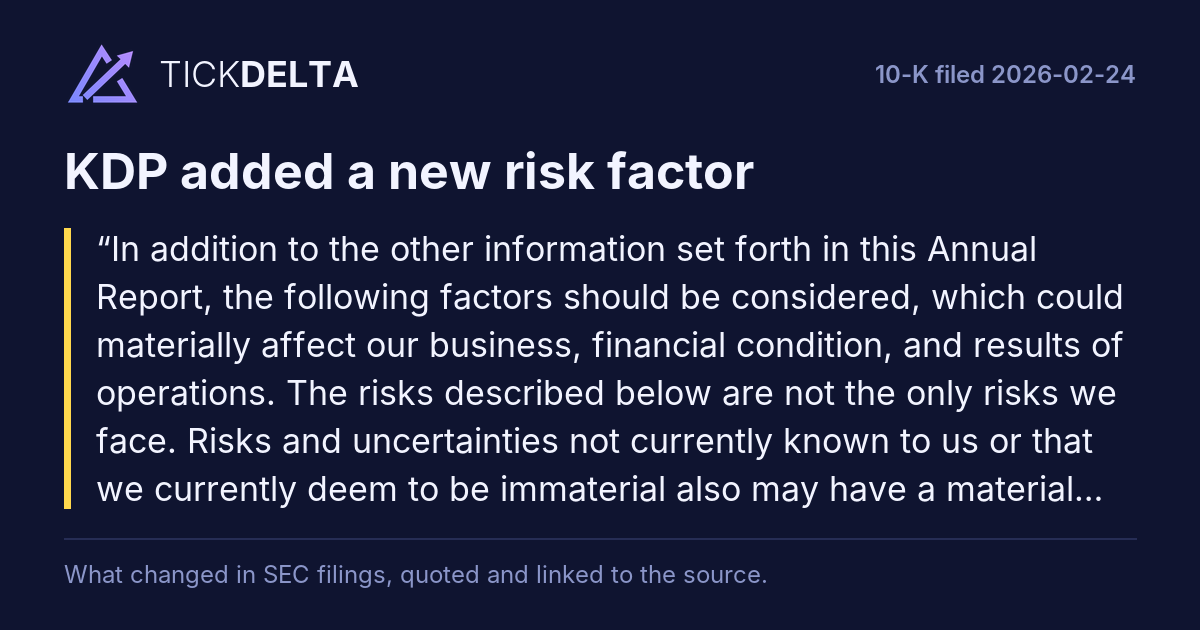
•We may not complete the proposed JDE Peet's Acquisition within the time frame we anticipate, or at all, which could adversely affect our business.
•The market price of our common stock may decline as a result the JDE Peet's Acquisition.
•We will incur significant direct and indirect costs as a result of the JDE Peet's Acquisition.
•The JDE Peet's Acquisition will expose us to inherent risks in JDE Peet's' business and those geographies where JDE Peet's currently operates, which could adversely affect our business.
•If our due diligence investigation of JDE Peet's was inadequate or if unexpected risks related to JDE Peet's and its business materialize, it could have a material adverse effect on our business.
•We may not successfully integrate JDE Peet's into our business, or such integration may be more difficult, time-consuming, or costly than expected, which could adversely affect our business.
•We will be subject to business uncertainties related to the JDE Peet's Acquisition.
•We will incur and assume significant debt as a result of the JDE Peet's Acquisition, which could adversely affect our financial performance.
•In connection with the JDE Peet's Acquisition, we expect to consummate the JV Investment, which could restrict our operational and corporate flexibility, impact our cash resources, and/or depress the market price of our common stock.
•The issuance of Convertible Preferred Stock in connection with the JDE Peet's Acquisition may adversely affect the rights and market price of our common stock as well as our capital resources.
•We may issue additional equity securities in the future to raise proceeds to fund the JDE Peet's Acquisition, which may result in further dilution to our existing shareholders.
•The Separation may not be completed on the terms or timeline currently contemplated, if at all, and will involve significant time, expenses, and resources, which could adversely affect our business.
•We may be unable to achieve some or all of the anticipated strategic and financial benefits from the Separation.
•Following the Separation, we may not maintain a satisfactory credit rating, which could adversely affect the financial performance of our businesses.
•Following the Separation, the price of our common stock may decline and may experience greater volatility.
Read in the 10-K ↗
Refer to the Risks Related to the JDE Peet's Acquisition section for risks specific to the JDE Peet's Acquisition.
Read in the 10-K ↗
We may not complete the proposed JDE Peet's Acquisition within the time frame we anticipate, or at all, which could adversely affect our business.
On August 24, 2025, we entered into the JDE Peet's Acquisition Agreement, and on January 16, 2026, pursuant to the terms of the JDE Peet's Acquisition Agreement, we commenced a tender offer to acquire all of the issued ordinary shares of JDE Peet's. The JDE Peet's Acquisition is expected to close in the first half of 2026 and will depend on a number of conditions being satisfied, including receiving the minimum number of tenders and other closing conditions. Our ability to complete the proposed JDE Peet's Acquisition in the anticipated timeline, or at all, could be impacted by any or all of the following events, which may have an adverse impact on our business:
The JDE Peet's Acquisition Agreement provides that the completion of the proposed JDE Peet's Acquisition will be subject to the satisfaction or waiver of certain conditions, including the minimum tender of at least 95% of the shares of JDE Peet's, which will be reduced if the shareholders of JDE Peet's adopt resolutions for the implementation of certain post-closing measures and such resolutions are in full force and effect on the tender offer closing date. Pursuant to the JDE Peet's Acquisition Agreement, the board of directors of JDE Peet's has recommended our offer to purchase JDE Peet's for acceptance by shareholders. Concurrently with the entry into the JDE Peet's Acquisition Agreement, we obtained irrevocable undertakings from Acorn Holdings B.V. and certain directors of JDE Peet's, who collectively hold in the aggregate, as of the date of such undertakings, approximately 69% of the shares of JDE Peet's. Pursuant to the terms of the irrevocable undertakings, Acorn and JDE Peet's directors have committed to tender their shares of JDE Peet's in the offer and to vote in favor of the resolutions proposed at the JDE Peet's Extraordinary General Meeting. Accordingly, additional shareholders of JDE Peet's will need to tender their shares in the offer for the offer to reach the minimum acceptance threshold and we cannot guarantee we will be successful in obtaining 100% of shares of JDE Peet's. If we are unable to obtain the requisite acceptance threshold of shares of JDE Peet's, additional measures may be performed to enable us to acquire the remaining shares, which may delay or impact our ability to complete the JDE Peet's Acquisition.
There could be legal proceedings in connection with the JDE Peet's Acquisition, the outcomes of which are uncertain, could result in substantial costs, and which could delay or prevent the completion of the JDE Peet's Acquisition.
In connection with the JDE Peet's Acquisition, plaintiffs may file lawsuits against us, JDE Peet's, and/or the directors and officers of either company. Securities class action lawsuits and derivative lawsuits are often brought against public companies that have entered into merger agreements. Even if such a lawsuit is unsuccessful, defending against these claims can result in substantial costs. An adverse judgment could also result in monetary damages. Both defense costs and adverse judgments could have a negative impact on our liquidity and financial condition. Such legal proceedings could also prevent or delay the completion of the JDE Peet's Acquisition and result in additional costs to us.
Similar paragraph at 1 of 31 other Consumer staples companies: SYYThe market price of our common stock may decline as a result the JDE Peet's Acquisition.
The market price of our common stock may decline as a result of the JDE Peet's Acquisition if, among other things, we are unable to achieve the expected benefits and synergies of the JDE Peet's Acquisition, if the JDE Peet's Acquisition is not completed within the anticipated timeframe, or if the transaction costs related to the JDE Peet's Acquisition are greater than expected.
The market price of our common stock also may decline if we do not achieve the expected benefits and synergies of the JDE Peet's Acquisition as rapidly or to the extent anticipated by financial or industry analysts, or if the effect of the JDE Peet's Acquisition on our financial position, results of operations, or cash flows is not consistent with the expectations of financial or industry analysts. The market price declined following the announcement of the JDE Peet's Acquisition and the Separation.
We will incur significant direct and indirect costs as a result of the JDE Peet's Acquisition.
We have incurred and expect to incur a number of costs associated with the JDE Peet's Acquisition, including legal, accounting, consulting, and other advisory fees, financing costs, and other transaction-related costs. The JDE Peet's Acquisition will require significant management and employee resources, which could impact our ability to grow our business and pursue additional strategic opportunities. Certain costs related to the JDE Peet's Acquisition will be incurred regardless of whether the acquisition is completed, which may provide no benefit if such acquisition fails to be completed. While we have assumed that a certain level of transaction expenses will be incurred, factors beyond our control could affect the total amount or the timing of these expenses. Many of the expenses that will be incurred, by their nature, are difficult to estimate accurately. These costs could restrict our resources and adversely affect our financial condition and results of operations leading up to, and following, the JDE Peet's Acquisition.
The JDE Peet's Acquisition will expose us to inherent risks in JDE Peet's' business and those geographies where JDE Peet's currently operates, which could adversely affect our business.
If consummated successfully, the JDE Peet's Acquisition would represent a significant transformation of our coffee business and will expand our operations to those geographies where JDE Peet's currently operates, including Russia, which represented 6% of consolidated revenue and 1% of total assets for JDE Peet's in both 2024 and 2023, as reported in their 2024 annual report. Upon completion of the JDE Peet's Acquisition, we would be subject to a variety of risks associated with JDE Peet's' business, in addition to those we already face in our current business. These risks include changes in consumer preferences, volatility in the prices of raw materials, consumer perceptions of the brands, competition in the retail market place, additional legal and regulatory regimes, and other risks. In addition, we will be exposed to risks inherent in operating in a significant number of geographies in which we have not operated or have been less present in the past, including countries that are experiencing significant unstable geopolitical conditions. These risks include, among others:
•the increased travel, infrastructure, legal, and compliance costs associated with new international locations;
•tariffs, sanctions, such as those imposed in response to the Russia and Ukraine conflict, trade barriers, trade disputes, and other regulatory or contractual limitations on our ability to operate in new foreign markets;
•adaptation to different business cultures, languages, and market structures; and
•military conflicts, such as the Russia and Ukraine conflict, and other geopolitical issues.
As we expand our business, our success will depend, in large part, on our ability to anticipate and effectively manage these risks and other risks associated with growing international operations. We cannot predict how such conditions may affect our business, or those with whom we do business, and any ongoing or new conflicts could adversely impact our business.
If our due diligence investigation of JDE Peet's was inadequate or if unexpected risks related to JDE Peet's and its business materialize, it could have a material adverse effect on our business.
We conducted a due diligence review related to our planned acquisition of JDE Peet's. However, we cannot be sure that our diligence surfaced all material issues that may be present inside JDE Peet's or its business, or that it would be possible to uncover all material issues through a customary amount of due diligence, or that factors outside of JDE Peet's and its business and outside of its control will not arise later. If any such material issues arise, they may materially and adversely impact our ongoing business and our shareholders' investment.
We may not successfully integrate JDE Peet's into our business, or such integration may be more difficult, time-consuming, or costly than expected, which could adversely affect our business.
The combination of two businesses is a complex, costly, and time-consuming process. As a result, we will be required to devote significant management attention and resources to combining JDE Peet's' operations, processes, policies, and systems with our business. The failure to meet the challenges involved in combining the businesses and to realize the anticipated benefits of the JDE Peet's Acquisition could cause an interruption of, or a loss of momentum in, our activities and could adversely affect the results of our operations. The overall combination of JDE Peet's' and our businesses may also result in material unanticipated expenses, liabilities, competitive responses, losses of customer and other business relationships, and other unexpected issues. The difficulties of combining the operations of the businesses include, among others:
•challenges in conforming standards, controls, procedures, accounting and other policies, business cultures, and compensation structures between the two companies;
•difficulties in assimilating employees and in attracting and retaining key personnel;
•difficulties in managing the expanded operations of a large company which operates in additional geographic markets;
•integrating the companies' financial reporting and internal control systems, including compliance by the combined company with Section 404 of the Sarbanes-Oxley Act of 2002, as amended, and the rules promulgated by the SEC; and
•potential unknown liabilities, adverse consequences, and unforeseen increased expenses associated with the integration.
Many of these factors may be outside of the control of KDP and JDE Peet's, and any one of them could result in increased costs, decreased expected revenues, and diversion of management time and energy, which could materially impact our business, financial condition, and results of operations. In addition, even if JDE Peet's' business operations are successfully integrated with ours, the full benefits of the JDE Peet's Acquisition may not be realized, including expected cost synergies and sales or growth opportunities. Moreover, many of the integration expenses that we expect to incur are, by their nature, difficult to estimate accurately. These expenses could, particularly in the near term, exceed the savings that we expect to achieve. As a result, it cannot be assured that the integration of JDE Peet's will result in the realization of the full anticipated benefits anticipated from the JDE Peet's Acquisition within the anticipated time frames, or at all.
Further, the success of the JDE Peet's Acquisition will depend in part on the retention of key employees. We may not be able to retain senior executives or key personnel. Furthermore, uncertainty about the effect of the JDE Peet's Acquisition on JDE Peet's employees may impair its ability to retain and motivate key personnel until and after the completion of the JDE Peet's Acquisition. If such key employees are not retained, we may not realize the anticipated benefits of the JDE Peet's Acquisition.
We will be subject to business uncertainties related to the JDE Peet's Acquisition.
Uncertainty about the effects of the JDE Peet's Acquisition may have an adverse effect on us, both prior and subsequent to completion of the acquisition. These uncertainties could disrupt our business or the business of JDE Peet's, and cause our collective customers, suppliers, vendors, partners, among others, to defer entering into contracts with the two companies, seek to change or cancel existing business relationships, or make other decisions concerning us and JDE Peet's that may be unfavorable to us. These uncertainties about the various effects of the JDE Peet's Acquisition on our business have caused, and may continue to cause, declines and greater volatility in the price of our common stock. We cannot guarantee that our stock price will fully recover from such declines after the JDE Peet's Acquisition is completed.
Retention and motivation of certain employees, both at KDP and JDE Peet's, may be challenging during the pendency of the JDE Peet's Acquisition due to uncertainty about their future roles and difficulty of integration. If key employees depart because of issues related to the uncertainty and difficulty of integration or a desire not to remain with us, our business following the JDE Peet's Acquisition could be negatively impacted.
Additionally, as discussed below, we expect to incur significant debt related to fund this transaction, and the resulting leverage level of our business may lead to a decline in our common stock price. We may also pursue other funding alternatives that may create dilution in our stock price, including the issuance of shares of our common stock, sale of certain assets, and reductions in the net income available to our shareholders, among others.
We will incur and assume significant debt as a result of the JDE Peet's Acquisition, which could adversely affect our financial performance.
We currently maintain investment grade credit ratings with Moody's and S&P for both our long-term debt and commercial paper. However, we will take on a significant amount of debt in order to complete the JDE Peet's Acquisition, as well as assume the existing debt of JDE Peet's, which could impact our credit ratings. We cannot provide assurances that our current credit ratings will remain in effect or that the ratings will not be lowered by Moody's and S&P. Increased indebtedness and any actual or anticipated downgrade of our credit ratings may have adverse effects on our borrowing costs, access to capital markets, liquidity, flexibility in responding to changing market conditions in the event of a general downturn in economic conditions or our business, and, as a result, our financial performance.
Additionally, the agreements that will govern any debt incurred or assumed in connection with the JDE Peet's Acquisition may contain various covenants that may, subject to certain significant exceptions, restrict our ability to, among other things, respond to market conditions, take advantage of business opportunities, incur debt, have liens on our property, and/or sell or convey certain of our assets. Our ability to comply with these provisions may be affected by events beyond our control. Failure to comply with these covenants could result in an event of default, which, if not cured or waived, could accelerate our repayment obligations and could result in a default and acceleration under other agreements containing cross-default provisions. Under these circumstances, we might not have sufficient funds or other resources to satisfy all of our obligations, which may adversely impact our business.
In an effort to limit our potential leverage in connection with the completion of the JDE Peet's Acquisition, we may elect to pursue alternative financing arrangements, which may include, but are not limited to, the issuance of junior hybrid securities, equity-linked securities, or other financing options. While these instruments may improve our leverage level and help preserve our credit ratings, each of these alternatives may involve other downsides. If these alternative financing strategies do not achieve their intended results, or if the market reacts negatively to their specific terms, this may have an adverse effect on our business or stock price.
In connection with the JDE Peet's Acquisition, we expect to consummate the JV Investment, which could restrict our operational and corporate flexibility, impact our cash resources, and/or depress the market price of our common stock.
In connection with the previously announced JV Commitment Letter, we entered into the JV Transaction Agreement, under which we will contribute the Coffee Production Assets, as well as certain of our related coffee assets (including sales and distribution) in Canada to the Pod Manufacturing JV, and the JV Investors will contribute, through the JV Investor Partner, $4 billion in cash in exchange for a 49% interest in the Pod Manufacturing JV. The remaining 51% ownership interest will remain under our ownership.
The JV Transaction Agreement provides that, at the closing of the JV Investment, we and the JV Investor Partner will enter into the Pod Manufacturing JV Agreement, which sets forth each partner's rights and responsibilities with respect to the Pod Manufacturing JV. A portion of all distributions by the Pod Manufacturing JV will be paid to the JV Investors, thereby reducing distributions to us. The JV Investor Partner will also have certain governance and consent rights that will restrict our operational and corporate flexibility with respect to the Pod Manufacturing JV. In addition, we may be required to contribute additional resources, including cash, to the Pod Manufacturing JV, which would reduce our cash available for other purposes. In the event of a change of control, the Pod Manufacturing JV would be required to redeem the interests of the JV Investors, which would reduce the cash available for distributions to us. Under certain circumstances, the interests of the JV Investors may be converted into shares of our common stock (or following the Separation, the common stock of the separated global coffee business), which could have a dilutive impact on holders of our existing common stock. Any sales of such common stock, or the perception that such shares may be sold, could depress the market price of our common stock. Furthermore, if we materially breach our obligations to the Pod Manufacturing JV, we may be required to pay monetary damages, or the JV Investors may be entitled to replace us as the operator of the Pod Manufacturing JV.
The issuance of Convertible Preferred Stock in connection with the JDE Peet's Acquisition may adversely affect the rights and market price of our common stock as well as our capital resources.
Under the Preferred Investment Agreement, we agreed to issue and sell shares of Convertible Preferred Stock to the Preferred Investors, subject to customary closing conditions. When issued, the Convertible Preferred Stock will rank senior to our common stock, meaning that, in the event of our liquidation, dissolution, or winding up, holders of the Convertible Preferred Stock would be paid in full prior to any proceeds being paid to holders of our common stock.
Preferred Investors will be entitled to dividends at a rate of 4.75% per annum, subject to increase in certain cases. They will also be entitled to participate in dividends paid to holders of our common stock on an as-converted basis, provided that any such dividends received on an as-converted basis will reduce, on a dollar-for-dollar basis, the dividends holders are entitled to receive on the Convertible Preferred Stock. Such dividends will reduce our cash available for other purposes, including working capital, strategic activities, and returning cash to holders of our common stock.
Preferred Investors will be entitled to vote, on an as-converted basis, together with holders of our common stock on all matters submitted to a vote of the holders of our common stock, effectively reducing the relative voting power of the holders of our common stock.
In addition, the conversion of the Convertible Preferred Stock to common stock would dilute the ownership interest of existing holders of our common stock, and any sales in the public market of the common stock issuable upon conversion of the Convertible Preferred Stock could adversely affect prevailing market prices of our common stock. We will grant certain Preferred Investors customary registration rights in respect of their Convertible Preferred Stock, and any shares of common stock issued upon conversion of the Convertible Preferred Stock. These registration rights would facilitate the resale of such securities into the public market, and any such resale would increase the number of shares available for public trading. Sales by the Preferred Investors of a substantial number of shares of our common stock in the public market, or the perception that such sales might occur, could have a material adverse effect on the price of our common stock.
In the event of a fundamental change, as defined in the document governing the Convertible Preferred Stock, we will be required to offer to repurchase the Convertible Preferred Stock, which would reduce the amount of cash available to us for other purposes.
Certain Preferred Investors will also have certain preemptive rights, which may impact our ability to raise capital in the future.
Our obligations to the Preferred Investors could limit our ability to obtain additional financing or increase our borrowing costs, which could have an adverse effect on our financial condition. The rights of the Preferred Investors could also result in divergent interests between the Preferred Investors and holders of our common stock.
The Preferred Investment Agreement provides that, prior to the closing of the JDE Peet's Acquisition, we (i) will use reasonable best efforts to operate our business in the ordinary course in all material respects (without restricting our activities with respect to the JDE Peet's Acquisition, the Preferred Investment, the JV Investment, the Separation, and the related transactions), and (ii) unless the KKR Investor and the Apollo Investor otherwise consent in writing (such consent not to be unreasonably withheld, conditioned, or delayed), not take any other action that, if taken following the issuance of the Preferred Investment, would require the prior written consent of the holders of the Convertible Preferred Stock or result in an adjustment to the conversion price unless such adjustment is effected in connection with the issuance of the Convertible Preferred Stock.
In addition, the Preferred Investment Agreement provides that, without the prior written consent of the KKR Investor or the Apollo Investor (so long as the KKR Investor or the Apollo Investor owns at least 50% of its initial Preferred Investment), we (i) will not amend the JDE Peet's Acquisition Agreement in a manner that would be materially adverse to the KKR Investor or the Apollo Investor, and (ii) will not permit the Separation to be consummated if (A) our pro forma total net leverage, as defined in the Preferred Investment Agreement, immediately following the Separation is greater than 4.00 to 1.00, if a Qualified IPO shall have been consummated on or prior to the Separation, or 4.25 to 1.00, if a Qualified IPO shall not have been consummated on or prior to the Separation, or (B) the corporate rating of either of the separated businesses, on a pro forma basis at the time of the Separation, would be less than investment grade from either Moody's or S&P. For so long as the Convertible Preferred Stock is outstanding, in the event of a ratings downgrade by either Moody's or S&P, we will be subject to additional negative covenants that would restrict our operational flexibility.
We may issue additional equity securities in the future to raise proceeds to fund the JDE Peet's Acquisition, which may result in further dilution to our existing shareholders.
If we raise additional capital in order to fund the JDE Peet's Acquisition, or to reduce our leverage after the JDE Peet's Acquisition, through the issuance of additional equity securities, our existing shareholders may experience further dilution. The terms of the securities we issue in the future may be more favorable to our new investors and introduce additional complexity to our capital structure.
The Separation may not be completed on the terms or timeline currently contemplated, if at all, and will involve significant time, expenses, and resources, which could adversely affect our business.
On August 25, 2025, we announced our intention to separate our beverage and coffee portfolios into two independent, publicly traded companies via a tax-free spin-off of our coffee business. The anticipated Separation is expected to occur subsequent to the completion of the JDE Peet's Acquisition. We cannot assure that the Separation will be completed on the anticipated timeline, if at all, or that the terms of the Separation will not change. The transaction will follow the satisfaction of customary conditions, including reviews and final approval by our Board, relevant tax opinions with respect to the tax-free nature of the transaction, effectiveness of appropriate filings with the SEC, and acceptance of the spin-off company for listing by a national securities exchange approved by our Board, the completion of audited financials of the new independent company, among others. The failure to satisfy any of the required conditions could delay the completion of the Separation for a significant period of time or prevent it from occurring at all.
Similar paragraph at 1 of 31 other Consumer staples companies: KHCUnanticipated developments, including changes in the competitive conditions of our markets, possible delays in obtaining various tax opinions or rulings or failure of the spin-off transaction to qualify for non-recognition treatment for U.S. federal income tax purposes, the filing and effectiveness of appropriate filings with the SEC and the listing on a stock exchange, negotiating challenges, the uncertainty of the financial markets, changes in the law, and challenges in executing the Separation, could delay or prevent the completion of the Separation, or cause the Separation to occur on terms or conditions that are different or less favorable than initially expected. Any changes to the Separation or delay in completing the Separation could cause us not to realize some or all of the expected benefits, or realize them on a different timeline than initially expected. Further, our Board could decide, either because of a failure of conditions or because of market or other factors, to abandon the Separation. No assurance can be given as to whether and when the Separation will occur.
Similar paragraph at 1 of 31 other Consumer staples companies: KHCWhether or not we complete the Separation, our ongoing business may be adversely affected, and we may be subject to certain risks and consequences as a result of pursuing the separation of our two businesses, including the following:
Similar paragraph at 1 of 31 other Consumer staples companies: KHC•We anticipate that the process of completing the Separation will be time-consuming and involve significant additional costs and expenses, which may not yield a discernible benefit if the Separation is not completed. Additionally, if the Separation is not completed, we will still be required to pay certain costs and expenses incurred in connection therewith, such as professional fees.
Similar paragraph at 1 of 31 other Consumer staples companies: KHC•Executing the Separation will require significant time and attention from our senior management and employees, which may impact management's attention to operating and growing our business and could adversely affect our business. Our employees may also be distracted due to uncertainty about their future roles with the separate companies pending completion of the Separation.
Similar paragraph at 1 of 31 other Consumer staples companies: KHC•We may also experience increased difficulties in attracting, retaining, and motivating employees leading up to, and following, completion of the Separation, which could harm our businesses.
Similar paragraph at 1 of 31 other Consumer staples companies: KHC•Some of our customers or suppliers may delay or defer decisions or may end their relationships with us.
Similar paragraph at 1 of 31 other Consumer staples companies: KHC•We may experience negative reactions from the financial markets if we fail to complete the Separation or fail to complete it on a timely basis.
Similar paragraph at 1 of 31 other Consumer staples companies: KHC•We could incur substantial additional costs and experience temporary business interruptions.
•Transfer or assignment to us of some contracts and other assets will require the consent of a third party. If such consent is not given, we may not be entitled to the benefit of such contracts, investments, and other assets in the future.
•The announcement and pendency of the Separation may cause some investors to sell shares of our common stock, which could create greater volatility or decline in the price of our shares.
Similar paragraph at 1 of 31 other Consumer staples companies: KHCAny of the above factors could cause the Separation, or the failure to execute the Separation, to have an adverse effect on our business and financial performance.
We may be unable to achieve some or all of the anticipated strategic and financial benefits from the Separation.
We may not realize the anticipated strategic, financial, operational, or other benefits from the Separation. We also cannot predict with certainty when the expected benefits will occur or the extent to which they will be achieved. If the Separation is completed, our operational and financial profile will change and we will face new risks. As two independent, publicly traded companies, our beverage and coffee businesses will each be smaller, less-diversified companies and may be more vulnerable to changing market conditions. There is no assurance that each separate company will be successful. The announcement and/or completion of the Separation may cause uncertainty for or disruptions with our customers, partners, suppliers, and employees, which may negatively impact these relationships or our operations. In addition, we will incur costs in connection with, or as a result of, the spin-offs, including costs of operating as independent, publicly-traded companies that the two businesses will no longer be able to share. Those costs may exceed our estimates or could negate some of the benefits we expect to realize. Significant unexpected costs or failure to realize the intended benefits of the Separation could result in a material adverse effect on the business, financial condition, results of operations, and trading price of us or the separated businesses.
Similar paragraph at 1 of 31 other Consumer staples companies: KHCFollowing the Separation, we may not maintain a satisfactory credit rating, which could adversely affect the financial performance of our businesses.
It is management's intent to structure each stand-alone business in a way to achieve investment grade credit ratings upon completion of the Separation. If we are not able to achieve or maintain satisfactory credit ratings post-separation, whether as a result of our actions or factors which are beyond our control, the independent businesses may face increased borrowing costs and limited access to raise funds in capital markets. A failure to achieve or maintain investment grade ratings could also impact business relationships with vendors, suppliers, regulators, and other business partners. There is no guarantee that we will be able to achieve or maintain our targeted credit ratings, and failure to do so may adversely affect the liquidity and financial performance of the businesses following the proposed Separation.
Following the Separation, the price of our common stock may decline and may experience greater volatility.
Upon completion of the Separation, the price of our common stock may decline compared to its level immediately prior to, as it will no longer include the value of the separated business. In addition, the price of our common stock may experience greater volatility until the market has fully analyzed our value without the separated business. We can not guarantee that the combined value of the shares of the two resulting companies will be equal to or greater than what the value of our common stock would have been had the proposed Separation not occurred.
Read in the 10-K ↗
New in the latest 10-Q
21 paragraphs in the 10-Q filed Nov 9, 2026 with nothing like them in the 10-Q filed Aug 10, 2026 (at least half the words must differ; new numbers alone do not count). Quoted exactly, grouped by the item heading above them. This is text that changed, not a judgement of how serious it is.
Financial statements and notes
First Nine Months (in millions) 2026 2025 ───────────────────────────────────────────────────────────────────────────────────────────────────────────────────────────────────────────────── Operating activities: Net income $ 1,432 $ 1,726 Adjustments to reconcile net income to net cash provided by operating activities: Depreciation expense 527 336 Amortization of intangibles 286 101 Amortization of inventory step-up 361 15 Other amortization expense 125 117 Provision for sales returns 132 42 Deferred income taxes (177) (39) Employee stock-based compensation expense 95 70 Amortization of deferred financing costs 115 15 Gain on sale of equity method investment (400) — Loss (gain) on disposal of property, plant, and equipment 69 (3) Unrealized (gain) loss on foreign currency (9) 7 Unrealized gain on derivatives (165) (127) Settlements of interest rate contracts 70 — Earnings of equity method investments (58) (62) Earned equity from distribution arrangements (16) (21) Other, net 63 (12) Changes in assets and liabilities, excluding the effects of business acquisitions: Trade accounts receivable (131) (16) Inventories 160 (533) Income taxes receivable and payable, net 119 (27) Other current and non-current assets (138) (183) Accounts payable and accrued expenses (41) (140) Other current and non-current liabilities (199) 13 Net change in operating assets and liabilities (230) (886) Net cash provided by operating activities 2,220 1,279 Investing activities: Acquisitions of businesses, net of cash acquired (16,633) (114) Proceeds from sale of equity method investment 400 — Purchases of property, plant, and equipment (457) (338) Proceeds from sales of property, plant, and equipment 145 14 Purchases of intangibles (4) (16) Other, net (2) 64 Net cash used in investing activities $ (16,551) $ (390)
Read in the 10-Q ↗
Under the acquisition method of accounting, total consideration as of September 30, 2026 was as follows:
Read in the 10-Q ↗
Basic EPS reflects net income attributable to common shareholders after consideration of participating securities. Diluted EPS reflects net income attributable to common shareholders divided by the weighted average number of common shares and potentially dilutive securities outstanding during the period using the treasury stock method (for stock-based awards) or the “if-converted” method (for participating securities). The weighted average number of common shares is computed independently for each quarter-to-date and year-to-date period.
Read in the 10-Q ↗
The following table presents our basic and diluted EPS and shares outstanding per common share:
Read in the 10-Q ↗
(1)The net income allocated to Preferred Investors in a given period, computed independently for each quarter-to-date and year-to-date period, is the greater of i) dividends declared to the Preferred Investors, or ii) the net income attributable to the Preferred Investors as a participating security. For the third quarter of 2026, the allocation of net income to the Preferred Investors as a participating security were greater. For the first nine months of 2026, dividends declared to the Preferred Investors were greater.
Read in the 10-Q ↗
During the third quarter of 2026, we completed a series of transactions with Chobani, including the sale of our equity interests in Chobani, as well as the sale of certain facilities, including our leasehold interests, to Chobani. The pre-tax impacts of these transactions on the unaudited Condensed Consolidated Statements of Income during the third quarter of 2026 were as follows:
Read in the 10-Q ↗
(in millions) Income Statement Location Total ───────────────────────────────────────────────────────────────────────────────────────────────────────────────────── Sale of equity interests Gain on sale of equity interests Gain on sale of equity method investment $ (400) Sale of Allentown facilities Loss on sale of owned assets Other operating expense (income), net 65 Gain on termination of leases upon assignment Other operating expense (income), net (14) Lease guarantees Impact of guarantee of assigned leases Other expense (income), net 9 Impact of expected credit loss liability Other expense (income), net 10 Total $ (330)
Read in the 10-Q ↗
During the third quarter of 2026, we sold our equity interests in Chobani for aggregate consideration of $ 800 million, consisting of $ 400 million in cash received during the third quarter of 2026 and a $ 400 million promissory note, which matures on December 26, 2026. This sale resulted in a gain of $ 400 million during the period.
Read in the 10-Q ↗
During the third quarter of 2026, we also sold our manufacturing facility and warehouse in Allentown, Pennsylvania, including the leasehold interests and equipment, to Chobani for proceeds of $ 125 million. We recognized a loss of $ 65 million on the sale of owned assets and a gain of $ 14 million on the termination of leases upon their assignment to Chobani.
Read in the 10-Q ↗
In connection with the assignment of our manufacturing facility and warehouse leases to Chobani as discussed above, we remain a guarantor of certain lease obligations under the assigned lease agreements. The leases have varying terms through 2040, with renewal options through 2060. We would be required to make payments under the guarantees only in the event of nonpayment or nonperformance by Chobani. As part of the Allentown asset purchase agreement, Chobani is required to indemnify and hold us harmless from losses, liabilities, claims, demands for payment, fees, and expenses incurred in connection with the lease guarantee or Chobani's failure to perform its obligations under the lease.
Read in the 10-Q ↗
As of September 30, 2026, the maximum potential future undiscounted payments we could be required to make under these guarantees was approximately $ 213 million.
Read in the 10-Q ↗
We monitor the payment and performance risk associated with these guarantees through periodic evaluation of Chobani's financial condition and other relevant indicators. Based on the information available as of September 30, 2026, we believe the likelihood of having to make payments under the guarantees is remote. The liabilities recorded for these lease guarantees as of September 30, 2026 and the corresponding impact on the unaudited Condensed Consolidated Statements of Income during the third quarter of 2026 were insignificant. Refer to the table above for further details.
Read in the 10-Q ↗
For the third quarter of 2026, the change in our effective tax rate was driven by a favorable shift in the mix of income from higher tax jurisdictions to lower tax jurisdictions, partially offset by an unfavorable comparison to the impact of non-recurring purchased tax credits in the third quarter of 2025.
Read in the 10-Q ↗
(in millions) Foreign Currency Translation Adjustments Pension and Post-Retirement Benefit Liabilities Cash Flow Hedges Total
Read in the 10-Q ↗
(1)Refer to Note 13 for additional information regarding the note receivable due from Chobani.
Read in the 10-Q ↗
In September and October 2026, the SDNY court issued rulings on various summary judgment motions, including Keurig’s motions as to the TreeHouse, JBR, McLane, BJ’s and Winn-Dixie plaintiffs. The court granted, in part, and denied, in part, Keurig’s motions. The court denied in all material respects these plaintiffs’ motions for summary judgment. As a result, the SDNY court dismissed certain material aspects of these plaintiffs’ antitrust and false advertising claims. Prior to the summary judgment rulings, these plaintiffs (which no longer include the purported direct purchaser class) collectively claimed more than $ 1.5 billion of monetary damages. Keurig filed a motion in October 2026 challenging these damages calculations in light of the court’s summary judgment rulings. We cannot predict when the SDNY court will rule on that motion, or when these plaintiffs’ remaining claims will be set for trial. The individual direct purchaser actions filed in 2026 will proceed on a separate procedural timeline.
Read in the 10-Q ↗
(in millions) Restructuring Liabilities ────────────────────────────────────────────────────────────────────────────────────────────────────────── Balance as of December 31, 2025 $ 8 Charges to expense and other adjustments 31 Restructuring liabilities assumed in the JDE Peet's Acquisition 74 Cash payments (52) Balance as of September 30, 2026 $ 61
Read in the 10-Q ↗
As of September 30, 2026, we had commenced the proceedings to acquire the remaining outstanding ordinary shares of JDE Peet's not yet acquired. Effective October 26, 2026, these proceedings were completed, and we own 100% of the ordinary shares of JDE Peet’s.
Read in the 10-Q ↗
Gain on sale of equity method investment reflected the gain on the sale of our equity method investment in Chobani in September 2026.
Read in the 10-Q ↗
Appliance volume increased 16.7%, primarily reflecting a favorable comparison to retailer inventory management practices in the prior year period. Coffee and related products volume decreased 0.5%.
Read in the 10-Q ↗
Gain on sale of equity method investment reflected the gain on the sale of our equity method investment in Chobani in September 2026.
Read in the 10-Q ↗
The 10-Q's risk factors against the 10-K
Item 1A of the 10-Q filed Nov 9, 2026 against Item 1A of the 10-K filed Feb 24, 2026.
A 10-Q repeats only the risks that changed, so a 10-K paragraph that is missing from it is not counted as removed.
Added is a paragraph with nothing like it in the 10-K, Reworded a sentence that is in both with several words changed,
Quiet changes a sentence in both where one to four words changed and one is a hedge or a modal
(cut words struck through, new words highlighted and underlined).
Text on the page, not a score; each links to the filing at sec.gov.
What the 10-Q itself says about its risk factors:
Read in the 10-Q ↗
In addition to other information set forth in this Quarterly Report on Form 10-Q, you should carefully consider the risks and uncertainties discussed in Part II, Item 1A in our Quarterly Report on Form 10-Q for the quarter ended June 30, 2026 and in Part I, Item 1A in our Annual Report. There have been no material changes from the risk factors set forth in our Annual Report, as updated by Part II, Item 1A in that Quarterly Report.
1 paragraph in the 10-Q's Item 1A, and none of them adds, rewords or quietly edits a paragraph of the 10-K's.
Work on KDP in a spreadsheet:
Excel workbook (a sheet per section, ten years by column, charts, links to the filings) ·
CSV.
For a Google Sheet that stays up to date, paste =IMPORTDATA("https://tickdelta.com/company/KDP/export.csv") into a cell.