tickdelta
Sign in

Tickdelta is free for now. Sign up and get Pro free

← Screener

KLACKLA Corporation

Technology · Optical Instruments · Nasdaq
Compare with peers → Embed
The 10-K against last year's

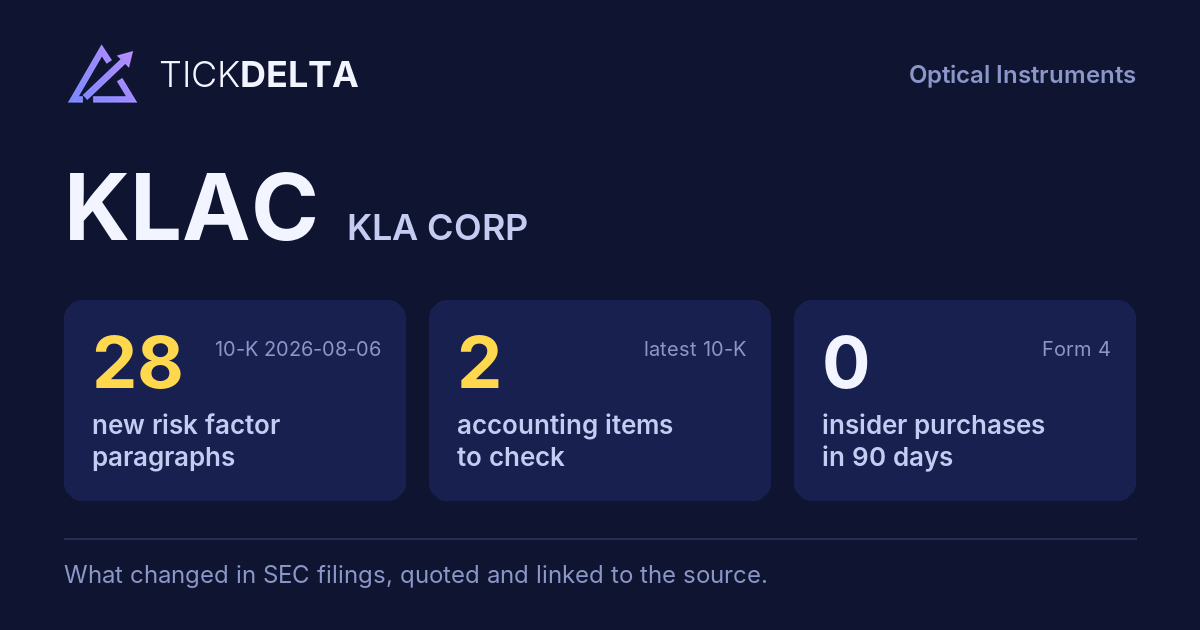
128 changes: 38 added, 22 removed, 66 reworded, 2 quiet changes

10-K Aug 6, 2026 vs Aug 8, 2025
Risk FactorsRedline ↓
13.5%
of the text changed · 19,896 words now
30.4%
of the text changed · 6,650 words now
Legal ProceedingsRedline ↓
64.8%
of the text changed · 213 words now
Accounting PoliciesRedline ↓
22.5%
of the text changed · 8,118 words now

10-K 0000319201-26-000027 (2026-08-06) vs 10-K 0000319201-25-000024 (2025-08-08)

The redline

The paragraph that changed most in each section

Marked against last year's 10-K: cut words struck through, new words highlighted and underlined.

Risk Factors 274 words changed in this paragraph; it is 39% similar to last year's version.
The threat of terrorism targeted at, or acts of war in, the regions of the world in which we do business increases the uncertainty in our markets. Any act of terrorism or war that affects the economy or the industries we serve could adversely affect our business. Increased international political instability or geopolitical tensions in various parts of the world, disruption in air transportation and further enhanced security measures as a result of terrorist attacks may hinder our ability to do business and may increase our costs of operations. We maintain significant operations in Israel. Since the establishment of the State of Israel in 1948, a number of armed conflicts have taken place between Israel and its Arab neighbors, and a state of hostility varying in degree and intensity has led to security and economic challenges for Israel. Persistent hostilities involving Iran and Iran-backed groups, including Hezbollah in Lebanon and Hamas in the Gaza Strip, have involved missile strikes against civilian targets in various parts of Israel and attacks on marine vessels traversing the Red Sea. Disruptions in shipping routes in the Red Sea could result in delays in shipping our products to customers, which could delay the timing of revenue recognition. In addition, some of our employees in Israel are obligated to perform annual reserve duty in the Israel Defense Forces, and may be called to active military duty in emergency circumstances. We cannot assess the impact that emergency conditions in Israel may have on our business, operations, financial condition or results of operations, but it could be material. Instability in any region could directly impact our ability to operate our business (or our customers’ ability to operate their businesses), cause us to incur increased costs in transportation, make such transportation unreliable, increase our insurance costs, and cause international currency markets to fluctuate. Instability in any region could also have the same effects on our suppliers and their ability to timely deliver their products. Our insurance does not cover losses we suffer attributable to war. If international political instability and geopolitical tensions continue or increase in any region in which we do business, our business and results of operations could be harmed.

Source: Item 1A, 10-K 0000319201-26-000027 vs Item 1A, 10-K 0000319201-25-000024

MD&A 257 words changed in this paragraph; it is 38% similar to last year's version.
The semiconductor industry continues to experience market expansion and diversification. HPC and data centers, supported by increasing adoption of AI, are contributing to industry growth and these trends are expected to continue to influence industry investment into fiscal year 2027. AI represents a key technology inflection point driving innovation and demand at the leading edge, and our portfolio of products is well positioned to support leading-edge demand and the ongoing AI infrastructure buildout. Our semiconductor customers generally operate in one or both of the major semiconductor device manufacturing markets: memory and foundry/logic. End-market Long-term demand drivers that are expected to continue to benefit KLA in the long term include continued adoption of EUV in HVM for Logic logic and DRAM memory, (including high-bandwidth memory), which drives new are increasing process control requirements and growth in key markets for KLA. expanding our served market. Demand for advanced semiconductor technologies, particularly evident in the 2-nanometer node, which at leading-edge nodes such as 2-nanometer, is seeing higher levels of investment increasing process complexity and process control intensity, continues to drive investments which in AI. turn is driving incremental demand for our solutions. Increasing complexity and value of semiconductor packages, particularly for AI and HPC applications, is also driving significant growth in our advanced packaging business. The digitization of all industries, Broader industry trends, including 5G markets, advances in digitization, communication improvements, healthcare and innovation, industrial applications, together with the and increasing adoption of electric vehicles semiconductor content in automobiles and intelligence intelligent systems, are supporting continued investment in automobiles, are powering leading-edge design node technology investments legacy and capacity expansions. While we continue to invest in technological innovation, factors such as delays from customers in adopting new chips mature-node capacity, where long product lifecycles and technology methods could impact process control capital intensity. Push out or cancellation of deliveries to our customers could still cause earnings volatility, due to the timing of revenue recognition as well as increased risk of inventory-related charges. expanding end-market demand require ongoing manufacturing investments.

Source: Item 7, 10-K 0000319201-26-000027 vs Item 7, 10-K 0000319201-25-000024

Accounting Policies 195 words changed in this paragraph; it is 60% similar to last year's version.
For derivative instruments designated and qualifying as cash flow hedges of forecasted foreign currency denominated transactions or debt financing, the effective portion of the gains or losses is reported in AOCI and reclassified into earnings in the same period or periods during which the hedged transaction affects earnings. We elected to include time value for the assessment of effectiveness on all forward transactions designated as cash flow hedges. The change in fair value of the derivative is recorded in AOCI until the hedged transaction is recognized in earnings. Cash flow hedges are evaluated for effectiveness monthly, based on changes in total fair value of the derivatives. The assessment of effectiveness of options contracts designated as cash flow hedges excludes time value. The initial value of the component excluded from the assessment of effectiveness is recognized in earnings over the life of the derivative contract. Any differences between change in the fair value of the excluded components and the amounts recognized in earnings are recorded in AOCI. For foreign exchange contracts that are designated and qualify as a net investment hedge in a foreign operation and that meet the effectiveness requirements, the net gains or losses attributable to changes in spot exchange rates are recorded in cumulative translation within AOCI. The remainder of the change in value of such instruments is recorded in earnings using the mark-to-market approach. Recognition in earnings of amounts previously recorded in cumulative translation is limited to circumstances such as complete or substantially complete liquidation of the net investment in the hedged foreign operations. For foreign exchange contracts that are not designated as hedges, gains and losses are recognized in Other expense (income), net. We use foreign exchange contracts to hedge certain foreign currency denominated assets or liabilities. The gains and losses on these derivative instruments are largely offset by the changes in the fair value of the assets or liabilities being hedged. Cash flows associated with these derivatives are classified as cash flows from operating activities in the Consolidated Statement of Cash Flows to align with the underlying items.

Source: Item 8, Note 1 – DESCRIPTION OF BUSINESS AND SUMMARY OF SIGNIFICANT ACCOUNTING POLICIES, 10-K 0000319201-26-000027 vs Item 8, Note 1 – DESCRIPTION OF BUSINESS AND SUMMARY OF SIGNIFICANT ACCOUNTING POLICIES, 10-K 0000319201-25-000024

Legal Proceedings 138 words changed in this paragraph; it is 52% similar to last year's version.
We are named, from time to time, as a party to lawsuits and other types of legal proceedings and claims in the normal course of our business. Actions filed against us include commercial, intellectual property (“IP”), customer, and labor and employment related claims, including complaints of alleged wrongful termination and potential class action lawsuits regarding alleged violations of federal and state wage and hour and other laws. In general, legal proceedings and claims, regardless of their merit, and associated internal investigations (especially those relating to IP or confidential information disputes) are often expensive to prosecute, defend or conduct and may divert management’s attention and other Company resources. Moreover, the results of legal proceedings are difficult to predict, and the costs incurred in litigation can be substantial, regardless of outcome. We believe the amounts provided in our Consolidated Financial Statements are adequate in light of the probable and estimated liabilities. However, because such matters are subject to many uncertainties and the ultimate outcomes are not predictable, there can be no assurances that the actual amounts required to satisfy alleged liabilities from the matters described above will not exceed the amounts reflected in our Consolidated Financial Statements or will not have a material adverse effect on our results of operations, financial condition or cash flows.

Source: Item 3, via Note 14 – LITIGATION AND OTHER LEGAL MATTERS, 10-K 0000319201-26-000027 vs Item 3, via Note 15 – LITIGATION AND OTHER LEGAL MATTERS, 10-K 0000319201-25-000024

Every change, by type

Sentences and paragraphs added, removed or reworded

Sentences and paragraphs of KLAC's Risk Factors and MD&A, 10-K 2026-08-06 against 10-K 2025-08-08. Each links to the text at sec.gov.

AddedRisk Factors
•Tariffs, retaliatory trade measures and other trade restrictions, including uncertainty related to tariff authority, implementation and refund processes;

Read it in 10-K 2026-08-06 at sec.gov ↗

AddedRisk Factors
•System failures, ERP system implementation risks or limited access to critical information could disrupt our operations and financial reporting processes;

Read it in 10-K 2026-08-06 at sec.gov ↗

AddedRisk Factors
•Prevailing local and global economic conditions, semiconductor industry cyclicality, customer capital spending patterns and AI-related investment trends may negatively affect customer demand and purchasing decisions; and

Read it in 10-K 2026-08-06 at sec.gov ↗

AddedRisk Factors
•We may not receive components, materials or subassemblies necessary to build our products in a timely, cost-effective or compliant manner, including as a result of limited-source suppliers, the availability of rare earth elements or DRAM chip shortages;

Read it in 10-K 2026-08-06 at sec.gov ↗

AddedRisk Factors
In September 2025, Commerce released an interim final rule that further expands export control restrictions and licensing requirements for foreign entities 50% or more directly or indirectly owned by one or more listed parties on the U.S. Entity List, Military End-User List, and certain entities on the Specially Designated Nationals and Block Persons List, which Commerce has labeled the “Affiliates Rule.” The new rule increases compliance requirements with the EAR by imposing on exporters, re-exporters, and transferors of items subject to the EAR a responsibility to know the ownership of the parties to a transaction. In November 2025, the BIS suspended the Affiliates Rule for one year until November 2026.

Read it in 10-K 2026-08-06 at sec.gov ↗

Show the other 14
AddedRisk Factors
In February 2026, the U.S. Supreme Court ruled that tariffs imposed under the International Emergency Economic Powers Act were not authorized, creating uncertainty around the status of prior tariffs, potential refund processes and the scope of future presidential tariff authority. This ruling adds volatility to an already fluid tariff environment and may result in rapid changes in tariff rates, shifts in enforcement, delays in customs processing and increased uncertainty in supply chain and capital planning for us and our customers.

Read it in 10-K 2026-08-06 at sec.gov ↗

AddedRisk Factors
Additionally, while we are pursuing recovery of duties previously paid through the administrative refund process established by U.S. Customs and Border Protection and have begun receiving refunds, changes in the refund process or related legal challenges could impact the timing of cash receipts and our results of operations.

Read it in 10-K 2026-08-06 at sec.gov ↗

AddedRisk Factors
The threat of terrorism targeted at, or acts of war in, the regions of the world in which we do business increases the uncertainty in our markets. Any act of terrorism or war that affects the economy or the industries we serve could adversely affect our business. Increased international political instability or geopolitical tensions in various parts of the world, disruption in air transportation and further enhanced security measures as a result of terrorist attacks may hinder our ability to do business and may increase our costs of operations.

Read it in 10-K 2026-08-06 at sec.gov ↗

AddedRisk Factors
We maintain significant operations in Israel. Since the establishment of the State of Israel in 1948, a number of armed conflicts have taken place between Israel and its Arab neighbors, and a state of hostility varying in degree and intensity has led to security and economic challenges for Israel. Persistent hostilities involving Iran and Iran-backed groups, including Hezbollah in Lebanon, the Houthis in Yemen and Hamas in the Gaza Strip, have involved missile strikes against civilian targets in various

Read it in 10-K 2026-08-06 at sec.gov ↗

AddedMD&A
While we continue to invest in technological innovation, demand for our products may be affected by the timing of customer adoption decisions and changes in delivery schedules, which can result in variability in our operating results. In addition, geopolitical factors, including government regulations and tariffs, have impacted our results of operations and may continue to do so. We have also increased our purchase commitments, in part to secure the supply of key components, which may affect the timing and magnitude of our costs and working capital requirements. Despite these dynamics, we delivered higher revenue and net income in fiscal year 2026 compared to fiscal year 2025, driven by increased sales volume and disciplined cost management. Looking ahead to fiscal year 2027, we expect continued revenue growth as customer engagement and demand signals continue to strengthen.

Read it in 10-K 2026-08-06 at sec.gov ↗

AddedMD&A
On June 11, 2026, the Company effected a ten-for-one stock split of its common stock and a proportional increase in the number of authorized shares of common stock. Share and per share information throughout this Annual Report on Form 10-K have been retroactively adjusted to reflect the stock split.

Read it in 10-K 2026-08-06 at sec.gov ↗

AddedMD&A
We performed the required annual goodwill impairment testing for all reportable segments as of December 31, 2025, and concluded that goodwill was not impaired. As a result of our qualitative assessment, we determined that it was not necessary to perform the quantitative assessment.

Read it in 10-K 2026-08-06 at sec.gov ↗

AddedMD&A
Revenue in China was comparable to the prior fiscal year, as continued investments in legacy-node technologies by domestic semiconductor companies were largely offset by export control restrictions affecting certain advanced technology transactions.

Read it in 10-K 2026-08-06 at sec.gov ↗

AddedMD&A
Revenue in Taiwan increased 13.7% compared with the prior fiscal year, primarily due to increased leading-edge customer investments in foundry/logic, memory and advanced packaging technologies, supported by strong demand associated with AI and HPC applications.

Read it in 10-K 2026-08-06 at sec.gov ↗

AddedMD&A
Revenue in Korea increased 26.2% compared with the prior fiscal year, due to increased investments by memory customers, including investments supporting high-bandwidth memory and advanced DRAM technology roadmaps.

Read it in 10-K 2026-08-06 at sec.gov ↗

AddedMD&A
Revenue in North America increased 29.0% compared with the prior fiscal year, primarily due to increased leading-edge customer investments in foundry/logic and memory technologies, supported by strong demand associated with AI and HPC applications.

Read it in 10-K 2026-08-06 at sec.gov ↗

AddedMD&A
Interest expense represents interest associated with our debt instruments. Interest on our Senior Notes is payable semi-annually. Concurrent with the Senior Notes interest payments, floating interest payments on our interest rate swaps are paid semi-annually and the fixed-rate interest receivable on the swaps is received semi-annually. Interest expense during the fiscal year ended June 30, 2026 decreased compared to the fiscal year ended June 30, 2025 primarily due to reduced interest expense following our $750.0 million debt repayment in the second quarter of fiscal 2025.

Read it in 10-K 2026-08-06 at sec.gov ↗

AddedMD&A
$3.94 billion authorization remaining as of December 31, 2025 under the then existing share repurchase program announced in the fourth quarter of fiscal 2025.

Read it in 10-K 2026-08-06 at sec.gov ↗
Next Related parties →