Paragraph 37 · 45% changed
Every version of it
Screener
/
SEC EDGAR
/CIK 0000055785
/10-K filed Feb 12, 2026, compared with Feb 13, 2025
/Numbers from the XBRL of the 10-Ks
Nasdaq
Consumer staples · Paper Products
Kimberly-Clark KMB
The 10-K against last year's
162 changes: 80 added, 17 removed, 65 reworded
10-K Feb 12, 2026 vs Feb 13, 2025
Risk Factors
33.5%
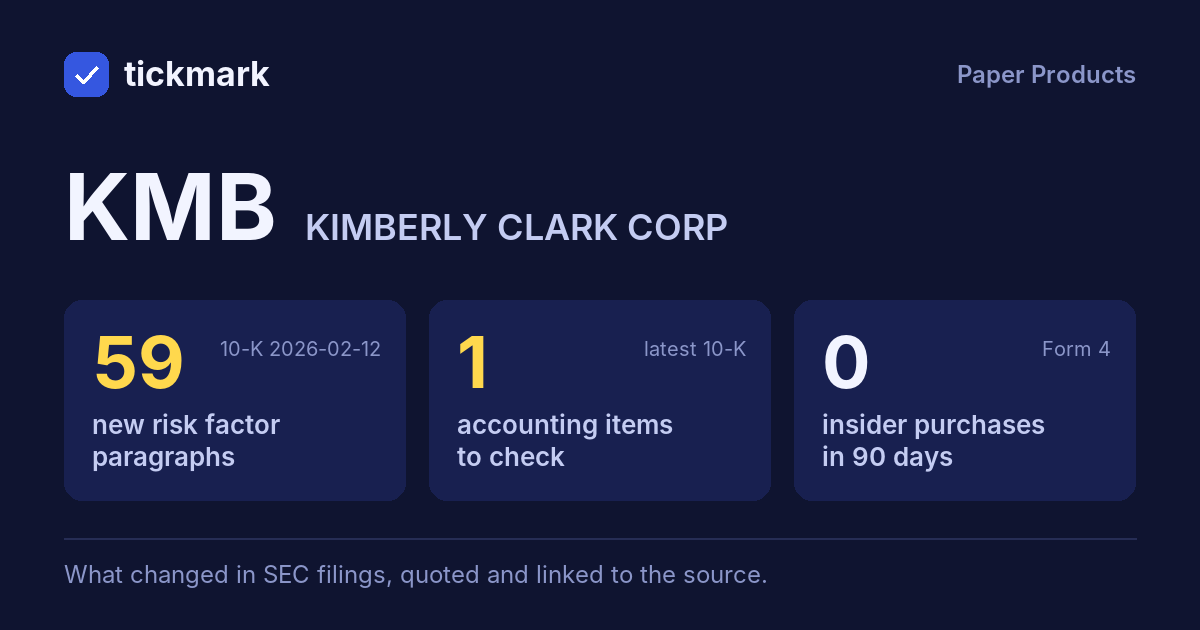
of the text changed · 8,290 words now · 59 new paragraphs, 4 gone
MD&A
31.8%
of the text changed · 9,167 words now · 21 new paragraphs, 13 gone
Legal Proceedings
28.2%
of the text changed · 528 words now
Accounting Policies
26.4%
of the text changed · 3,565 words now
10-K 0001628280-26-007567 (Feb 12, 2026) vs 10-K 0000055785-25-000013 (Feb 13, 2025)
Every paragraph, and how much of it changed
One bar per paragraph, in the order of the 10-K. Height and colour show the share of its words not in the closest paragraph a year earlier; the tallest bars are new paragraphs.
Risk Factors
117 paragraphs · 59 new · 18 reworded · 4 gone · 10-K Feb 12, 2026 against Feb 13, 2025
New paragraph
Reworded (5% of its words or more)
Same or nearly
Paragraph 38 · 42% changed
Every version of it
We may pursue have pursued, and expect to continue to pursue, various business development activities, including joint ventures, equity investments, licensing agreements and acquisitions or divestitures of product lines or businesses from third parties. Acquisitions businesses. Such activities involve numerous risks, including risk of litigation or regulatory actions, unexpected costs or expenses, difficulties in the assimilation of the operations, technologies, services and products of the acquired product lines or businesses, estimation and assumption of liabilities and contingencies, business disruption during the pendency of or following the proposed transaction, personnel turnover and the diversion of management's attention from other business concerns. Such activities may affect the ability of the Company to maintain relationships with customers, suppliers, employees, stockholders and others. We may be unable to successfully integrate and manage product lines or businesses that we acquire. Divestitures may acquire adversely impact our results if we are unable to offset the dilutive impacts from the loss of revenue associated with the divested products or businesses, or mitigate overhead costs allocated to those businesses. Furthermore, divestitures could adversely affect our ongoing business operations, including by enhancing our competitors' positions or reducing consumer confidence in the future, or our ongoing brands and products. We may be unable to achieve anticipated benefits or cost savings from acquisitions business development activities in the timeframe we anticipate, or at all.
Paragraph 10 · 32% changed
Every version of it
Paragraph 9 · 27% changed
Every version of it
To conduct our business, we rely extensively on information and operational technology systems, many of which are managed, hosted, provided and/or used by third parties and their vendors. These systems include, but are not limited to, programs and processes relating to internal communications and communicating with customers, consumers, vendors, investors and other parties; ordering and managing materials from suppliers; converting materials to finished products; receiving and processing purchase orders and shipping products to customers; processing transactions; storing, processing and transmitting data, including personal confidential information and payment card industry data; supporting employee data processing for our global workforce; hosting, processing and sharing confidential and proprietary research, business and financial information; and complying with financial reporting, regulatory, legal and tax requirements. Furthermore, we sell certain products directly to consumers online and through websites, mobile apps and connected devices, and we also engage in online activities, including data collection, promotions, rebates and customer loyalty and other programs, through which we may receive personal information. A breach or other breakdown in our technology, including a cyberattack, privacy incident, data incident or other event involving us or any of our third-party service providers or vendors could adversely affect our financial condition and results of operations.
Paragraph 15 · 24% changed
Every version of it
We are in the process of upgrading our enterprise resource planning system (known as SAP) to enhance operating efficiencies and provide more effective management of our business operations. We also use various other hardware, software and operating systems that may need to be upgraded or replaced in the near future as such systems cease to be supported by third-party service providers, and may be vulnerable to increased risks, including the risk of security breaches, system failures and disruptions. System upgrades take time, require oversight and may be costly, and pose several challenges, including training of personnel, communication of new rules and procedures, migration of data, increased risk of security breaches, and the potential instability of the new system. Moreover, there is no assurance that the new enterprise resource planning system will meet our current and future business needs or that it will operate as designed. Any significant failure or delay in system upgrades could cause an interruption to our business and adversely affect our operations and financial results.
Paragraph 16 · 24% changed
Every version of it
Paragraph 26 · 22% changed
Every version of it
We continue to implement plans to improve our competitive position by achieving cost reductions in our operations. In March 2024, we announced our 2024 Transformation Initiative intended to improve our focus on growth and reduce our structural cost base by realigning our internal operating and management structure to streamline our global supply chain and improve the efficiency of our corporate and regional overhead cost structures. In addition, we expect ongoing cost savings from our continuous improvement activities. We anticipate these cost savings will result from reducing material costs and manufacturing waste and realizing productivity gains, distribution efficiencies and overhead reductions in each of our business segments and in our corporate functions. Any negative impact these plans have on our relationships with employees, suppliers or customers or any failure to generate the anticipated efficiencies and savings could adversely affect our financial results.
Paragraph 14 · 17% changed
Every version of it
In addition, data incidents or theft of personal information collected by us and our third-party service providers as well as data incidents or theft of our information may occur. We are subject to the laws and regulations of various countries where we operate or do business related to solicitation, collection, processing, transferring, storing or use of consumer, customer, vendor or employee information or related data. These laws and regulations change frequently, and new legislation continues to be introduced and may be interpreted and applied differently from jurisdiction to jurisdiction and may create inconsistent or conflicting requirements. The changes introduced by data privacy and protection regulations increase the complexity of regulations enacted to protect business and personal data and they subject us to additional costs. These laws and regulations also may result in us incurring additional expenses and liabilities in the event of unauthorized access to or disclosure of personal data.
Paragraph 37 · 45% changed
Every version of it
10-K Feb 13, 2025The inability to effectively and efficiently manage acquisitions and divestitures with the results we expect or in the timeframe we anticipate could adversely affect our business, consolidated financial condition, results of operations or liquidity.
10-K Feb 12, 2026
Our engagement in business development activities, including acquisitions or divestitures of product lines or businesses, could impact our business, consolidated financial condition, results of operations or liquidity.
Paragraph 38 · 42% changed
Every version of it
10-K Feb 13, 2025
We may pursue acquisitions of product lines or businesses from third parties. Acquisitions involve numerous risks, including difficulties in the assimilation of the operations, technologies, services and products of the acquired product lines or businesses, estimation and assumption of liabilities and contingencies, personnel turnover and the diversion of management's attention from other business concerns. We may be unable to successfully integrate and manage product lines or businesses that we may acquire in the future, or be unable to achieve anticipated benefits or cost savings from acquisitions in the timeframe we anticipate, or at all.
10-K Feb 12, 2026
We have pursued, and expect to continue to pursue, various business development activities, including joint ventures, equity investments, licensing agreements and acquisitions or divestitures of product lines or businesses. Such activities involve numerous risks, including risk of litigation or regulatory actions, unexpected costs or expenses, difficulties in the assimilation of the operations, technologies, services and products of acquired product lines or businesses, estimation and assumption of liabilities and contingencies, business disruption during the pendency of or following the proposed transaction, personnel turnover and the diversion of management's attention from other business concerns. Such activities may affect the ability of the Company to maintain relationships with customers, suppliers, employees, stockholders and others. We may be unable to successfully integrate and manage product lines or businesses that we acquire. Divestitures may adversely impact our results if we are unable to offset the dilutive impacts from the loss of revenue associated with the divested products or businesses, or mitigate overhead costs allocated to those businesses. Furthermore, divestitures could adversely affect our ongoing business operations, including by enhancing our competitors' positions or reducing consumer confidence in our ongoing brands and products. We may be unable to achieve anticipated benefits or cost savings from business development activities in the timeframe we anticipate, or at all.
Paragraph 10 · 32% changed
Every version of it
10-K Feb 13, 2025To conduct our business, we rely extensively on information and operational technology systems, many of which are managed, hosted, provided and/or used by third parties and their vendors. These systems include, but are not limited to, programs and processes relating to internal communications and communicating with customers, consumers, vendors, investors and other parties; ordering and managing materials from suppliers; converting materials to finished products; receiving and processing purchase orders and shipping products to customers; processing transactions; storing, processing and transmitting data, including personal confidential information and payment card industry data; supporting employee data processing for our global workforce; hosting, processing and sharing confidential and proprietary research, business and financial information; and complying with financial reporting, regulatory, legal and tax requirements. Furthermore, we sell certain products directly to consumers online and through websites, mobile apps and connected devices, and we also engage in online activities, including data collection, promotions, rebates and customer loyalty and other programs, through which we may receive personal information. A breach or other breakdown in our technology, including a cyberattack, privacy incident, data incident or other event involving us or any of our third-party service providers or vendors could adversely affect our financial condition and results of operations.
10-K Feb 12, 2026
sharing confidential and proprietary research, business and financial information; and complying with financial reporting, regulatory, legal and tax requirements. Furthermore, we sell certain products directly to consumers online and through websites, mobile apps and connected devices, and we also engage in online activities, including data collection, promotions, rebates and customer loyalty and other programs, through which we may receive personal information. A breach or other breakdown in our technology, including a cyberattack, privacy incident, data incident or other event involving us or any of our third-party service providers or vendors could adversely affect our financial condition and results of operations.
Paragraph 9 · 27% changed
Every version of it
10-K Feb 13, 2025
To conduct our business, we rely extensively on information and operational technology systems, many of which are managed, hosted, provided and/or used by third parties and their vendors. These systems include, but are not limited to, programs and processes relating to internal communications and communicating with customers, consumers, vendors, investors and other parties; ordering and managing materials from suppliers; converting materials to finished products; receiving and processing purchase orders and shipping products to customers; processing transactions; storing, processing and transmitting data, including personal confidential information and payment card industry data; supporting employee data processing for our global workforce; hosting, processing and sharing confidential and proprietary research, business and financial information; and complying with financial reporting, regulatory, legal and tax requirements. Furthermore, we sell certain products directly to consumers online and through websites, mobile apps and connected devices, and we also engage in online activities, including data collection, promotions, rebates and customer loyalty and other programs, through which we may receive personal information. A breach or other breakdown in our technology, including a cyberattack, privacy incident, data incident or other event involving us or any of our third-party service providers or vendors could adversely affect our financial condition and results of operations.
10-K Feb 12, 2026
To conduct our business, we rely extensively on information and operational technology systems, many of which are managed, hosted, provided and/or used by third parties and their vendors. These systems include, but are not limited to, programs and processes relating to internal communications and communicating with customers, consumers, vendors, investors and other parties; ordering and managing materials from suppliers; converting materials to finished products; receiving and processing purchase orders and shipping products to customers; processing transactions; storing, processing and transmitting data, including personal confidential information and payment card industry data; supporting employee data processing for our global workforce; hosting, processing and
Paragraph 15 · 24% changed
Every version of it
10-K Feb 13, 2025
We are in the process of upgrading our enterprise resource planning system (known as SAP) to enhance operating efficiencies and provide more effective management of our business operations. We also use various other hardware, software and operating systems that may need to be upgraded or replaced in the near future as such systems cease to be supported by third-party service providers, and may be vulnerable to increased risks, including the risk of security breaches, system failures and disruptions. System upgrades take time, require oversight and may be costly, and pose several challenges, including training of personnel, communication of new rules and procedures, migration of data, increased risk of security breaches, and the potential instability of the new system. Moreover, there is no assurance that the new enterprise resource planning system will meet our current and future business needs or that it will operate as designed. Any significant failure or delay in system upgrades could cause an interruption to our business and adversely affect our operations and financial results.
10-K Feb 12, 2026
We are in the process of upgrading our enterprise resource planning system (known as SAP) to enhance operating efficiencies and provide more effective management of our business operations. We also use various other hardware, software and operating systems that may need to be upgraded or replaced in the near future as such systems cease to be supported by third-party service providers, and may be vulnerable to increased risks, including the risk of security breaches, system failures and disruptions. System upgrades take time, require oversight and
Paragraph 16 · 24% changed
Every version of it
10-K Feb 13, 2025We are in the process of upgrading our enterprise resource planning system (known as SAP) to enhance operating efficiencies and provide more effective management of our business operations. We also use various other hardware, software and operating systems that may need to be upgraded or replaced in the near future as such systems cease to be supported by third-party service providers, and may be vulnerable to increased risks, including the risk of security breaches, system failures and disruptions. System upgrades take time, require oversight and may be costly, and pose several challenges, including training of personnel, communication of new rules and procedures, migration of data, increased risk of security breaches, and the potential instability of the new system. Moreover, there is no assurance that the new enterprise resource planning system will meet our current and future business needs or that it will operate as designed. Any significant failure or delay in system upgrades could cause an interruption to our business and adversely affect our operations and financial results.
10-K Feb 12, 2026
may be costly, and pose several challenges, including training of personnel, communication of new rules and procedures, migration of data, increased risk of security breaches, and the potential instability of the new system. Moreover, there is no assurance that the new enterprise resource planning system will meet our current and future business needs or that it will operate as designed. Any significant failure or delay in system upgrades could cause an interruption to our business and adversely affect our operations and financial results.
Paragraph 26 · 22% changed
Every version of it
10-K Feb 13, 2025
we expect ongoing cost savings from our continuous improvement activities. We anticipate these cost savings will result from reducing material costs and manufacturing waste and realizing productivity gains, distribution efficiencies and overhead reductions in each of our business segments and in our corporate functions. Any negative impact these plans have on our relationships with employees, suppliers or customers or any failure to generate the anticipated efficiencies and savings could adversely affect our financial results.
10-K Feb 12, 2026
We continue to implement plans to improve our competitive position by achieving cost reductions in our operations. In March 2024, we announced our 2024 Transformation Initiative intended to improve our focus on growth and reduce our structural cost base by realigning our internal operating and management structure to streamline our global supply chain and improve the efficiency of our corporate and regional overhead cost structures. In addition, we expect ongoing cost savings from our continuous improvement activities. We anticipate these cost savings will result from reducing material costs and manufacturing waste and realizing productivity gains, distribution efficiencies and overhead reductions in each of our business segments and in our corporate functions. Any negative impact these plans have on our relationships with employees, suppliers or customers or any failure to generate the anticipated efficiencies and savings could adversely affect our financial results.
Paragraph 14 · 17% changed
Every version of it
10-K Feb 13, 2025
In addition, data incidents or theft of personal information collected by us and our third-party service providers as well as data incidents or theft of our information may occur. We are subject to the laws and regulations of various countries where we operate or do business related to solicitation, collection, processing, transferring, storing or use of consumer, customer, vendor or employee information or related data. These laws and regulations change frequently, and new legislation continues to be introduced and may be interpreted and applied differently from
10-K Feb 12, 2026
In addition, data incidents or theft of personal information collected by us and our third-party service providers as well as data incidents or theft of our information may occur. We are subject to the laws and regulations of various countries where we operate or do business related to solicitation, collection, processing, transferring, storing or use of consumer, customer, vendor or employee information or related data. These laws and regulations change frequently, and new legislation continues to be introduced and may be interpreted and applied differently from jurisdiction to jurisdiction and may create inconsistent or conflicting requirements. The changes introduced by data privacy and protection regulations increase the complexity of regulations enacted to protect business and personal data and they subject us to additional costs. These laws and regulations also may result in us incurring additional expenses and liabilities in the event of unauthorized access to or disclosure of personal data.
MD&A
143 paragraphs · 21 new · 72 reworded · 13 gone · 10-K Feb 12, 2026 against Feb 13, 2025
New paragraph
Reworded (5% of its words or more)
Same or nearly
Paragraph 54 · 50% changed
Paragraph 126 · 48% changed
Paragraph 64 · 47% changed
Net sales of $5.9 $10.8 billion decreased 2.6% 2.4%, as unfavorable currency impacts the exit of 7.9% were the private label diaper business in the US was partially offset by a 5.3% increase in organic sales. sales growth. Organic sales benefited from higher net selling prices of 7.9%, increased 1.8% primarily from hyperinflationary economies, and product mix volume gains of 1.6%, 2.6%, with all categories growing volume, partially offset by lower volumes. pricing and mix.
Paragraph 69 · 47% changed
Cash provided by operations for the year ended December 31, 2024 2025 was $3.2 $2.8 billion compared to $3.5 $3.2 billion in the prior year. Cash flow from operations benefited from higher operating profit, excluding the effect of non-cash charges, however this increase The decrease was more than offset by changes in working capital relative to the prior year coupled with cash payments for the 2024 Transformation Initiative. The impact to cash from working capital was primarily driven by the lower operating profit and timing impacts to working capital, including incremental restructuring and IFP Transaction separation cost payments of cash flows associated with the lapping of higher commodity and energy costs in prior periods. approximately $110.
Paragraph 56 · 46% changed
Paragraph 53 · 43% changed
Paragraph 67 · 43% changed
Operating profit of $632 million $796 decreased 5.7% 3.6% primarily due to unfavorable pricing net of cost inflation, supply chain related investments and currency impacts, higher advertising and promotion expenses, and lower volumes, partially offset by favorable pricing net of inflation. Pricing gross productivity savings, lower marketing, research and unfavorable currency impacts were primarily driven by hyperinflationary economies. general expenses and volume and mix gains.
Paragraph 133 · 42% changed
The following table provides a reconciliation of the Adjusted Effective Tax Rate: Organic Sales Growth from continuing operations:
Paragraph 54 · 50% changed
10-K Feb 13, 2025•Softex Tax Reserve Release - In 2024, we released a reserve for an uncertain tax position related to the prior year impairment of certain Softex intangible assets.
10-K Feb 12, 2026
The effective tax rate was 29.2% compared to 18.3% in the prior year. The increase was primarily due to incremental tax charges relating to a valuation allowance on current and prior year U.S. foreign tax credits due to provisions within the One Big Beautiful Bill Act ("OBBBA"), coupled with tax benefits recognized in the prior year for the release of an uncertain tax position reserve related to the impairment for certain Softex intangible assets. The adjusted effective tax rate was 22.8%, in line with the prior year.
Paragraph 126 · 48% changed
10-K Feb 13, 2025•Impairment of Intangible Assets - In 2024 and 2023, we recognized charges related to the impairment of certain intangible assets related to Softex and Thinx. See Item 8, Note 4 to the consolidated financial statements for details.
10-K Feb 12, 2026
•Kenvue Acquisition - Acquisition-related costs incurred in connection with the pending Kenvue Acquisition, primarily related to external advisory, legal, accounting, and other related costs. See Item 8, Note 4 to the Consolidated Financial Statements for details.
Paragraph 64 · 47% changed
10-K Feb 13, 2025
Net sales of $5.9 billion decreased 2.6% as unfavorable currency impacts of 7.9% were partially offset by a 5.3% increase in organic sales. Organic sales benefited from higher net selling prices of 7.9%, primarily from hyperinflationary economies, and product mix gains of 1.6%, partially offset by lower volumes.
10-K Feb 12, 2026
Net sales of $10.8 billion decreased 2.4%, as the exit of the private label diaper business in the US was partially offset by organic sales growth. Organic sales increased 1.8% primarily from volume gains of 2.6%, with all categories growing volume, partially offset by lower pricing and mix.
Paragraph 69 · 47% changed
10-K Feb 13, 2025
Cash provided by operations for the year ended December 31, 2024 was $3.2 billion compared to $3.5 billion in the prior year. Cash flow from operations benefited from higher operating profit, excluding the effect of non-cash charges, however this increase was more than offset by changes in working capital relative to the prior year coupled with cash payments for the 2024 Transformation Initiative. The impact to cash from working capital was primarily driven by the timing of cash flows associated with the lapping of higher commodity and energy costs in prior periods.
10-K Feb 12, 2026
Cash provided by operations for the year ended December 31, 2025 was $2.8 billion compared to $3.2 billion in the prior year. The decrease was driven by lower operating profit and timing impacts to working capital, including incremental restructuring and IFP Transaction separation cost payments of approximately $110.
Paragraph 56 · 46% changed
10-K Feb 13, 2025Operating profit of $2.5 billion increased 1.1% primarily due to gross productivity savings and volume growth, partially offset by incremental manufacturing costs and higher advertising and promotion expenses.
10-K Feb 12, 2026
Income from discontinued operations, net of income taxes of $400 increased 3.6% primarily due to gross productivity savings and a reduction in depreciation and amortization expense of $70, partially offset by pre-tax separation costs of $77.
Paragraph 53 · 43% changed
10-K Feb 13, 2025Net income of $2.5 billion for the year ended December 31, 2024 increased 44.3% primarily due to the increase in operating profit discussed above. Net interest expense of $222 was largely in line with the prior year period. Our share of net income of equity companies was $216 million, an increase of 10.2% primarily driven by Kimberly-Clark de Mexico, S.A.B. de C.V., which benefited from volume, mix and pricing growth and productivity savings, partially offset by unfavorable foreign currency effects and higher general and administrative expenses. The effective tax rate was 19.3% in 2024 compared to 22.4% in 2023, with the decline primarily due to the net benefit of items not reflective of our underlying operations discussed in the section above. Excluding these benefits, the adjusted effective tax rate was 23.0% in 2024 compared to 23.2% in 2023.
10-K Feb 12, 2026
Our share of net income of equity companies was $196 compared to $216 in the prior year. The decrease was primarily driven by Kimberly-Clark de Mexico, S.A.B. de C.V., due to unfavorable currency effects and higher input costs, partially offset by pricing, productivity savings and lower general and administrative expenses.
Paragraph 67 · 43% changed
10-K Feb 13, 2025
Operating profit of $632 million decreased 5.7% primarily due to unfavorable currency impacts, higher advertising and promotion expenses, and lower volumes, partially offset by favorable pricing net of inflation. Pricing and unfavorable currency impacts were primarily driven by hyperinflationary economies.
10-K Feb 12, 2026
Operating profit of $796 decreased 3.6% primarily due to unfavorable pricing net of cost inflation, supply chain related investments and currency impacts, partially offset by gross productivity savings, lower marketing, research and general expenses and volume and mix gains.
Paragraph 133 · 42% changed
10-K Feb 13, 2025
The following table provides a reconciliation of the Adjusted Effective Tax Rate:
10-K Feb 12, 2026
The following table provides a reconciliation of Organic Sales Growth from continuing operations:
A paragraph is matched with the one last year that shares the most of its words; under half in common makes it new. The paragraphs shown are the 8 reworded the most in each section.
The paragraph that changed most in each section
The redline
Marked against last year's 10-K: cut words struck through, new words highlighted.
MD&A199 words changed in this paragraph; it is 65% similar to last year's version.
The assumptions used as a basis for the forward-looking statements include many estimates that, among other things, depend on the successful completion of the mergers and the achievement of future cost savings and projected volume increases. In addition, many factors outside our control, including risks and uncertainties around the pending mergers (including the risk that the anticipated benefits and synergies of the mergers may not be realized when expected or at all, the terms and scope of the expected financing in connection with the mergers may prove to be less favorable than currently expected, that the mergers may not be completed in a timely matter or at all and the risk of litigation related to the mergers), the pending IFP Transaction (including risks related to delays or failure to complete the proposed transaction, the incurrence of significant transaction and separation costs, adverse market reactions, regulatory or legal challenges, and operational disruptions), risks that we are not able to realize the anticipated benefits of the 2024 Transformation Initiative (including risks related to disruptions to our business or operations or related to any delays in implementation), war in Ukraine (including the related responses of consumers, customers, and suppliers and sanctions issued by the U.S., the European Union, Russia or other countries), government trade or similar regulatory actions (including current and potential trade and tariff actions affecting the countries where we operate and the resulting negative impacts on our supply chain, commodity costs, and consumer spending), pandemics, epidemics, fluctuations in foreign currency exchange rates, the prices and availability of our raw materials, supply chain disruptions, disruptions in the capital and credit markets, counterparty defaults (including customers, suppliers and financial institutions with which we do business), failure to realize the expected benefits or synergies from our acquisition and disposition activity, impairment of goodwill and intangible assets and our projections of operating results and other factors that may affect our impairment testing, changes in customer preferences, severe weather conditions, regional instabilities and hostilities (including hostilities, potential competitive pressures on selling prices for our products, energy costs, general economic and political conditions globally and in the war markets in Israel), government trade or similar regulatory actions, which we do business, as well as our ability to maintain key customer relationships, could affect the realization of these estimates.
Source: Item 7, 10-K 0001628280-26-007567 vs Item 7, 10-K 0000055785-25-000013
Accounting Policies176 words changed in this paragraph; it is 71% similar to last year's version.
Our policies allow the use of derivatives for risk management purposes and prohibit their use for speculation. Our policies also prohibit the use of any leveraged derivative instrument. Consistent with our policies, foreign currency Our derivative instruments, interest rate swaps and locks, and the majority of commodity hedging contracts instruments are primarily entered into with a diversified group of major financial institutions, which limits our credit exposure under these arrangements. At inception, we formally designate certain derivatives as cash flow, fair value or net investment hedges and establish how the effectiveness of these hedges will be assessed and measured. This process links the derivatives to the transactions or financial balances they are hedging. Changes in the fair value of derivatives not designated as hedging instruments are recorded in earnings as they occur. All derivative instruments are recorded as assets or liabilities on the balance sheet at fair value. Changes in the fair value of derivatives are either recorded in the income statement or other comprehensive income, as appropriate. The gain or loss on derivatives designated as fair value hedges and the offsetting loss or gain on the hedged item attributable to the hedged risk are included in income in the period that changes in fair value occur. The gain or loss on derivatives designated as cash flow hedges is included in other comprehensive income in the period that changes in fair value occur, and is reclassified to income in the same period that the hedged item affects income. The gain or loss on derivatives designated as hedges of investments in foreign subsidiaries is recognized in other comprehensive income to offset the change in value of the net investments being hedged. Certain foreign-currency and commodity derivative instruments, not designated as hedging instruments, have been entered into to manage certain non-functional currency denominated monetary assets and liabilities, as well as changes in prices of certain commodities, respectively. The gain or loss on these derivatives is included in income in the period that changes in their fair values occur. Cash flows from derivatives are classified within the Consolidated Statements of Cash Flows in the same category as the items being hedged. Cash flows from derivatives are classified within Operating Activities, except for derivatives designated as net investment hedges which are classified in Investing Activities. See Note 13 for disclosures about derivative instruments and hedging activities.
Source: Item 8, Note 1 – Accounting Policies, 10-K 0001628280-26-007567 vs Item 8, Note 1 – Accounting Policies, 10-K 0000055785-25-000013
Risk Factors142 words changed in this paragraph; it is 53% similar to last year's version.
We may pursue have pursued, and expect to continue to pursue, various business development activities, including joint ventures, equity investments, licensing agreements and acquisitions or divestitures of product lines or businesses from third parties. Acquisitions businesses. Such activities involve numerous risks, including risk of litigation or regulatory actions, unexpected costs or expenses, difficulties in the assimilation of the operations, technologies, services and products of the acquired product lines or businesses, estimation and assumption of liabilities and contingencies, business disruption during the pendency of or following the proposed transaction, personnel turnover and the diversion of management's attention from other business concerns. Such activities may affect the ability of the Company to maintain relationships with customers, suppliers, employees, stockholders and others. We may be unable to successfully integrate and manage product lines or businesses that we acquire. Divestitures may acquire adversely impact our results if we are unable to offset the dilutive impacts from the loss of revenue associated with the divested products or businesses, or mitigate overhead costs allocated to those businesses. Furthermore, divestitures could adversely affect our ongoing business operations, including by enhancing our competitors' positions or reducing consumer confidence in the future, or our ongoing brands and products. We may be unable to achieve anticipated benefits or cost savings from acquisitions business development activities in the timeframe we anticipate, or at all.
Source: Item 1A, 10-K 0001628280-26-007567 vs Item 1A, 10-K 0000055785-25-000013
Legal Proceedings122 words changed in this paragraph; it is 59% similar to last year's version.
Source: Item 3, via Note 12 – Legal Matters, 10-K 0001628280-26-007567 vs Item 3, via Note 11 – Legal Matters, 10-K 0000055785-25-000013
Sentences and paragraphs added, removed or reworded
Every change, by type
Sentences and paragraphs of KMB's Risk Factors and MD&A, 10-K Feb 12, 2026 against 10-K Feb 13, 2025. Each links to the text at sec.gov.
Quiet changes are sentences kept from last year with one to four words changed, at least one of them a hedge, a modal or a qualifier (may, could, will, not, significant, material…). A year or date rolling forward is not counted.
The full word list
adverse, adversely, all, although, anticipate, anticipates, any, approximately, believe, believes, can, cannot, certain, could, expect, expects, generally, however, if, intend, intends, largely, likely, many, material, materially, may, might, most, must, never, no, not, possible, primarily, probable, should, significant, significantly, some, substantial, substantially, unlikely, will, would
No changes of this type found.
Sources
The two latest 10-Ks on EDGAR, section by section. Each change links to the text at sec.gov.
Also
New risk factors: paragraphs with nothing like them last year, quoted in full.
Work with it
Excel workbook · CSV. Google Sheet that stays up to date: paste =IMPORTDATA("https://tickdelta.com/company/KMB/export.csv") into a cell.