Added10-Q Oct 22, 2026 vs 10-K Feb 2, 2026
Laws and regulations regarding the development and operation of data centers could adversely affect demand for our distributed power solutions.
Each branch is a paragraph in Risk Factors with nothing like it in the 10-K filed Feb 6, 2025. A box jumps to the paragraph as filed, below.
26 paragraphs in Risk Factors of the 10-K filed Feb 2, 2026 with nothing like them in the 10-K filed Feb 6, 2025. Quoted exactly. Paragraphs that were only edited are under 10-K change.
The following is a summary of the certain risks that we believe apply to our business and the industry in which we operate:
•Power generating operations performance involves significant risks and hazards and may be below expected levels of output or efficiency.
•A distributed power business is dependent on our relationships with key suppliers to obtain equipment requiring significant capital commitments and may be on terms and conditions that limit our ability to adjust to changing market conditions.
•We may be unable to adapt our distributed power technologies to meet increasing customer needs and power loads, which could result in increased downtime of our power generation offering and disruptions to the power supply to our customers.
•Distributed power solutions in some applications could be affected by availability of the electrical grid.
•Distributed power systems involve long and uncertain sales cycles, and we may not be successful in converting our sales prospects into revenue generating contracts.
Moreover, while we have and may continue to create and publish voluntary disclosures regarding ESG matters from time to time, many of the statements in those voluntary disclosures are based on hypothetical expectations and assumptions that may
Power generating operations performance involves significant risks and hazards and may be below expected levels of output or efficiency.
The operation of a distributed power business involves risks, including the breakdown or failure of power generation equipment, pipelines or other equipment or processes, performance below expected levels of output or efficiency and risks related to the creditworthiness of our contract counterparties and the creditworthiness of our counterparties’ customers or other parties, with whom our counterparties have contracted. Our power plants could experience unplanned outages, including extensions of scheduled outages due to equipment breakdowns, failures or other problems which are an inherent risk of our business. Unplanned outages typically can result in lost revenues, inability to perform and potential recognition of liquidated damages owed and/or termination of existing long-term power purchase agreements, increase our maintenance expenses and may reduce our profitability, which could have a material adverse effect on our financial condition, results of operations and cash flows.
A distributed power business is dependent on our relationships with key suppliers to obtain equipment requiring significant capital commitments and may be on terms and conditions that limit our ability to adjust to changing market conditions.
A distributed power business can be dependent on a limited number of key suppliers for access to the unique equipment used in this line of business. If we fail to maintain adequate relationships with such suppliers or if we fail to receive equipment from our suppliers in a timely manner, then our competitive position may be harmed and our operations, financial conditions and/or cash flows may be negatively impacted.
In addition, the prices of certain equipment used in our distributed power business may continue to experience inflationary pressures and be subject to tariffs that could further increase such costs. We may not be able to pass on these costs to our customers or, if we do pass on these costs, our customers may seek out alternatives to us, which could have a material adverse impact on our results of operations, financial condition and/or cash flows.
Unavailability of, and lengthy delays in obtaining, the necessary equipment may result from a number of factors affecting our suppliers, including capacity constraints, labor shortages or disputes, supplier product quality issues, the impact of tariffs and other federal trade policy and suppliers’ allocations to other purchasers. These risks can be magnified in a weak economic environment or following increases in demand arising from an economic downturn, but are also generally present due to the nature of our business and our dependence on highly-specialized equipment, some of which is sourced internationally. Such disruptions could result in our inability to effectively meet the needs of our customers and could result in a material adverse effect on operations, financial condition and/or cash flows.
In order to secure inventory and equipment for our distributed power business, we have and may continue to make nonrefundable deposits and advance payments to vendors and enter into noncancellable commitments with vendors that could limit our ability to adjust to changing market conditions. In addition, we have and may continue to strategically purchase inventory and equipment in advance of demand to take advantage of concerns about future availability, which could adversely
affect our working capital and cash flow. If we fail to anticipate expected customer demand, an oversupply could result in excess inventory and equipment. Furthermore, as a result of high demand and limited supply for certain inventory and equipment needed by our distributed power business, we have and may continue to enter into long-term purchase commitments with vendors that obligate us to make purchases at prices, and on contractual terms and conditions, that are less favorable to us. In addition, our competitors may obtain inventory and equipment from the same vendors that we utilize. Our competitors may obtain better pricing, more favorable contractual terms and conditions, or more favorable allocations of inventory and equipment, and our ability to engage in relationships with certain vendors could be limited.
We may be unable to adapt our distributed power technologies to meet increasing customer needs and power loads, which could result in increased downtime of our power generation offering and disruptions to the power supply to our customers.
Demand for power has continued to significantly outpace available power generation supply from the grid, with the electrification of the oil and natural gas industry, as an example, straining aging and unreliable power grids. Further, the expanding use of artificial intelligence has led to the expansion of existing data centers and plans for new data centers. As we expand distributed power offerings, the possibility exists that our planned offerings may not be able to effectively manage related power loads, resulting in potential downtimes and disruptions for our customers. Such experiences could have a material adverse effect on our business and operating results due to the damage to our reputation and the resulting dissatisfaction of customers.
In addition, the sustainability of the favorable supply-demand dynamic in the power sector depends on multiple factors, including factors relating to technological advancements such as continued demand growth for generative AI computing applications, cloud computing, the level and pace at which the power industry can invest in power infrastructure and the pace of continued electrification-driven demand growth.
Distributed power solutions in some applications could be affected by availability of the electrical grid.
Distributed power solutions are an alternative for customers to consider when grid access is unavailable, cost prohibitive, or delayed. Our distributed power service offering could be adversely affected if grid power becomes readily available to customers on terms that are more attractive than those that we offer. Should this occur, customers may decide not to use our service offering or use it only until interconnected to the grid or as backup power thereafter. If this occurs, we may not be able to achieve our expected returns and our results of operations and cash flow may be adversely impacted.
The power industry is evolving rapidly, driven by increased demand from numerous end-markets, including those in the data center and energy businesses. Should increased competition continue, the portion of the total addressable market that we could capture with our distributed power business will be lower than expected, which could translate to lower than expected revenues. Additionally, as a result of increased demand for data centers and other consumers of distributed power, we will compete with a variety of energy providers. Our competitors may have greater access to capital, more established customer bases, deeper vendor relationships and fewer regulatory hurdles. In addition, the AI infrastructure segment is rapidly developing. Technological developments may require significant capital investment and continuous innovation. We may be unable to meet these evolving demands, resulting in lost business or underutilized capacity.
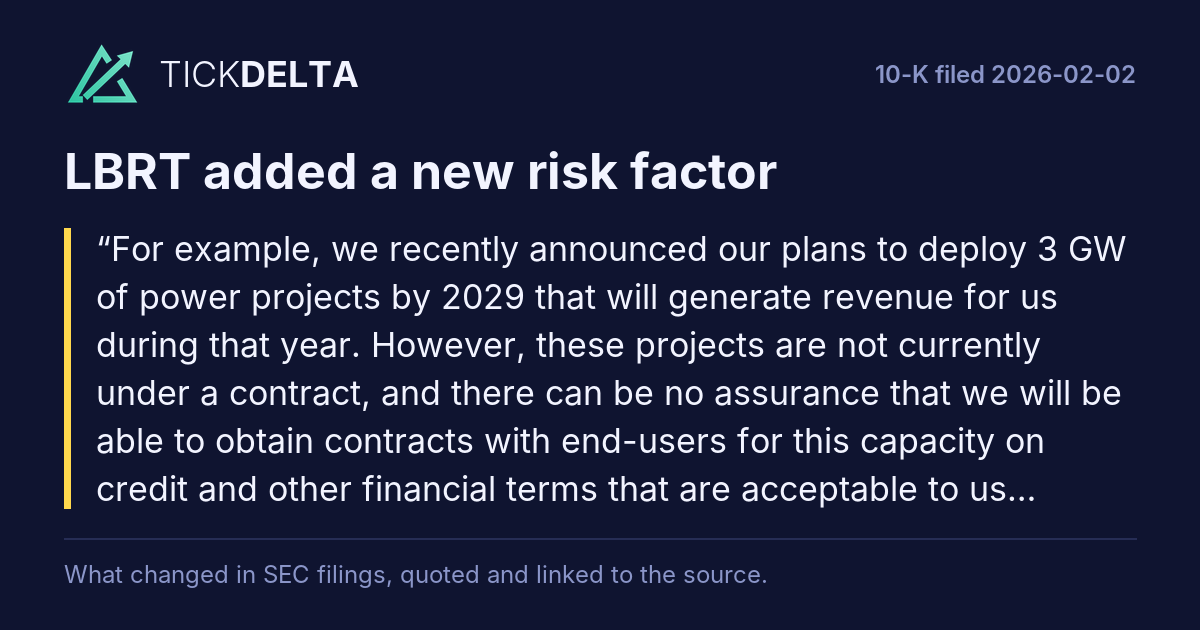
Distributed power systems involve long and uncertain sales cycles, and we may not be successful in converting our sales prospects into revenue generating contracts.
For example, we recently announced our plans to deploy 3 GW of power projects by 2029 that will generate revenue for us during that year. However, these projects are not currently under a contract, and there can be no assurance that we will be able to obtain contracts with end-users for this capacity on credit and other financial terms that are acceptable to us. Moreover, the final terms of these contracts are still subject to negotiation, and these ultimate terms may not match our modeled returns. Finally, even if we are able to obtain successful contracts, there may be delays in the actual deployment of this capacity and revenue generation due to factors that include, among others, supply chain issues, delays in receiving needed permits, inability to obtain adequate natural gas supply and overall delays with construction.
We have also recently announced a development agreement with Vantage Data Centers for at least 1 GW of power development over the next five years. However, this contract is not with the end-user of the eventual data center for actual provision of power, and while Vantage plans to work with us in concert with their customers, we must still secure these opportunities with the data center end user and arrive on acceptable final contract terms. In addition, our announced preliminary
reservation and energy services agreement with a data center developer in Texas for 330 MW of power still is subject to executing a final, binding contract for us to deploy the associated generation and realize revenue from that project.
Any failure to obtain these contracts on terms that are acceptable to us or delays in deployment could result in an adverse impact to our results of operation and financial condition.
New in the latest 10-Q
14 paragraphs in the 10-Q filed Oct 22, 2026 with nothing like them in the 10-Q filed Jul 23, 2026 (at least half the words must differ; new numbers alone do not count). Quoted exactly, grouped by the item heading above them. This is text that changed, not a judgement of how serious it is.
Nine Months Ended September 30, 2026 2025 ──────────────────────────────────────────────────────────────────────────────────────────────────────────────────────────────────────────── Supplemental disclosure of cash flow information: Net (refund received) cash paid for income taxes $ (2,936) $23,076 Cash paid for interest $ 20,188 $30,261 Non-cash investing and financing activities: Capital expenditures included in accounts payable and accrued liabilities $ 91,339 $70,986 Capital expenditures reclassified from prepaid and other current assets $ — $41,883 Capital expenditures reclassified from finance lease right-of-use assets $ — $907
Read in the 10-Q
On October 20, 2026, the Company entered into the second amendment to the Credit Agreement (the "Second Amendment") which, effective September 30, 2026, temporarily increases the maximum permitted leverage ratio from 3.50 to 1.00 to 4.50 to 1.00 for the fiscal quarters ending September 30, 2026 through March 31, 2027, with step-downs to 4.25 to 1.00 for the fiscal quarter ending June 30, 2027, 4.00 to 1.00 for fiscal quarter ending September 30, 2027, and 3.75 to 1.00 for the fiscal quarter ending December 31, 2027, before returning to 3.50 to 1.00 for each fiscal quarter ending on or after March 31, 2028. The Second Amendment also removed the $ 25.0 million limitation on the deduction of unrestricted cash and cash equivalents in calculating the leverage ratio and senior leverage ratio for purposes of testing compliance with such financial covenants when no loans are outstanding.
Read in the 10-Q
The Company was in compliance with these covenants, as amended by the Second Amendment as of September 30, 2026.
Read in the 10-Q
The following customers comprised 10% or more of the Company’s consolidated revenues:
Read in the 10-Q
On July 25, 2022, the Company’s board of directors (the “Board”) authorized and the Company announced a share repurchase program that allowed the Company to repurchase the Company’s Class A Common Stock. The share repurchase program expired on July 31, 2026.
Read in the 10-Q
For the three months ended September 30, 2026, the Company reported a net loss. Accordingly, approximately 3.8 million potential common shares related to outstanding restricted stock units and performance stock units were excluded from the calculation of diluted loss per share because their inclusion would have been anti-dilutive.
Read in the 10-Q
In addition to the commitments discussed above, the Company has entered into various equipment supply contracts for the purchase of power generation equipment, including engines, balance of plant equipment, and related services for our distributed power solutions business.
Read in the 10-Q
Global oil and refined product prices strengthened during the quarter amid ongoing geopolitical conflicts and disruptions to energy infrastructure. These conditions have contributed to uncertainty regarding global energy supplies and reinforced the strategic importance of North American oil and natural gas resources. Market expectations for prolonged supply disruptions, coupled with the potential for eventual replenishment of strategic petroleum reserves, have sustained the oil risk premium and supported stronger forward prices heading into 2027. North American natural gas fundamentals remain more balanced, as strong summer demand was outpaced by record production and ample inventories. Over the longer term LNG exports and growing power consumption from AI and data center development are expected to drive North American natural gas demand growth.
Read in the 10-Q
North American frac market conditions improved during the quarter, supported by modestly higher completions activity and stronger producer economics. Ongoing fleet attrition, equipment cannibalization, and industry underinvestment have constrained available capacity and supported continued improvement in service pricing. For the fourth quarter of 2026, we expect typical weather and holiday seasonality in our frac activity to be partially offset by activity deferred from the third quarter and continued strength in demand.
Read in the 10-Q
The change in transaction and other costs during the three months ended September 30, 2026 compared to the three months ended September 30, 2025 was not material.
Read in the 10-Q
The decrease in the gain on disposal of assets, net during the three months ended September 30, 2026 compared to the three months ended September 30, 2025 was not material.
Read in the 10-Q
The decrease in EBITDA was primarily attributable to an unrealized mark-to-market loss on investments in the Company's portfolio, partially offset by an increase in operating income, driven by increases in revenue out pacing the increase in operating expenses during the three months ended September 30, 2026 compared to the same period in 2025.
Read in the 10-Q
Under our share repurchase program, the Company was authorized to repurchase up to $750.0 million of outstanding Class A Common Stock through and including July 31, 2026. The Company did not repurchase or retire any shares of Class A Common Stock under the share repurchase program during the three or nine months ended September 30, 2026.
Read in the 10-Q
On October 20, 2026, Liberty Energy Services LLC, Freedom Proppant LLC, Liberty Power Innovations LLC, LOS Leasing Company LLC, Liberty Advanced Equipment Technologies LLC, Proppant Express Solutions, LLC and Liberty Wholesale Commodities LLC, as borrowers, and the Company, as parent guarantor, entered into the Second Amendment with JPMorgan Chase Bank, N.A., as administrative agent, and the lenders party thereto. The Second Amendment, which, effective as of September 30, 2026, temporarily increases the maximum permitted leverage ratio from 3.50 to 1.00 to 4.50 to 1.00 for the fiscal quarters ending September 30, 2026 through March 31, 2027, with step-downs to 4.25 to 1.00 for the fiscal quarter ending June 30, 2027, 4.00 to 1.00 for the fiscal quarter ending September 30, 2027 and 3.75 to 1.00 for the fiscal quarter ending December 31, 2027, before returning to 3.50 to 1.00 for each fiscal quarter ending on or after March 31, 2028. The Second Amendment also removed the $25.0 million limitation on the deduction of unrestricted cash and cash equivalents in
Read in the 10-Q
Item 1A of the 10-Q filed Oct 22, 2026 against Item 1A of the 10-K filed Feb 2, 2026.
A 10-Q repeats only the risks that changed, so a 10-K paragraph that is missing from it is not counted as removed.
Added is a paragraph with nothing like it in the 10-K, Reworded a sentence that is in both with several words changed,
Quiet changes a sentence in both where one to four words changed and one is a hedge or a modal
(cut words struck through, new words highlighted).
Text on the page, not a score; each links to the filing at sec.gov.
What the 10-Q itself says about its risk factors:In addition to the risk factors and other information set forth in this Quarterly Report, you should carefully consider the risk factors and other cautionary statements described under the heading “Item 1A. Risk Factors” included in the Annual Report and the risk factors and other cautionary statements contained in our other SEC filings, which could materially affect our businesses, financial condition or future results.
Read in the 10-Q
What the 10-Q itself says about its risk factors:There have been no material changes to the risk factors in the Annual Report except as follows:
Read in the 10-Q
Two-word phrases in Risk Factors of the 10-K filed Feb 2, 2026 that are in none of the 1 earlier 10-Ks stored, back to Feb 6, 2025
Used at least twice, small words left out. Counted, not picked: a phrase can be new because the company renamed something.
5 paragraphs of last year's Risk Factors with nothing like them now. The longest are quoted.
Item 1A of each 10-K and 10-Q on EDGAR, quoted exactly. Each paragraph links to the filing at sec.gov.
10-K change: what was reworded or cut, section by section.
Excel workbook · CSV. Google Sheet that stays up to date: paste =IMPORTDATA("https://tickdelta.com/company/LBRT/export.csv") into a cell.