Centrus Energy Corp LEU
New risk paragraphs, branching off last year
Each branch is a paragraph in Risk Factors with nothing like it in the 10-K filed Feb 7, 2025. A box jumps to the paragraph as filed, below.
Paragraphs with nothing like them in last year's 10-K
17 paragraphs in Risk Factors of the 10-K filed Feb 11, 2026 with nothing like them in the 10-K filed Feb 7, 2025. Quoted exactly. Paragraphs that were only edited are under 10-K change.
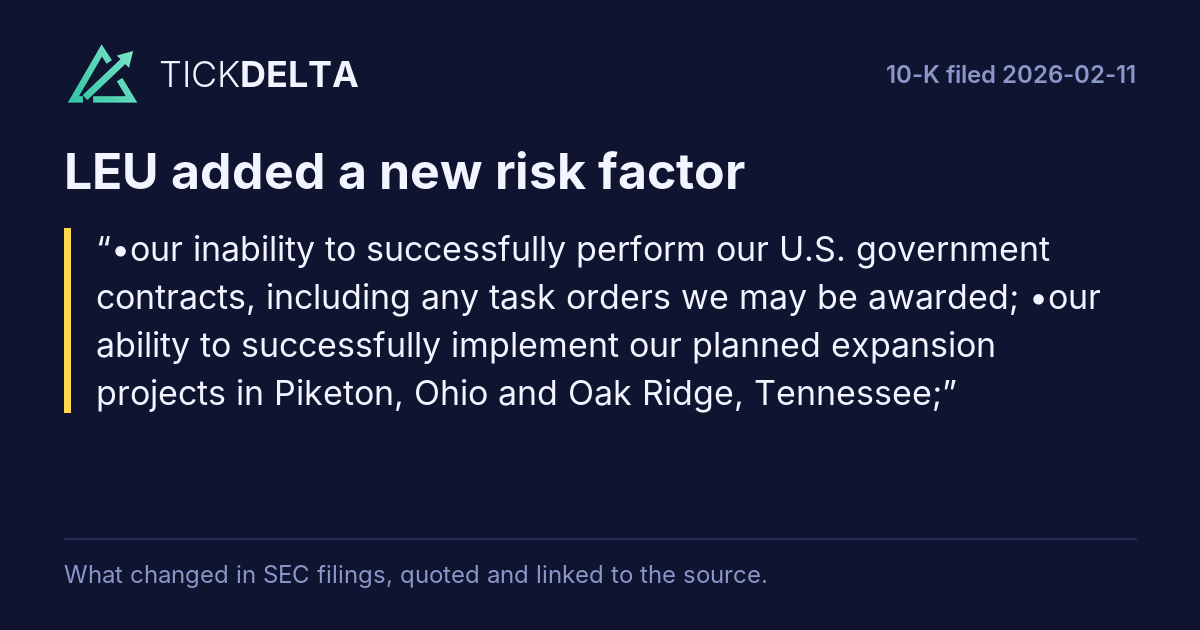
•our inability to successfully perform our U.S. government contracts, including any task orders we may be awarded;
•our ability to successfully implement our planned expansion projects in Piketon, Ohio and Oak Ridge, Tennessee;
•significant competition from foreign governments, and limitations on our ability to compete in foreign markets;
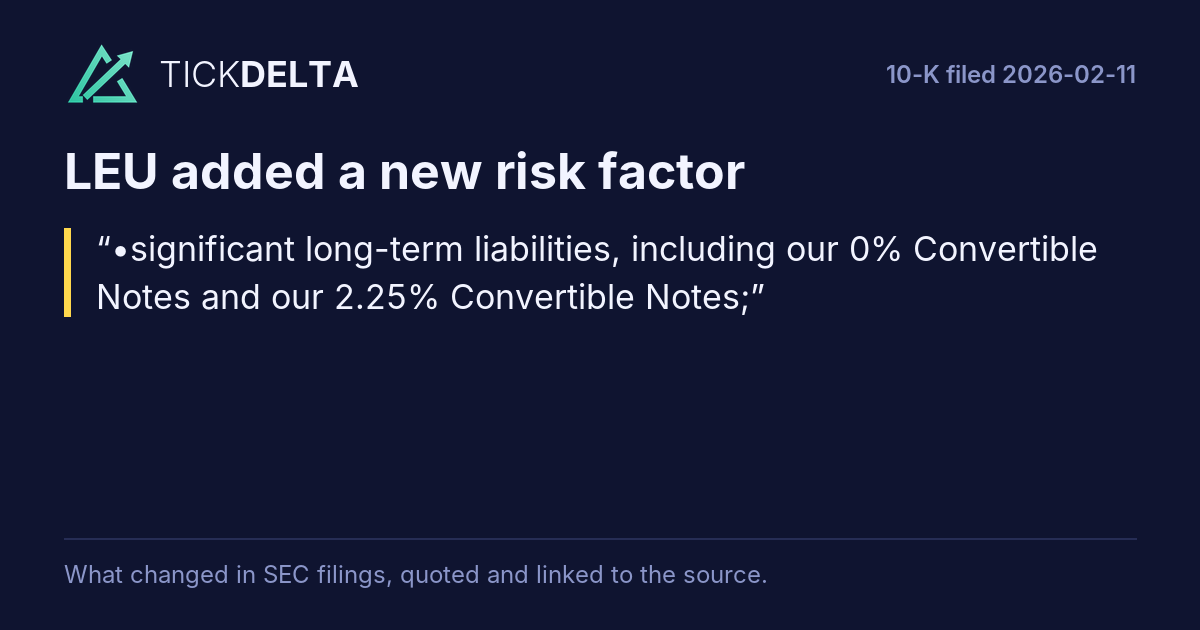
•significant long-term liabilities, including our 0% Convertible Notes and our 2.25% Convertible Notes;
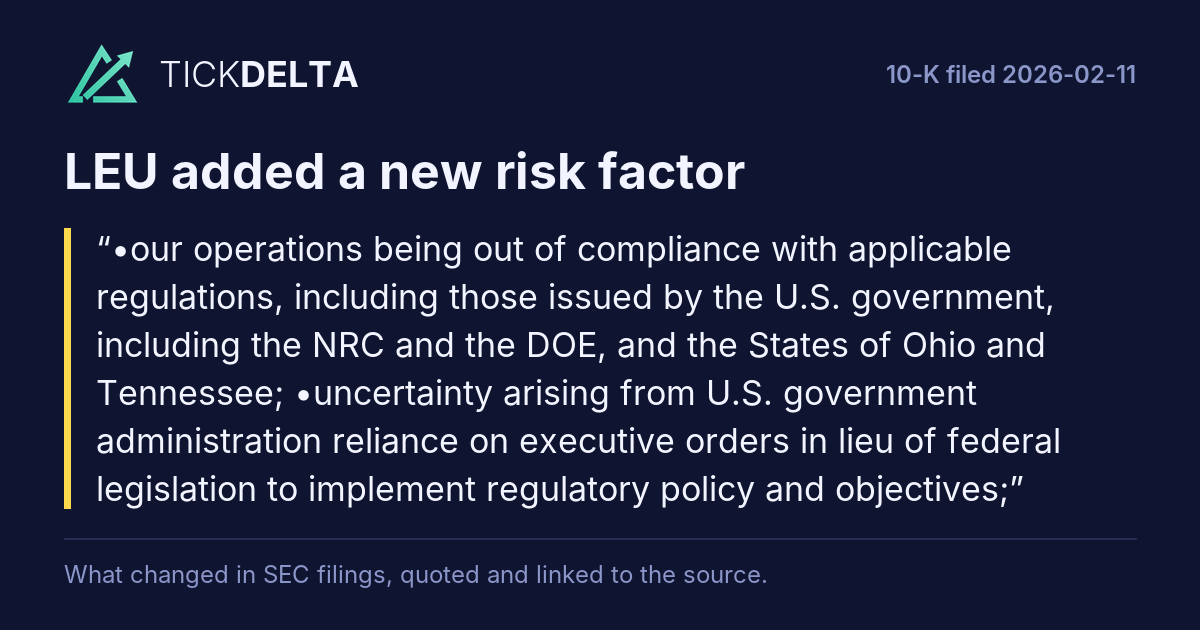
•our operations being out of compliance with applicable regulations, including those issued by the U.S. government, including the NRC and the DOE, and the States of Ohio and Tennessee;
•uncertainty arising from U.S. government administration reliance on executive orders in lieu of federal legislation to implement regulatory policy and objectives;
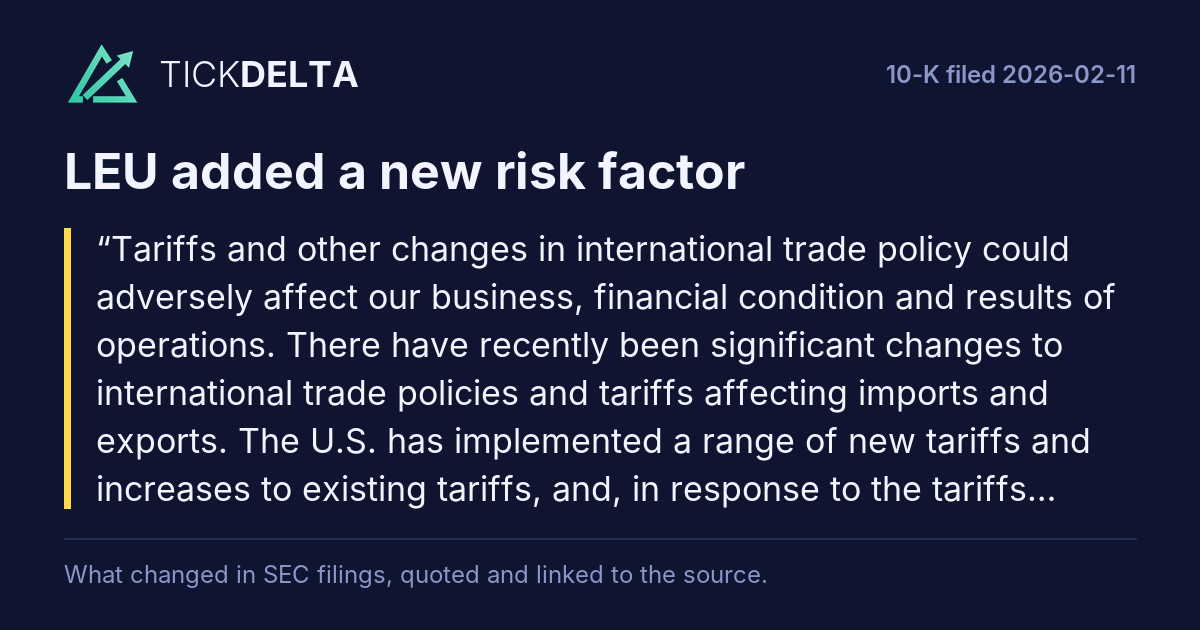
Tariffs and other changes in international trade policy could adversely affect our business, financial condition and results of operations.
There have recently been significant changes to international trade policies and tariffs affecting imports and exports. The U.S. has implemented a range of new tariffs and increases to existing tariffs, and, in response to the tariffs announced by the U.S., other countries have imposed new or increased tariffs on certain exports from the United States. There is currently significant uncertainty about the future relationship between the United States and other countries with respect to trade policies, government regulations and tariffs. We cannot predict whether, and to what extent, current tariffs will continue, or trade policies will change in the future.
Additionally, on April 17, 2025, the Office of the United States Trade Representative (“USTR”) released a notice issuing the results of its investigation into China’s dominance in the maritime, logistics, and shipbuilding sectors pursuant to Section 302(a) of the Trade Act of 1974, as amended. The USTR imposed new service fees on Chinese-built vessels entering U.S. ports above certain capacity. Our shipper of Russian LEU from Russia to the U.S. uses ships manufactured in China which happen to be exempt from the new fees under this notice. However, these fees would be significant if they were to be imposed on our shipper.
On September 8, 2025, the U.S. officially removed import tariffs on uranium as part of a broader executive order aimed at strengthening domestic supply chains and supporting strategic industries. However, there is draft legislation in the U.S. Congress designed to impose potentially significant tariffs on Russian goods. These developments are ongoing and are subject to change, including the imposition of additional tariffs and retaliatory measures by these and other countries. Depending on their extent, scope and duration, these tariffs and retaliatory measures may result in increased costs for any equipment and other goods we require to operate and develop our projects in accordance with our current plans. At the same time, it is possible that these tariffs and other measures may benefit certain aspects of our business, including by increasing demand for uranium produced in the U.S. Although discussions continue regarding potential economic arrangements between certain countries, there remains significant uncertainty over the scope, impact and duration of any tariffs and retaliatory measures, and they may, among other things, adversely impact general economic conditions, including the market and demand for uranium and our business financial condition and results of operations. For further discussion of these risks and uncertainties, refer to Part I, Item 1A, Risk Factors - The current war in Ukraine and related international or U.S. sanctions, tariffs, and restrictions on trade, and the Russian response thereto, could have a material adverse impact on our business, results of operations, and financial condition.
Show the other 4
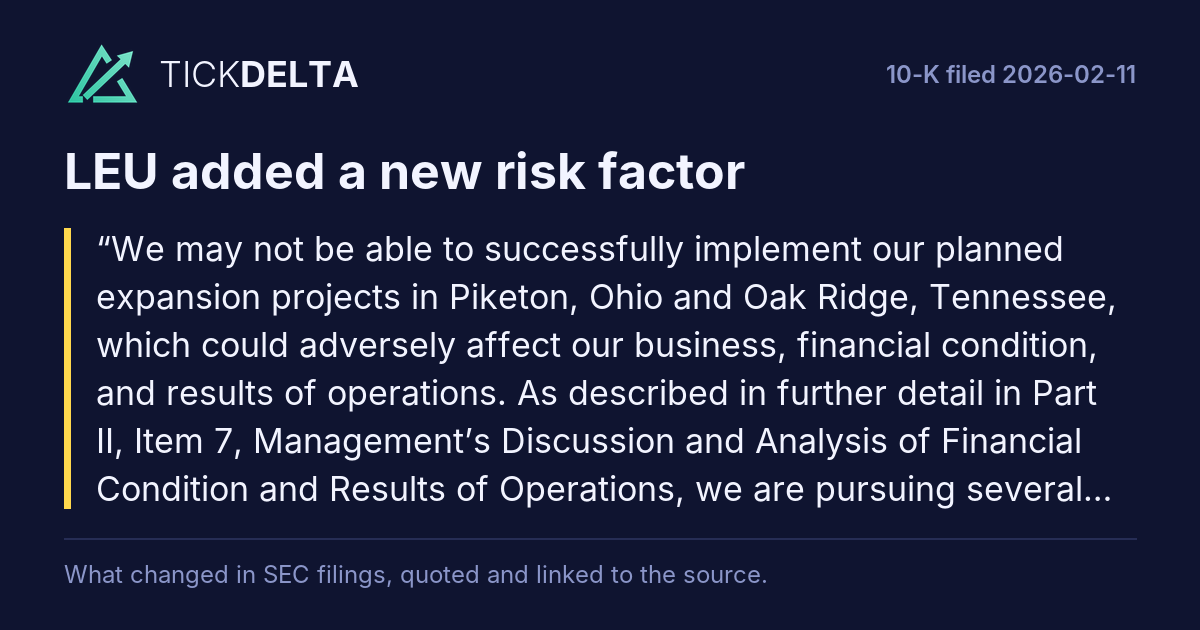
We may not be able to successfully implement our planned expansion projects in Piketon, Ohio and Oak Ridge, Tennessee, which could adversely affect our business, financial condition, and results of operations.
As described in further detail in Part II, Item 7, Management’s Discussion and Analysis of Financial Condition and Results of Operations, we are pursuing several expansion initiatives, including the expansion of the manufacturing capacity at our facility in Oak Ridge, Tennessee and a major expansion of our uranium capacity in Piketon, Ohio. ACO was awarded a $900.0 million task order from the DOE to expand its uranium enrichment facility in Piketon, Ohio, which is subject to negotiation of a definitive agreement. These projects are complex, costly, and subject to significant uncertainties. Delays, cost overruns, or operational disruptions could materially impact our ability to achieve the anticipated benefits of these initiatives. Our ability to complete expansion projects on time and within budget depends on a variety of factors, many of which are outside our control. These include challenges related to DOE funding, permitting, zoning, environmental reviews, supply chain constraints, and the availability and performance of contractors, subcontractors, and construction materials. Adverse weather, labor disputes, supply chain disruptions or delays, changing market conditions, unexpected engineering issues, or changes in regulatory requirements could further delay or disrupt construction activities.
In addition, expanded operations will require us to recruit, train, and retain additional employees with specialized skills. Competition for qualified personnel remains intense, and we may experience difficulties in hiring or retaining the workforce needed to support our growth. Wage inflation, labor shortages, or higher-than-expected training costs could increase our operating expenses and reduce the efficiency of new or expanded facilities.
If we are unable to complete expansion projects as planned, or within budget, or if the projects fail to deliver the expected operational or financial benefits, our growth strategy and future operations could be impaired. Any significant delays, increased costs, or operational inefficiencies could adversely affect our business, financial condition, and results of operations.
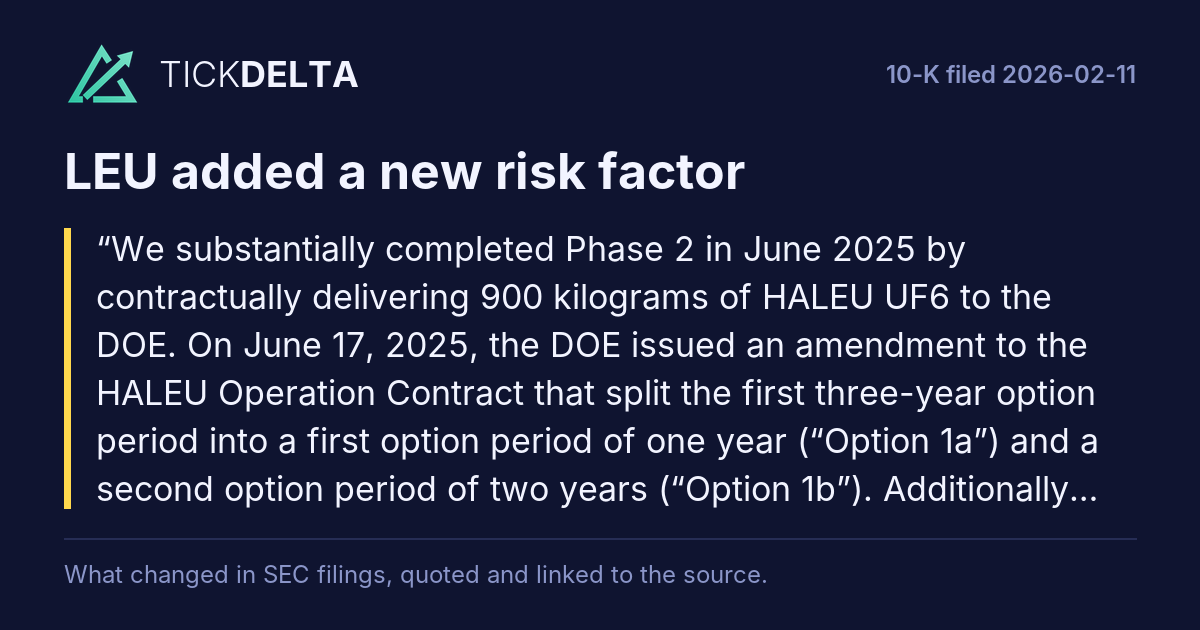
We substantially completed Phase 2 in June 2025 by contractually delivering 900 kilograms of HALEU UF6 to the DOE. On June 17, 2025, the DOE issued an amendment to the HALEU Operation Contract that split the first three-year option period into a first option period of one year (“Option 1a”) and a second option period of two years (“Option 1b”). Additionally, the amendment acknowledges that the estimated cost associated with Option 1b is insufficient to support full performance due to known cost increases since award of the HALEU Operation Contract and indicates that the Company will need to submit a revised cost proposal for review and negotiation prior to DOE’s consideration of Option 1b. In conjunction with the amendment, the DOE exercised Option 1a and extended the period of performance to June 30, 2026.
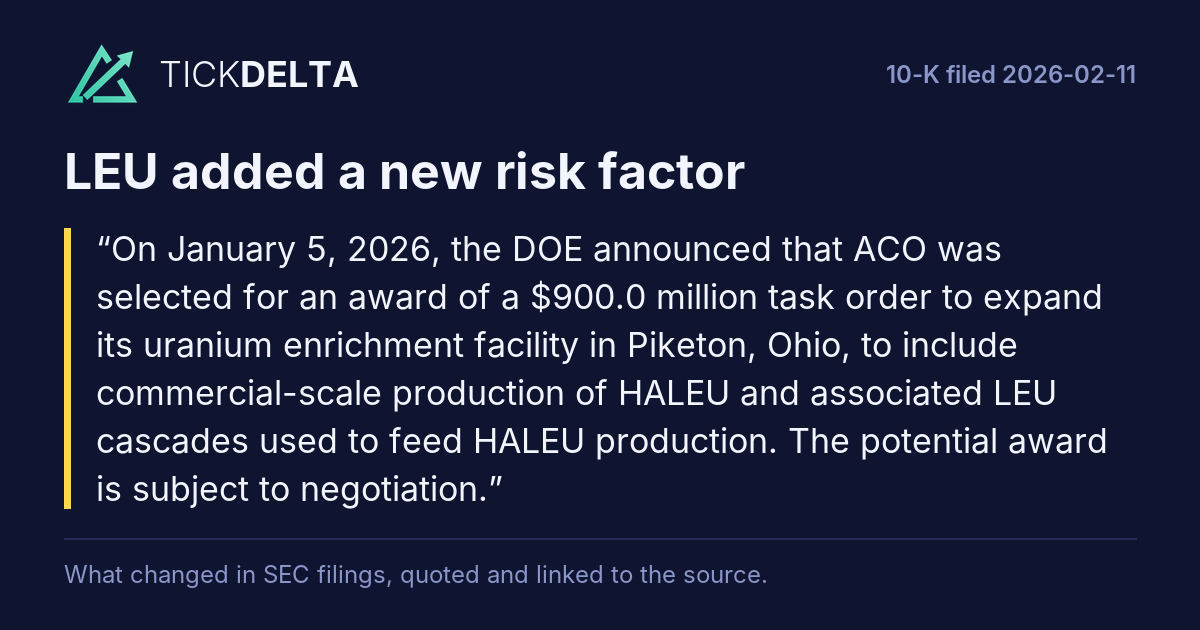
On January 5, 2026, the DOE announced that ACO was selected for an award of a $900.0 million task order to expand its uranium enrichment facility in Piketon, Ohio, to include commercial-scale production of HALEU and associated LEU cascades used to feed HALEU production. The potential award is subject to negotiation.
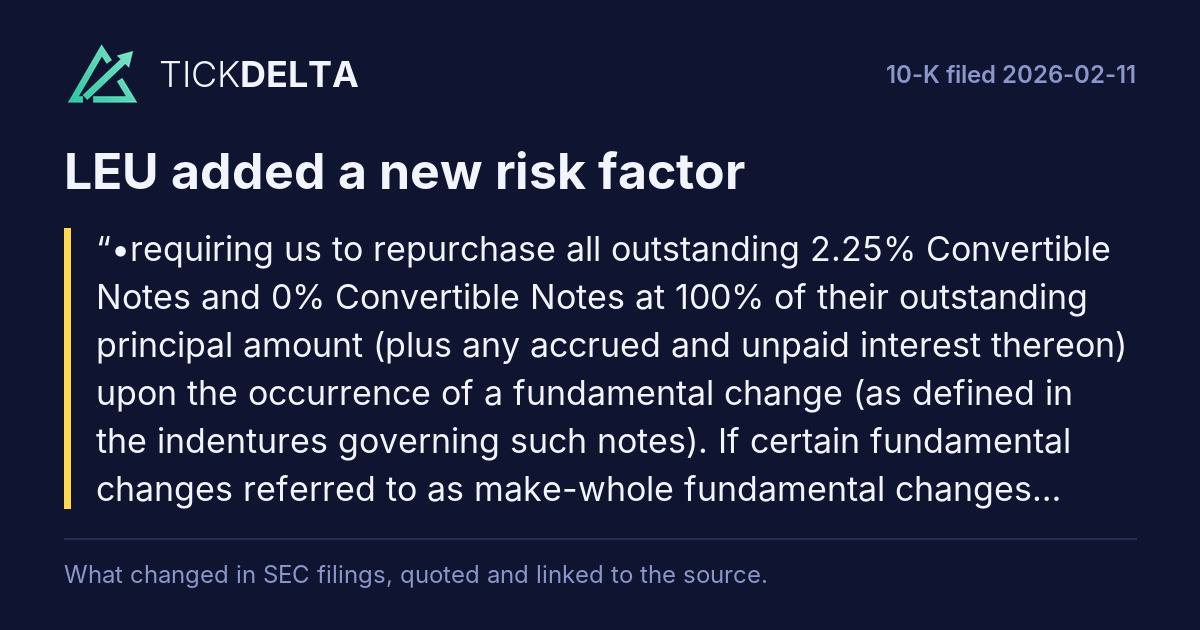
•requiring us to repurchase all outstanding 2.25% Convertible Notes and 0% Convertible Notes at 100% of their outstanding principal amount (plus any accrued and unpaid interest thereon) upon the occurrence of a fundamental change (as defined in the indentures governing such notes). If certain fundamental changes referred to as make-whole fundamental changes occur, the conversion rate for such notes may be increased.
Paragraphs in the 10-Q filed Nov 5, 2026 that were not in the one before
New in the latest 10-Q
42 paragraphs in the 10-Q filed Nov 5, 2026 with nothing like them in the 10-Q filed Aug 6, 2026 (at least half the words must differ; new numbers alone do not count). Quoted exactly, grouped by the item heading above them. This is text that changed, not a judgement of how serious it is.
10-Q
• our ability to obtain a long-term extension of our existing lease for Piketon from the DOE on acceptable terms or at all, including the potential need to delay, scale back, or abandon our planned expansion of LEU and HALEU enrichment capacity in Piketon and to recognize a significant non-cash charge relating to capitalized improvements at Piketon;
Read in the 10-Q
• our ability to realize the anticipated benefits of acquisitions, including our acquisition of Westerman, and risks associated with acquisitions, including integration difficulties, unknown liabilities, additional costs and dilution;
Read in the 10-Q
The Company accounts for warrants as either equity-classified or liability-classified instruments based on an assessment of the warrant’s specific terms and applicable authoritative guidance Accounting Standards Codification (“ASC”) Topic 480, Distinguishing Liabilities from Equity (“ASC 480”) and ASC Topic 815, Derivatives and Hedging (“ASC 815”). This assessment, which requires the use of professional judgment, is conducted at the time of warrant issuance and as of each subsequent quarterly period end date while the warrants are outstanding.
Read in the 10-Q
For warrants that meet all of the criteria for equity classification, the warrants are required to be recorded as a component of excess of capital over par value at the time of issuance. For warrants that do not meet all the criteria for equity classification, the warrants are required to be recorded at their initial fair value on the date of issuance, and each balance sheet date thereafter. This liability is subject to re-measurement at each balance sheet date until exercised, and any change in fair value is recognized in the Company’s Condensed Consolidated Statements of Operations and Comprehensive Income.
Read in the 10-Q
Under this guidance, the Company evaluates government awards, such as funding received under the DOE’s HALEU enrichment program, to determine the appropriate accounting treatment and ensure consistent application within its financial statements.
Read in the 10-Q
Show the other 37
On September 30, 2026, DOE issued an amendment to the HALEU Operation Contract to facilitate temporary storage of the HALEU produced and uranium products and certain equipment procured under the contract. Further, on October 20, 2026, the Company signed a contract with the DOE (the “HALEU Transfer Agreement”) under which the DOE transferred to ACO title to certain materials produced or procured under the HALEU Operation Contract, including HALEU, low-enriched uranium feed and heels, depleted tails and associated cylinders, and ACO assumed the DOE’s financial and operational responsibility for the facility costs, maintenance, security and environmental compliance associated with those materials, and agreed to hold the HALEU for resale to DOE upon request.
Read in the 10-Q
Contemporaneously with the HALEU Transfer Agreement, on October 19, 2026, Enrichment Corp. and DOE entered into an amendment to the lease for Piketon. Pursuant to the amendment, the expiration date of the lease was fixed at October 1, 2027, and DOE expressly permitted continued use of the demonstration cascade. Additionally, Enrichment Corp. agreed, subject to approval by NRC of ACO’s decommissioning funding plan, that Enrichment Corp. or ACO would assume from DOE liabilities for the decontamination and decommissioning of the facilities and equipment installed and any work performed under the HALEU Operation Contract, in addition to any additional decontamination and decommissioning liabilities arising from ACO’s use of the demonstration cascade and associated facilities and equipment under the amendment.
Read in the 10-Q
As announced on July 1, 2026, the Company is working with DOE on further agreements to enable the Company to privately operate the cascade indefinitely on a commercial basis, but there can be no assurances that any additional agreements are ultimately agreed. As noted above, the Company’s current lease at Piketon expires on October 1, 2027. The DOE has indicated that it will work diligently with the Company to complete a long-term extension of the lease for Piketon before December 31, 2026. However, the DOE is under no obligation to do so, and there can be no assurance that an extension of the Company’s existing lease will be executed by December 31, 2026, or at all, or that any such extension will be on terms that are acceptable to the Company.
Read in the 10-Q
During the three months ended September 30, 2026 and 2025, respectively, the Company sold the U3O8 contained in a quantity of UF6 to customers. Under the terms of the applicable agreement, the Company delivered the UF6 to a converter, who delivered the U308 to the customers and transferred $ 4.3 million and $ 10.4 million, respectively, of conversion services credits contained in the UF6 to the Company.
Read in the 10-Q
(c) The fair value of the common warrants was determined using Level 3 inputs. Centrus determined the fair value of the common warrants using unobservable inputs in the Black-Scholes option-pricing model. Inherent in the valuation were assumptions related to the expected stock-price volatility, expected term, risk-free interest rate, and dividend yield. The Company estimated the expected volatility based on the Company’s historical, implied, and guideline public company stock price volatility. The expected stock-price volatility was 55% as of September 30, 2026. The expected term was assumed to be equivalent to the warrants’ remaining contractual term. The risk-free interest rate was estimated using the yield on actively traded non-inflation-indexed U.S. treasury securities with contract maturities equal to the expected term. The dividend yield was based on the historical rate, which the Company anticipates remaining at zero. Refer to Note 11, Warrants, for details.
Read in the 10-Q
Centrus follows the asset and liability approach to account for deferred taxes. Deferred tax assets and liabilities are recognized for the anticipated future tax consequences of temporary differences between the balance sheet carrying amounts of assets and liabilities and their respective tax bases. A valuation allowance is provided if it is more likely than not that all, or some portion, of the deferred tax assets may not be realized. The ultimate realization of the net deferred tax assets is dependent upon generating sufficient taxable income in future years when deferred tax assets are recoverable or are expected to reverse.
Read in the 10-Q
Centrus evaluated both positive and negative evidence that was objectively verifiable to determine the amount of the federal valuation allowance that was required on Centrus’ federal deferred tax assets. In 2025, Centrus had visibility on a significant portion of revenue in the LEU segment for 2025 through 2028, primarily from its long-term sales contracts. Additionally, Centrus’ investment income forecast increased based upon increased liquidity. Centrus determined that the positive evidence of increased future investment income supported the release of the federal valuation allowance in 2025. However, because of the lack of objectively verifiable information in later years, it was determined that forecasted future income was not sufficient to realize all the deferred tax assets. Therefore, Centrus released $10.2 million of the valuation allowance against its federal net deferred tax assets in the three and nine months ended September 30, 2025. There was no release of valuation allowance in the three and nine months ended September 30, 2026.
Read in the 10-Q
Going forward, Centrus will continue to evaluate both positive and negative evidence that would support any further changes to the remaining federal and state valuation allowances. Such evidence in the Company’s Technical Solutions segment may include events that could have a significant impact on pre-tax income, such as signing new contracts with significantly higher or lower margins than currently forecasted, follow-on work related to the HALEU program, or abandonment of the commercial deployment of the centrifuge technology. Such evidence in the Company’s LEU segment may include renewing SWU sales contracts with existing customers and/or signing new sales or purchase contracts with significantly higher or lower margins than currently forecasted. Additional evidence in the LEU segment may include potential deferrals in the timing of deliveries requested by its customers, which could impact revenue recognition timing. The impact of these and other potential positive and negative events will be weighed and evaluated to determine if the valuation allowances should be increased or decreased in the future.
Read in the 10-Q
On September 9, 2026, Centrus entered into an underwriting agreement and sold (i) 500,000 shares of Class A Common Stock, (ii) pre-funded warrants to provide for the purchase, upon exercise, of up to 2,005,513 shares of Class A Common Stock, and (iii) common warrants to provide for the purchase, upon exercise, of up to 6,992,382 shares of Class A Common Stock. Each pre-funded warrant has a nominal exercise price of $ 0.10 and so these instruments are included in the basic weighted average number of common and common equivalent shares for the three and nine months ended September 30, 2026. The dilutive impact of the common warrants on the calculation of diluted income per share is considered using the treasury stock method. However, the dilutive impact of the common warrants is limited to in-the-money portion, based on the exercise price. For the three and nine months ended September 30, 2026, all of the common warrants are antidilutive. Refer to Note 11, Warrants, for additional information on this transaction.
Read in the 10-Q
On September 9, 2026, the Company entered into an underwriting agreement with Guggenheim Securities LLC and sold (i) 500,000 shares of Class A Common Stock, (ii) “pre-funded warrants” to purchase upon exercise, up to 2,005,513 shares of its Class A Common Stock, and (iii) common warrants to purchase upon exercise, up to 6,992,382 shares of its Class A Common Stock, which represented all of the securities offered in the offering. The Company received gross proceeds of approximately $ 500.0 million related to this sale and incurred related costs of approximately $ 11.2 million. In September 2026, the Company issued 500,000 shares of Class A Common Stock, 2,005,513 pre-funded warrants, and 6,992,382 common warrants. As of September 30, 2026, none of the pre-funded or common warrants have been exercised.
Read in the 10-Q
The following table shows the exercise price and expiration date of the pre-funded warrants and each tranche of the common warrants:
Read in the 10-Q
The pre-funded warrants are classified as stockholders’ equity and the common warrants are classified as liabilities and remeasured at each reporting period. Issuance costs of $ 4.6 million allocated to the common warrants were expensed and included in Selling, General, and Administrative costs, and the $ 6.6 million issuance costs allocated to the equity-classified instruments were recorded as a reduction of Excess of Capital over Par Value.
Read in the 10-Q
On October 16, 2026, Centrus entered into a Membership Interest Purchase Agreement with Ventura Trust, not in its individual capacity but solely as trustee of the Westerman Employee Stock Ownership Trust (“Seller”), and Westerman Holdings, LLC, a Delaware limited liability company (“Westerman”), pursuant to which on the same date the Company purchased 100 % of the issued and outstanding limited liability company membership interests of Westerman (the “LLC Interests”) from the Seller (the “Acquisition”). Westerman is a U.S. equipment manufacturing and engineering firm focused primarily on the energy sector. As a result of the Acquisition, Westerman is a wholly owned subsidiary of the Company.
Read in the 10-Q
The aggregate purchase price for the LLC Interests was approximately $ 116.0 million (“Purchase Price”), which was paid by the Company $ 95.0 million in cash, and $ 21.0 million in shares of Class A Common Stock. In connection with the Acquisition, the Company paid, out of the Purchase Price and on behalf of Westerman, an aggregate amount of (a) approximately $ 31.5 million to the holders of subordinated notes previously issued by Westerman in full satisfaction of the notes and (b) $ 12.7 million to the lender under a term loan facility of Westerman in full repayment of the loan. The Company also paid, out of the Purchase Price, approximately $ 10.5 million of the Seller’s and Westerman’s transaction expenses. The number of shares of Class A Common Stock issued was determined based on the closing price of the Class A Common Stock as of October 15, 2026, and were issued pursuant to Section 4(a)(2) of the Securities Act of 1933, as amended.
Read in the 10-Q
On September 30, 2026, DOE issued an amendment to the HALEU Operation Contract to facilitate temporary storage of the HALEU produced and uranium products and certain equipment procured under the contract. Further, on October 20, 2026, the Company signed a contract with the DOE (the “HALEU Transfer Agreement”) under which the DOE transferred to ACO title to certain materials produced or procured under the HALEU Operation Contract, including HALEU, low-enriched uranium feed and heels, depleted tails and associated cylinders, and ACO assumed the DOE’s financial and operational responsibility for the facility costs, maintenance, security and environmental compliance associated with those materials, and agreed to hold the HALEU for resale to DOE upon request.
Read in the 10-Q
Contemporaneously with the HALEU Transfer Agreement, on October 19, 2026, Enrichment Corp. and DOE entered into an amendment to the lease for the Piketon, Ohio, facility. Pursuant to the amendment, the expiration date of the lease was fixed at October 1, 2027, and DOE expressly permitted continued use of the demonstration cascade. Additionally, Enrichment Corp. agreed, subject to approval by NRC of ACO’s decommissioning funding plan, that Enrichment Corp. or ACO would assume from DOE liabilities for the decontamination and decommissioning of the facilities and equipment installed and any work performed under the HALEU Operation Contract, in addition to any additional decontamination and decommissioning liabilities arising from ACO’s use of the demonstration cascade and associated facilities and equipment under the amendment.
Read in the 10-Q
As announced on July 1, 2026, the Company is working with DOE on further agreements to enable the Company to privately operate the cascade indefinitely on a commercial basis, but, there can be no assurances that any additional agreements are ultimately agreed, As noted above, the Company’s current lease at Piketon expires on October 1, 2027. Further, the DOE has indicated that it will work diligently with the Company to complete a long-term extension of the lease for Piketon before December 31, 2026. However, the DOE is under no obligation to do so, and there can be no assurance that an extension of the Company’s existing lease will be executed by December 31, 2026, or at all, or that any such extension will be on terms that are acceptable to the Company.
Read in the 10-Q
In the third quarter of 2026, Centrus announced additional commercial HALEU partnerships. The Company executed long‑term supply agreements with X‑energy to supply both LEU and HALEU, with Radiant to provide HALEU, and with Antares to provide HALEU. All three of these multi-year agreements include prepayments to Centrus to support the development of our domestic commercial enrichment facilities in Piketon and Oak Ridge.
Read in the 10-Q
• Our ability to obtain a long-term extension of our lease for Piketon from DOE before the October 1, 2027 expiration date of the lease, as amended, on acceptable terms or at all, and the related decontamination and decommissioning liabilities assumed under the lease amendment;
Read in the 10-Q
• Our ability to realize the anticipated benefits of acquisitions, including our acquisition of Westerman, and risks associated with acquisitions, including integration difficulties, unknown liabilities, additional costs and dilution;
Read in the 10-Q
Three Months Ended September 30, 2026 Compared with Three Months Ended September 30, 2025
Read in the 10-Q
Nine Months Ended September 30, 2026 Compared with Nine Months Ended September 30, 2025
Read in the 10-Q
Three Months Ended September 30, 2026 Compared with Three Months Ended September 30, 2025
Read in the 10-Q
The Company issued common warrants in September 2026. The warrants are classified as liabilities and remeasured at each reporting period. The Company recorded a gain of $46.4 million in the three months ended September 30, 2026 related to the revaluation at September 30, 2026.
Read in the 10-Q
Nine Months Ended September 30, 2026 Compared with Nine Months Ended September 30, 2025
Read in the 10-Q
The Company issued common warrants in September 2026. The warrants are classified as liabilities and remeasured at each reporting period. The Company recorded a gain of $46.4 million in the September 30, 2026 related to the revaluation at September 30, 2026.
Read in the 10-Q
Normalized earnings exclude the revaluation of the Warrant Liability is included as Gain on Change in Fair Value of Warrant Valuation on the Condensed Consolidated Statements of Operations and Comprehensive Income. We are also adjusting for the one-time expenses related to the issuance of the warrants, which were included as Selling, General and Administrative expense on the Condensed Consolidated Statements of Operations and Comprehensive Income.
Read in the 10-Q
Three Months Ended September 30, 2026 Compared with Three Months Ended September 30, 2025
Read in the 10-Q
GAAP Warrant Normalized (Non-GAAP) Growth Costs Stock-Based Compensation Adjusted (Non-GAAP)
Read in the 10-Q
Nine Months Ended September 30, 2026 Compared with Nine Months Ended September 30, 2025
Read in the 10-Q
On September 30, 2026, DOE issued an amendment to the HALEU Operation Contract to facilitate temporary storage of the HALEU produced and uranium products and certain equipment procured under the contract. Further, on October 20, 2026, the Company signed the HALEU Transfer Agreement with the DOE, under which the DOE transferred to ACO title to certain materials produced or procured under the HALEU Operation Contract, including HALEU, low-enriched uranium feed and heels, depleted tails and associated cylinders, and ACO assumed the DOE’s financial and operational responsibility for the facility costs, maintenance, security and environmental compliance associated with those materials, and agreed to hold the HALEU for resale to DOE upon request.
Read in the 10-Q
Contemporaneously with the HALEU Transfer Agreement, on October 19, 2026, Enrichment Corp. and DOE entered into an amendment to the lease for Piketon. Pursuant to the amendment, the expiration date of the lease was fixed at October 1, 2027, and DOE expressly permitted continued use of the demonstration cascade. Additionally, Enrichment Corp. agreed, subject to approval by NRC of ACO’s decommissioning funding plan, that Enrichment Corp. or ACO would assume from DOE liabilities for the decontamination and decommissioning of the facilities and equipment installed and any work performed under the HALEU Operation Contract, in addition to any additional decontamination and decommissioning liabilities arising from ACO’s use of the demonstration cascade and associated facilities and equipment under the amendment.
Read in the 10-Q
As announced on July 1, 2026, the Company is working with DOE on further agreements to enable the Company to privately operate the cascade indefinitely on a commercial basis, but there can be no assurances that any additional agreements are ultimately agreed. Further, the DOE has indicated that it will work diligently with the Company to complete a long-term extension of the lease for Piketon before December 31, 2026. However, the DOE is under no obligation to do so, and there can be no assurance that an extension of the Company’s existing lease will be executed by December 31, 2026, or at all, or that any such extension will be on terms that are acceptable to the Company.
Read in the 10-Q
On October 16, 2026, Centrus entered into a Membership Interest Purchase Agreement with the Seller and Westerman, pursuant to which on the same date the Company completed the Acquisition. Westerman is a U.S. equipment manufacturing and engineering firm focused primarily on the energy sector. As a result of the Acquisition, Westerman is a wholly owned subsidiary of the Company.
Read in the 10-Q
The aggregate Purchase Price for the LLC Interests was approximately $116.0 million, which was paid by the Company $95.0 million in cash, and $21.0 million in shares of the Company’s Class A Common Stock. In connection with the Acquisition, the Company paid, out of the Purchase Price and on behalf of Westerman, an aggregate amount of (a) approximately $31.5 million to the holders of subordinated notes previously issued by Westerman in full satisfaction of the notes and (b) $12.7 million to the lender under a term loan facility of Westerman in full repayment of the loan. The Company also paid, out of the Purchase Price, approximately $10.5 million of the Seller’s and Westerman’s transaction expenses. The number of shares of Class A Common Stock issued was determined based on the closing price of the Class A Common Stock as of October 15, 2026, and were issued pursuant to Section 4(a)(2) of the Securities Act of 1933, as amended.
Read in the 10-Q
On September 9, 2026, the Company entered into an underwriting agreement with Guggenheim Securities, LLC and sold (i) 500,000 shares of Class A Common Stock, (ii) “pre-funded warrants” to purchase upon exercise, up to 2,005,513 shares of its Class A Common Stock, and (iii) common warrants to purchase upon exercise, up to 6,992,382 shares of its Class A Common Stock, which represented all of the securities offered in the offering. The Company received gross proceeds of approximately $500.0 million related to this sale and incurred related costs of approximately $11.2 million. The Company intends to use the net proceeds from the offering for general working capital and corporate purposes, which may include investment in technology development and deployment, repayment or repurchase of outstanding debt, capital expenditures, potential acquisitions and other business opportunities and purposes.
Read in the 10-Q
The pre-funded warrants have an exercise price of $0.10 per share and became exercisable upon issuance. They are exercisable through and including the twenty five-year anniversary of the issuance date. As of September 30, 2026, none of the pre-funded warrants had been exercised. The common warrants became exercisable immediately upon issuance and are exercisable through the expiration date of each individual tranche of common warrants. Under the common warrants, the Company may elect to require cashless exercise on each six-month anniversary of the issuance date. As of September 30, 2026, none of the common warrants had been exercised. Additional terms and conditions of the pre-funded and common warrants are described in Note 11, Warrants, of the Financial Statements.
Read in the 10-Q
The 10-Q's risk factors against the 10-K
Item 1A of the 10-Q filed Nov 5, 2026 against Item 1A of the 10-K filed Feb 11, 2026.
A 10-Q repeats only the risks that changed, so a 10-K paragraph that is missing from it is not counted as removed.
Added is a paragraph with nothing like it in the 10-K, Reworded a sentence that is in both with several words changed,
Quiet changes a sentence in both where one to four words changed and one is a hedge or a modal
(cut words struck through, new words highlighted).
Text on the page, not a score; each links to the filing at sec.gov.
What the 10-Q itself says about its risk factors:There have been no material changes to the Risk Factors described in Part I, Item 1A, Risk Factors, in our Annual Report on Form 10-K for the year ended December 31, 2025, as updated in our Quarterly Report on Form 10-Q for the quarter ended March 31, 2026, in our Quarterly Report on Form 10-Q for the quarter ended June 30, 2026, and the Risk Factors in our Form S-3 Shelf Registration filed with the SEC on November 2, 2026.
Read in the 10-Q
1 paragraph in the 10-Q's Item 1A, and none of them adds, rewords or quietly edits a paragraph of the 10-K's.
Phrases used for the first time
Two-word phrases in Risk Factors of the 10-K filed Feb 11, 2026 that are in none of the 1 earlier 10-Ks stored, back to Feb 7, 2025
Where each one is used
- indentures governing: •requiring us to repurchase all outstanding 2.25% Convertible Notes and 0% Convertible Notes at 100% of their outstanding principal amount (plus any accrued and unpaid interest thereon) upon the occurrence of a fundamental change (as defined in the indentures governing such notes). If certain fundamental changes...
- expansion projects: •our ability to successfully implement our planned expansion projects in Piketon, Ohio and Oak Ridge, Tennessee;
- ridge tennessee: •our ability to successfully implement our planned expansion projects in Piketon, Ohio and Oak Ridge, Tennessee;
- sanctions tariffs: The current war in Ukraine and related international or U.S. sanctions, tariffs and restrictions on trade, and the Russian response thereto, could have a material adverse impact on our business, results of operations, and financial condition.
- million task: As described in further detail in Part II, Item 7, Management’s Discussion and Analysis of Financial Condition and Results of Operations, we are pursuing several expansion initiatives, including the expansion of the manufacturing capacity at our facility in Oak Ridge, Tennessee and a major expansion of our uranium...
- additional task: •lack of assurance that we will be awarded additional task orders under any of our IDIQ contracts and, if awarded, the nature, timing and amount of the task orders that may be issued under an award is uncertain.
- trade policies: There have recently been significant changes to international trade policies and tariffs affecting imports and exports. The U.S. has implemented a range of new tariffs and increases to existing tariffs, and, in response to the tariffs announced by the U.S., other countries have imposed new or increased tariffs on...
- retaliatory measures: On September 8, 2025, the U.S. officially removed import tariffs on uranium as part of a broader executive order aimed at strengthening domestic supply chains and supporting strategic industries. However, there is draft legislation in the U.S. Congress designed to impose potentially significant tariffs on Russian...
Used at least twice, small words left out. Counted, not picked: a phrase can be new because the company renamed something.
What was taken out
7 paragraphs of last year's Risk Factors with nothing like them now. The longest are quoted.
Sources
Item 1A of each 10-K and 10-Q on EDGAR, quoted exactly. Each paragraph links to the filing at sec.gov.
Also
10-K change: what was reworded or cut, section by section.
Work with it
Excel workbook · CSV. Google Sheet that stays up to date: paste =IMPORTDATA("https://tickdelta.com/company/LEU/export.csv") into a cell.