26 paragraphs in Risk Factors of the 10-K filed Feb 24, 2026
with nothing like them in the 10-K filed Feb 25, 2025. Quoted exactly.
Paragraphs that were only edited are under 10-K change.
Compared with the Risk Factors in the latest 10-K of the other 59 Health care companies:
a paragraph with at least half its words the same at another company is called similar, and the companies are listed under it.
A paragraph most of them have is marked boilerplate. No line means no other company has one like it.
This counts text; it does not say how serious a risk is.
Natural disasters (e.g., severe weather, fires, and earthquakes), geopolitical events (e.g., terrorism, war, and political instability), public health crises, criminal activity, supply chain disruptions, and other events beyond the Company’s control could negatively affect the Company’s operations. These disruptions may temporarily reduce testing volumes, delay study progress, hinder specimen transport, limit access to laboratories and IT systems, and interrupt supply deliveries. They may also affect customer operations, further decreasing demand. Prolonged disruptions caused by such events, especially in key operational locations, could harm the Company’s results of operations.
Read in the 10-K ↗
The Company’s diagnostic testing services are primarily billed to third parties, including MCOs, employer plans, and other health insurance providers. A shift toward a higher mix of government and MCO payers may adversely effect revenues due to lower reimbursement rates. Ongoing efforts by payers to reduce reimbursement, tighten payment policies, and control utilization are expected to continue. If the Company cannot offset these reductions through cost efficiencies, increased volume or new services, its revenues, profitability, and cash flows may be materially impacted. PAMA has already reduced Medicare reimbursement rates for many tests, and further reductions are expected, although rate reductions are frozen for 2026 and capped at 15% per year for 2027-2029. Delays and changes in coding, billing, and payer policies have historically impacted
revenue and margins, and similar disruptions may continue. Increasing patient cost-sharing and evolving value-based care models also pose collection challenges and may affect the Company’s ability to attract and retain MCOs.
Read in the 10-K ↗
BLS supports pharmaceutical, biotechnology, and medical device companies in navigating the regulatory approval and post-approval compliance requirements process. Changes in government regulations, whether easing or tightening requirements and changes in government operations, including staff reductions and reorganization efforts, could reduce the demand for BLS’s services or make them less competitive. Additionally, efforts to control drug and device costs, or changes in insurer reimbursement practices, may lead customers to reduce R&D spending, which could adversely affect BLS’s business.
Read in the 10-K ↗
BLS’s revenues are closely tied to R&D spending by pharmaceutical, biotechnology, and medical device companies, which may depend on access to capital and reimbursement from payers. Economic conditions, industry trends, or funding constraints could lead to reduced or delayed R&D activity or outsourcing, materially impacting BLS’s business and financial performance.
Read in the 10-K ↗
The Company’s quarterly results of operations may vary significantly from quarter to quarter making it harder to predict future results.
Read in the 10-K ↗
The Company’s operations rely on the continued performance and security of its information technology systems. System failures, cybersecurity incidents, disruptions, or other issues affecting information technology systems could impair data processing, service delivery, billing, and customer communications. The Company also relies on third parties for critical services, including transportation, supplies, and data processing and expects them to comply with applicable laws and regulations, including environmental, health and safety, and privacy and data security laws. Failures by these providers, whether operational, legal, or cybersecurity-related, and issues affecting their information technology systems, could disrupt services, compromise personal or other confidential information, expose the Company to liability and could materially impact its business, even if the Company is not responsible for the underlying cause of any such failure or issue. In addition, the Company may be subject to regulatory, contractual, or other obligations arising from any such failure or issues. Despite contingency plans, risks remain, and a significant information technology system disruption could adversely affect the Company’s reputation, operations, financial condition, and profitability.
Read in the 10-K ↗
The Company continues to face cybersecurity threats, including ransomware attempts, data breaches, and phishing and social engineering attempts targeting its systems and its employees, and those of third-party vendors. Increasingly sophisticated methods, including the use of AI by threat actors, heighten these risks. The Company has implemented a formal cybersecurity program; however, threat actors’ techniques continue to evolve and may not be identifiable until deployed, which could limit the Company’s ability to prevent unauthorized access, data compromise, service disruption, or fraudulent activity. The Company may be unable to anticipate and/or implement appropriate controls needed to protect against these evolving threats or be required to expend additional resources to prepare for and respond to any cybersecurity vulnerabilities. Evolving threats may outpace defenses, requiring ongoing investment in security measures. Data and cybersecurity incidents, including those involving third parties, such as the AMCA Incident, could result in data loss, service disruption, reputational harm, litigation, regulatory penalties, and increased insurance costs. Remote work arrangements further elevate exposure to cyber risks.
Read in the 10-K ↗
The Company and certain of its third-party vendors use AI and machine learning tools to enhance productivity and innovation, but these technologies also introduce risks. Improper use may lead to data leaks of sensitive, proprietary, or confidential information, flawed outputs, biased decisions, or reputational harm. In addition, rapid advancements could render existing tools obsolete or give competitors an edge, emerging regulations may subject the Company to new restrictions or penalties, and AI systems may be vulnerable to new security threats. These risks could result in legal liabilities, customer loss, and reputational damage, each of which could have an adverse impact on the Company’s business and operations.
Read in the 10-K ↗
9 more
Government payers, including Medicare and Medicaid, and private insurers, such as MCOs, continue to implement measures to control healthcare costs, utilization, and delivery. These efforts include changes of reimbursement rates, coverage criteria, and administrative requirements.
Under PAMA, phased reductions to Medicare reimbursement began in January 1, 2018, and are now frozen for 2026 but will resume in 2027, with capped reductions in 2027-2029, with potential for further reductions thereafter. Additional changes such as prior authorization requirements, diagnosis code edits, and other claims processing rules may also impact payment for diagnostic services. Reimbursement for pathology services performed by Dx under the Medicare PFS is subject to ongoing statutory and regulatory adjustments. Similar actions by commercial payers have historically led to lower payments, increased administrative costs, and reduced test utilization. Future changes in payer policies, laboratory benefit management programs, or insurance regulations could materially and adversely affect Dx’s business, financial condition, and results of operations, which could have an adverse effect on the Company’s business.
Read in the 10-K ↗
In the U.S., HIPAA imposes detailed requirements on the use, disclosure, and safeguarding of PHI. HIPAA violations can lead to significant civil and criminal penalties. HIPAA also provides individuals with certain privacy rights regarding their PHI
and requires the Company to notify individuals about its privacy practices. The Company has implemented policies to comply with HIPAA, but evolving regulations—including a proposed rule to clarify the HIPAA Security Rule—may increase compliance obligations. State laws, such as the CCPA and the Washington My Health My Data Act, impose additional requirements that may exceed requirements under HIPAA and other federal standards. The Company must also comply with restrictions on international data transfers imposed through standards such as the DOJ’s Data Security Program, and emerging laws regulating AI, algorithms, and automated processing, which may increase compliance costs.
Internationally, the Company is subject to data protection laws, such as the EU GDPR and the U.K. GDPR, which impose strict requirements and significant penalties for noncompliance. Similar laws have been enacted in other regions where the Company operates, including Asia, Latin America, and other parts of Europe.
Compliance with these complex and evolving regulations may require changes to the Company’s business practices and result in increased operational costs. Failure to comply could materially and adversely affect the Company’s business and reputation, result in the imposition of fines, penalties, or orders to stop certain activities, and potentially expose the Company to actions for the wrongful use or disclosure of personal information.
Read in the 10-K ↗
The Company’s international operations are subject to foreign laws and regulations that differ from those in the U.S. Noncompliance may result in penalties, restrictions, and reputational harm. Risks include changes in reimbursement by foreign governments, export controls, trade regulations, tax policies, labor laws, and currency repatriation restrictions. Some jurisdictions may lack clear legal frameworks or strong enforcement of contractual and intellectual property rights.
The Company may also face challenges related to regulatory approval, pricing, reimbursement, and marketing of its services abroad. Operating internationally can lead to unanticipated costs, including those related to compliance, staffing, collections, and managing local operations. In certain countries, success may depend on forming relationships with local partners, and failure to do so could adversely affect the Company’s business and operations.
Read in the 10-K ↗
The Company’s preclinical and central laboratory operations must comply with applicable standards, including GLP, GCP, and for certain services, cGMP. These operations also involve the import, export, and use of medical devices, reagents, and biological products, which are subject to extensive local and international regulations. Failure to comply with these requirements could result in regulatory enforcement, civil, criminal, or administrative sanctions, including fines, suspension of laboratory operations, or restrictions on import/export activities. Maintaining compliance may also require significant resources and ongoing investment. Any enforcement action or disruption in laboratory operations could have a material adverse effect on the Company’s business and results of operations.
Read in the 10-K ↗
other acts by animal rights activists who object to the use of animals in drug development could have an adverse effect on the Company.
Read in the 10-K ↗
BLS’s preclinical services rely on healthy research animal populations. The presence of infectious or other diseases can compromise research quality, result in inventory loss, and pose risks to human or external animal populations. Such incidents may lead to reputational damage, operational disruption, and increased costs, adversely affecting the Company’s financial condition and results of operations.
Read in the 10-K ↗
BLS’s preclinical research activities must comply with animal welfare laws in the jurisdictions where it operates, including the AWA and similar regulations in the U.K., the EU, and China. These laws govern standards for housing, care, and oversight of research animals. Failure to meet regulatory requirements may result in fines, suspension or revocation of licenses, confiscation of animals, and reputational harm, any of which could have a material adverse effect on the Company’s operations and financial results.
Read in the 10-K ↗
The Company’s diagnostic instruments, test kits, reagents, and point-of-care devices are subject to regulation by the FDA, which oversees their development, manufacturing, labeling, marketing, and performance. The FDA regularly inspects facilities and may take enforcement actions for noncompliance.
Historically, LDTs offered by high-complexity laboratories have been regulated under CLIA without FDA oversight. However, on April 29, 2024, the FDA issued a final rule asserting authority to regulate LDTs as medical devices, initiating a four-year phase-out of its prior enforcement discretion. Legal challenges to the rule led to its recission, but if the FDA reissues a revised rule or otherwise seeks to reassert authority over LDTs, such actions could increase regulatory burdens and enforcement risks for LDTs not cleared or approved by the FDA.
Noncompliance with FDA requirements may result in warning letters, fines, recalls, injunctions, and other civil or criminal penalties, potentially impacting the Company’s ability to develop and commercialize new tests.
Outside the U.S., the Company is subject to similar regulations, including the EU IVDR, which imposes classification, quality, and safety standards. Compliance with these evolving international frameworks may increase costs and affect the Company’s ability to support clinical trials and offer laboratory services.
Read in the 10-K ↗
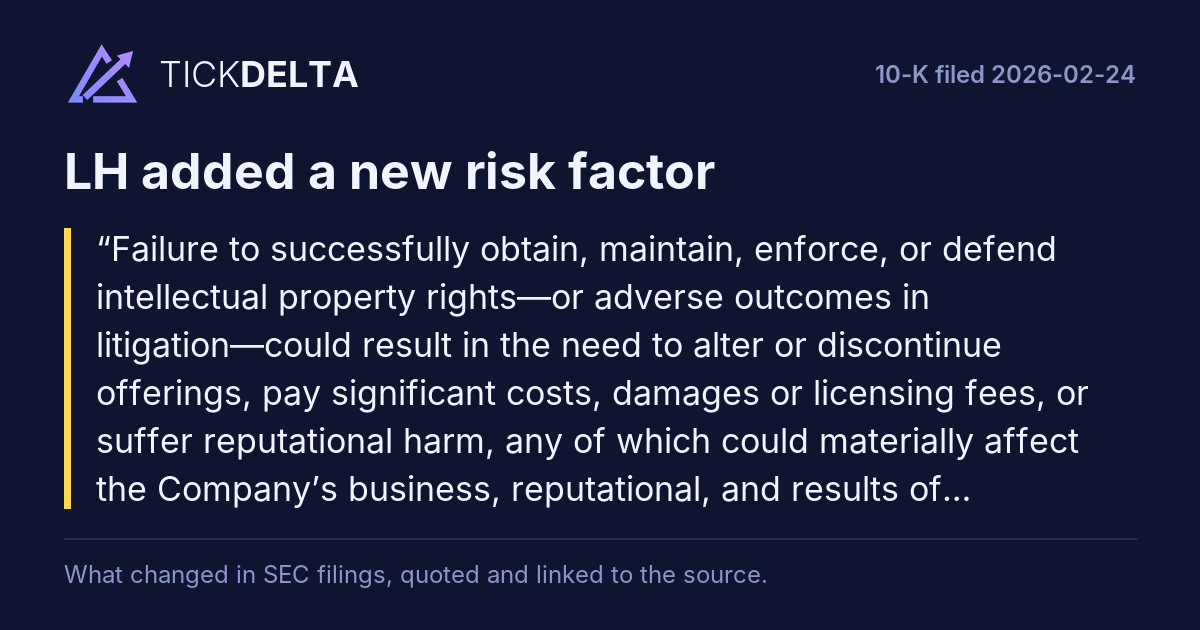
Failure to successfully obtain, maintain, enforce, or defend intellectual property rights—or adverse outcomes in litigation—could result in the need to alter or discontinue offerings, pay significant costs, damages or licensing fees, or suffer reputational harm, any of which could materially affect the Company’s business, reputational, and results of operations.
Read in the 10-K ↗
New in the latest 10-Q
11 paragraphs in the 10-Q filed Oct 30, 2026 with nothing like
them in the 10-Q filed Aug 5, 2026 (at least half the words must differ; new numbers alone do not count).
Quoted exactly, grouped by the item heading above them. This is text that changed, not a judgement of how serious it is.
Financial statements and notes
Common Additional Paid-in Capital Retained Earnings Accumulated Other Comprehensive Loss Total
Read in the 10-Q ↗
Certain amounts in the prior year’s Condensed Consolidated Statement of Operations, Condensed Consolidated Statement of Cash Flows, and Note 11 Business Segment Information have been reclassified to conform to the current year presentation. These reclassifications had no impact on previously reported Net earnings attributable to LHI, Basic and Diluted EPS, Net cash provided by operating activities, Net cash used for investing activities, or Net decrease in Cash and cash equivalents.
Read in the 10-Q ↗
During the nine months ended September 30, 2026, the Company purchased select licenses classified as intangible assets for a total estimated purchase price up to $ 41.0, which included a $ 15.0 cash payment and up to $ 26.0 of consideration contingent upon meeting event-based outcomes, and will be amortized over a 20 -year useful life. The cash payment is classified within investing activities in the Condensed Consolidated Statement of Cash Flows.
Read in the 10-Q ↗
Settlement and Release, which was preliminarily approved by the court on August 21, 2026. The settlement is subject to final court approval.
Read in the 10-Q ↗
On July 27, 2026, the Company was served with a putative class action lawsuit, B.W., a Minor, through his Guardian, Julie Weiss, et al. v. Invitae Corporation and Labcorp Genetics Inc., filed in the U.S. District Court for the Northern District of Illinois. The complaint asserts claims under the Illinois Genetic Information Privacy Act concerning the Company’s acquisition of certain assets from Invitae Corporation pursuant to Invitae’s bankruptcy proceedings and alleges that patients’ genetic information was disclosed without appropriate consent. The Plaintiff seeks statutory damages, injunctive relief, and attorneys’ fees and costs. On August 12, 2026, the Company joined Invitae Corporation’s motion to transfer the action to the U.S. District Court for the District of New Jersey for referral to the U.S. Bankruptcy Court for the District of New Jersey, where Invitae’s bankruptcy proceedings remain pending. The Company will vigorously defend the lawsuit.
Read in the 10-Q ↗
34. challenges, deficiencies, or higher-than-anticipated costs in implementing, integrating, or operating the Company’s new ERP system across broader areas of the Company could disrupt the Company’s business operations, including its supply chain and procurement processes, result in data errors, impair its ability to process transactions, or reduce cash flows or liquidity, including as a result of increased inventory purchases;
Read in the 10-Q ↗
Borrowings under the Company’s 2026 Term Loan, the AR Facility, and the revolving credit facility bear interest at variable rates. In the current interest rate environment, the Company has experienced an increase in interest expense. Further increases in benchmark interest rates would further increase interest expense on the Company’s variable-rate debt, and wider credit spreads could increase the cost of any new debt the Company incurs. In addition, the Company expects to refinance its $600.0 3.60% senior notes due 2027, which mature on September 1, 2027. In the current interest rate environment, the Company expects that new or refinanced debt will bear interest at rates higher than that of the debt being replaced, which will also increase interest expense. See Item 3, “Quantitative and Qualitative Disclosures About Market Risk.”
Read in the 10-Q ↗
Risk Factors
Failure in the information technology systems of the Company or its vendors and other third-party service providers, or newly acquired businesses, or delays or failures in the development and implementation of new systems or updates or enhancements to existing systems, including the implementation of the Company’s new ERP system, could adversely affect the Company’s business.
Read in the 10-Q ↗
The Company’s operations rely on the continued performance and security of its information technology systems. System failures, cybersecurity incidents, disruptions, or other issues affecting information technology systems could impair data processing, service delivery, billing, and customer communications. Failure in the information technology systems of the Company or its vendors and other third-party service providers, or newly acquired businesses, or delays or failures in the development and implementation of new systems or updates or enhancements to existing systems, could adversely affect the Company’s business. The Company also relies on third parties for critical services, including transportation, supplies, and data processing and expects them to comply with applicable laws and regulations, including environmental, health and safety, and privacy and data security laws. Failures by these providers, whether operational, legal, or cybersecurity-related, and issues affecting their information technology systems, could disrupt services, compromise personal or other confidential information, expose the Company to liability and could materially impact its business, even if the Company is not responsible for the underlying cause of any such failure or issue. In addition, the Company may be subject to regulatory, contractual, or other obligations arising from any such failure or issue. Despite contingency plans, risks remain, and a significant information technology system disruption could adversely affect the Company’s reputation, operations, financial condition, and profitability.
Read in the 10-Q ↗
The Company is implementing a new ERP system and expects to extend its deployment across broader areas of the Company. Integrating an ERP system of this scope is complex, and the process may be more difficult or costly than anticipated. Challenges or deficiencies in the integration, data migration, or operation of the system as it is extended could disrupt aspects of the Company’s business operations, including its supply chain and procurement processes, result in data errors, or affect the Company’s ability to process transactions and operate effectively. In connection with extending the system and mitigating potential supply chain disruptions, the Company may increase or accelerate certain inventory purchases, which could adversely affect cash flows and liquidity.
Read in the 10-Q ↗
Other information
(1) The figure presented represents the shares to be sold that were previously acquired from an equity award vesting event.
Read in the 10-Q ↗
The 10-Q's risk factors against the 10-K
Item 1A of the 10-Q filed Oct 30, 2026 against Item 1A of the 10-K filed Feb 24, 2026.
A 10-Q repeats only the risks that changed, so a 10-K paragraph that is missing from it is not counted as removed.
Added is a paragraph with nothing like it in the 10-K, Reworded a sentence that is in both with several words changed,
Quiet changes a sentence in both where one to four words changed and one is a hedge or a modal
(cut words struck through, new words highlighted and underlined).
Text on the page, not a score; each links to the filing at sec.gov.
What the 10-Q itself says about its risk factors:
The risk factors set forth below revise and supplement the corresponding risk factors set forth in the Company’s Annual Report. With the exception of the following, there have been no material changes in the risk factors that appear in Part I. Item 1A of the Annual Report.
Read in the 10-Q ↗
Added10-Q 2026-10-30 vs 10-K 2026-02-24
The Company is implementing a new ERP system and expects to extend its deployment across broader areas of the Company. Integrating an ERP system of this scope is complex, and the process may be more difficult or costly than anticipated. Challenges or deficiencies in the integration, data migration, or operation of the system as it is extended could disrupt aspects of the Company’s business operations, including its supply chain and procurement processes, result in data errors, or affect the Company’s ability to process transactions and operate effectively. In connection with extending the system and mitigating potential supply chain disruptions, the Company may increase or accelerate certain inventory purchases, which could adversely affect cash flows and liquidity.
Read it in the 10-Q at sec.gov ↗
Added10-Q 2026-10-30 vs 10-K 2026-02-24
ITEM 2. UNREGISTERED SALES OF EQUITY SECURITIES AND USE OF PROCEEDS (dollars in millions)
Read it in the 10-Q at sec.gov ↗
Added10-Q 2026-10-30 vs 10-K 2026-02-24
During the three months ended September 30, 2026, the Company did not repurchase any of its shares of Common Stock.
Read it in the 10-Q at sec.gov ↗
Added10-Q 2026-10-30 vs 10-K 2026-02-24
On July 8, 2026, the Board authorized the repurchase of an additional $1,000.0 in the maximum value of the Company’s shares of Common Stock as part of the Company’s ongoing share repurchase program. At September 30, 2026, the Company had outstanding authorization from its Board to purchase up to $1,378.6 maximum value of shares of Common Stock. The repurchase authorization has no expiration date.
Read it in the 10-Q at sec.gov ↗
Reworded10-Q 2026-10-30 vs 10-K 2026-02-24
Failure in the information technology systems of the Company or its vendors and other third-party service providers, or newly acquired businesses, or delays or failures in the development and implementation of new systems or updates or enhancements to existing systems, including the implementation of the Company’s new ERP system, could adversely affect the Company’s business.
Read it in the 10-Q at sec.gov ↗ · The 10-K sentence ↗