Screener / SEC EDGAR /CIK 0001065696 /10-K filed Feb 19, 2026, compared with Feb 20, 2025 /Numbers from the XBRL of the 10-Ks
Nasdaq Industrials · Motor Vehicles & Motor Vehicle Parts & Supplies

LKQ Corp LKQ

Compare with peers Embed
New in the 10-K 12 paragraphs with nothing like them in the 10-K filed Feb 20, 2025 New in the 10-Q 29 paragraphs not in the 10-Q filed Jul 30, 2026 10-Q against the 10-K 3 risk factor paragraphs and sentences added or reworded

New risk paragraphs, branching off last year

Each branch is a paragraph in Risk Factors with nothing like it in the 10-K filed Feb 20, 2025. A box jumps to the paragraph as filed, below.

12 new

Paragraphs with nothing like them in last year's 10-K

Quoted exactly

12 paragraphs in Risk Factors of the 10-K filed Feb 19, 2026 with nothing like them in the 10-K filed Feb 20, 2025. Quoted exactly. Paragraphs that were only edited are under 10-K change.

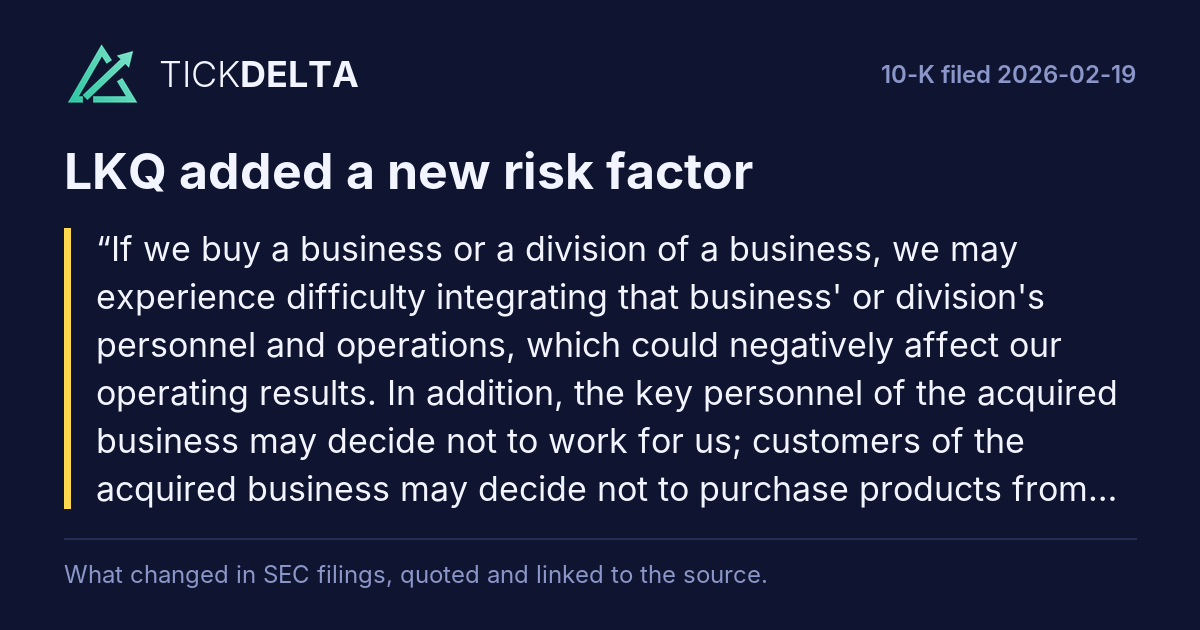
If we buy a business or a division of a business, we may experience difficulty integrating that business' or division's personnel and operations, which could negatively affect our operating results. In addition, the key personnel of the acquired business may decide not to work for us; customers of the acquired business may decide not to purchase products from us; suppliers of the acquired business may decide not to sell products to us; we may experience business disruptions as a result of IT systems conversions; we may experience additional financial and accounting challenges and complexities in areas such as tax planning, treasury management, and financial reporting; we may be held liable for environmental, tax or other risks and liabilities as a result of our acquisitions, some of which we may not have discovered during our due diligence; we may intentionally assume the liabilities of the businesses we acquire, which could result in material adverse effects on our business; the acquired business could place unanticipated demands on our management, operational resources and financial and internal control systems; our existing business may be disrupted or receive insufficient management attention; we may not be able to realize the cost savings or other financial benefits we anticipated, either in the amount or in the time frame that we expect; and we may incur debt or issue equity securities to pay for any future acquisition, the issuance of which could involve the imposition of restrictive covenants or be dilutive to our existing stockholders.

Read in the 10-K

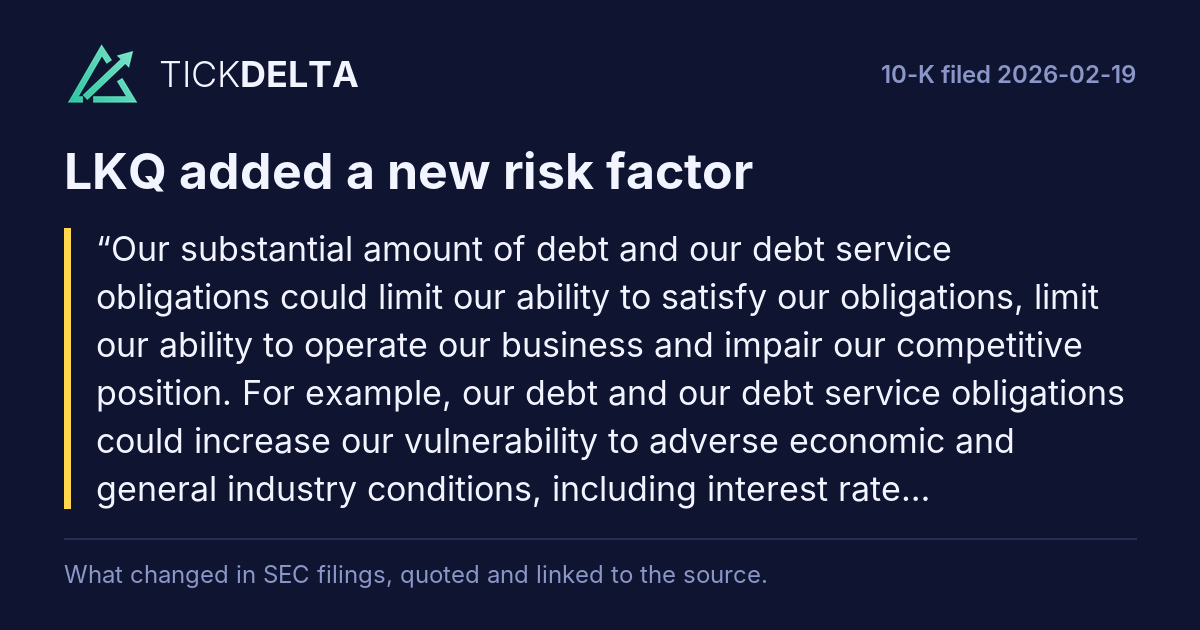
Our substantial amount of debt and our debt service obligations could limit our ability to satisfy our obligations, limit our ability to operate our business and impair our competitive position. For example, our debt and our debt service obligations could increase our vulnerability to adverse economic and general industry conditions, including interest rate fluctuations, because a portion of our borrowings are and will continue to be at variable rates of interest; require us to dedicate a substantial portion of our cash flow from operations to payments on our debt, which would reduce the availability of our cash flow from operations to fund working capital, capital expenditures, dividends, share repurchases, other investments or other general corporate purposes; limit our flexibility in planning for, or reacting to, changes in our business and industry; place us at a disadvantage compared to competitors that may have proportionately less debt; limit our ability to obtain additional debt or equity financing due to applicable financial and restrictive covenants in our debt agreements and indentures; and increase our cost of borrowing.

Read in the 10-K

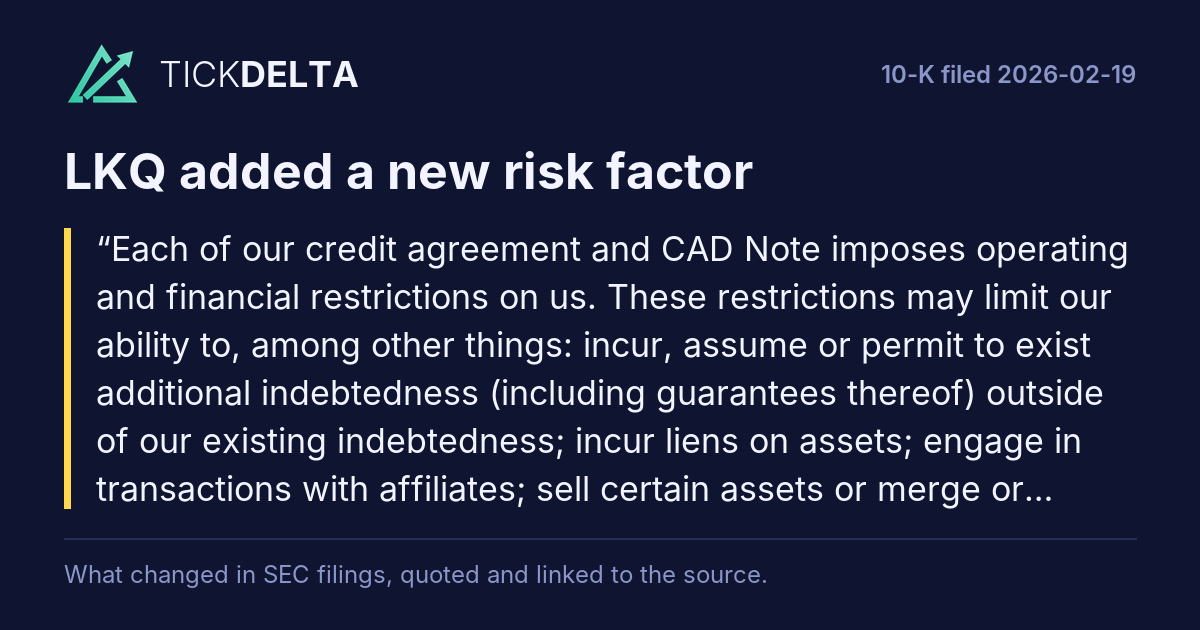
Each of our credit agreement and CAD Note imposes operating and financial restrictions on us. These restrictions may limit our ability to, among other things: incur, assume or permit to exist additional indebtedness (including guarantees thereof) outside of our existing indebtedness; incur liens on assets; engage in transactions with affiliates; sell certain assets or merge or consolidate with or into other companies; guarantee indebtedness; and alter the business we conduct.

Read in the 10-K

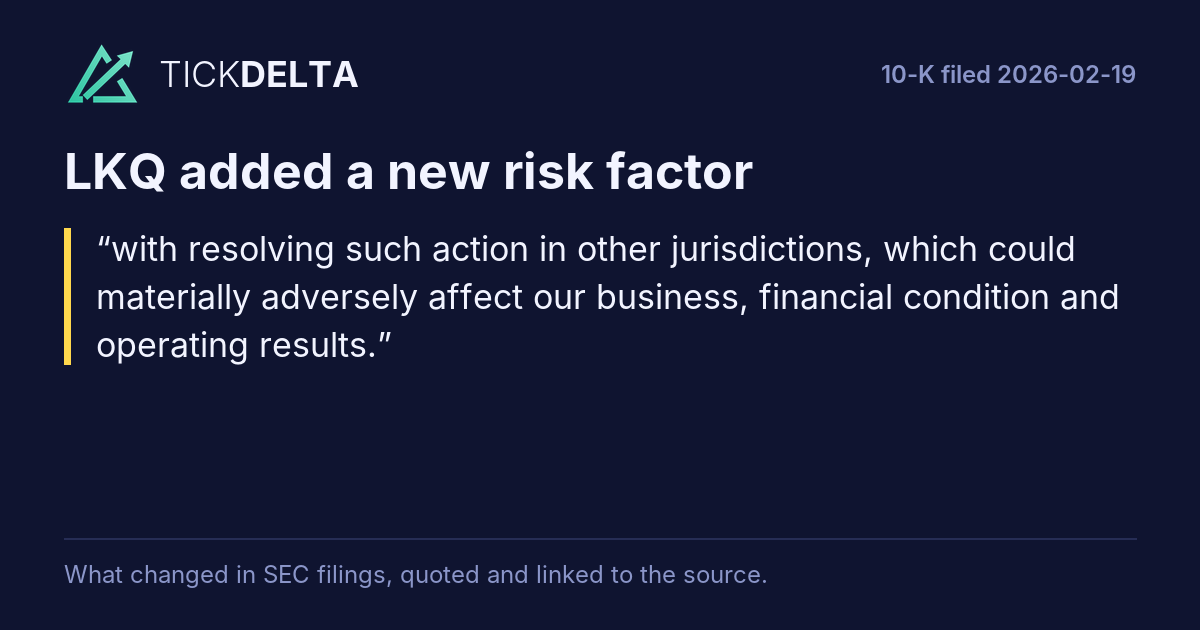
with resolving such action in other jurisdictions, which could materially adversely affect our business, financial condition and operating results.

Read in the 10-K

Additionally, on July 4, 2025, new U.S tax legislation was signed into law, commonly referred to as the One Big Beautiful Bill Act (“OBBBA”), which includes significant provisions, such as the permanent extension of certain expiring provisions of the Tax Cuts and Jobs Act of 2017, modifications to the international tax framework and the restoration of favorable tax treatment for certain business provisions. These new provisions take effect starting in 2025 through 2027. The Company has evaluated the OBBBA enacted during the year and estimated its impact on the consolidated financial statements to be immaterial. We will continue to evaluate the full impact of these legislative changes as additional guidance becomes available.

Read in the 10-K
Show the other 2

new collective bargaining or similar agreements, and work stoppages could materially increase our costs and reduce revenue and could limit our flexibility in terms of work schedules, reductions in force and other operational matters.

Read in the 10-K

We cannot assure you that our previously announced review of strategic alternatives will result in any transaction being consummated or any particular outcome being achieved, and speculation and uncertainty regarding the outcome of this review may adversely impact our business.

On January 26, 2026, we announced that our Board has initiated a comprehensive review of strategic alternatives to enhance shareholder value. As part of the review, the Board is working with its advisors to evaluate the Company’s strategic alternatives, including a potential sale of all or a portion of the Company. There can be no assurance this review process will result in any transaction or outcome. Whether the process will result in any transaction, our ability to complete any such transaction, and if the Board decides to pursue one or more transactions, will depend on numerous factors, some of which are beyond our control. Such factors include the interest of potential acquirers or strategic partners in a potential transaction, the value potential acquirers or strategic partners attribute to our businesses, regulatory approvals, market conditions, the expected impact of the transaction on our outstanding indebtedness and financial condition, and industry trends. Potential strategic transactions that require stockholder approval may not be approved by our stockholders or, if required, a counterparty's stockholders. Furthermore, any strategic transaction into which we enter may be delayed or may ultimately not be consummated

as a result of regulatory reviews (which may include domestic and foreign antitrust, foreign direct investment, CFIUS or other regulatory agency reviews) and determinations or other factors.

The price of our common stock and outstanding senior notes may be adversely affected if the strategic review process does not result in any transaction or if one or more transactions are consummated on terms that investors view as unfavorable to us. Even if one or more transactions are completed, there can be no assurance that any such transactions will be successful or have a positive effect on stockholder value. Our Board may also determine that no transaction is in the best interest of our stockholders, in which case no transaction will be consummated as a result of the strategic review process. Our financial results and operations (including our ability to refinance our outstanding indebtedness on favorable terms) could be adversely affected by the strategic process and by the uncertainty regarding its outcome.

The attention of management and our Board could be diverted from our core business operations as a result of this strategic review process. We have diverted capital and other resources to the process that otherwise could have been used in our business operations, and we expect to continue to do so until the process is completed. We could incur substantial expenses associated with identifying and evaluating potential strategic alternatives, including those related to employee retention payments, equity compensation, severance pay and legal, accounting and financial advisor fees. A considerable portion of these expenses will be incurred regardless of whether a transaction is completed. In addition, the process could lead us to lose or fail to attract, retain and motivate key employees, and to lose or fail to attract customers or business partners. The consummation of a transaction may also cause acceleration of the repayment or redemption dates for our outstanding indebtedness. For example, in certain circumstances we may be required to redeem our senior notes at a premium to face value. Furthermore, it could expose us to litigation. The public announcement of a strategic alternative may also yield a negative impact on operating results if prospective or existing customers, vendors or partners are reluctant to commit to new or renewed contracts.

We do not intend to disclose developments or provide updates on the progress or status of the strategic process until our Board deems further disclosure is appropriate or necessary or to the extent required by applicable law. Accordingly, speculation regarding any developments related to the review of strategic alternatives and perceived uncertainties related to the future of our company could cause the price of our common stock and senior notes to fluctuate significantly and could make it more difficult or costly for us to obtain amendments, consents or waivers under our existing debt agreements. If we are unable to mitigate these or other potential risks related to the uncertainty caused by our evaluation of strategic alternatives, it could disrupt our business and adversely impact operating results and financial condition.

Read in the 10-K

Paragraphs in the 10-Q filed Oct 29, 2026 that were not in the one before

New in the latest 10-Q

29 paragraphs in the 10-Q filed Oct 29, 2026 with nothing like them in the 10-Q filed Jul 30, 2026 (at least half the words must differ; new numbers alone do not count). Quoted exactly, grouped by the item heading above them. This is text that changed, not a judgement of how serious it is.

Financial statements and notes

(2) Non-cash investing activities for the nine months ended September 30, 2025 includes an approximately $390 million receivable related to the sale of Self Service. Refer to Note 3, "Discontinued Operations" for further information.

Read in the 10-Q

Vesting of restricted stock units, net of shares withheld for employee tax 0.2 — — — (1) — — — (1)

Read in the 10-Q

Dividends declared to LKQ stockholders ($0.30 per share) — — — — — (77) — — (77)

Read in the 10-Q

In September 2026, we entered into a definitive agreement to sell our Romanian operations within our Europe segment to Elit Kar OOD, an equity method investee in which we hold a 20% ownership interest, in exchange for a purchase price receivable, with no cash consideration at closing. We expect to close the transaction in the fourth quarter of 2026 subject to regulatory approvals and customary closing conditions. In connection with entering into this agreement, we concluded that this disposal group met the held for sale criteria and classified their assets and liabilities as held for sale. As of September 30, 2026, the assets and liabilities held for sale were not material and are presented within Prepaid expenses and other current assets and Other current liabilities on the Unaudited Condensed Consolidated Balance Sheets, respectively. Upon classification as held for sale, we recorded a $23 million impairment charge to write down the carrying value of the net assets of our operations in Romania to its fair value less costs to sell, which is recorded within Impairment of net assets held for sale on the Unaudited Condensed Consolidated Statements of Income.

Read in the 10-Q

(2) During the nine months ended September 30, 2025, we recorded an impairment to write down the carrying value of Self Service to its fair value less costs to sell.

Read in the 10-Q
Show the other 24

Goodwill and indefinite-lived intangible assets are tested for impairment at least annually. During our annual goodwill and indefinite-lived intangible assets impairment test performed in the fourth quarter of 2025, we determined the carrying value of our Specialty reporting unit exceeded the fair value estimate and an impairment charge was recorded. During the three months ended September 30, 2026, we identified a triggering event under Accounting Standards Codification ("ASC") 350 for our Specialty and Europe reporting units resulting from declining financial performance. The triggering event occurred due to both reporting units experiencing underperformance relative to our current year forecasts and reductions in expected future segment profitability with the Specialty reporting unit forecasting lower operating profitability as a result of, among other things, unfavorable customer and product mix shifts, higher fuel and freight costs, and unexpected declines in certain markets and our Europe reporting unit experiencing lower than expected demand and forecasting slower than previously anticipated revenue recovery from the operational challenges resulting from the ERP implementation in Germany. As a result, we performed interim quantitative goodwill impairment tests for our Specialty and Europe reporting units as of September 30, 2026.

Read in the 10-Q

Based on the results of the interim quantitative goodwill impairment tests, we determined that the carrying amount of the Specialty reporting unit was in excess of its fair value and recorded a goodwill impairment charge of $ 88 million, which was recorded in Impairment of goodwill on the Unaudited Condensed Consolidated Statements of Income. For our Europe reporting unit, the estimated fair value exceeded the respective carrying value by 20 % and, accordingly, no goodwill impairment was recorded.

Read in the 10-Q

Management estimated the fair value of each reporting unit using both an income approach and a market approach. Under the income approach, management applied a discounted cash flow method reflecting discounted projected future (debt-free) cash flows, which were based on internal forecasts and other assumptions. Discount rates applied to the projected cash flows were based on the weighted average cost of capital for each reporting unit, which takes market participant assumptions into consideration and may include reporting-unit-specific risk premiums. Under the market approach, management utilized the guideline public company method, which analyzes market multiples (including revenue and/or earnings before interest, taxes, depreciation and amortization) for a group of comparable public companies, and used this market approach to validate the results of the income approach. The interim quantitative goodwill impairment tests utilized significant unobservable inputs, which are considered Level 3 inputs.

Read in the 10-Q

For the first nine months of 2026, we did not identify any triggering events or other indicators of impairment that necessitated any further interim test of goodwill impairment for our North America reporting unit.

Read in the 10-Q

On October 15, 2026, the court presiding over Derivative Actions 1, 2, and 4, on its own accord, transferred those actions to the United States District Court for the District of Delaware before it could issue a decision on LKQ’s motion to stay Derivative Action 4 or the consolidation motion filed by plaintiffs in Derivative Actions 1, 2 and 4. As such, both motions remain pending. On October 28, 2026, Derivative Actions 1, 2, and 4 were reassigned to the same judge who is presiding over Derivative Action 3.

Read in the 10-Q

For the nine months ended September 30, 2026 and 2025, the Company's CODM was Justin Jude, Chief Executive Officer. See Note 19, "Subsequent Event" regarding changes to the CODM and Chief Executive Officer effective on October 23, 2026.

Read in the 10-Q

(5) Amounts primarily include inventory write-downs and property, plant, and equipment impairment charges for operations impacted by the Ukraine/Russia conflict.

Read in the 10-Q

On October 23, 2026, Justin Jude departed from his position as President and Chief Executive Officer of the Company and Salvatore A. Abbate was appointed as President and Chief Executive Officer with an effective date of December 15, 2026. Until Mr. Abbate assumes the role of President and Chief Executive Officer, the Company has established an interim Office of the Chief Executive Officer to provide ongoing leadership continuity, consisting of John Mendel, Chairman of the Board, and Sue Gove, Chair of LKQ’s Audit Committee. Rick Galloway, Senior Vice President and Chief Financial Officer, will serve as the Company's Principal Executive Officer and CODM during such time.

Read in the 10-Q

On October 29, 2026, the Company announced that its Board of Directors has decided to suspend the previously announced strategic review, including the Specialty segment sales process, to provide the new leadership team an opportunity to conduct a comprehensive assessment of the business and evaluate the full range of value‑creation pathways available to the Company.

Read in the 10-Q

We continue to monitor our reporting units for events or changes in circumstances that may indicate it is more likely than not that the fair value of a reporting unit is below its carrying amount and, therefore, require us to perform an interim goodwill impairment test. During the three months ended September 30, 2026, we identified a triggering event under ASC 350 for our Specialty and Europe reporting units resulting from declining financial performance. Both reporting units experienced underperformance relative to our current year forecasts and reductions in expected future segment profitability. For the Specialty reporting unit, the underperformance was due to, among other factors, unfavorable customer and product mix shifts, higher fuel and freight costs, and unexpected declines in certain markets. For the Europe reporting unit, the underperformance was due to lower than expected demand and slower than previously anticipated forecasted revenue recovery from the operational challenges resulting from the ERP implementation in Germany.

Read in the 10-Q

As a result, we performed interim quantitative goodwill impairment tests for our Specialty and Europe reporting units as of September 30, 2026. Based on the results of the interim quantitative goodwill impairment tests, we determined that the carrying amount of the Specialty reporting unit was in excess of its fair value and recorded a goodwill impairment charge of $88 million, which was recorded in Impairment of goodwill on the Unaudited Condensed Consolidated Statements of Income. The estimated fair value of the Specialty reporting unit is sensitive to changes in the significant assumptions used in the valuation. Holding all other assumptions constant, a 5% decrease in projected cash flows would result in approximately $45 million of additional impairment, a 25 basis point increase in the discount rate would result in approximately $25 million of additional impairment, and a 0.25 decrease in the market multiples assumption would result in approximately $5 million of additional impairment.

Read in the 10-Q

Additionally, events that cause declines to Specialty's future cash flows such as underperformance relative to our forecasts, since actual results may differ from our estimates of future performance, or events that have a negative impact on the market value of the business, such as a deterioration in macroeconomic conditions, could result in additional future impairment to the goodwill in our Specialty reporting unit. For our Europe reporting unit, the estimated fair value exceeded the respective carrying value by 20% and, accordingly, no goodwill impairment was recorded. Holding all other assumptions constant, it would take a decrease in projected cash flows in excess of 22%, or an increase in the discount rate of more than 200 basis points to result in an impairment to goodwill.

Read in the 10-Q

Management estimated the fair value of each reporting unit using both an income approach and a market approach. Under the income approach, management applied a discounted cash flow method reflecting discounted projected future (debt-free) cash flows, which were based on internal forecasts and other assumptions. Discount rates applied to the projected cash flows were based on the weighted average cost of capital for each reporting unit, which takes market participant assumptions into consideration and may include reporting-unit-specific risk premiums. Under the market approach, management utilized the guideline public company method, which analyzes market multiples (including revenue and/or earnings before interest, taxes, depreciation and amortization) for a group of comparable public companies, and used this market approach to validate the results of the income approach. The interim quantitative goodwill impairment tests utilized significant unobservable inputs, which are considered Level 3 inputs.

Read in the 10-Q

For the first nine months of 2026, we did not identify any triggering events or other indicators of impairment that necessitated any further interim test of goodwill impairment for our North America reporting unit.

Read in the 10-Q

Three Months Ended September 30, 2026 Compared to Three Months Ended September 30, 2025

Read in the 10-Q

Nine Months Ended September 30, 2026 Compared to Nine Months Ended September 30, 2025

Read in the 10-Q

Three Months Ended September 30, 2026 Compared to Three Months Ended September 30, 2025

Read in the 10-Q

North America 2026 % of Total Segment Revenue 2025 % of Total Segment Revenue $ Change

Read in the 10-Q

Nine Months Ended September 30, 2026 Compared to Nine Months Ended September 30, 2025

Read in the 10-Q

Controls and procedures

There was no change in the Company’s internal control over financial reporting that occurred during the Company’s most recently completed fiscal quarter that has materially affected, or is reasonably likely to materially affect, the Company’s internal control over financial reporting.

Read in the 10-Q

Risk Factors

If we determine that our goodwill or other intangible assets have become impaired, we may incur significant charges to our pretax income.

Read in the 10-Q

As of September 30, 2026, we had $ 5,274 million of goodwill and $ 1,007 million of other intangible assets, net. Goodwill represents the excess of the purchase price over the fair market value of the net assets acquired in a business combination. Our other intangible assets include both definite- and indefinite-lived intangible assets in connection with trade names, software and other technology related assets, customer relationships, and contractual arrangements. In the future, our goodwill and intangible assets may increase as a result of acquisitions. We test goodwill and indefinite-lived intangible assets for impairment annually in the fourth quarter or more frequently when events or changes in circumstances indicate that any portion of an asset’s carrying amount may not be recoverable.

Read in the 10-Q

The impairment tests require us to make an estimate of the fair value of our reporting units and other intangible assets. We have previously recorded non-cash impairment charges, including during the year ended December 31, 2025 and the quarter ended September 30, 2026, and could do so again in the future if assumptions, estimates or circumstances change, some of which are beyond our control. Factors which could result in an impairment include, among other things, deterioration in the performance of acquired businesses; deterioration of expected future cash flows or performance; increases in our cost of capital; a sustained decline in our stock price and market capitalization; changes in our discount rate, risk-free rate or other general interest rate; adverse market conditions; and adverse changes in applicable laws or regulations, including modifications that restrict the activities of the acquired business. We cannot accurately predict the amount or timing of any future impairment. Should the value of goodwill or other intangible assets become impaired, our financial condition and results of operations may be adversely affected.

Read in the 10-Q

Item 6

Exhibit Description ──────────────────────────────────────────────────────────────────────────────────────────────────────────────────────────────────────────────────────────────────────────────────────── 10.1 Offer Letter to Salvatore A. Abbate dated October 21, 2026. 22.1 Subsidiary Guarantors of Guaranteed Securities. 31.1 Certification of Chief Executive Officer Pursuant to Rule 13a-14(a) or Rule 15d-14(a), as adopted pursuant to Section 302 of the Sarbanes-Oxley Act of 2002. 31.2 Certification of Chief Financial Officer Pursuant to Rule 13a-14(a) or Rule 15d-14(a), as adopted pursuant to Section 302 of the Sarbanes-Oxley Act of 2002. 32.1 Certification of Chief Executive Officer Pursuant to 18 U.S.C. Section 1350, as adopted pursuant to Section 906 of the Sarbanes-Oxley Act of 2002. 32.2 Certification of Chief Financial Officer Pursuant to 18 U.S.C. Section 1350, as adopted pursuant to Section 906 of the Sarbanes-Oxley Act of 2002. 101. INS Inline XBRL Instance Document - the instance document does not appear in the Interactive Data File because its XBRL tags are embedded within the Inline XBRL document. 101. SCH Inline XBRL Taxonomy Extension Schema Document 101. CAL Inline XBRL Taxonomy Extension Calculation Linkbase Document 101. DEF Inline XBRL Taxonomy Extension Definition Linkbase Document 101. LAB Inline XBRL Taxonomy Extension Label Linkbase Document 101. PRE Inline XBRL Taxonomy Extension Presentation Linkbase Document 104 Cover Page Interactive Data File (embedded within the Inline XBRL document)

Read in the 10-Q

The 10-Q's risk factors against the 10-K

Item 1A of the 10-Q filed Oct 29, 2026 against Item 1A of the 10-K filed Feb 19, 2026. A 10-Q repeats only the risks that changed, so a 10-K paragraph that is missing from it is not counted as removed. Added is a paragraph with nothing like it in the 10-K, Reworded a sentence that is in both with several words changed, Quiet changes a sentence in both where one to four words changed and one is a hedge or a modal (cut words struck through, new words highlighted). Text on the page, not a score; each links to the filing at sec.gov.

Added10-Q Oct 29, 2026 vs 10-K Feb 19, 2026
Our operations and financial results are subject to various risks and uncertainties that could adversely affect our business, financial condition and results of operations, and the trading price of our common stock. Please refer to our 2025 Form 10-K for information concerning risks and uncertainties that could negatively impact us. The following item is an update to the risks and uncertainties previously disclosed in such report.

Read it in the 10-Q at sec.gov

Added10-Q Oct 29, 2026 vs 10-K Feb 19, 2026
As of September 30, 2026, we had $ 5,274 million of goodwill and $ 1,007 million of other intangible assets, net. Goodwill represents the excess of the purchase price over the fair market value of the net assets acquired in a business combination. Our other intangible assets include both definite- and indefinite-lived intangible assets in connection with trade names, software and other technology related assets, customer relationships, and contractual arrangements. In the future, our goodwill and intangible assets may increase as a result of acquisitions. We test goodwill and indefinite-lived intangible assets for impairment annually in the fourth quarter or more frequently when events or changes in circumstances indicate that any portion of an asset’s carrying amount may not be recoverable.

Read it in the 10-Q at sec.gov

Added10-Q Oct 29, 2026 vs 10-K Feb 19, 2026
The impairment tests require us to make an estimate of the fair value of our reporting units and other intangible assets. We have previously recorded non-cash impairment charges, including during the year ended December 31, 2025 and the quarter ended September 30, 2026, and could do so again in the future if assumptions, estimates or circumstances change, some of which are beyond our control. Factors which could result in an impairment include, among other things, deterioration in the performance of acquired businesses; deterioration of expected future cash flows or performance; increases in our cost of capital; a sustained decline in our stock price and market capitalization; changes in our discount rate, risk-free rate or other general interest rate; adverse market conditions; and adverse changes in applicable laws or regulations, including modifications that restrict the activities of the acquired business. We cannot accurately predict the amount or timing of any future impairment. Should the value of goodwill or other intangible assets become impaired, our financial condition and results of operations may be adversely affected.

Read it in the 10-Q at sec.gov

Phrases used for the first time

Two-word phrases in Risk Factors of the 10-K filed Feb 19, 2026 that are in none of the 1 earlier 10-Ks stored, back to Feb 20, 2025

strategic alternatives ×6review process ×4outstanding indebtedness ×3strategic review ×3assets engage ×2salvage products ×2uncertainty regarding ×2potential acquirers ×2strategic partners ×2strategic process ×2
Where each one is used
  • strategic alternatives: We cannot assure you that our previously announced review of strategic alternatives will result in any transaction being consummated or any particular outcome being achieved, and speculation and uncertainty regarding the outcome of this review may adversely impact our business.
  • review process: On January 26, 2026, we announced that our Board has initiated a comprehensive review of strategic alternatives to enhance shareholder value. As part of the review, the Board is working with its advisors to evaluate the Company’s strategic alternatives, including a potential sale of all or a portion of the Company....
  • outstanding indebtedness: On January 26, 2026, we announced that our Board has initiated a comprehensive review of strategic alternatives to enhance shareholder value. As part of the review, the Board is working with its advisors to evaluate the Company’s strategic alternatives, including a potential sale of all or a portion of the Company....
  • strategic review: The price of our common stock and outstanding senior notes may be adversely affected if the strategic review process does not result in any transaction or if one or more transactions are consummated on terms that investors view as unfavorable to us. Even if one or more transactions are completed, there can be no...
  • assets engage: Although we are subject to our credit agreement and CAD Note for so long as each of those respective agreements remain in effect, the indentures governing the senior notes do not restrict the future incurrence of unsecured indebtedness, guarantees or other obligations. The indentures contain certain limitations,...
  • salvage products: Some jurisdictions have enacted laws prohibiting or severely restricting the sale of certain salvage products that we provide, such as airbags. In addition, laws relating to the regulation of parts affecting vehicle emissions, such as California’s Proposition 65, may impact the ability of our Specialty segment to...
  • uncertainty regarding: We cannot assure you that our previously announced review of strategic alternatives will result in any transaction being consummated or any particular outcome being achieved, and speculation and uncertainty regarding the outcome of this review may adversely impact our business.
  • potential acquirers: On January 26, 2026, we announced that our Board has initiated a comprehensive review of strategic alternatives to enhance shareholder value. As part of the review, the Board is working with its advisors to evaluate the Company’s strategic alternatives, including a potential sale of all or a portion of the Company....

The 10-K at sec.gov

Used at least twice, small words left out. Counted, not picked: a phrase can be new because the company renamed something.

What was taken out

19 paragraphs of last year's Risk Factors with nothing like them now. The longest are quoted.

Across all companies
•require us to dedicate a substantial portion of our cash flow from operations to payments on our debt, which would reduce the availability of our cash flow from operations to fund working capital, capital expenditures, dividends, share repurchases, other investments or other general corporate purposes;
In the 10-K filed Feb 20, 2025
•increase our vulnerability to adverse economic and general industry conditions, including interest rate fluctuations, because a portion of our borrowings are and will continue to be at variable rates of interest;
In the 10-K filed Feb 20, 2025
If we buy a business or a division of a business, we may experience difficulty integrating that business' or division's personnel and operations, which could negatively affect our operating results. In addition:
In the 10-K filed Feb 20, 2025
•we may incur debt or issue equity securities to pay for any future acquisition, the issuance of which could involve the imposition of restrictive covenants or be dilutive to our existing stockholders.
In the 10-K filed Feb 20, 2025

Sources

Item 1A of each 10-K and 10-Q on EDGAR, quoted exactly. Each paragraph links to the filing at sec.gov.

Also

10-K change: what was reworded or cut, section by section.

Work with it

Excel workbook · CSV. Google Sheet that stays up to date: paste =IMPORTDATA("https://tickdelta.com/company/LKQ/export.csv") into a cell.

Next:10-K change
Esc

Type a ticker such as AAPL, a name, an investor such as Buffett, or a topic such as tariffs. ↑ ↓ to move, Enter to open.