Form 10-K
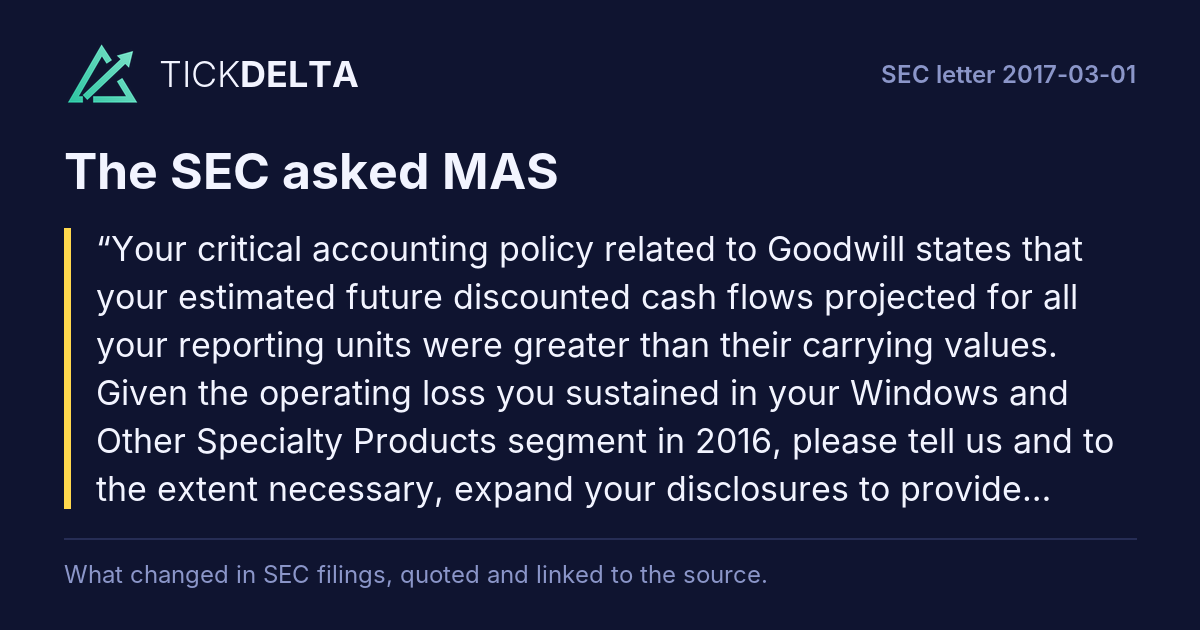
Your critical accounting policy related to Goodwill states that your estimated future discounted cash flows projected for all your reporting units were greater than their carrying values. Given the operating loss you sustained in your Windows and Other Specialty Products segment in 2016, please tell us and to the extent necessary, expand your disclosures to provide insight into how the operational issues you mentionRest of the question
have impacted your goodwill impairment analysis for the reporting units comprising this segment. As part of your disclosure enhancements, please quantify in percentage terms, the extent to which your individual reporting unit fair values exceed their carrying values for every period presented.
We respectfully inform the Staff that our Windows and Other Specialty Products segment is comprised of three reporting units: Milgard, UK Window Group and Arrow Fastener. As of December 31, 2016, the carrying value of goodwill for the Milgard, UK Window Group and Arrow Fastener reporting units was $199 million, $7 million, and $47 million, respectively.Read in the reply ↗Rest of the answer
The goodwill impairment tests for 2016 for Milgard, UK Window Group and Arrow Fastener resulted in fair value in excess of the carrying value by 38%, 202% and 27%, respectively, and we concluded that none of these reporting units were at risk of potential goodwill impairment at December 31, 2016.
The operational issues we disclosed with respect to our Windows and Other Specialty Products segment pertained solely to Milgard. In 2016, Milgard had an operating loss of $19 million due primarily to a $31 million warranty liability adjustment that related to a change in estimate of expected future warranty claim costs primarily for products sold prior to 2016. If we had not adjusted the warranty liability, Milgard would have achieved operating profit in 2016. We currently do not expect any significant changes to the Milgard warranty liability going forward, other than ordinary course changes resulting from future sales. The UK Window Group and Arrow Fastener reporting units each achieved operating profit and positive operating cash flows in 2016.
We use a discounted cash flow model for purposes of determining fair value for our goodwill impairment test. Milgard’s operational issues combined with other assumption changes, including a higher risk premium that resulted in our using a higher discount rate, contributed to a 44% reduction in Milgard’s fair value for 2016 compared to the prior year. Milgard’s goodwill impairment test for 2016 resulted in fair value in excess of carrying value by 38%, despite the reduction in fair value and without fully considering the positive impact we expect from the operational improvement initiatives Milgard implemented in the fourth quarter of 2016. These initiatives include reassignment of key management, reductions in Milgard’s labor force and other cost savings measures.
In our “Critical Accounting Policies and Estimates” disclosure in Management’s Discussion and Analysis of Financial Condition and Results of Operations (the “MD&A”) in our Annual Report on Form 10-K (“our Form 10-K”), on page 18, we disclosed that a 10% decrease in the estimated fair value of our reporting units would not have resulted in any additional analysis of goodwill impairment for any reporting unit. Because each reporting unit in the Windows and Other Specialty Products segment had a fair value substantially in excess of carrying value, we do not believe these reporting units are currently at risk of being impaired. Therefore, we respectfully submit that additional disclosure is not necessary to enhance investor understanding.
First report after the company's reply of 2017-03-14: 10-Q filed 2017-04-25 ↗, against the 10-Q filed 2016-10-25 ↗.
Tickdelta does not hold the text of both reports, so they are not compared here.
We note the Widows and Other Specialty Products component of your business sustained a loss in fiscal year 2016. In future filings, please enhance your disclosure to more fully discuss and quantify the factors which contributed to the segment’s operating results.Rest of the question
We note elsewhere in your document that your Milgard business is experiencing operational issues and production inefficiencies, including hiring and retaining qualified labor. Your MD&A for this segment should more fully discuss these matters and any other factors which may have impacted your results.
As disclosed in our “Business Segment Results Discussion” in our MD&A of our Form 10-K, on page 30, the warranty liability adjustment noted in our response to comment 1 above, along with higher labor costs and ERP system implementation costs were the most significant factors affecting the 2016 operating results of our Windows and Other Specialty Products segment.Read in the reply ↗Rest of the answer
In response to the Staff’s comment, in future filings we will provide additional disclosure to more fully discuss and quantify, to the extent needed to enhance investor understanding, factors that may have impacted our operating results or known trends that may in the future impact our operating results for this reporting segment.
First report after the company's reply of 2017-03-14: 10-Q filed 2017-04-25 ↗, against the 10-Q filed 2016-10-25 ↗.
Tickdelta does not hold the text of both reports, so they are not compared here.
We note the significant increase in your accrual related to pre-existing warranties for your Windows and Other Specialty Products segment. As this accrual does not relate to warranties issued during the current year, please expand your discussion and analysis to provide insight into the products and factors that have contributed to your determination that an increase in the accruals for pre-existing warranties wasRest of the question
necessary. Please also address the warranty claim trends you have experienced and whether or not you believe the need for additional accruals may be reasonably possible.
The increase in the warranty liability for our Windows and Other Specialty Products segment only related to our Milgard business. Our MD&A of our Form 10-K, on page 20, refers to Note U to our audited consolidated financial statements for the year ended December 31, 2016, on page 73 of our Form 10-K, where we disclose the change in estimate of expected future warranty claims resulting from recent warranty claim trends, including, among other items, the nature and type of claim and estimate of costs to service claims.
In 2014, Milgard replaced a legacy service ticket system with an enhancedRead in the reply ↗Rest of the answer
system based on salesforce.com (SFDC) and Oracle Field Service Cloud (OFSC). As a result of implementing SFDC, Milgard was able to capture additional information relating to warranty service tickets. The OFSC implementation better supported multiple technician routing, including tracking drive time to the customer’s home and to the next job, as well as tracking actual time to complete service jobs. During 2016, Milgard’s management, with the assistance of a third-party consultant, reviewed service claims cost trends, including a shift to increased costs to repair, and commenced refining its valuation model for warranty liability, using in part, the additional data provided by the SFDC and OFSC systems. Although the refinements to the valuation model were not yet completed, in June 2016 Milgard’s management concluded that the additional information that had become available necessitated a $10 million increase in Milgard’s warranty liability. This increase was disclosed in Note G to the condensed consolidated financial statements for the period ended June 30, 2016, on page 11 of our Quarterly Report on Form 10-Q.
The third-party consultant used actuarial analyses and supported Milgard’s evaluation of certain underlying assumptions used in the warranty valuation model. In September 2016 Milgard’s management finalized the development, testing and implementation of the revised warranty valuation model. In using the revised model with the additional information that became available through the implementation of SFDC and OFSC, we determined that a $21 million additional increase in Milgard’s warranty liability was necessary. This increase was disclosed in Note G to the condensed consolidated financial statements for the period ended September 30, 2016, on page 11 of our Quarterly Report on Form 10-Q.
Since the valuation model was fully implemented in the third quarter of 2016, there was no significant change in the fourth quarter to the warranty liability. We also currently do not expect any significant changes to the Milgard warranty liability going forward, other than ordinary course changes resulting from future sales; however, as we have disclosed in our “Critical Accounting Policies and Estimates” in our MD&A on page 20 of our Form 10-K, as well as in the “Warranty” section of Note A to our audited consolidated financial statements on page 44 of our Form 10-K, actual claims incurred could differ from the original estimates, thereby requiring adjustments to previously established accruals.
In response to the Staff’s comment, in our Quarterly Report on Form 10-Q for the period ending March 31, 2017, and in subsequent filings, we will include the following disclosure in the notes to the condensed consolidated financial statements for as long as the relevant 2016 amounts are reported in our filings:
In the second and third quarters of 2016, a business unit in the Windows and Other Specialty Products segment recorded a $10 million and a $21 million increase in its estimate of expected future warranty claims relating to previously sold windows and doors. The change in estimate resulted from the adoption of an improved warranty valuation model and the availability of additional information used to support the estimate of costs to service claims and recent warranty claims trends, including a shift to increased costs to repair.
If you have any further questions or comments, please contact me at 313-792-6044.
First report after the company's reply of 2017-03-14: 10-Q filed 2017-04-25 ↗, against the 10-Q filed 2016-10-25 ↗.
Tickdelta does not hold the text of both reports, so they are not compared here.
Also in this review: closing letter, 2017-04-11