Form 10-K for the Fiscal Year Ended April 29, 2016
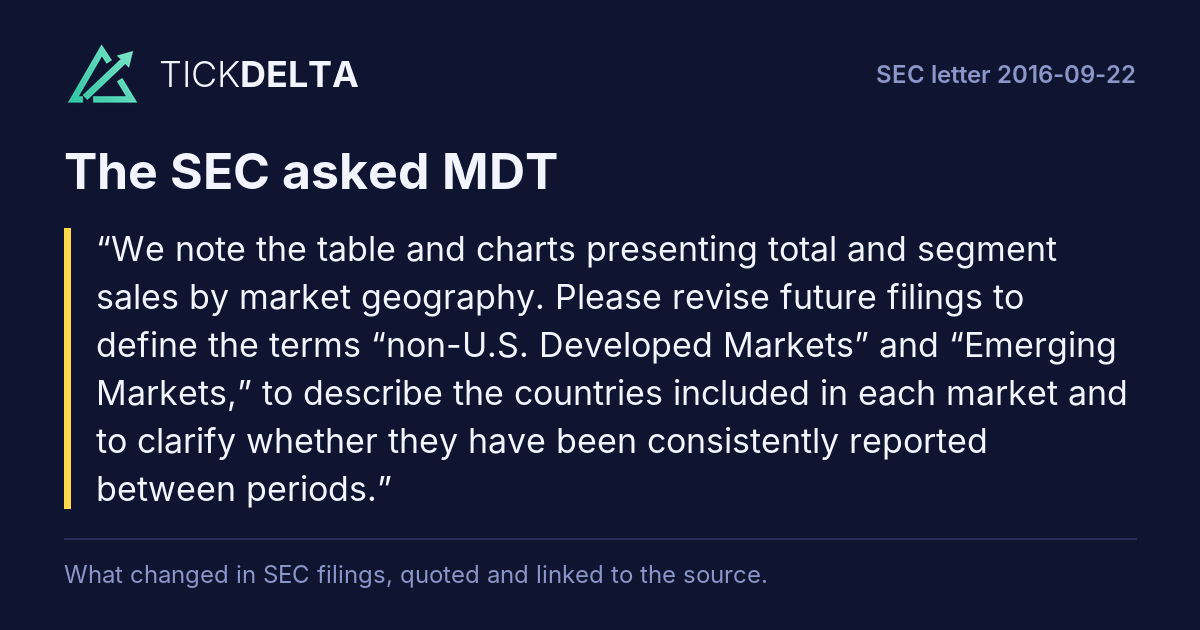
We note the table and charts presenting total and segment sales by market geography. Please revise future filings to define the terms “non-U.S. Developed Markets” and “Emerging Markets,” to describe the countries included in each market and to clarify whether they have been consistently reported between periods.
The Company notes the Staff’s comment and respectfully informs the Staff that it will revise its disclosure in future filings to define the terms “non-U.S. Developed Markets” and “Emerging Markets,” including a description of the countries included in such markets. In addition, the Company will identify in future filings significant changes that it makes to the composition of a geographic market category as compared to the prior-year period. Read in the reply ↗
First report after the company's reply of 2016-10-06: 10-Q filed 2016-12-05 ↗, against the 10-Q filed 2016-09-07 ↗.
Tickdelta does not hold the text of both reports, so they are not compared here.
We note that as a result of your Internal Reorganization $9.7 billion of cash, cash equivalents, and investments became available for general corporate purposes and you recorded a $442 million tax adjustment charge, which primarily related to U.S. income tax expense.Rest of the question
We also note that at the end of fiscal 2015 and 2016, cash, cash equivalents and investments of $6 billion and $5 billion, respectively, were held by U.S. controlled non-U.S. subsidiaries and may not have represented available liquidity. Please address the following: Describe to us in greater detail the reorganization of the Covidien businesses and tell us how it impacted the reporting and holding of cash, cash equivalents and investments by the U.S. controlled non-U.S subsidiaries. Reconcile for us the $6 billion of cash, cash equivalents and investments not available for general corporate purposes at the end of fiscal 2015 with the $5 billion disclosed at the end of fiscal 2016, clearly showing how the additional $9.7 billion became available in the second quarter of 2016. Tell us how you applied the guidance in ASC 740 in recording the tax adjustment charge, including your calculation of the amount of the charge and determination of the appropriate tax rate.
Describe to us in greater detail the reorganization of the Covidien businesses and tell us how it impacted the reporting and holding of cash, cash equivalents and investments by the U.S. controlled non-U.S subsidiaries.
With respect to the factual background for this request, the Company respectfully notes that in the fiscal year 2015 10-K filing for Medtronic plc, the Liquidity and Capital Resources section of the disclosure stated that as of the end of fiscal year 2015 “approximately $17.7 billion . . .Read in the reply ↗Rest of the answer
of cash, cash equivalents, and investments in marketable debt and equity securities were held by our non-U.S. subsidiaries.” This figure included cash, cash equivalents, and investments in marketable debt and equity securities held by both U.S. controlled non-U.S. subsidiaries and non-U.S. subsidiaries that were not U.S.
controlled; amounts held by the U.S. controlled non-U.S. subsidiaries referenced in the Company’s fiscal year 2016 10-K filing totaled approximately $15 billion as of 2015 fiscal year end. Following the reorganization described below, the Company refined its Liquidity and Capital Resources disclosure prior to its fiscal year 2016 10-K filing to reference only the amounts held by certain U.S. controlled non-U.S. subsidiaries that may not be available for general corporate purposes. The fiscal year 2016 10‑K Liquidity and Capital Resources disclosure therefore stated that “Approximately $5 billion of our cash, cash equivalents, and investments held by certain U.S. controlled non-U.S. subsidiaries may not represent available liquidity for general corporate purposes.”
In January of 2015, Medtronic, Inc. and Covidien were combined under and became subsidiaries of Medtronic plc. As is customary following an acquisition, the Company evaluated whether the newly-combined company could benefit from optimizing administrative functions, manufacturing and supply chain infrastructure and achieving other synergies by integrating and reorganizing its subsidiary legal entity structure. As part of the resulting internal restructuring of entities, one Medtronic plc subsidiary purchased all of the shares of another Medtronic plc subsidiary, which at the time of the disclosure had an anticipated value of approximately $9.7 billion. Pursuant to the terms of this intercompany sale of shares, the acquiring Medtronic subsidiary, which was a U.S. controlled non-U.S. subsidiary, delivered $9.7 billion cash, cash equivalents and investments to the selling subsidiary, which was not a U.S. controlled non-U.S. subsidiary. As a result, the Company updated the reporting of the cash, cash equivalents and investments in subsequent filings to disclose the approximate amounts held by certain U.S. controlled non-U.S. subsidiaries. As described in more detail in response to last bullet point of comment 2 below, Medtronic estimated the total tax cost associated with this transaction to be $442 million.
The Company continues to engage in other internal restructurings of legal entities as part of its ongoing effort to integrate the legacy Medtronic and Covidien businesses. In addition, cash is generated by ongoing business operations and continues to be used for general corporate purposes. The levels of cash, cash equivalents and investments held by U.S. controlled non-U.S. subsidiaries are affected by these intracompany transactions and ongoing business operations due to movements of cash among entities and changes to operations held by such entities, which has a resulting impact to cash flow from operations and the entities’ overall cash balances. The Company therefore makes corresponding updates in its periodic reports to the disclosed amount of cash, cash equivalents, and investments which are held by certain U.S. controlled non-U.S. subsidiaries.
Reconcile for us the $6 billion of cash, cash equivalents and investments not available for general corporate purposes at the end of fiscal 2015 with the $5 billion disclosed at the end of fiscal 2016, clearly showing how the additional $9.7 billion became available in the second quarter of 2016.
As noted in the response to the first bullet point of comment 2 above, approximately $15 billion of cash, cash equivalents, and investments was held by certain U.S. controlled non-
U.S. subsidiaries as of the end of the Company’s 2015 fiscal year. This amount decreased by approximately $10 billion during fiscal 2016 as a result of the $9.7 billion reorganization transaction described above, as well as other intracompany transactions and our ongoing business operations.
Tell us how you applied the guidance in ASC 740 in recording the tax adjustment charge, including your calculation of the amount of the charge and determination of the appropriate tax rate.
In order to determine the amount of tax associated with the reorganization transaction described above, the Company determined the relevant U.S. federal income tax rate attributable to the subsidiary acquiring the shares and estimated the total amount of income taxes due using an approximately $9.7 billion valuation for the transferred shares. The relevant tax rates were based on the general U.S. tax federal and state tax rates on corporate income as well as the relevant withholding tax rates under applicable treaties. The Company also addressed the non-U.S. tax consequences of this reorganization, using the non-U.S. tax rates applicable to the subsidiary selling the shares and the same valuation for the transferred shares. The aggregate estimated taxes due under U.S. and foreign tax law were estimated to be approximately $442 million which was calculated at various statutory rates. The majority of this expense was required to be paid immediately, but based on the specific U.S. tax laws, a portion of the payment was deferred until a subsequent tax year.
First report after the company's reply of 2016-10-06: 10-Q filed 2016-12-05 ↗, against the 10-Q filed 2016-09-07 ↗.
Tickdelta does not hold the text of both reports, so they are not compared here.
We note that you omit a quantitative reconciliation with respect to your forward looking non-GAAP guidance, but you do not provide the disclosures required when the reconciliation is omitted. In your next earnings release, please follow the guidance in Question 102.10 of the updated Non-GAAP Compliance and Disclosure Interpretations issued on May 17, 2016.
The Company notes the Staff’s comment and will ensure that future disclosures of forward looking non-GAAP measures that are subject to Item 10(e)(1)(i) of Regulation S-K are consistent with the guidance set forth in Question 102.10 of the updated Non-GAAP Compliance and Disclosure Interpretations. In its next earnings release, the Company will either provide a quantitative reconciliation to the most directly comparable forward looking GAAP measures or disclose that a reconciliation is not available without unreasonable efforts, in which case the Company will identify the information that isRead in the reply ↗Rest of the answer
unavailable and its probable significance.
First report after the company's reply of 2016-10-06: 10-Q filed 2016-12-05 ↗, against the 10-Q filed 2016-09-07 ↗.
Tickdelta does not hold the text of both reports, so they are not compared here.
We note that you exclude restructuring charges from your non-GAAP measures. Please explain to us why these are not normal, recurring, cash operating expenses necessary to operate your business. See Question 100.01 of the updated Non-GAAP Compliance and Disclosure Interpretations issued on May 17, 2016.
The Company has reviewed the updated Non-GAAP Compliance and Disclosure Interpretations issued on May 17, 2016, as well as Regulation G and Item 10(e) of Regulation S-K, in the identification of items for which the GAAP financial measures are adjusted. The Company believes that adjusting non-GAAP results for restructuring costs is consistent with the guidance referenced above. Consistent with Compliance and Disclosure Interpretation 102.03, the Company does not describe these charges as non-recurring or in other terms that mischaracterize the frequency of these charges.Read in the reply ↗Rest of the answer
Moreover, because the Company may incur restructuring charges in connection with various cost-reduction or productivity initiatives or synergy initiatives in relation to acquisitions, it does not view such charges as normal, recurring, cash operating expenses necessary to the operation of its business.
The Company’s restructuring charges may or may not recur with similar materiality or impact on results across reporting periods, due to changes in cost-reduction activities and productivity initiatives, including progress on or changes to synergy initiatives arising out of acquisitions, which may be impacted by variations in the number, size and nature of acquisitions and the extent of integration activity from period to period. While it is not unusual for the Company to incur some manner of restructuring charges in a period, the nature and amount of such charges vary and are not incurred in the ordinary course of business. Because variations in restructuring charges may affect the comparability of the Company’s operational results across reporting periods, the Company’s management uses financial measures that exclude restructuring charges to facilitate reviews of operational performance and as a basis for strategic planning, and management believes that presenting non-GAAP financial measures that exclude restructuring charges allows investors to supplement their understanding of the Company’s short-term and long-term financial trends.
First report after the company's reply of 2016-10-06: 10-Q filed 2016-12-05 ↗, against the 10-Q filed 2016-09-07 ↗.
Tickdelta does not hold the text of both reports, so they are not compared here.
We note your response to comment 3. While you do not describe your restructuring charges as non-recurring or in other terms that mischaracterize the frequency of these charges we note that you have incurred restructuring charges in each of the last three years.Rest of the question
Please explain to us in detail your restructuring plans for each of the last three years and explain to us why these are not normal, recurring, cash operating expenses necessary to operate your business.
As a point of clarification, we believe the Staff intends to refer to comment 4 from the September 22, 2016 letter. As indicated in our October 6, 2016 response, we do not view restructuring charges as normal, recurring cash operating expenses necessary to the operation of our business. We incur restructuring charges in connection with our cost-reduction and productivity initiatives or with acquisitions when we implement plans to restructure and integrate the acquired operations.Read in the reply ↗Rest of the answer
During the last three fiscal years, our restructuring charges consisted of the following:
•
Restructuring Charges Incurred in the First Quarter of Fiscal Year 2014 through the First Quarter of Fiscal Year 2015:
During fiscal year 2014, net restructuring charges for Medtronic, Inc. (our predecessor registrant) were $88 million.
In the first quarter of fiscal year 2014, Medtronic, Inc. recognized restructuring charges primarily related to distributor and agent contract termination costs associated with a shift in selling strategy to sell directly to the consumer in Latin America. The restructuring charges also included remaining lease payments related to office optimization efforts associated with the first phase of a strategic shift in Europe to reduce back-office support functions, which was part of the “Fit for Growth” initiative designed to scale back infrastructure in slower growing regions of the business.
In the fourth quarter of fiscal year 2014, Medtronic, Inc. recognized restructuring charges related primarily to employee termination costs and asset write-downs as a result of the second phase of the “Fit for Growth” initiative and non-cash fixed asset and inventory impairment costs associated with discontinued product lines.
In the first quarter of fiscal year 2015, we recognized net restructuring charges of $30 million, which consisted primarily of distributor and agent contract termination costs associated with a shift in selling strategy to sell directly to the consumer in Europe.
Restructuring Charges Incurred in theFourth Quarter of Fiscal Year 2015 through the First Quarter of Fiscal Year 2017:
During the fourth quarter of fiscal year 2015, the Company completed the acquisition (Acquisition) of Covidien plc (Covidien) in a cash and stock transaction valued at approximately $50 billion. In connection with the transaction, Medtronic, Inc. and Covidien were combined under and became subsidiaries of Medtronic plc.
We began our restructuring program related to the Acquisition, the “Cost Synergies” initiative, in the fourth quarter of fiscal year 2015. In the fourth quarter of fiscal year 2015, throughout fiscal year 2016, and in the first quarter of fiscal year 2017, the Company recognized net restructuring charges of $222 million, $299 million, and $104 million, respectively.
The “Cost Synergies” initiative includes restructuring charges related to the integration of Covidien, including costs associated with duplicate facilities, manufacturing and supply chain infrastructure efficiencies, certain program cancellations and general and administrative redundancies, multiple distributors in the same region, and a shift in selling strategy to sell directly to the consumer, as opposed to utilizing external distributors within our sales process. Restructuring charges primarily related to employee termination costs and costs related to manufacturing/building site closures.
We are in the business of providing medical technology, services and solutions to further the provision of healthcare across the world. Our restructuring expenses relate to ancillary cost-reduction and productivity initiatives, such as severance charges arising from the reduction of excess overhead, which are not considered normal to operate our business. The restructuring programs described above affect comparability of our operational results. The expenses do not reflect investments in our current operations and are not indicative of performance by our current operations, which are the focus of both management and the investing community when evaluating our performance. Restructuring charges are not necessary to operate the business and are not necessary to generate revenue. Additionally, the restructuring charges included in our non-GAAP adjustments are expenses incurred by the Company with no related benefit to the Company’s current operations. As such, including restructuring charges in the determination of operating margins would result in providing confusing information to the users of the financial statements about a particular period’s operating performance.
Moreover, the nature, frequency and magnitude of restructuring charges do not recur predictably from period to period because our restructuring programs may be impacted by acquisition activity. This is illustrated by the variation in the level of restructuring costs from fiscal year 2014 to the two years immediately following the Acquisition, and by the fact that our restructuring expenses in fiscal years 2015 and 2016 primarily derived from the Acquisition. The Acquisition was a significant transaction for the Company.
In light of the foregoing factors, our management uses financial measures that exclude restructuring charges to facilitate reviews of operational performance and as a basis for strategic planning, and management believes that such measures allow investors to supplement their understanding of our short-term and long-term financial trends. We do not believe that it is misleading to exclude the impact of restructuring charges from clearly-labeled non-GAAP financial measures, because our restructuring charges are not normal, recurring operating expenses necessary to the operation of the business. The adjusted figures are expected and requested by our investors in order to quantify the impact of our restructuring programs and facilitate their review and understanding of the results of our operations.
Also in this review: closing letter, 2016-11-29