Mirion Technologies, Inc. MIR
New risk paragraphs, branching off last year
Each branch is a paragraph in Risk Factors with nothing like it in the 10-K filed Feb 26, 2025. A box jumps to the paragraph as filed, below.
Paragraphs with nothing like them in last year's 10-K
7 paragraphs in Risk Factors of the 10-K filed Feb 19, 2026 with nothing like them in the 10-K filed Feb 26, 2025. Quoted exactly. Paragraphs that were only edited are under 10-K change.
We operate in complex markets and regulatory environments and that involves significant risk. You should carefully consider the following risk factors before making an investment decision as they may have an adverse effect on our business, results of operations and financial condition:
Following the Paragon acquisition, our growth strategy relies in part on plans to supply our products and services to SMRs and other advanced reactors in the U.S., an emerging market that may grow more slowly than we expect. Our Nuclear and Safety growth strategy relies on market research that estimates that the market for SMRs will surge, driven by a global growth in energy, and specifically electricity demand, and we have accordingly pursued entering into strategic agreements with a number of SMR companies in the U.S. However, these companies face multiple commercialization obstacles including reactor design, regulatory licensing, and securing customers willing and able to make large investments in emerging nuclear technologies. Each SMR developer faces unique risks, including risks related to technology, regulatory approvals, and financing. Even for those SMR companies that succeed, the cost curves that will be required for successful commercialization at scale will be aggressive and competition will be fierce among them, and also from other cost-competitive energy solutions. Further, many of these SMR companies are new entrants to the nuclear market and may fail operationally even if they develop a successful reactor, which may negatively impact the entire market. Our assumptions, estimates and plans about the SMR market may not be correct or they may change at any time, and our revenue may be subject to volatility as our SMR partners succeed, delay or cancel their projects, or fail altogether, which could cause material and adverse impacts on our business, results of operations and financial condition.
In July 2025 and December 2025 we acquired Certrec and Paragon, respectively. These acquisitions may not meet our expectations. Their success, including anticipated benefits, will depend, in part, on our ability to successfully integrate our respective organizations without materially disrupting existing business and strategic relationships. If we experience difficulties in the integration process, we may not fully realize the anticipated benefits of the acquisitions in a timely manner, or at all.
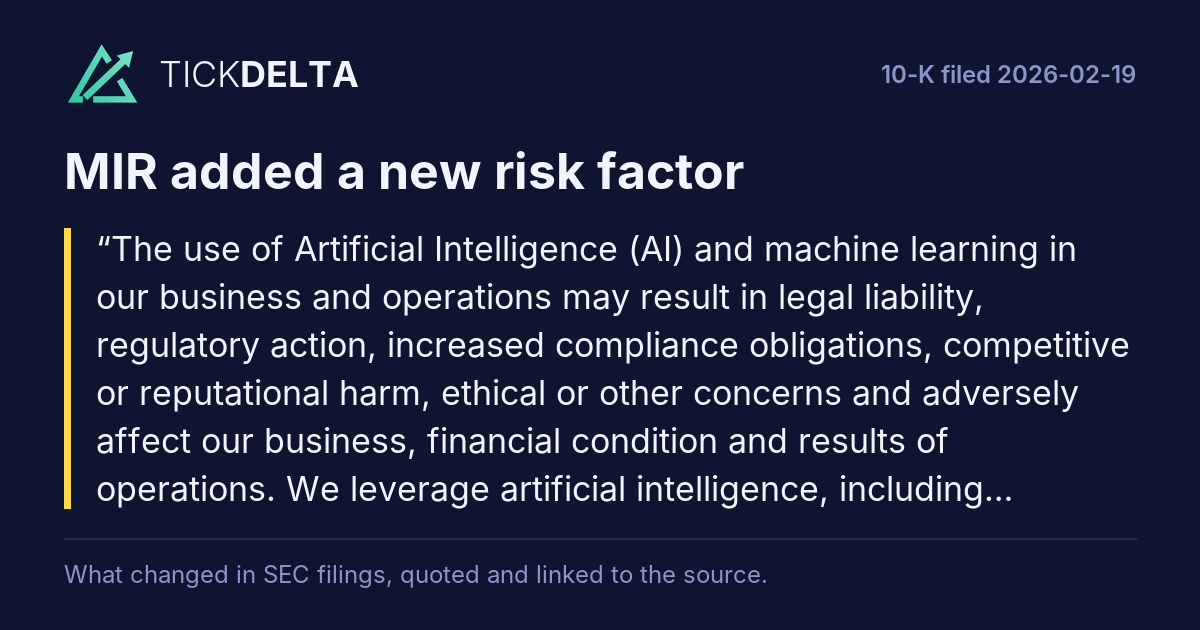
The use of Artificial Intelligence (AI) and machine learning in our business and operations may result in legal liability, regulatory action, increased compliance obligations, competitive or reputational harm, ethical or other concerns and adversely affect our business, financial condition and results of operations. We leverage artificial intelligence, including generative artificial intelligence and machine learning in certain of our business operations and may also use products and services from third parties that use artificial intelligence technology. Our competitors or other third parties may incorporate artificial intelligence into their operational processes more quickly or more successfully than us, which could have a material adverse effect on our competitive position, reputation and operations. In addition, there are significant risks involved in developing and deploying artificial intelligence and there can be no assurance that our use of artificial intelligence will increase our efficiency or profitability or be beneficial to our business. Laws and regulations regarding artificial intelligence technologies are rapidly evolving and complex, including in the areas of intellectual property, cybersecurity, privacy and data protection. We have implemented policies and controls to mitigate many of the novel risks presented by these new technologies but compliance with new or changing laws, regulations or industry standards relating to artificial intelligence may impose significant costs and limit our ability to develop, deploy or use artificial intelligence technologies in our business. There has been an increase in artificial intelligence related litigation and government regulatory actions targeting the design, deployment and other uses of artificial intelligence and claiming liability under numerous areas of law, such a consumer protection, product liability, privacy, intellectual property, securities and defamation. Any of these risks could have an adverse effect on our business, results of operations and financial condition.
to, or use of our data and systems, could far exceed the limits of our insurance coverage for such events. Any significant data breach or misuse of confidential information may result in significant costs, litigation and regulatory enforcement actions, harm our reputation, and therefore, may have a material adverse impact on our business, reputation, results of operations and financial condition.
Show the other 1
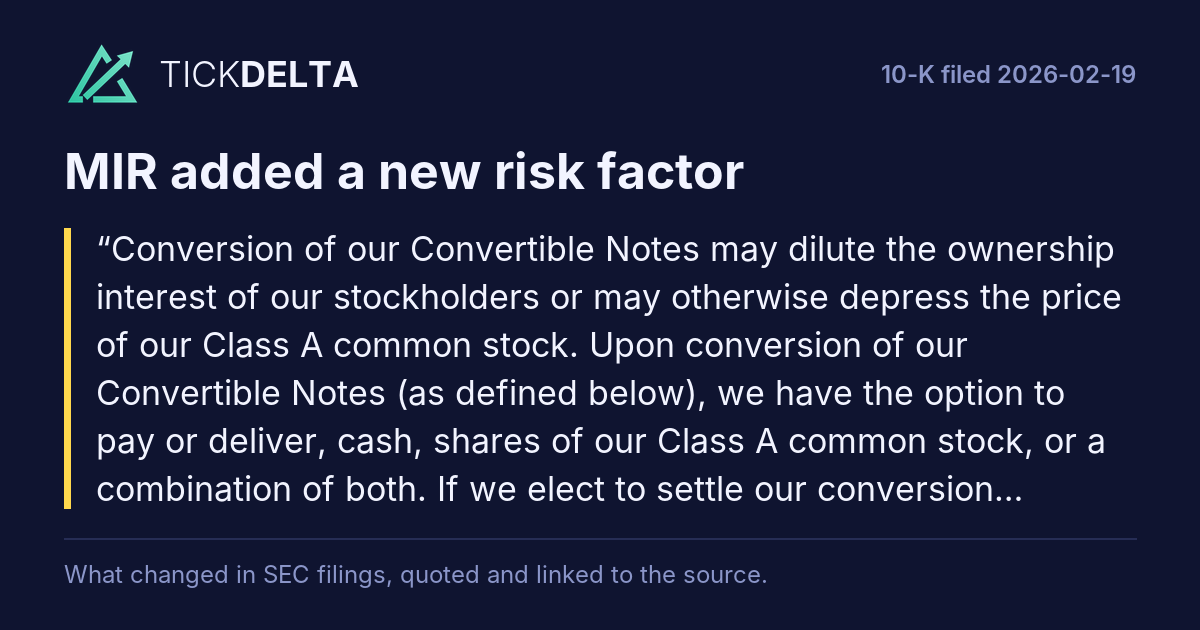
Conversion of our Convertible Notes may dilute the ownership interest of our stockholders or may otherwise depress the price of our Class A common stock. Upon conversion of our Convertible Notes (as defined below), we have the option to pay or deliver, cash, shares of our Class A common stock, or a combination of both. If we elect to settle our conversion obligation in shares of our Class A common stock or a combination of cash and shares of our Class A common stock, any sales in the public market of our Class A common stock issuable upon such conversion could adversely affect prevailing market prices of our Class A common stock. In addition, the existence of our Convertible Notes may encourage short selling by market participants because the conversion of the notes could be used to satisfy short positions, or anticipated conversion of our Convertible Notes into shares of our Class A common stock could depress the price of our Class A common stock.
The conditional conversion feature of our Convertible Notes, if triggered, may adversely affect our financial condition and operating results. In the event the conditional conversion feature of our Convertible Notes is triggered, holders of such notes will be entitled to convert their notes at any time during specified periods at their option. If one or more holders elect to convert their Convertible Notes, we can elect to satisfy our conversion obligation by delivering solely shares of our Class A common stock (other than paying cash in lieu of delivering any fractional share) or we can settle a portion or all of our conversion obligation through the payment of cash. If we elected to settle a portion or all of our conversion obligations through the payment of cash, it could adversely affect our liquidity. In addition, even if holders do not elect to convert their Convertible Notes, we could be required under applicable accounting rules to reclassify all or a portion of the outstanding principal of the notes as a current rather than long-term liability, which would result in a material reduction of our net working capital.
Paragraphs in the 10-Q filed Oct 28, 2026 that were not in the one before
New in the latest 10-Q
17 paragraphs in the 10-Q filed Oct 28, 2026 with nothing like them in the 10-Q filed Jul 29, 2026 (at least half the words must differ; new numbers alone do not count). Quoted exactly, grouped by the item heading above them. This is text that changed, not a judgement of how serious it is.
Financial statements and notes
Adjustments to reconcile net income to net cash provided by operating activities:
Read in the 10-Q
Acquisitions of businesses, net of cash and cash equivalents acquired (0.2) (79.9)
Read in the 10-Q
Stock repurchased to satisfy tax withholding for vesting restricted stock units (4.9) (5.2)
Read in the 10-Q
Effect of exchange rate changes on cash, cash equivalents, and restricted cash (6.2) 12.8
Read in the 10-Q
Net (decrease) increase in cash, cash equivalents, and restricted cash (3.6) 758.0
Read in the 10-Q
Show the other 12
No triggering events for interim goodwill impairment testing occurred in the third quarter of 2026. However, the Company will continue to monitor macroeconomic conditions for future changes in assumptions or deterioration in market conditions, including impacts from rising long-term interest rates and geopolitical risks impacting global trade conditions, which could result in an impairment in one or more of the Company's reporting units. Our required annual goodwill impairment assessment for all reporting units will be performed during the fourth quarter of 2026.
Read in the 10-Q
Nine Months Ended September 30, 2026 Nine Months Ended September 30, 2025 ─────────────────────────────────────────────────────────────────────────────────────────────────────────────────────────────────────────────────────────────────────────── Cash Paid For: Cash paid for interest $20.7 $30.1 Cash paid for income taxes $12.8 $21.1 Non-Cash Investing and Financing Activities: Property, plant, and equipment purchases in accrued expenses and other liabilities $0.6 $0.9 Property, plant, and equipment purchases in accounts payable $0.8 $0.4 Excise tax on purchases of treasury stock in accrued expenses and other liabilities $0.8 $— Convertible debt issuance costs in accrued expenses and other liabilities $— $0.4 Common stock issuance costs in accrued expenses and other liabilities $— $0.5
Read in the 10-Q
Notional Amount Gain (Loss) Recognized in AOCL As of Three Months Ended September 30, 2026 Three Months Ended September 30, 2025 Nine Months Ended September 30, 2026 Nine Months Ended September 30, 2025 September 30, 2026 December 31, 2025 Cross-currency rate swaps € 238.8 € 238.8 $2.8 $0.5 $10.3 $ (31.1) Total € 238.8 € 238.8 $2.8 $0.5 $10.3 $ (31.1)
Read in the 10-Q
immediately due and payable, the revolving credit commitments may be terminated and remedies against the collateral may be exercised. Mirion IntermediateCo, Inc. was in compliance with all debt covenants on September 30, 2026 and December 31, 2025.
Read in the 10-Q
Notional Amount Gain (Loss) Recognized in AOCL As of Three Months Ended September 30, 2026 Three Months Ended September 30, 2025 Nine Months Ended September 30, 2026 Nine Months Ended September 30, 2025 September 30, 2026 December 31, 2025 Cross-currency rate swaps € 238.8 € 238.8 $2.8 $0.5 $10.3 $ (31.1) Total € 238.8 € 238.8 $2.8 $0.5 $10.3 $ (31.1)
Read in the 10-Q
Risk Factors
Our growth strategy depends in part on plans to supply our products and services to small modular reactors ("SMRs") and other advanced reactors in the United States, an emerging market that may grow more slowly than we expect. Sales to SMRs and advanced reactor developers are currently a small but growing part of our business and our strategy assumes this share will increase over time. We have pursued agreements with a number of companies building SMRs, but they face commercialization obstacles, including reactor design, regulatory licensing, and securing customers willing and able to make large investments in emerging nuclear technologies. Many rely significantly on government support for licensing, fuel production, and first-of-a-kind construction. If political support for nuclear energy declines or funding or tax incentives change, our SMR and advanced reactor partners may be unable to obtain the financing they require, which could cause them to delay, scale back, or cancel projects and reduce demand for our products and services. Many of these companies are also publicly traded with volatile stock prices, and a sustained decline could impair their ability to raise the capital needed to carry out their plans, and some are also new entrants that may fail operationally even if they develop a successful reactor, which could harm the broader market. If these risks materialize, demand for our products and services in this market may develop more slowly than we expect, or not at all. Any of the foregoing could have an adverse effect on our business, results of operations, and financial condition.
Read in the 10-Q
Supply chain issues, including electronic component shortages driven by artificial intelligence and data center demand, could disrupt production, cause delays and increase costs for the commodities or components that we use in our operations which may materially and adversely impact our business, results of operations and financial condition. We rely on third-party suppliers for our manufacturing operations including from sole or limited source suppliers due to quality assurance, cost effectiveness, availability, contractual obligations or unique design or technology. Suppliers’ capacity constraints and decreased availability of key materials could cause increased expenses, production interruptions, delays, extended lead times, and inefficiencies, and adversely impact our business, results of operations and financial condition. In particular, our products incorporate electronic components, for which demand has increased significantly due to global investment in artificial intelligence and the rapid expansion of hyperscale data center infrastructure. As suppliers prioritize capacity for these allocations, we have experienced, and may continue to experience, reduced availability, longer and less
Read in the 10-Q
predictable lead times, accelerated obsolescence and higher costs for certain components. These constraints could delay our production and deliveries, impair our ability to meet customer demand and contractual commitments, delay revenue recognition, compress margins on our fixed-price and limited price-escalation contracts, and cause our results of operations to fluctuate. Although we seek to mitigate these risks through supplier relationships, dual-sourcing, strategic inventory purchases, and pricing actions, these measures may be insufficient.
Read in the 10-Q
We derive a significant portion of our revenue from international sales and our operations in non-U.S. countries are subject to political, economic, legal, currency and other risks, which could materially and adversely affect us. Revenue generated from outside of North America accounted for approximately 37%, 37%, and 36% of our net sales for the years ended December 31, 2025, December 31, 2024, and December 31, 2023, respectively. International sales are expected to remain a material percentage of our total net sales in future periods. Regional political and economic instability can impact these operations. In particular, we have significant revenue and operations in Europe, including France, where we are exposed to economic weakness in the Eurozone, political and fiscal uncertainty (including government budget and sovereign credit pressures), and social unrest, strikes and other labor actions. These factors could disrupt our operations, increase our costs, limit the financing our customers depend on and reduce demand for our products or compress our margins, and adversely affect our business, results of operations and financial condition.
Read in the 10-Q
Other information
(1) Denotes whether the trading plan is intended, when adopted, to satisfy the affirmative defense of Rule 10b5-1(c).
Read in the 10-Q
(2) Reflects the maximum aggregate number of gross shares underlying restricted stock unit and performance stock unit awards (performance stock units shown at target) that vest in 2027 and 2028 and are subject to the trading arrangement. Upon vesting, the Company will withhold shares to satisfy tax withholding obligations and only the net remaining shares will be sold; the number of shares actually sold will be less than the number shown and cannot be determined until the vesting events occur.
Read in the 10-Q
Item 6
10.1*+ Mirion Technologies, Inc. Fourth Amended and Restated Non-Employee Director Compensation Program, dated as of August 5, 2026.
Read in the 10-Q
The 10-Q's risk factors against the 10-K
Item 1A of the 10-Q filed Oct 28, 2026 against Item 1A of the 10-K filed Feb 19, 2026.
A 10-Q repeats only the risks that changed, so a 10-K paragraph that is missing from it is not counted as removed.
Added is a paragraph with nothing like it in the 10-K, Reworded a sentence that is in both with several words changed,
Quiet changes a sentence in both where one to four words changed and one is a hedge or a modal
(cut words struck through, new words highlighted).
Text on the page, not a score; each links to the filing at sec.gov.
Show the other 10
Phrases used for the first time
Two-word phrases in Risk Factors of the 10-K filed Feb 19, 2026 that are in none of the 1 earlier 10-Ks stored, back to Feb 26, 2025
Where each one is used
- convertible notes: Conversion of our Convertible Notes may dilute the ownership interest of our stockholders or may otherwise depress the price of our Class A common stock. Upon conversion of our Convertible Notes (as defined below), we have the option to pay or deliver, cash, shares of our Class A common stock, or a combination of...
- conversion obligation: Conversion of our Convertible Notes may dilute the ownership interest of our stockholders or may otherwise depress the price of our Class A common stock. Upon conversion of our Convertible Notes (as defined below), we have the option to pay or deliver, cash, shares of our Class A common stock, or a combination of...
- always achieve: We have incurred operating losses in the past and we cannot yet assure you we will always achieve positive net income. As of December 31, 2025, we had an accumulated deficit of $512.7 million. For the years ended December 31, 2025, December 31, 2024, and December 31, 2023, we experienced net income (losses) of...
- international trade: Our operating results may be impacted by the effects of, and changes in, worldwide economic conditions, international trade, tariffs and retaliatory countermeasures, export controls and other trade barriers, global trade wars or domestic preferences which could increase our costs and materially and adversely affect...
- retaliatory countermeasures: Our operating results may be impacted by the effects of, and changes in, worldwide economic conditions, international trade, tariffs and retaliatory countermeasures, export controls and other trade barriers, global trade wars or domestic preferences which could increase our costs and materially and adversely affect...
- trade restrictions: Our operating results may be impacted by the effects of, and changes in, worldwide economic conditions, international trade, tariffs and retaliatory countermeasures, export controls and other trade barriers, global trade wars or domestic preferences which could increase our costs and materially and adversely affect...
- chain disruptions: Our operating results may be impacted by the effects of, and changes in, worldwide economic conditions, international trade, tariffs and retaliatory countermeasures, export controls and other trade barriers, global trade wars or domestic preferences which could increase our costs and materially and adversely affect...
- strategy relies: Following the Paragon acquisition, our growth strategy relies in part on plans to supply our products and services to SMRs and other advanced reactors in the U.S., an emerging market that may grow more slowly than we expect. Our Nuclear and Safety growth strategy relies on market research that estimates that the...
Used at least twice, small words left out. Counted, not picked: a phrase can be new because the company renamed something.
What was taken out
8 paragraphs of last year's Risk Factors with nothing like them now. The longest are quoted.
Sources
Item 1A of each 10-K and 10-Q on EDGAR, quoted exactly. Each paragraph links to the filing at sec.gov.
Also
10-K change: what was reworded or cut, section by section.
Work with it
Excel workbook · CSV. Google Sheet that stays up to date: paste =IMPORTDATA("https://tickdelta.com/company/MIR/export.csv") into a cell.