MKS Inc MKSI
New risk paragraphs, branching off last year
Each branch is a paragraph in Risk Factors with nothing like it in the 10-K filed Feb 25, 2025. A box jumps to the paragraph as filed, below.
Paragraphs with nothing like them in last year's 10-K
19 paragraphs in Risk Factors of the 10-K filed Feb 24, 2026 with nothing like them in the 10-K filed Feb 25, 2025. Quoted exactly. Paragraphs that were only edited are under 10-K change.
In addition, if we do not successfully complete acquisitions or integrate acquired businesses, we may need to re-evaluate our growth strategy. We may incur substantial expenses and devote significant management time and resources to complete acquisitions that may not generate the financial results we planned to achieve.
unanticipated liabilities or ongoing obligations to support the businesses following such divestitures, decreases in revenue and earnings associated with such businesses, and other adverse financial impacts.
•High and fluctuating tariffs on our supplies, resulting in higher prices and our products becoming less competitive;
regions. Additionally, if we are unable to successfully manage the relocation, initiation or oversight of these operations and functions, including identifying, training and retaining skilled labor, our business, financial condition and operating results would be harmed.
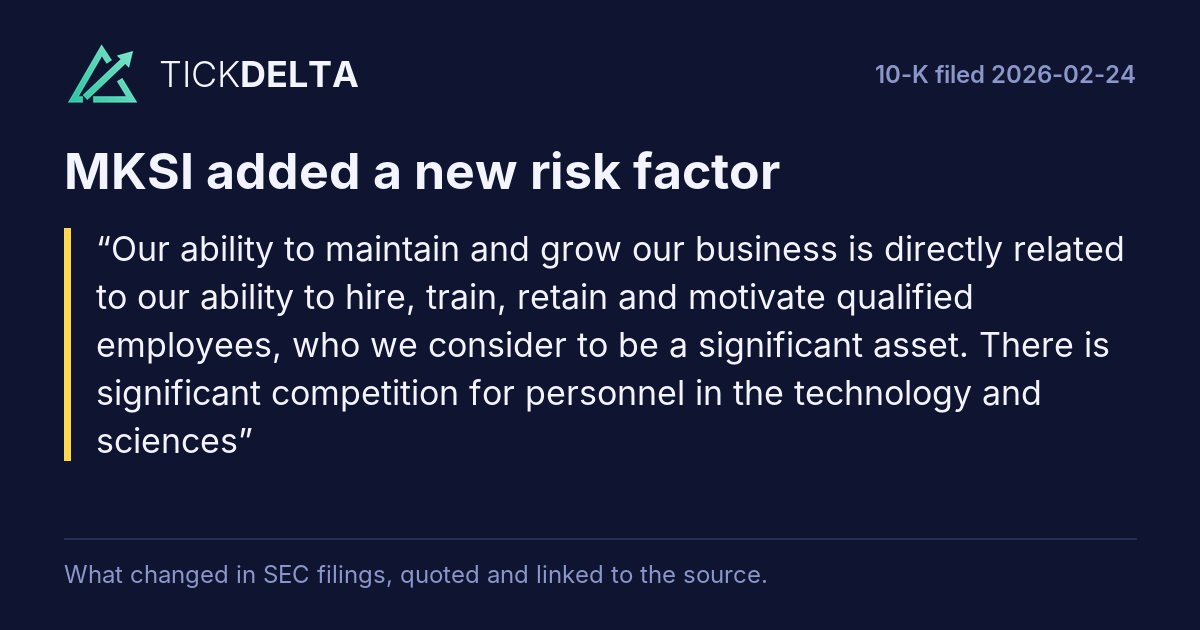
Our ability to maintain and grow our business is directly related to our ability to hire, train, retain and motivate qualified employees, who we consider to be a significant asset. There is significant competition for personnel in the technology and sciences
Show the other 7
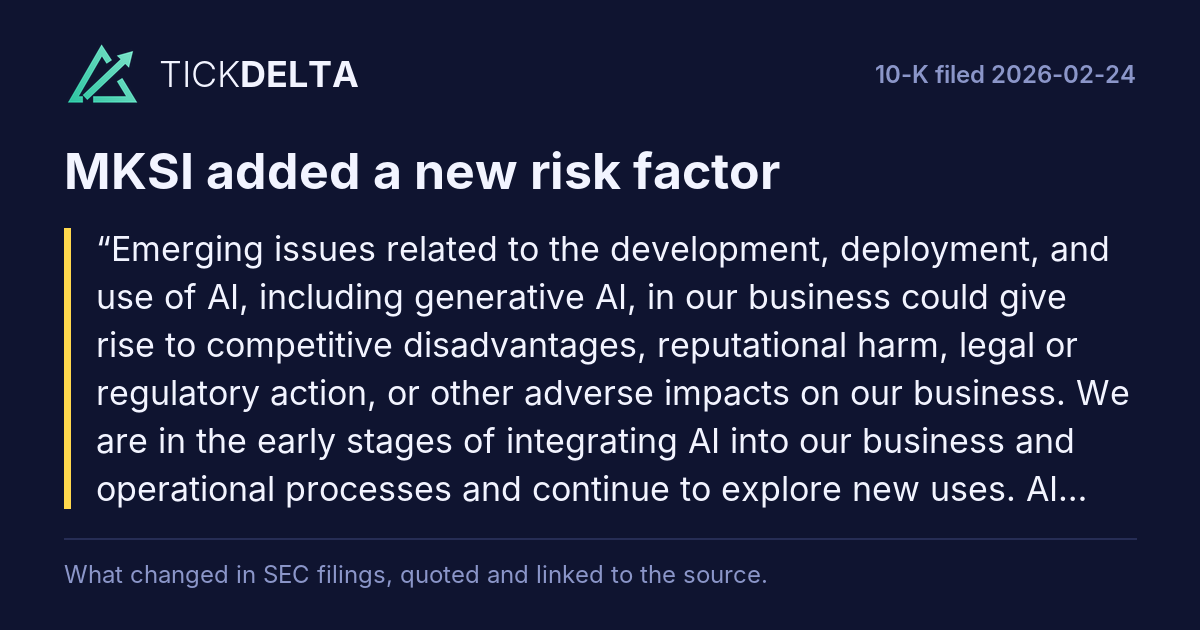
Emerging issues related to the development, deployment, and use of AI, including generative AI, in our business could give rise to competitive disadvantages, reputational harm, legal or regulatory action, or other adverse impacts on our business.
We are in the early stages of integrating AI into our business and operational processes and continue to explore new uses. AI technologies are complex and rapidly evolving. They may be difficult and costly to implement and govern, with no assurance that our investments in AI will deliver anticipated benefits. Our competitors may adopt or leverage AI more quickly or effectively, achieving greater benefits, which could potentially diminish our market position.
AI tools can produce outputs that are erroneous, misleading, biased, or otherwise flawed due to inaccurate, incomplete, or skewed training data, algorithms, or methodologies. Reliance on AI outputs without adequate human oversight and control mechanisms may lead to operational inefficiencies or disruptions, poor business decisions or reputational damage.
Our use of AI raises significant IP, data protection and privacy, cybersecurity, and ethical considerations. Improper development, deployment or use of AI tools by our employees or business partners would increase the risk of loss of confidential or proprietary information, complicate assertion or enforcement of IP rights, introduce defects or malware into our products or business systems, or expose us to claims of infringement, misappropriation, or other violations of third-party rights, including individual rights such as privacy rights. Reliance on third-party vendors that use AI may introduce additional implementation, security, and compliance risks.
The legal and regulatory landscape governing AI is dynamic, with evolving frameworks addressing data protection and privacy, IP, and responsible AI practices. Compliance may be costly and require significant resources and could restrict certain AI applications or limit our ability to deploy AI capabilities. Failure to anticipate, implement, and maintain appropriate governance and risk management controls, or to comply with applicable laws and standards, could result in sensitive data loss, regulatory scrutiny, legal liability, increased costs, or reputational damage.
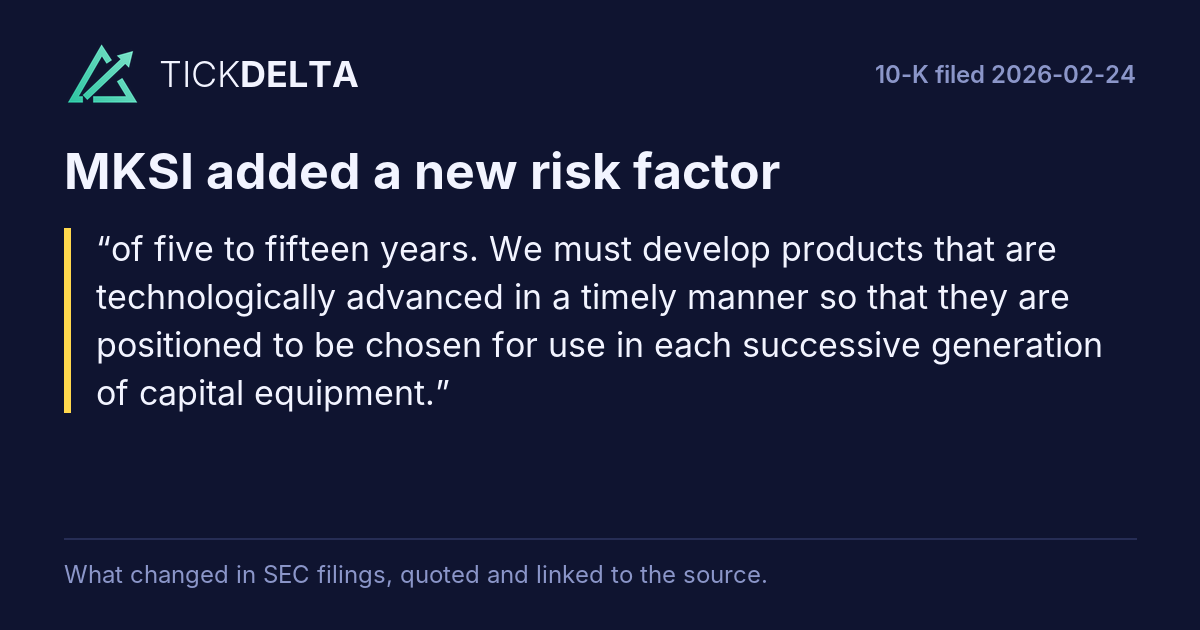
of five to fifteen years. We must develop products that are technologically advanced in a timely manner so that they are positioned to be chosen for use in each successive generation of capital equipment.
•Increased risk of exposure to significant health concerns, including pandemics;
Following a period of extreme escalation in early 2025, where U.S. duties on Chinese imports reached a peak of 145% (inclusive of a 125% reciprocal tariff and a 20% fentanyl-related surcharge), the trade environment has transitioned into a complex, multi-layered duty regime. As of January 2026, we remain subject to a combined 20% International Emergency Economic Powers Act (“IEEPA”)-based baseline duty on Chinese imports (10% reciprocal and 10% fentanyl-related), which stacks upon existing Section 301 duties, standard most-favored-nation rates as well as applicable Section 232 duties. Beyond China, the U.S. government has transitioned the 10% IEEPA baseline into a permanent Reciprocal Tariff Schedule, affecting nearly all global imports. This regime imposes variable, country-specific duties that fluctuate based on the perceived “reciprocity” of a trading partner's own tariff walls. In February 2026, the U.S. Supreme Court held that the IEEPA does not authorize the U.S. President to impose tariffs, invalidating both the “reciprocal” tariffs and the country-specific tariffs. However, the U.S. President took steps to impose new tariffs under other authorities.
Separately, in April 2025, the U.S. Department of Commerce initiated an investigation under Section 232 of the Trade Expansion Act of 1962 into the national security implications of imports of semiconductors, semiconductor manufacturing equipment, and their derivative products and concluded that additional tariffs on specific covered products are appropriate, subject to several end-use exemptions.
The U.S. government has also imposed global tariffs on certain critical raw materials, including steel, aluminum, and copper, and certain products, such as passenger vehicles and light trucks. Further, the Chinese government has imposed trade restrictions on certain rare earth elements critical to many advanced manufacturing, computing and defense applications and has implemented extra-territorial controls on items produced outside of China that are made with such elements. The continuation or expansion of the scope or amount of such global raw material or product-based tariffs or restrictions could significantly increase our costs or have an adverse effect on the end markets we support. Attempts to mitigate the impact of tariffs could cause us to sub-optimize operations, increasing our cost to operate. Tariffs have increased, and will continue to increase, the cost of our materials and lead us to apply surcharges or raise prices, which could reduce demand for our products. Customers and end-users may delay, reduce, or cancel spending on projects involving our products, negatively impacting demand and our financial results. Our mitigation efforts and price increases may not fully offset the impact of tariffs and may result in lowering our margin on products sold. If the U.S. government expands or adopts additional tariffs, or if other countries retaliate, the resulting trade barriers could have a significant adverse impact on our suppliers, our customers and on our business. The volatility and unpredictability of international trade policies and conditions add further complexity to our operations, making it challenging to forecast and plan effectively. We cannot predict the future trade policy of the United States or of any foreign countries in which we operate or purchase goods, or the terms of any trade agreements or their impact on our business. The continued adoption and expansion of tariffs, quotas and embargoes, the occurrence or threat of a trade war or other governmental action related to tariffs or trade agreements or policies, has the potential to adversely impact demand for our products, our costs, our customers, our suppliers and the world and U.S. economies, which in turn could have a material adverse effect on our business, operating results and financial condition.
In addition, “Entity List” designations and “military end-user” controls have been significantly expanded, as have some rules relating to items produced outside the United States that incorporate more than de minimis levels of U.S. controlled content or that are derived from (i.e., the “direct product” of) U.S. origin technologies, equipment or software. In October 2022, the U.S. Department of Commerce’s Bureau of Industry and Security (“BIS”) implemented new and novel restrictions related to end-uses in semiconductor, semiconductor manufacturing, supercomputer, and advanced computing, along with certain equipment used to develop and produce them, as well as controls around the activities of U.S. persons in certain markets, including China. These regulations, which BIS has amended several times since initial publication (as amended, the “BIS Rules”), have resulted in, and
costs, costs of waste disposal, natural resource damages and payments for property damage and personal injury, could have a material adverse effect on our business, financial condition or operating results.
Additionally, we have established and communicated environmental goals, targets and objectives. For example, in December 2023, we announced our commitment to reduce our combined Scope 1 and 2 emissions by 42% by 2030 from our 2022 baseline. We may be unable to achieve these goals, targets and objectives or we may determine to modify these goals, targets and objectives or prioritize other business, social, governance or sustainable investments over these goals, targets and objectives, based on
sales of these products, or the cancellation or rescheduling of orders for these products, our business and operating results would be harmed.
Paragraphs in the 10-Q filed Nov 5, 2026 that were not in the one before
New in the latest 10-Q
12 paragraphs in the 10-Q filed Nov 5, 2026 with nothing like them in the 10-Q filed Aug 6, 2026 (at least half the words must differ; new numbers alone do not count). Quoted exactly, grouped by the item heading above them. This is text that changed, not a judgement of how serious it is.
Financial statements and notes
(7) Goodwill and Intangible Assets Goodwill Effective February 1, 2026, the Company reassigned goodwill to certain reporting units within PSD due to a reorganization of PSD. The goodwill was reassigned to the new reporting units using the relative fair value approach. The Company also concluded that the fair value of each reporting unit immediately before and after the reorganization exceeded its respective carrying value. Goodwill associated with each of the Company’s reportable segments was as follows: VSD PSD MSD Total ──────────────────────────────────────────────────────────────────────────────────────────────────────────────────────────────────────────────────────────────────────────────────────────────────── Reportable segment: Gross goodwill at December 31, 2025 $ 358 $ 1,012 $ 3,037 $ 4,407 Foreign currency translation adjustments 1 (2) 27 26 Gross goodwill at September 30, 2026 359 1,010 3,064 4,433 Accumulated goodwill impairment at December 31, 2025 (141) (390) (1,302) (1,833) Impairment charge - - - - Accumulated goodwill impairment at September 30, 2026 (141) (390) (1,302) (1,833) Goodwill, net of accumulated impairment and foreign currency translation adjustments at September 30, 2026 $ 218 $ 620 $ 1,762 $ 2,600
Read in the 10-Q
• effectively subordinated to the Company’s and the Guarantors’ existing and future secured indebtedness (including the Credit Agreement) to the extent of the value of the assets securing such indebtedness; • senior in right of payment to any of the Company’s and the Guarantors’ future subordinated indebtedness; • structurally senior to any existing and future indebtedness of the Company that is not guaranteed by the Guarantors (including the Convertible Notes); and • structurally subordinated to any existing and future indebtedness and other liabilities of the Company’s and the Guarantors’ subsidiaries that are not and do not become Guarantors. At any time prior to February 15, 2029, the Company may redeem the 2034 Notes in whole or in part at a redemption price equal to 100% of their principal amount, plus a make-whole premium, plus accrued and unpaid interest, if any, and additional amounts, if any, to, but excluding, the redemption date. At any time and from time to time on or after February 15, 2029, the Company may redeem for cash all or any portion of the 2034 Notes at a redemption price equal to the percentage of principal amount set forth below, plus accrued and unpaid interest, if any, and additional amounts, if any, to, but excluding, the applicable redemption date, if redeemed during the twelve-month period beginning on February 15 of the year indicated below: Year Percentage ─────────────────────────────────────── 2029 102.125% 2030 101.0625% 2031 and thereafter 100.000% At any time and from time to time prior to February 15, 2029, the Company may redeem up to 40% of the original aggregate principal amount of the 2034 Notes using the net cash proceeds of certain equity offerings at a redemption price equal to 104.250%. In the event of certain developments affecting taxation, the Company may elect to redeem all, but not less than all, of the 2034 Notes at 100% of their principal amount, plus accrued and unpaid interest, if any, and additional amounts, if any, to, but excluding, the date fixed for redemption. Upon the occurrence of a change of control triggering event (as defined in the 2034 Notes Indenture), each holder of the 2034 Notes may require the Company to repurchase all or a portion of their 2034 Notes at a price equal to 101% of their principal amount plus accrued and unpaid interest, if any, and additional amounts, if any, to, but excluding, the repurchase date. The 2034 Notes Indenture contains customary terms and covenants that limit the ability of the Company and its Restricted Subsidiaries (as defined in the 2034 Notes Indenture) to, among other things, (i) incur liens, (ii) provide guarantees and (iii) consolidate, merge or sell or otherwise dispose of substantially all their assets. The 2034 Notes Indenture also provides for customary events of default. Upon certain events of default that are occurring and continuing, either the 2034 Notes Trustee or the holders of at least 30% in aggregate principal amount of the outstanding 2034 Notes may declare the principal of, and accrued and unpaid interest, if any, and additional amounts, if any, on, all the 2034 Notes to be due and payable. In the event of certain insolvency and bankruptcy related events of default specified in the 2034 Notes Indenture, the principal of, and accrued and unpaid interest, if any, and additional amounts, if any, on, all the 2034 Notes shall automatically become due and payable. The 2034 Notes are not subject to financial maintenance covenants. As of September 30, 2026, the effective interest rate of the 2034 Notes was 4.46%.
Read in the 10-Q
On July 25, 2011, the Company’s Board of Directors approved a share repurchase program for the repurchase of up to an aggregate of $200 of its outstanding common stock (the “2011 Program”).
Read in the 10-Q
The Company derives its segment results directly from the manner in which results are reported in its management reporting system. The Company groups its product offerings by its reportable segments, VSD, PSD, and MSD. For each reportable segment, the Company also provides services relating to the maintenance and repair of its products, sales of spare parts, installation and training. Unallocated corporate expenses represent those costs not specifically related to the operations of each segment and are managed separately at the corporate level and primarily relate to labor costs of global functions, such as supply chain, operations and real estate.
Read in the 10-Q
The following tables set forth the details of gross profit by reportable segment and the reconciliation to income before income taxes:
Read in the 10-Q
Show the other 7
On October 17, 2026, the Company entered into a definitive agreement to sell its Ophir® Optics business to TTM Technologies, Inc. in an all-cash transaction for a purchase price of $650, subject to customary closing adjustments. The Company expects to record a gain upon completion of the sale, but the amount of the gain has not yet been finalized.
Read in the 10-Q
The Ophir Optics business provides high-precision infrared thermal imaging and laser optics solutions to customers in the Company’s Specialty Industrial market, serving defense, security and industrial applications. The Ophir Optics business is a part of PSD. The transaction excludes the Company’s Ophir Instruments laser characterization business and the Ophir brand.
Read in the 10-Q
On October 17, 2026, we entered into a definitive agreement to sell our Ophir Optics business to TTM Technologies, Inc. in an all-cash transaction for a purchase price of $650 million, subject to customary closing adjustments. We expect to record a gain upon completion of the sale, but the amount of the gain has not yet been finalized.
Read in the 10-Q
The Ophir Optics business provides high-precision infrared thermal imaging and laser optics solutions to customers in our Specialty Industrial market, serving defense, security and industrial applications. The Ophir Optics business is a part of PSD (as defined below). The transaction excludes our Ophir Instruments laser characterization business and the Ophir brand.
Read in the 10-Q
The transaction is expected to close in the second quarter of 2027, subject to customary closing conditions, including certain regulatory approvals and certain governmental consents and permits.
Read in the 10-Q
Interest expense, net was flat for the three months ended September 30, 2026 compared to the prior quarter.
Read in the 10-Q
On July 25, 2011, our Board of Directors approved a share repurchase program for the repurchase of up to an aggregate of $200 million of our outstanding common stock (the “2011 Program”).
Read in the 10-Q
The 10-Q's risk factors against the 10-K
Item 1A of the 10-Q filed Nov 5, 2026 against Item 1A of the 10-K filed Feb 24, 2026.
A 10-Q repeats only the risks that changed, so a 10-K paragraph that is missing from it is not counted as removed.
Added is a paragraph with nothing like it in the 10-K, Reworded a sentence that is in both with several words changed,
Quiet changes a sentence in both where one to four words changed and one is a hedge or a modal
(cut words struck through, new words highlighted).
Text on the page, not a score; each links to the filing at sec.gov.
What the 10-Q itself says about its risk factors:Information regarding risk factors affecting our business is discussed in the section entitled “Risk Factors” in our Annual Report on Form 10-K for the year ended December 31, 2025 filed with the U.S. Securities and Exchange Commission on February 24, 2026.
Read in the 10-Q
1 paragraph in the 10-Q's Item 1A, and none of them adds, rewords or quietly edits a paragraph of the 10-K's.
Phrases used for the first time
Two-word phrases in Risk Factors of the 10-K filed Feb 24, 2026 that are in none of the 1 earlier 10-Ks stored, back to Feb 25, 2025
Where each one is used
- rare earth: •Difficulty obtaining raw materials, including critical rare earth elements, concentrated in limited geographies at reasonable prices or at all due to trade restrictions for those materials;
- containing pfas: Perfluorooctanesulfonic acid and other per- and polyfluoroaklyl substances (“PFAS”) are chemical agents that have been targeted for risk assessment, restriction, regulation and high-priority remediation and are the subject of litigation and governmental investigations in the United States and other countries. For...
- pursue acquisitions: As part of our business strategy, we have consummated and may continue to pursue acquisitions and other strategic transactions, which may be challenging and costly to identify and complete, disruptive to our business and our management, and/or dilutive to stockholder value.
- strategic transactions: As part of our business strategy, we have consummated and may continue to pursue acquisitions and other strategic transactions, which may be challenging and costly to identify and complete, disruptive to our business and our management, and/or dilutive to stockholder value.
- substantial consolidated: Our substantial consolidated indebtedness could adversely affect us, including by increasing our interest expense and decreasing our business flexibility.
- senior notes: We have substantial consolidated indebtedness. As of February 4, 2026, we had approximately $1.6 billion of principal indebtedness outstanding under a senior secured term loan facility (the “Term Loan Facility”) comprised of two tranches: a $914 million loan (the “USD Tranche B”) and a €587 million loan (the “Euro...
- notes due: We have substantial consolidated indebtedness. As of February 4, 2026, we had approximately $1.6 billion of principal indebtedness outstanding under a senior secured term loan facility (the “Term Loan Facility”) comprised of two tranches: a $914 million loan (the “USD Tranche B”) and a €587 million loan (the “Euro...
- earth elements: •Difficulty obtaining raw materials, including critical rare earth elements, concentrated in limited geographies at reasonable prices or at all due to trade restrictions for those materials;
Used at least twice, small words left out. Counted, not picked: a phrase can be new because the company renamed something.
What was taken out
9 paragraphs of last year's Risk Factors with nothing like them now. The longest are quoted.
Sources
Item 1A of each 10-K and 10-Q on EDGAR, quoted exactly. Each paragraph links to the filing at sec.gov.
Also
10-K change: what was reworded or cut, section by section.
Work with it
Excel workbook · CSV. Google Sheet that stays up to date: paste =IMPORTDATA("https://tickdelta.com/company/MKSI/export.csv") into a cell.