12 paragraphs in Risk Factors of the 10-K filed Feb 27, 2026
with nothing like them in the 10-K filed Feb 28, 2025. Quoted exactly.
Paragraphs that were only edited are under 10-K change.
Compared with the Risk Factors in the latest 10-K of the other 31 Consumer staples companies:
a paragraph with at least half its words the same at another company is called similar, and the companies are listed under it.
A paragraph most of them have is marked boilerplate. No line means no other company has one like it.
This counts text; it does not say how serious a risk is.
disputes between our bottler/distributors and their customers or buying groups may result in the delisting of certain of the Company’s products, temporarily or otherwise. Bottler/distributor consolidation may also have an adverse impact on our business.
Read in the 10-K ↗
are a member, and/or any international beverage associations, it could negatively affect our overall reputation, which in turn could have a negative impact on our business, financial condition and results of operations.
Similar paragraph at 5 of 31 other Consumer staples companies:
BG,
COST,
HSY,
SYY,
TSN
success will depend, in part, upon our continued ability to develop and introduce different and innovative beverages that appeal to consumers.
Read in the 10-K ↗
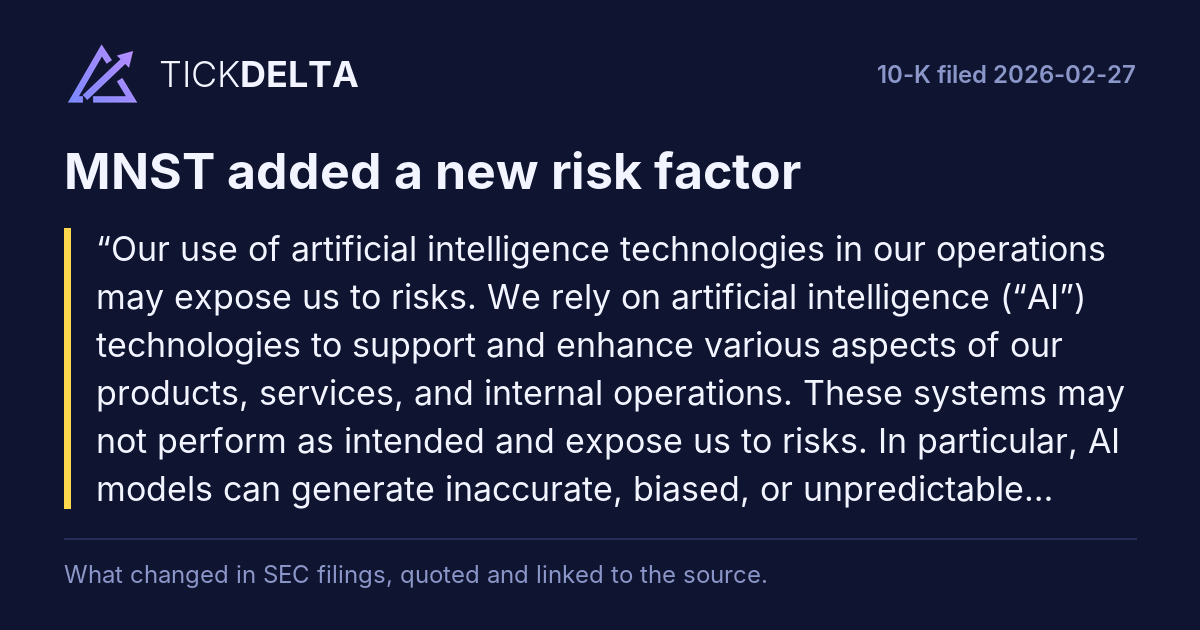
Our use of artificial intelligence technologies in our operations may expose us to risks.
Similar paragraph at 1 of 31 other Consumer staples companies:
MDLZWe rely on artificial intelligence (“AI”) technologies to support and enhance various aspects of our products, services, and internal operations. These systems may not perform as intended and expose us to risks. In particular, AI models can generate inaccurate, biased, or unpredictable outputs, and failures in data quality, system design, or oversight could result in operational disruptions, security or privacy incidents, reputational challenges, and other harms. Because AI systems can be complex and difficult to fully evaluate or
audit, we may be unable to detect errors or vulnerabilities in a timely manner. If we are unable to effectively implement, monitor, and manage these technologies, our business, financial condition, and results of operations could be adversely affected.
Similar paragraph at 2 of 31 other Consumer staples companies:
KO,
TGT
Changes in the regulation of artificial intelligence could result in enforcement actions, fines, or other adverse consequences.
We operate in a global market, and our use of AI is subject to different levels of regulations in different markets. These differences, as well as changes in the way AI is regulated—including potential new requirements governing transparency, accountability, data usage, and model controls—could increase our compliance costs, limit the use of certain technologies, or require changes to our products and processes. Any failure to comply with emerging AI regulatory frameworks could result in enforcement actions, fines, or other adverse consequences.
Read in the 10-K ↗
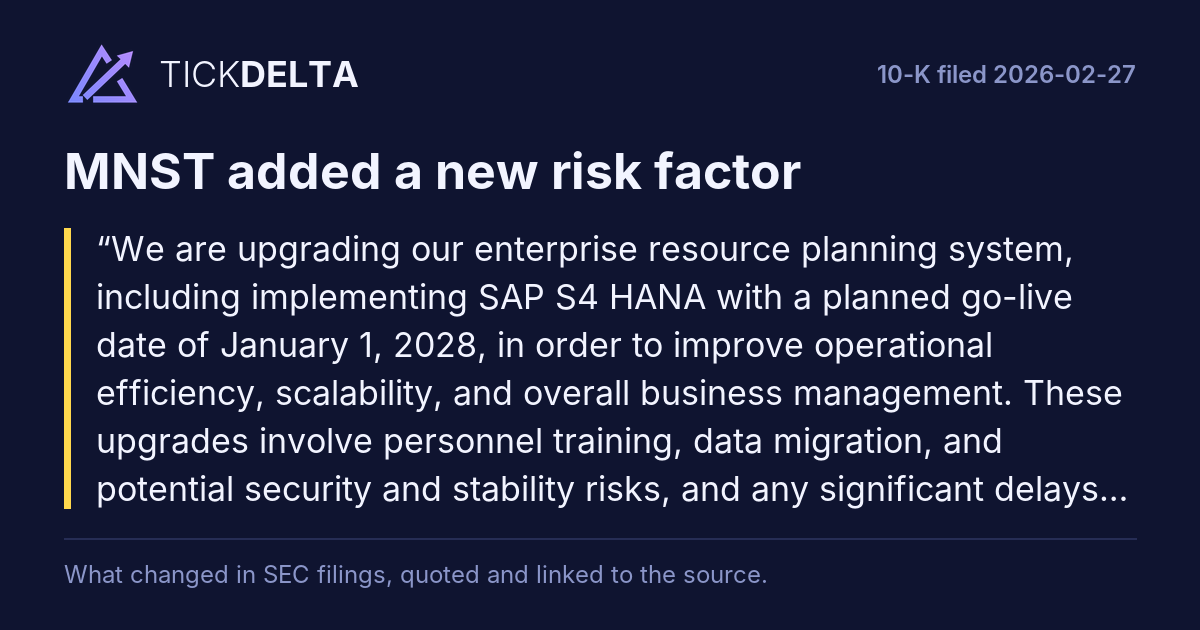
We are upgrading our enterprise resource planning system, including implementing SAP S4 HANA with a planned go-live date of January 1, 2028, in order to improve operational efficiency, scalability, and overall business management. These upgrades involve personnel training, data migration, and potential security and stability risks, and any significant delays or failures could disrupt our business and negatively affect our operations and financial results.
Read in the 10-K ↗
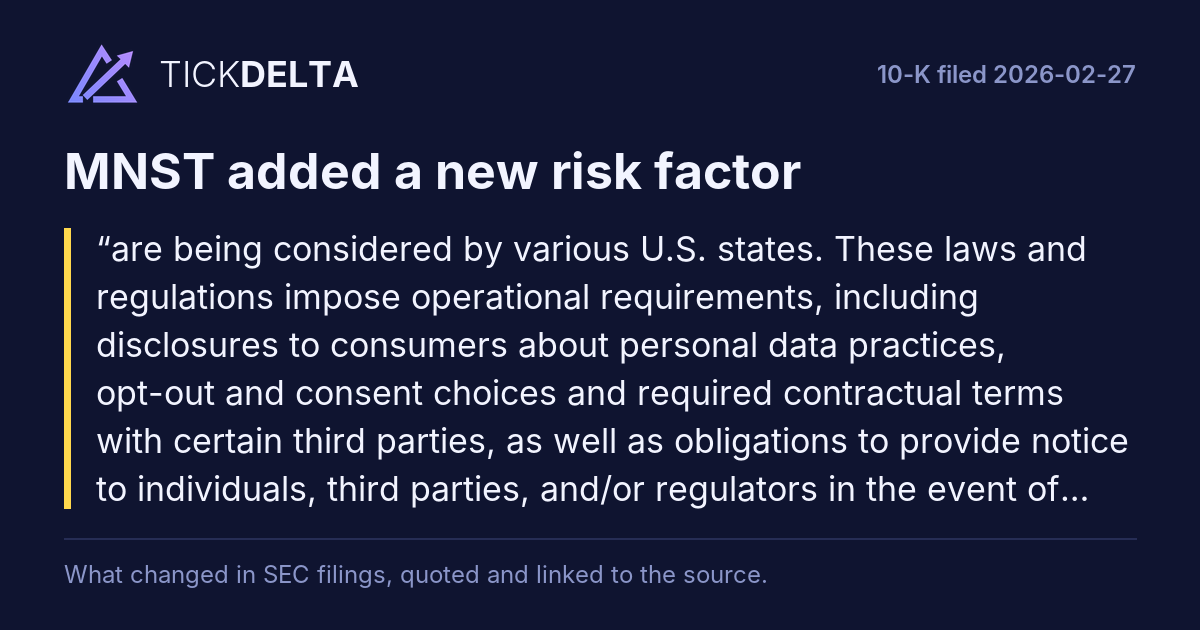
are being considered by various U.S. states. These laws and regulations impose operational requirements, including disclosures to consumers about personal data practices, opt-out and consent choices and required contractual terms with certain third parties, as well as obligations to provide notice to individuals, third parties, and/or regulators in the event of certain cybersecurity incidents involving personal data. In China, for instance, the Personal Information Protection Law also imposes requirements on the collection, use, and cross-border transfer of personal information, and noncompliance may result in penalties and operational restrictions.
Read in the 10-K ↗
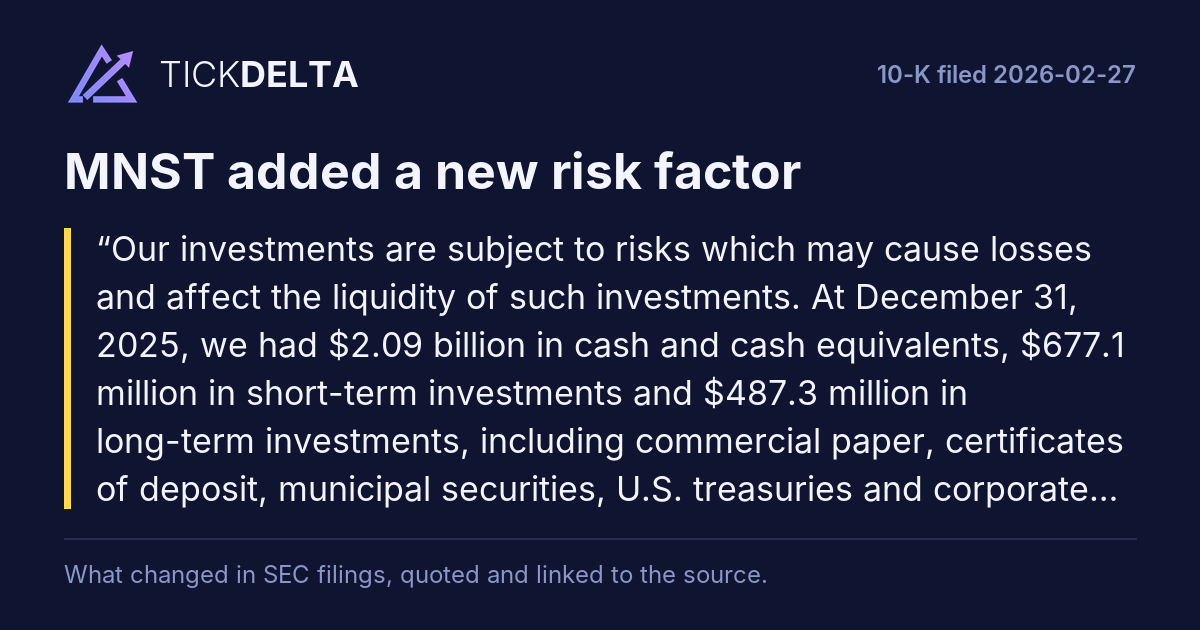
Our investments are subject to risks which may cause losses and affect the liquidity of such investments.
Similar paragraph at 1 of 31 other Consumer staples companies:
STZAt December 31, 2025, we had $2.09 billion in cash and cash equivalents, $677.1 million in short-term investments and $487.3 million in long-term investments, including commercial paper, certificates of deposit, municipal securities, U.S. treasuries and corporate bonds. Certain of these investments are subject to general credit, liquidity, market and interest rate risks. These risks associated with our investment portfolio may have an adverse effect on our future results of operations, liquidity and financial condition.
Read in the 10-K ↗
New in the latest 10-Q
11 paragraphs in the 10-Q filed Nov 6, 2026 with nothing like
them in the 10-Q filed Aug 7, 2026 (at least half the words must differ; new numbers alone do not count).
Quoted exactly, grouped by the item heading above them. This is text that changed, not a judgement of how serious it is.
Financial statements and notes
1Stock Split - On July 8, 2026, the Company announced a two -for-one stock split of its common stock, effected in the form of a 100% stock dividend. The stock dividend was issued on August 10, 2026 (the “Stock Split”). The accompanying condensed consolidated financial statements and notes thereto have been retroactively updated to reflect the Stock Split. See Note 1 for additional information.
Read in the 10-Q ↗
1Stock Split - The accompanying condensed consolidated financial statements and notes thereto have been retroactively updated to reflect the Stock Split. See Note 1 for additional information.
Read in the 10-Q ↗
1Stock Split - The accompanying condensed consolidated financial statements and notes thereto have been retroactively updated to reflect the Stock Split. See Note 1 for additional information.
Read in the 10-Q ↗
Stock Split - On July 8, 2026, the Company announced a two-for-one stock split of the Company’s common stock that was effected in the form of a 100% stock dividend. The common stock dividend was issued on August 10, 2026 (the “Stock Split”) and the Company’s common stock began trading at the split-adjusted price on August 11, 2026. Accordingly, all per share amounts, weighted-average common stock outstanding, common stock outstanding, common stock repurchased and equity-based compensation disclosure presented in the condensed consolidated financial statements and notes have been adjusted retroactively, where applicable, to reflect the Stock Split. Stockholders’ equity has been retroactively adjusted, where applicable, to give effect to the Stock Split for all periods presented by reclassifying the par value of the additional shares issued in connection with the Stock Split to common stock from additional paid-in capital.
Read in the 10-Q ↗
Level 2: Observable inputs other than Level 1 prices, such as quoted prices for similar assets or liabilities, quoted prices in markets that are not active, or other inputs that are observable or can be corroborated by observable market data for substantially the full term of the related assets or liabilities.
Read in the 10-Q ↗
Level 3: Unobservable inputs that are supported by little or no market activity and that are significant to the fair value of the assets or liabilities.
Read in the 10-Q ↗
Generally, the Monster Energy® Drinks segment generates higher per case net operating revenues, but lower per case gross profit margin percentages than the Strategic Brands segment.
Read in the 10-Q ↗
Generally, the Alcohol Brands segment has lower gross profit margin percentages than the Monster Energy® Drinks segment.
Read in the 10-Q ↗
Corporate and unallocated amounts that do not relate to a reportable segment have been allocated to “Corporate & Unallocated.” No asset information, other than goodwill and other intangible assets, has been provided in the Company’s reportable segments, as management does not measure or allocate such assets on a segment basis.
Read in the 10-Q ↗
The Company’s chief operating decision maker is the chief executive officer (the “CEO”). The CEO assesses segments’ performance by using each segment’s operating income and considers budget-to-actual variances on a periodic basis (at least quarterly) when making decisions about operational planning, including resource allocation. Further, the CEO uses segments’ operating income when comparing the results of each segment with one another.
Read in the 10-Q ↗
expropriation, nationalization or other government takeover of our or our bottlers’/distributors’ operations or assets, government limitations on foreign ownership, and restrictions on our ability to repatriate or recover our assets or funds; and
Read in the 10-Q ↗
The 10-Q's risk factors against the 10-K
Item 1A of the 10-Q filed Nov 6, 2026 against Item 1A of the 10-K filed Feb 27, 2026.
A 10-Q repeats only the risks that changed, so a 10-K paragraph that is missing from it is not counted as removed.
Added is a paragraph with nothing like it in the 10-K, Reworded a sentence that is in both with several words changed,
Quiet changes a sentence in both where one to four words changed and one is a hedge or a modal
(cut words struck through, new words highlighted and underlined).
Text on the page, not a score; each links to the filing at sec.gov.
Added10-Q 2026-11-06 vs 10-K 2026-02-27
On August 19, 2024, the Company’s Board of Directors authorized a share repurchase program for the purchase of up to an additional $500.0 million of the Company’s outstanding common stock (the “August 2024 Repurchase Plan”). During the three-months ended September 30, 2026, the Company purchased approximately 2.3 million shares of its common stock at an average purchase price of $43.87 per share, for a total amount of approximately $100.0 million under the August 2024 Repurchase Plan. As of November 4, 2026, approximately $300.0 million remained available for repurchase under the August 2024 Repurchase Plan.
Read it in the 10-Q at sec.gov ↗
Added10-Q 2026-11-06 vs 10-K 2026-02-27
On May 14, 2026, the Company’s Board of Directors authorized a share repurchase program for the purchase of up to an additional $500.0 million of the Company’s outstanding common stock (the “May 2026 Repurchase Plan”). During the three-months ended September 30, 2026, no shares were repurchased under the May 2026 Repurchase Plan. As of November 4, 2026, approximately $500.0 million remained available for repurchase under the May 2026 Repurchase Plan.
Read it in the 10-Q at sec.gov ↗
Added10-Q 2026-11-06 vs 10-K 2026-02-27
The aggregate amount of the Company’s outstanding common stock that remains available for repurchase under all previously authorized repurchase plans is approximately $800.0 million as of November 4, 2026.
Read it in the 10-Q at sec.gov ↗
Added10-Q 2026-11-06 vs 10-K 2026-02-27
During the three-months ended September 30, 2026, 8,760 shares of common stock were purchased from employees in lieu of cash payments for options exercised or withholding taxes due for a total amount of $0.4 million. While such purchases are considered common stock repurchases, they are not counted as purchases against the Company’s authorized share repurchase programs. Such shares are included in common stock in treasury in the accompanying condensed consolidated balance sheet at September 30, 2026.
Read it in the 10-Q at sec.gov ↗
Added10-Q 2026-11-06 vs 10-K 2026-02-27
The following tabular summary reflects the Company’s repurchase activity during the quarter ended September 30, 2026.
Read it in the 10-Q at sec.gov ↗
Added10-Q 2026-11-06 vs 10-K 2026-02-27
Maximum Number (or Approximate Dollar Total Number of Value) of Shares that Shares Purchased May Yet Be Purchased Total Number as Part of Publicly Under the Plans or of Shares Average Price Announced Plans Programs Period Purchased1 per Share or Programs2 (In thousands) Jul 1 – Jul 31, 2026 — $ — — $ 900,000 Aug 1 – Aug 31, 2026 — $ — — $ 900,000 Sep 1 – Sep 30, 2026 2,288,942 $ 43.87 2,280,182 $ 799,966 Total 2,288,942 $ 43.87 2,280,182 $ 799,966
Read it in the 10-Q at sec.gov ↗
Added10-Q 2026-11-06 vs 10-K 2026-02-27
1The total number of shares purchased includes (1) shares repurchased, if any, pursuant to the August 2024 Repurchase Plan and the May 2026 Repurchase Plan, and (2) shares repurchased, if any, to satisfy exercise price and/or tax withholding obligations in connection with exercises of employee stock options and/or the vesting of restricted stock issued to employees.
Read it in the 10-Q at sec.gov ↗
Added10-Q 2026-11-06 vs 10-K 2026-02-27
2On August 19, 2024, the Company’s Board of Directors authorized the August 2024 Repurchase Plan. On May 14, 2026, the Company’s Board of Directors authorized the May 2026 Repurchase Plan. Board authorization of the repurchase plans remains in effect until shares in the amount authorized thereunder have been repurchased.
Read it in the 10-Q at sec.gov ↗
Reworded10-Q 2026-11-06 vs 10-K 2026-02-27
In addition to the other information set forth in this Annual Quarterly Report on Form 10-K, 10-Q, including Management’s Discussion and Analysis of Financial Condition and Results of Operations (“MD&A”) and the condensed consolidated financial statements and related notes, you should carefully consider the following risks. risks discussed in “Part I, Item 1A - Risk Factors” in our Form 10-K.
Read it in the 10-Q at sec.gov ↗ · The 10-K sentence ↗