tickdelta
Sign in

Tickdelta is free for now. Sign up and get Pro free

← Screener

MNSTMonster Beverage

Consumer staples · Soft Drinks · Nasdaq
Compare with peers → Embed
SEC comment letters, last 20 years

3 reviews of MNST's filings by SEC staff

UPLOAD and CORRESP
ReviewsRead ↓
3
latest letter 2020-09-21
Questions asked
11
each answered in the company's own letter
No closing letter
0
reviews without a letter saying the staff completed it

When the SEC's staff reviews a filing, it writes to the company with numbered questions, and the company answers each one in a letter. SEC publishes the exchange once the review is over, at least 20 business days later. A question is not an accusation; most reviews end with the company adding detail to its next filing.

Form 10-K for the Year Ended December 31, 2019

2020-09-21 to 2021-01-21 · 2 questions · 2 letters from the SEC, 3 from the company
Review closed 2021-01-21
Non-GAAP measuresResults discussion (MD&A)Revenue
Management's Discussion and Analysis of Financial Condition and Results of Operations · Non-GAAP Financial Measures, page 48
SEC asked
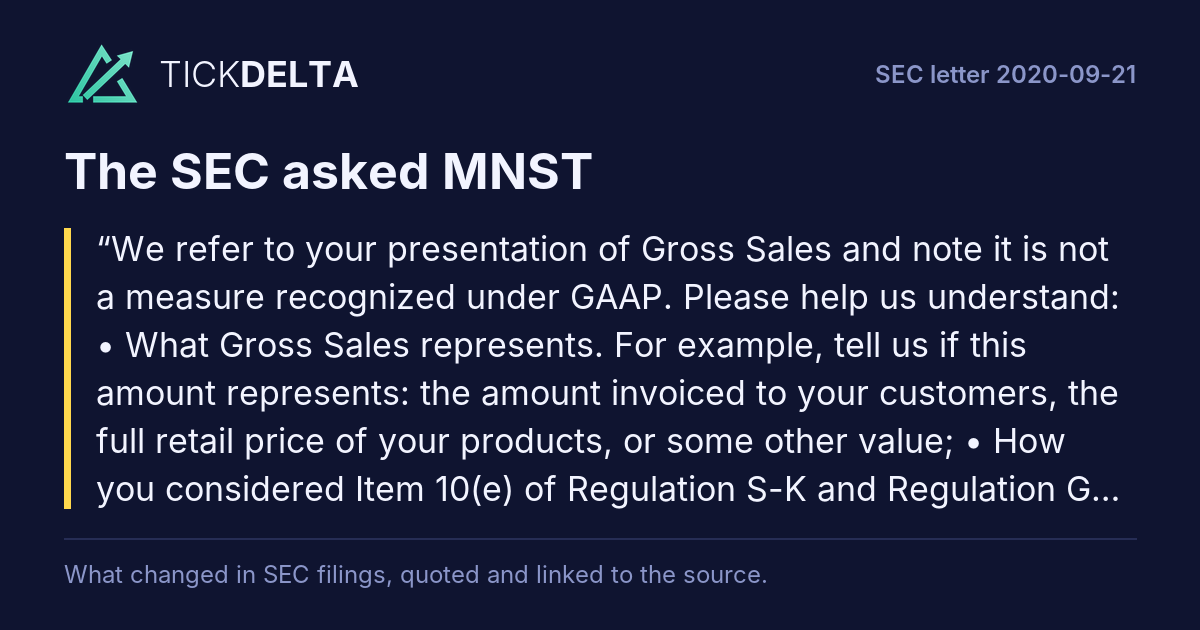
We refer to your presentation of Gross Sales and note it is not a measure recognized under GAAP. Please help us understand: • What Gross Sales represents. For example, tell us if this amount represents: the amount invoiced to your customers, the full retail price of your products, or some other value; • How you considered Item 10(e) of Regulation S-K and Regulation G; • How you analyze trends in the level of
Rest of the question

Promotional and Other Allowances, aside from the amount as percentage of gross sales as disclosed in your filing; and • How Gross Sales is useful to investors given that gross sales may not be realized in the form of cash receipts due to the allowances given to your bottlers/distributors or retail customers.

MNST answered
Gross Sales represents the recognition of deferred revenue and amounts invoiced to customers net of cash discounts and returns. In future filings, beginning with the Company’s quarterly report on Form 10-Q for the quarter ended September 30, 2020, anticipated to be filed with the Commission in November 2020, the Company will, where applicable, revise the disclosure as follows:

**Gross Sales represents the recognition of deferred revenue and amounts invoiced to customers net of cash discounts and returns.

The Company has considered both Item 10(e) of Regulation S-K and Regulation G in the
Rest of the answer

Company’s presentation of Gross Sales. With respect to Item 10(e) of Regulation S-K, the Company includes: (i) a presentation, with equal or greater prominence, of Net Sales (the most directly comparable GAAP financial measure) beginning on page 44 of the Form 10-K; (ii) a reconciliation of Gross Sales with Net Sales in a table on page 50 of the Form 10-K; and (iii) a footnote on pages 49-50 of the 10-K disclosing why the Company’s management believes the presentation of Gross Sales provides useful information to investors regarding the Company’s financial condition and results of operations. With respect to Regulation G, the Company includes (i) a presentation of Net Sales, the most directly comparable financial measure calculated and presented in accordance with GAAP, beginning on page 44 of the Form 10-K; and (ii) a reconciliation of Gross Sales with Net Sales in a table on page 50 of the Form 10-K. The Company will continue to ensure that the Company’s presentation of Gross Sales complies with all applicable provisions of Item 10(e) of Regulation S-K and Regulation G.

The Company primarily analyzes trends in Promotional and Other Allowances as a percentage of Gross Sales as disclosed on page 49 of the Form 10-K. In addition, the Company analyzes trends on a per unit case volume basis. (Unit case volume is defined on page 50 of the Form 10-K.) For each of the foregoing, the Company compares historical trends from year to year, quarter to quarter, and month to month.

Although Gross Sales may not be realized in the form of cash receipts, we believe that Gross Sales is useful to investors because, as described in the footnote on pages 49-50 of the Form 10-K, Gross Sales allows evaluation of sales performance before the effect of any promotional items, which can mask certain performance issues, such as the timing of certain promotional programs. In addition, the presentation of Gross Sales with a reconciliation to Net Sales discloses the level of promotional spend incurred by the Company. The reconciliation of Gross Sales with Net Sales in a table on page 50 of the Form 10-K provides investors with the information necessary to understand the amount of Gross Sales that will be realized in the form of cash receipts, namely Net Sales.

Read in the reply ↗
In its next report

First report after the company's reply of 2020-10-02: 10-Q filed 2020-11-06 ↗, against the 10-Q filed 2020-08-06 ↗.

Tickdelta does not hold the text of both reports, so they are not compared here.

Management's Discussion and Analysis of Financial Condition and Results of Operations · Non-GAAP Financial Measures, page 48
SEC asked
We have carefully considered your response to prior comment 1 and your revised disclosures that “gross sales” represent the recognition of deferred revenue and amounts invoiced to customers, net of cash discounts and returns. Based on this clarification, it appears that “gross sales” is more akin to a billings-type metric.
Rest of the question

Accordingly, please revise the title of this metric so as not to imply that it represents GAAP sales or revenue and comply with the metrics guidance set forth in SEC Release No. 33-10751. Please also clarify for us how the amount of deferred revenue included in Gross Sales is determined. In your response, please include your proposed revisions, including your discussion of this metric in MD&A.

MNST answered
, please include your proposed revisions, including your discussion of this metric in MD&A.

Response:

In future filings, where applicable, the Company will revise the title of Gross Sales to “Adjusted Billings” so as not to imply that it represents GAAP sales or revenue and to comply with the metrics guidance set forth in SEC Release No.
Rest of the answer

33-10751.

The amount of deferred revenue included in Gross Sales (to be titled Adjusted Billings in future filings) represents payments received from certain bottlers/distributors at inception of their distribution contracts or at the inception of certain sales/marketing programs and are accounted for as deferred revenue. Amounts received are recognized as revenue ratably over the anticipated life of the respective distribution agreement, generally 20 years, or through completion of the sales/marketing program.

In future filings, the disclosure of Adjusted Billings in MD&A will be as follows (using the description of the metric for year-ended numbers as a model):

Overview

Key Business Metrics

We use certain key metrics and financial measures not prepared in accordance with United States Generally Accepted Accounting Principles (“GAAP”) to evaluate and manage our business. For a further discussion of how we use key metrics and certain non-GAAP financial measures, see “Non-GAAP Financial Measures and Other Key Metrics”.

Non-GAAP

Financial Measures and Other Key Metrics

Year Ended December

31, _____ Compared to the Year Ended December 31, ____.

Adjusted Billings**. Adjusted billings were $___ billion for the year ended December 31, ____, an increase of approximately $___ million, or ___% higher than

Adjusted billings of $___ billion for the year ended December 31, ____. We do not believe that the COVID-19 pandemic had a material adverse impact on our Adjusted billings for the year ended December 31, ____, other than in EMEA, where an adverse impact was experienced. Net changes in foreign currency exchange rates had an [unfavorable] impact on Adjusted billings of approximately

$___ million for the year ended December 31, ____.

Adjusted billings for our Monster

Energy® Drinks segment were $___ billion for the year ended December 31, ____, an increase of approximately $___ million, or

___% higher than Adjusted billings of $___ billion for the year ended December 31, ____. [Adjusted billings for the Monster Energy®

Drinks segment increased primarily due to increased worldwide sales by volume of our Monster Energy® brand energy drinks and increased sales by volume for our Reign Total Body Fuel® high performance energy drinks, both as a result of increased consumer demand.] Net changes in foreign currency exchange rates had an [unfavorable] impact on Adjusted billings for the Monster Energy®

Drinks segment of approximately $___ million for the year ended December 31, ____.

Adjusted billings for our Strategic

Brands segment were $___ million for the year ended December 31, ____, an increase of $___ million, or ___% higher than Adjusted billings of $___ million for the year ended December 31, ____. Net changes in foreign currency exchange rates had an [unfavorable] impact on Adjusted billings in the Strategic Brands segment of approximately $___ million for the year ended December 31, ____.

Adjusted billings for our Other segment were $___ million for the year ended December 31, ____, an [increase] of $___ million, or ___% [higher] than Adjusted billings of $___ million for the year ended December 31, ____.

Promotional allowances, commissions and other expenses, as described in the footnote below, were $___ million for the year ended December 31, ____, an increase of

$___ million, or ___% [higher] than promotional allowances, commissions and other expenses of $___ million for the year ended December

31, ____. Promotional allowances, commissions and other expenses as a percentage of Adjusted billings [increased] to ___% from

___% for the year ended December 31, ____ and 2019, respectively.

Amounts received from certain bottlers/distributors at inception of their distribution contracts or at the inception of certain sales/marketing programs are accounted for as deferred revenue and are recognized as revenue ratably over the anticipated life of the respective distribution contract, generally 20 years, or through completion of the sales/marketing program. Revenue recognized was $___ million and $___ million for the years ended December 31, and , respectively.

**Adjusted

Billings (titled Gross Sales in prior filings) represent amounts invoiced to customers net of cash discounts and returns as well as the recognition of deferred revenue. Adjusted billings are used internally by management as an indicator of and to monitor operating performance, including sales performance of particular products, salesperson performance, product growth or declines and is useful to investors in evaluating overall Company performance. The use of adjusted billings allows evaluation of sales performance before the effect of any promotional items, which can mask certain performance issues, such as the timing of certain promotional programs. We therefore believe that the presentation of adjusted billings provides a useful measure of our operating performance.

The use of adjusted billings is not a measure that is recognized under GAAP and should not be considered as an alternative to net sales, which is determined in accordance with GAAP, and should not be used alone as an indicator of operating performance in place of net sales. Additionally, adjusted billings may not be comparable to similarly titled measures used by other companies, as adjusted billings has been defined by our internal reporting practices. In addition, adjusted billings may not be realized in the form of cash receipts as promotional payments and allowances may be deducted from payments received from certain customers.

The key metric “Adjusted

Billings” is presented in the following table:

(In thousands)

Year Ended

December 31,

Percentage

Change

[ ]

[ ] vs. [ ]

Adjusted Billings

$

-

Read in the reply ↗
In its next report

First report after the company's reply of 2020-12-18: 10-K filed 2021-03-01 ↗, against the 10-K filed 2020-02-28 ↗.

Tickdelta does not hold the text of both reports, so they are not compared here.
Also in this review: company letter, 2021-01-13, closing letter, 2021-01-21
Form 10-K for the Fiscal Year Ended December 31, 2017

2018-05-09 to 2018-05-21 · 3 questions · 1 letter from the SEC, 1 from the company
Review closed 2018-05-21
SegmentsResults discussion (MD&A)Non-GAAP measures
Item 7. Management’s Discussion and Analysis of Financial Condition and Results of Operations · Results of Operations, page 44
SEC asked (1)
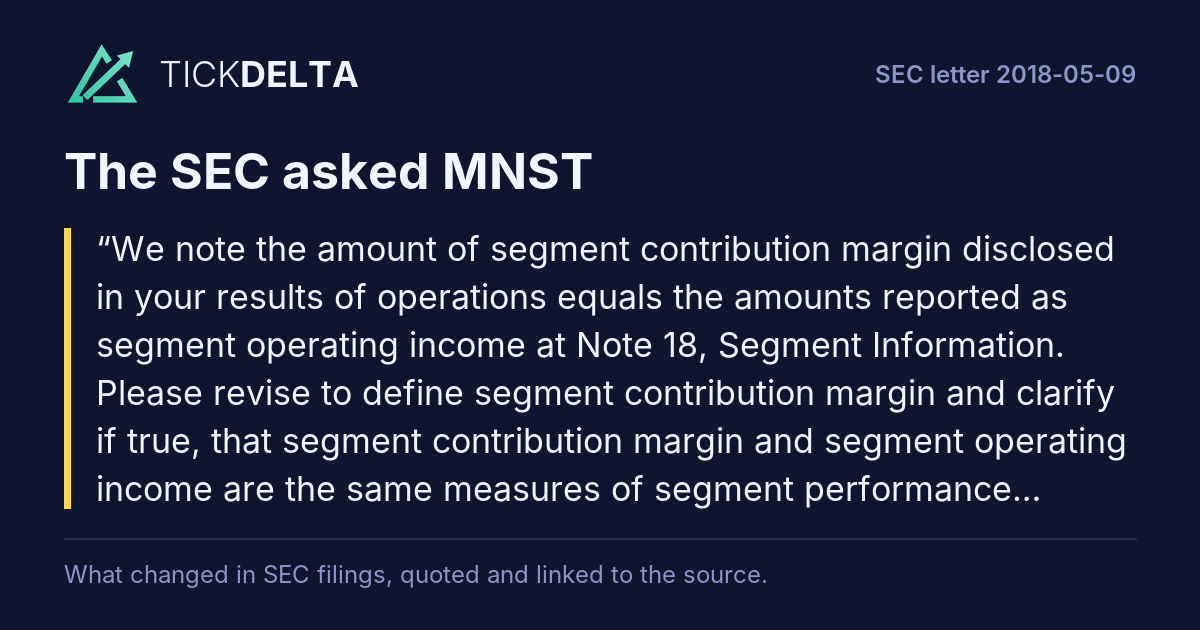
We note the amount of segment contribution margin disclosed in your results of operations equals the amounts reported as segment operating income at Note 18, Segment Information. Please revise to define segment contribution margin and clarify if true, that segment contribution margin and segment operating income are the same measures of segment performance.
Rest of the question

Alternatively, revise your disclosure in MD&A to discuss the segment performance measures disclosed in Note 18. Notes to Consolidated Financial Statements 1. Organization and Summary of Significant Accounting Policies

MNST answered
In response to the Staff’s comment, the Company advises the Staff that segment contribution margin and segment operating income are the same measures of segment performance. In the Company’s most recent Quarterly Report on Form 10-Q for the quarter ended March 31, 2018, filed with the Commission on May 10, 2018 (“Form 10-Q”), operating income was consistently used as a measure of segment performance in both the footnotes to the condensed consolidated financial statements as well as in MD&A.
Rest of the answer

In future filings, where applicable, the Company will consistently refer to segment operating income as a measure of segment performance.

Notes to Consolidated Financial Statements

1. Organization and Summary of Significant Accounting Policies

Read in the reply ↗
In its next report

First report after the company's reply of 2018-05-18: 10-Q filed 2018-08-09 ↗, against the 10-Q filed 2017-11-09 ↗.

Tickdelta does not hold the text of both reports, so they are not compared here.

Cost of Sales, page 84
SEC asked (2)
Please disclose whether you allocate a portion of your payroll costs and depreciation and amortization to cost of sales. Refer to ASC 330-10-30-1 through 30-8. In this regard, please refer to your letter dated April 13, 2017 in response to comment 1 of our letter dated March 31, 2017.
MNST answered
In response to the Staff’s comment, the Company advises the Staff that a portion of its payroll costs, depreciation and amortization related to the direct manufacture of certain flavors by American Fruits & Flavors LLC, a subsidiary of the Company, is allocated to cost of sales.

The Company advises the Staff that the Company inadvertently did not update its Form 10-K as indicated in the Company’s letter dated April 13, 2017 (response to comment 1).
Rest of the answer

In future filings, where applicable, the Company will revise the disclosure of significant accounting policies set forth in the notes to the Company’s financial statements. Below is an example of our proposed revised disclosure:

Cost of Sales — Cost of sales consists of the costs of concentrates and/or beverage bases, the costs of raw materials utilized in the manufacture of products, co-packing fees, repacking fees, in-bound freight charges, as well as certain internal transfer costs, warehouse expenses incurred prior to the manufacture of the Company’s finished products and certain quality control costs. In addition, the Company includes certain costs such as depreciation, amortization and payroll costs that relate to the direct manufacture by the Company of certain flavors. Raw materials account for the largest portion of the cost of sales. Raw materials include cans, bottles, other containers, flavors, ingredients and packaging materials.

Read in the reply ↗
In its next report

First report after the company's reply of 2018-05-18: 10-Q filed 2018-08-09 ↗, against the 10-Q filed 2017-11-09 ↗.

Tickdelta does not hold the text of both reports, so they are not compared here.

Form 8-K Filed February 28, 2018 · Exhibit 99.1
SEC asked (3)
We note you present gross sales as a non-GAAP measure for the fourth quarter and year ended December 31, 2017. Please provide the quantitative reconciliations of your non- GAAP measures to the most directly comparable GAAP measures as required by Item 10(e)(i) of Regulation S-K or tell us why this guidance does not apply to you. Please revise or advise.
MNST answered
In response to the Staff’s comment, the Company advises the Staff that both its Form 10-K and Form 10-Q included a quantitative reconciliation of gross sales (a non-GAAP measure) to net sales (the most directly comparable GAAP measure) under the heading “Non-GAAP Financial Measures.”

The Company acknowledges the Staff’s comment with respect to press releases and will include quantitative reconciliations in future press releases which contain non GAAP financial measures.

As requested by the Staff, the following table reconciles the non-GAAP financial measure of gross sales with the most
Rest of the answer

directly comparable GAAP financial measure of net sales for the threeand twelve-months ended:

Three-Months Ended

December 31,

Read in the reply ↗
In its next report

First report after the company's reply of 2018-05-18: 10-Q filed 2018-08-09 ↗, against the 10-Q filed 2017-11-09 ↗.

Tickdelta does not hold the text of both reports, so they are not compared here.

Also in this review: closing letter, 2018-05-21

Form 10-K for the Fiscal Year Ended December 31, 2014

2015-03-25 to 2015-04-28 · 6 questions · 1 letter from the SEC, 1 from the company
Review closed 2015-04-28
Non-GAAP measuresLiquidity and cashAcquisitionsLegal and contingencies
Operations, page 41 · Result of Operations, page 48
SEC asked (1)
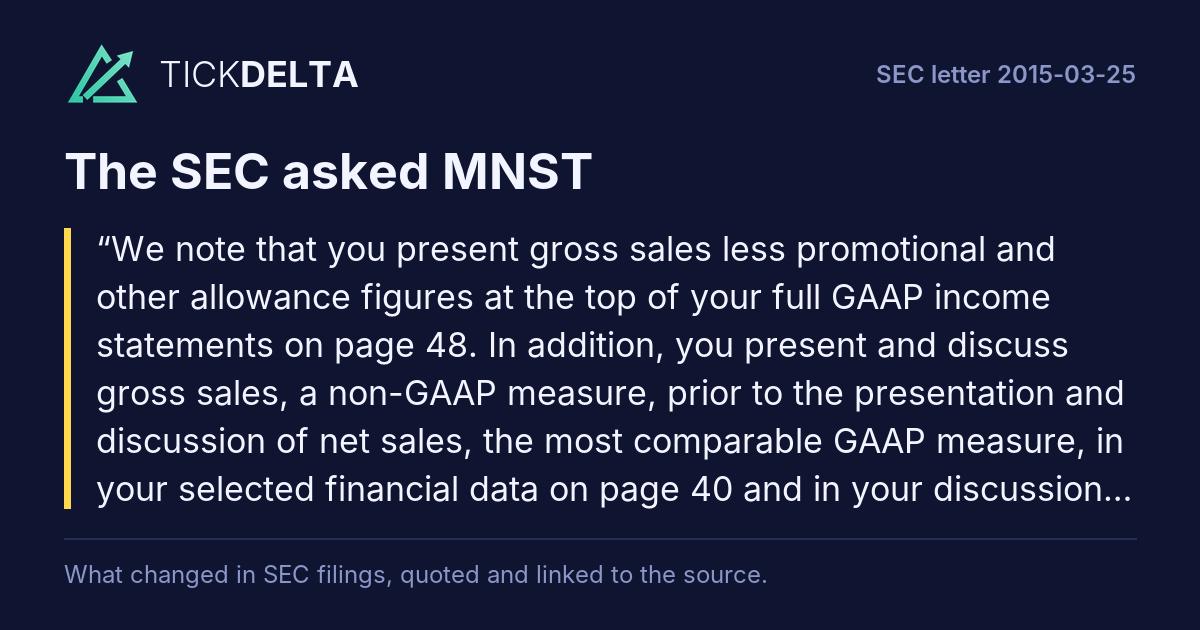
We note that you present gross sales less promotional and other allowance figures at the top of your full GAAP income statements on page 48. In addition, you present and discuss gross sales, a non-GAAP measure, prior to the presentation and discussion of net sales, the most comparable GAAP measure, in your selected financial data on page 40 and in your discussion on page 49.
Rest of the question

Furthermore, it appears that you reconcile gross sales, the non-GAAP measure, to net sales, the most directly comparable GAAP measure, by presenting this reconciliation in a full non-GAAP income statement which is generally not considered appropriate as it may attach undue prominence to the non-GAAP measure, gross sales. Please revise future filings to present and discuss the GAAP measure net sales, more prominently than the non-GAAP measure, gross sales. In addition, any reconciliation of the two measures should not be included on your full income statement as this may result in presentation of a full non-GAAP income statement. Refer to the guidance outlined in Item 10(e) of Regulation S-K and Question 102.10 of Staff’s

MNST answered
In response to the Staff’s comment, the Company advises the Staff that in future filings, beginning with the Company’s Quarterly Report on Form 10-Q for the quarter ended March 31, 2015, anticipated to be filed with the Commission in May 2015, where applicable, it will revise disclosure to present and discuss the GAAP measure “net sales” more prominently than the non-GAAP measure “gross sales”, and will not include a reconciliation of the two measures on its full income statement. Read in the reply ↗
In its next report

First report after the company's reply of 2015-04-07: 10-Q filed 2015-05-11 ↗, against the 10-Q filed 2014-11-07 ↗.

Tickdelta does not hold the text of both reports, so they are not compared here.

Compliance & Disclosure Interpretation on Non-GAAP Financial Measures at · http://www.sec.gov/divisions/corpfin/guidance/nongaapinterp.htm
SEC asked (2)
We note from your discussion on page 49 that promotional and other allowances have increased $22.1 million from the prior year to $362.2 million for the year ended December 31, 2014. Please provide us a draft disclosure to be included in future filings to describe your promotional and other allowance activities and to discuss what factors or circumstances drive these promotional spending levels that ultimately
Rest of the question

impact your net sales.

MNST answered
In response to the Staff’s comment, the Company notes that it describes promotional and other allowance activities in the footnote to the results of Operations table on page 49 of the Form 10-K. The Company further notes that although promotional and other allowances increased in absolute dollars, promotional and other allowances as a percentage of gross sales decreased to 12.8% from 13.1% for the year ended December 31, 2014 and 2013, respectively, as disclosed in the Gross Sales paragraph on page 49 of the Form 10-K.

In future filings, beginning with the Company’s Quarterly Report on Form
Rest of the answer

10-Q for the quarter ended March 31, 2015, anticipated to be filed with the Commission in May 2015, the Company will supplement its disclosure regarding factors driving its promotional spending levels. An example of such supplementary disclosure for the year ended December 31, 2014 is as follows:

“The primary drivers of our promotional and other allowance activities for the years ended December 31, 2014 and 2013, were (i) to increase sales volume and trial, (ii) to address market conditions, and (iii) to secure shelf and display space at retail.”

Read in the reply ↗
Liquidity and Capital Resources, page 55
SEC asked (3)
Your discussion and analysis of cash flows provided by operating, investing and financing activities merely recites the numerical information presented in the consolidated statements of cash flows. Please provide us with, and confirm to us that you will provide in future filings, a robust discussion and analysis of your operating, investing and financing cash flows to address material changes in these cash flows and
Rest of the question

the underlying drivers of these cash flows. Refer to FRC 501.13b for additional guidance.

MNST answered
In response to the Staff’s comment, the Company notes that in future periodic reports beginning with the Company’s Quarterly Report on Form 10-Q for the quarter ended March 31, 2015, anticipated to be filed with the Commission in May 2015, the Company will supplement its disclosure regarding cash flows with disclosure similar to the following:

“Cash flows provided by operating activities — We generated $585.6 million, $342.0 million and $287.7 million of cash flows from operations for the years ended December 31, 2014, 2013 and 2012, respectively.
Rest of the answer

The increase of $243.6 million in cash flows from operations in 2014 as compared to 2013 was primarily the result of the increase in net income, a decrease in inventories, as well as the timing of receipts and payments of working capital. The increase of $54.3 million in cash flows from operations in 2013 as compared to 2012 was primarily due to the timing of receipts and payments of working capital.

Cash flows (used in) provided by investing activities — We used $440.4 million and $339.8 million of cash flows for the years ended December 31, 2014 and 2013, respectively. The increase in cash flows used in investing activities of $100.6 million from 2014 as compared to 2013 was primarily the result of the increase in our short-term investments due to the overall increase in cash provided by operations. In 2012, cash flow provided by investments was $271.8 million, as a portion of our investments were sold in order to repurchase our common stock.

Cash flows provided by (used in) financing activities — We generated $19.3 million of cash flows for the year ended December 31, 2014 and used $17.9 million and $699.1 million of cash flows for the years ended December 31, 2013 and 2012, respectively. The cash used in both 2013 and 2012 was primarily related to repurchases of our common stock.”

Read in the reply ↗
In its next report

First report after the company's reply of 2015-04-07: 10-Q filed 2015-05-11 ↗, against the 10-Q filed 2014-11-07 ↗.

Tickdelta does not hold the text of both reports, so they are not compared here.

Liquidity and Capital Resources, page 55
SEC asked (4)
We note from your disclosures on pages 46 and 47 of Amendment No. 1 to Form S-4 filed on March 12, 2015 by New Laser Corporation that you will incur $280 million of termination expense to certain distributors terminated as part of the expanded US distribution rights transferred to TCCC’s distribution network.
Rest of the question

You further disclose in that filing that the amount of distributor termination expenses have been estimated, taking into account your contractual obligations under the termination provisions of the applicable distribution agreements. Please clarify why your contractual obligation for the aggregate amount of $280 million is not presented in your contractual obligations table on page 57 or discussed in a footnote to the table.

MNST answered
In response to the Staff’s comment, the Company notes that the contractual obligations table and footnotes represent a summary of the Company’s known contractual commitments as of the end of its fiscal year ended December 31, 2014, as required by 303(a)(5) of Regulation S-K. Per ASC No. 420, the Company expenses distributor termination costs in the period in which the written notification of termination occurs. The Company began sending notices of termination to certain of its third-party distributors on February 9, 2015.
Rest of the answer

Accordingly, no contractual obligations were incurred as of the 2014 fiscal year end and were not included in the contractual obligations table presented in the Form 10-K. However, the Company disclosed the pending distribution transitions on pages 22, 44 and 96 of the Form 10-K.

Read in the reply ↗
In its next report

First report after the company's reply of 2015-04-07: 10-Q filed 2015-05-11 ↗, against the 10-Q filed 2014-11-07 ↗.

Tickdelta does not hold the text of both reports, so they are not compared here.

Note 1. Organization and Summary of Significant Accounting Policies, page 81 · Acquisitions and Divestitures, page 81
SEC asked (5)
Please revise the notes to your financial statements in future filings to disclose the nature and significant terms of the milestones that must be achieved for the $625 million of cash payments from TCCC that will be placed in escrow as part to the TCCC transactions, to be released from escrow following completion of the transactions.
Rest of the question

Your revised disclosure should also explain why you believe collection of the full $625 million is probable. 10. Commitments and Contingencies, page 97

MNST answered
In response to the Staff’s comment, the Company advises the Staff that in future filings beginning with the Company’s Quarterly Report on Form 10-Q for the quarter ended March 31, 2015, anticipated to be filed with the Commission in May 2015, where applicable, it will revise the disclosure set forth in the notes to the Company’s financial statements to address the nature and significant terms of the milestones that must be achieved for the $625 million escrow (or the remaining amount then in escrow as of the applicable filing) to be released, following completion of the TCCC transactions.
Rest of the answer

In addition, the Company will explain why it believes collection of the then-applicable escrow amount is probable.

10. Commitments and Contingencies, page 97

Read in the reply ↗
In its next report

First report after the company's reply of 2015-04-07: 10-Q filed 2015-05-11 ↗, against the 10-Q filed 2014-11-07 ↗.

Tickdelta does not hold the text of both reports, so they are not compared here.

Note 1. Organization and Summary of Significant Accounting Policies, page 81 · Acquisitions and Divestitures, page 81
SEC asked (6)
We note from your disclosure on page 101 that you evaluate on a quarterly basis, developments in legal proceedings and other matters that could cause an increase or decrease in the amount of the liability that is accrued, if any, or in the amount of any related insurance reimbursements recorded.
Rest of the question

Please clarify why you do not disclose an estimated range of reasonably possible loss in excess of amounts accrued for the pending litigation you describe on pages 98 through 101. To the extent that you cannot estimate a range of additional loss, please disclose in future filings that such amount cannot be estimated and supplementally (1) describe for us the procedures you undertake on a quarterly basis to attempt to develop a range of reasonable possible loss for disclosure and (2) tell us, for each material matter, what specific factors are causing your inability to provide an estimate and when you expect those factors to be alleviated. Refer to ASC 450-20-50-3 and 50-4.

MNST answered
In response to the Staff’s comment, the Company advises the Staff that as part of the quarterly closing process, the Company’s legal department prepares a summary status report of all outstanding, pending and threatened litigation. This report is prepared taking into consideration the advice received from outside legal counsel representing or advising the Company in connection with the matters.
Rest of the answer

The summary is reviewed by the Company’s financial reporting team and is used as the primary basis (1) to determine whether any accruals are necessary under the provisions of ASC 450-20-25, 20-30, and 20-50-3 and 4, and (2) to determine the appropriate disclosures in the notes to the consolidated financial statements and in the Company’s Form 10-K in response to the requirements of Item 103 of Regulation S-K. Specifically, the summary is used to determine whether any of the pending or threatened matters would result in a loss that is (1) “probable” and “estimable,” or (2) “reasonably possible” in excess of the amounts already accrued and included in the consolidated financial statements.

With respect to matters for which a loss is deemed probable or reasonably possible, the Company’s legal department, in consultation with the Company’s finance department, makes a determination as to whether the possible loss or range of loss is reasonably estimable. Such determinations are made on a case-by-case basis considering factors such as: the nature of the claim and proceeding; the progress and procedural status of the claim (including any rulings on the merits or determinations of liability); whether the claim is an individual claim or an alleged class action, the extent of discovery; whether the damages sought have been specified, relevant precedent; the Company’s prior experience with respect to similar claims and theories of liability asserted; information obtained during settlement discussions and the Company’s defenses and counterclaims.

Significant management judgment is required to determine both the probability and estimated amount of a possible loss or range of loss. If a loss is determined to be probable and estimable, an accrual for such estimate is recorded. For matters for which the possible loss or range of loss is reasonably estimable, the Company discloses the estimated possible losses or range of estimated possible losses on an aggregate basis. For each disclosed matter for which the Company cannot reasonably estimate the possible loss or range of loss in excess of accrued amounts, the Company will disclose the fact that the possible loss cannot be estimated.

The Company advises that no possible range of loss is disclosed in connection with the Fournier action, as the Company believes an award for damages is not estimable, is remote and, if awarded, would not have a material adverse effect on the Company’s financial position or results of operations.

The Company advises that no possible range of loss is disclosed in connection with the Consolidated Class Action Complaint, as the Company disclosed in the Form 10-K that such action has settled and additionally disclosed the amount paid to settle the action and that such payment was made entirely by certain of the Company’s insurance carriers.

The Company advises that, based on information available at the time it filed the Form 10-K, no evaluation of the likelihood of an unfavorable outcome or range of potential loss can be expressed regarding the State Attorney General Inquiry or the San Francisco City Attorney Litigation. As described in the disclosure, the State Attorney General Inquiry and the San Francisco City Attorney Litigation remain in their early stages and have not progressed to a point where an adverse outcome is deemed probable or the Company is capable of estimating an associated reasonably possible range of loss. In future filings, if applicable, assuming such matters have not progressed, the Company will revise the disclosures to include the following:

“The actions or investigations described above have not progressed to a point where a reasonably possible range of losses associated with their ultimate outcome can be estimated at this time. If the final resolution of any such litigation or proceedings is unfavorable, our financial condition, operating results and cash flows could be materially affected.”

The Company will continue to monitor the status of these cases in light of ASC 450-20-50-4 and update our disclosures as appropriate.

***

The Company acknowledges that (i) it is responsible for the adequacy and accuracy of the disclosure in the filing; (ii) Staff comments or changes to disclosure in response to Staff comments do not foreclose the Commission from taking any action with respect to the filing; and (iii) the Company may not assert Staff comments as a defense in any proceedings initiated by the Commission or any person under the federal securities laws of the United States.

We hope that the foregoing has been responsive to the Staff’s comments. If you have any further questions or need any additional information, please feel free to contact the undersigned at (951) 739-6200 at your convenience.

Read in the reply ↗
In its next report

First report after the company's reply of 2015-04-07: 10-Q filed 2015-05-11 ↗, against the 10-Q filed 2014-11-07 ↗.

Tickdelta does not hold the text of both reports, so they are not compared here.

Also in this review: closing letter, 2015-04-28

From the SEC's correspondence on EDGAR: staff letters (form UPLOAD) and company letters (form CORRESP), 30 letters filed since 2014-07-09. Questions and answers are matched by their numbers; topics come from words in each question. The reports are compared word for word (same form, before the first SEC letter against the first report after the company's reply). No AI.

Next in Owners and insiders Insider trades →