Form 10-K for the Year Ended December 31, 2019
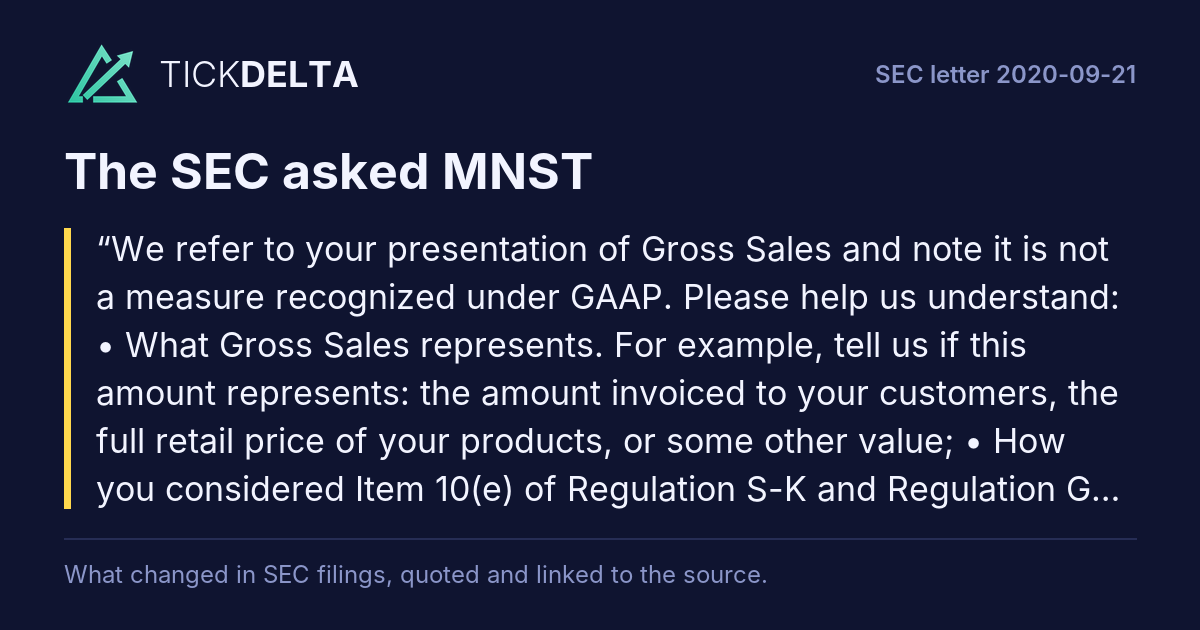
We refer to your presentation of Gross Sales and note it is not a measure recognized under GAAP. Please help us understand: • What Gross Sales represents. For example, tell us if this amount represents: the amount invoiced to your customers, the full retail price of your products, or some other value; • How you considered Item 10(e) of Regulation S-K and Regulation G; • How you analyze trends in the level ofRest of the question
Promotional and Other Allowances, aside from the amount as percentage of gross sales as disclosed in your filing; and • How Gross Sales is useful to investors given that gross sales may not be realized in the form of cash receipts due to the allowances given to your bottlers/distributors or retail customers.
Gross Sales represents the recognition of deferred revenue and amounts invoiced to customers net of cash discounts and returns. In future filings, beginning with the Company’s quarterly report on Form 10-Q for the quarter ended September 30, 2020, anticipated to be filed with the Commission in November 2020, the Company will, where applicable, revise the disclosure as follows:
**Gross Sales represents the recognition of deferred revenue and amounts invoiced to customers net of cash discounts and returns.
The Company has considered both Item 10(e) of Regulation S-K and Regulation G in theRead in the reply ↗Rest of the answer
Company’s presentation of Gross Sales. With respect to Item 10(e) of Regulation S-K, the Company includes: (i) a presentation, with equal or greater prominence, of Net Sales (the most directly comparable GAAP financial measure) beginning on page 44 of the Form 10-K; (ii) a reconciliation of Gross Sales with Net Sales in a table on page 50 of the Form 10-K; and (iii) a footnote on pages 49-50 of the 10-K disclosing why the Company’s management believes the presentation of Gross Sales provides useful information to investors regarding the Company’s financial condition and results of operations. With respect to Regulation G, the Company includes (i) a presentation of Net Sales, the most directly comparable financial measure calculated and presented in accordance with GAAP, beginning on page 44 of the Form 10-K; and (ii) a reconciliation of Gross Sales with Net Sales in a table on page 50 of the Form 10-K. The Company will continue to ensure that the Company’s presentation of Gross Sales complies with all applicable provisions of Item 10(e) of Regulation S-K and Regulation G.
The Company primarily analyzes trends in Promotional and Other Allowances as a percentage of Gross Sales as disclosed on page 49 of the Form 10-K. In addition, the Company analyzes trends on a per unit case volume basis. (Unit case volume is defined on page 50 of the Form 10-K.) For each of the foregoing, the Company compares historical trends from year to year, quarter to quarter, and month to month.
Although Gross Sales may not be realized in the form of cash receipts, we believe that Gross Sales is useful to investors because, as described in the footnote on pages 49-50 of the Form 10-K, Gross Sales allows evaluation of sales performance before the effect of any promotional items, which can mask certain performance issues, such as the timing of certain promotional programs. In addition, the presentation of Gross Sales with a reconciliation to Net Sales discloses the level of promotional spend incurred by the Company. The reconciliation of Gross Sales with Net Sales in a table on page 50 of the Form 10-K provides investors with the information necessary to understand the amount of Gross Sales that will be realized in the form of cash receipts, namely Net Sales.
First report after the company's reply of 2020-10-02: 10-Q filed 2020-11-06 ↗, against the 10-Q filed 2020-08-06 ↗.
Tickdelta does not hold the text of both reports, so they are not compared here.
We have carefully considered your response to prior comment 1 and your revised disclosures that “gross sales” represent the recognition of deferred revenue and amounts invoiced to customers, net of cash discounts and returns. Based on this clarification, it appears that “gross sales” is more akin to a billings-type metric.Rest of the question
Accordingly, please revise the title of this metric so as not to imply that it represents GAAP sales or revenue and comply with the metrics guidance set forth in SEC Release No. 33-10751. Please also clarify for us how the amount of deferred revenue included in Gross Sales is determined. In your response, please include your proposed revisions, including your discussion of this metric in MD&A.
, please include your proposed revisions, including your discussion of this metric in MD&A.
Response:
In future filings, where applicable, the Company will revise the title of Gross Sales to “Adjusted Billings” so as not to imply that it represents GAAP sales or revenue and to comply with the metrics guidance set forth in SEC Release No.Read in the reply ↗Rest of the answer
33-10751.
The amount of deferred revenue included in Gross Sales (to be titled Adjusted Billings in future filings) represents payments received from certain bottlers/distributors at inception of their distribution contracts or at the inception of certain sales/marketing programs and are accounted for as deferred revenue. Amounts received are recognized as revenue ratably over the anticipated life of the respective distribution agreement, generally 20 years, or through completion of the sales/marketing program.
In future filings, the disclosure of Adjusted Billings in MD&A will be as follows (using the description of the metric for year-ended numbers as a model):
Overview
Key Business Metrics
We use certain key metrics and financial measures not prepared in accordance with United States Generally Accepted Accounting Principles (“GAAP”) to evaluate and manage our business. For a further discussion of how we use key metrics and certain non-GAAP financial measures, see “Non-GAAP Financial Measures and Other Key Metrics”.
Non-GAAP
Financial Measures and Other Key Metrics
Year Ended December
31, _____ Compared to the Year Ended December 31, ____.
Adjusted Billings**. Adjusted billings were $___ billion for the year ended December 31, ____, an increase of approximately $___ million, or ___% higher than
Adjusted billings of $___ billion for the year ended December 31, ____. We do not believe that the COVID-19 pandemic had a material adverse impact on our Adjusted billings for the year ended December 31, ____, other than in EMEA, where an adverse impact was experienced. Net changes in foreign currency exchange rates had an [unfavorable] impact on Adjusted billings of approximately
$___ million for the year ended December 31, ____.
Adjusted billings for our Monster
Energy® Drinks segment were $___ billion for the year ended December 31, ____, an increase of approximately $___ million, or
___% higher than Adjusted billings of $___ billion for the year ended December 31, ____. [Adjusted billings for the Monster Energy®
Drinks segment increased primarily due to increased worldwide sales by volume of our Monster Energy® brand energy drinks and increased sales by volume for our Reign Total Body Fuel® high performance energy drinks, both as a result of increased consumer demand.] Net changes in foreign currency exchange rates had an [unfavorable] impact on Adjusted billings for the Monster Energy®
Drinks segment of approximately $___ million for the year ended December 31, ____.
Adjusted billings for our Strategic
Brands segment were $___ million for the year ended December 31, ____, an increase of $___ million, or ___% higher than Adjusted billings of $___ million for the year ended December 31, ____. Net changes in foreign currency exchange rates had an [unfavorable] impact on Adjusted billings in the Strategic Brands segment of approximately $___ million for the year ended December 31, ____.
Adjusted billings for our Other segment were $___ million for the year ended December 31, ____, an [increase] of $___ million, or ___% [higher] than Adjusted billings of $___ million for the year ended December 31, ____.
Promotional allowances, commissions and other expenses, as described in the footnote below, were $___ million for the year ended December 31, ____, an increase of
$___ million, or ___% [higher] than promotional allowances, commissions and other expenses of $___ million for the year ended December
31, ____. Promotional allowances, commissions and other expenses as a percentage of Adjusted billings [increased] to ___% from
___% for the year ended December 31, ____ and 2019, respectively.
Amounts received from certain bottlers/distributors at inception of their distribution contracts or at the inception of certain sales/marketing programs are accounted for as deferred revenue and are recognized as revenue ratably over the anticipated life of the respective distribution contract, generally 20 years, or through completion of the sales/marketing program. Revenue recognized was $___ million and $___ million for the years ended December 31, and , respectively.
**Adjusted
Billings (titled Gross Sales in prior filings) represent amounts invoiced to customers net of cash discounts and returns as well as the recognition of deferred revenue. Adjusted billings are used internally by management as an indicator of and to monitor operating performance, including sales performance of particular products, salesperson performance, product growth or declines and is useful to investors in evaluating overall Company performance. The use of adjusted billings allows evaluation of sales performance before the effect of any promotional items, which can mask certain performance issues, such as the timing of certain promotional programs. We therefore believe that the presentation of adjusted billings provides a useful measure of our operating performance.
The use of adjusted billings is not a measure that is recognized under GAAP and should not be considered as an alternative to net sales, which is determined in accordance with GAAP, and should not be used alone as an indicator of operating performance in place of net sales. Additionally, adjusted billings may not be comparable to similarly titled measures used by other companies, as adjusted billings has been defined by our internal reporting practices. In addition, adjusted billings may not be realized in the form of cash receipts as promotional payments and allowances may be deducted from payments received from certain customers.
The key metric “Adjusted
Billings” is presented in the following table:
(In thousands)
Year Ended
December 31,
Percentage
Change
[ ]
[ ] vs. [ ]
Adjusted Billings
$
-
First report after the company's reply of 2020-12-18: 10-K filed 2021-03-01 ↗, against the 10-K filed 2020-02-28 ↗.
Tickdelta does not hold the text of both reports, so they are not compared here.
Also in this review: company letter, 2021-01-13, closing letter, 2021-01-21