RemovedRisk Factors
The 10-K against last year's
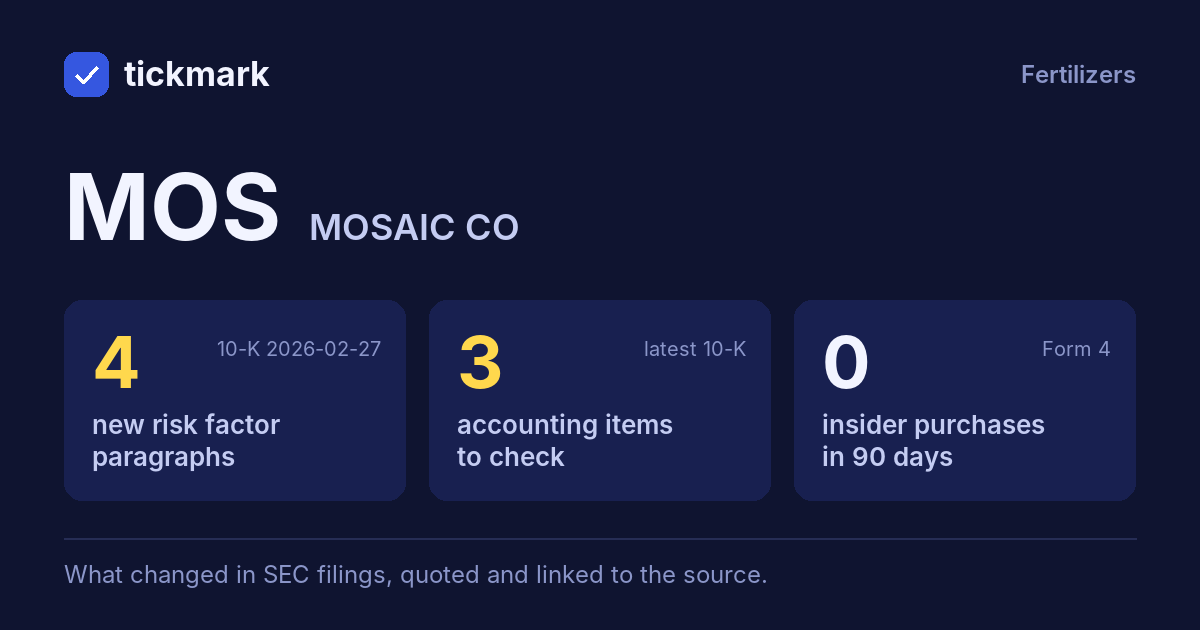
152 changes: 24 added, 22 removed, 105 reworded, 1 quiet changes
10-K 0001285785-26-000017 (2026-02-27) vs 10-K 0001618034-25-000003 (2025-03-03)
The redline
The paragraph that changed most in each section
Marked against last year's 10-K:
cut words struck through, new words highlighted and underlined.
Legal Proceedings 165 words changed in this paragraph; it is 31% similar to last year's version.
Faustina Plant Risk Management Plan. On September 14, 2022, EPA Region 6 issued a Notice of Potential Violation and Opportunity to Confer (“NOPVOC”) regarding compliance of our Faustina Plant with Section 112(r) of the Federal Clean Air Act and 40 C.F.R. Part 68, commonly known as the Risk Management Plan Rule (“RMP Rule”). The NOPVOC relates to a compliance evaluation inspection conducted by the EPA at the Faustina Plant from February 22-25, 2022 and alleges violations of the RMP Rule. We conferred with the EPA regarding the allegations in the NOPVOC on November 30, 2022. We negotiated a Consent Agreement and Final Order (“CAFO”) with the agency that was filed on January 30, 2024. As required by the CAFO, we paid a penalty in the amount of $217,085. The CAFO also requires the completion of two supplemental environmental projects: (1) installation of ammonia monitors and monitoring at the plant for a period of two years, and (2) donation of two generators to the St. James Parish Department of Emergency Preparedness. We completed the donation to the St. James Parish Department of Emergency Preparedness on March 14, 2024, and we completed installation and began operation of the ammonia monitors on April 24, 2024.
Source: Item 3, 10-K 0001285785-26-000017 vs Item 3, 10-K 0001618034-25-000003
MD&A 141 words changed in this paragraph; it is 41% similar to last year's version.
Gross margin for the Mosaic Fertilizantes segment increased to $406.6 $492.0 million for the year ended December 31, 2024, 2025, from $211.6 $406.6 million in the prior year. The This increase in gross margin was primarily due to the focus on obtaining margin over sales volume as discussed in the Overview and lower costs, which had a favorable impact of $1.13 billion, driven by a decrease in product costs for our distribution business, and lower sulfur and ammonia costs in our production business. higher average selling prices of approximately $420 million during the current year period. This benefit was partially offset by approximately $870 $280 million related to the of higher production costs, primarily in our distribution operations, along with a decrease in average selling prices during the current year period, sales volumes, which reduced gross margin by approximately $80 million, higher turnaround and idle costs of approximately $40 $35 million due to lower sales volumes and higher freight expenses of approximately $20 million. Additionally, foreign currency changes positively impacted gross margin by approximately $80 million in the current year period. Although gross margin increased from the prior year, our margin declined in the fourth
Source: Item 7, 10-K 0001285785-26-000017 vs Item 7, 10-K 0001618034-25-000003
Risk Factors 137 words changed in this paragraph; it is 43% similar to last year's version.
Our primary foreign currency exposures are the Canadian dollar and Brazilian real. The functional currency for our Brazilian subsidiaries is the Brazilian real. However, we finance our Brazilian inventory purchases with U.S. dollar-denominated liabilities. The functional currency of several of our Canadian entities is the Canadian dollar. For those entities, sales are primarily denominated in U.S. dollars, but the costs are paid principally in Canadian dollars. Canadian entities have significant U.S. dollar denominated intercompany loans and U.S. entities, with the U.S. dollar as functional currency, have Brazilian real denominated loans. During periods of local or global economic crises, local currencies may be devalued significantly against the U.S. dollar. During times of a strengthening dollar, our net earnings can be reduced due to transaction currency losses arising from these exposures of U.S. dollar denominated liabilities held in the Brazilian and Canadian entities and Brazilian real denominated assets held in U.S. entities. To reduce economic risk and volatility on expected cash flows that are denominated in the Canadian dollar and Brazilian real, we use financial instruments that may include forward contracts, options or collars when unable to naturally offset the exposures.
Source: Item 1A, 10-K 0001285785-26-000017 vs Item 1A, 10-K 0001618034-25-000003
Accounting Policies 135 words changed in this paragraph; it is 34% similar to last year's version.
In the U.S., we sell our products to manufacturers, distributors and retailers primarily in the Midwest and Southeast. Internationally, We generally sell our potash principal products are sold primarily through Canpotex, an export association. A concentration to a large number of customers. At December 31, 2025 and 2024, one customer accounted for approximately 12% and 11%, respectively, of our trade accounts receivable. We continually monitor the creditworthiness of our customers and general economic conditions to manage our credit risk arises from our sales and accounts receivable associated with the international sales of potash product through Canpotex. We consider our concentration risk related to the Canpotex receivable to be mitigated by their credit policy, which requires the underlying receivables to be substantially insured or secured by letters of credit. exposure. As of December 31, 2024 and 2023, such, we do not believe there were $65.1 million and $193.1 million, respectively, of trade accounts receivable due from Canpotex. During 2024, 2023 and 2022, sales to Canpotex were $884.3 million, $1.3 billion and $3.0 billion, respectively. is any significant collection risk.
Source: Item 8, Note 2 – SUMMARY OF SIGNIFICANT ACCOUNTING POLICIES, 10-K 0001285785-26-000017 vs Item 8, Note 2 – SUMMARY OF SIGNIFICANT ACCOUNTING POLICIES, 10-K 0001618034-25-000003
Every change, by type
Sentences and paragraphs added, removed or reworded
Sentences and paragraphs of MOS's Risk Factors and MD&A, 10-K 2026-02-27 against 10-K 2025-03-03. Each links to the text at sec.gov.
RemovedRisk Factors
RemovedRisk Factors
RemovedRisk Factors
RemovedRisk Factors
RemovedRisk Factors
RemovedMD&A
RemovedMD&A
Show the other 10
RemovedMD&A
RemovedMD&A
RemovedMD&A
RemovedMD&A
RemovedMD&A
RemovedMD&A
RemovedMD&A
RemovedMD&A
RemovedMD&A
RemovedMD&A