Form 10-K for the Year Ended December 31, 2016
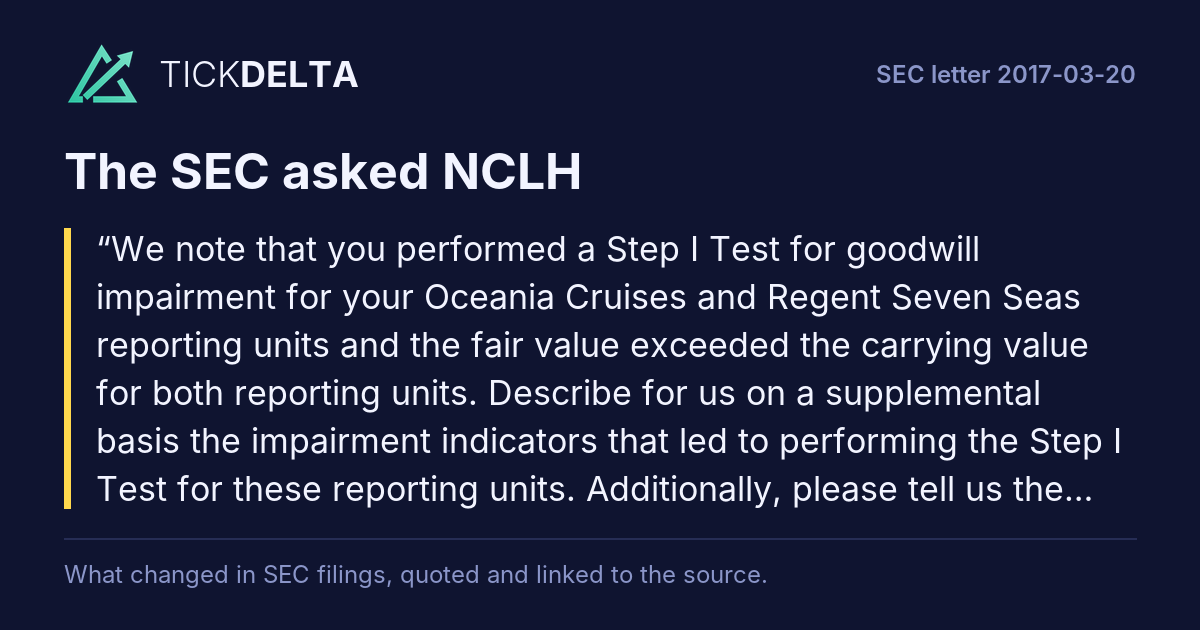
We note that you performed a Step I Test for goodwill impairment for your Oceania Cruises and Regent Seven Seas reporting units and the fair value exceeded the carrying value for both reporting units. Describe for us on a supplemental basis the impairment indicators that led to performing the Step I Test for these reporting units.Rest of the question
Additionally, please tell us the percentage by which fair value exceeded carrying value and revise to disclose this information or state that fair value substantially exceeded the carrying value. Please refer to Item 303(a)(3)(ii) of Regulation S-K and Section V of SEC Release No. 33-8350.
In the third quarter of 2016, we performed a Step I impairment test for Oceania Cruises based on our revised earnings expectation for the remainder of 2016 and into 2017. The main reason for our lowered earnings expectation was the rapid deterioration of the operating environment in Europe due to the negative impact that geopolitical events have had on cruise demand to the region, especially from our core North American consumers.Read in the reply ↗Rest of the answer
Additionally, as part of our annual impairment evaluation we conducted a Step 0 test for the Norwegian reporting unit as it had such a significant excess of fair value over carrying value that a Step 1 test was not warranted for our annual impairment review. We elected to bypass the Step 0 test for Oceania Cruises and Regent Seven Seas and instead voluntarily prepared Step 1 analyses for these two reporting units.
The excess of fair value over carrying value was 24% and 81% for Oceania Cruises and Regent Seven Seas, respectively, as of December 31, 2016. In our Form 10-Q for the quarter ended March
31, 2017 we will revise our disclosure regarding the goodwill impairment test performed as of December 31, 2016 to include the following under Critical Accounting Policies in our Management’s Discussion and Analysis of Financial Condition and Results of Operations:
“Asset Impairment
We review our long-lived assets, principally ships, for impairment whenever events or changes in circumstances indicate that the carrying amount of an asset may not be recoverable. Assets are grouped and evaluated at the lowest level for which there are identifiable cash flows that are largely independent of the cash flows of other groups of assets. We consider historical performance and future estimated results in our evaluation of potential impairment and then compare the carrying amount of the asset to the estimated future cash flows expected to result from the use of the asset.
If the carrying amount of the asset exceeds the estimated expected undiscounted future cash flows, we measure the amount of the impairment by comparing the carrying amount of the asset to its fair value. We estimate fair value based on the best information available making whatever estimates, judgments and projections considered necessary. The estimation of fair value is generally measured by discounting expected future cash flows at discount rates commensurate with the risk involved.
We evaluate goodwill for impairment annually or more frequently when an event occurs or circumstances change that indicates the carrying value of a reporting unit may not be recoverable. For our evaluation of goodwill and tradenames we use the Step 0 Test which allows us to first assess qualitative factors to determine whether it is more likely than not (i.e., more than 50%) that the fair value of a reporting unit is less than its carrying value.
In order to make this evaluation, we consider the following circumstances:
· General macroeconomic conditions such as a deterioration in general economic conditions; limitations on accessing capital; fluctuations in foreign exchange rates; or other developments in equity and credit markets;
· Industry and market conditions such as a deterioration in the environment in which an entity operates; an increased competitive environment; a decline in market-dependent multiples or metrics (in both absolute terms and relative to peers); a change in the market for an entity’s products or services; or a regulatory or political development;
· Changes in cost factors that have a negative effect on earnings and cash flows;
· Overall financial performance (for both actual and expected performance);
· Entity and reporting unit specific events such as changes in management, key personnel, strategy, or customers; litigation; or a change in the composition or carrying amount of net assets; and
· Share price (in both absolute terms and relative to peers).
We believe our estimates and judgments with respect to our long-lived assets, principally ships, and goodwill and other indefinite-lived intangible assets are reasonable. Nonetheless, if there was a material change in assumptions used in the determination of such fair values or if there is a material change in the conditions or circumstances that influence such assets, we could be required to record an impairment charge. If a material change occurred, we may conduct a quantitative assessment comparing the fair value of each reporting unit to its carrying value, including goodwill.
This is called the Step I Test which consists of a combined approach using the expected future cash flows and market multiples to determine the fair value of the reporting units.
In the third quarter of 2016, based on the performance of the
Oceania Cruises reporting unit, we performed an interim goodwill impairment evaluation consisting of a Step I Test. Based on that evaluation, we determined that there was no impairment of goodwill because its fair value exceeded its carrying value. For our annual impairment evaluation, we performed a Step 0 Test for the Norwegian reporting unit and Step I Tests for the Regent Seven
Seas and the Oceania Cruises reporting units. As a result of the Step 0 Test for the Norwegian reporting unit, we determined there were no factors indicating it was more likely than not (i.e., more than 50%) that the fair value of the reporting unit was less than its carrying value. Based on the results of the Step 1 Tests, we determined there was no impairment of goodwill because the fair value of the Oceania Cruises and Regent Seven Seas reporting units exceeded their carrying values by 24% and 81%, respectively.
However, if the fair value of any reporting unit declines in future periods, its goodwill may become impaired at that time. As of December 31, 2016, there was $523.0 million, $462.1 million and $403.8 million of goodwill for the Oceania Cruises, Regent Seven
Seas and Norwegian reporting units, respectively. As of December 31, 2016, our annual review consisting of the Step 0 and
Step I Tests supported the carrying values of these assets. Subsequent to December 31, 2016, the Company has continued to monitor the results of each of these reporting units and will perform the necessary tests should events occur or circumstances change that indicate the carrying value of a reporting unit may not be recoverable.”
First report after the company's reply of 2017-03-31: 10-Q filed 2017-05-10 ↗, against the 10-Q filed 2016-11-09 ↗.
Tickdelta does not hold the text of both reports, so they are not compared here.
We note your disclosure of Free Cash Flow and that management uses Free Cash Flow as a measure to assess both business performance and overall liquidity. We further note your disclosure of Adjusted Free Cash Flow, which adjusts for the proceeds from ship construction financing facilities and other supplemental adjustments.Rest of the question
Please tell us and disclose how Adjusted Free Cash Flow is useful to investors and management pursuant to Item 10(e)(1)(i)(C)-(D) of Regulation S-K. Additionally, to the extent you view one or both of these measures as a liquidity performance measure, please revise to also present cash flows from investing and financing activities. Please refer to Question 102.06 of the Non-GAAP Compliance and Disclosure Interpretations issued on May 17, 2016.
In future filings we will no longer refer to the Non-GAAP measures of Free Cash Flow and Adjusted Free Cash Flow. If, in the future, we determine it would be useful to investors to disclose Free
Cash Flow and/or Adjusted Free Cash Flow as liquidity performance measures, we will revise our presentation in accordance with the requirements of the Staff’s Guidance in Question 102.06 of the Non-GAAP Compliance and Disclosure Interpretations issued on May 17, 2016 and Item 10(e)(1)(i)(C)-(D) of Regulation S-K. Read in the reply ↗
First report after the company's reply of 2017-03-31: 10-Q filed 2017-05-10 ↗, against the 10-Q filed 2016-11-09 ↗.
Tickdelta does not hold the text of both reports, so they are not compared here.
Also in this review: closing letter, 2017-04-12