
Added10-Q Nov 9, 2026 vs 10-K Feb 26, 2026
We may not be able to successfully redeploy the net proceeds from the sale of the NHC properties in a manner that generates comparable returns.
Each branch is a paragraph in Risk Factors with nothing like it in the 10-K filed Feb 25, 2025. A box jumps to the paragraph as filed, below.
15 paragraphs in Risk Factors of the 10-K filed Feb 26, 2026 with nothing like them in the 10-K filed Feb 25, 2025. Quoted exactly. Paragraphs that were only edited are under 10-K change.
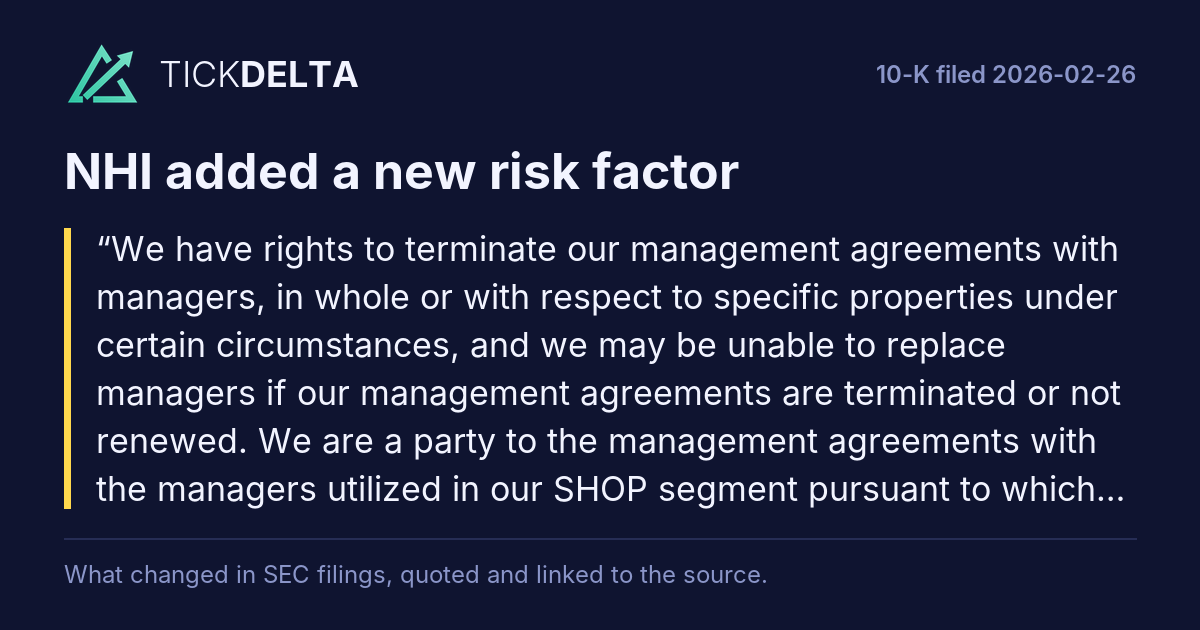
We have rights to terminate our management agreements with managers, in whole or with respect to specific properties under certain circumstances, and we may be unable to replace managers if our management agreements are terminated or not renewed.
We are a party to the management agreements with the managers utilized in our SHOP segment pursuant to which the managers operate the properties providing comprehensive property management, accounting and other services at the respective properties. Although we have the right to terminate any of our management agreements, whether upon the occurrence of certain events or for no cause, there is no assurance that we would be able to timely source a replacement or that any replacement manager would be effective. Any transition to a new manager may require regulatory approval and potentially the approval of the holders of any liens on the property. The failure to replace a manager on a timely or successful basis, as well as the failure to receive required approvals, could have an adverse effect on the properties and our revenue.
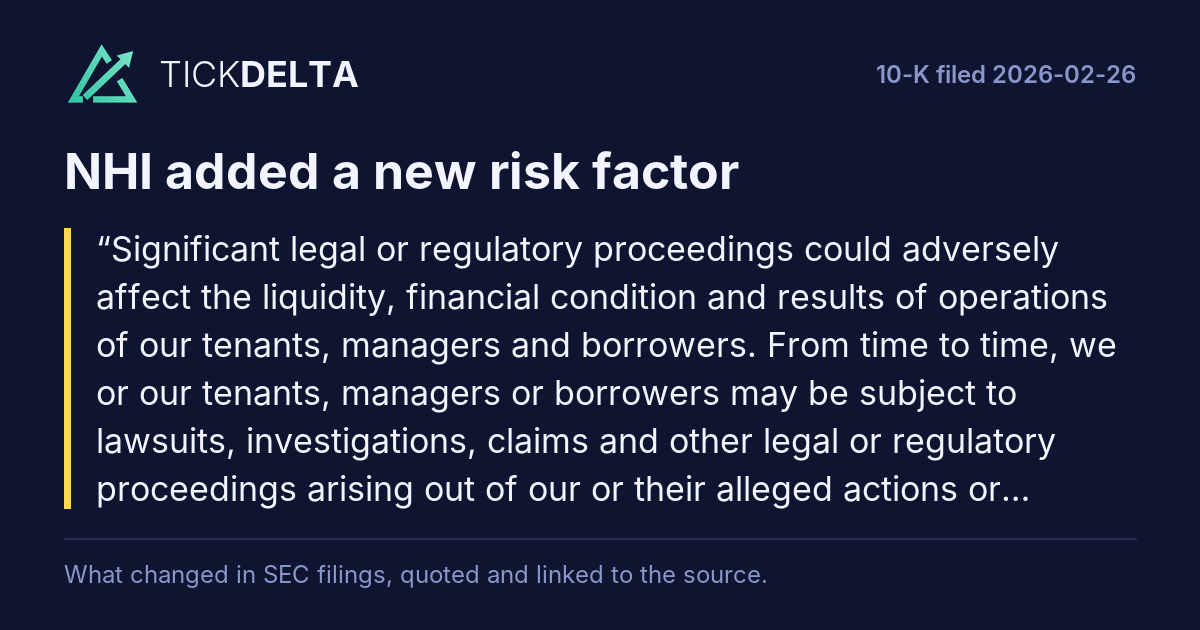
Significant legal or regulatory proceedings could adversely affect the liquidity, financial condition and results of operations of our tenants, managers and borrowers.
From time to time, we or our tenants, managers or borrowers may be subject to lawsuits, investigations, claims and other legal or regulatory proceedings arising out of our or their alleged actions or inactions. These claims may include, among other things, professional liability and general liability claims, commercial liability claims, unfair business practices claims, class action claims, employment-related claims, as well as regulatory proceedings, including proceedings related to our SHOP segment, where we are typically the holder of the applicable healthcare license.
In our SHOP segment, we are generally responsible for all liabilities of the properties, other than those arising out of certain limited actions by our managers, such as those caused by gross negligence, fraud or willful misconduct. As a result, we are exposed to professional and general liability claims, employment-related claims, and the costs of defending and resolving such matters, some of which may not be insured or may only be partially insured due to limited coverage or cost constraints. If a manager within our SHOP segment fails to comply with applicable laws or regulations, we could be held responsible, which could subject us to civil, criminal and administrative penalties.
In our Real Estate Investments segment, our tenants and borrowers generally operate the facilities and are responsible for all related liabilities, including those arising from professional, general, or employment-related claims. Under the terms of our leases and loan agreements, these tenants and borrowers are obligated to indemnify and defend us against liabilities related to their operations.
We cannot assure you that any contractual obligations to indemnify, defend and hold us harmless from the liabilities described above will be satisfied by third parties, or that any amounts held in escrow for such purpose will be sufficient.
An unfavorable resolution of any such lawsuit, investigation, claim or other legal or regulatory proceeding could materially and adversely affect our or our tenants’, managers’ or borrowers’ liquidity, financial condition and results of operations, and may not be protected by sufficient or any insurance coverage.
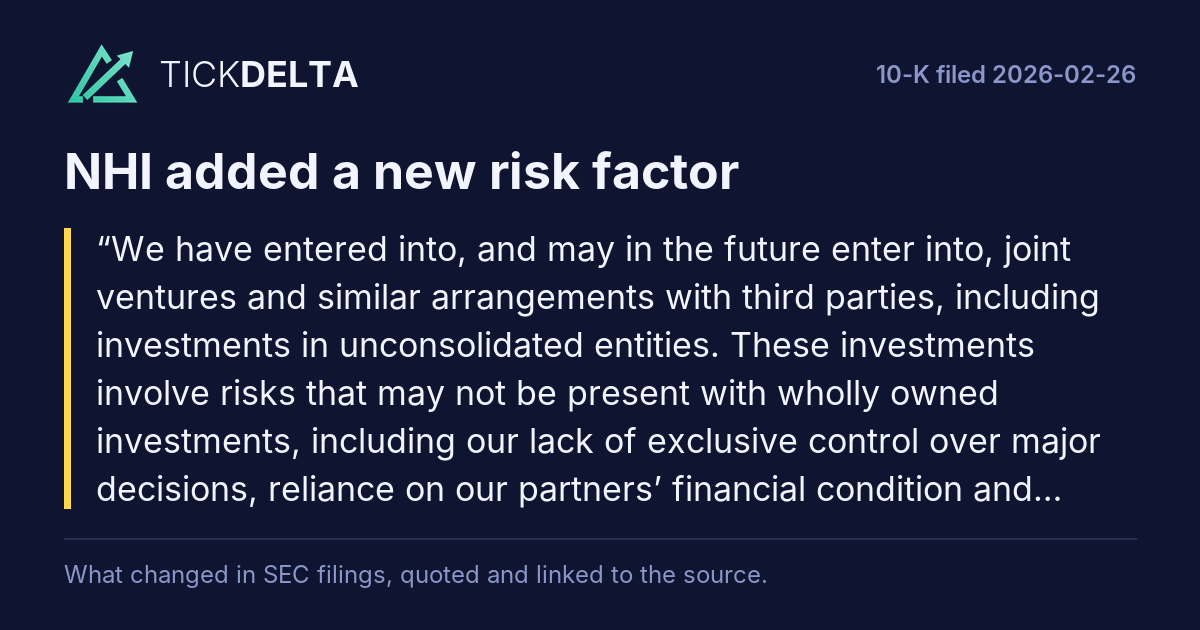
We have entered into, and may in the future enter into, joint ventures and similar arrangements with third parties, including investments in unconsolidated entities. These investments involve risks that may not be present with wholly owned investments, including our lack of exclusive control over major decisions, reliance on our partners’ financial condition and performance, and the potential for disputes with our partners.
In some of our joint ventures, including our investment in Timber Ridge OpCo, certain major decisions regarding management, financing, capital expenditures or disposition of assets may require partner approval. Our partners may have interests, objectives or financial constraints that differ from ours, which could delay or prevent actions we believe are in our best interests. In addition, our partners may become insolvent, fail to fund required capital contributions or otherwise fail to meet their obligations, which could limit the joint venture’s ability to operate effectively and may require us to contribute additional capital or expose us to liabilities under guarantees or other commitments.
Disputes with joint venture partners could result in litigation or arbitration, increased expenses, management distraction and disruptions to operations. Certain joint venture arrangements may also include buy-sell provisions, put or call rights or forced sale mechanisms that could require us to sell our interest, acquire our partner’s interest or sell the underlying asset at a time or on terms that are unfavorable to us, and our ability to fund or transfer such interests may be limited.
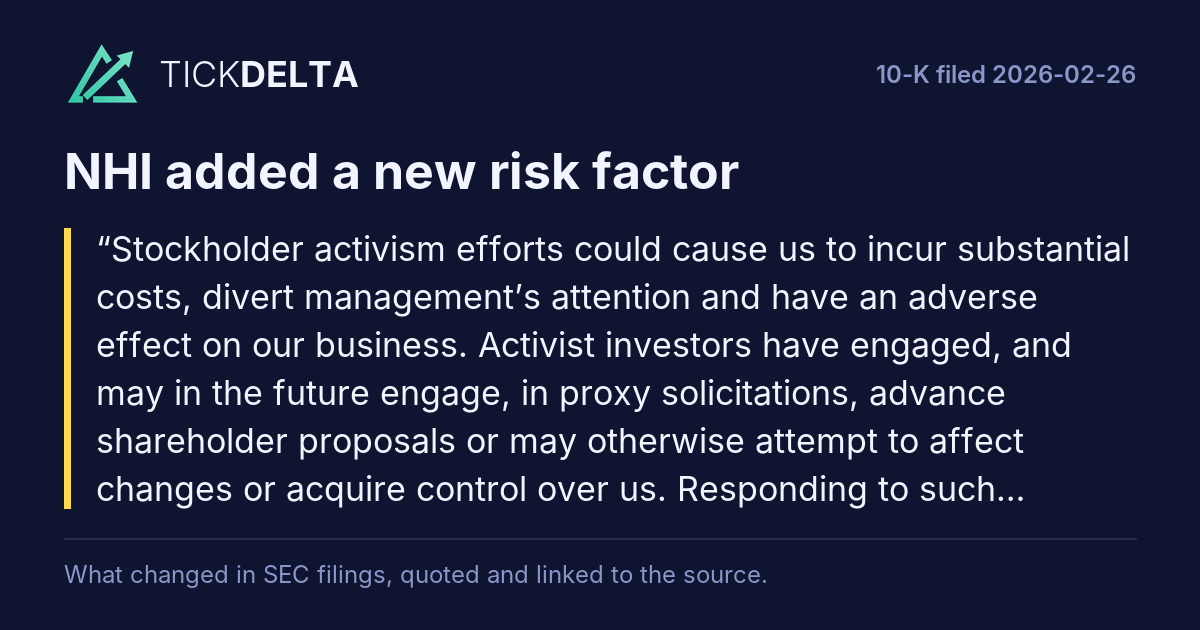
Stockholder activism efforts could cause us to incur substantial costs, divert management’s attention and have an adverse effect on our business.
Activist investors have engaged, and may in the future engage, in proxy solicitations, advance shareholder proposals or may otherwise attempt to affect changes or acquire control over us. Responding to such investor activism can be costly and time consuming, and can divert the attention of our Board of Directors and management from the management of our business and the pursuit of our business strategies. In addition to incurring costs, perceived uncertainties as to our future direction may result in the loss of potential business opportunities, damage to our reputation and may make it more difficult to attract and retain qualified directors, personnel and business partners. These actions could also cause our stock price to experience periods of volatility.
We may use AI tools in our operations, including machine learning technology and generative and agentic AI technologies. The current and potential future applications of these AI tools are rapidly evolving, as are the legal and regulatory frameworks that govern them. AI could significantly disrupt the markets in which we operate and subject us to increased competition, legal and regulatory risks and compliance costs, which could have a material adverse effect on our business, financial condition and results of operations.
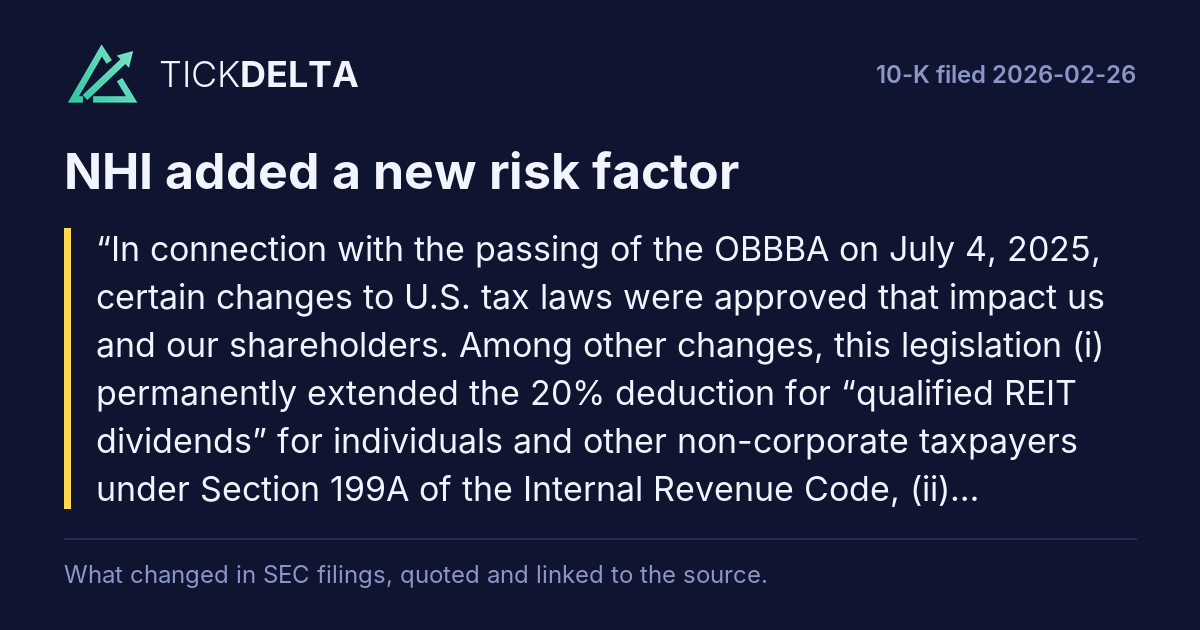
In connection with the passing of the OBBBA on July 4, 2025, certain changes to U.S. tax laws were approved that impact us and our shareholders. Among other changes, this legislation (i) permanently extended the 20% deduction for “qualified REIT dividends” for individuals and other non-corporate taxpayers under Section 199A of the Internal Revenue Code, (ii) increased the percentage limit under the REIT asset test applicable to TRSs from 20% to 25% for taxable years beginning after December 31, 2025 and (iii) increased the basis on which the 30% interest deduction limit under Section 163(j) of the Internal Revenue Code applies by excluding depreciation, amortization and depletion from the definition of “Adjusted Taxable Income” for taxable years beginning after December 31, 2024.
New in the latest 10-Q
19 paragraphs in the 10-Q filed Nov 9, 2026 with nothing like them in the 10-Q filed Aug 10, 2026 (at least half the words must differ; new numbers alone do not count). Quoted exactly, grouped by the item heading above them. This is text that changed, not a judgement of how serious it is.
Nine Months Ended September 30, 2026 2025 ───────────────────────────────────────────────────────────────────────────────────────────────────────────────────────────────────────────────────── Cash flows from operating activities: Net income $ 658,323 $ 102,984 Adjustments to reconcile net income to net cash provided by operating activities: Depreciation and amortization 75,002 59,291 Amortization of debt issuance costs and discounts 2,515 2,575 Share-based compensation expense 6,063 4,612 Deferred income tax expense 956 — Straight-line rent revenue adjustments (1,780) 8,499 Non-cash rental income related to operations transfers upon early lease terminations — (1,375) Non-cash interest income on mortgage and other notes receivable (985) (1,203) Other non-cash items, net 2,265 1,403 Loan and realty losses (gains), net 9,608 (3,386) Gains on dispositions of real estate properties (567,283) (337) Gain from equity method investment (688) (2,012) Changes in operating assets and liabilities: Other assets, net (15,745) (125) Accounts payable and other liabilities (1,754) (2,587) Deferred income (109) 488 Net cash provided by operating activities 166,388 168,827 Cash flows from investing activities: Acquisitions of real estate properties (229,886) (130,984) Deposits on real estate acquisitions (107,554) — Investments in existing real estate properties and equipment (18,030) (9,850) Net proceeds from dispositions of real estate properties 666,556 — Investments in mortgage and other notes receivable (14,671) (31,299) Repayments of mortgage and other notes receivable 15,999 88,003 Distributions received from equity method investment 688 2,012 Net cash provided by (used in) investing activities 313,102 (82,118) Cash flows from financing activities: Proceeds from revolving credit facility 509,000 505,000 Repayments of revolving credit facility (510,000) (736,200) Repayments of term loans (125,000) (150,815) Proceeds from issuance of senior notes — 346,161 Payments of debt issuance costs — (3,809) Proceeds from issuance of common shares, net 44,934 134,923 Payments of equity issuance costs (414) (153) Capital contributions from noncontrolling interests 700 306 Distributions paid to noncontrolling interests (369) (716) Dividends paid to stockholders (134,208) (125,868) Taxes paid related to net settlement of stock incentive awards (5,415) (415) Cash settlement of restricted stock awards (45) — Net cash used in financing activities (220,817) (31,586) Increase in cash, cash equivalents and restricted cash 258,673 55,123 Cash, cash equivalents and restricted cash at the beginning of the period 19,624 26,502 Cash, cash equivalents and restricted cash at the end of the period $ 278,297 $ 81,625
Read in the 10-Q
1 As of September 30, 2026, restricted cash consisted of net proceeds from the sale of the NHC portfolio that were available for future acquisitions under Section 1031 of the Internal Revenue Code (“Section 1031”). The Section 1031 eligibility period expires on December 28, 2026. Reference Note 15 for additional information.
Read in the 10-Q
In October 2026, we acquired a portfolio of six SHOs located in Kentucky, Michigan and Tennessee that have been included in our SHOP segment. The total purchase price was $ 107.7 million, including $ 1.2 million of closing costs. As of September 30, 2026, $ 107.6 million of the purchase price consideration was held by the title company and recognized in deposits on real estate acquisitions on our condensed consolidated balance sheet. The portfolio, which consists of five ALFs and one ILF with a combined total of 443 units is being managed by Allegro Living Management.
Read in the 10-Q
In October 2026, we purchased an ALF located in Michigan from Bickford for $ 16.8 million that has been included in our Real Estate Investments segment. In connection with the purchase, Bickford repaid its $ 14.7 million construction loan which was secured by this property. The property is being leased back to Bickford pursuant to an existing master lease agreement that has an annual lease rate of 8.70 % and expires in May 2033. Reference Note 4 for additional information on our loans with Bickford and reference Note 5 for additional information on our leases with Bickford.
Read in the 10-Q
In October 2026, we purchased an inpatient rehabilitation HOSP from The Sanders Trust, LLC for $ 34.6 million. The property is located in Florida and has been included in our Real Estate Investments segment. In connection with the purchase, The Sanders Trust, LLC repaid its $ 27.6 million construction loan which was secured by this property. We assumed the existing lease on the property with ClearSky Lake City which has an annual lease rate of 8.25 % and expires in October 2046.
Read in the 10-Q
In October 2026, Bickford repaid its $ 14.7 million construction loan in connection with our purchase of the underlying property securing the loan. As of September 30, 2026, the annual interest rate on the construction loan was 9.0 %. In addition, Bickford also repaid its $ 1.2 million non-performing note in October 2026. We recognized a $ 1.2 million reduction in our credit loss reserves in connection with this repayment.
Read in the 10-Q
In October 2026, The Sanders Trust repaid its $ 27.6 million construction loan in connection with our purchase of the underlying property securing the loan. As of September 30, 2026, the annual interest rate on the construction loan was 9.0 %.
Read in the 10-Q
When we measure the credit quality of our construction loans, we take into consideration additional factors, such as the construction and stabilization timelines of the properties, current economic and market conditions and any changes that occur in the financial conditions of our borrowers. The coverage ratios discussed above are not meaningful indicators of the credit quality of our construction loans as the operators of the properties typically are not generating operating income yet or otherwise typically have insufficient operating income from the properties because the necessary occupancy levels have not been achieved yet.
Read in the 10-Q
We analyze our credit loss reserves on a quarterly basis. The coverage ratios presented in the table below have been calculated using information as of June 30, 2026, the most recent date for which data was available. We evaluate any loan modifications, extensions and renewals occurring during the period using the accounting guidance in ASC 310-20, Receivables - Nonrefundable Fees and Other Costs, to determine whether the changes constitute a current period loan origination.
Read in the 10-Q
2 During each of the three and nine months ended September 30, 2025, we recognized $ 12.1 million of write-offs of straight-line rents receivable related to the early lease terminations discussed above. Reference the “Transitioned Properties” section below for more information.
Read in the 10-Q
We recognize revenues in our SHOP segment based on the amounts earned from the individual agreements between us and each resident. As a result, we do not have any concentrations of revenues in our SHOP segment.
Read in the 10-Q
In August 2025, we terminated two leases and transitioned all seven of the leased properties from our Real Estate Investments segment to the SHOP segment. We received $ 3.9 million in cash consideration and $ 1.4 million in non-cash consideration from the tenants and wrote off $ 12.1 million of straight-line rents receivable related to the lease terminations. Each of these amounts was recognized in rental income in our condensed consolidated statements of income. During the three and nine months ended September 30, 2025, we recognized reductions in rental income of $ 6.1 million and $ 2.0 million, respectively, related to these properties.
Read in the 10-Q
As of September 30, 2026, we had $ 336.3 million of remaining proceeds available from the NHC portfolio sale that could be applied to qualifying future acquisitions of real estate properties under Section 1031 to reduce the amount of net capital gain we will recognize on the NHC portfolio sale. The Section 1031 eligibility period expires on December 28, 2026. As of September 30, 2026, we had $ 104.6 million of these proceeds on deposit with a title company and subsequently used these funds on qualifying acquisitions in October 2026.
Read in the 10-Q
In October 2026, we acquired a portfolio of six SHOs located in Kentucky, Michigan and Tennessee that have been included in our SHOP segment. The total purchase price was $107.7 million, including $1.2 million of closing costs. As of September 30, 2026, $107.6 million of the purchase price consideration was held by the title company and recognized in deposits on real estate acquisitions on our condensed consolidated balance sheet included in this Quarterly Report. The portfolio, which consists of five ALFs and one ILF with a combined total of 443 units, is being managed by Allegro Living Management.
Read in the 10-Q
In October 2026, we purchased an ALF located in Michigan from Bickford for $16.8 million that has been included in our Real Estate Investments segment. In connection with the purchase, Bickford repaid its $14.7 million construction loan which was secured by this property. The property is being leased back to Bickford pursuant to an existing master lease agreement that has an annual lease rate of 8.70% and expires in May 2033. Reference the section below on “Bickford Leases and Loans” for additional information.
Read in the 10-Q
In October 2026, we purchased an inpatient rehabilitation HOSP from The Sanders Trust, LLC for $34.6 million. The property is located in Florida and has been included in our Real Estate Investments segment. In connection with the purchase, The Sanders Trust, LLC repaid its $27.6 million construction loan which was secured by this property. We assumed the existing lease on the property with ClearSky Lake City which has an annual lease rate of 8.25% and expires in October 2046.
Read in the 10-Q
• Other non-operating income for the three months ended September 30, 2026 consisted primarily of the interest earned on the net proceeds from the sale of the NHC portfolio.
Read in the 10-Q
• Other non-operating income for the nine months ended September 30, 2026 consisted primarily of the interest earned on the net proceeds from the sale of the NHC portfolio.
Read in the 10-Q
In our SHOP segment, substantially all of our resident agreements have terms of 30 days to one year. During periods of inflation, we believe that we can increase our prices for room and care charges, community fees and charges for optional services within a reasonable time period to satisfactorily offset any increases in operating costs that we may experience at these communities. However, competitive pressures may limit our ability to increase prices, fees and charges faster than the rate of inflation or even at the same rate to inflation.
Read in the 10-Q
Item 1A of the 10-Q filed Nov 9, 2026 against Item 1A of the 10-K filed Feb 26, 2026.
A 10-Q repeats only the risks that changed, so a 10-K paragraph that is missing from it is not counted as removed.
Added is a paragraph with nothing like it in the 10-K, Reworded a sentence that is in both with several words changed,
Quiet changes a sentence in both where one to four words changed and one is a hedge or a modal
(cut words struck through, new words highlighted).
Text on the page, not a score; each links to the filing at sec.gov.
What the 10-Q itself says about its risk factors:There have been no material changes from the risk factors previously disclosed in “Part I, Item 1A, Risk Factors” of our Annual Report, except as noted below:
Read in the 10-Q
Two-word phrases in Risk Factors of the 10-K filed Feb 26, 2026 that are in none of the 1 earlier 10-Ks stored, back to Feb 25, 2025
Used at least twice, small words left out. Counted, not picked: a phrase can be new because the company renamed something.
25 paragraphs of last year's Risk Factors with nothing like them now. The longest are quoted.
Item 1A of each 10-K and 10-Q on EDGAR, quoted exactly. Each paragraph links to the filing at sec.gov.
10-K change: what was reworded or cut, section by section.
Excel workbook · CSV. Google Sheet that stays up to date: paste =IMPORTDATA("https://tickdelta.com/company/NHI/export.csv") into a cell.