NNN Reit, Inc. NNN
New risk paragraphs, branching off last year
Each branch is a paragraph in Risk Factors with nothing like it in the 10-K filed Feb 11, 2025. A box jumps to the paragraph as filed, below.
Paragraphs with nothing like them in last year's 10-K
12 paragraphs in Risk Factors of the 10-K filed Feb 11, 2026 with nothing like them in the 10-K filed Feb 11, 2025. Quoted exactly. Paragraphs that were only edited are under 10-K change.
NNN's business is dependent upon its tenants successfully operating their businesses and their failure to do so could materially and adversely affect NNN's cash flow and results of operations.
NNN's strategy focuses on investing in single-tenant, commercial real estate subject to long-term net leases across the U.S. The financial failure of, or default in payment by, a single-tenant under its lease is likely to cause a significant or complete reduction in NNN's rental revenue from that Property and a reduction in the value of the Property. NNN may also experience difficulty or a significant delay in re-leasing or selling the Property. This risk will be magnified if NNN decides to lease multiple Properties to a single-tenant under a master lease. A tenant failure or default under a master lease could reduce or eliminate rental revenue from multiple Properties and reduce the value of the Properties. In addition, NNN would be responsible for all of the operating costs of a Property following a vacancy of a single-tenant building. Because Properties have been built to suit a particular tenant's specific needs, NNN may also incur significant costs to make the Property ready for another tenant.
NNN's real estate investments are generally illiquid, which could significantly impede its ability to respond to market conditions or adverse changes in the performance of its tenants or its Properties and which would harm NNN’s financial condition.
NNN's investments are relatively difficult to sell quickly. As a result of this illiquidity, NNN's ability to promptly sell one or more Properties in response to changing economic, financial or investment conditions is limited. Return of capital and realization of gains, if any, from an investment typically will occur upon disposition or refinancing of the underlying Property. NNN may be unable to realize its investment objective by sale, other disposition or refinancing at attractive prices within any given period of time or may otherwise be unable to complete any exit strategy. In particular, these risks could arise from weakness in or even the lack of an established market for a Property, changes adversely affecting the tenant of a Property, changes adversely affecting the area in which a particular Property is located, adverse changes in the financial condition or prospects of prospective purchasers and changes in local, national or international economic conditions. Therefore, NNN may not be able to vary its Property Portfolio in response to economic or other conditions promptly or on favorable terms.
A significant portion of Properties are leased to unrated tenants whose credit is evaluated through NNN's internal underwriting and credit analysis. However, the tools and methods utilized by NNN may not accurately assess the investment related credit risk.
A significant portion of Properties are leased to unrated tenants whose credit is evaluated through NNN's internal underwriting and credit analysis. Most of NNN's tenants are required to provide financial information to NNN periodically or, in some instances, upon request that it uses in evaluating their creditworthiness. NNN's methods may not adequately assess the risk of an investment. Any internal scoring or rating is not the same as, and may not be as indicative of creditworthiness as, a rating published by a nationally recognized statistical rating organization. NNN's internal scorings, ratings and rent coverage ratios are unaudited and are based on financial information provided by NNN's tenants and prospective tenants without independent verification on NNN's part, and NNN assumes the appropriateness of estimates and judgments that were made by the party preparing the financial information. If NNN's assessment of credit quality proves to be inaccurate, it may be subject to defaults, and NNN's cash flows may be less stable. The ability of an unrated tenant to meet its obligations to NNN may be more speculative than that of a rated tenant.
Some of NNN's tenants operate under franchise or license agreements, which, if terminated or not renewed prior to the expiration of their leases with NNN, would likely impair their ability to pay NNN rent.
Franchise agreements often have terms that end earlier than the respective expiration dates of the related leases with NNN. In addition, a tenant's rights as a franchisee or licensee typically may be terminated, and the tenant may be precluded from competing with the franchiser or licensor upon termination. NNN typically has no notice or cure rights with respect to such a termination and has no rights to assignment of any such franchise agreement. This may have an adverse effect on NNN's ability to mitigate losses arising from a default on any of its leases. A franchisor's or licensor's termination or refusal to renew a franchise or license agreement would likely have a material adverse effect on the ability of the tenant to make payments under its lease, which could materially and adversely affect NNN.
NNN may experience a decline in the fair value of its long-lived real estate assets, which may have a material impact on its financial condition, liquidity and results of operations.
NNN periodically assesses its long-lived real estate assets for possible impairment whenever certain events or changes in circumstances indicate that the carrying value of the asset may not be recoverable. In such event, NNN would recognize unrealized losses through earnings and write down the carrying value of such assets to a new cost basis based on the estimated fair value of such assets on the date they are considered to be impaired. Such impairment losses reflect non-cash losses at the time of recognition; subsequent disposition or sale of such assets could further affect NNN's future losses or gains, as they are based on the difference between the sale price received and adjusted carrying value of such assets at the time of sale, which may adversely affect NNN's financial condition, liquidity and results of operations.
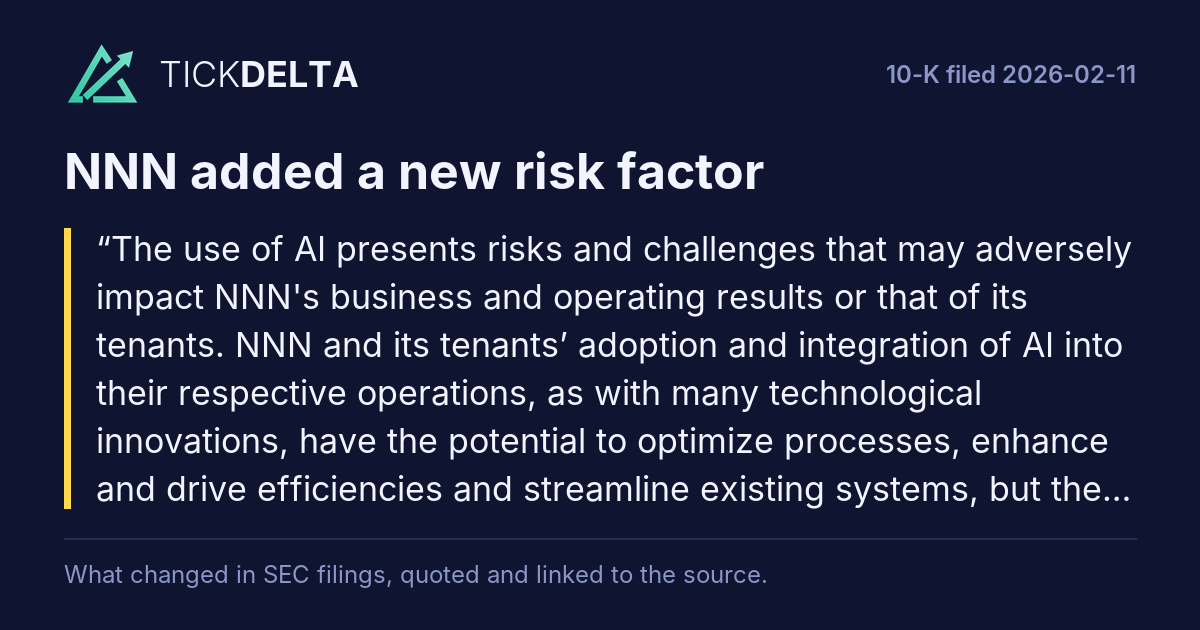
The use of AI presents risks and challenges that may adversely impact NNN's business and operating results or that of its tenants.
NNN and its tenants’ adoption and integration of AI into their respective operations, as with many technological innovations, have the potential to optimize processes, enhance and drive efficiencies and streamline existing systems, but the deployment and maintenance of AI tools also entail substantial inherent risks. These include, but are not limited to, the potential for inaccuracy, bias, intellectual property infringement or misappropriation, as well as concerns regarding data privacy, cybersecurity and confidentiality.
Paragraphs in the 10-Q filed Nov 4, 2026 that were not in the one before
New in the latest 10-Q
2 paragraphs in the 10-Q filed Nov 4, 2026 with nothing like them in the 10-Q filed Aug 5, 2026 (at least half the words must differ; new numbers alone do not count). Quoted exactly, grouped by the item heading above them. This is text that changed, not a judgement of how serious it is.
Financial statements and notes
On October 15, 2026, NNN entered into a forward starting swap with a notional value of $100,000,000 effective November 16, 2026.
Read in the 10-Q
Additionally, as of October 30, 2026, NNN had no tenants in bankruptcy under Chapter 11 of the U.S. Bankruptcy Code.
Read in the 10-Q
The 10-Q's risk factors against the 10-K
Item 1A of the 10-Q filed Nov 4, 2026 against Item 1A of the 10-K filed Feb 11, 2026.
A 10-Q repeats only the risks that changed, so a 10-K paragraph that is missing from it is not counted as removed.
Added is a paragraph with nothing like it in the 10-K, Reworded a sentence that is in both with several words changed,
Quiet changes a sentence in both where one to four words changed and one is a hedge or a modal
(cut words struck through, new words highlighted).
Text on the page, not a score; each links to the filing at sec.gov.
What the 10-Q itself says about its risk factors:There were no material changes in NNN's risk factors disclosed in Item 1A. Risk Factors in NNN's Annual Report on Form 10-K for the year ended December 31, 2025.
Read in the 10-Q
1 paragraph in the 10-Q's Item 1A, and none of them adds, rewords or quietly edits a paragraph of the 10-K's.
Phrases used for the first time
Two-word phrases in Risk Factors of the 10-K filed Feb 11, 2026 that are in none of the 1 earlier 10-Ks stored, back to Feb 11, 2025
Where each one is used
- climate change: Climate change, natural disasters and impacts of weather may adversely affect the operations of NNN's tenants and their ability to pay rent, NNN's operating results and asset values of NNN's Property Portfolio.
- nnn's internal: A significant portion of Properties are leased to unrated tenants whose credit is evaluated through NNN's internal underwriting and credit analysis. However, the tools and methods utilized by NNN may not accurately assess the investment related credit risk.
- carrying value: NNN periodically assesses its long-lived real estate assets for possible impairment whenever certain events or changes in circumstances indicate that the carrying value of the asset may not be recoverable. In such event, NNN would recognize unrealized losses through earnings and write down the carrying value of...
- property nnn: NNN's strategy focuses on investing in single-tenant, commercial real estate subject to long-term net leases across the U.S. The financial failure of, or default in payment by, a single-tenant under its lease is likely to cause a significant or complete reduction in NNN's rental revenue from that Property and a...
- multiple properties: NNN's strategy focuses on investing in single-tenant, commercial real estate subject to long-term net leases across the U.S. The financial failure of, or default in payment by, a single-tenant under its lease is likely to cause a significant or complete reduction in NNN's rental revenue from that Property and a...
- property changes: NNN's investments are relatively difficult to sell quickly. As a result of this illiquidity, NNN's ability to promptly sell one or more Properties in response to changing economic, financial or investment conditions is limited. Return of capital and realization of gains, if any, from an investment typically will...
- change natural: Climate change, natural disasters and impacts of weather may adversely affect the operations of NNN's tenants and their ability to pay rent, NNN's operating results and asset values of NNN's Property Portfolio.
- unrated tenants: A significant portion of Properties are leased to unrated tenants whose credit is evaluated through NNN's internal underwriting and credit analysis. However, the tools and methods utilized by NNN may not accurately assess the investment related credit risk.
Used at least twice, small words left out. Counted, not picked: a phrase can be new because the company renamed something.
What was taken out
43 paragraphs of last year's Risk Factors with nothing like them now. The longest are quoted.
Sources
Item 1A of each 10-K and 10-Q on EDGAR, quoted exactly. Each paragraph links to the filing at sec.gov.
Also
10-K change: what was reworded or cut, section by section.
Work with it
Excel workbook · CSV. Google Sheet that stays up to date: paste =IMPORTDATA("https://tickdelta.com/company/NNN/export.csv") into a cell.