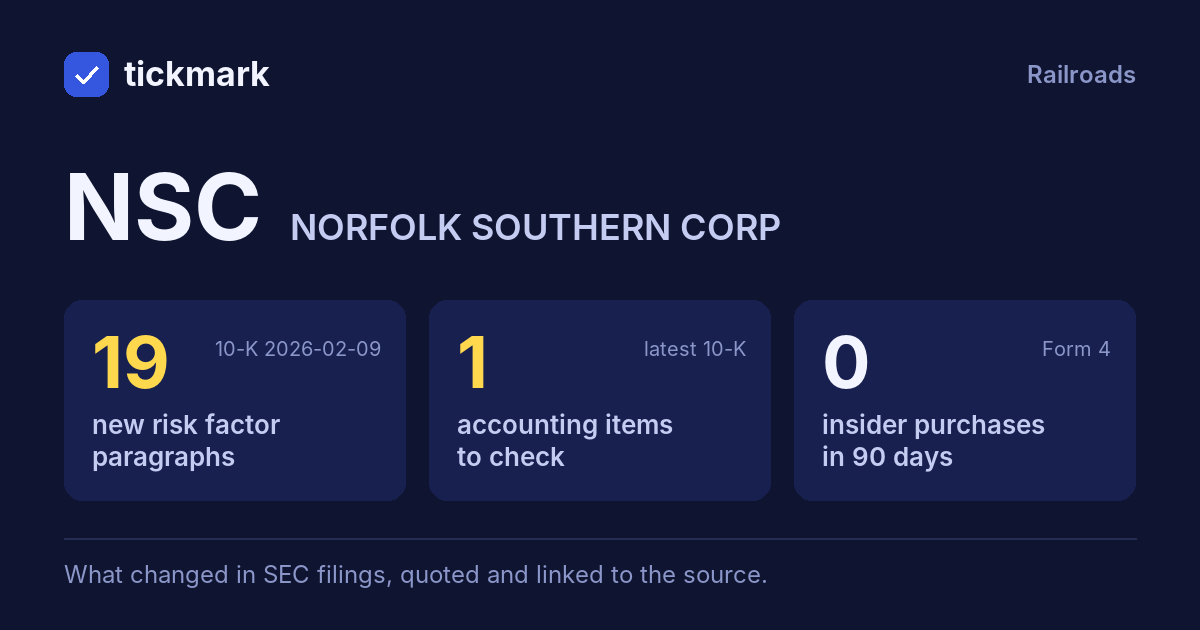
Sentences and paragraphs of NSC's Risk Factors and MD&A, 10-K 2026-02-09 against 10-K 2025-02-10.
Each links to the text at sec.gov.
Show the other 16
AddedRisk Factors
In addition, if the Mergers are not completed, the Company could be subject to litigation related to any failure to complete the Mergers or related to any enforcement proceeding commenced against the Company to perform its obligations under the Merger Agreement, and whether or not any such litigation has any merit, the cost of defending such litigation may be significant. The materialization of any of these risks could adversely impact the Company’s ongoing business.
Read it in 10-K 2026-02-09 at sec.gov ↗
AddedRisk Factors
Similarly, delays in the completion of the Mergers could, among other things, result in additional transaction costs, loss of revenue, or other negative effects associated with uncertainty about completion of the Mergers.
Read it in 10-K 2026-02-09 at sec.gov ↗
AddedRisk Factors
The Mergers are subject to the receipt of the requisite regulatory approvals, which requisite regulatory approvals may never be obtained, therefore preventing completion of the Mergers. In addition, in granting such approvals, regulatory authorities may impose conditions that could have a significant adverse effect on the Company or the combined company and the expected benefits of the Mergers therefore preventing completion of the Mergers. Before the Mergers may be completed, the requisite regulatory approvals must have been obtained, including STB approval. While the initial Merger application with the STB was determined to be incomplete, the Company and Union Pacific are in process of preparing a revised application that incorporates the additional items identified by the STB. The terms and conditions of the approvals that are granted may impose requirements, concessions, limitations, or costs or place restrictions on the conduct of the combined company’s business. Subject to the terms and conditions of the Merger Agreement, Union Pacific and the Company have each agreed to use their reasonable best efforts to take, or cause to be taken, all actions, and to do, or cause to be done, and to assist and cooperate with each other in doing, all things necessary, proper, or advisable to cause the conditions to closing set forth in the Merger Agreement to be satisfied and to consummate and make effective the Mergers and the other transactions contemplated by the Merger Agreement prior to the end date, except that Union Pacific and its subsidiaries are not required to take, or commit to take, or agree to or accept any “materially burdensome regulatory condition.” For purposes of the foregoing, “reasonable best efforts” includes, among others, (i) proposing, negotiating, committing to, and effecting, by consent decree, hold separate order, or otherwise, the sale, divestiture, license, hold separate, or disposition of any and all of the share capital or other equity interest, assets, products, or businesses of Union Pacific and its subsidiaries or of the Company and its subsidiaries and (ii) otherwise taking or committing to take any actions that after the first effective time would limit Union Pacific’s or its subsidiaries’ freedom of action with respect to, or their ability to retain, or otherwise agreeing to any restriction, requirement, or limitation with respect to their or one or more of their subsidiaries’ assets, products, or businesses, in each case as may be required in order to avoid the entry of, or to effect the dissolution of, any injunction, temporary restraining order, or other order that would otherwise have the effect of preventing or delaying the closing. The STB and other regulatory and governmental authorities may impose requirements, concessions, and other conditions on the granting of such approvals. If such regulatory and governmental authorities seek to impose such requirements, concessions, or conditions, lengthy negotiations may ensue among such authorities, Union Pacific and the Company. Such requirements, concessions, and conditions and the process of obtaining regulatory approvals could have the effect of delaying completion of the Mergers and such requirements, concessions, and conditions may not be identified or satisfied for an extended period of time following the Union Pacific special meeting and the Company’s special meeting. Such requirements, concessions and conditions may also impose additional costs or limitations on the combined company following the completion of the Mergers and the parties have agreed to accept such requirements, concessions, and conditions, even if significant, subject to the agreed-upon materially burdensome regulatory condition limitation in favor of Union Pacific. These requirements, concessions, and conditions may therefore reduce the anticipated benefits of the Mergers, including synergies, which could also have a significant adverse effect on the combined company’s business and cash flows and results of operations, and
Read it in 10-K 2026-02-09 at sec.gov ↗
AddedRisk Factors
neither Union Pacific nor the Company can predict what, if any, requirements, concessions, and conditions may be required by regulatory or governmental authorities whose approvals are required. The requisite regulatory approvals may not be obtained at all, may not be obtained in a timely fashion, and may contain conditions on the completion of the Mergers.
Read it in 10-K 2026-02-09 at sec.gov ↗
AddedMD&A
Throughout 2025, we took deliberate actions to strengthen the Company and position it for long-term success. On July 28, 2025, we entered into a Merger Agreement with Union Pacific, marking a transformational step toward creating America’s first transcontinental railroad—an outcome we believe will unlock new opportunities for our customers, employees, and the broader U.S. economy. By integrating two complementary networks, the merged company will be positioned to deliver more efficient, reliable, and sustainable freight service across the nation. Details of the proposed transactions are further described in Note 2.
Read it in 10-K 2026-02-09 at sec.gov ↗
AddedMD&A
We also continued to make progress towards resolving environmental and legal matters resulting from the Incident (as defined further and described in Note 19) with insurance and other recoveries during 2025 exceeding incremental expenses. Safety continued to be a core value, and our relentless focus and intentional actions drove improvements in numerous safety metrics. Operational execution remained a key focus in 2025, with an emphasis on delivering high quality service while delivering notable improvements in labor productivity and fuel efficiency. Despite periods of macroeconomic uncertainty, growth in automotive and chemicals traffic, reflecting improved service and customer demand, drove merchandise revenues higher and led to a modest increase in overall volumes.
Read it in 10-K 2026-02-09 at sec.gov ↗
AddedMD&A
Merger-related expenses in 2025 were $80 million and primarily relate to costs associated with employee retention agreements, third-party advisor fees, and legal fees.
Read it in 10-K 2026-02-09 at sec.gov ↗
AddedMD&A
Eastern Ohio incident activity during 2025 reflected insurance and other recoveries that exceeded additional Incident-related expenses by $254 million. Insurance and other recoveries total $418 million in 2025. During 2024,
Read it in 10-K 2026-02-09 at sec.gov ↗
AddedMD&A
On July 4, 2025, the One Big Beautiful Bill Act (OBBBA) was signed into law. The OBBBA makes permanent or introduces certain changes to the Internal Revenue Code, including 100% bonus depreciation, the deductibility of business interest expense, and expensing of domestic research costs. Financial Accounting Standards Board (FASB) Accounting Standards Codification (ASC) 740 “Income Taxes” requires that the effect of changes in tax rates and laws be recognized in the period in which the legislation is enacted. The impact of this change is primarily a reclassification from current to deferred taxes.
Read it in 10-K 2026-02-09 at sec.gov ↗
AddedMD&A
particular year. We have now completed recoveries under our liability insurance policies. Any additional amounts that are recoverable under other insurance policies or from third parties will be reflected in the period in which recovery is considered probable.
Read it in 10-K 2026-02-09 at sec.gov ↗
AddedMD&A
Moratorium clauses in these new ratified agreements foreclose the parties from serving further notices to compel mandatory bargaining until November 1, 2029. During this period, self-help against Norfolk Southern (e.g., a strike or other work stoppage) related to the mandatory collective-bargaining process is prohibited by law.
Read it in 10-K 2026-02-09 at sec.gov ↗
AddedMD&A
•the occurrence of any event, change or other circumstance that could give rise to the right of one or both of the Company or Union Pacific to terminate the Merger Agreement;
Read it in 10-K 2026-02-09 at sec.gov ↗
AddedMD&A
•the possibility that the Mergers do not close when expected or at all because required Surface Transportation Board review and approval, or other approvals and other conditions to close are not received or satisfied on a timely basis or at all (and the risk that such approvals may result in the imposition of conditions that could adversely affect the combined company or the expected benefits of the Mergers);
Read it in 10-K 2026-02-09 at sec.gov ↗
AddedMD&A
•the risk that the combined company will not realize expected benefits, cost savings, accretion, synergies and/or growth from the Mergers, or that such benefits may take longer to realize or be more costly to achieve than expected;
Read it in 10-K 2026-02-09 at sec.gov ↗
AddedMD&A
•disruption to the Company's business as a result of the announcement and pendency of the Mergers, including the restrictions contained in the Merger Agreement on the ability of the Company to operate its business outside the ordinary course during the pendency of the Mergers;
Read it in 10-K 2026-02-09 at sec.gov ↗
AddedMD&A
•the diversion of the Company's management's attention and time from ongoing business operations and opportunities on Merger-related items;
Read it in 10-K 2026-02-09 at sec.gov ↗