Added10-Q Oct 30, 2026 vs 10-K Feb 13, 2026
Item 2. Unregistered Sales of Equity Securities, Use of Proceeds and Issuer Purchases of Equity Securities
Each branch is a paragraph in Risk Factors with nothing like it in the 10-K filed Feb 14, 2025. A box jumps to the paragraph as filed, below.
7 paragraphs in Risk Factors of the 10-K filed Feb 13, 2026 with nothing like them in the 10-K filed Feb 14, 2025. Quoted exactly. Paragraphs that were only edited are under 10-K change.
products or line extensions could cause a decline in sales of the Company’s existing products. If new product development and commercialization efforts are not successful, the Company’s financial results could be adversely affected.
The Company’s operations and financial condition can be adversely impacted by global macroeconomic environment, including the impact of tariffs imposed by the U.S. and retaliatory tariffs imposed by other countries.
The Company’s ability to attract, retain and develop critical talent, including readiness for emerging technologies such as AI, is essential to executing its strategic objectives and sustaining long-term performance.
The Company’s success depends significantly on the continued contributions of executive leadership and other key personnel. The loss of the services of one or more of these individuals could materially and adversely affect the Company’s business, financial condition, and operating results. Additionally, maintaining a pipeline of highly skilled talent across all levels of the organization is critical as global competition intensifies and workforce expectations evolve, including remote work flexibility and technology-driven roles. Failure to attract, retain, or upskill employees—particularly in areas requiring AI proficiency, could impair our ability to innovate, adapt to market changes, and achieve operational goals.
The Company is a party to a $1.00 billion credit revolver maturing in August 2027 (the “Credit Revolver”), which requires compliance with certain financial covenants (as more fully described in Item 7-Management’s Discussion and Analysis of Financial Condition and Results of Operations). The failure of the Company to achieve anticipated financial results at any point during the term of the Credit Revolver, due to an economic downturn or otherwise, could result in a failure to satisfy one of more financial covenants under the Credit Revolver. The Company’s ability to continue to comply with these financial covenants is dependent upon the Company’s future operating and financial performance, which may be affected by economic conditions and other factors beyond our control. A failure to maintain the Company’s financial covenants and to subsequently remedy a default would impair our ability to borrow under the Credit Revolver and, absent a waiver of such default by the lenders under the Credit Revolver or an amendment or replacement of the Credit Revolver with alternative financing, potentially subject the Company to cross-default and acceleration provisions in its debt documents, which would have a significant adverse effect on the Company’s business, financial condition and operating results.
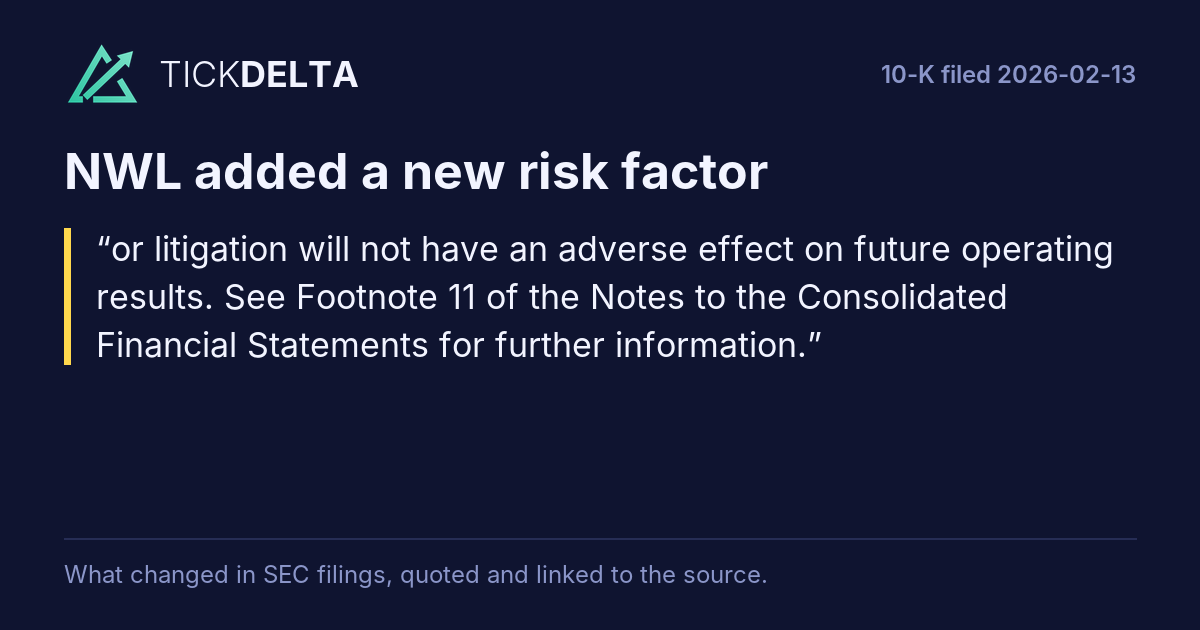
or litigation will not have an adverse effect on future operating results. See Footnote 11 of the Notes to the Consolidated Financial Statements for further information.
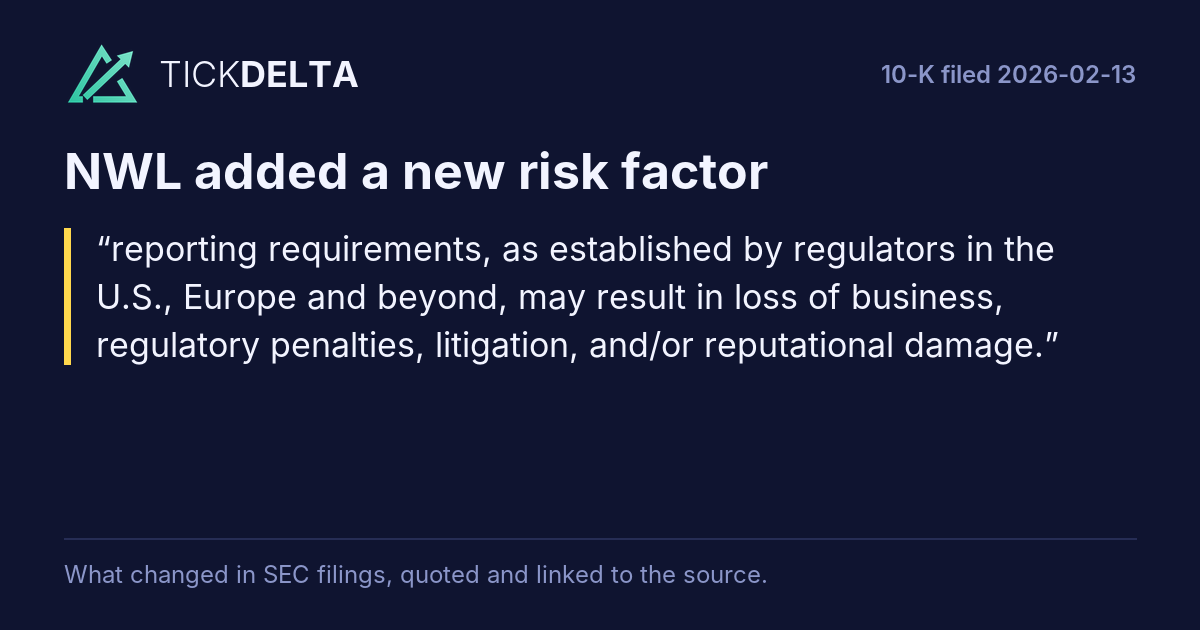
reporting requirements, as established by regulators in the U.S., Europe and beyond, may result in loss of business, regulatory penalties, litigation, and/or reputational damage.
New in the latest 10-Q
34 paragraphs in the 10-Q filed Oct 30, 2026 with nothing like them in the 10-Q filed Jul 31, 2026 (at least half the words must differ; new numbers alone do not count). Quoted exactly, grouped by the item heading above them. This is text that changed, not a judgement of how serious it is.
During the third quarter of 2026, the Company concluded that a triggering event had occurred for an indefinite-lived tradename in the Commercial reporting unit, as well as the goodwill associated with the Commercial reporting unit, in the H&CS segment, as a result of a downward revision of forecasted cash flows primarily due to lower profitability expectations driven by higher operating costs, as well as rising interest rates, which increased the discount rate used in the fair value determination. The Company performed quantitative impairment tests and determined that the indefinite-lived tradename in the H&CS segment was impaired, while the Commercial reporting unit goodwill was not impaired. During the three and nine months ended September 30, 2026, the Company recorded a non-cash impairment charge of $ 101 million, as the carrying value of the tradename exceeded its fair value. See Footnote 6 for further information.
Read in the 10-Q
The Company maintains a factoring agreement with a financial institution to sell certain customer receivables (the “Customer Receivables Purchase Agreement”). On September 2, 2026, the Company and the financial institution amended the Customer Receivables Purchase Agreement, effective September 14, 2026, to reduce the purchase limit for eligible accounts receivable from $ 700 million to $ 625 million and granted the financial institution a first-priority lien in and the right of set-off against certain accounts receivables to the extent not sold under the Customer Receivables Purchase Agreement (as further described therein). The amendment also reduced the effective funding rate associated with the sold customer receivables.
Read in the 10-Q
Effective October 2, 2026, the Company renewed and amended its Receivables Facility, as further discussed in Footnote 15.
Read in the 10-Q
benefit-style retirement benefits to certain senior executives, and authorized qualified distributions under such plans. In connection with the termination, the Company surrendered certain company-owned life insurance policies and received cash surrender proceeds of approximately $ 105 million, which were subsequently invested in money market funds during the third quarter of 2026, which were classified as prepaid expenses and other current assets in the Condensed Consolidated Balance Sheets. The Company plans to liquidate such money market funds in anticipation of settling the related benefit obligations through lump-sum payments made to participants in the fourth quarter of 2026.
Read in the 10-Q
During the third quarter of 2026, the Company concluded that a triggering event had occurred for the goodwill associated with the Commercial reporting unit, in the H&CS segment, as a result of a downward revision of forecasted cash flows primarily due to lower profitability expectations driven by higher operating costs, as well as rising interest rates, which increased the discount rate used in the fair value determination. The Company performed a quantitative impairment test and concluded that the Commercial reporting unit goodwill was not impaired during the third quarter of 2026.
Read in the 10-Q
During the third quarter of 2026, the Company concluded that a triggering event had occurred for an indefinite-lived tradename in the Commercial reporting unit, in the H&CS segment, as a result of a downward revision of forecasted cash flows primarily due to lower profitability expectations driven by higher operating costs, as well as rising interest rates, which increased the discount rate used in the fair value determination. The Company performed a quantitative impairment test and determined that the indefinite-lived tradename in the H&CS segment was impaired. During the three and nine months ended September 30, 2026, the Company recorded a non-cash impairment charge of $ 101 million, as the carrying value of the tradename exceeded its fair value. A hypothetical 10% reduction in the forecasted revenue and residual (excess) cash flows used in the excess earnings method applied in determining the fair value of the tradename would have resulted in an incremental impairment charge in the H&CS segment of $ 9 million. In addition, the Company concluded that the tradename, with a remaining carrying value of $ 87 million, no longer qualified as an indefinite‑lived intangible as of September 30, 2026. The tradename was assigned an estimated useful life of 15 years with amortization commencing on October 1, 2026. The financial statement impact associated with such change will not be material to the Company’s Condensed Consolidated Statement of Operations.
Read in the 10-Q
The Company’s goodwill and indefinite-lived intangibles are fair valued using discounted cash flows. Goodwill impairment testing requires significant use of judgment and assumptions including the identification of reporting units; the assignment of assets and liabilities to reporting units; and the estimation of future cash flows, business growth rates, terminal values and discount rates. The testing of indefinite-lived intangibles under established guidelines for impairment also requires significant use of judgment and assumptions, such as the estimation of cash flow projections, terminal values, royalty rates, contributory cross charges, where applicable, and discount rates. Accordingly, these fair value measurements fall in Level 3 of the fair value hierarchy. These assets and certain liabilities are measured at fair value on a nonrecurring basis as part of the Company’s annual impairment testing and as circumstances require.
Read in the 10-Q
At September 30, 2026, an indefinite-lived tradename in the H&CS segment was recorded at fair value based upon the Company’s impairment testing. The most significant unobservable input (Level 3) used to estimate the fair values of the Company's intangible assets is the discount rate. The discount rate used in the measurement was 11.5 % for the indefinite-lived tradename.
Read in the 10-Q
Prior to the reclassification described above, the indefinite-lived tradename within the H&CS segment was fair valued at $87 million on a non-recurring basis in connection with a triggering event that occurred during the third quarter of 2026.
Read in the 10-Q
In August 2026, in an offering exempt from the registration requirements of the Securities Act of 1933 and all state securities laws, the Company completed the offering and sale of $ 600 million of 6.250 % senior notes due 2031 (the “2031 Notes”) and received proceeds of $ 592 million, net of fees and expenses paid. The 2031 Notes were issued pursuant to an indenture, dated as of August 19, 2026, between the Company and U.S. Bank Trust Company, National Association (the “Indenture”). The Indenture provides, among other things, that the 2031 Notes are the senior unsecured obligations of the Company and include covenants that limit the ability of the Company and its subsidiaries
Read in the 10-Q
to incur or guarantee additional debt, create or permit certain liens, redeem or repurchase certain debt, consummate certain asset sales, make certain loans and investments, consolidate, merge, or sell all or substantially all of the Company and its subsidiaries assets, enter into certain transactions with affiliates and pay distributions on, or redeem or repurchase the Company’s capital stock, subject in each case to certain qualifications and exceptions, including the termination of certain of these covenants upon the 2031 Notes receiving investment grade credit ratings. The Company used the net proceeds from the sale of the 2031 Notes to redeem in full its outstanding 6.375 % senior notes due 2027 (the “2027 Notes”), pay related fees and expenses in connection with the offering and the redemption, and repay a portion of outstanding borrowings under its ABL Credit Facility (defined hereafter).
Read in the 10-Q
On August 20, 2026, the Company fully redeemed its 2027 Notes at a redemption price equal to 101.530 % of the outstanding aggregate principal amount of the notes. The total consideration was approximately $ 508 million. The Company also paid accrued and unpaid interest to, but not including, the redemption date. The Company recorded $ 13 million loss on debt extinguishment, primarily composed of prepayment premiums and deferred loss on terminated interest rate swaps. See Footnote 9 for information on the interest rate swaps.
Read in the 10-Q
Borrowings under the ABL Credit Facility denominated in U.S. Dollars bear interest based on the term secured overnight financing rate (“SOFR”) or daily SOFR or the alternate base rate, in each case, plus an applicable margin. The applicable margin is determined by reference to a pricing grid set forth in the ABL Credit Agreement based on the Company’s availability under the ABL Credit Facility, ranging from 1.50 % to 2.00 % for SOFR-based loans and 0.50 % to 1.00 % for alternate base rate loans. In addition, any unused portion of the ABL Credit Facility is subject to a commitment fee, also determined by reference to the pricing grid, ranging from 0.25 % to 0.30 %, based upon the Company’s average quarterly availability. Borrowings in certain foreign currencies bear interest at the applicable currency-specific benchmark rate plus the margin applicable to SOFR-based loans.
Read in the 10-Q
The carrying value of the ABL Credit Facility approximates fair value due to the variable-rate nature of the borrowings.
Read in the 10-Q
In August 2026, in conjunction with the redemption of the 2027 Notes, the Company terminated the interest rate swaps with an aggregate notional amount of $ 500 million that has been designated as fair value hedge against the principal of the 2027 Notes, prior to their maturity in September 2027. As a result of the early termination, the Company recognized an immaterial amount of loss, included in loss on extinguishment of debt in the Condensed Consolidated Statements of Operations. See Footnote 8 for additional information on the redemption of the 2027 Notes.
Read in the 10-Q
Over 100 entities, including the Company and its subsidiary, Berol Corporation (together, the “Company Parties”), have been identified as PRPs at the Diamond Alkali Superfund Site (the “Site”) pursuant to CERCLA. The Site is divided into four “operable units,” and the Company Parties have received notice letters in connection with Operable
Read in the 10-Q
The Company paid approximately $ 120 million and $ 20 million of IEEPA Tariffs during 2025 and 2026, respectively. The Company evaluated the probability and recoverability of IEEPA Tariffs previously paid and concluded that
Read in the 10-Q
Effective as of October 2, 2026, the Company renewed and amended the Receivables Facility. As part of the renewal, the scheduled termination date was extended to October 1, 2027; the facility limit on factored receivables outstanding was amended to $ 75 million; obligor concentration limits were increased; and debt rating criteria were adjusted.
Read in the 10-Q
In August 2026, the Company completed the offering and sale of $600 million of 6.250% senior notes due 2031 (the “2031 Notes”) and received proceeds of approximately $592 million, net of fees and expenses paid. The Company used the proceeds of the offering to fully redeem its outstanding 6.375% senior notes due 2027 (the “2027 Notes”) at a redemption price equal to 101.530% of the outstanding aggregate principal amount of the notes. The total consideration was approximately $508 million. The Company also paid accrued and unpaid interest to, but not including, the redemption date.
Read in the 10-Q
On October 2, 2026, the Company renewed and amended its three-year factoring agreement with a financial institution to sell certain customer receivables through a wholly-owned special purpose entity of eligible accounts receivable without recourse on a revolving basis (the “Receivables Facility”). Certain terms of the Receivables Facility were also amended as part of the renewal, which included among others: the scheduled termination date was extended to October 1, 2027; the facility limit on the factored receivables outstanding was adjusted to $75 million; obligor concentration limits were increased; and the debt rating criteria were adjusted.
Read in the 10-Q
During the third quarter of 2026, the Company concluded that a triggering event had occurred for an indefinite-lived tradename in the Commercial reporting unit, in the H&CS segment, as a result of a downward revision of forecasted cash flows primarily due to lower profitability expectations driven by higher operating costs, as well as rising interest rates, which increased the discount rate used in the fair value determination. The Company performed a quantitative impairment test and determined that the indefinite-lived tradename in the H&CS segment was impaired. During the three and nine months ended September 30, 2026, the Company recorded a non-cash impairment charge of $101 million, as the carrying value of the tradename exceeded its fair value. See Footnotes 1 and 6 of the Notes to Unaudited Condensed Consolidated Financial Statements and Significant Accounting Policies and Estimates for additional information.
Read in the 10-Q
The $16 million loss on the extinguishment of debt for the three months ended September 30, 2026, relates to the redemption of the Company’s 2027 Notes and the refinancing and replacement of the Company’s $1.00 billion senior secured revolving credit facility maturing in August 2027 (the “Credit Revolver”).
Read in the 10-Q
The $16 million loss on the extinguishment of debt for the nine months ended September 30, 2026, relates to the redemption of the Company’s 2027 Notes and the refinancing and replacement of the Credit Revolver. The $13 million loss on the extinguishment of debt for the nine months ended September 30, 2025, was related to the redemption of the Company’s 4.200% senior notes due 2026.
Read in the 10-Q
During the third quarter of 2026, the Company entered into a new ABL Credit Agreement that replaced the Credit Revolver and extended the facility's general maturity to 2031. The Company also amended the Customer Receivables Purchase Agreement, reducing the purchase limit for eligible accounts receivable from $700 million to $625 million. In addition, on October 2, 2026, the Company renewed and amended its Receivables Facility agreement, extending the scheduled termination date to October 1, 2027 and reducing the limit on the factored receivables outstanding to $75 million. See Recent Developments and Footnotes 1 and 8 of the Notes to Unaudited Condensed Consolidated Financial Statements for further information.
Read in the 10-Q
The ABL Credit Facility provides for borrowings of up to $800 million, subject to a borrowing base comprised of, without limitation, qualified cash, accounts receivable, inventory, equipment and intellectual property. Borrowings may be used for working capital and other general corporate purposes. Borrowings under the facility are classified as long-term debt because its contractual maturity date is beyond twelve months from the balance sheet date.
Read in the 10-Q
In August 2026, the Company completed the offering and sale of the 2031 Notes and used the proceeds of the offering to fully redeem its 2027 Notes.
Read in the 10-Q
The Company was in compliance with all of its debt covenants at September 30, 2026.
Read in the 10-Q
Goodwill and indefinite-lived intangibles are tested and reviewed for impairment annually during the fourth quarter (on December 1), or more frequently if facts and circumstance warrant.
Read in the 10-Q
Goodwill is tested for impairment at a reporting unit level, and all of the Company’s goodwill is assigned to its reporting units. Reporting units are determined based upon the Company’s organizational structure in place at the date of the goodwill impairment testing and generally are one level below the operating segment level. The Company’s operations are comprised of six reporting units, within its three primary operating segments. The Company has the option of first analyzing qualitative factors to determine whether it is more likely than not that the fair value of any reporting unit is less than its carrying amount. However, the Company may elect to perform a quantitative goodwill impairment test in lieu of the qualitative test.
Read in the 10-Q
In performing a quantitative assessment, the Company estimates the fair value of each reporting unit by using the income approach. The quantitative goodwill impairment test requires significant use of judgment and assumptions, such as the identification of reporting units; assignment of assets and liabilities to reporting units; and estimation of future cash flows (including net sales, gross profit and operating expenses), terminal values, discount rates and total enterprise value.
Read in the 10-Q
During the third quarter of 2026, the Company concluded that a triggering event had occurred for the goodwill associated with the Commercial reporting unit, within the H&CS segment, as a result of a downward revision of forecasted cash flows primarily due to lower profitability expectations driven by higher operating costs, as well as rising interest rates, which increased the discount rate used in the fair value determination. The Company performed a quantitative impairment test and concluded that the Commercial reporting unit goodwill was not impaired. However, a hypothetical 10% reduction in forecasted earnings before interest, taxes, depreciation and amortization used in the discounted cash flow analysis would have resulted in an impairment charge of approximately $121 million against the Commercial reporting unit goodwill carrying value of $747 million.
Read in the 10-Q
The testing of indefinite-lived intangibles (primarily tradenames) under established guidelines for impairment also requires significant use of judgment and assumptions (such as cash flow projections, royalty rates, terminal values and discount rates). An indefinite-lived intangible asset is impaired by the amount its carrying value exceeds its estimated fair value. For impairment testing purposes, the fair value of indefinite-lived intangibles is determined using either the relief from royalty method or the excess earnings method. The relief from royalty method estimates the value of a tradename by discounting the hypothetical avoided royalty payments to their present value over the economic life of the asset. The excess earnings method estimates the value of the intangible asset by quantifying the residual (or excess) cash flows generated by the asset and discounts those cash flows to the present. The excess earnings methodology requires the application of contributory asset charges. Contributory asset charges typically include assumed payments for the use of working capital, tangible assets and other intangible assets. Changes in forecasted operations and other assumptions could materially affect the estimated fair values. Changes in business conditions could potentially require adjustments to these asset valuations.
Read in the 10-Q
During the third quarter of 2026, the Company concluded that a triggering event had occurred for an indefinite-lived tradename in the Commercial reporting unit, in the H&CS segment, as a result of downward revision of forecasted cash flows primarily due to lower profitability expectations driven by higher operating costs, as well as rising interest rates, which increased the discount rate used in the fair value determination. The Company performed a quantitative impairment test and determined that the indefinite-lived tradename in the H&CS segment was impaired. As a result, the Company recorded a non-cash impairment charge of $101 million, as the carrying value of the individual assets exceeded their fair value. A hypothetical 10% reduction in the forecasted revenue and residual (excess) cash flows
Read in the 10-Q
used in the excess earnings method applied in determining the fair value of the tradename would have resulted in an incremental impairment charge in the H&CS segment of $9 million.
Read in the 10-Q
Item 1A of the 10-Q filed Oct 30, 2026 against Item 1A of the 10-K filed Feb 13, 2026.
A 10-Q repeats only the risks that changed, so a 10-K paragraph that is missing from it is not counted as removed.
Added is a paragraph with nothing like it in the 10-K, Reworded a sentence that is in both with several words changed,
Quiet changes a sentence in both where one to four words changed and one is a hedge or a modal
(cut words struck through, new words highlighted).
Text on the page, not a score; each links to the filing at sec.gov.
What the 10-Q itself says about its risk factors:There have been no material changes in our risk factors from those disclosed in Part I, Item 1A. of the Company’s Annual Report on Form 10-K for the fiscal year ended December 31, 2025.
Read in the 10-Q
Two-word phrases in Risk Factors of the 10-K filed Feb 13, 2026 that are in none of the 1 earlier 10-Ks stored, back to Feb 14, 2025
Used at least twice, small words left out. Counted, not picked: a phrase can be new because the company renamed something.
5 paragraphs of last year's Risk Factors with nothing like them now. The longest are quoted.
Item 1A of each 10-K and 10-Q on EDGAR, quoted exactly. Each paragraph links to the filing at sec.gov.
10-K change: what was reworded or cut, section by section.
Excel workbook · CSV. Google Sheet that stays up to date: paste =IMPORTDATA("https://tickdelta.com/company/NWL/export.csv") into a cell.