Form 10-K for the Fiscal Year Ended June 30, 2016
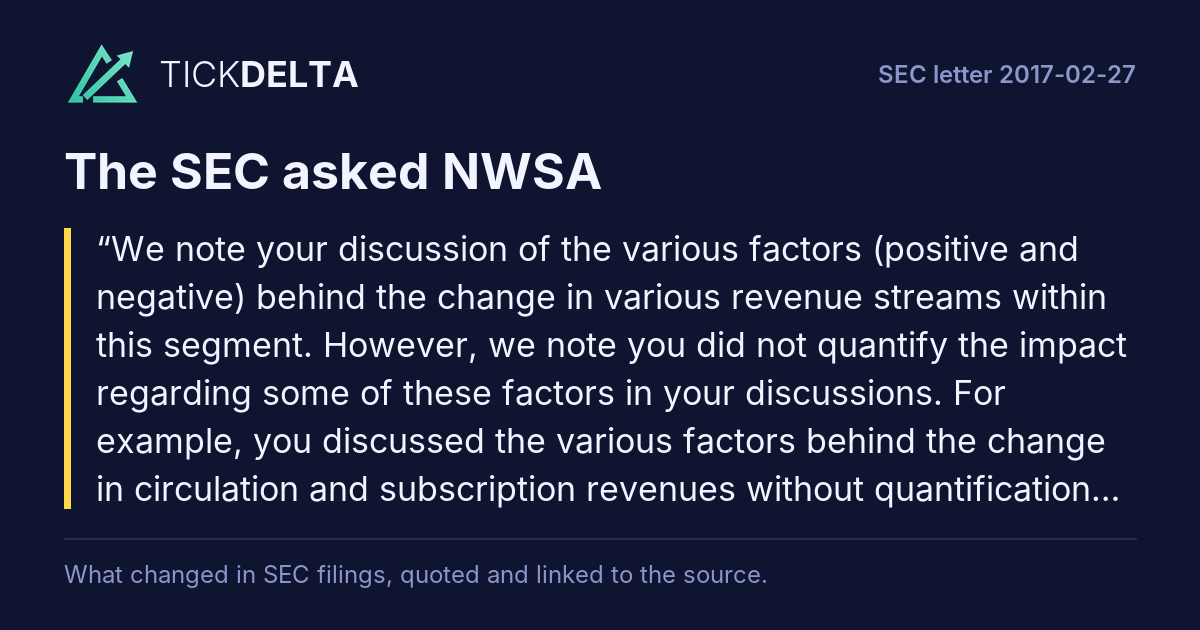
We note your discussion of the various factors (positive and negative) behind the change in various revenue streams within this segment. However, we note you did not quantify the impact regarding some of these factors in your discussions.Rest of the question
For example, you discussed the various factors behind the change in circulation and subscription revenues without quantification of the positive impact of price increases and digital subscriber growth on Dow Jones and the Australian newspapers. In future filings, please provide a more robust segment operating result discussion here and elsewhere, including the quantifications of various factors behind the change in revenues to the extent that they are material in understanding your operations. Refer to Item 303 of Regulation S-K.
The Company acknowledges the Staff’s comment and undertakes to include the requested disclosure in future filings. Read in the reply ↗
First report after the company's reply of 2017-03-09: 10-Q filed 2017-05-10 ↗, against the 10-Q filed 2017-02-10 ↗.
Tickdelta does not hold the text of both reports, so they are not compared here.
Please revise the table of contractual obligations to include your long-term debt in accordance with Regulation S-K, Item 303(A)(5).
In response to the Staff’s comment, the Company undertakes to include the obligations associated with its long-term debt in tabular format in its future filings subject to Item 303(A)(5) of Regulation S-K. By way of example, using our Form 10-K for the fiscal year ended June 30, 2016 as a model, in future filings we intend to revise the table of contractual obligations to reflect our long-term debt in the format shown below:
As of June 30, 2016
Payments Due by Period
Total
1 year
2-3 years
4-5 years
After 5 years
(in millions)
Purchase obligations(a)
$
787
339
183
166
SportsRead in the reply ↗Rest of the answer
programming rights(b)
1,184
158
379
388
259
Operating leases(c)
Land and buildings
1,436
129
274
207
826
Plant and machinery
—
Borrowings(d)
373
190
180
Total commitments and contractual obligations
3,784
631
1,028
874
1,251
The Company has not included expected interest payments in the table above as the payments are considered immaterial. We also intend to include the following footnote to the table with respect to borrowings (footnotes (a)-(c) that have been previously included in our Form 10-K are omitted for purposes of this example):
(d)
Primarily represents the REA Group unsecured syndicated revolving loan facility based on the contractual maturity date of the various sub facilities included within the agreement. See Note 9 to the Consolidated
Financial Statements.
The Company also respectfully notes that information related to the expected maturity of the
Company’s borrowings is included on page 67 of Management’s Discussion and Analysis and page 110 of the Notes to the consolidated financial statements in the Company’s Form 10-K for the fiscal year ended June 30, 2016.
Financial Statements
Notes to the Consolidated Financial Statements
Note 4.
We note that during fiscal 2016 you sold your Digital Education business and classified the results as discontinued operations. Given that in recent prior years the revenues of the Digital Education segment represented only 1% of your total revenues, please tell us why you believe this business is appropriately classified as discontinued operations under ASC 205-20.Rest of the question
Specifically indicate in your response why the disposition of such a small portion of your business is considered a “strategic shift” under ASC 205-20-45-1. We may have further comment upon receipt of your response.
The Company respectfully believes that it has appropriately classified the disposal of its Digital Education segment as
Discontinued Operations in accordance with ASC 205-20. Specifically, ASC 205-20-45-1B states that:
“A disposal of a component of an entity or a group of components of an entity shall be reported in discontinued operations if the disposal represents a strategic shift that has (or will have) a major effect on an entity’s operations and financial results when any of the following occurs:
a.
The component of an entity or group of components of an entity meets the criteria inRead in the reply ↗Rest of the answer
paragraph 205-20-45-1E to be classified as held for sale.
b.
The component of an entity or group of components of an entity is disposed of by sale.
c.
The component of an entity or group of components of an entity is disposed of other than by sale in accordance with paragraph 360-10-45-15 (for example, by abandonment or in a distribution to owners in a spinoff).”
During the three months ended September 30, 2015, the Company’s Digital Education segment met the six criteria necessary to be classified as assets held for sale in accordance with ASC 205-20-45-1E. Management’s decision to dispose of the Digital Education segment represented a significant strategic shift in the Company’s overall business as it signaled the Company’s full exit from the digital education sector and the sale of one of its six reportable segments. The Company acknowledges the Staff’s comment regarding the materiality of the Digital Education segment’s historical revenue contribution, however, the Company notes that the disposed segment had a significant negative contribution to the Company’s overall profitability and liquidity measures. For the fiscal years ended June 30,
2015 and 2014, the Digital Education segment had a Segment EBITDA loss of $93 million and $193 million, respectively, on consolidated Total Segment EBITDA of $852 million and $770 million, respectively. For the fiscal years ended June 30, 2015 and 2014, the Digital Education segment had Operating cash outflows of $157 million and $175 million, respectively, on consolidated net cash provided by operating activities of $831 million and $854 million, respectively. In light of these factors, the Company believes that it has appropriately classified the disposal of its Digital Education segment as Discontinued Operations under ASC 205-20.
First report after the company's reply of 2017-03-09: 10-Q filed 2017-05-10 ↗, against the 10-Q filed 2017-02-10 ↗.
Tickdelta does not hold the text of both reports, so they are not compared here.
Please provide entity-wide disclosure with respect to your revenues from external customers for each product or service or each group of similar products or services. Refer to ASC 280-10-50-40.
The Company respectfully believes that it has addressed the disclosures required under ASC 280-10-50-40. The Company disclosed its revenues from external customers by major product or service on the face of the Statements of Operations for the fiscal years ended June 30, 2016, 2015 and 2014. In the Company’s Form 10-K for the fiscal year ended June 30, 2016, the consolidated revenues reported in the Statements of Operations are broken out into four separate line items, Advertising, Circulation and subscription, Consumer and Other, reflecting its groups of products and services as described inRead in the reply ↗Rest of the answer
Note 2 under “Revenue recognition” and the corresponding revenues from external customers for each. Additionally, information regarding revenues for these products and services by segment is included in Management’s Discussion and Analysis in the Form 10-K for the fiscal year ended June 30, 2016.
First report after the company's reply of 2017-03-09: 10-Q filed 2017-05-10 ↗, against the 10-Q filed 2017-02-10 ↗.
Tickdelta does not hold the text of both reports, so they are not compared here.
During the fiscal year ended June 30, 2016, the quarterly data shows significant fluctuations in operating results between the quarters. Specifically, there are large variations in net income for all quarters. Please revise to add a discussion of any unusual or infrequently occurring items during each quarter, such as impairment charges, legal settlements, etc., which may have contributed to the significantRest of the question
fluctuations in operating results. Refer to Item 302(a)(3) of Regulation S-K.
The Company acknowledges the Staff’s comment. The Company respectfully notes that disclosure of unusual or infrequently occurring items has been made throughout the Notes to the consolidated financial statements contained in the Form 10-K for the fiscal year ended June 30, 2016. These items include the disposal of the Digital Education segment (discussed on pages 101 and 102), the impact of certain legal settlements recognized during the fiscal year (discussed on pages 121 and 122) and the related tax impacts of such transactions (discussed on page 131).Read in the reply ↗Rest of the answer
The Company undertakes to include in any corresponding
“quarterly data” Note to the annual consolidated financial statements contained in future filings discussion of any unusual or infrequently occurring items during each quarter. By way of example, using our Form 10-K for the fiscal year ended June 30, 2016 as a model, in future filings we intend to include footnotes related to Income (loss) from continuing operations and Income (loss) from discontinued operations to the quarterly data table such as the following:
For the three months ended
September 30,
December 31,
March 31,
June 30,
(in millions, except per share amounts)
Fiscal 2016
Revenues
2,014
2,161
1,891
2,226
Income (loss) from continuing operations attributable to News Corporation stockholders(a)
(147
)
Income (loss) from discontinued operations, net of tax(b)
(24
(2
(5
Net income (loss) attributable to News Corporation stockholders
175
(149
Income (loss) from continuing operations available to News Corporation stockholders per share
— basic and diluted
0.22
0.15
(0.26
0.16
Income (loss) available to News Corporation stockholders per share — basic and diluted
0.08
(0.04
(0.01
0.30
0.11
Fiscal 2015
2,108
2,258
2,041
2,117
Income from continuing operations attributable to News Corporation stockholders(a)
162
(Loss) income from discontinued operations, net of
(21
(19
(22
(383
143
(378
Income from continuing operations available to News Corporation stockholders per share — basic and diluted
0.27
0.01
Loss available to News Corporation stockholders per share — basic and diluted
(0.03
(0.66
0.24
0.04
(0.65
(a)
Income (loss) from continuing operations includes the impact of the following items:
•
The $106 million tax benefit recognized during the first quarter of fiscal 2016 related to the release of previously established valuation allowances related to certain U.S. federal net operating losses and state deferred tax assets. See Note 18 – Income Taxes.
In the third quarter of fiscal 2016, the Company recognized one-time costs of approximately $280 million in connection with the settlement of certain litigation and related claims at News America Marketing. See Note 15
– Commitments and Contingencies.
In the fourth quarter of fiscal 2016, the Company recognized a gain of $122 million in connection with the settlement of litigation with Zillow, Inc., which reflects settlement proceeds received from Zillow of $130 million, less $8 million paid to the National Association of Realtors® (“NAR”). See Note 15 – Commitments and Contingencies.
(b)
Income (loss) from discontinued operations includes the impact of the following items:
In the fourth quarter of fiscal 2015, as part of the Company’s long-range planning process, the Company recorded a non-cash impairment charge of $371 million related to its Digital Education segment. See Note 4
– Discontinued Operations.
In the first quarter of fiscal 2016, the Company recognized a pre-tax non-cash impairment charge of $76 million reflecting a write down of the digital education business to its fair value less costs to sell.
Additionally, during the first quarter of fiscal 2016, the Company recognized a tax benefit of $144 million upon reclassification of the Digital Education segment to discontinued operations. See Note 4 – Discontinued Operations and Note 18
– Income Taxes.
First report after the company's reply of 2017-03-09: 10-Q filed 2017-05-10 ↗, against the 10-Q filed 2017-02-10 ↗.
Tickdelta does not hold the text of both reports, so they are not compared here.
We note your definition of Total Segment EBITDA, a non-GAAP measure, on page 17 and that you believe the measure allows users of the company’s financial statements to evaluate changes in the operating results of the company separate from non-operational factors that affect net (loss) income, thus providing insight into both the operations and the other factors that affect reported results.Rest of the question
Based on the definition, please explain to us how the adjustments provide insights into both the operations and the other factors that affect reported results. For example, depreciation and amortization and impairment and restructuring charges appear to be operating expenses rather than non-operating expenses. We note you present the adjustments as operating expenses on the face of the consolidated statements of operations.
The Company believes that the presentation of Total Segment EBITDA provides useful information regarding the Company’s operations and other factors that affect the Company’s reported results. Specifically, the Company believes that by excluding certain one-time or non-cash items such as impairment and restructuring charges and depreciation and amortization, as well as potential distortions between periods caused by factors such as financing and capital structures and changes in tax positions or regimes, the Company provides users of its financial statements with insight into both its coreRead in the reply ↗Rest of the answer
operations as well as the factors that affect reported results between periods but which the Company believes are not representative of its core business. As a result, users of the Company’s financial statements are better able to evaluate changes in the core operating results of the Company across different periods. In response to the Staff’s comment, the Company undertakes in future filings to clarify its discussion regarding the reasons why management believes Total Segment EBITDA provides useful information by replacing the disclosure referenced by the Staff with the explanation provided above.
First report after the company's reply of 2017-03-09: 10-Q filed 2017-05-10 ↗, against the 10-Q filed 2017-02-10 ↗.
Tickdelta does not hold the text of both reports, so they are not compared here.
We note your presentation of the decrease in cash and cash equivalents from discontinued operations in one line item. Please note that ASC 230-10-45-10 requires that a statement of cash flows shall classify cash receipts and cash payments as resulting from investing, financing, or operating activities.Rest of the question
Please revise your current presentation to classify the cash flows from discontinued operations within each of the operating, investing and financing categories.
While the Company acknowledges that it presented the decrease in cash and cash equivalents from discontinued operations in one line item on the Statements of Cash Flows, we respectfully believe that the information required by ASC 230-10-45-10 is included in the notes to the financial statements, as described in ASC
230-10-45-24A.
1211 Avenue of the Americas • New York, NY 10036 newscorp.com
Specifically, for cash flow disclosure requirements related to a discontinued operation, ASC
230-10-45-24A refers to ASC 205-20-50-5B, which states in relevant part:
“An entity shall disclose, to theRead in the reply ↗Rest of the answer
extent not presented on the face of the financial statements as part of discontinued operations, all of the following in the notes to the financial statements: … c. Either of the following:
The total operating and investing cash flows of the discontinued operation for the periods in which the results of operations of the discontinued operation are presented in the statement where net income is reported
First report after the company's reply of 2017-03-23: 10-Q filed 2017-05-10 ↗, against the 10-Q filed 2017-02-10 ↗.
Tickdelta does not hold the text of both reports, so they are not compared here.
Also in this review: closing letter, 2017-03-24