Screener / SEC EDGAR /CIK 0001849056 /10-K filed Mar 17, 2026, compared with Mar 24, 2025 /Numbers from the XBRL of the 10-Ks
NYSE Utilities · Electric Utilities

Oklo Inc. OKLO

Compare with peers Embed
New in the 10-K 46 paragraphs with nothing like them in the 10-K filed Mar 24, 2025 New in the 10-Q 54 paragraphs not in the 10-Q filed Aug 7, 2026 10-Q against the 10-K 14 risk factor paragraphs and sentences added or reworded

New risk paragraphs, branching off last year

Each branch is a paragraph in Risk Factors with nothing like it in the 10-K filed Mar 24, 2025. A box jumps to the paragraph as filed, below.

46 new

Paragraphs with nothing like them in last year's 10-K

Quoted exactly

46 paragraphs in Risk Factors of the 10-K filed Mar 17, 2026 with nothing like them in the 10-K filed Mar 24, 2025. Quoted exactly. Paragraphs that were only edited are under 10-K change.

The following summarizes some, but not all, of the risks provided below. Please carefully consider all of the information discussed in this Item 1A “Risk Factors” in this Annual Report for a more thorough description of these and other risks.

Read in the 10-K

•Our business is, and the markets in which we compete are, rapidly evolving, including with respect to artificial intelligence products, which make it difficult to forecast demand for our power.

Read in the 10-K

•Changes to trade policies, including higher tariffs, restrictions, and other economic disincentives to trade, may lead to operational delays, higher procurement and operational costs, and increased regulatory and compliance complexities, resulting in supply chain disruptions and higher prices and lower demand for devices and services we sell.

Read in the 10-K

recycling facilities as well as any failure to obtain final investment decisions for future orders could have a material adverse effect on our business, results of operations, and financial condition and could harm our reputation.

Read in the 10-K

can be sourced in small amounts from the DOE, and a small but growing supply is being produced domestically and made available at high prices by Centrus Energy Corp. (“Centrus”) and others.

Read in the 10-K
Show the other 20

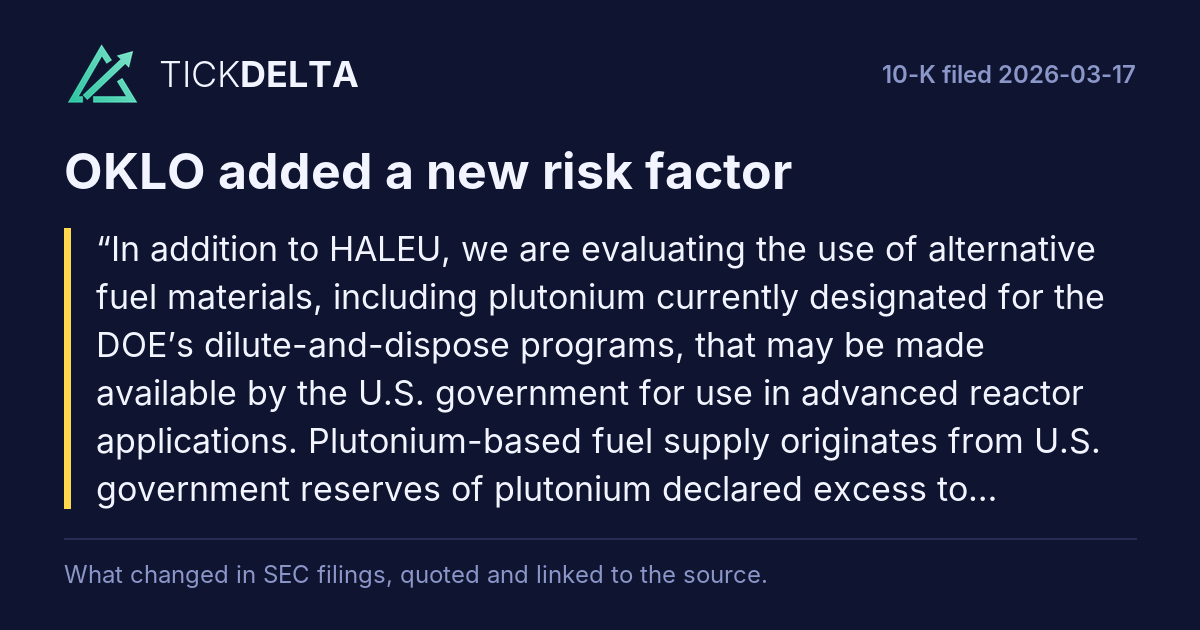
In addition to HALEU, we are evaluating the use of alternative fuel materials, including plutonium currently designated for the DOE’s dilute-and-dispose programs, that may be made available by the U.S. government for use in advanced reactor applications. Plutonium-based fuel supply originates from U.S. government reserves of plutonium declared excess to defense needs, and the use of plutonium-based fuels may be subject to increased fuel certifications, regulatory uncertainty, cost recovery requirements, secure transportation requirements, and security and proliferation concerns. Delays in obtaining HALEU or plutonium-based fuels could impact key activities such as fuel loading, testing, and operation of our powerhouses, potentially exposing us to cost and scheduling uncertainties. Any such delays may negatively affect the ability of our powerhouses to effectively compete in the market for power and heat production.

Read in the 10-K

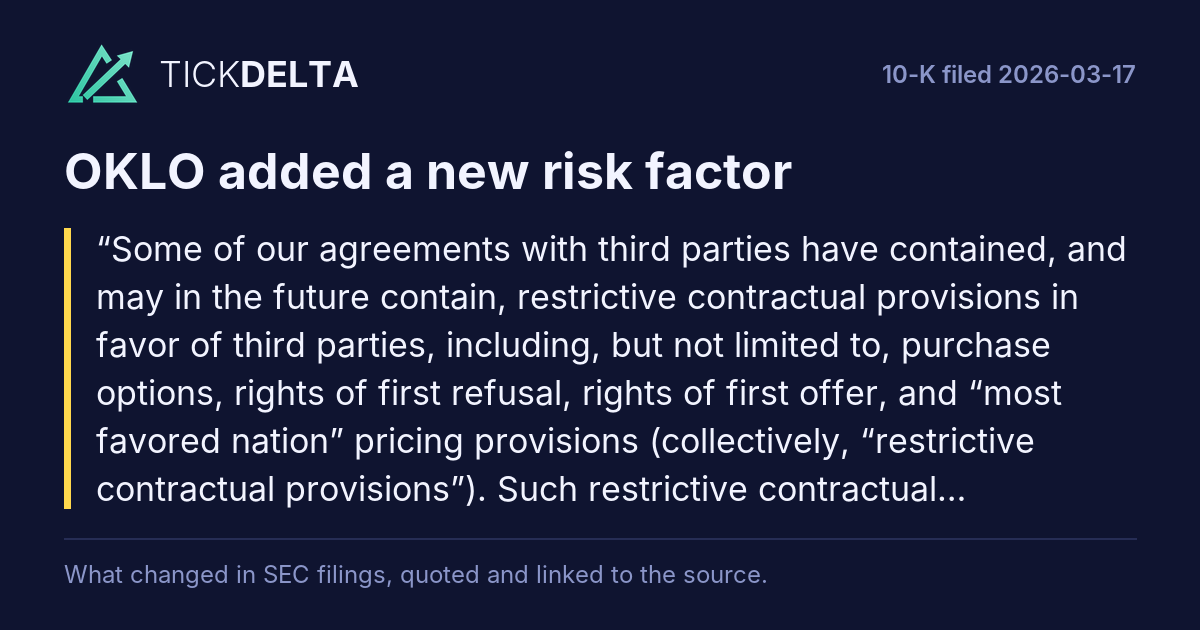
Some of our agreements with third parties have contained, and may in the future contain, restrictive contractual provisions in favor of third parties, including, but not limited to, purchase options, rights of first refusal, rights of first offer, and “most favored nation” pricing provisions (collectively, “restrictive contractual provisions”). Such restrictive contractual provisions may adversely affect our ability to enter into agreements with third parties for the purchase of power, limit the amount we are able to charge for our power, prevent us from entering into relationships with potential customers, and negatively impact future revenues. If we do not successfully manage compliance with these restrictive contractual provisions, we may be required to forego revenues from some third parties or reduce the amount we charge certain third parties with most favored nation pricing, which would adversely affect our business, results of operations, and financial condition.

In addition, disputes or legal proceedings relating to such restrictive contractual provisions may arise, which may result in the incurrence of legal costs and diversion of management resources to resolve.

Read in the 10-K

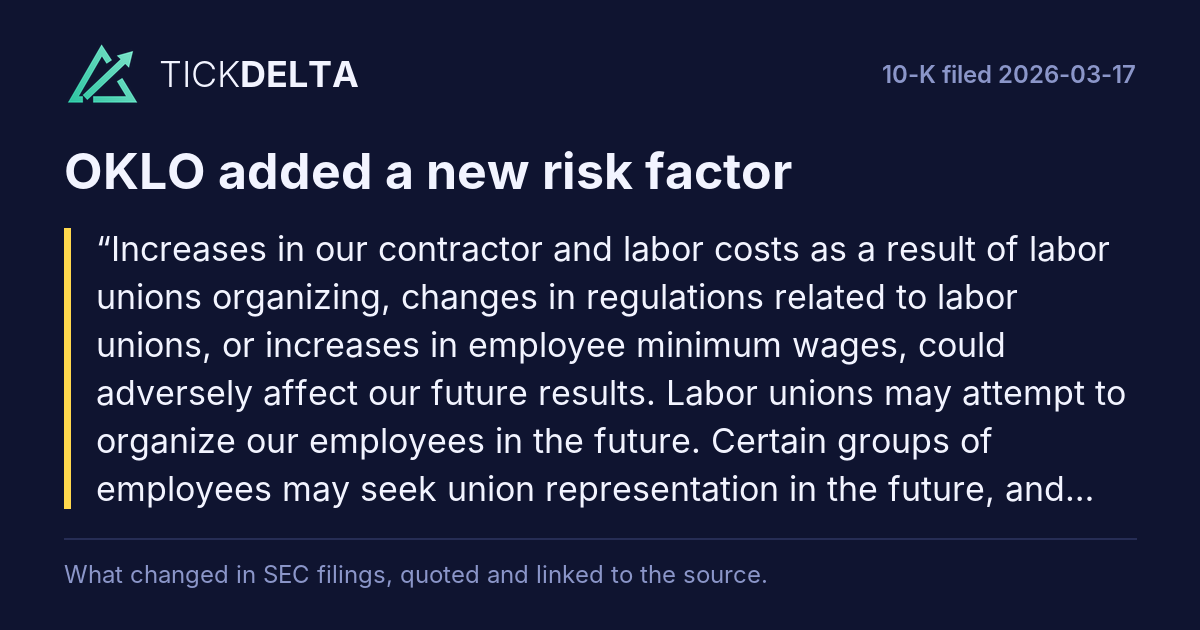
Increases in our contractor and labor costs as a result of labor unions organizing, changes in regulations related to labor unions, or increases in employee minimum wages, could adversely affect our future results.

Labor unions may attempt to organize our employees in the future. Certain groups of employees may seek union representation in the future, and, if successful, would enhance organized labor’s leverage to obtain higher than expected wage and benefits costs and resist the introduction of new technology and other initiatives, which can result in increased operating expenses. If we are unable to negotiate acceptable collective bargaining agreements, our operating expenses could increase significantly as a result of work stoppages, including strikes. Additionally, increases in minimum wage rates, or the enactment of new wage-related legislation, may significantly increase our labor costs. Any of these matters could adversely affect our business, results of operations, and financial condition.

Read in the 10-K

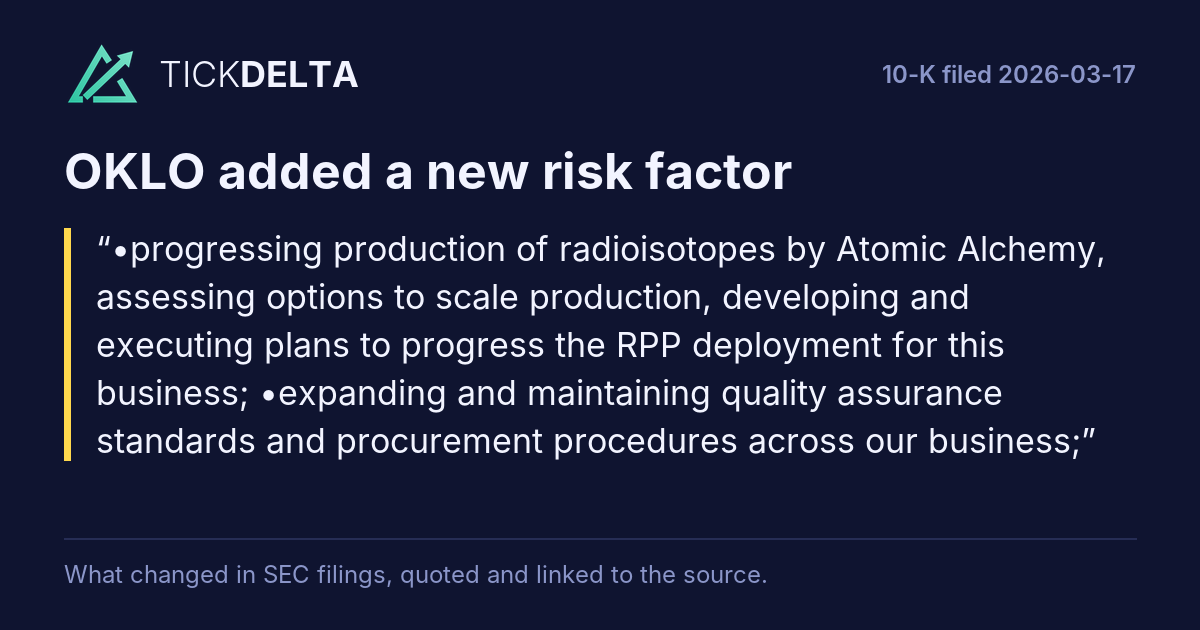
•progressing production of radioisotopes by Atomic Alchemy, assessing options to scale production, developing and executing plans to progress the RPP deployment for this business;

•expanding and maintaining quality assurance standards and procurement procedures across our business;

Read in the 10-K

•establishing the supply chain required to source and obtain fuel at acceptable costs;

Read in the 10-K

•prioritizing resources and attention across multiple concurrent critical projects;

Read in the 10-K

Moreover, the cost and time associated with the construction and maintenance of our metal‑fueled fast reactors may be greater than we expect because of a lack of a domestic labor force with relevant commercial experience and an inexperienced supply chain for this type of reactor. Suppliers, contractors, and service providers often lack relevant commercial experience and price components, labor, and services based on assumptions applicable to NRC-licensed large light water reactors. These pricing assumptions take into account regulatory, quality assurance, and compliance requirements that may not be applicable to our metal-fueled fast reactors, including in cases where we pursue alternative regulatory pathways such as through the DOE. Such misalignment between our regulatory framework and supplier pricing models may result in higher procurement costs and extended procurement timelines. Significant portions of our supply chain are being developed specifically to support our metal-fueled fast reactor technology rather than relying on an established commercial supply base tailored toward serving the existing fleet of large light water reactors.

In addition, there is limited recent commercial operating experience in the U.S. with fuel recycling, fuel fabrication, and radioisotope production facilities of the type and scale we intend to deploy. This lack of commercial operating experience could cause us to fail to identify latent design, manufacturing, construction, and operations issues of our facilities early

enough to avoid negative effects on production, fabrication, construction, or ultimate performance of our fuel recycling, fuel fabrication, and radioisotope production facilities and related technologies. We may encounter unforeseen challenges in scaling processes for such facilities to commercial production. The longer lead times and reduced pricing transparency we face increases construction and operating costs and impairs our ability to accurately forecast project budgets and schedules, heightening the risk of cost overruns and project delays. Any such outcomes may have a material adverse effect on our business, results of operations, and financial condition and could harm our reputation.

Read in the 10-K

•higher than expected costs and/or timing delays in the construction of powerhouses, fuel fabrication facilities, or fuel recycling facilities;

Read in the 10-K

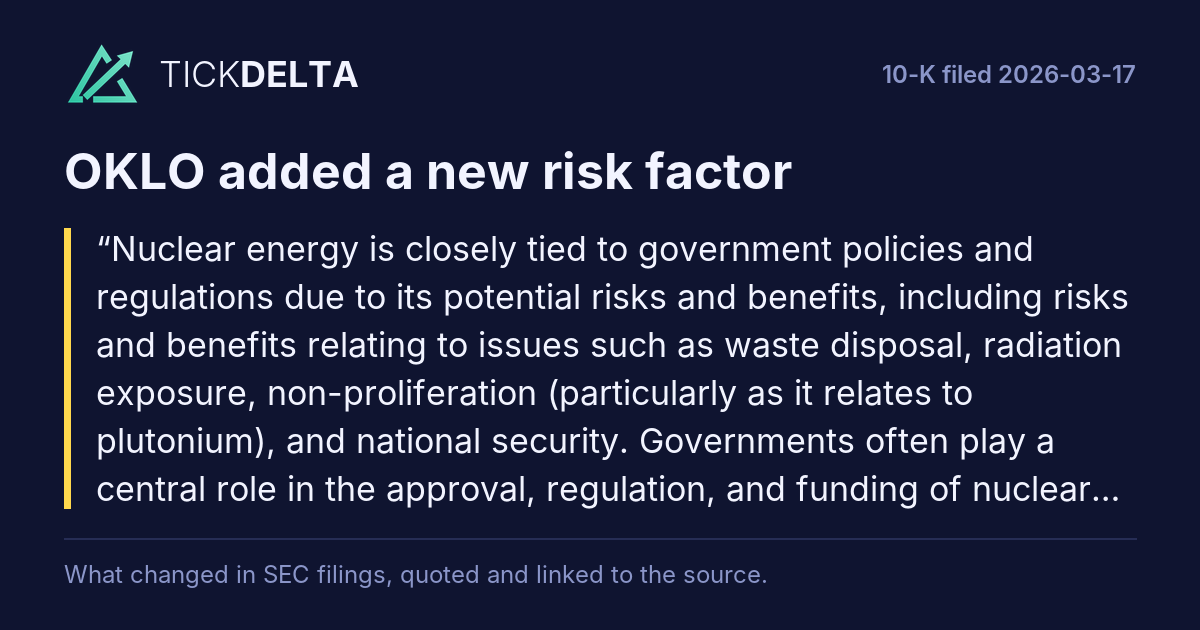
Nuclear energy is closely tied to government policies and regulations due to its potential risks and benefits, including risks and benefits relating to issues such as waste disposal, radiation exposure, non-proliferation (particularly as it relates to plutonium), and national security. Governments often play a central role in the approval, regulation, and funding of nuclear projects. Changes in political leadership or shifts in public sentiment can lead to shifts in nuclear energy policies, which can affect the viability and profitability of nuclear businesses. The regulatory framework for nuclear energy is stringent and subject to public scrutiny. Regulatory decisions can influence the cost, timeline, and feasibility of nuclear projects. Public concerns and political pressure can lead to tighter regulations or stricter enforcement of existing ones. Government policies and incentives, often influenced by public opinion and political considerations, can directly impact the growth and competitiveness of nuclear energy. Favorable policies such as subsidies, tax credits, or incentives for clean energy can attract more customers to the nuclear energy sector.

Changing political environments in the U.S. and abroad may amplify the media and political scrutiny we face. Negative publicity about us, including about our management, the efficacy and reliability of our technologies, and our product offerings, even if inaccurate, may adversely affect our reputation and brand. Additionally, the nature and complexity of our business could make us susceptible to various claims, including government investigations, due to changes in the political environment in the U.S. and the heightened regulatory scrutiny of our industry.

Additionally, while we have made intentional efforts to work with legislators, policymakers, and politicians from across the political spectrum, there may be an external perception that we are solely or primarily associated with one political party. In a highly partisan era, that perception can lead to undue and unexpected scrutiny, can subject us to litigation or governmental investigations, and can otherwise cause us to expend significant resources and attention that we might otherwise use on our business operations. Further, actions we take in response to the activities of certain political leaders, government agencies, and customers could harm our brand and reputation. The resulting harm to our reputation could cause certain customers to cease doing business with us, impair our ability to attract new customers or to expand our relationships with existing customers, diminish our ability to recruit, hire, or retain employees, or undermine our standing in professional communities to which we contribute and from which we receive expert knowledge. Any of these factors could adversely impact our business, results of operations, and financial condition.

Read in the 10-K

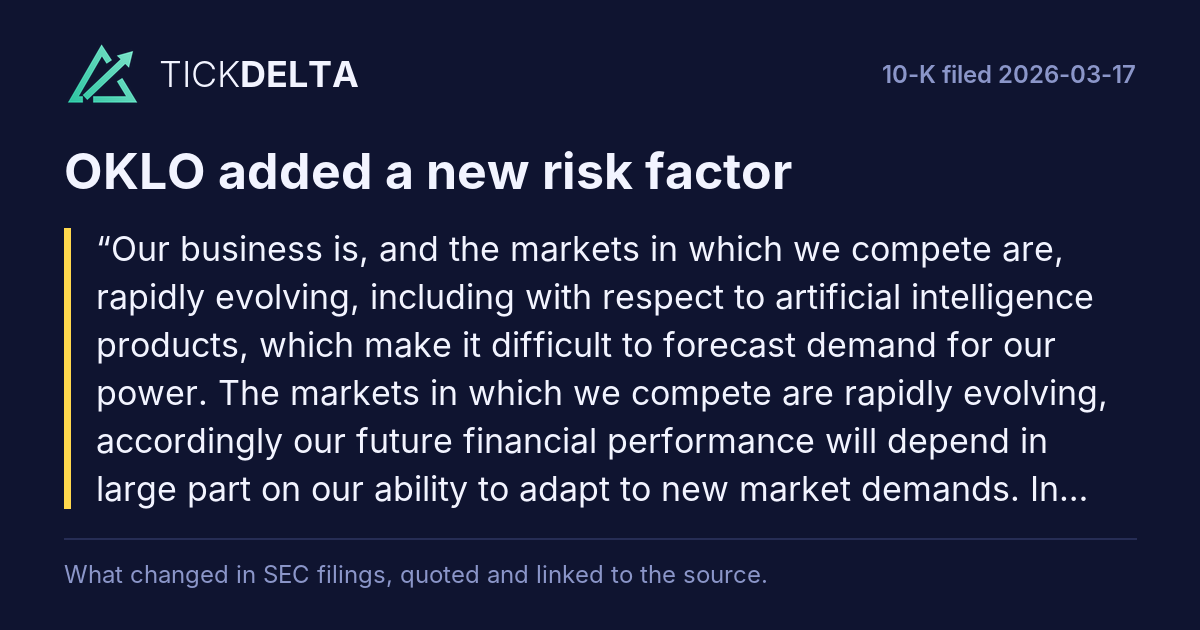
Our business is, and the markets in which we compete are, rapidly evolving, including with respect to artificial intelligence products, which make it difficult to forecast demand for our power.

The markets in which we compete are rapidly evolving, accordingly our future financial performance will depend in large part on our ability to adapt to new market demands. In recent years, an increasing number of customers and potential customers have been allocating their spending toward artificial intelligence capabilities. The market to provide power for artificial intelligence, machine learning, and generative artificial intelligence workloads is expected to be an intensely competitive and rapidly evolving market, and our future financial performance may depend on our ability to adapt to, and capture new spending, in this market. Our estimates of the market opportunity, including forecasts of the demand for our power and our ability to capture new spending, are subject to significant uncertainty and are based on assumptions and estimates that may not prove to be accurate. In addition, if the markets in which we compete experience a shift in customer demand, or if customers in these markets focus their new spending on, or shift their existing spending to, other energy solutions, our solutions may not compete as effectively, if at all.

Read in the 10-K

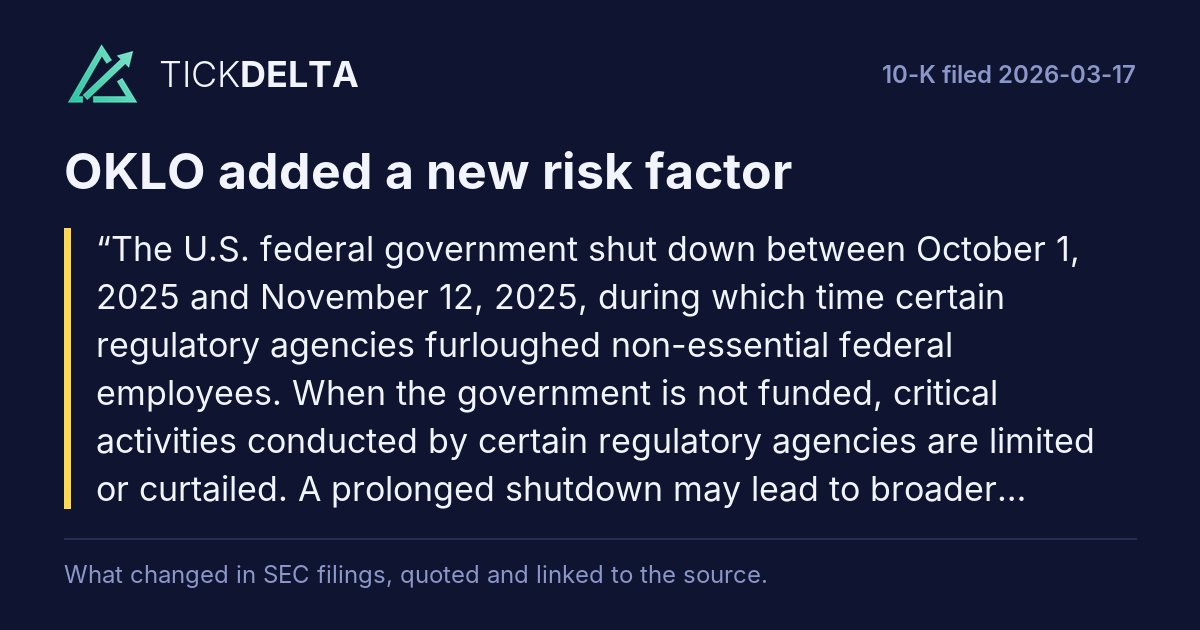
The U.S. federal government shut down between October 1, 2025 and November 12, 2025, during which time certain regulatory agencies furloughed non-essential federal employees. When the government is not funded, critical activities conducted by certain regulatory agencies are limited or curtailed. A prolonged shutdown may lead to broader economic uncertainty and financial market volatility. These conditions could have a negative impact on our business, results of operations, and financial condition.

The ability of regulatory agencies, such as the DOE and NRC, to review license applications and other regulatory submissions can be affected by a variety of factors, including government budget and funding levels, reductions in workforce, ability to hire and retain key personnel, and statutory, regulatory, and policy changes. In addition, there may be delays in necessary interactions with regulators and other important agencies and contractors due to limitations in employee

In the event of a government shutdown, the SEC may operate with limited staff or suspend certain functions altogether, which could delay the review or effectiveness of our filings, including registration statements or other financing-related disclosures. Such delays could adversely affect our ability to access the public markets and obtain necessary capital in order to properly capitalize and continue to fund our operations. Our inability to raise capital or our inability to raise capital on favorable terms, could cause the trading price of our common stock to decline.

While we strive to mitigate these risks through contingency planning and government engagement and outreach, the ultimate impact of any government shutdown is difficult to predict and may be outside of our control. Such a government shutdown could have a negative impact on our business, results of operations, and financial condition.

Read in the 10-K

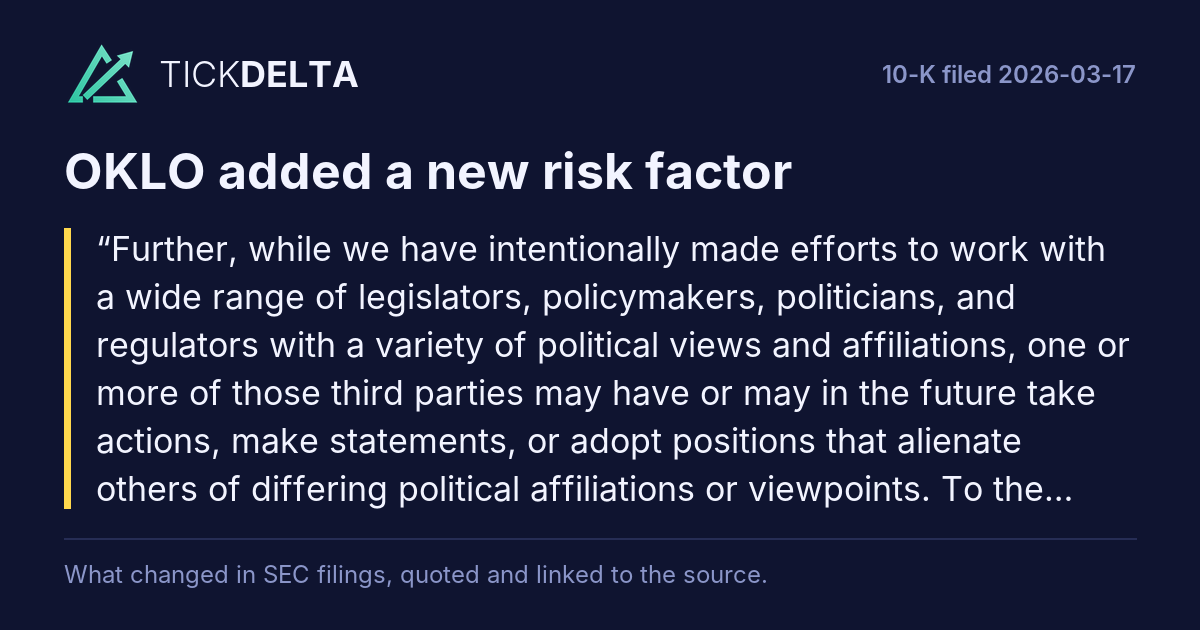
Further, while we have intentionally made efforts to work with a wide range of legislators, policymakers, politicians, and regulators with a variety of political views and affiliations, one or more of those third parties may have or may in the future take actions, make statements, or adopt positions that alienate others of differing political affiliations or viewpoints. To the extent that we are or become affiliated with such a person, such alienation may make it more difficult for us in the future to build bipartisan support for efforts supportive of advanced nuclear power technologies, may subject us to disproportionate scrutiny, may alienate customers or potential customers, and may cause harm to our reputation, which could have a material adverse impact on our business, results of operations, and financial condition.

Read in the 10-K

Beyond the regulatory requirements to construct and operate our nuclear facilities, additional DOE, state, and local regulations may apply to our nuclear facilities, which could introduce additional complications and timeline delays for deployment. For example, with respect to our Aurora powerhouse at INL, the Company has been granted a site use permit and provisional acceptance for a specific location; the provisional acceptance still exposes us to significant uncertainty based on pre-existing uncharacterized site conditions, which could impact our deployment timelines. Changes in leadership and vision for INL could result in the DOE deprioritizing siting the Aurora powerhouse, resulting in significant time delays for deployment. Additionally, certain aspects of our current fuels research and development activity take place within INL, and such activities are subject to DOE regulation (i.e., authorization and contractual requirements). DOE may place additional requirements or restrictions on us which could adversely affect our business.

Read in the 10-K

Changes to trade policies, including higher tariffs, restrictions, and other economic disincentives to trade, may lead to operational delays, higher procurement and operational costs, and increased regulatory and compliance complexities, resulting in supply chain disruptions and higher prices and lower demand for devices and services we sell.

We depend on suppliers to provide us, directly or through other suppliers, with items such as equipment for the development of our powerhouses, other components and raw materials. Changes or proposed changes in U.S. or other countries’ trade policies that result in higher tariffs, restrictions, and other economic disincentives to international trade may materially increase the costs we incur in developing, deploying and maintaining our powerhouses. A certain portion of the increased costs may be absorbed by certain suppliers, but some suppliers may struggle to absorb the increased costs, especially over the long term, potentially leading to supply disruptions or cost pass-throughs to us, which may lead to an

increase in our expenditures. In addition, rapid changes in trade policies may negatively affect procurement timelines and supplier relationships and may introduce new compliance requirements. We may face potential delays in sourcing critical equipment due to customs clearance and supply chain bottlenecks, and material changes to cost structures could pressure our expenses and customer pricing.

Our attempts to mitigate potential disruptions to our supply chain and offset procurement and operational cost pressures, such as through alternative sourcing and/or increases in the selling prices of some of our products, may not be successful. Higher prices for our customers may make it more difficult to attract new customers or cause increases in customer churn. Furthermore, we may not be able to offset any cost increases through productivity and cost-saving initiatives. To the extent that cost increases result in significant increases in our expenditures, or if our price increases are not sufficient to offset these increased costs adequately or in a timely manner, and/or if our revenues decrease, our business, results of operations, or financial condition may be adversely affected.

Read in the 10-K

If it appears that we fail to comply with requirements imposed by applicable law or other governmental regulations, we could become subject to lawsuits, investigations, and other liabilities and restrictions on our operations that could significantly and adversely affect our business.

We are subject to governmental regulation at the federal, state, and local levels in many areas of our business, such as employment laws, wage and hour laws, discrimination laws, immigration laws, human health and safety laws, import and export controls and customs laws, false claims or whistleblower statutes, tax codes, antitrust and competition laws, procurement regulations, intellectual property laws, supply chain laws, cost and accounting principles, anti-corruption laws, lobbying laws, and data privacy and security laws. While we attempt to comply with all applicable laws and regulations, there can be no assurance that we are in full compliance with all applicable laws and regulations or interpretations of these laws and regulations at all times, or that we will be able to comply with any future laws, regulations or interpretations of these laws and regulations.

If we fail to comply or appear to fail to comply with applicable laws and regulations, including those referred to above, we may be subject to investigations, criminal sanctions, or civil remedies, including fines, penalties, damages, reimbursement, injunctions, seizures, disgorgements, or debarments from government contracts. The cost of compliance or the consequences of non-compliance could have a material adverse effect on our business, results of operations, and financial condition and could cause reputational harm and impede our growth and retention efforts. In addition, government agencies may make changes in the regulatory frameworks within which we operate that may require us to incur substantial increases in costs in order to comply with such laws and regulations.

We may suffer a significant loss resulting from fraud, bribery, corruption, other illegal acts, inadequate or failed internal processes or systems, or from external events.

We may suffer a significant loss resulting from fraud, bribery, corruption, other illegal acts by our company’s employees or those of companies providing services to our company, inadequate or failed internal processes or systems, or from external events, such as security threats affecting our ability to operate. We rely on our employees to follow our policies and processes as well as applicable laws in their activities. Risk of illegal acts or failed systems is managed through our company’s infrastructure, controls, systems, and people, complemented by a focus on enterprise-wide management of specific operational risks such as fraud, bribery, and corruption, as well as personnel and systems risks. Specific programs, policies, standards, and methodologies have been developed to support the management of these risks. However, these cannot guarantee that such conduct does not occur, and if it does, it can result in direct or indirect financial loss, reputational impact or regulatory consequences.

In addition, non-compliance with anti-corruption, anti-bribery, anti-money laundering or financial and economic sanctions laws could subject us to whistleblower complaints, adverse media coverage, investigations and severe administrative, civil and criminal sanctions, collateral consequences, remedial measures and legal expenses, all of which could materially and adversely affect our business, results of operations, and financial condition.

Read in the 10-K

•development of our radioisotope production facilities and the supporting supply chains;

Read in the 10-K

We have the ability to issue additional equity securities or securities convertible into equity securities, which would lead to dilution of our issued and outstanding common stock.

We may from time to time issue additional equity securities or securities convertible into equity securities, which would result in dilution of our existing stockholders’ equity interests in us. Our board of directors has the authority to issue, without vote or action of stockholders, preferred shares in one or more series, and has the ability to fix the rights, preferences, privileges, and restrictions of any such series. Any such series of preferred shares could contain dividend rights, conversion rights, voting rights, terms of redemption, redemption prices, liquidation preferences, or other rights superior to the rights of holders of our common stock. In addition, we are authorized to issue, without stockholder approval, up to an aggregate of 500 million shares of common stock, of which approximately 286,512,150 million shares remained unissued and unreserved as of December 31, 2025. We are also authorized to issue, without stockholder approval (except as required by the rules of the NYSE), securities convertible into either common stock or preferred stock. We may issue such shares in connection with financing transactions, joint ventures, mergers and acquisitions, or other purposes. In addition, our stockholders will experience additional dilution when performance or restricted share units vest and settle, when we issue equity awards to our employees under our equity incentive plans, or when we otherwise issue additional equity.

Read in the 10-K

We may face risks related to securities litigation that could result in significant legal expenses and settlement or damage awards.

Read in the 10-K

As a public company, we are subject to Section 404 of the Sarbanes‑Oxley Act and are required to provide management’s attestation on internal controls. The standards required for a public company under Section 404(a) of the Sarbanes‑Oxley Act are significantly more stringent than those required of a privately held company. Effective internal control over financial reporting is necessary for reliable financial reports and, together with adequate disclosure controls and procedures, such internal controls are designed to prevent fraud. Any failure to implement required new or improved controls, or difficulties encountered in their implementation, could cause us to fail to meet reporting obligations.

Read in the 10-K

We are no longer a "smaller reporting company" and the reduced reporting requirements applicable to smaller reporting companies will no longer apply to us.

Although we are permitted to provide in this Annual Report scaled disclosures permitted for a smaller reporting company, beginning with our first quarterly report on Form 10-Q for the quarter ending March 31, 2026, we will no longer be permitted to rely on exemptions from those requirements that are applicable to smaller reporting companies. We expect that the loss of smaller reporting company status and compliance with these additional requirements may place a burden on our financial and management resources and increase our accounting, legal, and financial compliance costs associated with corporate governance requirements applicable to us as a public company, including under the rules and regulations of the SEC, the Sarbanes-Oxley Act, the Securities Act, and the Exchange Act, as well as the NYSE rules, and make some activities more time consuming. We cannot predict or estimate the amount or timing of additional costs we may incur to respond to these requirements. Furthermore, if our additional disclosures in future SEC filings are perceived as insufficient or inadequate by investors or regulatory authorities, the market price of our stock could decline and we could be subject to actions by stockholders or regulatory authorities.
Read in the 10-K

Paragraphs in the 10-Q filed Nov 6, 2026 that were not in the one before

New in the latest 10-Q

54 paragraphs in the 10-Q filed Nov 6, 2026 with nothing like them in the 10-Q filed Aug 7, 2026 (at least half the words must differ; new numbers alone do not count). Quoted exactly, grouped by the item heading above them. This is text that changed, not a judgement of how serious it is.

10-Q

Important factors that could cause such differences between our expectations and outcomes include our ability to: complete the design, testing, construction, commissioning and operation of our first-of-a-kind powerhouses and fuel and radioisotope facilities within anticipated costs and schedules; integrate acquired businesses and realize anticipated benefits; obtain and maintain required authorizations, licenses, permits and other approvals from the U.S Department of Energy ("DOE"), the U.S. Nuclear Regulatory Commission ("NRC"), and other governmental entities; secure suitable sites and necessary interconnection and transmission arrangements; access high-assay low-enriched uranium ("HALEU"), plutonium, and other fuels (including recycled fuels) at acceptable costs and under acceptable timelines; obtain specialized components, qualified suppliers, and construction services at acceptable costs and within anticipated timelines; enter into, satisfy the conditions of, and obtain the anticipated benefits of power purchase, prepayment, fuel supply and other commercial or strategic arrangements, and the performance of our counterparties under such arrangements; accurately estimate project costs, capital expenditures, market demand, and deployment schedules; obtain additional project-level or corporate financing on acceptable terms when needed; and successfully navigate any changes in applicable laws, regulations, or governmental policies.

Read in the 10-Q

Additional information concerning these and other important factors is contained in Part I, Item 2, "Management's Discussion and Analysis of Financial Condition and Results of Operations," including under "Key Factors Affecting Our Performance" and "Plan of Operations," and any risk factors included in Part II, Item 1A of this Quarterly Report, as well as Part I, Item 1A, "Risk Factors" of our Annual Report on Form 10-K for the fiscal year ended December 31, 2025, as updated by our subsequent filings with the with the U.S. Securities and Exchange Commission (the "SEC"). The discussion in this Quarterly Report should be read in conjunction with the unaudited condensed consolidated financial statements and notes thereto included in Item 1 of this Quarterly Report.

Read in the 10-Q

Financial statements and notes

During the three months ended September 30, 2026, the Company recognized a gain of $ 11,430 in the condensed consolidated statement of operations related to the sale of land to a third party.

Read in the 10-Q

Fair value measurements are classified and disclosed in one of the following categories: Level 1, quoted prices in active markets for identical assets or liabilities; Level 2, observable inputs other than Level 1 quoted prices; and Level 3, significant unobservable inputs.

Read in the 10-Q

The following table presents assets and liabilities measured at fair value and categorized in accordance with the fair value hierarchy:

Read in the 10-Q
Show the other 49

(1) Fair Value of securities classified as Level 1 within the fair value hierarchy is determined using readily available, quotable market prices. The Company invests in money market funds and U.S. Treasury securities that have active and identifiable markets. In addition, the Company's other investments include investments in publicly-traded equity securities that have quotable market prices. For additional information, refer to Note 4 - Balance Sheet Components.

Read in the 10-Q

There were no transfers between Level 1, Level 2 or Level 3 of the fair value hierarchy during the periods presented.

Read in the 10-Q

On October 13, 2026, a letter of credit issued by the Company in August 2026 was released. The balance of $ 58,014 subject to the letter of credit was reported as part of restricted cash as of September 30, 2026, and is now available for general corporate purposes.

Read in the 10-Q

Oklo was founded in 2013 with the goal of developing a novel model to generate and distribute nuclear energy at scale. Our sodium-cooled Aurora powerhouses are at the center, within an integrated business that includes fuel fabrication, fuel recycling, and isotope production. We are building fast reactors that can meet the needs of individual customers, broader power grids, and the U.S.’s rapidly growing demand for electricity. Our ambition is to build a nuclear ecosystem within Oklo: power generation that creates additional demand for fuel, fuel fabrication, and recycling that enable powerhouse deployment at scale, and isotope production for valuable medical and industrial uses that generates reliable revenue and supports the continuing development of the entire business. Our business model allows us to learn at each step so that we may continually improve our designs, operations, and strategy.

Read in the 10-Q

Oklo stands apart from the legacy nuclear industry - we will primarily own and operate our powerhouses and directly sell our power to customers, rather than licensing our designs for others to build and operate. We are incentivized to design, build, and operate more efficiently because we will bear the costs of creating and operating our powerhouses. The opportunity for iterative improvement is inherent in our business model. The Aurora Powerhouse product line is expected not just to broaden our customer base, but also to provide shorter construction cycles and more frequent deployments - each an opportunity to learn and improve with the next project. Despite the distinct technical requirements across our suite of projects, there can be significant learnings related to construction, procurement, instrumentation, regulatory licensing pathways, and nuclear and non-nuclear operations.

Read in the 10-Q

Our fuel strategy is fundamental to our business plan. Aurora is designed to use fresh, recycled, and down-blended nuclear fuels, allowing us to pursue a diversified fuel strategy that can adapt to changing market conditions and use bridge solutions rather than depend on a single fuel type or supply chain. To enable our first deployment, we have secured five metric tons of HALEU produced from recovered uranium from previously irradiated EBR-II fuel. To enable future deployments, we are securing HALEU supply commitments from large uranium enrichers and partnering with early stage companies who are researching and developing innovative new enrichment methods. At the same time, we are building our fuel fabrication capabilities and actively investigating other paths to fueling, including potential government partnerships. We are also developing fuel recycling technology and aim to build facilities that can unlock the abundant residual energy in the U.S.’s large stock of used nuclear fuel, while also potentially recovering valuable isotope materials.

Read in the 10-Q

Our business advances in stages and we aim to develop this ecosystem through investments that build on each other. We believe that a strong ecosystem for nuclear energy will enable each of power, fuel fabrication, recycling and isotopes to achieve their respective business objectives. Our early facilities establish capabilities and lessons for later deployments within and across fields. Through the Groves Isotope Test Reactor, we have already gained valuable construction, siting, regulatory, and operating know-how. This is knowledge that can’t be gained from design alone and is informing subsequent isotope, powerhouse, fuel fabrication, and fuel recycling development. Oklo is pursuing an integrated nuclear business of lasting commercial value: the technology to supply power, the fuel to sustain growth, and the experience to continually improve - all in service of making nuclear energy available at the scale the U.S. needs.

Read in the 10-Q

• September 2025: DOE approval for non-nuclear construction and Aurora-ID groundbreaking

Read in the 10-Q

• February 2026: Execution of Other Transaction Agreement ("OTA") with DOE for Aurora-ID

Read in the 10-Q

The NSDA and PDSA represent two of five steps in the DOE regulatory pathway for nuclear facility operation. The PDSA approval for the Aurora-ID is an important milestone. It is comparable to an NRC construction permit in that it serves as a key regulatory review point for the project’s preliminary design and safety analysis, supporting the advancement of safety-related construction and procurement while helping reduce the risk of significant safety-driven design changes later in development. Other regulatory approvals, including the OTA and receipt of the Environmental Compliance Permit, have further advanced our plans to deliver the first commercial advanced fission power plant in the U.S.

Read in the 10-Q

On September 30, 2026, in connection with the Prepayment Agreement, we entered into a HALEU supply agreement with Centrus to support the deployment of powerhouses for Meta, subject to certain conditions. On November 2, 2026, an initial funding amount from Meta was released from escrow and paid directly to Centrus as a credit towards fuel orders. We

Read in the 10-Q

continue to explore, and have engaged in discussions with, additional potential suppliers of HALEU to support our initial powerhouse developments and planned subsequent scaling.

Read in the 10-Q

Our fuel strategy is intended to combine external supply arrangements with the development of our own fuel fabrication and recycling capabilities. We believe that this strategy can provide the fuel supply needed for our initial development, as well as longer-term sources that will support the scaled deployment of our powerhouses, and could potentially provide products and services for other nuclear companies. Alongside our efforts to secure external sources of HALEU and government-held nuclear materials (including surplus plutonium), we have designed our powerhouses to use alternate fuels (including recycled and down-blended fuels), and are developing in-house fabrication capabilities to convert fuel materials into finished fuel products usable in our reactors and recycling capabilities to recover usable materials from spent nuclear fuel. We have made significant progress in implementing this strategy, including securing external fuel (see above, "Power - Fuel Supply, Logistics and Collaboration") and in advancing our nuclear fuel recycling and fuel fabrication efforts.

Read in the 10-Q

We are developing capabilities to produce and process radioisotopes used in cancer diagnosis and treatment and other medical and industrial applications. These efforts are part of our integrated nuclear strategy, creating opportunities to supply valuable products while building capabilities that support our power and fuel projects. Achieving first criticality at our Groves Isotope Test Reactor, as described below, marked a significant step toward isotope production and has already provided practical experience in nuclear construction, regulatory authorization, and operations that have informed development across Oklo.

Read in the 10-Q

In particular, we expect the construction of our first powerhouse projects, including the Aurora-ID, to include investments that support both initial deployment and the development of our broader powerhouse fleet. These include enhanced fuel and core testing capabilities, as well as initial engineering, construction planning, and supply-chain development activities. Certain investments are specific to the capabilities planned for INL and are not expected to be required at each subsequent powerhouse, while other costs are expected to decline as we reuse designs, refine construction methods, and apply experience from initial deployments. The enhanced testing capabilities planned for Aurora-ID are intended to generate information on fuel and reactor performance that can inform future design and operating decisions. Although these capabilities add cost and complexity to the initial project, we expect them to support improvements in subsequent

Read in the 10-Q

deployments. We also expect opportunities to reduce costs through design optimization and standardization, repeat procurement, and more efficient construction execution. The extent and timing of these reductions will depend on deployment experience, site-specific requirements, supply-chain conditions, and the incorporation of lessons learned.

Read in the 10-Q

On October 13, 2026, we announced plans to advance Groves-2 Forge, an isotope production and processing pilot facility, through the DOE’s National Reactor Innovation Center Nuclear Energy Launch Pad initiative. The initiative provides selected participants with a prioritized pathway to the DOE authorization process and access to technical expertise and regulatory support. Groves-2 Forge is planned to build on our experience developing and operating the Groves Isotope Test Reactor under DOE authorization by integrating reactor irradiation with hot-cell processing, including isotope separation and product recovery, and capabilities for packaging and transportation. The facility is expected to focus initially on lutetium-177 and other therapeutic isotopes used in manufacturing radiopharmaceutical treatments. We intend to use these integrated capabilities to prepare isotope products and generate operating experience to support the planned transition of Groves-2 Forge from pilot operations to commercial-scale production, subject to obtaining the appropriate NRC licenses for commercial operation.

Read in the 10-Q

On October 29, 2026, Oklo was awarded $6.8 million by ARPA-E towards our Fabrication of Optimized Recycled Fuel for Gen IV reactors from Electrorefiner Product ("FORGE") program. Through our FORGE program, Oklo will work alongside INL to develop metal fuel containing uranium, transuranic elements, and zirconium from recycled nuclear

Read in the 10-Q

materials. The effort will support our future development of recycled fuel for Oklo’s Aurora powerhouses and other sodium-cooled reactors.

Read in the 10-Q

In October 2026, Oklo entered into a strategic manufacturing agreement with U.S. Forged Rings, Inc. ("USFR") to support the deployment of our Aurora powerhouses. The agreement reserves USFR's planned domestic capacity for manufacturing large reactor components, including reactor vessels, lids, supporting structures, and other large stainless steel components The agreement contemplates initial finished component deliveries in 2030, with capacity reserved through 2035, and with certain options to expand the amount of capacity reserved.

Read in the 10-Q

On October 26, 2026, the NRC published a final rule, effective November 25, 2026, establishing an additional framework for using relevant information from previously DOE-authorized reactors that have been tested and demonstrated the ability to function safely to support NRC licensing applications. We intend to use applicable safety analyses, testing results, and operating experience developed through the DOE authorization and operation of Aurora-ID to support subsequent NRC licensing of Aurora-ID and future Aurora deployments. We believe this framework could reduce duplicative technical reviews and improve licensing efficiency. Its application will depend on demonstrating the relevance of that information to the proposed NRC-licensed facility, addressing differences in design, operating conditions, and site characteristics, and satisfying applicable NRC requirements. The NRC retains independent review and licensing authority.

Read in the 10-Q

• Negotiating and executing fuel supply agreements with uranium enrichment counterparties to secure future supplies of HALEU for Aurora powerhouse deployments, while advancing fuel fabrication and related procurement arrangements to support our broader fuel supply strategy.

Read in the 10-Q

with significant bipartisan support, streamlines licensing, reduces costs, and boosts U.S. leadership in advanced nuclear energy by modernizing regulations, supporting fuel innovation, and expanding global competitiveness.

Read in the 10-Q

Interest and dividend income, net, relates primarily to fixed-income interest or dividend payments from our marketable securities balances.

Read in the 10-Q

Unrealized gain on investments, net, relates to changes in the fair value of publicly traded equity securities held by the Company.

Read in the 10-Q

Gain on sale of asset of $11.4 million in the period ending September 30, 2026 arose from the sale of land in the ordinary course of business.

Read in the 10-Q

Gain on sale of asset of $11.4 million in the nine months ended September 30, 2026 arose from the sale of land in the ordinary course of business.

Read in the 10-Q

Market risk

We hold marketable equity investments in publicly traded companies with a total fair value of $15.0 million as of September 30, 2026. These investments are subject to market price volatility, and current global economic conditions add further uncertainty. Because these securities are measured at fair value, changes in market prices are recognized in earnings each reporting period. As a result, future reported earnings may be materially affected by unrealized gains and losses

Read in the 10-Q

associated with these investments, which may not be indicative of realized investment results or underlying operating performance.

Read in the 10-Q

Risk Factors

Growth in artificial intelligence and data-center activity may not result in the demand for our power and heat that we anticipate, and constraints on customer development could adversely affect our business.

Read in the 10-Q

Some of our customers and prospective customers operate or otherwise rely on data centers and other similar infrastructure that can support, among other things, the growing demand for technologies that use artificial intelligence. Their business plans, including their construction of or expansion of infrastructure facilities that they intend to power or heat using our offerings, may rely in part on assumptions around AI adoption, computing requirements, energy consumption, and the economic returns on their investments, which may prove to be unwarranted.

Read in the 10-Q

Improvements in the efficiency of computing hardware, AI models, software, or cooling systems could reduce the energy required for particular workloads. Changes in computing architectures, including increased use of distributed or on-device processing, could also alter the location, scale, or characteristics of data-center power demand. As a result, even if AI adoption continues to grow, customers’ requirements for additional power or heat may be lower than anticipated or differ from those contemplated by our development plans.

Read in the 10-Q

Customers’ and prospective customers’ development plans may also be constrained by reduced availability or increased cost of financing, including concerns about the utilization or economic returns of AI infrastructure. Public opposition or governmental actions concerning electricity costs, grid reliability, water use, land use, or other community impacts could increase development costs or delay, restrict, or prevent data-center projects. These actions could include restrictions on development or interconnection and requirements to fund additional generation or supporting infrastructure.

Read in the 10-Q

These developments could cause customers or prospective customers to defer, reduce, relocate, or abandon planned projects, reduce their requirements for our products or services, decline to enter into binding agreements with us, or seek to cancel or renegotiate existing agreements. The resulting reduction or delay in customer commitments could adversely affect our deployment plans and project economics and financing, and could adversely affect our business, results of operations, and financial condition.

Read in the 10-Q

Rapidly evolving energy markets and customer requirements make it difficult to forecast demand for our power and compete effectively.

Read in the 10-Q

The markets in which we compete are rapidly evolving. Accordingly, our future financial performance will depend in large part on our ability to adapt to new market demands. The market to supply power for data centers and AI workloads is highly competitive, and growth in spending on these activities does not assure demand for our offerings. Our estimates of the market opportunity, including forecasts of the demand for our power and our ability to capture new spending, are subject to significant uncertainty and are based on assumptions and estimates that may not prove to be accurate. In addition, if customers’ requirements regarding price, location, capacity, delivery timing, or contract duration change, or customers choose other energy solutions, our solutions may not compete as effectively, if at all. Customers may secure alternative power supplies before our powerhouses become available, and their requirements when we are able to deliver power may differ from those reflected in current forecasts. These developments could reduce our ability to obtain long-term customer commitments on terms that support the financing and deployment of our powerhouses. If we are unable to meet the demands of a rapidly evolving market or if our estimates of the market opportunity, including forecasts of the demand for our power, prove to be incorrect, our commercialization may be delayed and our future revenues and cash flows may be lower than anticipated, which could have a material adverse effect on our business, results of operations, and financial condition.

Read in the 10-Q

The market price of our common stock is, and could remain, highly volatile. Purchasers of our common stock could incur substantial losses.

Read in the 10-Q

The trading price of our common stock is, and could remain, volatile and subject to significant fluctuations. The trading price of our common stock depends on many factors, including those described in this “Risk Factors” section, many of which are beyond our control and may not be related to our operating performance. We do not intend to pay cash dividends on our common stock for the foreseeable future.

Read in the 10-Q

Furthermore, the stock markets in general have experienced extreme volatility, which has sometimes been unrelated to the operating performance of issuers. The trading price of our common stock may be adversely affected by third parties trying to drive down or drive up the market price. Short sellers and others, some of whom post anonymously on social media, may be positioned to profit if our stock declines or otherwise exhibits volatility, and their activities can negatively affect our stock price and increase the volatility of our stock price. These broad market and industry factors may seriously harm the market price of our common stock, regardless of our operating performance.

Read in the 10-Q

Investor expectations regarding the growth of AI and data centers, their associated electricity requirements, and the role of nuclear energy in meeting those requirements may influence the trading price of our common stock. Changes in those expectations, including in response to technological developments, policy changes, or concerns about the financing or economic returns of AI and data-center infrastructure, could adversely affect our stock price even if our business plans, customer relationships, or progress toward commercialization have not changed.

Read in the 10-Q

Our ability to deploy our powerhouses and deliver electricity depends in part on obtaining and maintaining interconnection and transmission arrangements, which may be delayed, unavailable or uneconomic.

Read in the 10-Q

Certain of our planned powerhouses, including those contemplated for our Ohio campus, will require interconnection to the electric grid and related arrangements with utilities, transmission owners, regional transmission organizations ("RTOs") or independent system operators ("ISOs"). Obtaining these arrangements can involve lengthy studies, technical requirements, financial commitments and regulatory proceedings. Submission or acceptance of an interconnection application, or participation in an interconnection study process, does not assure that a project will obtain interconnection rights, or that the requested capacity or interconnection can be completed on commercially acceptable terms or within our anticipated timelines. Nuclear regulatory authorizations do not themselves provide the grid access or electricity delivery arrangements needed for a project.

Read in the 10-Q

Interconnection processes may require us to satisfy technical modeling, site-control, deposit and other requirements within specified deadlines. Deficiencies, changes to a project’s design or capacity, changes in other projects being studied, or changes in applicable requirements may result in additional studies, increased costs, delays or withdrawal of a request from the process. We may also be required to fund or await transmission upgrades, substations or other infrastructure whose cost, availability and completion depend on third parties. Pursuing applications across multiple potential sites does not ensure that any particular project will obtain the interconnection arrangements necessary for deployment.

Read in the 10-Q

We have experienced an adverse outcome in this process. FERC denied our complaint challenging PJM Interconnection, L.L.C.’s ("PJM") withdrawal of an interconnection request for an early-stage potential project in Virginia. That proceeding concerned a request separate from the Ohio campus application. Other pending or future requests may nevertheless encounter similar or different challenges, and we cannot assure favorable outcomes in disputes with utilities, transmission owners, RTOs or ISOs.

Read in the 10-Q

The rules and interpretations governing interconnection, transmission service and electricity sales, including the treatment of generation co-located with large electricity users, are subject to change and challenge. Requirements imposed by the Federal Energy Regulatory Commission ("FERC"), state regulators, utilities, RTOs or ISOs could require changes to our proposed configurations or commercial arrangements, impose additional charges or operating restrictions, or limit our ability to serve customers as contemplated. Locating a powerhouse near a customer or behind the customer’s meter does not necessarily eliminate these requirements or the need for supplemental power, backup service or arrangements to export excess electricity. Once interconnected, projects may also be affected by transmission constraints, outages, or curtailment.

Read in the 10-Q

These circumstances could delay or prevent deployment, increase development and financing costs, result in unrecoverable expenditures, reduce the capacity we can deliver, or impair our ability to meet customer commitments. They could also

Read in the 10-Q

cause customers to delay, renegotiate or terminate arrangements with us, materially adversely affecting our business, results of operations and financial condition.

Read in the 10-Q

Other information

On August 11, 2026, R. Craig Bealmear, the Company's Chief Financial Officer, adopted a Rule 10b5-1 trading arrangement providing for the exercise of stock options for an aggregate of 233,714 shares of the Company's common stock and "eligible sell-to-cover" transactions (as described in Rule 10b5-1(c)(1)(ii)(D)(3) under the Exchange Act) to satisfy tax withholding obligations arising exclusively from the exercise of such options. The transactions are scheduled to begin on February 1, 2027, with outstanding orders expiring on December 10, 2027 and the arrangement terminating no later than December 13, 2027, subject to early termination in accordance with its terms.

Read in the 10-Q

On September 29, 2026, trusts associated with Jacob DeWitte, the Company's Chief Executive Officer and a director, and Caroline DeWitte, the Company's Chief Operating Officer and a director, adopted a Rule 10b5-1 trading arrangement. The arrangement provides for the sale of an aggregate of up to 2,500,000 shares of the Company's common stock, consisting of 1,250,000 shares allocated to the Jacob DeWitte Family Trust and Jacob DeWitte Grantor Retained Annuity Trust No. 1 and 1,250,000 shares allocated to the Caroline DeWitte Family Trust and Caroline DeWitte Grantor Retained Annuity Trust No. 1. Sales are scheduled to begin on January 12, 2027, subject to certain commencement conditions, and continue through December 31, 2027, subject to earlier termination in accordance with its terms.

Read in the 10-Q

The 10-Q's risk factors against the 10-K

Item 1A of the 10-Q filed Nov 6, 2026 against Item 1A of the 10-K filed Mar 17, 2026. A 10-Q repeats only the risks that changed, so a 10-K paragraph that is missing from it is not counted as removed. Added is a paragraph with nothing like it in the 10-K, Reworded a sentence that is in both with several words changed, Quiet changes a sentence in both where one to four words changed and one is a hedge or a modal (cut words struck through, new words highlighted). Text on the page, not a score; each links to the filing at sec.gov.

What the 10-Q itself says about its risk factors:There are numerous factors that affect our business and operating results, many of which are beyond our control. Except as provided below, there are no material changes to the risk factors previously disclosed under the “Risk Factors” section in Oklo’s Annual Report on Form 10-K for the fiscal year ended December 31, 2025.

Read in the 10-Q
Added10-Q Nov 6, 2026 vs 10-K Mar 17, 2026
Growth in artificial intelligence and data-center activity may not result in the demand for our power and heat that we anticipate, and constraints on customer development could adversely affect our business.

Read it in the 10-Q at sec.gov

Added10-Q Nov 6, 2026 vs 10-K Mar 17, 2026
Improvements in the efficiency of computing hardware, AI models, software, or cooling systems could reduce the energy required for particular workloads. Changes in computing architectures, including increased use of distributed or on-device processing, could also alter the location, scale, or characteristics of data-center power demand. As a result, even if AI adoption continues to grow, customers’ requirements for additional power or heat may be lower than anticipated or differ from those contemplated by our development plans.

Read it in the 10-Q at sec.gov

Added10-Q Nov 6, 2026 vs 10-K Mar 17, 2026
Customers’ and prospective customers’ development plans may also be constrained by reduced availability or increased cost of financing, including concerns about the utilization or economic returns of AI infrastructure. Public opposition or governmental actions concerning electricity costs, grid reliability, water use, land use, or other community impacts could increase development costs or delay, restrict, or prevent data-center projects. These actions could include restrictions on development or interconnection and requirements to fund additional generation or supporting infrastructure.

Read it in the 10-Q at sec.gov

Added10-Q Nov 6, 2026 vs 10-K Mar 17, 2026
These developments could cause customers or prospective customers to defer, reduce, relocate, or abandon planned projects, reduce their requirements for our products or services, decline to enter into binding agreements with us, or seek to cancel or renegotiate existing agreements. The resulting reduction or delay in customer commitments could adversely affect our deployment plans and project economics and financing, and could adversely affect our business, results of operations, and financial condition.

Read it in the 10-Q at sec.gov

Added10-Q Nov 6, 2026 vs 10-K Mar 17, 2026
Investor expectations regarding the growth of AI and data centers, their associated electricity requirements, and the role of nuclear energy in meeting those requirements may influence the trading price of our common stock. Changes in those expectations, including in response to technological developments, policy changes, or concerns about the financing or economic returns of AI and data-center infrastructure, could adversely affect our stock price even if our business plans, customer relationships, or progress toward commercialization have not changed.

Read it in the 10-Q at sec.gov

Show the other 9
Added10-Q Nov 6, 2026 vs 10-K Mar 17, 2026
Our ability to deploy our powerhouses and deliver electricity depends in part on obtaining and maintaining interconnection and transmission arrangements, which may be delayed, unavailable or uneconomic.

Read it in the 10-Q at sec.gov

Added10-Q Nov 6, 2026 vs 10-K Mar 17, 2026
Certain of our planned powerhouses, including those contemplated for our Ohio campus, will require interconnection to the electric grid and related arrangements with utilities, transmission owners, regional transmission organizations ("RTOs") or independent system operators ("ISOs"). Obtaining these arrangements can involve lengthy studies, technical requirements, financial commitments and regulatory proceedings. Submission or acceptance of an interconnection application, or participation in an interconnection study process, does not assure that a project will obtain interconnection rights, or that the requested capacity or interconnection can be completed on commercially acceptable terms or within our anticipated timelines. Nuclear regulatory authorizations do not themselves provide the grid access or electricity delivery arrangements needed for a project.

Read it in the 10-Q at sec.gov

Added10-Q Nov 6, 2026 vs 10-K Mar 17, 2026
Interconnection processes may require us to satisfy technical modeling, site-control, deposit and other requirements within specified deadlines. Deficiencies, changes to a project’s design or capacity, changes in other projects being studied, or changes in applicable requirements may result in additional studies, increased costs, delays or withdrawal of a request from the process. We may also be required to fund or await transmission upgrades, substations or other infrastructure whose cost, availability and completion depend on third parties. Pursuing applications across multiple potential sites does not ensure that any particular project will obtain the interconnection arrangements necessary for deployment.

Read it in the 10-Q at sec.gov

Added10-Q Nov 6, 2026 vs 10-K Mar 17, 2026
We have experienced an adverse outcome in this process. FERC denied our complaint challenging PJM Interconnection, L.L.C.’s ("PJM") withdrawal of an interconnection request for an early-stage potential project in Virginia. That proceeding concerned a request separate from the Ohio campus application. Other pending or future requests may nevertheless encounter similar or different challenges, and we cannot assure favorable outcomes in disputes with utilities, transmission owners, RTOs or ISOs.

Read it in the 10-Q at sec.gov

Added10-Q Nov 6, 2026 vs 10-K Mar 17, 2026
The rules and interpretations governing interconnection, transmission service and electricity sales, including the treatment of generation co-located with large electricity users, are subject to change and challenge. Requirements imposed by the Federal Energy Regulatory Commission ("FERC"), state regulators, utilities, RTOs or ISOs could require changes to our proposed configurations or commercial arrangements, impose additional charges or operating restrictions, or limit our ability to serve customers as contemplated. Locating a powerhouse near a customer or behind the customer’s meter does not necessarily eliminate these requirements or the need for supplemental power, backup service or arrangements to export excess electricity. Once interconnected, projects may also be affected by transmission constraints, outages, or curtailment.

Read it in the 10-Q at sec.gov

Added10-Q Nov 6, 2026 vs 10-K Mar 17, 2026
These circumstances could delay or prevent deployment, increase development and financing costs, result in unrecoverable expenditures, reduce the capacity we can deliver, or impair our ability to meet customer commitments. They could also

Read it in the 10-Q at sec.gov

Added10-Q Nov 6, 2026 vs 10-K Mar 17, 2026
cause customers to delay, renegotiate or terminate arrangements with us, materially adversely affecting our business, results of operations and financial condition.

Read it in the 10-Q at sec.gov

Reworded10-Q Nov 6, 2026 vs 10-K Mar 17, 2026
Their business plans, including their construction of or expansion of infrastructure facilities that they intend to power or heat using our offerings, may rely in part on assumptions around AI adoption, computing requirements, energy consumption, and the growth of artificial intelligence technologies, economic returns on their investments, which may prove to be unwarranted.

Read it in the 10-Q at sec.govThe 10-K sentence

Phrases used for the first time

Two-word phrases in Risk Factors of the 10-K filed Mar 17, 2026 that are in none of the 1 earlier 10-Ks stored, back to Mar 24, 2025

radioisotope production ×11production facilities ×10plutonium-based fuels ×8plutonium-based fuel ×7radioisotopes facilities ×6restrictive contractual ×5contractual provisions ×5binding power ×3purchase options ×3options rights ×3refusal rights ×3first offer ×3potential international ×3higher tariffs ×3tariffs restrictions ×3economic disincentives ×3
Where each one is used
  • radioisotope production: •Our business operations rely heavily on securing agreements with suppliers for essential materials and components that will be used to construct our powerhouses, fuel fabrication facilities, fuel recycling facilities, and radioisotope production facilities.
  • production facilities: •Our business operations rely heavily on securing agreements with suppliers for essential materials and components that will be used to construct our powerhouses, fuel fabrication facilities, fuel recycling facilities, and radioisotope production facilities.
  • plutonium-based fuels: •Our powerhouses, like many advanced fission reactors, are expected to rely at least in part on HALEU or plutonium-based fuels, either partially or for a period of time until recycled used nuclear fuel is available. HALEU and plutonium-based fuels are not currently available at scale.
  • plutonium-based fuel: •Our powerhouses, like many advanced fission reactors, are expected to rely at least in part on HALEU or plutonium-based fuels, either partially or for a period of time until recycled used nuclear fuel is available. HALEU and plutonium-based fuels are not currently available at scale.
  • radioisotopes facilities: •We rely on a limited number of suppliers for certain materials and supplied components, some of which are highly specialized and are being designed for first‑of‑a‑kind or sole use in our powerhouses, fuel fabrication facilities, fuel recycling facilities, and radioisotopes facilities.
  • restrictive contractual: Some of our agreements with third parties have contained, and may in the future contain, restrictive contractual provisions in favor of third parties, including, but not limited to, purchase options, rights of first refusal, rights of first offer, and “most favored nation” pricing provisions (collectively,...
  • contractual provisions: Some of our agreements with third parties have contained, and may in the future contain, restrictive contractual provisions in favor of third parties, including, but not limited to, purchase options, rights of first refusal, rights of first offer, and “most favored nation” pricing provisions (collectively,...
  • binding power: •We have not yet constructed any powerhouses or entered into any binding power purchase agreement with any customer to operate a plant or deliver electricity or heat, and there is no guarantee that we will be able to do so in the future. Our limited commercial operating history makes it difficult to evaluate our...

The 10-K at sec.gov

Used at least twice, small words left out. Counted, not picked: a phrase can be new because the company renamed something.

What was taken out

24 paragraphs of last year's Risk Factors with nothing like them now. The longest are quoted.

Across all companies
On February 16, 2024 (the “LOI Execution Date”), Legacy Oklo entered into that certain Confidential Letter of Intent to Purchase Power, dated as of February 16, 2024, by and between Legacy Oklo and Equinix (the "February 2024 LOI"), which confirms Equinix’s interest in purchasing power from our powerhouses to serve its data centers in the United States. The terms and conditions contained in the February 2024 LOI are expected to be further expanded specific to future deployments within a Power Purchase Agreement (each a “PPA”). The terms of a PPA are expected to include, but not be limited...
In the 10-K filed Mar 24, 2025
We are an emerging growth company within the meaning of the Securities Act, as modified by the JOBS Act, and we take advantage of certain exemptions from various reporting requirements that are applicable to other public companies that are not emerging growth companies including, but are not limited to, not being required to comply with the auditor attestation requirements of Section 404 of the Sarbanes‑Oxley Act, reduced disclosure obligations regarding executive compensation in our periodic reports and proxy statements, and exemptions from say‑on‑pay, say‑on‑frequency and say‑on‑golden...
In the 10-K filed Mar 24, 2025
DOE regulations and additional applicable Idaho state laws and regulations might also apply to the Aurora powerhouse we plan to site at INL. This could introduce substantial complications and time delays for deployment. Currently, the Company has been granted a site use permit and provisional acceptance for a specific location to site the Aurora powerhouse at INL; the provisional acceptance clearly states that there is still significant uncertainty for the final site location for the Aurora at INL, which could impact our deployment timelines. Changes in leadership and vision for INL could...
In the 10-K filed Mar 24, 2025
Portions of the Ohio sites that Oklo is investigating for deployment are currently owned by the DOE and are under decommissioning and decontamination for transfer to the Southern Ohio Diversification Initiative. Similar to the INL site, the deployment timeline is impacted by the DOE regulations, processes, approvals, and requirements. The state of Ohio or local authorities could elect to change their processes for regulations of nuclear materials or commercial nuclear power. Additionally, certain aspects of our current fuels research and development activity take place within INL. These...
In the 10-K filed Mar 24, 2025

Sources

Item 1A of each 10-K and 10-Q on EDGAR, quoted exactly. Each paragraph links to the filing at sec.gov.

Also

10-K change: what was reworded or cut, section by section.

Work with it

Excel workbook · CSV. Google Sheet that stays up to date: paste =IMPORTDATA("https://tickdelta.com/company/OKLO/export.csv") into a cell.

Next:10-K change
Esc

Type a ticker such as AAPL, a name, an investor such as Buffett, or a topic such as tariffs. ↑ ↓ to move, Enter to open.