Screener / SEC EDGAR /CIK 0001747777 /10-K filed Feb 18, 2026, compared with Mar 6, 2025 /Numbers from the XBRL of the 10-Ks
NYSE Financials

Blue Owl Technology Finance Corp. OTF

Compare with peers Embed
New in the 10-K 45 paragraphs with nothing like them in the 10-K filed Mar 6, 2025 New in the 10-Q 26 paragraphs not in the 10-Q filed Aug 5, 2026 10-Q against the 10-K 1 risk factor paragraphs and sentences added or reworded

New risk paragraphs, branching off last year

Each branch is a paragraph in Risk Factors with nothing like it in the 10-K filed Mar 6, 2025. A box jumps to the paragraph as filed, below.

45 new

Paragraphs with nothing like them in last year's 10-K

Quoted exactly

45 paragraphs in Risk Factors of the 10-K filed Feb 18, 2026 with nothing like them in the 10-K filed Mar 6, 2025. Quoted exactly. Paragraphs that were only edited are under 10-K change.

Investing in our securities involves a number of significant risks. You should consider carefully the following information before making an investment in our securities. The risks below are not the only risks we face. Additional risks and uncertainties not

presently known to us or not presently deemed material by us may also impair our operations and performance. If any of the following events occur, our business, financial condition and results of operations could be materially and adversely affected.

The following is a summary of the principal risks that you should carefully consider before investing in our securities.

Read in the 10-K

•Our Board may change our operating policies and strategies without prior notice or shareholder approval, the effects of which may be adverse to our shareholders.

•Cybersecurity risks and cyber data security incidents could adversely affect our business by causing a disruption to our operations, a compromise or corruption of our confidential information and confidential information in our possession and damage to our business relationships.

•Use of AI technologies by us could lead to the exposure of our data or other adverse effects and increase competitive, operational, legal, and regulatory risks in ways that we cannot predict.

Read in the 10-K

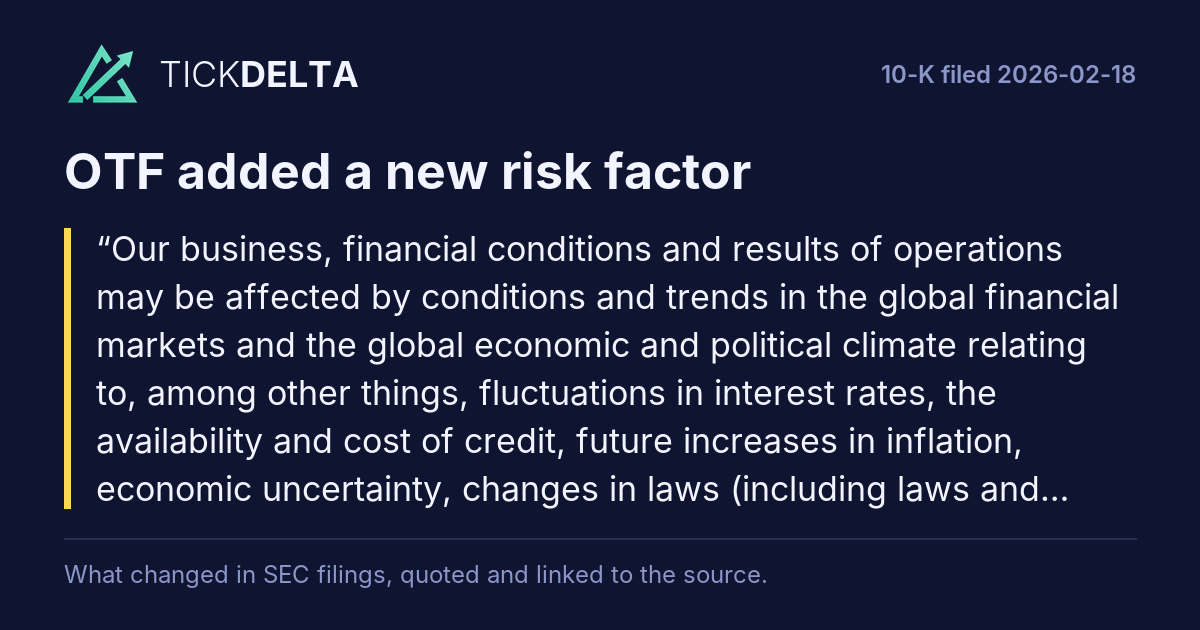
Our business, financial conditions and results of operations may be affected by conditions and trends in the global financial markets and the global economic and political climate relating to, among other things, fluctuations in interest rates, the availability and cost of credit, future increases in inflation, economic uncertainty, changes in laws (including laws and regulations relating to our taxation, taxation of our clients and applicable to alternative asset managers), trade policies, commodity prices, tariffs (including retaliatory tariffs), currency exchange rates and controls, political elections and administration transitions, and national and international political events (including contract terminations or funding pauses, government agency closures, prolonged government shutdowns, wars and other forms of conflict, terrorist acts, and security operations), work stoppages, labor shortages and labor disputes, supply chain disruptions and catastrophic events such as fires, floods, earthquakes, tornadoes, hurricanes and global health pandemics.

Changes in trade policies, including the imposition of new tariffs or increases in existing tariffs between the United States, Mexico, Canada, China or other countries, or reactionary measures in response thereto including retaliatory tariffs, legal challenges, or currency manipulation, could adversely affect the market conditions in which we operate. These factors are outside of our control and

Read in the 10-K

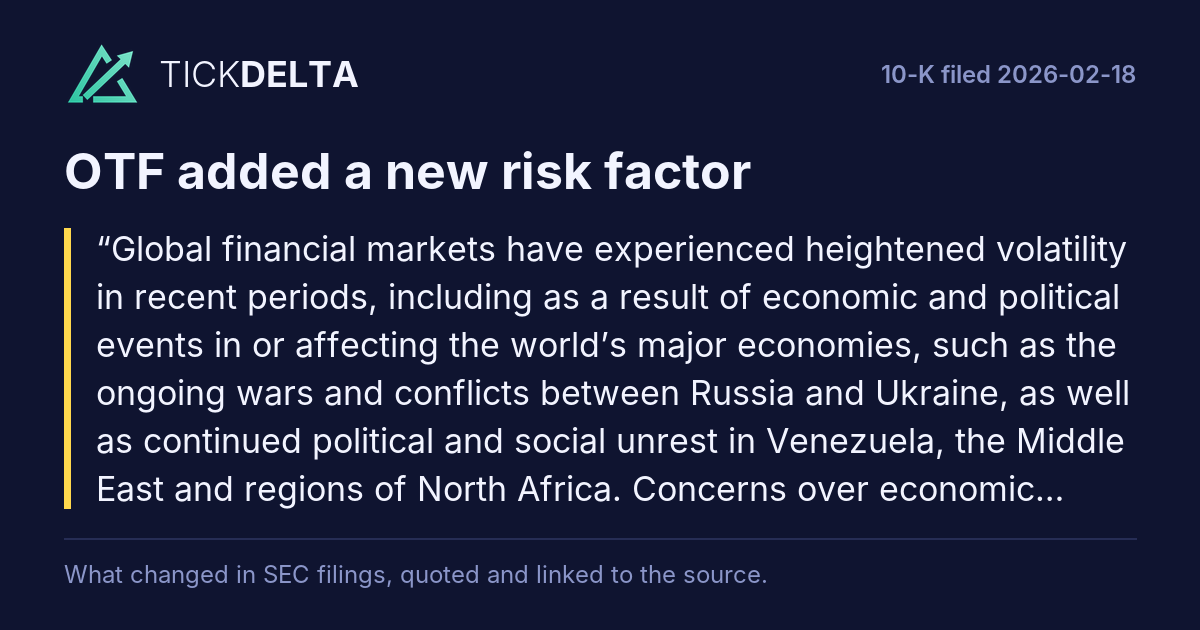
Global financial markets have experienced heightened volatility in recent periods, including as a result of economic and political events in or affecting the world’s major economies, such as the ongoing wars and conflicts between Russia and Ukraine, as well as continued political and social unrest in Venezuela, the Middle East and regions of North Africa. Concerns over economic recession, future increases in inflation, interest rate volatility, fluctuations in oil and gas prices resulting from global production and demand levels and geopolitical tension, have exacerbated market volatility. Market volatility has been further exacerbated by social unrest, changes regarding immigration and work permit policies and other political and security concerns both in the United States and across various international regions. Due to interrelationships within the global financial markets, our business may be adversely affected by such issues both within and outside of the directly affected regions.

During periods of difficult market conditions or slowdowns, which may be across one or more industries, sectors or geographies, the companies in which we invest may experience decreased revenues, financial losses, credit rating downgrades, difficulty in obtaining access to financing and increased funding costs. During such periods, those companies may also have difficulty in pursuing growth strategies, expanding their businesses and operations and be unable to meet their debt service obligations or other expenses as they become due, including obligations and expenses payable us. Negative financial results in our portfolio companies could have a material adverse effect on our business, financial condition, cash flows and results of operations and could cause the market value of our common shares and/or debt securities to decline.

Read in the 10-K

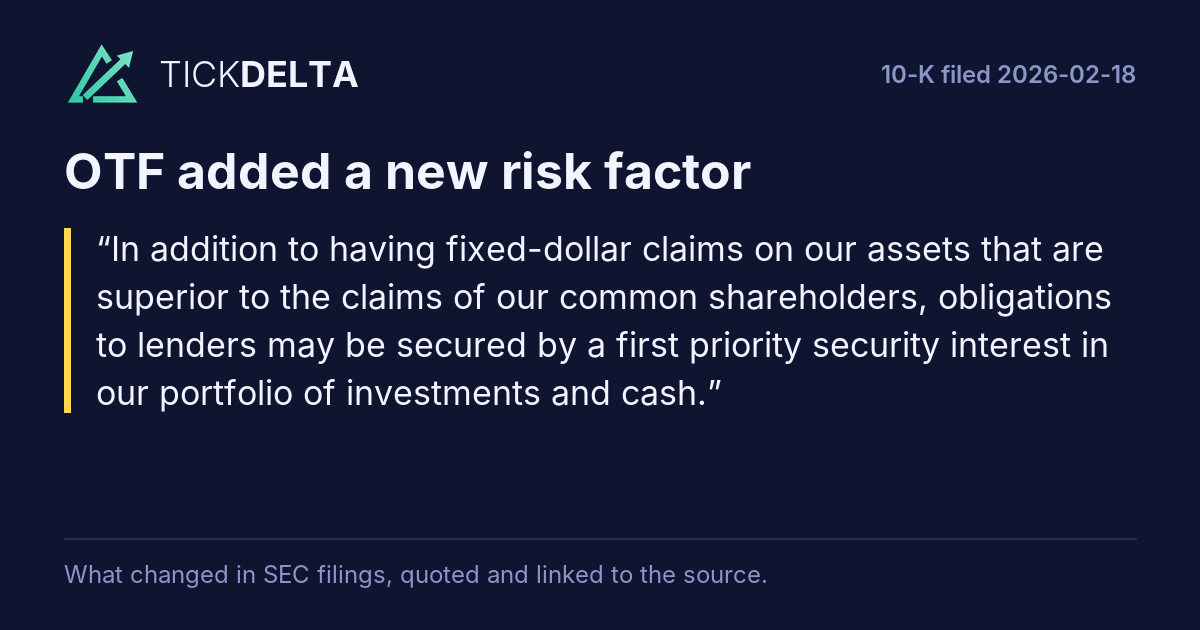
In addition to having fixed-dollar claims on our assets that are superior to the claims of our common shareholders, obligations to lenders may be secured by a first priority security interest in our portfolio of investments and cash.

Read in the 10-K
Show the other 18

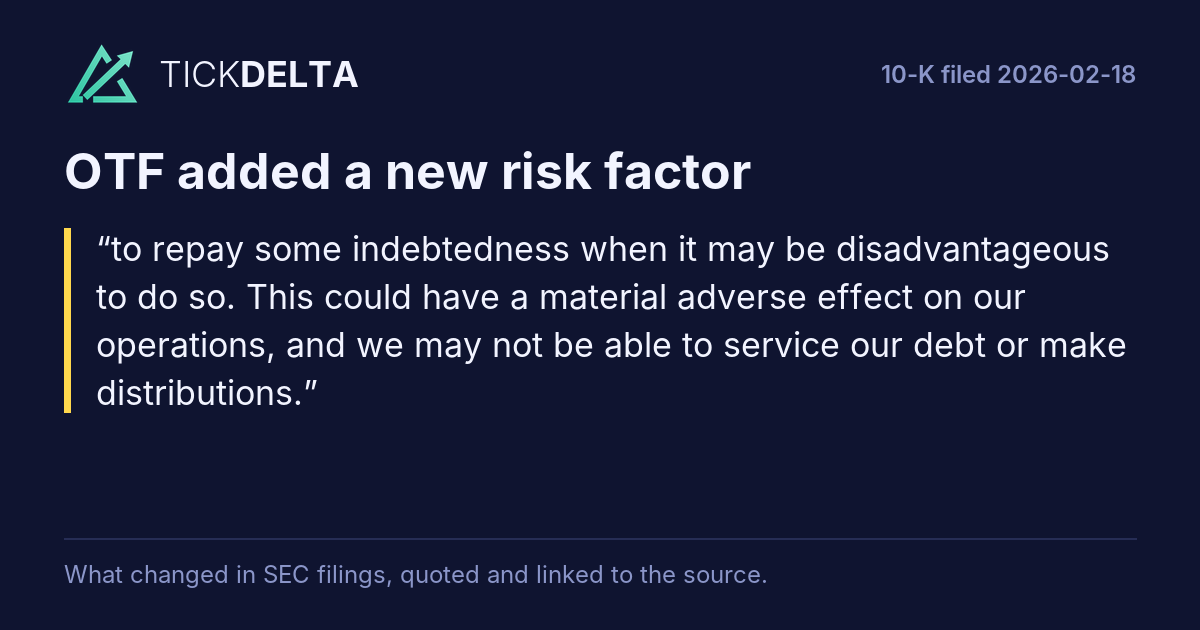
to repay some indebtedness when it may be disadvantageous to do so. This could have a material adverse effect on our operations, and we may not be able to service our debt or make distributions.

Read in the 10-K

investment opportunities from time to time. Also, we may not be able to identify and make investments that are consistent with our investment objective.

Read in the 10-K

Cybersecurity risks and cyber data security incidents could adversely affect our business by causing a disruption to our operations, a compromise or corruption of our confidential information and confidential information in our possession and damage to our business relationships.

There has been an increase in the frequency and sophistication of the cyber and security threats we face, with attacks ranging from those common to businesses generally to those that are more advanced and persistent, which may target us because, as an alternative asset management firm, we hold confidential and other price sensitive information about existing and potential investments. Malicious cyber activity involving ransomware, extortion, business email compromise, social engineering and other security threats could

Read in the 10-K

The efficient operation of our business is dependent on computer hardware and software systems, as well as data processing systems and the secure processing, storage and transmission of information, which, despite implementation of a variety of security measures, are vulnerable to security breaches and cyber-attacks. A cyber-attack is considered to be an intentional attack or an unintentional event or series of events and involves gaining unauthorized access to our information systems for purposes of misappropriating assets, stealing confidential information, corrupting data or causing operational disruption or otherwise compromising the confidentiality, integrity or availability of our systems or infrastructure. Some factors that could create a heightened risk of a cyber incident include the use of remote work tools and/or third-party service providers, including cloud-based service providers. In addition, we may be the target of social engineering, fraudulent emails or other targeted attempts to gain unauthorized access to proprietary or sensitive information. In addition to cyber-related threats, our and our affiliates’ information systems and those of our third-party service providers may be subject to failures or interruptions arising from other causes beyond our control, including sudden electrical or telecommunications outages, natural disasters such as earthquakes, tornadoes or hurricanes, disease pandemics, social unrest and geopolitical events including wars and acts of terrorism. Any such events could materially disrupt our operations and adversely affect our business and financial results. The result of any cyber-attack may include disrupted operations, including in our, our affiliates’, our investors’, our counterparties’, or third parties’ operations, misstated or unreliable financial data, fraudulent transfers or requests for transfers of money, liability for stolen or improperly accessed assets or information (including personal information), increased cybersecurity protection and insurance costs, litigation or damage to our business relationships and reputation, in each case causing our business and results of operations to suffer.

The rapid evolution and increased availability of artificial intelligence and machine learning technologies (collectively, “AI technologies”) may also intensify cybersecurity risks by making such attacks and other cybersecurity incidents more difficult to detect, contain, and mitigate. For example, threat actors could impersonate Blue Owl or its employees, including through the use of AI technologies. Such technologies make such impersonation more likely to occur or appear more credible.

Read in the 10-K

Use of AI technologies by us could lead to the exposure of our data or other adverse effects and increase competitive, operational, legal, and regulatory risks in ways that we cannot predict.

Recent technological advances in AI technologies, as well as the rapid growth and widespread use thereof, present risks to our business, products, portfolio companies and investments. AI technologies may result in significant and disruptive changes in companies, sectors or industries, including those in which we invest, and any such changes could render our Adviser’s underwriting models obsolete or create new and unpredictable operational, legal and/or regulatory risks. To the extent our competitors make more

efficient or extensive use of AI technologies, there is a possibility that such competitors will gain a competitive advantage. Many jurisdictions have passed or are considering laws and regulations concerning AI technologies, which could adversely affect our business, products, portfolio companies and investments. Additionally, we and the companies in which we invest could be further exposed to the risks of AI technologies if third-party service providers or any counterparties, whether or not known to us, use AI technologies in their business activities. We will not be able to control the use of AI technologies in third-party products or services, including those provided by our and our affiliates’ service providers. Additionally, the Adviser expects to use AI technologies in connection with its business activities, including to support our due diligence and investment activities. AI technologies are generally highly reliant on the collection and analysis of large amounts of data, and it is not possible or practicable to review all data upon which AI technologies are trained or which are otherwise utilized. AI technologies are also highly reliant on the accuracy, adequacy, completeness and objectivity of their underlying data, and any inaccuracies, deficiencies, errors or biases in this data could lead to errors affecting our decision-making and investment processes, which could have adverse impacts on us and our portfolio companies.

Read in the 10-K

We may be the target of litigation or similar proceedings in the future and we are subject to public perception risks.

We could generally be subject to litigation or similar proceedings in the future, including securities litigation and derivative actions by our stockholders. Any litigation or similar proceedings could result in substantial costs, divert management’s attention and resources from our business or otherwise have a material adverse effect on our business, financial condition and results of operations. In addition, in recent periods, there has been increased negative publicity with respect to the private credit industry, which could in the future harm our reputation.

Read in the 10-K

If the Blue Owl Credit Advisers and their affiliates fail to appropriately address those conflicts, it could negatively impact their reputation and ability to raise additional funds and the willingness of counterparties to do business with them or result in potential litigation against them.

Read in the 10-K

principal and interest payments according to the loan’s terms, or at all, or that we will be able to collect on the loan should we need to enforce our remedies.

Read in the 10-K

For any such investments, the optimization of the joint venture may be a complex, costly and time-consuming process and if we experience difficulties in this process, the anticipated benefits may not be realized fully or at all, or may take longer to realize than expected, which could have an adverse effect on us for an undetermined period after any such acquisition. There can be no assurances that we will realize any potential operating efficiencies, synergies and other benefits anticipated in connection with such joint ventures.

Read in the 10-K

competitors introduce or acquire new products that compete with their software and related services or add new features to their products. Any of this could, in turn, materially adversely affect our business, financial condition and results of operations.

Read in the 10-K

While the United States has withdrawn from the Paris Agreement, various other regulatory and voluntary initiatives launched by international, federal, state, and regional policymakers and regulatory authorities as well as private actors seeking to reduce greenhouse gas emissions may expose our business operations, products and products’ portfolio companies to other types of transition risks, such as: (i) political and policy risks, (including changing regulatory incentives, and legal requirements including with respect to

Read in the 10-K

•adverse publicity about the investment management industry generally or individual scandals specifically;

•a breach of our computer systems, software or networks, or misappropriation of our proprietary information;

Read in the 10-K

Sales of substantial amounts of our common stock or the perception that such sales could occur could adversely affect the prevailing market prices for our common stock. If this occurs, it could impair our ability to raise additional capital through the sale of equity securities should we desire to do so. We cannot predict what effect, if any, future sales of securities or the availability of securities for future sales will have on the market price of our common stock prevailing from time to time.

Our stock repurchase program could affect the price of our common stock and increase volatility and may be suspended or terminated at any time, which may result in a decrease in the trading price of our common stock.

Our Board has approved a share repurchase program for us to repurchase shares of our common stock and may approve additional share repurchase programs in the future. On May 27, 2025, our Board approved the 2025 Stock Repurchase Program under which we may repurchase up to $200 million of our outstanding common stock. Under the 2025 Stock Repurchase Program, purchases may be made at management’s discretion from time to time in open-market transactions, in accordance with all applicable securities laws and regulations. Unless extended by our Board, the 2025 Stock Repurchase Program will terminate 18-months from the date of the Exchange Listing.

The 2025 Stock Repurchase Program is discretionary and whether purchases will be made under the 2025 Stock Repurchase Program and how much will be purchased at any time is uncertain, dependent on prevailing market prices and trading volumes, all of which we cannot predict. These activities and activities under any future stock repurchase programs may have the effect of maintaining the market price of our common stock or retarding a decline in the market price of the common stock, and, as a result, the price of our common stock may be higher than the price that otherwise might exist in the open market. Repurchases pursuant to the 2025 Stock Repurchase Program and any future stock repurchase programs could affect the price of our common stock and increase its volatility. The existence of the 2025 Stock Repurchase Program could also cause the price of our common stock to be higher than it

would be in the absence of such a plan and could potentially reduce the market liquidity for our common stock. There can be no assurance that any stock repurchases will enhance stockholder value because the market price of our common stock may decline below the levels at which we repurchased such shares. Any failure to repurchase shares after we have announced our intention to do so may negatively impact our reputation and investor confidence in us and may negatively impact our stock price. Although the 2025 Stock Repurchase Program is intended to enhance long-term stockholder value, short-term stock price fluctuations could reduce the 2025 Stock Repurchase Program’s effectiveness.

Read in the 10-K

operations also could reduce the amount of capital we ultimately invest in debt or equity securities of portfolio companies. We cannot assure you that we will pay distributions to our shareholders in the future.

Read in the 10-K

For U.S. federal income tax purposes, we may be required to recognize taxable income in circumstances in which we do not receive a corresponding payment in cash. For example, since we will likely hold debt obligations that are treated under applicable tax

Read in the 10-K

Economic sanction laws in the U.S. and other jurisdictions may prohibit us and our affiliates from transacting with certain countries, individuals and companies.

Economic sanction laws in the U.S. and other jurisdictions may restrict or prohibit us or our affiliates from transacting with certain countries, territories, individuals and entities. In the U.S., the U.S. Department of the Treasury’s Office of Foreign Assets Control (“OFAC”) administers and enforces laws, executive orders and regulations establishing U.S. economic and trade sanctions, which restrict or prohibit, among other things, direct and indirect transactions with, and the provision of services to, certain countries, territories, industry sectors, individuals and entities. These types of sanctions may significantly restrict or completely prohibit lending activities in certain jurisdictions, and violation of any such laws or regulations, may result in significant legal and monetary penalties, as well as reputational damage. OFAC sanctions programs change frequently, which may make it more difficult for us or our affiliates to ensure compliance. Moreover, OFAC enforcement is increasing, which may increase the risk that we become the subject of such actual or threatened enforcement. Sanctions laws and regulations enforced by other countries may conflict with U.S. law such that compliance with both becomes difficult or even impossible.

Additionally, Section 2019 of the Iran Threat Reduction and Syria Human Rights Act of 2012 (the “ITRA”) amended the Exchange Act to require companies subject to SEC reporting obligations under Section 13 of the Exchange Act to disclose in their periodic reports specified dealings or transactions involving Iran or other individuals and entities targeted by OFAC during the period covered by the relevant periodic report. In some cases, the ITRA requires companies to disclose these types of transactions even if they were permissible under U.S. law. Companies that currently may be or may have been at the time considered our affiliates, may have from time to time publicly filed and/or provided to us such disclosures. We do not independently verify or participate in the preparation of these disclosures. We are required, either periodically or annually to separately file with the SEC a notice when such activities have been disclosed, and the SEC is required to post such notice of disclosure on its website and send the report to the President and certain U.S. Congressional committees. Disclosure of such activity, even if such activity is not subject to sanctions under applicable law, and any sanctions actually imposed on us or our affiliates as a result of these activities, could harm our reputation and have a negative impact on our business, financial condition and results of operations, and any failure to disclose any such activities as required could additionally result in fines or penalties.

Failure to comply with anti-corruption laws or with regulations regarding the prevention of money laundering or terrorism or national security could adversely affect our business.

We and the Adviser are committed to complying with all applicable anti-corruption and anti-bribery laws. As a result, the Adviser may forgo investment opportunities because of our unwillingness to participate in transactions that may expose us to risks under applicable anti-corruption and anti-bribery laws. Law enforcement agencies in the European Union, the United Kingdom, the United States and elsewhere devote significant resources to enforcement of anti-corruption and anti-bribery laws and regulations. Any failure to comply with anti-corruption and anti-bribery laws and regulations could have serious legal, financial and reputational consequences, including operational disruptions and significant financial penalties.

As part of our responsibility for the prevention of money laundering under applicable laws, we may require detailed verification of a prospective investor’s identity and the source of such prospective investor’s funds. We may from time to time request additional information as may be required for us to satisfy our obligations under these and other laws that may be adopted in the future. Additionally, we may from time to time be obligated to file reports with regulatory authorities in various jurisdictions with regard to, among other things, the identity of our investors and suspicious activities involving investments in us. In the event it is determined that any investor, or any direct or indirect owner of any investor, is a person identified in any of these laws as a prohibited person, or is otherwise engaged in activities of the type prohibited under these laws, we may be obligated, among other actions to be taken, to withhold distributions of any funds otherwise owing to such investor or to cause such investor’s interests to be cancelled or otherwise redeemed (without the payment of any consideration in respect of those interests).

The Bank Secrecy Act of 1970 and the USA PATRIOT Act require that financial institutions (a term that includes banks, broker-dealers and investment companies) establish and maintain compliance programs to guard against money laundering activities. These implementing regulations were amended to include registered investment advisers within scope of financial institutions that will be obliged to adopt stand-alone anti-money laundering programs, though the U.S. Department of the Treasury’s Financial Crimes Enforcement Network (“FinCEN”) has postponed the effective date of the amendment to January 1, 2028 and announced its intention to revisit the scope and applicability of the amendment to certain asset managers at a future date. Laws or regulations may presently or in the future require us, any of our affiliates or other service providers to establish additional anti-money laundering procedures, to collect information with respect to our products’ investors, to share information with governmental authorities with respect to our products’ investors or to implement additional restrictions on the transfer of the interests. These requirements can lead to increased expenses and exposure to enforcement actions.

Read in the 10-K

continue to pursue enforcement actions against asset managers. The current administration and the current leadership of the SEC have indicated that they intend to not adopt certain proposals or modify or repeal certain regulations perceived as burdensome to private fund advisers, particularly those related to sustainability investing and cybersecurity. This enforcement activity and the evolving regulatory landscape have caused, and could further cause us to reevaluate certain practices and adjust our compliance control function as necessary and appropriate.

Read in the 10-K

Credit funds have been the subject of increasing regulatory focus at international and regional levels. To the extent that we are engaged in lending activity, we may be subject to restrictions on our activities and be obliged to comply with regulatory reporting and disclosure requirements. The International Organization of Securities Commissions (“IOSCO”) and the Financial Stability Board (“FSB”) have called on regulators to consider issues arising from the rapid growth in private finance, including in relation to systemic risk, transparency, leverage, liquidity, and conflicts of interest. It is likely that regulators will continue to focus on the credit funds sector and may introduce further regulatory requirements in the future.
Read in the 10-K

Paragraphs in the 10-Q filed Nov 4, 2026 that were not in the one before

New in the latest 10-Q

26 paragraphs in the 10-Q filed Nov 4, 2026 with nothing like them in the 10-Q filed Aug 5, 2026 (at least half the words must differ; new numbers alone do not count). Quoted exactly, grouped by the item heading above them. This is text that changed, not a judgement of how serious it is.

Financial statements and notes

(e) Represents the transfers into (out of) Non-Controlled Affiliates and Controlled Affiliates at fair value during the period, as applicable.

Read in the 10-Q

(29)Non-income producing investment, which does not have a stated rate of interest or a stated dividend return.

Read in the 10-Q

Portfolio Company Investment Acquisition Date 6Sense Insights, Inc. Series E-1 Preferred Stock January 20, 2022 AAM Series 1.1 Rail and Domestic Intermodal Feeder, LLC Specialty finance equity investment July 01, 2022 AAM Series 2.1 Aviation Feeder, LLC Specialty finance equity investment July 01, 2022 Accelerate Topco Holdings, LLC Common Units March 24, 2025 ──────────────────────────────────────────────────────────────────────────────────────────────────────────────────────────

Read in the 10-Q

• Credit, which includes several strategies, including (i) direct lending, which generally offers privately negotiated financing solutions to primarily upper-middle-market companies; (ii) alternative credit, which targets credit-oriented investments in markets underserved by traditional lenders or the broader capital markets, with deep expertise investing across specialty finance, private corporate credit and equipment leasing; (iii) investment grade credit, which focuses on generating capital-efficient investment income through asset-backed finance, private corporate credit, and structured products; (iv) liquid credit, which focuses on the management of CLOs; and (v) our other adjacent investment strategies (e.g., strategic equity and healthcare opportunities),

Read in the 10-Q

• GP Strategic Capital, which primarily focuses on acquiring equity stakes in, and providing debt financing to, large, multi-product private equity and private credit firms through two investment strategies (GP minority stakes and GP debt financing), and also includes a professional sports minority stakes strategy), and

Read in the 10-Q
Show the other 21

• Real Assets, which includes a net lease strategy, which focuses on acquiring net-leased real estate occupied by investment grade and creditworthy tenants; a real estate credit strategy which offers a diverse range of competitive financing solutions; and digital infrastructure, which focuses on acquiring, financing, developing and operating data centers and related digital infrastructure assets. Subject to the overall supervision of the Company’s board of directors (the “Board”), the Adviser manages the day-to-day operations of, and provides investment advisory and management services to, the Company.

Read in the 10-Q

The following table provides a reconciliation of cash, restricted cash and foreign cash as reported on the Consolidated Statements of Assets and Liabilities to the total of such amounts shown as of the end of the applicable period as reported on the Consolidated Statements of Cash Flows:

Read in the 10-Q

The Company enters into International Swaps and Derivatives Association master netting agreements (“ISDA Agreements”) with each of its derivatives counterparties. The Company has determined it has a legal right to offset the recognized amounts under ISDA Agreements by counterparty, and it intends to settle on a net basis. As a result, the Company classifies by counterparty net derivative assets in the line item prepaid expenses and other assets, and net derivative liabilities in the line item accrued expenses and other liabilities in the Company’s Consolidated Statements of Assets and Liabilities. The Company nets all of its derivatives by counterparty across all derivative instruments, not taking into account collateral posted, which is recorded separately as restricted cash, if applicable.

Read in the 10-Q

Investments are generally placed on non-accrual status when it is not probable that principal or interest will be collected in full. Accrued but unpaid interest is generally reversed when an investment is placed on non-accrual status.

Read in the 10-Q

In September 2026, the Financial Accounting Standards Board (“FASB”) issued ASU No. 2026-03, “Fair Value Measurement (Topic 820),” which requires that a contractual restriction on the sale of an equity security be considered in measuring the fair value of the equity security and disclose the amount of the discount attributable to the contractual sale restriction. ASU 2026-03 is effective for annual reporting periods beginning after December 15, 2027, and interim reporting periods within those annual reporting periods. Early adoption is permitted and application of the amendments prospectively are required for all equity securities with any adjustments from the adoption of the amendments recognized in earnings. The Company is currently assessing the impact of this guidance, however, the Company does not expect a material impact on its consolidated financial statements.

Read in the 10-Q

The Company has entered into an investment advisory agreement between the Company and the Adviser (the “Investment Advisory Agreement”). On May 4, 2026, the Board approved the continuation of the Investment Advisory Agreement.

Read in the 10-Q

Credit SLF makes investments primarily in senior secured broadly syndicated loans to U.S. middle market companies. It was formed in May 2024 and made its first portfolio company investment in July 2024.

Read in the 10-Q

Blue Owl Leasing makes investments primarily in secured fixed-rate equipment leases and loans.

Read in the 10-Q

equityholder and as services provider, and the lenders party thereto. On September 11, 2026, the parties to the SPV Asset Facility V entered into the First Amendment to Loan Financing and Servicing Agreement, in order to, among other changes, increase the maximum principal amount and modify the conditions with respect to the borrowing base test. The following describes the terms of the SPV Asset Facility V as amended through September 11, 2026.

Read in the 10-Q

commitment is subject to an undrawn fee of 0.15 % per annum. Certain additional fees are payable to Natixis, New York Branch as administrative agent.

Read in the 10-Q

(1) Shares purchased in the open market in order to satisfy dividends reinvested under the Company’s dividend reinvestment program.

Read in the 10-Q

• Credit, which includes several strategies, including (i) direct lending, which generally offers privately negotiated financing solutions to primarily upper-middle-market companies; (ii) alternative credit, which targets credit-oriented investments in markets underserved by traditional lenders or the broader capital markets, with deep expertise investing across specialty finance, private corporate credit and equipment leasing; (iii) investment grade credit, which focuses on generating capital-efficient investment income through asset-backed finance, private corporate credit, and structured products; (iv) liquid credit, which focuses on the management of CLOs; and (v) our other adjacent investment strategies (e.g., strategic equity and healthcare opportunities),

Read in the 10-Q

• GP Strategic Capital, which primarily focuses on acquiring equity stakes in, and providing debt financing to, large, multi-product private equity and private credit firms through two investment strategies (GP minority stakes and GP debt financing), and also includes a professional sports minority stakes strategy), and

Read in the 10-Q

Technology Lending Investment Committee’s supervision, sources investment opportunities, conducts research, performs due diligence on potential investments, structures our investments and will monitor our portfolio companies on an ongoing basis.

Read in the 10-Q

Secular Trends Supporting Growth for Private Credit - According to Gartner, a research and advisory company, global technology spend was $5.6 trillion in 2025 and is expected to grow to more than $6.2 trillion in 2026. We believe global demand for technology products and services will continue to grow rapidly, and that growth will stimulate demand for capital from technology

Read in the 10-Q

During the third quarter of 2026, global equity and debt markets remained driven by expectations around inflation, interest rates, artificial intelligence (“AI”)-related capital expenditures, and ongoing geopolitical tensions, including in the Middle East and their impact on certain energy prices. Equity indices saw modest appreciation during the third quarter despite lack of market breadth, with approximately two-thirds of S&P 500 and Russell 1000 stocks retreating during the quarter. The 10-year Treasury yield in the United States ended the third quarter of 2026 at 5.29%, approximately 85 basis points higher than June 30, 2026 and in late September, the Federal Reserve announced a rate hike of 25 basis points, increasing the federal funds target range to 3.75% to 4.00%. This represented a significant shift from the beginning of the year, when market participants had anticipated further reductions in the federal funds rate. Increases in base rates and credit spreads increase the yields available on our new investments and the income generated by our existing floating rate investments.

Read in the 10-Q

For the quarter ended September 30, 2026, a substantial portion of our financings were with existing borrowers. Many of these come from large, incumbent borrowers, reflecting the advantage of incumbency and scale and allowing us to support their continued growth and maintain the credit quality of our portfolio.

Read in the 10-Q

In connection with the Exchange Listing, shares of our common stock were subject to certain restricted periods all of which have expired.

Read in the 10-Q

(1) Shares purchased in the open market in order to satisfy dividends reinvested under the Company’s dividend reinvestment program.

Read in the 10-Q

Market risk

U.S. inflation rates have fluctuated in recent periods, and remain well above historical levels over the past several decades. Ongoing inflationary pressures have increased the costs of labor, energy and raw materials and have adversely affected consumer spending, economic growth and our portfolio companies’ operations.

Read in the 10-Q

Legal proceedings

On October 5, 2026, Randy Lewis, a purported former shareholder of OTF II, filed a complaint in New York State Supreme Court in New York County, on behalf of himself and a purported class of former OTF II shareholders. Plaintiff Lewis asserts claims against the Company, certain of its current officers and directors and the Adviser alleging violations of Sections 11, 12(a)(2), and 15 of the Securities Act of 1933 based on allegedly false and misleading statements in the Company’s registration and offering materials issued in connection with the March 24, 2025 merger of OTF II into the Company.

Read in the 10-Q

The 10-Q's risk factors against the 10-K

Item 1A of the 10-Q filed Nov 4, 2026 against Item 1A of the 10-K filed Feb 18, 2026. A 10-Q repeats only the risks that changed, so a 10-K paragraph that is missing from it is not counted as removed. Added is a paragraph with nothing like it in the 10-K, Reworded a sentence that is in both with several words changed, Quiet changes a sentence in both where one to four words changed and one is a hedge or a modal (cut words struck through, new words highlighted). Text on the page, not a score; each links to the filing at sec.gov.

Added10-Q Nov 4, 2026 vs 10-K Feb 18, 2026
In addition to the other information set forth in this report, you should carefully consider the risk factors discussed in Part I, “ITEM 1A. RISK FACTORS” in our annual report on Form 10-K for the fiscal year ended December 31, 2025, which could materially affect our business, financial condition and/or operating results. The risks described in our annual report on Form 10-K for the fiscal year ended December 31, 2025, are not the only risks we face. Additional risks and uncertainties not currently known to us or that we currently deem to be immaterial also may materially and adversely affect our business, financial condition and/or operating results.

Read it in the 10-Q at sec.gov

Phrases used for the first time

Two-word phrases in Risk Factors of the 10-K filed Feb 18, 2026 that are in none of the 1 earlier 10-Ks stored, back to Mar 6, 2025

clo issuers ×12stock repurchase ×12repurchase program ×10owl clients ×8clo transactions ×6anti-bribery laws ×4difficult market ×3operational legal ×3regulatory risks ×3customer information ×3similar proceedings ×3one blue ×3owl client ×3repurchase programs ×3money laundering ×3geopolitical conditions ×2
Where each one is used
  • clo issuers: Under the terms of the loan sale agreements entered into in connection with our debt securitization transactions with respect to the CLOs (collectively, the “CLO Transactions”), we and certain financing subsidiaries sold and/or contributed to the respective issuers in connection with the particular CLO Transaction...
  • stock repurchase: Our stock repurchase program could affect the price of our common stock and increase volatility and may be suspended or terminated at any time, which may result in a decrease in the trading price of our common stock.
  • repurchase program: Our stock repurchase program could affect the price of our common stock and increase volatility and may be suspended or terminated at any time, which may result in a decrease in the trading price of our common stock.
  • owl clients: We may compete for investments with other BDCs and investment funds (including registered investment companies, private equity funds and mezzanine funds), including the other Blue Owl Clients or other funds managed by our Adviser or its affiliates comprising Blue Owl’s Credit platform (including Blue Owl’s...
  • clo transactions: Under the terms of the loan sale agreements entered into in connection with our debt securitization transactions with respect to the CLOs (collectively, the “CLO Transactions”), we and certain financing subsidiaries sold and/or contributed to the respective issuers in connection with the particular CLO Transaction...
  • anti-bribery laws: We and the Adviser are committed to complying with all applicable anti-corruption and anti-bribery laws. As a result, the Adviser may forgo investment opportunities because of our unwillingness to participate in transactions that may expose us to risks under applicable anti-corruption and anti-bribery laws. Law...
  • difficult market: •Difficult market and geopolitical conditions could have a significant adverse effect on our business, financial condition and results of operations.
  • operational legal: •Use of AI technologies by us could lead to the exposure of our data or other adverse effects and increase competitive, operational, legal, and regulatory risks in ways that we cannot predict.

The 10-K at sec.gov

Used at least twice, small words left out. Counted, not picked: a phrase can be new because the company renamed something.

What was taken out

100 paragraphs of last year's Risk Factors with nothing like them now. The longest are quoted.

Across all companies
Finally, there continues to be significant evolution and developments in the use of artificial intelligence technologies, such as ChatGPT. We cannot fully determine the impact or cybersecurity risk of such evolving technology to our business at this time. We may incorporate, directly or through third-party vendors, the use of artificial intelligence (“AI”) into our business and operations, and anticipate that usage and adoption of AI in the marketplace will continue to grow. As with many disruptive innovations, AI presents risks and challenges that could affect its accuracy adoption and...
In the 10-K filed Mar 6, 2025
Our operations will be impacted by a growing movement to adopt comprehensive privacy and data protection laws similar to the GDPR, including in the U.S., where such laws focus on privacy as an individual right in general. For example, the State of California passed the California Consumer Privacy Act of 2018 (as amended, the “CCPA”), which took effect on January 1, 2020. The CCPA generally applies to businesses that collect personal information about California consumers and meet certain thresholds with respect to revenue or buying and/or selling consumers’ personal information. The CCPA...
In the 10-K filed Mar 6, 2025
Uncertainty can result in or coincide with, among other things: increased volatility in the financial markets for securities, derivatives, loans, credit and currency; a decrease in the reliability of market prices and difficulty in valuing assets (including portfolio company assets); greater fluctuations in spreads on debt investments and currency exchange rates; increased risk of default (by both government and private obligors and issuers); further social, economic, and political instability; nationalization of private enterprise; greater governmental involvement in the economy or in...
In the 10-K filed Mar 6, 2025
The Mergers are subject to closing conditions, including certain approvals of OTF II’s shareholders and our shareholders and the receipt of any necessary state securities or “blue sky” authorizations, that, if not satisfied, will prevent the Mergers from being completed. The closing condition that OTF II's shareholders adopt the Merger Agreement and approve the Mergers (the “Merger Proposal”) may not be waived under applicable law and must be satisfied for the Mergers to be completed. If OTF II's shareholders do not approve the Merger Proposal and the Mergers are not completed, the...
In the 10-K filed Mar 6, 2025

Sources

Item 1A of each 10-K and 10-Q on EDGAR, quoted exactly. Each paragraph links to the filing at sec.gov.

Also

10-K change: what was reworded or cut, section by section.

Work with it

Excel workbook · CSV. Google Sheet that stays up to date: paste =IMPORTDATA("https://tickdelta.com/company/OTF/export.csv") into a cell.

Next:10-K change
Esc

Type a ticker such as AAPL, a name, an investor such as Buffett, or a topic such as tariffs. ↑ ↓ to move, Enter to open.