Paragraphs with nothing like them in last year's 10-K
Quoted exactly
11 paragraphs in Risk Factors of the 10-K filed May 14, 2026
with nothing like them in the 10-K filed May 9, 2025. Quoted exactly.
Paragraphs that were only edited are under 10-K change.
•Adverse customer or stockholder reaction to the acquisition and/or the associated debt.
Heightened regulatory activity and expectations worldwide, particularly for sterile eye care products, have contributed to ongoing manufacturing disruptions and capacity constraints across the industry. These conditions have impacted, and we expect they will continue to impact for the foreseeable future, the availability of sterile eye care products, which has and may continue to adversely affect our net revenues, product mix, customer service levels, and our ability to fully meet demand in affected categories. While we continue to pursue alternate sources of supply where feasible, qualification, validation and regulatory readiness activities can require significant time and resources and may not fully mitigate near-term constraints. In fiscal 2026, we acquired a sterile eye care manufacturing facility and expect to make investments to enhance quality systems, expand capabilities and improve the consistency and reliability of supply over the long term. The timing and extent of any improvements will depend on the successful execution of these initiatives, including equipment upgrades, process improvements, staffing, and completion of required validations and regulatory activities. Accordingly, while we believe these investments position us to strengthen supply over time, achieving sustained improvements is expected to be a multi-step process and may not alleviate current or near-term supply limitations.
Regulatory authorities, including the Federal Trade Commission, have increasingly focused on the substantiation of marketing and advertising claims and have commenced enforcement actions against companies for failures to adequately substantiate such claims. As a result, we may face increased scrutiny of our marketing practices, and any determination that our claims are not adequately supported could result in enforcement actions, including fines, injunctions, product relabeling or other corrective measures, as well as increased risk of private litigation, which could adversely affect our business, financial condition and results of operations.
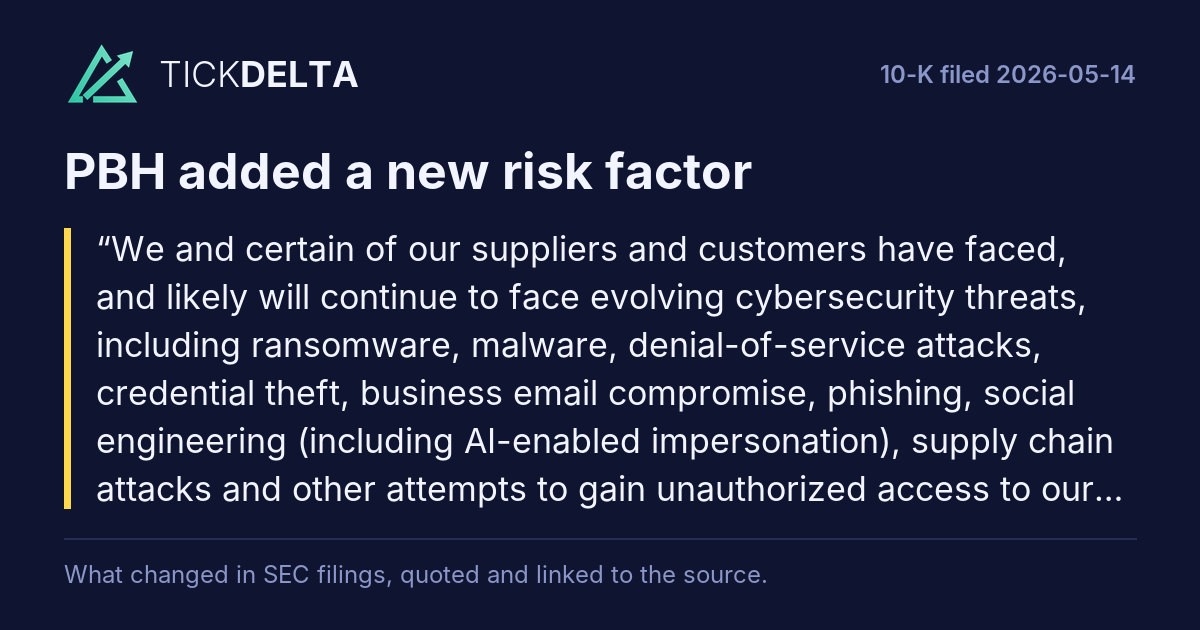
We and certain of our suppliers and customers have faced, and likely will continue to face evolving cybersecurity threats, including ransomware, malware, denial-of-service attacks, credential theft, business email compromise, phishing, social engineering (including AI-enabled impersonation), supply chain attacks and other attempts to gain unauthorized access to our systems, networks, devices and data. These threats may be directed at our information technology environment or at third parties that provide technology or operational services to us, such as cloud service providers, ERP or other enterprise application providers, customer/retailer ordering interfaces, payment processors, marketing or data analytics vendors, contract manufacturers and third-party logistics providers. Because we rely on these third parties and data connections to operate key processes, a cybersecurity incident could also result from a compromise of, or disruption to, a third-party’s systems even if our own systems are not directly compromised. A cybersecurity incident could, among other things, disrupt the availability of systems used for order processing, forecasting, manufacturing planning, distribution, invoicing, treasury operations or financial reporting; delay shipments; reduce product availability; result in chargebacks or penalties from customers; and cause us to incur significant costs related to containment, investigation, remediation, restoration of data and systems, and enhanced protective measures. While we do not believe prior incidents have had a material adverse impact on our business, future attacks including as a result of vulnerabilities in third-party systems or supply chain cyber risks, could result in a serious information security breach, related litigation and regulatory inquiries, reputational harm and diversion of management attention, any of which could have a material adverse impact on our business, results of operations or financial condition.
The use of artificial intelligence technologies presents operational, legal and regulatory risks.
Show the other 4
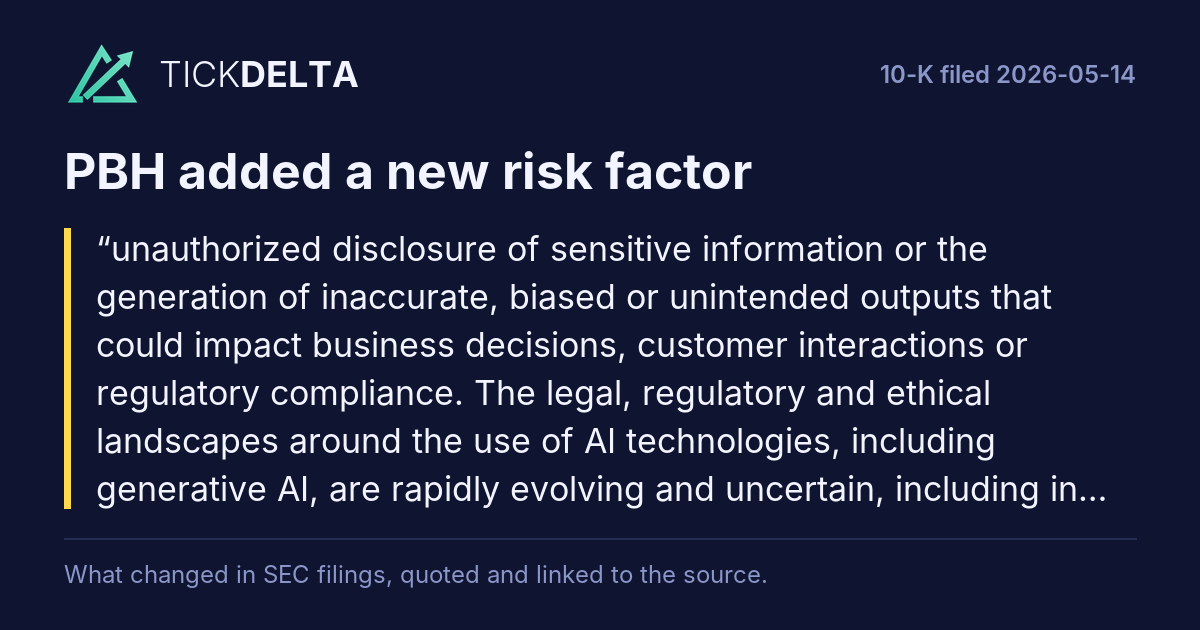
unauthorized disclosure of sensitive information or the generation of inaccurate, biased or unintended outputs that could impact business decisions, customer interactions or regulatory compliance.
The legal, regulatory and ethical landscapes around the use of AI technologies, including generative AI, are rapidly evolving and uncertain, including in relation to the areas of intellectual property, cybersecurity and privacy and data protection. These developments may result in new or expanded legal and compliance obligations and could impose significant operational or compliance burdens on our business. In addition, the use of AI technologies may create risks relating to the ownership, protection or enforceability of our intellectual property, or result in claims that we have infringed the intellectual property rights of third parties.
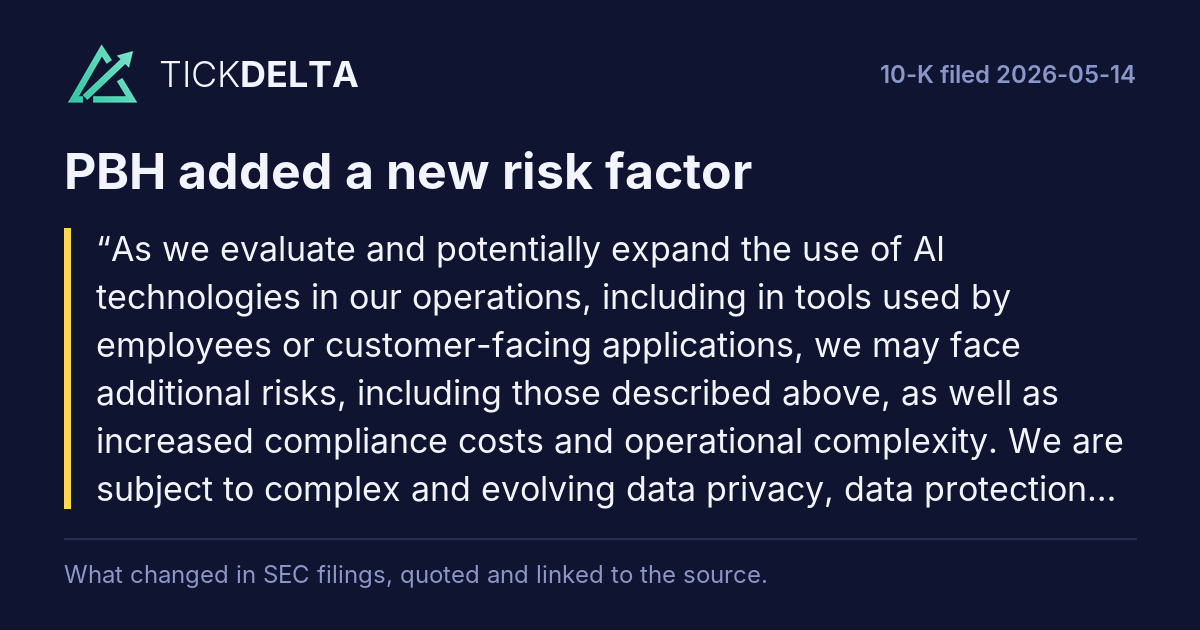
As we evaluate and potentially expand the use of AI technologies in our operations, including in tools used by employees or customer-facing applications, we may face additional risks, including those described above, as well as increased compliance costs and operational complexity.
We are subject to complex and evolving data privacy, data protection and data security laws, and failure to comply could result in significant costs, liabilities and operational restrictions.
Compliance with these evolving requirements may necessitate significant operational changes and could impose substantial and increasing costs over time. Any failure to comply could result in regulatory investigations, significant fines, penalties or restrictions on our ability to process or transfer data across jurisdictions, and reputational harm.
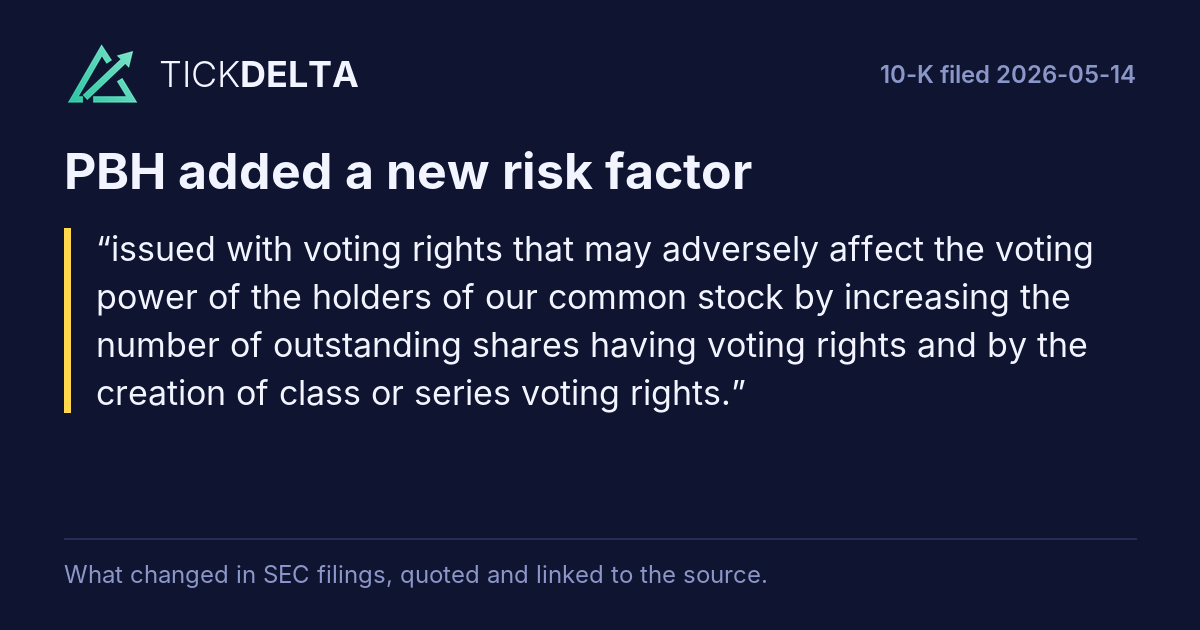
issued with voting rights that may adversely affect the voting power of the holders of our common stock by increasing the number of outstanding shares having voting rights and by the creation of class or series voting rights.
Paragraphs in the 10-Q filed Nov 5, 2026 that were not in the one before
New in the latest 10-Q
7 paragraphs in the 10-Q filed Nov 5, 2026 with nothing like
them in the 10-Q filed Aug 6, 2026 (at least half the words must differ; new numbers alone do not count).
Quoted exactly, grouped by the item heading above them. This is text that changed, not a judgement of how serious it is.
10-Q
As of October 30, 2026, there were 47,397,106 shares of common stock outstanding.
Read in the 10-Qopen_in_new
Financial statements and notes
brand. The increase in the Dermatologicals category was primarily attributable to the acquisition of LaCorium Health, particularly the Dermal Therapy brand.
Read in the 10-Qopen_in_new
During the three months ended September 30, 2026, we recorded a loss on extinguishment of debt of $1.4 million related to the redemption of our 2019 Senior Notes.
Read in the 10-Qopen_in_new
increase in the Dermatologicals category was primarily attributable to the acquisition of LaCorium Health, particularly the Dermal Therapy brand.
Read in the 10-Qopen_in_new
During the six months ended September 30, 2026, we recorded a loss on extinguishment of debt of $1.4 million related to the
Read in the 10-Qopen_in_new
Show the other 2
Market risk
We are exposed to changes in interest rates because our Term Loan Credit Agreement and 2012 ABL Revolver are variable rate debt. At September 30, 2026, $1,110.0 million of our debt carries a variable rate of interest.
Read in the 10-Qopen_in_new
Holding other variables constant, including levels of indebtedness, a 1.0% increase in interest rates on our variable rate debt would have an adverse impact on pre-tax earnings and cash flows for the three and six months ended September 30, 2026 of approximately $2.8 million and $3.4 million, respectively.
Read in the 10-Qopen_in_new
The 10-Q's risk factors against the 10-K
Item 1A of the 10-Q filed Nov 5, 2026 against Item 1A of the 10-K filed May 14, 2026.
A 10-Q repeats only the risks that changed, so a 10-K paragraph that is missing from it is not counted as removed.
Added is a paragraph with nothing like it in the 10-K, Reworded a sentence that is in both with several words changed,
Quiet changes a sentence in both where one to four words changed and one is a hedge or a modal
(cut words struck through, new words highlighted).
Text on the page, not a score; each links to the filing at sec.gov.
Added10-Q Nov 5, 2026 vs 10-K May 14, 2026
You should carefully consider the risk factors discussed in Part I, Item 1A. "Risk Factors" in our Annual Report on Form 10-K for the year ended March 31, 2026, which could materially affect our business, financial condition or results of operations. The risk factors described in our Annual Report on Form 10-K have not materially changed in the period covered by this Quarterly Report on Form 10-Q, but such risks are not the only risks facing us. Additional risks and uncertainties not currently known to us or that we currently deem to be immaterial also may materially adversely affect our business, financial condition and results of operations.
Read it in the 10-Q at sec.govopen_in_new
Added10-Q Nov 5, 2026 vs 10-K May 14, 2026
Our quarterly operating results and revenues may fluctuate as a result of any of these or other factors. Accordingly, results for any one quarter are not necessarily indicative of results to be expected for any other quarter or for any year, and revenues for any particular future period may decrease. In the future, operating results may fall below the expectations of securities analysts and investors. In that event, the market price of our outstanding securities could be adversely impacted.
Read it in the 10-Q at sec.govopen_in_new
Phrases used for the first time
Two-word phrases in Risk Factors of the 10-K filed May 14, 2026 that are in none of the 1 earlier 10-Ks stored, back to May 9, 2025
reputational harm ×4sterile eye ×3regulatory action ×2manufacturers one ×2risks associated ×2middle east ×2reduce product ×2producer responsibility ×2unauthorized access ×2costs liabilities ×2privacy requirements ×2compliance obligations ×2
Where each one is used
- reputational harm: Many of our products are produced by a limited number of third-party manufacturers. Our ability to retain our current manufacturing relationships or engage in and successfully transition to new relationships or to our own manufacturing facilities is critical to our ability to deliver quality products to our...
- sterile eye: Heightened regulatory activity and expectations worldwide, particularly for sterile eye care products, have contributed to ongoing manufacturing disruptions and capacity constraints across the industry. These conditions have impacted, and we expect they will continue to impact for the foreseeable future, the...
- regulatory action: Many of our products are produced by a limited number of third-party manufacturers. Our ability to retain our current manufacturing relationships or engage in and successfully transition to new relationships or to our own manufacturing facilities is critical to our ability to deliver quality products to our...
- manufacturers one: Certain of our manufacturers who produce products for us have experienced cash flow shortages, and we have provided both prepayments and short-term loans to these suppliers to ensure continuous supply. Following the full transfer of product supply to other manufacturers, one supplier to which we extended a...
- risks associated: At March 31, 2026, we had relationships with 95 third-party manufacturers. Of those, we had long-term contracts with 18 manufacturers that produced items that accounted for approximately 60% of gross sales for 2026, compared to 16 manufacturers with long-term contracts that accounted for approximately 58% of gross...
- middle east: Our financial performance depends on the stability of conditions that impact consumer spending. Adverse conditions or volatility in financial markets or the economy, including high interest rates, inflation from rising costs, tariffs, unemployment, bank failures, reductions in government assistance and the lack of...
- reduce product: During 2026, Walmart and Amazon, which accounted for approximately 20% and 15%, respectively, of our gross revenues, were our only customers that accounted for more than 10% of our gross revenues. We expect that for future periods, our top ten customers, including Walmart and Amazon, in the aggregate, will continue...
- producer responsibility: While we seek to maintain sustainable operations that are both operationally and financially beneficial to our business, and contribute to the health and wellness of the communities in which we operate, we may experience reduced demand for our products and loss of customers if we do not meet their expectations,...
The 10-K at sec.govopen_in_new
Used at least twice, small words left out. Counted, not picked: a phrase can be new because the company renamed something.
We and certain of our suppliers and customers have been, and likely will continue to be, subject to malware, computer viruses, computer hacking, attempted acts of data theft, phishing, other cyber-attacks and employee error or malfeasance related to information technology systems. We do not believe that any of these attacks or events has had a material adverse impact on our business, but future attacks could result in a serious information security breach and have a material adverse impact on our business, results of operations or financial condition.
In the 10-K filed May 9, 2025open_in_new
successfully resolve those claims, which would cause us to lose the right to use the intellectual property subject to those claims. If we were to lose the exclusive right to use one or more of our intellectual property rights, the loss of such exclusive right could have a material adverse effect on our financial condition and results of operations.
In the 10-K filed May 9, 2025open_in_new
The costs to manufacture and distribute our products are subject to fluctuation based on a variety of factors. Volatility and increases in commodity raw material (e.g. resins) and packaging component prices, labor, energy and transportation costs, and
In the 10-K filed May 9, 2025open_in_new
We could also be required for a variety of reasons to initiate product recalls, which we have done on several occasions. Any product recalls could have a material adverse effect on our business, financial condition and results of operations.
In the 10-K filed May 9, 2025open_in_new
Sources
Item 1A of each 10-K and 10-Q on EDGAR, quoted exactly. Each paragraph links to the filing at sec.gov.
Also
10-K change: what was reworded or cut, section by section.
Work with it
Excel workbook · CSV. Google Sheet that stays up to date: paste =IMPORTDATA("https://tickdelta.com/company/PBH/export.csv") into a cell.