Added10-Q Nov 5, 2026 vs 10-K Feb 24, 2026
Servicing our debt may require a significant amount of cash, and we may not have sufficient cash flow from our business to service our debt.
Each branch is a paragraph in Risk Factors with nothing like it in the 10-K filed Feb 26, 2025. A box jumps to the paragraph as filed, below.
22 paragraphs in Risk Factors of the 10-K filed Feb 24, 2026 with nothing like them in the 10-K filed Feb 26, 2025. Quoted exactly. Paragraphs that were only edited are under 10-K change.
Continuing and increasing sales of our products and services depends to a significant extent on our ability to expand our sales and marketing capabilities. It is difficult to predict customer demand, customer retention, and expansion rates, the size and growth rate of the market, the entry of competitive products and services, or the success of existing competitive products and services. Our sales and marketing efforts involve educating prospective customers about the uses and benefits of our products, services, and platform. We spend
We are increasingly building or incorporating AI tools (including generative and agentic AI tools) into our products, services, and platform. We also deploy AI tools in our business operations. We have used, and may continue to use, third parties to provide and support these tools. Our use of AI may present significant risks, uncertainties, and challenges that could materially adversely affect our business, financial condition, results of operations, and prospects.
Developing, testing, selling, deploying, and adopting resource-intensive AI capabilities has increased and will likely continue to increase our operating costs. We have invested, and expect to continue to invest, significant resources to develop AI tools. We may also face greater competition from general purpose AI solutions that rely on generic large language models, generative AI, and general purpose AI agents to address a broad range of business needs. If the integration of AI tools into our products, services, and platform fails to operate as anticipated, or as well as competing offerings, or otherwise does not meet customer needs, or if we are unable to bring AI-related offerings to market as effectively or as quickly as our competitors, we may fail to recoup our investments in AI, our competitive position may be harmed, and our business and reputation may be adversely impacted.
revealed. Any such leak, disclosure, or revelation of data could harm our business, expose us to reputational harm and competitive risk, or result in legal or regulatory action against us. We could also experience an increased risk of litigation if any AI tools that we provide or use are alleged to produce outputs that infringe or violate third-party intellectual property rights.
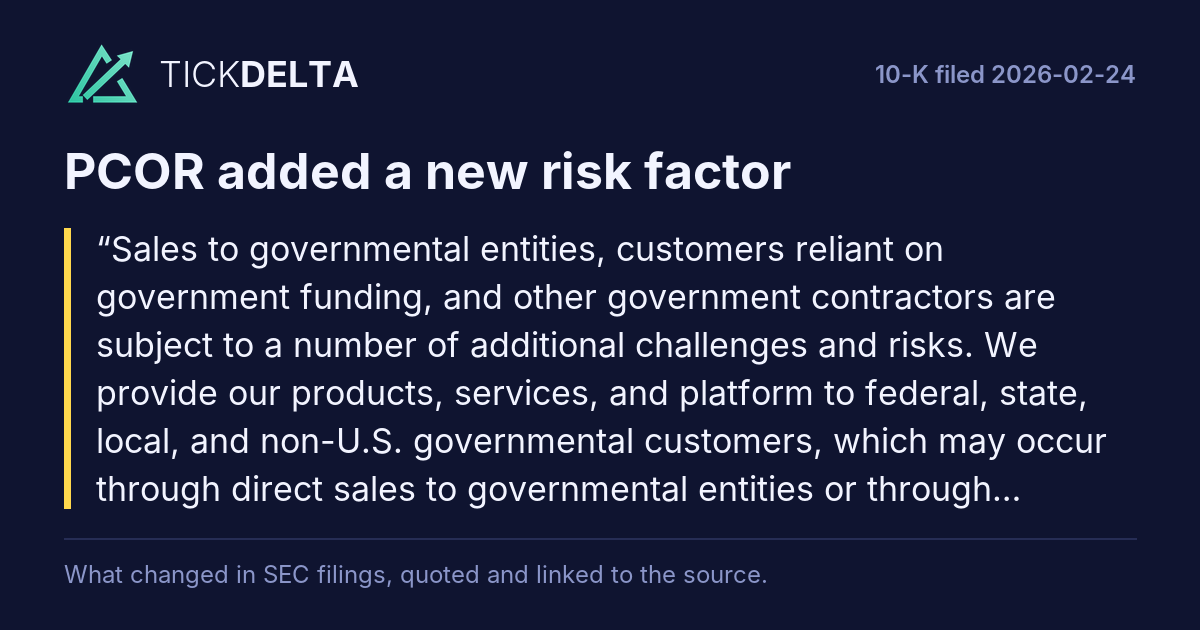
Sales to governmental entities, customers reliant on government funding, and other government contractors are subject to a number of additional challenges and risks.
We provide our products, services, and platform to federal, state, local, and non-U.S. governmental customers, which may occur through direct sales to governmental entities or through channel partners that may sell directly to governmental entities. We also provide our products, services, and platform to customers that may be reliant on funding derived from federal, state, local or non-U.S. governmental sources. We achieved U.S. Federal Risk and Authorization Management Program (“FedRAMP”) Moderate authorization for our Procore for Government solution in January 2026, which we believe will allow us to expand our ability to sell to U.S. federal government customers and contractors. Even with FedRAMP Moderate authorization of Procore for Government, selling to governmental entities, customers reliant on government funding, and other government contractors presents a number of unique challenges and risks, including the following:
•selling to governmental entities can be highly competitive, expensive, and time-consuming, often requiring significant upfront time and expense without any assurance that these efforts will generate a sale;
•governmental entities may have statutory, contractual, or other legal rights to terminate our contracts or contracts with channel partners for convenience or due to default;
•government certification or technical requirements for products and services may change, or we may be unable to achieve one or more government certifications, which may restrict our ability to sell into certain governmental entities until we have attained such certifications or technical requirements;
•contracts with governmental entities, customers reliant on government funding, and other government contractors, including channel partners in the government market, may contain terms that are less favorable than what we generally agree to in our standard commercial agreements, including terms that may be required by statute or regulation and/or maynot be negotiable with the customer;
•non-compliance with terms or conditions of government contracts, or with representations or certifications made in connection with government contracts, can result in significantly more adverse consequences than we typically would expect in the commercial market, including, depending on the circumstances, criminal liability, liability under the civil False Claims Act, and/or suspension or debarment from doing business with governmental entities;
•governmental entities routinely investigate and audit government contractors’ administrative processes, and any unfavorable audit could result in governmental entities refusing to continue buying our products and services, a loss of revenue, fines, and/or civil or criminal liability;
•negative publicity related to our contracts with governmental entities or with channel partners who sell to governmental entities or any proceedings surrounding them may damage our business and affect our competitive position;
•demand and payment for our products from governmental entities or other customers may be adversely impacted by, among other things, government shutdowns, changes in administrations, fiscal policies, contracting policies or requirements, efforts by government to evaluate and reduce overall government spending, budgetary cycles, and funding authorizations; and
•in January 2025, the U.S. presidential administration began issuing Executive Orders identifying new government policies and directing U.S. federal agencies to evaluate their current actions, including certain spending, to ensure that such actions are consistent with new administration priorities. Some of those Executive Orders are the subject of pending litigation, and there remains significant uncertainty about the ways in which agencies will implement the new Executive Orders. Such implementation could negatively affect our current and future business with U.S. government customers.
There is a risk that the costs of achieving and maintaining FedRAMP authorization will not be offset, in full or at all, by increased sales of our products and services. Though our current revenue impact from contracts with governmental entities is not significant, to the extent that we become more reliant on contracts with
Our future success is substantially dependent on our ability to attract, retain, and motivate our executive officers, other members of our management team and other key personnel throughout our organization. Our U.S. employees, including our executive officers, the members of our management team, and other key personnel, work for us on an “at-will” basis, which means they may terminate their employment with us at any time. As previously disclosed, effective November 10, 2025, Craig F. Courtemanche, Jr., our founder, and former President and Chief Executive Officer, resigned as President and Chief Executive Officer of the Company, and Dr. Ajei S. Gopal was appointed as President and Chief Executive Officer. If Dr. Gopal or one or more other members of our management team or other key personnel resign or otherwise cease to provide us with their services, our business, financial condition, results of operations, and prospects could be materially adversely affected.
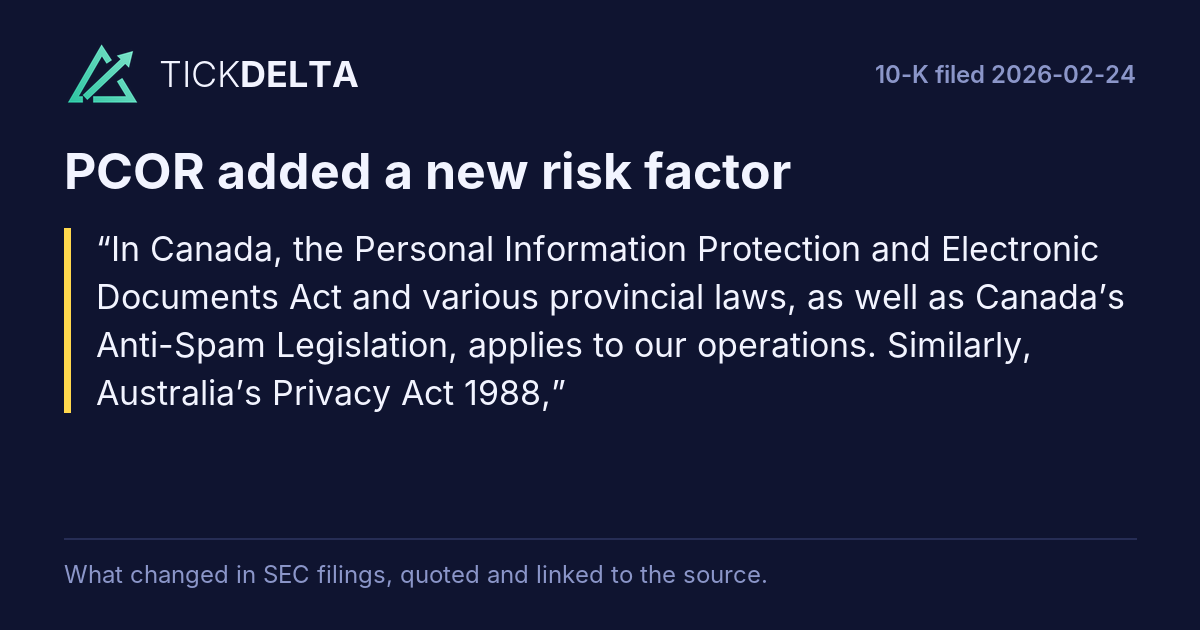
In Canada, the Personal Information Protection and Electronic Documents Act and various provincial laws, as well as Canada’s Anti-Spam Legislation, applies to our operations. Similarly, Australia’s Privacy Act 1988,
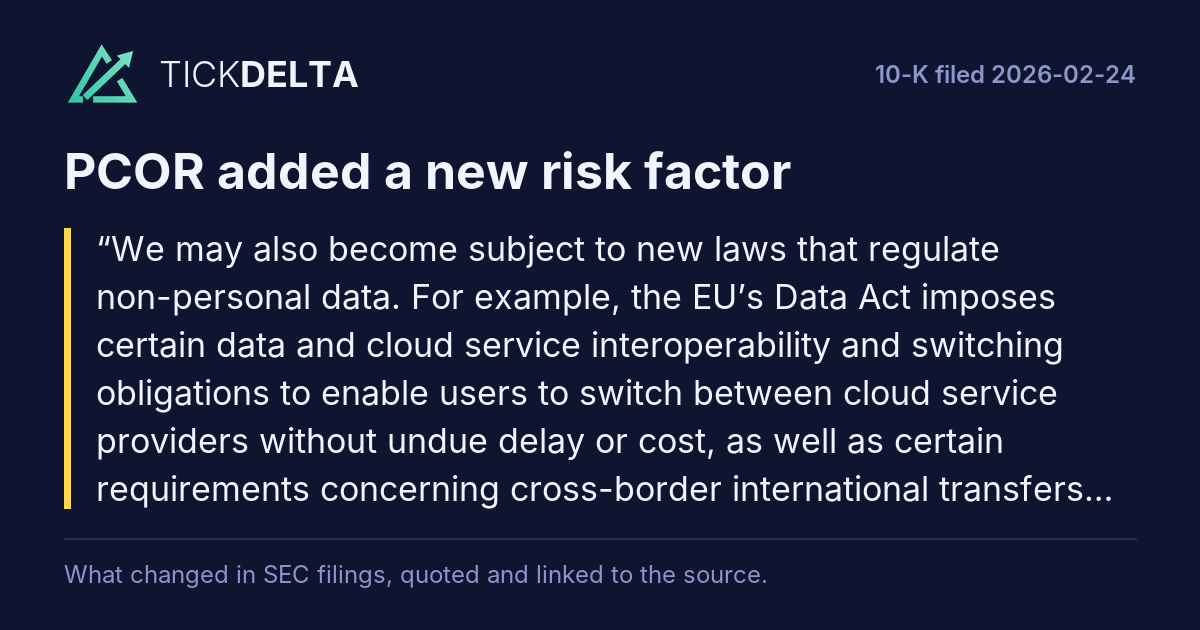
We may also become subject to new laws that regulate non-personal data. For example, the EU’s Data Act imposes certain data and cloud service interoperability and switching obligations to enable users to switch between cloud service providers without undue delay or cost, as well as certain requirements concerning cross-border international transfers of, and governmental access to, non-personal data outside the European Economic Area (“EEA”). Depending on how this and similar laws are implemented and interpreted, we may have to adapt our business practices, contractual arrangements, products, and services to comply with such laws.
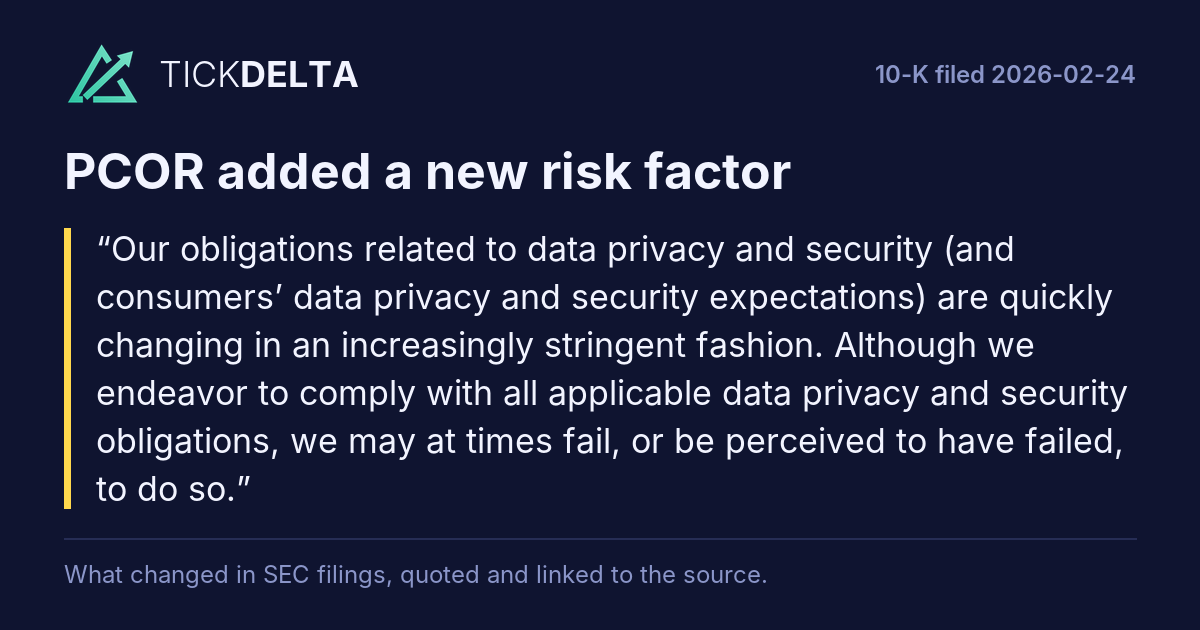
Our obligations related to data privacy and security (and consumers’ data privacy and security expectations) are quickly changing in an increasingly stringent fashion. Although we endeavor to comply with all applicable data privacy and security obligations, we may at times fail, or be perceived to have failed, to do so.
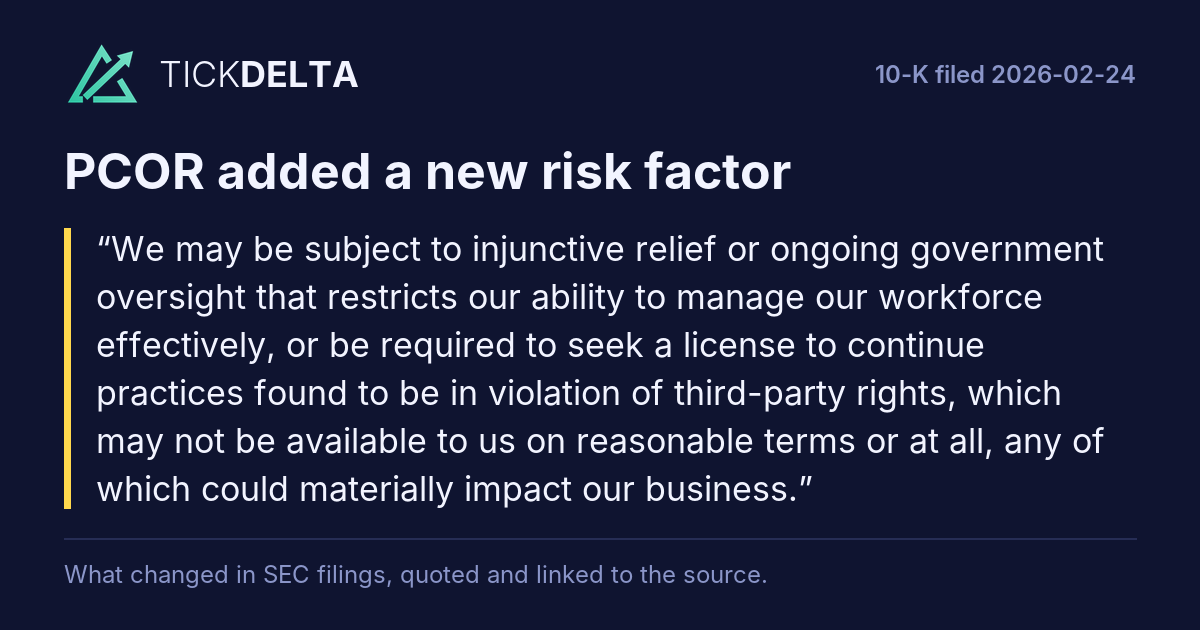
We may be subject to injunctive relief or ongoing government oversight that restricts our ability to manage our workforce effectively, or be required to seek a license to continue practices found to be in violation of third-party rights, which may not be available to us on reasonable terms or at all, any of which could materially impact our business.
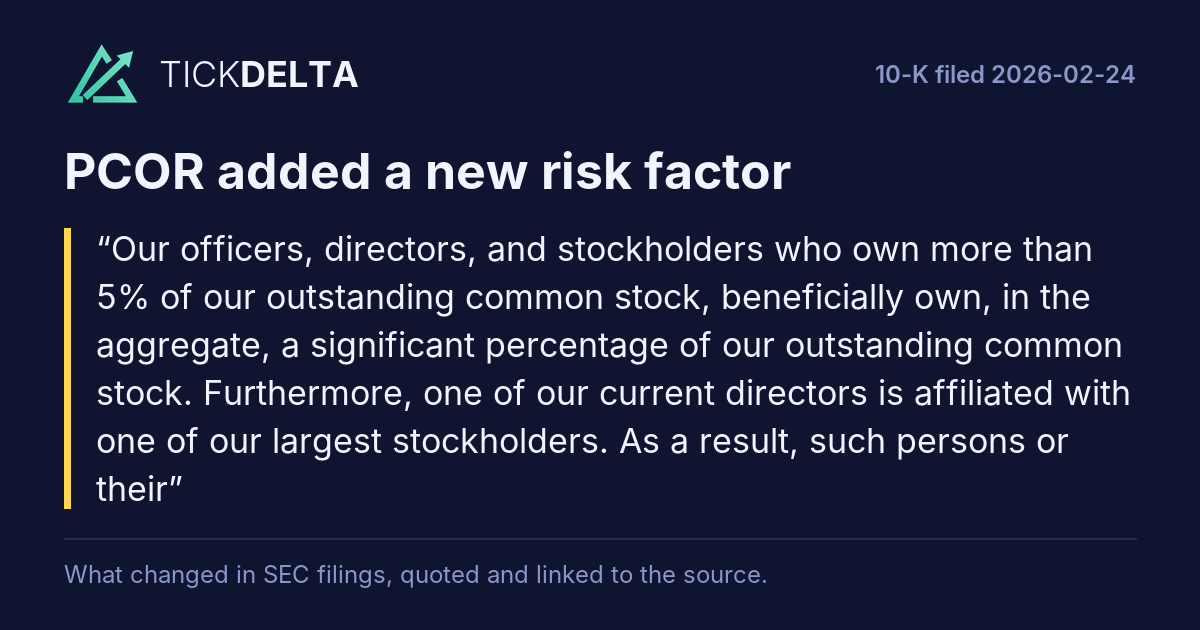
Our officers, directors, and stockholders who own more than 5% of our outstanding common stock, beneficially own, in the aggregate, a significant percentage of our outstanding common stock. Furthermore, one of our current directors is affiliated with one of our largest stockholders. As a result, such persons or their
New in the latest 10-Q
60 paragraphs in the 10-Q filed Nov 5, 2026 with nothing like them in the 10-Q filed Jul 31, 2026 (at least half the words must differ; new numbers alone do not count). Quoted exactly, grouped by the item heading above them. This is text that changed, not a judgement of how serious it is.
• our expectations regarding our 2031 Notes (as defined below), including our ability to meet the requirements of the 2031 Notes and meet our cash needs to repay the 2031 Notes when they come due;
Read in the 10-Q
(in thousands, except number of shares and par value) September 30, December 31,
Read in the 10-Q
components of the Company for purposes of assessing performance or allocating resources. As a result, the Company operates as a single operating segment.
Read in the 10-Q
The CODM uses net income (loss), as reported on the Company’s condensed consolidated statements of operations and comprehensive income (loss), as its measure of segment profit or loss; and total assets, as reported on the Company’s condensed consolidated balance sheets, to assess performance, monitor budget versus actual results, evaluate potential acquisitions, and allocate resources. Significant segment expenses and assets are consistent with those reported in the condensed consolidated statements of operations and comprehensive income (loss) and condensed consolidated balance sheets, respectively. The CODM also uses net income (loss) and total assets when comparing the Company’s financial results and financial condition versus comparable companies.
Read in the 10-Q
sheets based on the security’s contractual maturity at the balance sheet date. The Company re-evaluates such classifications at each balance sheet date.
Read in the 10-Q
On August 6, 2026, the Company issued $ 950.0 million aggregate principal amount of 0.00 % convertible senior notes due August 15, 2031 (the “2031 Notes”), in a private placement to qualified institutional buyers pursuant to Rule 144A under the Securities Act of 1933, as amended. Net proceeds from the 2031 Notes were $ 927.3 million after deducting initial purchasers’ discount and offering expenses of $ 22.7 million paid by the Company. Debt issuance costs, including the initial purchasers’ commissions and other transaction expenses,
Read in the 10-Q
are recorded as a reduction to the carrying value of the 2031 Notes and amortized to interest expense using the effective interest method over the term of the 2031 Notes. The amortization of debt issuance costs is recorded to interest expense in the condensed consolidated statements of operations and comprehensive income (loss). The Company used a portion of the net proceeds to pay a portion of the cash consideration for the acquisition of DroneDeploy, Inc., a Delaware corporation (“DroneDeploy”), a leader in reality capture and robotic automation, to pay the cost of capped call transactions of $ 59.1 million, and to repurchase $ 175.0 million of shares of its common stock.
Read in the 10-Q
In addition to its cash equivalents and marketable securities, the Company measures the fair value of its outstanding convertible senior notes on a quarterly basis for disclosure purposes. While the Company considers the fair value of the convertible senior notes to be a Level 2 measurement due to limited trading activity of the convertible senior notes, the 2031 Notes are measured at amortized cost on the Company’s condensed consolidated balance sheets. Refer to Note 9 to the condensed consolidated financial statements for further details.
Read in the 10-Q
On September 9, 2026, the Company completed the acquisition of DroneDeploy. The purchase price was $ 845.0 million in cash adjusted for closing cash, transaction expenses, hold back, and acceleration of vesting of certain DroneDeploy equity awards. The preliminary purchase consideration totaled $ 811.7 million.
Read in the 10-Q
The following unaudited pro forma financial information combines the results of operations for Procore and DroneDeploy as if the closing of the acquisition had occurred on January 1, 2025, and adjusts for amortization of acquired intangible assets, transaction costs associated with the acquisition, compensation expense as if the retention payments discussed above had vested, stock-based compensation expense for RSUs granted to continuing employees, compensation expenses related to the accelerated vesting discussed above, and tax benefits recorded as a result of the acquisition. The unaudited pro forma results do not reflect any cost saving synergies from operating efficiencies or the effect of the incremental costs of integrating these companies. Accordingly, these unaudited pro forma results are presented for informational purposes only and are not necessarily indicative of what the actual results of operations of the combined company would have been if the acquisition had occurred as of January 1, 2025, nor are they indicative of future results of operations (in thousands):
Read in the 10-Q
Since the acquisition date, DroneDeploy contributed $ 5.4 million in revenue and incurred $ 4.8 million in net loss which are included in the Company's condensed consolidated statements of operations and comprehensive loss for the three and nine months ended September 30, 2026.
Read in the 10-Q
indemnity obligations and is scheduled to be released from escrow to Novorender’s stockholders 24 months after the acquisition date (subject to any indemnification claims).
Read in the 10-Q
The 2031 Notes were issued pursuant to an indenture (the “Indenture”) dated August 6, 2026, between the Company and U.S. Bank Trust Company, National Association, as trustee. The 2031 Notes are general senior unsecured obligations of the Company and will mature on August 15, 2031, unless earlier converted, redeemed, or repurchased. The 2031 Notes do not bear regular interest, and the principal amount of the 2031 Notes will not accrete. Special interest will accrue on the 2031 Notes in the circumstances and at the rates provided in the Indenture.
Read in the 10-Q
The 2031 Notes will be convertible at the option of the holders in certain circumstances. Upon conversion, the Company will pay cash up to the aggregate principal amount of the 2031 Notes converted, and it will pay or deliver, as the case may be, cash, shares of common stock, or a combination thereof, at the Company’s election, for any conversion value in excess of such principal.
Read in the 10-Q
The initial conversion rate is 12.0642 shares of the Company’s common stock per $1,000 principal amount of the 2031 Notes, which is equivalent to an initial conversion price of approximately $ 82.89 per share. Up to 11,460,990 shares of common stock are initially issuable upon conversion depending on the settlement method elected by the Company and the conversion value at the time of conversion.
Read in the 10-Q
Holders may convert all or any portion of their 2031 Notes at their option at any time prior to the close of business on the business day immediately preceding May 15, 2031, only under the following circumstances:
Read in the 10-Q
• during any calendar quarter commencing after the calendar quarter ending on September 30, 2026 (and only during such calendar quarter), if the last reported sale price of the Company’s common stock for at least 20 trading days (whether or not consecutive) during a period of 30 consecutive trading days ending on, and including, the last trading day of the immediately preceding calendar quarter is greater than or equal to 150 % of the conversion price for the 2031 Notes on each applicable trading day;
Read in the 10-Q
• during the five business day period after any 10 consecutive trading day period (the “measurement period”) in which the trading price per $1,000 principal amount of the 2031 Notes for each trading day of the measurement period was less than 98 % of the product of the last reported sale price of the Company’s common stock and the conversion rate on each such trading day;
Read in the 10-Q
• if the Company calls the 2031 Notes for redemption, at any time prior to the close of business on the second scheduled trading day immediately preceding the redemption date, but only with respect to the 2031 Notes that are called (or deemed called, in the case of an optional redemption) for redemption; or
Read in the 10-Q
• upon the occurrence of specified corporate events as set forth in the Indenture.
Read in the 10-Q
On or after May 15, 2031, until the close of business on the second scheduled trading day immediately preceding the maturity date, holders may convert all or any portion of their 2031 Notes at any time, regardless of the above conditions.
Read in the 10-Q
The Company may not redeem the 2031 Notes prior to August 20, 2029, except in the event of a cleanup redemption described below. The Company may redeem for cash all or any portion of the 2031 Notes (subject to certain limitations), at its option, on a redemption date on or after August 20, 2029 and before the 31st scheduled trading day immediately prior to the maturity date if the last reported sale price of the Company’s common stock has been at least 130 % of the conversion price then in effect for at least 20 trading days (whether or not consecutive) during any 30 consecutive trading day period (including the last trading day of such period) ending on, and including, the trading day immediately preceding the date on which the Company provides the related notice of redemption at a redemption price equal to 100 % of the principal amount of the 2031 Notes to be redeemed, plus accrued and unpaid special interest, if any, to, but excluding, the redemption date. In addition, subject to certain conditions, the Company may redeem for cash all, but not less than all, of the 2031 Notes at any time if the aggregate principal amount of the 2031 Notes that remains outstanding at such time is less than $ 100.0 million at a redemption price equal to 100 % of the principal amount of the 2031 Notes to be redeemed, plus accrued and unpaid special interest, if any, to, but excluding, the redemption date.
Read in the 10-Q
The conversion rate is subject to adjustment in some events in accordance with the terms of the Indenture but will not be adjusted for any accrued and unpaid special interest. In addition, following certain corporate events that occur prior to the maturity date of the 2031 Notes or if the Company delivers a notice of redemption, the Company will, in certain circumstances, increase the conversion rate of the 2031 Notes for a holder who elects to convert its 2031 Notes in connection with such a corporate event or convert its 2031 Notes called (or deemed called, in the case of an optional redemption) for redemption during the related redemption period (as set forth in the Indenture), as the case may be.
Read in the 10-Q
Fair Value Principal Unamortized Debt Issuance Costs Net Carrying Value Amount Level 2031 Notes $950,000 $22,060 $927,940 $ 887,623 Level 2
Read in the 10-Q
Debt issuance costs are amortized over the term of the 2031 Notes at an effective interest rate of 0.5 % for the three and nine months ended September 30, 2026.
Read in the 10-Q
On August 4, 2026, in connection with the offering of the 2031 Notes, the Company entered into privately negotiated capped call transactions (the “Capped Calls”) with certain financial institutions at an initial strike price of $ 82.89 per share, which corresponds to the initial conversion price of the 2031 Notes, for a total cost of $ 59.1 million. The Capped Calls cover, subject to customary adjustments substantially similar to those applicable to the 2031 Notes, approximately 11,460,990 shares of the Company’s common stock, and expire on August 15, 2031, the maturity date of the 2031 Notes, subject to earlier termination under certain circumstances.
Read in the 10-Q
The Capped Calls are expected to offset potential dilution to the Company’s common stock upon any conversion of the 2031 Notes and/or offset any cash payments the Company is required to make in excess of the principal amount of converted 2031 Notes, as the case may be, with such reduction subject to a cap based on a cap price initially equal to $ 110.52 per share (which represents a premium of 100 % over the last reported sale price of the Company’s common stock of $ 55.26 on the New York Stock Exchange on August 3, 2026), and is subject to certain adjustments under the terms of the Capped Calls. The Capped Calls are excluded from the calculation of diluted net income (loss) per share as their effect would be anti-dilutive.
Read in the 10-Q
The Capped Calls are freestanding financial instruments, meet the conditions for equity classification, and were recorded as a reduction to additional paid-in capital in the accompanying condensed consolidated balance sheets. The Capped Calls are not remeasured in subsequent periods. Transaction costs directly attributable to the Capped Calls are also recorded as a reduction to additional paid-in capital.
Read in the 10-Q
On October 25, 2024, Oracle America, Inc., Oracle International Corporation, and Textura Corporation (collectively, “Oracle”) filed a lawsuit against the Company, its subsidiary Procore Payment Services, Inc., and a former employee of Oracle employed by the Company, in the U.S. District Court for the Northern District of California, captioned Oracle America, Inc. et al. v. Procore Technologies, Inc. et al., No. 4:24-cv-07457-JST (N.D. Cal.). The lawsuit alleges misappropriation of trade secrets in violation of the Defend Trade Secrets Act, asserting that the Company used Oracle’s trade secrets to develop and enhance the Company’s construction payment product, Procore Pay, and related enterprise resource planning integrations. On August 21, 2026, the court granted in part and denied in part the Company’s motion for summary judgment. Until recently, the pretrial conference was scheduled to take place on November 6, 2026, and trial was scheduled to begin on November 30, 2026. On October 27, 2026, the court vacated the dates of the pretrial conference and trial. The parties are working to reschedule such dates for 2027.
Read in the 10-Q
Of the 4,932,407 shares the Company repurchased during the nine months ended September 30, 2026, 3,166,847 shares were repurchased in privately negotiated transactions effected with or through one or more purchasers of the 2031 Notes or their respective affiliates. Such repurchases were authorized separately from, and were not a part of, the Company’s authorized stock repurchase program.
Read in the 10-Q
On September 9, 2026, we completed the acquisition of DroneDeploy for a purchase price of $845.0 million in cash, subject to certain adjustments for working capital, transaction expenses, cash, and indebtedness, among other things. In addition to the purchase price, we issued service-based restricted stock units (“RSUs”) to certain employees of DroneDeploy. In connection with our entry into an Agreement and Plan of Merger to acquire DroneDeploy, on August 6, 2026, we issued $950.0 million aggregate principal amount of 0.00% convertible senior notes due August 15, 2031 (the “2031 Notes”).
Read in the 10-Q
On September 9, 2026, we completed the acquisition of DroneDeploy for approximately $845.0 million in total cash consideration and on January 16, 2026, we completed the acquisition of Datagrid for approximately $168.0 million in total cash consideration, both subject to certain adjustments for working capital, transaction expenses, cash, and indebtedness, among other things, as described in Note 6 of our condensed consolidated financial statements.
Read in the 10-Q
On August 6, 2026, we issued $950.0 million aggregate principal amount of the 2031 Notes. Net proceeds from the 2031 Notes were $927.3 million after deducting the initial purchasers discounts and offering expenses of $22.7 million paid by us. The 2031 Notes are general, senior unsecured obligations and will mature on August 15, 2031, unless earlier converted, redeemed, or repurchased. The 2031 Notes do not bear regular interest and the principal amount of the 2031 Notes will not accrete. Special interest will accrue on the 2031 Notes in the circumstances and at the rates provided in an indenture dated August 6, 2026 (the “Indenture”), between the Company and U.S. Bank Trust Company, National Association, as trustee. The outstanding principal of the 2031 Notes was $950.0 million as of September 30, 2026. Refer to Note 9 of the Notes to the Condensed Consolidated Financial Statements in Part I, Item 1 of this Quarterly Report on Form 10-Q for more information about the Indenture and the 2031 Notes.
Read in the 10-Q
In connection with the offering of the 2031 Notes, we entered into privately negotiated capped call transactions (the “Capped Calls”) with certain financial institutions at an initial strike price of $82.89 per share, which corresponds to the initial conversion price of the 2031 Notes for a total cost of $59.1 million. The Capped Calls cover, subject to customary adjustments substantially similar to those applicable to the 2031 Notes, the number of shares of our common stock initially underlying the 2031 Notes. The Capped Calls are expected to reduce potential dilution to our common stock upon conversion of the 2031 Notes, and/or offset any cash payments that we are required to make in excess of the principal amount of converted 2031 Notes, as the case may be, with such reduction subject to a cap based on a cap price initially equal to $110.52 per share (which represents a premium of 100% over the last reported sale price of our common stock of $55.26 per share on the New York Stock Exchange on August 3, 2026), and is subject to certain adjustments under the terms of the Capped Calls.
Read in the 10-Q
During the nine months ended September 30, 2026, we had a $29.7 million decrease in contractual commitments beyond those disclosed in our 2025 Form 10-K, related to the Carpinteria lease modifications. The Company modified its office leases in Carpinteria, California to extend the term of its primary core lease
Read in the 10-Q
The $950.0 million aggregate principal of our 2031 Notes does not bear regular interest, and the principal amount of the 2031 Notes will not accrete. Special interest will accrue on the 2031 Notes in the circumstances and at the fixed rates provided in the Indenture. Accordingly, we do not have economic interest rate exposure on the 2031 Notes.
Read in the 10-Q
Servicing our debt may require a significant amount of cash, and we may not have sufficient cash flow from our business to service our debt.
Read in the 10-Q
Holders of the 2031 Notes will have the right, subject to certain conditions and except as described in the Indenture, to require us to repurchase all or any portion of their 2031 Notes upon the occurrence of a fundamental change at a fundamental change repurchase price equal to 100% of the principal amount of the 2031 Notes to be repurchased, plus accrued and unpaid special interest, if any, up to, but excluding, the fundamental change repurchase date. Upon maturity of the 2031 Notes, we must pay the principal amount of the 2031 Notes plus accrued and unpaid special interest, if any, in cash, unless the 2031 Notes have been previously repurchased, redeemed, or converted. In addition, upon conversion of the 2031 Notes, we will be required to make cash payments for each $1,000 in principal amount of 2031 Notes converted of at least the lesser of $1,000 and the sum of the daily conversion values. We may not have enough available cash or be able to obtain financing at the time we are required to make repurchases of 2031 Notes surrendered therefor or pay cash with respect to 2031 Notes being converted. In addition, our future debt may prohibit us from making any cash payments on the conversion or repurchase of the 2031 Notes if an event of default exists thereunder or making any cash payments upon a fundamental change. Our ability to repurchase the 2031 Notes or to pay cash upon conversions or at maturity of the 2031 Notes may also be limited by law or by regulatory authority. Our failure to repurchase 2031 Notes at a time when the repurchase is required by the Indenture or to pay any cash payable on future conversions or at maturity of the 2031 Notes as required by the Indenture would constitute a default under the Indenture. A default under the Indenture or the fundamental change itself could also lead to a default under agreements governing our future indebtedness. If the repayment of the related indebtedness were to be accelerated after any applicable notice or grace periods, we may not have sufficient funds to repay the indebtedness and repurchase the 2031 Notes or make cash payments upon conversions thereof.
Read in the 10-Q
The conversion of some or all of the 2031 Notes may dilute the ownership interests of our stockholders. Upon conversion of the 2031 Notes, we have the option to pay or deliver, as the case may be, cash, shares of our common stock, or a combination of cash and shares of our common stock in respect of the remainder, if any, of our conversion obligation in excess of the aggregate principal amount of the 2031 Notes being converted. If we elect to settle the remainder, if any, of our conversion obligation in excess of the aggregate principal amount of the 2031 Notes being converted in shares of our common stock or a combination of cash and shares of our common stock, any sales in the public market of our common stock issuable upon such conversion could adversely affect prevailing market prices of our common stock. In addition, the existence of the 2031 Notes may encourage short selling by market participants because the conversion of the 2031 Notes could be used to satisfy short positions, or anticipated conversion of the 2031 Notes into shares of our common stock could depress the price of our common stock.
Read in the 10-Q
In the event the conditional conversion feature of the 2031 Notes is triggered, holders of 2031 Notes will be entitled to convert their 2031 Notes at any time during specified periods at their option. If one or more holders elect to convert their 2031 Notes, we would be required to settle any converted principal through the payment of cash, which could adversely affect our liquidity. In addition, even if holders do not elect to convert their 2031 Notes, we would be required under applicable accounting rules to reclassify all or any portion of the outstanding principal of the 2031 Notes as a current rather than long-term liability, which would result in a material reduction of our net working capital.
Read in the 10-Q
The accounting method for the 2031 Notes could adversely affect our reported earnings and financial condition
Read in the 10-Q
The accounting method for reflecting the 2031 Notes on our balance sheet, accruing interest expense for the 2031 Notes, and reflecting the underlying shares of our common stock in our reported diluted earnings per share may adversely affect our reported earnings and financial condition.
Read in the 10-Q
In August 2020, the Financial Accounting Standards Board published an Accounting Standards Update 2020-06 (“ASU 2020-06”), which simplifies certain of the accounting standards that apply to convertible notes. In accordance with ASU 2020-06 the 2031 Notes are reflected as a liability on our condensed consolidated balance sheets, with the initial carrying amount equal to the principal amount of the 2031 Notes, net of issuance costs. The issuance costs are treated as a debt discount for accounting purposes, and are amortized into interest expense over the term of the 2031 Notes. As a result of this amortization, we will recognize interest expense for the 2031 Notes for accounting purposes which is greater than the cash interest payments of 0.00% on the 2031 Notes, which will result in lower reported net income.
Read in the 10-Q
In addition, the shares of common stock underlying the 2031 Notes are reflected in our diluted earnings per share using the “if converted” method, in accordance with ASU 2020-06. Under that method, diluted earnings per share generally is calculated assuming that all the 2031 Notes were converted into cash and shares of common stock at the beginning of the reporting period based on the average market price of common stock determined in accordance with applicable accounting rules, unless the result would be anti-dilutive. The application of the if-converted method may reduce our reported diluted earnings per share.
Read in the 10-Q
Furthermore, if any of the conditions to the convertibility of the 2031 Notes is satisfied, then we will be required under applicable accounting standards to reclassify the liability carrying value of the 2031 Notes as a current, rather than a long-term liability. This reclassification could be required even if no noteholders convert their 2031 Notes and could materially reduce our reported working capital.
Read in the 10-Q
Certain provisions in the Indenture governing the 2031 Notes may delay or prevent an otherwise beneficial takeover attempt of us.
Read in the 10-Q
Certain provisions in the Indenture may make it more difficult or expensive for a third party to acquire us. For example, except as otherwise set forth in the Indenture, the Indenture will require us to repurchase the 2031 Notes for cash upon the occurrence of a fundamental change and, in certain circumstances, to increase the conversion rate for a holder that converts its 2031 Notes in connection with a make-whole fundamental change. A takeover of us may trigger the requirement that we repurchase the 2031 Notes and/or increase the conversion rate, which could make it costlier for a potential acquirer to engage in such takeover. Such additional costs may have the effect of delaying or preventing a takeover of us that would otherwise be beneficial to investors.
Read in the 10-Q
The Capped Calls may affect the value of the market price of our common stock and subject us to counterparty risk.
Read in the 10-Q
In connection with the pricing of the 2031 Notes, we entered into privately negotiated Capped Calls with certain financial institutions (collectively, the “option counterparties”). The Capped Calls cover, subject to customary adjustments substantially similar to those applicable to the 2031 Notes, the number of shares of our common stock initially underlying the 2031 Notes. The Capped Calls are expected generally to reduce the potential dilution to our common stock upon any conversion of the 2031 Notes and/or offset any cash payments we are required to make in excess of the principal amount of converted 2031 Notes, as the case may be, with such reduction and/or offset subject to a cap.
Read in the 10-Q
The option counterparties or their respective affiliates may modify their hedge positions by entering into or unwinding various derivatives with respect to our common stock and/or purchasing or selling our common stock or other securities of ours in secondary market transactions prior to the maturity of the 2031 Notes (and are likely to do so during any observation period related to a conversion of 2031 Notes, following any redemption of the 2031 Notes or any repurchase of the 2031 Notes upon a fundamental change, or, to the extent we exercise the relevant election under the Capped Calls, following any other repurchase of the 2031 Notes). This activity could also cause or avoid an increase or a decrease in the market price of our common stock. We cannot predict the direction or magnitude of any potential effect that Capped Calls may have on the price of our common stock. In addition, we do not make any representation that the option counterparties or their respective affiliates will not discontinue the Capped Calls without notice.
Read in the 10-Q
The option counterparties are financial institutions, and we are subject to the risk that one or more of the option counterparties may default or otherwise fail to perform, or may exercise certain rights to terminate, their obligations under the Capped Calls. Our exposure to the credit risk of the option counterparties is not secured by any collateral.
Read in the 10-Q
Global economic conditions have from time to time resulted in the actual or perceived failure or financial difficulties of many financial institutions and could adversely affect the option counterparties’ performance under the Capped Calls. If an option counterparty becomes subject to insolvency proceedings, we will become an unsecured creditor in those proceedings with a claim equal to our exposure at that time under the Capped Call with such option counterparty. Our exposure will depend on many factors but, generally, our exposure will increase if the market price or the volatility of our common stock increases. In addition, upon a default or other failure to perform, or a termination of obligations, by an option counterparty, we may suffer adverse tax consequences or more dilution than we currently anticipate with respect to our common stock. We can provide no assurances as to the financial stability or viability of the option counterparties.
Read in the 10-Q
In addition, the terms of the Capped Calls may be subject to adjustment, modification or, in some cases, renegotiation in the event of certain corporate and other transactions. The Capped Calls may not operate as we intend in the event that we are required to adjust the terms of such instruments as a result of transactions in the future or in the event of other unanticipated developments that may adversely affect the functioning of the Capped Calls.
Read in the 10-Q
The following table summarizes the stock repurchase activity and the approximate dollar value of shares that may yet be purchased pursuant to the 2025 Stock Repurchase Program for the three months ended September 30, 2026:
Read in the 10-Q
(2) Following the completion of the offering of the 2031 Notes, we used $175.1 million of the net proceeds from the offering to repurchase 3,166,847 shares of our outstanding common stock concurrently with the pricing of the 2031 Notes. Such repurchases were made in privately negotiated transactions effected with or through one or more purchasers of the 2031 Notes or their respective affiliates. Such repurchases were authorized separately from, and were not a part of, our authorized stock repurchase program. As such, such repurchases did not reduce the approximate dollar value of shares that may yet be purchased under our authorized stock repurchase program.
Read in the 10-Q
During the quarterly period ended September 30, 2026, our directors and officers (as defined in Rule 16a-1(f) under the Exchange Act) adopted or terminated the contracts, instructions, or written plans for the purchase or sale of our securities as set forth in the table below.
Read in the 10-Q
(2) “Non-Rule 10b5-1 trading arrangement” as defined in Item 408(c) of Regulation S-K under the Exchange Act.
Read in the 10-Q
(3) Represents the maximum number of shares that may be sold pursuant to the Rule 10b5-1 trading arrangement. The number of shares actually sold may be lower and will depend on the satisfaction of certain conditions as set forth in the written plan.
Read in the 10-Q
(4) The actual number of shares that will be sold under this Rule 10b5-1 trading arrangement will be based in part on the number of shares sold to satisfy tax withholding obligations arising from the vesting of certain shares subject to the trading arrangement, which number is not yet determinable.
Read in the 10-Q
101. PRE* Inline XBRL Taxonomy Extension Presentation Linkbase Document 104 Cover Page Interactive Data File (formatted as inline XBRL and contained in Exhibit 101)
Read in the 10-Q
Item 1A of the 10-Q filed Nov 5, 2026 against Item 1A of the 10-K filed Feb 24, 2026.
A 10-Q repeats only the risks that changed, so a 10-K paragraph that is missing from it is not counted as removed.
Added is a paragraph with nothing like it in the 10-K, Reworded a sentence that is in both with several words changed,
Quiet changes a sentence in both where one to four words changed and one is a hedge or a modal
(cut words struck through, new words highlighted).
Text on the page, not a score; each links to the filing at sec.gov.
The first 14 of 20 are shown (at most 12 of each type).
Two-word phrases in Risk Factors of the 10-K filed Feb 24, 2026 that are in none of the 1 earlier 10-Ks stored, back to Feb 26, 2025
Used at least twice, small words left out. Counted, not picked: a phrase can be new because the company renamed something.
14 paragraphs of last year's Risk Factors with nothing like them now. The longest are quoted.
Item 1A of each 10-K and 10-Q on EDGAR, quoted exactly. Each paragraph links to the filing at sec.gov.
10-K change: what was reworded or cut, section by section.
Excel workbook · CSV. Google Sheet that stays up to date: paste =IMPORTDATA("https://tickdelta.com/company/PCOR/export.csv") into a cell.