Paragraphs with nothing like them in last year's 10-K
Quoted exactly
7 paragraphs in Risk Factors of the 10-K filed Feb 27, 2026
with nothing like them in the 10-K filed Feb 28, 2025. Quoted exactly.
Paragraphs that were only edited are under 10-K change.
Risks associated with another potential U.S. government shutdown include delays in regulatory reviews, approvals, or rulemaking from federal agencies, reduced access to government economic data and reports which could affect our ability to assess risk and make informed investment or risk management decisions, heightened volatility or reduced liquidity in financial markets, credit and counterparty risk exposure in connection with clients or counterparties that rely on government funding or contracts, and diminished investor and consumer confidence which could reduce demand for financial products
Any event that disrupts the U.S. federal government’s continuity or undermines perceptions of fiscal stability could reduce investor confidence and adversely affect the value of U.S. government securities, thereby increasing market volatility and our future borrowing costs.
Financial institutions are facing increased scrutiny and potential enforcement actions from federal agencies, leading to the need to update internal risk-scoring and compliance procedures.
In August 2025, the President of the United States issued an Executive Order entitled “Guaranteeing Fair Banking for All Americans” that addressed access to financial services and directed several actions by certain federal agencies, to include a review and revision of their internal policies and manuals, which they in turn communicated to regulated entities such as the Company. The Company has provided initial responses to requests from government authorities regarding, among other things, the Company’s past and existing policies and processes and the provision. Federal agencies may return with additional inquiries, requirements, or enforcement actions that require us to use additional resources to respond to and comply with.
Increasingly, many customers can complete certain transactions such as bill payments or fund transfers using alternatives to traditional banking, as the financial services industry undergoes rapid technological changes. Digital payments, cryptocurrencies, blockchain, and other “fintech” technologies offer new ways of making payments while not being subject to the same regulatory restrictions as domestic banks, which increases competition in the sector and reduces the need for banks as financial deposit-keepers and intermediaries. Digital currencies known as “stablecoins” are pegged to the U.S. dollar or other currencies and provide users with the ability to conduct transactions without risk of losing value. These competing services could result in the loss of fee income in traditional banking, as well as the loss of customer deposits and the related income generated from those deposits, which could negatively impact the Company’s deposit base and related revenue.
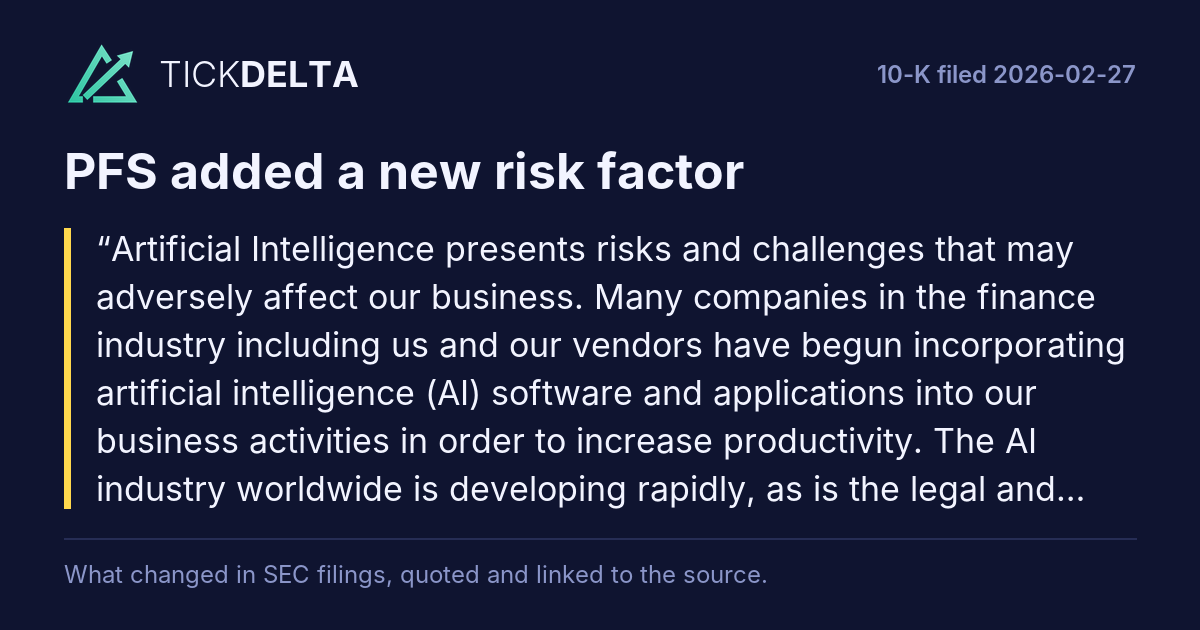
Artificial Intelligence presents risks and challenges that may adversely affect our business.
Many companies in the finance industry including us and our vendors have begun incorporating artificial intelligence (AI) software and applications into our business activities in order to increase productivity. The AI industry worldwide is developing rapidly, as is the legal and regulatory environment around its use. Reliance on AI therefore presents risks and challenges as we adapt to evolving rules and regulations, concerns regarding data privacy and misuse of intellectual property, and data biases and accuracy of responses to inquiries during use. These potential issues could raise compliance costs and increase security and liability concerns, which may reduce any productivity gained through its use. The complexity surrounding AI use makes it difficult to know the expected impact on our business.
Paragraphs in the 10-Q filed Nov 6, 2026 that were not in the one before
New in the latest 10-Q
4 paragraphs in the 10-Q filed Nov 6, 2026 with nothing like
them in the 10-Q filed Aug 7, 2026 (at least half the words must differ; new numbers alone do not count).
Quoted exactly, grouped by the item heading above them. This is text that changed, not a judgement of how serious it is.
Financial statements and notes
by independent third-parties. Reports by the independent third-parties are presented to the Audit Committee of the Board of Directors.
Read in the 10-Qopen_in_new
Management and its tax advisors continue to engage in discussions with the New Jersey Division of Taxation regarding the tax positions under examination. Certain legal and factual issues remain unresolved, including clarification related to nexus and the State’s ability to assess periods prior to those currently under examination, including periods dating back to the formation of the entity. Depending on the resolution of these issues, the final assessment could be materially more or less favorable than the amount reflected in the initial assessment described above.
Read in the 10-Qopen_in_new
The Company continues to defend its positions regarding New Jersey nexus and the sourcing of income, and believes its positions are supported by the relevant facts and applicable tax law.
Read in the 10-Qopen_in_new
history and three of the four loans require no specific reserve allocations, while one loan has a specific reserve of $488,000. These allocations are based on sales agreements for the four collateral properties and stipulation agreements for the related loan payoffs, all of which have been approved by the bankruptcy court.
Read in the 10-Qopen_in_new
The 10-Q's risk factors against the 10-K
Item 1A of the 10-Q filed Nov 6, 2026 against Item 1A of the 10-K filed Feb 27, 2026.
A 10-Q repeats only the risks that changed, so a 10-K paragraph that is missing from it is not counted as removed.
Added is a paragraph with nothing like it in the 10-K, Reworded a sentence that is in both with several words changed,
Quiet changes a sentence in both where one to four words changed and one is a hedge or a modal
(cut words struck through, new words highlighted).
Text on the page, not a score; each links to the filing at sec.gov.
What the 10-Q itself says about its risk factors:There were no material changes to the risk factors previously disclosed in the Company’s Annual Report on Form 10-K for the fiscal year ended December 31, 2025.
Read in the 10-Qopen_in_new
Added10-Q Nov 6, 2026 vs 10-K Feb 27, 2026
Period (a) Total Number of Shares (b) Average (c) Total Number of Shares Purchased as Part of Publicly Announced Plans or Programs (1) (2) (d) Maximum Number of Shares that May Yet Be Purchased under the Plans or Programs (1) (2)
Read it in the 10-Q at sec.govopen_in_new
Added10-Q Nov 6, 2026 vs 10-K Feb 27, 2026
(1) On December 28, 2020, the Company’s Board of Directors approved the purchase of up to 3.9 million shares of its common stock under a ninth general repurchase program to commence upon completion of the eighth repurchase program. The repurchase program has no expiration date.
Read it in the 10-Q at sec.govopen_in_new
Added10-Q Nov 6, 2026 vs 10-K Feb 27, 2026
(2) On January 26, 2026, the Company’s Board of Directors authorized the Company’s tenth stock repurchase program to commence upon completion of the existing authorization. Under the new authorization, the Company may repurchase an additional 2.0 million shares of common stock currently outstanding.
Read it in the 10-Q at sec.govopen_in_new
The Company completed its acquisition of Lakeland on May 16, 2024. To realize the anticipated benefits and cost savings from the merger, the Company must successfully integrate and combine the Company’s and Lakeland’s businesses in a manner that permits those cost savings to be realized without adversely affecting current revenues and future growth. If the Company is not able to successfully achieve these objectives, the anticipated benefits of the merger may not be realized fully or at all, or may take longer to realize than expected. It is possible that the integration process could...
In the 10-K filed Feb 28, 2025open_in_new
The success of the merger will depend in part on the combined company’s ability to manage its human capital and retain the talent and dedication of key employees. It is possible that these employees may decide not to remain with the Company going forward. If the Company is unable to retain key employees, including management, who are critical to the successful integration and future operations of the Company, the Company could face disruptions in its operations, loss of existing customers, loss of key information, expertise or know-how and unanticipated additional recruitment costs. In...
In the 10-K filed Feb 28, 2025open_in_new
In addition, the actual cost savings of the merger could be less than anticipated, and integration may result in additional and unforeseen expenses, including costs related to requirements of regulatory agencies. An inability to realize the full extent of the anticipated benefits of the merger, as well as any delays encountered in the integration process, could have an adverse effect upon the business, financial condition and results of operations of the Company.
In the 10-K filed Feb 28, 2025open_in_new
The failure to address the federal debt ceiling in a timely manner, downgrades of the U.S. credit rating and uncertain credit and financial market conditions may affect the stability of securities issued or guaranteed by the federal government, which may affect the valuation or liquidity of our investment securities portfolio and increase future borrowing costs.
In the 10-K filed Feb 28, 2025open_in_new
Sources
Item 1A of each 10-K and 10-Q on EDGAR, quoted exactly. Each paragraph links to the filing at sec.gov.
Also
10-K change: what was reworded or cut, section by section.
Work with it
Excel workbook · CSV. Google Sheet that stays up to date: paste =IMPORTDATA("https://tickdelta.com/company/PFS/export.csv") into a cell.