tickdelta
Sign in

Tickdelta is free for now. Sign up and get Pro free

← Screener

PHParker Hannifin

Industrials · Metal Products · NYSE
Compare with peers → Embed
The 10-K against last year's

113 changes: 25 added, 31 removed, 56 reworded, 1 quiet changes

10-K Aug 21, 2026 vs Aug 22, 2025
Risk FactorsRedline ↓
24.1%
of the text changed · 5,744 words now
38.9%
of the text changed · 5,493 words now
Legal ProceedingsRedline ↓
4.7%
of the text changed · 379 words now
Accounting PoliciesRedline ↓
22.2%
of the text changed · 2,199 words now

10-K 0000076334-26-000105 (2026-08-21) vs 10-K 0000076334-25-000035 (2025-08-22)

The redline

The paragraph that changed most in each section

Marked against last year's 10-K: cut words struck through, new words highlighted and underlined.

Risk Factors 264 words changed in this paragraph; it is 59% similar to last year's version.
We rely extensively on information technology systems to manage and operate our business, some of which are managed or accessible by third parties. The security and functionality of these information technology systems, and the processing of data by these systems, are critical to our business operations. If these systems, or any part of the systems, are damaged, intruded upon, attacked, shutdown shut down or cease to function properly (whether by planned upgrades, force majeure, telecommunications failures, criminal acts, including hardware or software break-ins or extortion attempts, or viruses, or other cybersecurity incidents) and we suffer any resulting interruption in our ability to manage and operate our business or if our products are affected, our results of operations and financial condition could be materially adversely affected. The sophistication of cyber threats continues to evolve and grow, including the risk associated with the use of artificial intelligence and quantum computing by threat actors to conduct more targeted and evasive attacks. There can be no guarantee that the actions and controls we have implemented and are implementing, or which we cause or have caused third-parties third parties with access to our systems to implement, will be sufficient to protect and mitigate risks associated with our information technology systems. Additionally, our increasing use of digital technologies within our operations as well as other evolving practices such as certain of our employees working remotely at times and the increased adoption of generative artificial intelligence may increase our vulnerability to cyber and data protection risks. In addition to existing risks, any adoption or deployment of or exposure to new technologies via acquisitions or internal initiatives or changes to our information technology systems as a result of divestitures may increase our exposure to risks, breaches, or failures, which could materially adversely affect our results of operations or financial condition. Furthermore, the Company has access to sensitive, confidential, or personal data or information that is subject to privacy and security laws, regulations, or other contractually-imposed controls. Despite our use of reasonable and appropriate controls, security breaches, theft, misplaced, lost or corrupted data, programming, or employee errors and/or malfeasance have led and could in the future lead to the compromise or improper use of such sensitive, confidential, or personal data or information. Such events may result in possible negative consequences, such as fines, ransom demands, penalties, failure to comply with laws governing sensitive data, loss of reputation, intellectual property, competitiveness or customers, increased security and compliance costs or other negative consequences. Further, the amount of insurance coverage that we maintain may be inadequate to cover claims or liabilities relating to a cybersecurity incident. Depending on the nature and magnitude of these events, they may have an adverse impact on our results of operations or financial condition.

Source: Item 1A, 10-K 0000076334-26-000105 vs Item 1A, 10-K 0000076334-25-000035

MD&A 255 words changed in this paragraph; it is 30% similar to last year's version.
As of June 30, 2025, the Company had a line of credit totaling $3.0 billion through a multi-currency During 2026, we amended our revolving credit agreement with a group of banks with $1.2 billion available for borrowing under the credit agreement. On August 21, 2025, the multi-currency revolving credit agreement was amended to increase the total line of credit by $750 million to $3.75 billion, and authorized a corresponding increase in the commercial paper program size to $3.75 billion. The revolving credit agreement expires in June 2028; however, we have the right to request a one-year extension of the expiration date. Advances from the revolving credit agreement can be used for general corporate purposes, including acquisitions, and for the refinancing of existing indebtedness. The credit agreement supports our commercial paper program, and issuances Issuances of commercial paper reduce the amount of credit available under the revolving credit agreement. The As of June 30, 2026, there were no borrowings outstanding under the revolving credit agreement, and commercial paper notes outstanding were $1.0 billion. Taking into account outstanding commercial paper notes, $2.7 billion was available for borrowing under the revolving credit agreement expires in as of June 2028; however, the Company has the right to request a one-year extension of the expiration date on an annual basis, which request may result in changes to the current terms and conditions of the credit agreement. The credit agreement requires the payment of an annual facility fee, the amount of which is dependent upon the Company’s credit ratings. Although a lowering of the Company’s credit ratings would increase the cost of future debt, it would not limit the Company’s ability to use the credit agreement nor would it accelerate the repayment of any outstanding borrowings. Refer to Note 10 to the Consolidated Financial Statements in Part II, Item 8 of this Annual Report on Form 10-K for further discussion. 30, 2026.

Source: Item 7, 10-K 0000076334-26-000105 vs Item 7, 10-K 0000076334-25-000035

Accounting Policies 143 words changed in this paragraph; it is 37% similar to last year's version.
In November 2024, September 2025, the Financial FASB issued ASU 2025-06, “Intangibles - Goodwill and Other - Internal-Use Software (Subtopic 350-40): Targeted Improvements to the Accounting Standards Board ("FASB") issued Accounting Standards Update ("ASU") 2024-03, “Income Statement - Reporting Comprehensive Income - Expense Disaggregation Disclosures (Subtopic 220-40): Disaggregation of Income Statement Expenses,” for Internal-Use Software," which requires expanded interim modernizes the accounting for costs related to internal-use software by removing all references to prescriptive and annual disclosures of expense information, including the amounts of inventory purchases, employee compensation, depreciation, amortization and depletion within commonly presented expense captions during the period. sequential software development stages. The amendments are effective for annual reporting periods fiscal years beginning after December 15, 2026, 2027, and interim reporting periods beginning after December 15, 2027. Early within those annual reporting periods, with early adoption is permitted. The amendments should be applied either (1) prospectively to financial statements issued for reporting periods after the effective date or (2) retrospectively to any or all prior periods presented in the financial statements. The Company is currently evaluating the ASU to determine its impact on the Company's disclosures. disclosures and consolidated financial statements.

Source: Item 8, Note 1 – Significant Accounting Policies, 10-K 0000076334-26-000105 vs Item 8, Note 1 – Significant Accounting Policies, 10-K 0000076334-25-000035

Legal Proceedings 2 words changed in this paragraph; it is 98% similar to last year's version.
Environmental - We are currently responsible for environmental matters primarily relating to known exposures arising from environmental litigation, investigations, and remediation at various manufacturing facilities presently or formerly operated by Parker and for which we have been named as a “potentially responsible party,” along with other companies, at off-site waste disposal facilities and regional sites.

Source: Item 3, via Note 17 – Contingencies, 10-K 0000076334-26-000105 vs Item 3, via Note 18 – Contingencies, 10-K 0000076334-25-000035
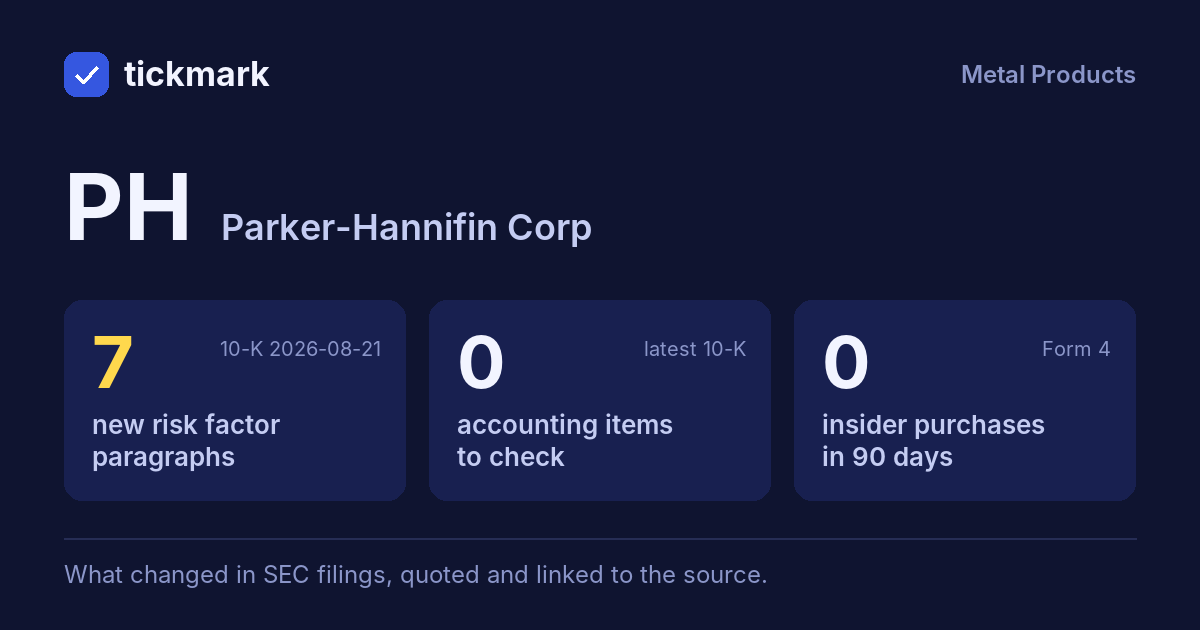
Every change, by type

Sentences and paragraphs added, removed or reworded

Sentences and paragraphs of PH's Risk Factors and MD&A, 10-K 2026-08-21 against 10-K 2025-08-22. Each links to the text at sec.gov.

AddedRisk Factors
We rely on a limited number of suppliers for certain critical components, such as specialty electronics, rare earths, specialty chemicals, aerospace super alloys and filtration media, and recent and planned acquisitions may increase our exposure to supply concentration risk. Any disruption in supply from these sources could require us to seek alternative suppliers, potentially at higher cost or with delays that could impact production schedules. Furthermore, our suppliers of component parts may significantly and quickly increase their prices in response to increases in

Read it in 10-K 2026-08-21 at sec.gov ↗

AddedRisk Factors
Increased public awareness and concern regarding environmental risks, including global climate change, may result in more international, regional and/or federal requirements or industry standards to reduce or mitigate global warming and other environmental risks. These regulations or standards could mandate more restrictive requirements, such as stricter limits on greenhouse gas emissions, than the voluntary commitments that we have made or require such changes on a more accelerated time frame. There continues to be a lack of consistent climate legislation across jurisdictions, which creates economic and regulatory uncertainty. Conversely, changes in governmental policy or leadership could lead to the rollback of existing climate regulations, potentially exposing the Company to stranded investments in compliance infrastructure or creating competitive disparities relative to companies that did not make such investments. If environmental laws or regulations or industry standards are either changed or adopted and impose significant operational restrictions and compliance requirements upon the Company or its products, or if anticipated regulations fail to materialize after we have made substantial compliance investments, our business, operations and financial condition could be negatively impacted.

Read it in 10-K 2026-08-21 at sec.gov ↗

AddedRisk Factors
cost pressures for labor. These challenges in labor markets could have material adverse effects on our results of operations, financial condition and cash flows.

Read it in 10-K 2026-08-21 at sec.gov ↗

AddedRisk Factors
We continually assess the strategic fit of our existing businesses and may divest or otherwise dispose of businesses that are deemed not to fit within our strategic plan or are not achieving the desired return on investment. These transactions pose risks and challenges that could negatively impact our business. For example, when we decide to sell or otherwise dispose of a business or assets, we may be unable to do so on satisfactory terms within our anticipated timeframe or at all, and even after reaching a definitive agreement to sell or dispose of a business, the sale is typically subject to satisfaction of pre-closing conditions which may not become satisfied. The divestiture process may also result in the disclosure of proprietary or competitively sensitive information to potential buyers, the incurrence of stranded costs that are not fully absorbed by the divested business, or the need to provide transition services that divert management attention and resources. Any strategic divestiture of a product line or business or exit of a product line or product category may reduce our revenue and earnings, result in material costs and expenses, create potential indemnification or retained liability obligations and cause disruption to our employees, customers, vendors and communities in which we operate.

Read it in 10-K 2026-08-21 at sec.gov ↗

AddedRisk Factors
Share repurchases generally constitute a component of our capital allocation strategy. We have historically funded our share repurchases with free cash flow and short-term borrowings. The amount and timing of share repurchases will be based on a variety of factors and past activity is not necessarily indicative of future repurchase levels. Important factors that could impact our decisions to pursue share repurchases include market conditions, the price of our shares, the nature and timing of other investment opportunities, such as acquisitions, changes in our business strategy, the terms of our financing arrangements, our outlook as to the ability to obtain financing at attractive rates, the impact on our credit ratings, legal and regulatory restrictions (including under the terms of financing arrangements), the availability of domestic cash, and overall business expectations. There can be no assurance that any share repurchases will enhance shareholder value because the market price of our shares may decline below the levels at which we repurchased our shares, and short-term stock price fluctuations could reduce the program’s effectiveness.

Read it in 10-K 2026-08-21 at sec.gov ↗

AddedRisk Factors
For example, our Aerospace Systems Segment produces aircraft components and systems that are critical to flight safety, and accordingly, the adverse impact of product quality issues, actual or perceived, can be significant. Our operations expose us to potential liabilities for personal injury or death as a result of the failure of an aircraft product that we have designed or manufactured, and such liabilities could be substantial given the catastrophic nature of potential aerospace incidents. In addition, a product safety issue could result in mandatory or voluntary recalls, airworthiness directives from the Federal Aviation Administration or other regulatory authorities, grounding of aircraft or temporary cessation of operations by our airline customers. If personal injury or death were to be caused by one of our products, or if we were to otherwise fail to maintain a satisfactory record of safety and reliability, our ability to retain and attract customers may be materially adversely affected.

Read it in 10-K 2026-08-21 at sec.gov ↗

AddedMD&A
The following discussion and accompanying table provide an analysis of our operating performance for 2026 and 2025, with selected Consolidated Statements of Income line items expressed as a percentage of revenue to enhance comparability between periods.

Read it in 10-K 2026-08-21 at sec.gov ↗

Show the other 11
AddedMD&A
Throughout this discussion, both reported sales growth, determined in accordance with U.S. GAAP, and organic sales growth, a non-GAAP measure, are presented. Organic sales growth represents the percentage change in net sales adjusted to exclude the effects of acquisitions and divestitures for the twelve-month period following their completion, as well as the impact of changes in currency exchange rates. Management believes these adjustments provide management and investors with additional insight into underlying sales trends and facilitate meaningful period-to-period comparisons of operating performance. References to organic sales in this discussion reflect this measure and are presented as a percentage increase or decrease relative to the comparable prior-year period. Total Company net sales changed as follows:

Read it in 10-K 2026-08-21 at sec.gov ↗

AddedMD&A
Net sales in 2026 increased by $1,649 million, or 8.3%, compared to 2025, which was primarily driven by organic growth in both segments. Acquisitions net of divestitures increased sales by approximately $91 million in 2026. These changes are discussed in more detail within the business segment results section below.

Read it in 10-K 2026-08-21 at sec.gov ↗

AddedMD&A
For the years ended June 30, 2026 2025 Net sales Diversified Industrial $ 14,438 $ 13,665 Aerospace Systems 7,061 6,185 Total net sales $ 21,499 $ 19,850 Segment operating income Diversified Industrial $ 3,440 $ 3,120 Aerospace Systems 1,833 1,441 Total segment operating income 5,273 4,561 Corporate general and administrative expenses 205 214 Income before interest expense and other expense (income), net 5,068 4,347 Interest expense 401 409 Other expense (income), net 104 (169) Income before income taxes $ 4,563 $ 4,107

Read it in 10-K 2026-08-21 at sec.gov ↗

AddedMD&A
North America International Total 2026 Reported sales growth 3.2% 9.3% 5.7% Less: currency 0.4% 3.4% 1.7% Less: divestitures (1.8)% —% (1.1)% Less: acquisitions 1.5% 2.0% 1.7% Organic sales growth 3.1% 3.9% 3.4%

Read it in 10-K 2026-08-21 at sec.gov ↗

AddedMD&A
Corporate general and administrative expenses primarily included salaries, benefits and incentive compensation expense, professional service fees, information technology, charitable contributions and other discretionary spending.

Read it in 10-K 2026-08-21 at sec.gov ↗

AddedMD&A
For the years ended June 30, 2026 2025 Foreign currency transaction (gain) loss $ (31) $ 46 Stock-based compensation expense 179 97 Non-service components of retirement benefit cost (income) (64) (51) Acquisition-related expenses 30 — Gain on sale of businesses(1) (9) (253) Interest income (14) (11) Insurance-related charges (recoveries) (23) 8 Other items, net 36 (5) Total other expense (income), net $ 104 $ (169) (1) For further discussion of the gain on sale of businesses refer to Note 3 to the consolidated financial statements.

Read it in 10-K 2026-08-21 at sec.gov ↗

AddedMD&A
We expect that our cash and cash equivalents, cash flows from operations, availability under our commercial paper program, and access to capital markets will be sufficient to meet our liquidity needs for the next twelve months and the foreseeable future.

Read it in 10-K 2026-08-21 at sec.gov ↗

Next Related parties →