Screener / SEC EDGAR /CIK 0001761312 /10-K filed Feb 24, 2026, compared with Feb 25, 2025 /Numbers from the XBRL of the 10-Ks
Nasdaq Financials · Property & Casualty Insurance

Palomar Holdings, Inc. PLMR

Compare with peers Embed
New in the 10-K 16 paragraphs with nothing like them in the 10-K filed Feb 25, 2025 New in the 10-Q 17 paragraphs not in the 10-Q filed Aug 5, 2026 10-Q against the 10-K 65 risk factor paragraphs and sentences added or reworded

New risk paragraphs, branching off last year

Each branch is a paragraph in Risk Factors with nothing like it in the 10-K filed Feb 25, 2025. A box jumps to the paragraph as filed, below.

16 new

Paragraphs with nothing like them in last year's 10-K

Quoted exactly

16 paragraphs in Risk Factors of the 10-K filed Feb 24, 2026 with nothing like them in the 10-K filed Feb 25, 2025. Quoted exactly. Paragraphs that were only edited are under 10-K change.

•There is intense competition for business in our industry, which may result in pricing pressure, reduced underwriting margins, or changes in market share;

Read in the 10-K

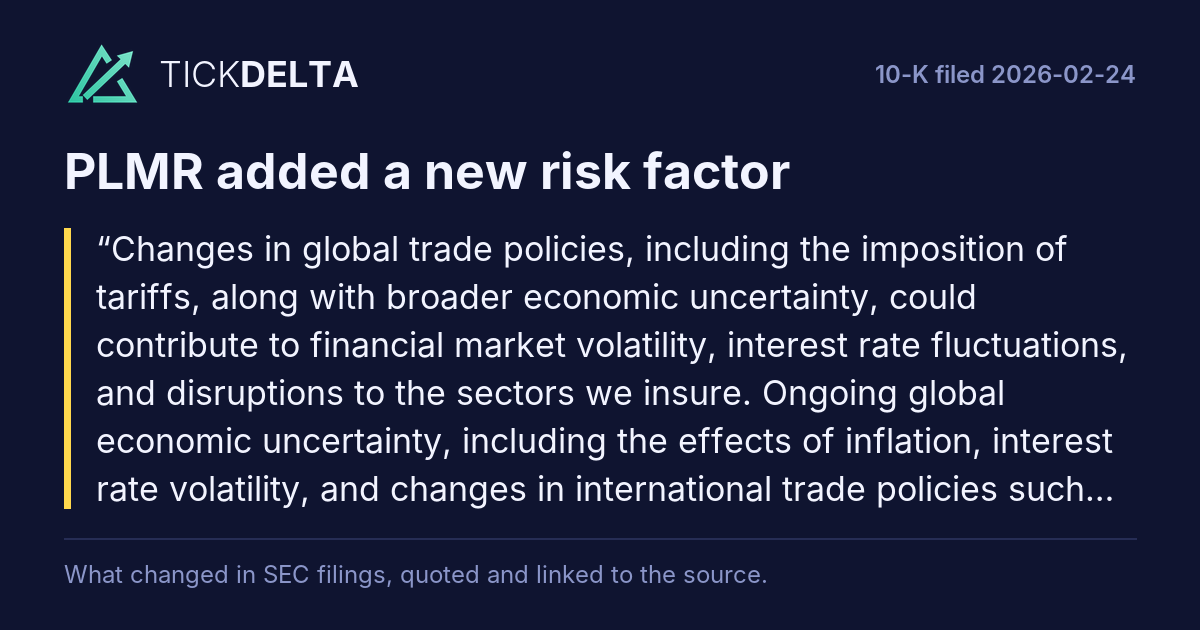
•Changes in global trade policies, including the imposition of tariffs, along with broader economic uncertainty, could contribute to financial market volatility, interest rate fluctuations, and disruptions to the sectors we insure;

Read in the 10-K

new insurance policies could also be materially adversely impacted as a result of corresponding reductions in our capital. In addition, a natural disaster could materially impact the financial condition of our policyholders, resulting in loss of premiums.

Read in the 10-K

to quantify its impact on our business, but no assurance can be given that our attempt to quantify such inputs will be accurate or successful.

Read in the 10-K

•The models may not accurately reflect the true frequency or severity of events;

Read in the 10-K
Show the other 8

Participants in the insurance industry use ratings from independent ratings agencies, such as A.M. Best, as an important means of assessing the financial strength and creditworthiness of insurers. In setting its ratings, A.M. Best performs quantitative and qualitative analysis of a company’s balance sheet strength, operating performance and business profile. A.M. Best financial strength

ratings range from “A++” (Superior) to “F” for insurance companies that have been publicly placed in liquidation. As of December 31, 2025, A.M. Best has assigned a financial strength rating of “A” (Excellent) (Outlook Stable) to our insurance company subsidiaries, Palomar Specialty Insurance Company (“PSIC”), Palomar Excess and Surplus Insurance Company (“PESIC”) and First Indemnity of America Insurance Co. (“FIA”) .

Read in the 10-K

Competition for business in our industry is intense, which may result in pricing pressure, reduced underwriting margins, or changes in market share.

Read in the 10-K

Instability in the surety market, resulting from construction defaults, contractual disputes, or evolving regulatory requirements, could negatively impact the performance of our surety products;

Fluctuations in construction industry performance, defaults on bonded projects, contractual disagreements and regulatory changes are inherent risks in the surety insurance industry. These events may lead to increased challenges in underwriting, claims management, and regulatory compliance. Depending on our ability to effectively manage the impact of these risks, we could face increased loss reserves, higher underwriting losses, and rising operational costs, all of which could materially affect our financial performance and overall profitability.

Read in the 10-K

Changes in global trade policies, including the imposition of tariffs, along with broader economic uncertainty, could contribute to financial market volatility, interest rate fluctuations, and disruptions to the sectors we insure.

Ongoing global economic uncertainty, including the effects of inflation, interest rate volatility, and changes in international trade policies such as the imposition of tariffs, could have wide-ranging impacts on the markets in which we operate. These conditions may lead to shifts in consumer behavior, changes in exposure levels across personal and commercial lines, and increased costs associated with claims, operations, and policy administration. In addition, market volatility may negatively impact the performance of our investment portfolio and influence policyholder behavior. Together, these developments could adversely affect our financial results, capital position, and ability to execute our long-term business strategy.

Read in the 10-K

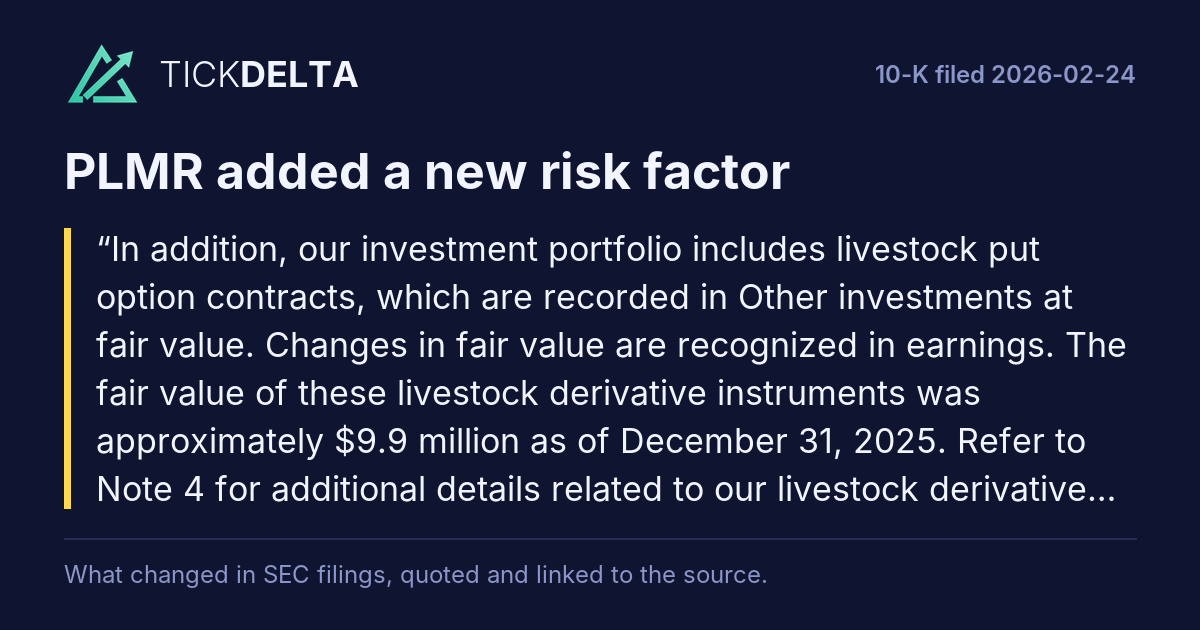
In addition, our investment portfolio includes livestock put option contracts, which are recorded in Other investments at fair value. Changes in fair value are recognized in earnings. The fair value of these livestock derivative instruments was approximately $9.9 million as of December 31, 2025. Refer to Note 4 for additional details related to our livestock derivative instruments.

Read in the 10-K

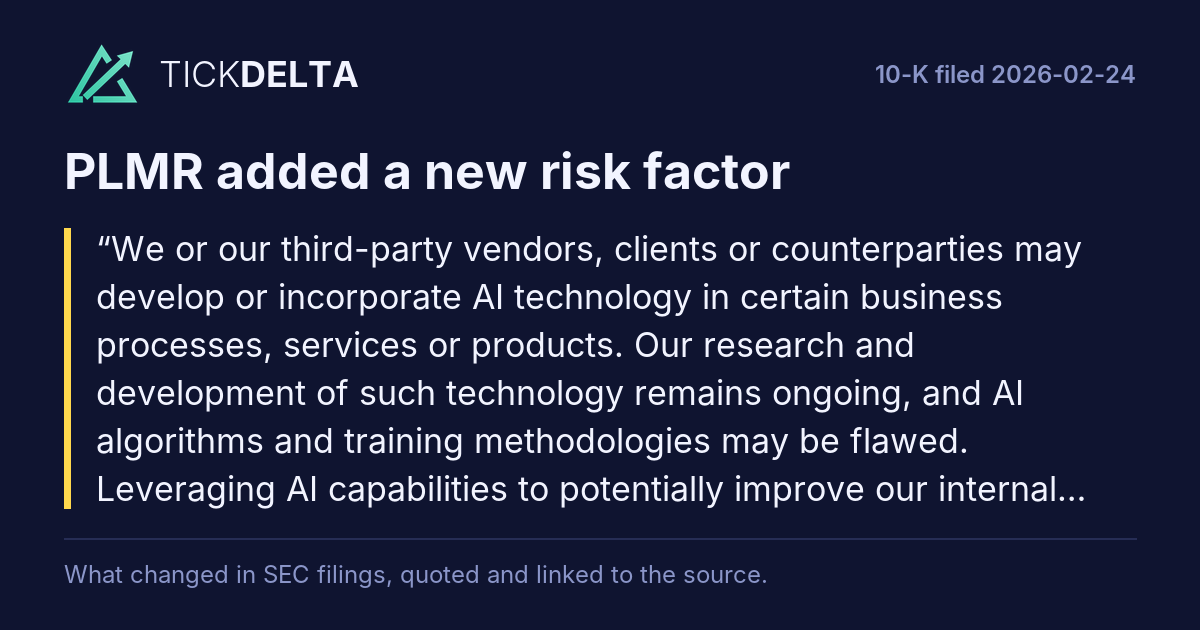
We or our third-party vendors, clients or counterparties may develop or incorporate AI technology in certain business processes, services or products. Our research and development of such technology remains ongoing, and AI algorithms and training methodologies may be flawed. Leveraging AI capabilities to potentially improve our internal operations also presents further risks, costs, and challenges. While we aim to develop and use AI responsibly and attempt to identify and mitigate ethical and legal issues presented by its use, we may be unsuccessful in identifying or resolving issues before they arise.

Read in the 10-K

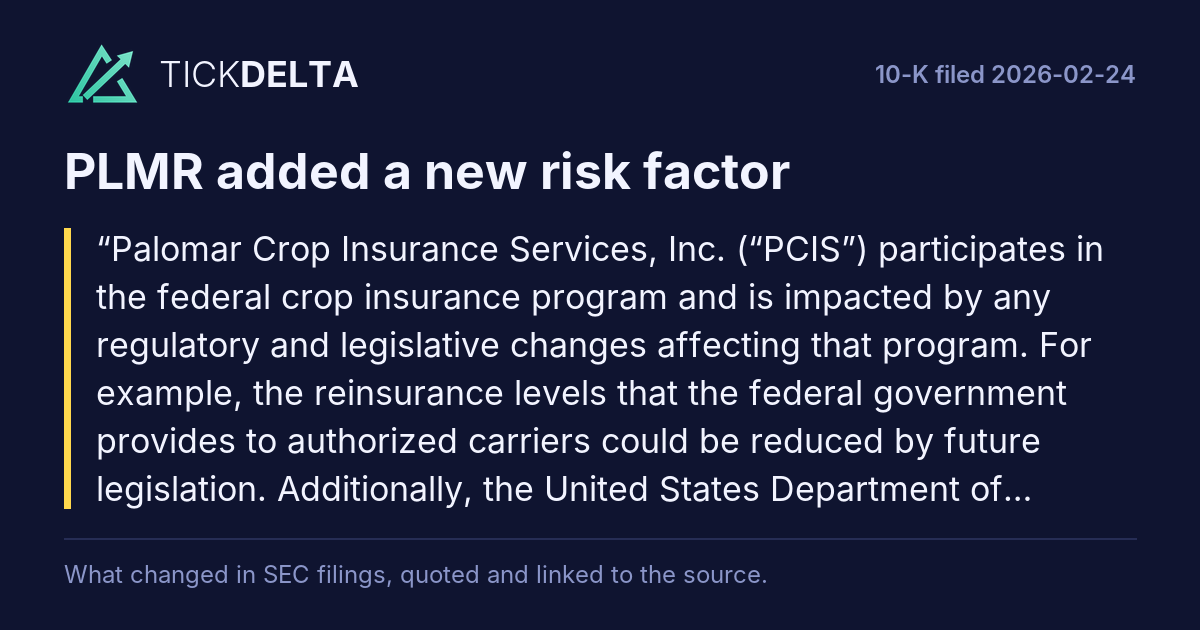
Palomar Crop Insurance Services, Inc. (“PCIS”) participates in the federal crop insurance program and is impacted by any regulatory and legislative changes affecting that program. For example, the reinsurance levels that the federal government provides to authorized carriers could be reduced by future legislation. Additionally, the United States Department of Agriculture’s Risk Management Agency (“RMA”) establishes policy terms and conditions, rates and forms and is also responsible for setting compliance standards for our Crop insurance policies. We report all details of policies to the RMA and are party to a Standard Reinsurance Agreement (“SRA”) which sets out the relationship between private insurance companies and the Federal Crop Insurance Corporation. Noncompliance with any of the aforementioned regulations or legislative changes to the federal crop insurance program may impact PCIS’ ability to write crop insurance premiums in the future.

Read in the 10-K

reporting, technical accounting, and internal control knowledge to satisfy the ongoing requirements of Section 404 and provide internal audit services.

Read in the 10-K

Paragraphs in the 10-Q filed Nov 6, 2026 that were not in the one before

New in the latest 10-Q

17 paragraphs in the 10-Q filed Nov 6, 2026 with nothing like them in the 10-Q filed Aug 5, 2026 (at least half the words must differ; new numbers alone do not count). Quoted exactly, grouped by the item heading above them. This is text that changed, not a judgement of how serious it is.

Financial statements and notes

As of September 30, 2026, the Company held one debt security classified as held-to-maturity, representing its investment in a floating rate senior surplus note issued by a Florida-domiciled reciprocal insurance exchange (the “Senior Surplus Note”), which the Company acquired on September 22, 2026. The Senior Surplus Note has a principal amount of $15.0 million, was purchased at a discount for $14.7 million and is scheduled to mature in September 2033. Interest, which is based on the three-month U.S. Treasury rate plus a spread that varies with the issuer’s surplus note leverage, is payable semi-annually beginning December 31, 2026. The Senior Surplus Note is redeemable at the issuer’s option beginning September 2027. It is unsecured and ranks junior to policyholder and other creditor claims. All payments of principal and interest on the Senior Surplus Note are subject to prior approval by the Florida Office of Insurance Regulation, and if approval is not granted, payment is deferred until approval is obtained. The Company has the intent and ability to hold the security to maturity, and it is carried at amortized cost, with the discount accreted to interest income over the contractual term on a straight-line basis, which approximates the effective interest method, net of an allowance for credit losses.

Read in the 10-Q

As of September 30, 2026, the Senior Surplus Note had a carrying amount of $14.7 million and an estimated fair value that approximated its carrying amount. The carrying amount and estimated fair value of the Senior Surplus Note are both classified in the after five years through ten years maturity grouping, based on its contractual maturity of September 2033. See Note 4 for further discussion of the fair value measurement and its categorization within Level 3 of the fair value hierarchy.

Read in the 10-Q

The Company evaluates expected credit losses on its held-to-maturity security based on an assessment of the issuer's credit quality, including statutory capital and surplus, senior surplus note leverage, operating performance, reinsurance arrangements, regulatory developments, and other information relevant to the collectability of contractual cash flows. Based on this assessment, the Company has concluded that no allowance for credit losses was required as of September 30, 2026.

Read in the 10-Q

Less Than 12 Months More Than 12 Months Total Fair Unrealized Fair Unrealized Fair Unrealized December 31, 2025 Value Losses Value Losses Value Losses ─────────────────────────────────────────────────────────────────────────────────────────────────────────────────────────────────────────────────────────────────────────────────────────────────────────────────────────────────────────────────────────── ($ in thousands) Fixed maturity securities: U.S. Governments $ 2,006 $ (38) $ 5,704 $ (188) $ 7,710 $ (226) U.S. States, Territories, and Political Subdivisions 5,157 (441) 9,509 (553) 14,666 (994) Special revenue excluding mortgage/asset-backed securities - - 15,185 (1,887) 15,185 (1,887) Corporate and other 49,963 (948) 160,780 (7,456) 210,743 (8,404) Mortgage/asset-backed securities 47,313 (406) 79,733 (7,594) 127,046 (8,000) Total available-for-sale investments $ 104,439 $ (1,833) $ 270,911 $ (17,678) $ 375,350 $ (19,511) The Company reviews all securities with unrealized losses on a quarterly basis to assess whether the decline in the securities’ fair value necessitates the recognition of an allowance for credit losses. The Company considers numerous factors in its review as described in Note 2 of the Notes to the Consolidated Financial Statements in the 2025 Annual Report on Form 10-K. Based on the Company’s review as of September 30, 2026, the Company determined that the fixed maturity securities’ unrealized losses were primarily the result of the interest rate environment and not the credit quality of the issuers. The Company does not intend to sell the investments and it is not more likely than not that the Company will be required to sell the investments before the recovery of their amortized cost basis. Contractual maturities of available‑for‑sale fixed maturity securities The amortized cost and fair value of fixed maturity securities at September 30, 2026, by contractual maturity, are shown below: Amortized Fair Cost Value ($ in thousands) Due within one year $ 56,013 $ 55,930 Due after one year through five years 295,592 285,306 Due after five years through ten years 342,520 323,763 Due after ten years 210,343 188,106 Mortgage and asset-backed securities 745,975 712,514 $ 1,650,443 $ 1,565,619 Expected maturities may differ from contractual maturities because borrowers may have the right to call or prepay obligations. Net investment income summary Net investment income is summarized as follows: Three Months Ended Nine Months Ended September 30, September 30, 2026 2025 2026 2025 ───────────────────────────────────────────────────────────────────────────────────────────────────────────────────────────────────────────── ($ in thousands) ($ in thousands) Interest income $ 21,333 $ 14,515 $ 57,731 $ 39,824 Dividend income 1,539 298 3,879 857 Investment expense (466) (241) (1,270) (667) Net investment income $ 22,406 $ 14,572 $ 60,340 $ 40,014

Read in the 10-Q

Holders of unvested RSUs and PSUs are entitled to dividend equivalents on the same per-share basis as dividends declared on the Company’s common stock. Dividend equivalents accrue when dividends are declared and are paid only if and when the underlying RSUs or PSUs vest; dividend equivalents related to any RSUs or PSUs that are forfeited are also forfeited. Dividends and dividend equivalents declared during the three and nine months ended September 30, 2026 were $12.2 million, of which $11.8 million was paid in cash to holders of common stock and $0.4 million represents dividend equivalents accrued on unvested RSUs and PSUs. These amounts are reflected within retained earnings in the Company’s unaudited condensed consolidated statement of changes in stockholders’ equity.

Read in the 10-Q
Show the other 12

Three months ended September 30, 2026 compared to three months ended September 30, 2025

Read in the 10-Q

Commission and other income was materially consistent for the three months ended September 30, 2026 as compared to the three months ended September 30, 2025.

Read in the 10-Q

Interest expense increased $5.0 million to $5.1 million for the three months ended September 30, 2026 from $0.1 million for the three months ended September 30, 2025, primarily due to interest on the Term Loan entered into in January 2026 to fund the acquisition of Gray Surety and, to a lesser extent, borrowings under our FHLB line of credit.

Read in the 10-Q

Nine months ended September 30, 2026 compared to nine months ended September 30, 2025

Read in the 10-Q

Interest expense increased $12.9 million to $13.2 million for the nine months ended September 30, 2026 from $0.3 million for the nine months ended September 30, 2025, primarily due to interest on the Term Loan entered into in January 2026 to fund the acquisition of Gray Surety and, to a lesser extent, borrowings under our FHLB line of credit.

Read in the 10-Q

In December 2021, we entered into a credit agreement with U.S. Bank National Association (the “2021 Credit Agreement”) which provided a revolving credit facility of up to $100 million through December 8, 2026. In January 2026, we entered into a new credit agreement (the “2026 Credit Agreement”) that replaced the 2021 Credit Agreement.

Read in the 10-Q

Market risk

We are also exposed to interest rate risk associated with our variable-rate Term Loan. A hypothetical 100-basis-point increase in interest rates would increase annual interest expense on the $296.3 million of principal outstanding under our Term Loan as of September 30, 2026, by approximately $3.0 million.

Read in the 10-Q

Risk Factors

Most insurance regulations are designed to protect the interests of insurance policyholders, as opposed to the interests of investors or stockholders. These regulations generally are administered by a department of insurance in each state and relate to, among

Read in the 10-Q

Share sales and buybacks

Approximate Dollar Total Total Number of Value of Shares Number Average Shares Purchased that May Yet Be of Shares Price Paid as Part of Publicly Purchased Under the Purchased Per Share(1) Announced Plans Plans or Programs(2) ($ in thousands) July 1, 2026 to July 31, 2026 — $ — — $ 163,181 August 1, 2026 to August 31, 2026 — — — 163,181 September 1, 2026 to September 30, 2026 70,000 126.93 70,000 154,295 Total 70,000 $ 126.93 70,000

Read in the 10-Q

Other information

On September 4, 2026, Angela Grant, the Company’s Chief Legal Officer, entered a trading plan intended to satisfy the affirmative defense conditions of Rule 10b5-1(c) under the Exchange Act, providing for the exercise of stock options and sale of up to 1,254 shares of common stock underlying such options and the sale of up to 1,848 shares of the Company’s common stock. Pursuant to this plan, Ms. Grant may sell shares beginning December 4, 2026 and ending May 31, 2027.

Read in the 10-Q

On September 11, 2026, T. Christopher Uchida, the Company’s Chief Financial Officer, entered a trading plan intended to satisfy the affirmative defense conditions of Rule 10b5-1(c) under the Exchange Act, providing for the exercise of stock options and sale of up to 168 shares of common stock underlying such options and the sale of up to 9,827 shares of the Company’s common stock. Pursuant to this plan, Mr. Uchida may sell shares beginning December 11, 2026 and ending May 31, 2027.

Read in the 10-Q

On September 13, 2026, Jon Christianson, the Company’s President, entered a trading plan intended to satisfy the affirmative defense conditions of Rule 10b5-1(c) under the Exchange Act, providing for the exercise of stock options and sale of up to 6,924 shares of common stock underlying such options and the sale of up to 12,000 shares of the Company’s common stock. Pursuant to this plan, Mr. Christianson may sell shares beginning December 13, 2026 and ending May 31, 2027.

Read in the 10-Q

The 10-Q's risk factors against the 10-K

Item 1A of the 10-Q filed Nov 6, 2026 against Item 1A of the 10-K filed Feb 24, 2026. A 10-Q repeats only the risks that changed, so a 10-K paragraph that is missing from it is not counted as removed. Added is a paragraph with nothing like it in the 10-K, Reworded a sentence that is in both with several words changed, Quiet changes a sentence in both where one to four words changed and one is a hedge or a modal (cut words struck through, new words highlighted). Text on the page, not a score; each links to the filing at sec.gov.

Added10-Q Nov 6, 2026 vs 10-K Feb 24, 2026
• Litigation, judicial and regulatory trends, such as increased litigation, higher jury awards, class action lawsuits, multi-district litigation, and evolving legal theories that may increase claim duration, defense costs and settlement values;

Read it in the 10-Q at sec.gov

Added10-Q Nov 6, 2026 vs 10-K Feb 24, 2026
• claims inflation assumptions, such as increased costs of raw materials, labor, and other components of claims cost.

Read it in the 10-Q at sec.gov

Added10-Q Nov 6, 2026 vs 10-K Feb 24, 2026
Expansion into new products, acquired businesses and lines of business may result in more limited historical claims experience for certain exposures, increasing uncertainty in estimating ultimate losses and loss adjustment expenses.

Read it in the 10-Q at sec.gov

Added10-Q Nov 6, 2026 vs 10-K Feb 24, 2026
disruptions, may increase the cost of construction materials, auto parts, labor and other inputs used to settle claims, increasing claim severity, reserve requirements and pressure on underwriting margins, which could adversely affect our financial results, capital position and ability to execute our long-term business strategy.

Read it in the 10-Q at sec.gov

Added10-Q Nov 6, 2026 vs 10-K Feb 24, 2026
We have invested, and may in the future invest, a small percentage of our investment portfolio in private companies, limited partnerships and other less liquid instruments, which we believe provide strategic opportunities. These types of investments are typically illiquid, and we have limited ability to take actions that protect or increase the value of this type of investment. In addition, we have invested, and may in the future invest, in securities that we classify as held-to-maturity, which may have no active market, may be valued using significant unobservable inputs, and, in the case of instruments such as surplus notes, may have payments that are subject to regulatory approval and may be deferred. Net losses from these investments or impairment of these investments may negatively impact our operating results.

Read it in the 10-Q at sec.gov

Show the other 20
Added10-Q Nov 6, 2026 vs 10-K Feb 24, 2026
We are incorporating AI and AI-adjacent technology and tools in certain business processes and workflows and expect AI to have a more meaningful impact on our Company in the future. While we are attempting to implement AI deliberately to enhance automation, efficiency, and risk management, we believe it introduces several additional risks. The increased investment in and reliance on AI for business processes creates risks should AI not provide the anticipated benefits or operate as anticipated. There are numerous AI-adjacent tools which may improve the efficiency or effectiveness of our processes, and there is a risk that we do not implement the correct tools or do not implement the tools effectively. While we issue guidelines to employees on the use of AI, employees may use it in unanticipated ways that introduce additional risk to us. Generative AI tools may provide inaccurate, incomplete or false information, introduce biases or otherwise adversely affect our operations, financial results or regulatory compliance. We also use AI to support risk selection, underwriting, pricing, and claims handling; if the analyses or recommendations these tools produce are, or are alleged to be, inaccurate, biased, or unfairly discriminatory, whether due to flawed algorithms, insufficient or biased data, or deficient training methodologies, our business, results of operations, reputation, and regulatory standing could be adversely affected.

Read it in the 10-Q at sec.gov

Added10-Q Nov 6, 2026 vs 10-K Feb 24, 2026
While we aim to develop and use AI deliberately and responsibly, we cannot anticipate all of the ways AI will impact us and cannot guarantee that the risks associated with AI use will be fully mitigated. Failure to manage AI risks could adversely impact our business.

Read it in the 10-Q at sec.gov

Added10-Q Nov 6, 2026 vs 10-K Feb 24, 2026
Most insurance regulations are designed to protect the interests of insurance policyholders, as opposed to the interests of investors or stockholders. These regulations generally are administered by a department of insurance in each state and relate to, among

Read it in the 10-Q at sec.gov

Added10-Q Nov 6, 2026 vs 10-K Feb 24, 2026
In addition, regulatory standards relating to the use of artificial intelligence are evolving, and certain states have issued regulatory guidance to insurance companies on the use of AI. Certain states have adopted the NAIC Model Bulletin on the Use of Artificial Intelligence, while the New York Department of Financial Services issued a circular letter on the use of AI in insurance underwriting and pricing. Such state guidance on the use of AI sets forth expectations that companies have governance and risk management practices in place to ensure the use of AI complies with various state laws governing the business of insurance.

Read it in the 10-Q at sec.gov

Added10-Q Nov 6, 2026 vs 10-K Feb 24, 2026
The continued operation and growth of our business will require substantial capital. Because we are a holding company with no business operations of our own, our ability to support our growth and return capital to stockholders, including through dividends and share repurchases, largely depends on dividends and other distributions from our insurance subsidiaries, PSIC, PESIC, PSRE, FIA, and PCSC.

Read it in the 10-Q at sec.gov

Added10-Q Nov 6, 2026 vs 10-K Feb 24, 2026
The payment of cash dividends reduces the cash otherwise available to us for other purposes, including funding operations, debt service, acquisitions, and share repurchases, and there can be no assurance that our dividend payments will not adversely affect our liquidity or capital resources, particularly in the event of significant catastrophe losses or other unanticipated cash needs. In addition, our ability to pay dividends is subject to restrictions under our 2026 Credit Agreement and applicable state insurance and Bermuda insurance regulations affecting the ability of our insurance subsidiaries to pay dividends or make distributions to us, as described below and in Note 13 to the condensed consolidated financial statements included in Part I, Item 1, of this Quarterly Report.

Read it in the 10-Q at sec.gov

Reworded10-Q Nov 6, 2026 vs 10-K Feb 24, 2026
We closed a $360 million catastrophe bond in the second quarter of 2026, effective June 1, 2026 through June 1, 2029; a $525 million catastrophe bond in the second quarter of 2025, effective June 1, 2025 through June 1, 2028; a $420 million catastrophe bond in the second quarter of 2024, effective June 1, 2024 through June 1, 2027; and a $200 million catastrophe bond in the second quarter of 2023, effective June 1, 2023 through June 1, 2026; and a $275 million 144A catastrophe bond in the second quarter of 2022, effective June 1, 2022 through June 1, 2025. 2026.

Read it in the 10-Q at sec.govThe 10-K sentence

Reworded10-Q Nov 6, 2026 vs 10-K Feb 24, 2026
We may not realize the anticipated benefits of acquisitions we have completed or may complete in the future, and we may not be able to incorporate any acquired lines of business with our existing operations, or effectively integrate personnel from the acquired businesses, in including their operations, systems and personnel, which case could materially adversely affect our business, financial condition and results of operations could be harmed. operations.

Read it in the 10-Q at sec.govThe 10-K sentence

Reworded10-Q Nov 6, 2026 vs 10-K Feb 24, 2026
The extent of the impact of a pandemic, disease outbreak or other public health crisis on our operational and financial performance depends on several factors, including the ultimate duration and severity of the event, the emergence and severity of variant strains, new or evolving health threats, actions taken and restrictions imposed by the government and health officials in response, officials, the effectiveness and adoption of vaccines and therapeutics, the ability for of our customers to continue to pay premiums, contraction of the insurance and reinsurance markets, and the ability for of reinsurers to satisfy claims, all of which are uncertain and cannot be predicted. claims.

Read it in the 10-Q at sec.govThe 10-K sentence

Reworded10-Q Nov 6, 2026 vs 10-K Feb 24, 2026
We monitor and mitigate our exposure through a number of several methods designed to minimize risk, including underwriting specialization, modeling and data systems, data quality control, strategic use of policy deductibles, regular review of aggregate exposure and probable maximum loss reports, which report the maximum amount of expected losses based on computer or actuarial modeling techniques.

Read it in the 10-Q at sec.govThe 10-K sentence

Reworded10-Q Nov 6, 2026 vs 10-K Feb 24, 2026
Unexpected changes in the interpretation of The failure to manage our coverage or provisions, including loss limitations and exclusions, in our policies growth effectively could have a material adverse effect on our business, financial condition condition, and results of operations.

Read it in the 10-Q at sec.govThe 10-K sentence

Reworded10-Q Nov 6, 2026 vs 10-K Feb 24, 2026
Consequently, If we reduce or discontinue dividends, investors may need to sell all or part of their holdings of our common stock after rely on price appreciation, which may never occur, as the only way to realize any future gains on their investment.

Read it in the 10-Q at sec.govThe 10-K sentence

Reworded10-Q Nov 6, 2026 vs 10-K Feb 24, 2026
Any determination to pay dividends in the future future, including whether we continue to pay dividends at all, in the current amount, or on a quarterly schedule, will be at the discretion of our Board of Directors and will depend upon results of operations, financial condition, capital requirements, restrictions imposed by applicable law and other factors our Board of Directors deems relevant.

Read it in the 10-Q at sec.govThe 10-K sentence

Reworded10-Q Nov 6, 2026 vs 10-K Feb 24, 2026
We must maintain accounting and finance staff and consultants with appropriate public company reporting, technical accounting, and internal control knowledge to satisfy the ongoing requirements of Section 404 and provide internal audit services.

Read it in the 10-Q at sec.govThe 10-K sentence

Reworded10-Q Nov 6, 2026 vs 10-K Feb 24, 2026
Our There is also risk around third-party use of AI as our customers, software vendors and other service providers are increasingly incorporating AI into their processes and this processes, which may expose us to additional risks should they not be able to incorporate the technology effectively.

Read it in the 10-Q at sec.govThe 10-K sentence

Reworded10-Q Nov 6, 2026 vs 10-K Feb 24, 2026
Although we are not currently involved in any material litigation with our customers, other members of the insurance industry are the target of class action lawsuits and other types of litigation, some of which involve claims for substantial or indeterminate amounts, and the outcomes of which are unpredictable. unpredictable and can be influenced by evolving legal trends, including third-party litigation funding and social inflation.

Read it in the 10-Q at sec.govThe 10-K sentence

Reworded10-Q Nov 6, 2026 vs 10-K Feb 24, 2026
In particular, our future success is substantially dependent on the continued service of our Founder, Chief Executive Officer and Chairman, Mac Armstrong, our Chief Financial Officer, Christopher Uchida and our President, Jon Christianson, and other members of our senior management team. T.

Read it in the 10-Q at sec.govThe 10-K sentence

The first 25 of 65 are shown (at most 12 of each type).

Phrases used for the first time

Two-word phrases in Risk Factors of the 10-K filed Feb 24, 2026 that are in none of the 1 earlier 10-Ks stored, back to Feb 25, 2025

new jersey ×5pricing pressure ×4twelve months ×4party software ×4litigation trends ×3trade policies ×3economic uncertainty ×3months ended ×3respective state ×3federal crop ×3equity particularly ×2events occur ×2greater frequency ×2claims severity ×2severity litigation ×2loss development ×2
Where each one is used
  • new jersey: FIA is subject to regulation from the New Jersey Department of Banking and Insurance, which requires that FIA comply with New Jersey Statutes and Insurance Code. Failure to meet these regulatory requirements could result in substantial fines or penalties and may negatively affect FIA’s relationship with the New...
  • pricing pressure: •There is intense competition for business in our industry, which may result in pricing pressure, reduced underwriting margins, or changes in market share;
  • twelve months: Our policyholders and insurance risks are currently concentrated in California, which generated 43% of our gross written premiums for the year ended December 31, 2024 and 31% for the twelve months ended December 31, 2025. We are exposed to business, economic, political, judicial and regulatory risks due to this...
  • party software: Multiple areas of our business rely on certain third‑party software obtained under licenses from other companies, and we expect to continue to rely on such third‑party software in the future. Unforeseen issues may arise in third-party software platforms which may have an adverse impact on our operations....
  • litigation trends: •Our loss reserves are established based on estimates and assumptions, which may be inadequate to cover actual incurred losses, including as a result of changes in claims severity, litigation trends, or other loss development, which could have a material adverse impact on our results of operations and financial condition;
  • trade policies: •Changes in global trade policies, including the imposition of tariffs, along with broader economic uncertainty, could contribute to financial market volatility, interest rate fluctuations, and disruptions to the sectors we insure;
  • economic uncertainty: •Changes in global trade policies, including the imposition of tariffs, along with broader economic uncertainty, could contribute to financial market volatility, interest rate fluctuations, and disruptions to the sectors we insure;
  • months ended: Our policyholders and insurance risks are currently concentrated in California, which generated 43% of our gross written premiums for the year ended December 31, 2024 and 31% for the twelve months ended December 31, 2025. We are exposed to business, economic, political, judicial and regulatory risks due to this...

The 10-K at sec.gov

Used at least twice, small words left out. Counted, not picked: a phrase can be new because the company renamed something.

What was taken out

13 paragraphs of last year's Risk Factors with nothing like them now. The longest are quoted.

Across all companies
We have based the forward-looking statements contained in this Annual Report on Form 10-K primarily on our current expectations and projections about future events and trends that we believe may affect our business, financial condition, results of operations, prospects, business strategy and financial needs. The outcome of the events described in these forward-looking statements is subject to risks, uncertainties, assumptions and other factors described in the section captioned “Risk Factors” and elsewhere in this Annual Report on Form 10-K. These risks are not exhaustive. Other sections...
In the 10-K filed Feb 25, 2025
This Annual Report on Form 10-K contains forward-looking statements within the meaning of the federal securities laws, which statements involve substantial risks and uncertainties. Forward-looking statements generally relate to future events or our future financial or operating performance. In some cases, you can identify forward-looking statements because they contain words such as “may”, “will”, “should”, “expects”, “plans”, “anticipates”, “could”, “intends”, “target”, “projects”, “contemplates”, “believes”, “estimates”, “predicts”, “would”, “potential” or “continue” or the negative of...
In the 10-K filed Feb 25, 2025
In addition, statements that “we believe” and similar statements reflect our beliefs and opinions on the relevant subject. These statements are based upon information available to us as of the date of this Annual Report on Form 10-K, and while we believe such information forms a reasonable basis for such statements, such information may be limited or incomplete, and our statements should not be read to indicate that we have conducted an exhaustive inquiry into, or review of, all potentially available relevant information. These statements are inherently uncertain and investors are...
In the 10-K filed Feb 25, 2025
You should read this Annual Report on Form 10-K and the documents that we reference in this Annual Report on Form 10-K and have filed as exhibits to this Annual Report on Form 10-K with the understanding that our actual future results, levels of activity, performance and achievements may be materially different from what we expect. We qualify all of our forward-looking statements by these cautionary statements.
In the 10-K filed Feb 25, 2025

Sources

Item 1A of each 10-K and 10-Q on EDGAR, quoted exactly. Each paragraph links to the filing at sec.gov.

Also

10-K change: what was reworded or cut, section by section.

Work with it

Excel workbook · CSV. Google Sheet that stays up to date: paste =IMPORTDATA("https://tickdelta.com/company/PLMR/export.csv") into a cell.

Next:10-K change
Esc

Type a ticker such as AAPL, a name, an investor such as Buffett, or a topic such as tariffs. ↑ ↓ to move, Enter to open.