Paragraphs with nothing like them in last year's 10-K
Quoted exactly
12 paragraphs in Risk Factors of the 10-K filed Feb 26, 2026
with nothing like them in the 10-K filed Feb 27, 2025. Quoted exactly.
Paragraphs that were only edited are under 10-K change.
The use of artificial intelligence in our business, including in our products and internally by our employees or business partners, may expose us to additional legal, regulatory and other risks that could adversely affect our business.
We use, and may continue to expand our use of, artificial intelligence (“AI”) technologies in our products and operations. For example, our HYDROS Robotic System includes AI-enabled, imaging-related assistive functionality designed to support Aquablation therapy. AI technologies are complex and rapidly evolving, and AI-enabled functionality may produce outputs that are inaccurate, incomplete, misleading, or biased, and could adversely affect our business.
In addition, our employees, contractors, and other third parties with whom we do business may use AI tools, including generative AI tools provided by third parties, in the course of their work. Such use may increase the risk that confidential, proprietary, or sensitive business information is inadvertently disclosed or incorporated into third-party systems, or that the security of our internal IT systems could be compromised. Although we have adopted policies, training, contractual restrictions, and technical controls intended to govern the use of AI tools and mitigate these risks, we cannot assure you that such measures will be effective in all instances.
Foreign data protection laws, including the General Data Protection Regulation, including as implemented in the United Kingdom, or collectively or GDPR, may also apply to our processing of health-related and other personal data
the future, or delays in entering into new strategic partnership agreements could delay tour sales and marketing efforts, which would harm our business prospects, financial condition and results of operations.
As a result of new administration and associated policy changes or shifting proposals by the U.S. government, there may be greater restrictions and economic disincentives on international trade. For example, the U.S. government has pursued a new approach to trade policy, including renegotiating or terminating certain existing bilateral or multi-lateral trade agreements. Beginning in 2025, the U.S. government has imposed significant new tariffs on imports, which, along
with other U.S. trade actions, have triggered retaliatory actions by certain affected countries, including retaliatory measures on U.S. goods and other protectionist measures that could limit our ability to offer our products and services outside of the U.S.
Show the other 5
business. In addition, an organization that fails to prevent bribery by anyone associated with the organization can be charged under the Bribery Act, unless the organization can establish the defense of having implemented adequate procedures to prevent bribery.
and financial resources, expose us to product liability or other claims, harm our reputation with customers and adversely impact our business, financial condition and results of operations.
adverse effect on our business. Any of the foregoing may cause us to incur substantial costs, and could place a significant strain on our financial resources, divert the attention of management from our core business and harm our reputation.
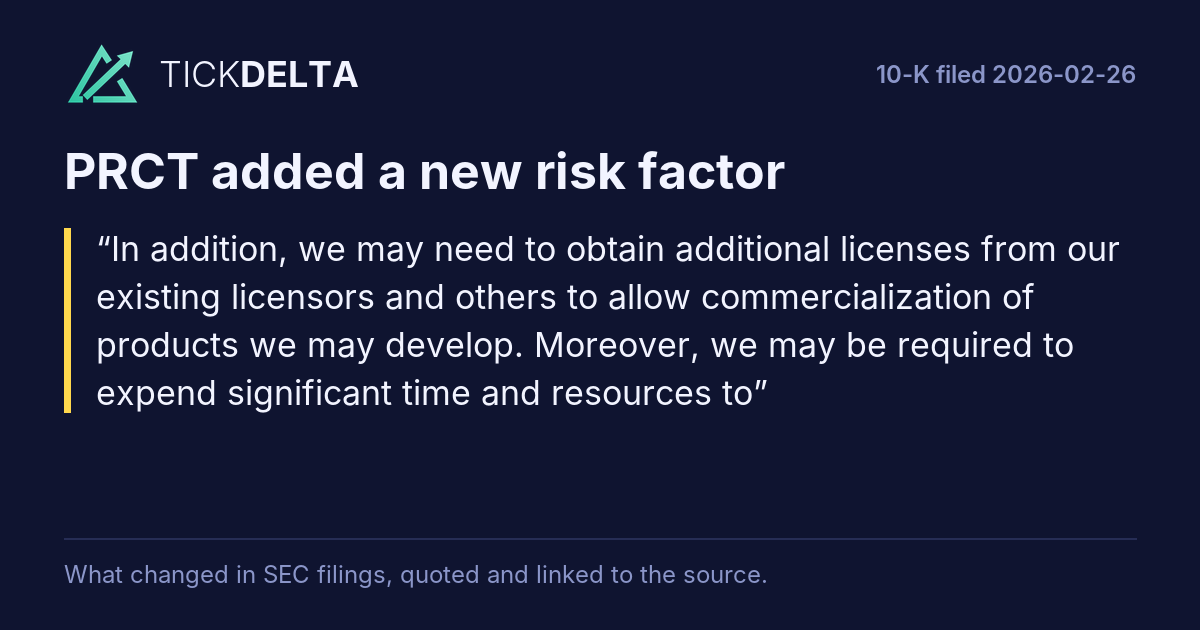
In addition, we may need to obtain additional licenses from our existing licensors and others to allow commercialization of products we may develop. Moreover, we may be required to expend significant time and resources to
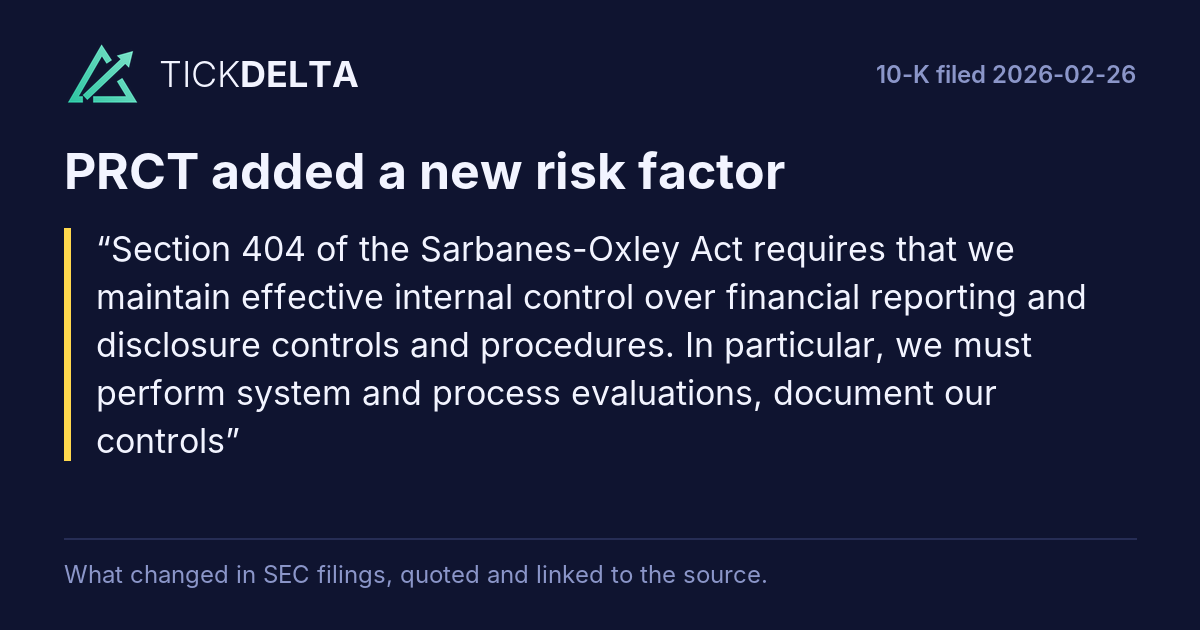
Section 404 of the Sarbanes-Oxley Act requires that we maintain effective internal control over financial reporting and disclosure controls and procedures. In particular, we must perform system and process evaluations, document our controls
Paragraphs in the 10-Q filed Nov 4, 2026 that were not in the one before
New in the latest 10-Q
4 paragraphs in the 10-Q filed Nov 4, 2026 with nothing like
them in the 10-Q filed Aug 5, 2026 (at least half the words must differ; new numbers alone do not count).
Quoted exactly, grouped by the item heading above them. This is text that changed, not a judgement of how serious it is.
10-Q
In September 2026, the Company entered into a third amendment to the Agreement which extended the maturity date of the Term Loan Facility by 12 months from October 1, 2027 to October 1, 2028.
Read in the 10-Qopen_in_new
On September 15, 2026, a shareholder derivative action was filed in the U.S. District Court for the Northern District of California, captioned Chen v. Zadno, et al., No. 5:26-cv-10492 (the “Derivative Action” and, together with the Securities Class Action, the “Litigation”). The Derivative Action complaint names certain current and former executive officers and members of our Board of Directors as defendants and names the Company as a nominal defendant. The complaint arises from substantially similar underlying allegations as the Securities Class Action and asserts claims for violations of Section 14(a) of the Exchange Act, breaches of fiduciary duty and related state-law claims, and contribution under Sections 10(b) and 21D of the Exchange Act. The plaintiff seeks, among other relief, unspecified damages and restitution on behalf of the Company, corporate governance reforms, and attorneys’ and experts’ fees and expenses.
Read in the 10-Qopen_in_new
Selling, general and administrative, or SG&A, expenses consist primarily of compensation for personnel, including stock-based compensation, related to selling, marketing, post-market clinical affairs, professional
Read in the 10-Qopen_in_new
In September 2026, we entered into a third amendment to the loan and security agreement, which extended the maturity date of Term Loan Facility by 12 months, from October 1, 2027 to October 1, 2028.
Read in the 10-Qopen_in_new
The 10-Q's risk factors against the 10-K
Item 1A of the 10-Q filed Nov 4, 2026 against Item 1A of the 10-K filed Feb 26, 2026.
A 10-Q repeats only the risks that changed, so a 10-K paragraph that is missing from it is not counted as removed.
Added is a paragraph with nothing like it in the 10-K, Reworded a sentence that is in both with several words changed,
Quiet changes a sentence in both where one to four words changed and one is a hedge or a modal
(cut words struck through, new words highlighted).
Text on the page, not a score; each links to the filing at sec.gov.
Added10-Q Nov 4, 2026 vs 10-K Feb 26, 2026
Our business, financial condition and operating results are affected by a number of factors, whether currently known or unknown, including risks specific to us or the healthcare industry as well as risks that affect businesses in general. In addition to the information set forth in this Quarterly Report on Form 10-Q, you should consider carefully the factors discussed in Part I, Item 1A, “Risk Factors” in our Annual Report on Form 10-K for the fiscal year ended December 31, 2025, filed with the SEC on February 26, 2026. The risks and uncertainties disclosed in such Annual Report and in this Quarterly Report could materially adversely affect our business, financial condition, cash flows or results of operations and thus our stock price. During the nine months ended September 30, 2026, there were no material changes to our previously disclosed risk factors. Besides risk factors disclosed in the Annual Report and this Quarterly Report, additional risks and uncertainties not currently known or we currently deem to be immaterial may also materially adversely affect our business, financial condition or results of operations.
Read it in the 10-Q at sec.govopen_in_new
Added10-Q Nov 4, 2026 vs 10-K Feb 26, 2026
These risk factors may be important to understanding other statements in this Quarterly Report and should be read in conjunction with the unaudited condensed consolidated financial statements and related notes in Part I, Item 1, “Financial Statements” and Part I, Item 2, “Management’s Discussion and Analysis of Financial Condition and Results of Operations” of this Quarterly Report. Because of such risk factors, as well as other factors affecting our financial condition and operating results, past financial performance should not be considered to be a reliable indicator of future performance, and investors should not use historical trends to anticipate results or trends in future periods.
Read it in the 10-Q at sec.govopen_in_new
We rely in part on our portfolio of issued patents and pending patent applications in the United States and other countries to protect our intellectual property and competitive position. However, our patent applications may not result in issued patents, and any patents that are issued may not provide meaningful protection against competitors or competitive technologies. Further, the examination process may require us to narrow the claims for our pending patent applications, which may limit the scope of patent protection that may be obtained if these applications issue. It is also possible that we
In the 10-K filed Feb 27, 2025open_in_new
and/or if we are otherwise unable to transfer personal data between and among countries and regions in which we operate, it could affect the manner in which we provide our services, the geographical location or segregation of our relevant systems and operations, and could adversely affect our financial results.
In the 10-K filed Feb 27, 2025open_in_new
will not be deemed to have waived our compliance with the federal securities laws and the rules and regulations thereunder. These provisions may also result in increased costs for investors seeking to bring a claim against us or any of our directors, officers or other employees.
In the 10-K filed Feb 27, 2025open_in_new
Initiating and completing clinical trials necessary to support any future PMA applications or de novo requests, or to provide additional safety and efficacy data beyond those typically required for a 510(k) clearance, for our possible future
In the 10-K filed Feb 27, 2025open_in_new
Sources
Item 1A of each 10-K and 10-Q on EDGAR, quoted exactly. Each paragraph links to the filing at sec.gov.
Also
10-K change: what was reworded or cut, section by section.
Work with it
Excel workbook · CSV. Google Sheet that stays up to date: paste =IMPORTDATA("https://tickdelta.com/company/PRCT/export.csv") into a cell.