Primerica, Inc. PRI
New risk paragraphs, branching off last year
Each branch is a paragraph in Risk Factors with nothing like it in the 10-K filed Feb 28, 2025. A box jumps to the paragraph as filed, below.
Paragraphs with nothing like them in last year's 10-K
10 paragraphs in Risk Factors of the 10-K filed Feb 27, 2026 with nothing like them in the 10-K filed Feb 28, 2025. Quoted exactly. Paragraphs that were only edited are under 10-K change.
compliance and supervisory efforts, the breadth of our operations and the broad regulatory requirements could result in oversight failures and instances of non-compliance or violations on the part of the Company or independent sales representatives.
We began distributing segregated funds on behalf of a third party on a limited basis in January 2025 with a full rollout in December 2025. On November 19, 2025, the Canadian Council of Insurance Regulators and Canadian Insurance Services Regulatory Organizations issued new Segregated Funds Guidance, which continues to allow existing compensation models but with additional requirements around their usage. We are assessing the impact of these requirements.
arrangements. Failure to comply with such disclosure requirements could result in regulatory sanctions, which could have an adverse effect on our ability to offer mortgage loan referrals in Canada.
We, our third-party service providers, or competitors, may develop or incorporate artificial intelligence (“AI”) technology in certain business processes, products or services. AI technologies are complex and rapidly evolving. The regulatory environment related to AI is also uncertain and evolving, which could require changes in our potential use and implementation of AI technologies and could increase compliance costs and the risk of non-compliance. AI technologies used by us or our third-party service providers could result in inaccurate information. More rapid adoption of AI by our competitors resulting in more cost-effective technologies and/or products could result in a change in the competitive environment in which we operate that could negatively affect our ability to maintain or increase our market share or profitability.
Additionally, our or our third-party service providers’ use of AI technologies could increase the risk of loss or inadvertent sharing of consumer or proprietary data, which could increase the risk of related information and security and privacy incidents, regulatory actions and/or consumer litigation. Likewise, malefactors are also increasingly using AI to target individuals to gain access to consumer accounts, such as through “deep fakes” and impersonations. AI may also be used to increase the frequency and severity of cybersecurity attacks against us or our third-party service providers. An increase in any of these wrongdoings may adversely impact our business, financial condition and results of operations.
Risks Related to Legislative and Regulatory Changes and Government Policy Uncertainty
Show the other 3
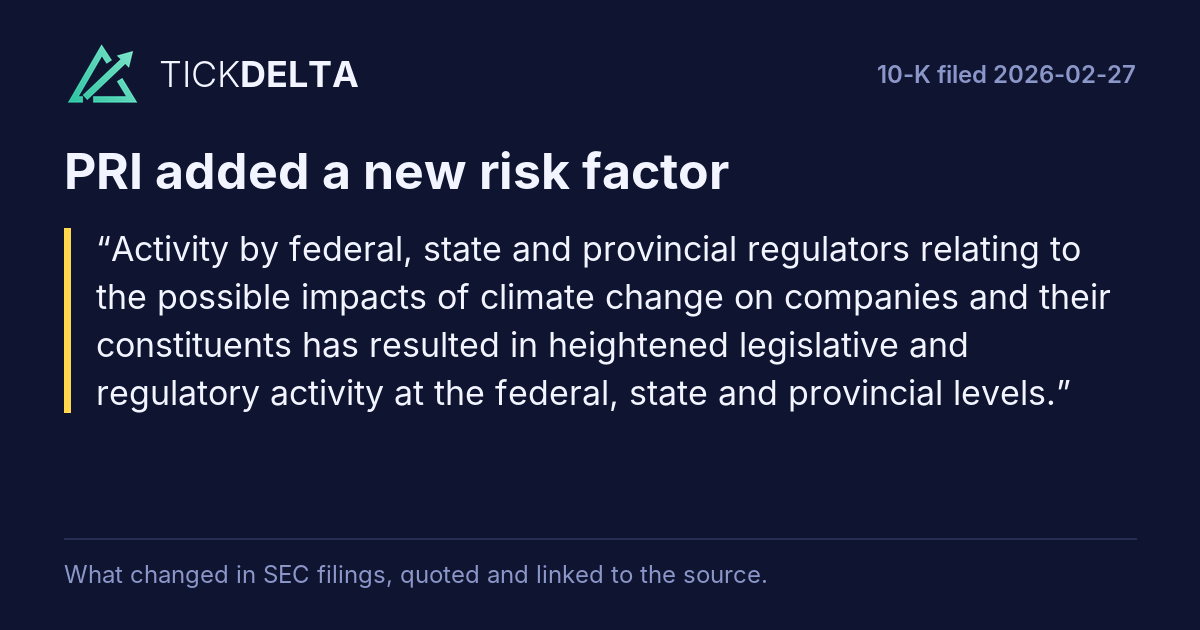
Activity by federal, state and provincial regulators relating to the possible impacts of climate change on companies and their constituents has resulted in heightened legislative and regulatory activity at the federal, state and provincial levels.
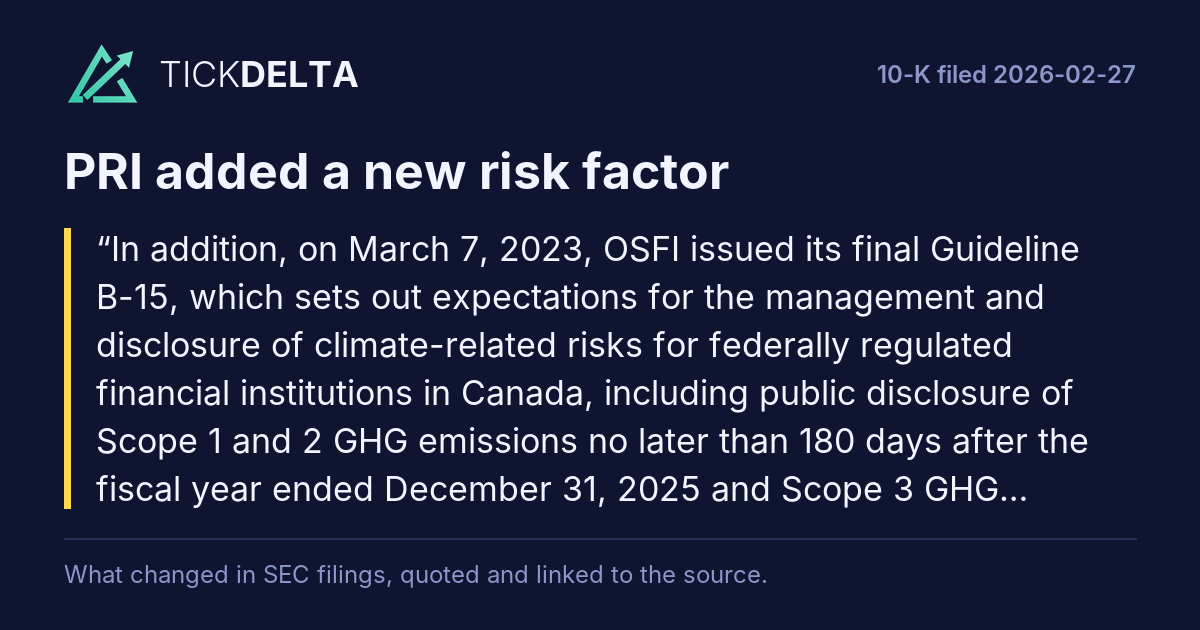
In addition, on March 7, 2023, OSFI issued its final Guideline B-15, which sets out expectations for the management and disclosure of climate-related risks for federally regulated financial institutions in Canada, including public disclosure of Scope 1 and 2 GHG emissions no later than 180 days after the fiscal year ended December 31, 2025 and Scope 3 GHG emissions no later than 180 days after the fiscal year ending December 31, 2028. Guideline B-15 also includes OSFI’s expectation that applicable entities conduct internal and standardized climate scenario analyses and report the results to OSFI periodically.
Compliance with SB 253, SB 219, Guideline B-15 and any other climate disclosure rules applicable to the Company may require significant assistance from third-party vendor(s). Factors that could adversely impact our ability to comply with any new climate disclosure rules include, but are not limited to, failure to secure the assistance of a third-party vendor(s), inability to gather the requisite data in a timely manner or at all, and/or significant associated financial costs.
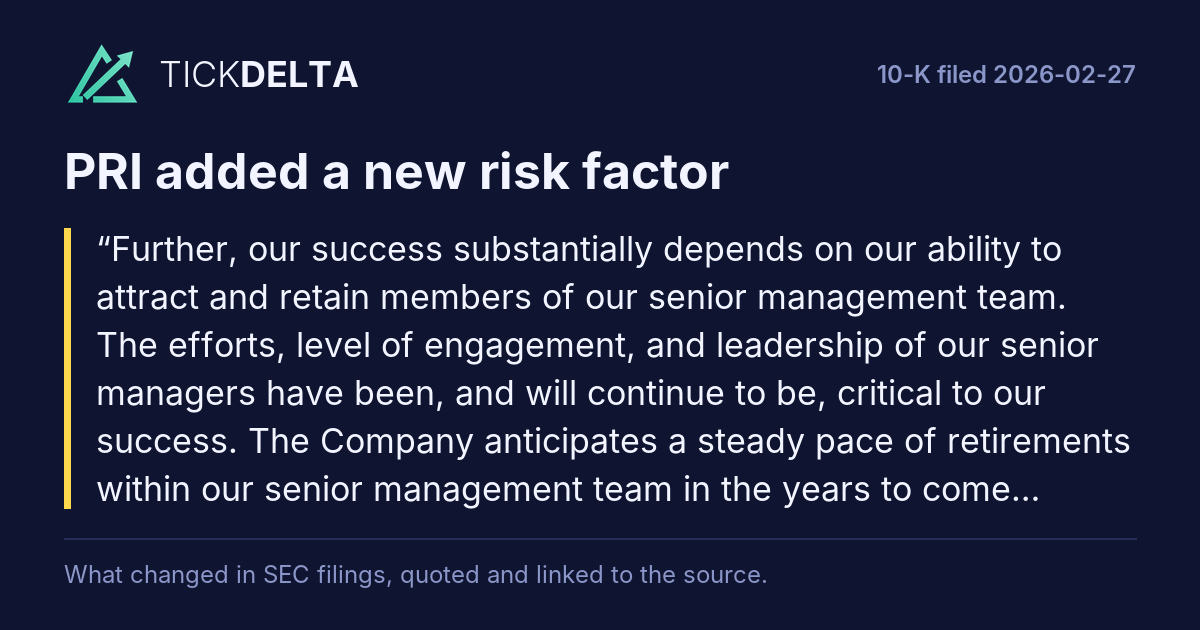
Further, our success substantially depends on our ability to attract and retain members of our senior management team. The efforts, level of engagement, and leadership of our senior managers have been, and will continue to be, critical to our success. The Company anticipates a steady pace of retirements within our senior management team in the years to come. While our senior management talent
Paragraphs in the 10-Q filed Nov 5, 2026 that were not in the one before
New in the latest 10-Q
15 paragraphs in the 10-Q filed Nov 5, 2026 with nothing like them in the 10-Q filed Aug 6, 2026 (at least half the words must differ; new numbers alone do not count). Quoted exactly, grouped by the item heading above them. This is text that changed, not a judgement of how serious it is.
Financial statements and notes
Total other comprehensive income (loss) before income taxes 317,928 (73,976) 346,880 (67,694)
Read in the 10-Q
Income tax expense (benefit) related to items of other comprehensive income (loss) 68,058 (13,601) 77,236 (16,289)
Read in the 10-Q
Other comprehensive income (loss), net of income taxes 249,870 (60,375) 269,644 (51,405)
Read in the 10-Q
equity investment is recognized when the cash distribution is realized or realizable in Investment income net of investment expenses in our unaudited condensed consolidated statements of income.
Read in the 10-Q
The carrying values and estimated fair values of our financial instruments were as follows:
Read in the 10-Q
Show the other 10
The fair values of financial instruments presented above are estimates of the fair values at a specific point in time using various sources and methods, including market quotations and a complex matrix system that takes into account issuer sector, quality, and spreads in the current marketplace.
Read in the 10-Q
Financial Instruments Recognized at Fair Value in the Balance Sheets. Estimated fair values of investments in AFS securities are principally a function of current spreads and interest rates that are corroborated by independent third-party data. Therefore, the fair values presented are indicative of amounts we could realize or settle at the respective balance sheet date. We do not necessarily intend to dispose of or liquidate such instruments prior to maturity. Trading securities and equity securities, including common and nonredeemable preferred stocks, are carried at fair value. Segregated funds in separate accounts are carried at the underlying value of the variable insurance contracts, which is fair value.
Read in the 10-Q
The carrying amounts for cash and cash equivalents, trade receivables, accrued investment income, accounts payable, cash collateral and payables for security transactions approximate their fair values due to the short-term nature of these instruments. Consequently, such financial instruments are not included in the above table.
Read in the 10-Q
Our annual actuarial assumption review was performed during the third quarter of 2026 and included analyzing experience studies based on the Company’s own data and comparing actual to expected cash flow variances by policy cohort. Actuarial judgment was also used since prior historical experience may not fully reflect future expected experience. In 2026, we continued to observe higher overall lapse rates compared to our actuarial assumption for policies sold in the U.S. that are within the level premium term period. Given the continuation of this trend from prior periods, we adjusted our lapse assumptions higher, most notably in the early durations of our policy cohorts. The impact of increasing lapse assumptions during the period generally results in a remeasurement gain as the reserves needed for future policy benefits are reduced. However, the overall remeasurement gain recognized by increasing lapse assumptions during the three months ended September 2026 was partially offset by reduced lapse assumptions specific to certain later durations of initial term policies where experience indicated that such adjustments were appropriate. Additionally, in 2026, we have continued to observe lower overall actual mortality experience compared to the actuarial assumptions in our Term Life Insurance segment. As a result, we adjusted our mortality assumptions for certain U.S. population subsets where we observed credible experience of mortality variances versus our previous long-term assumptions. The magnitude of the change in mortality assumptions during the 2026 annual actuarial assumption review was more modest than the mortality assumption reductions made during the third quarter of 2025. During the three and nine months ended September 30, 2026, the remeasurement gains recognized for experience variances are primarily attributable to both overall higher policy lapse rates and overall lower mortality, consistent with the experience described above. We also performed our annual reviews of LFPB assumptions for our closed block of non-term life insurance included in the Corporate and Other Distributed Products segment. Based on these reviews, we recognized a remeasurement gain of $2 million during the three months ended September 30, 2026 and a remeasurement loss of less than $1 million during the three months ended September 30, 2025. Discount rates, while a material assumption to our LFPB, are not part of the assumption-setting process since they are updated quarterly based on observable rates. There have been no changes in the compilation of data sources used for this input. Losses recognized as a result of capping the net premium ratio at 100% were immaterial during the three and nine months ended September 30, 2026 and 2025. The following table reconciles the LFPB to the unaudited condensed consolidated balance sheets: September 30, 2026 December 31, 2025 (In thousands) ───────────────────────────────────────────────────────────────────────────────────── Term Life Insurance $ 6,103,881 $6,614,501 Other 183,044 203,678 Total $ 6,286,925 $6,818,179 The following table reconciles the reinsurance recoverables to the unaudited condensed consolidated balance sheets: September 30, 2026 December 31, 2025 (In thousands) ───────────────────────────────────────────────────────────────────────────────────── Term Life Insurance $ 2,274,323 $2,550,187 Other 12,933 14,765 Total $ 2,287,256 $2,564,952 The amount of discounted (using the then current discount rate) and undiscounted expected gross premiums and expected future benefit payments were as follows: September 30, 2026 December 31, 2025 (In thousands) ───────────────────────────────────────────────────────────────────────────────────────────────────────────────────────────────────── Term Life Insurance Undiscounted Discounted Undiscounted Discounted Expected future benefit payments $ 33,946,505 $19,144,679 $34,009,893 $20,681,706 Expected future gross premiums $ 39,058,823 $25,360,675 $39,384,920 $27,195,943 The amount of revenue and interest recognized in our unaudited condensed consolidated statements of income were as follows: Three months ended September 30, Nine months ended September 30, 2026 2025 2026 2025 (In thousands) ───────────────────────────────────────────────────────────────────────────────────────────────────────────────────────────────────────────────────────────────────────────────────────── Term Life Insurance Gross premiums $ 872,573 $ 864,047 $ 2,613,380 $ 2,580,396 Interest accretion (expense) $ (84,677) $ (83,320) $ (252,857) $ (247,934)
Read in the 10-Q
The weighted-average discount rates were as follows: September 30, 2026 December 31, 2025 ─────────────────────────────────────────────────────────────────────────────────────────────── Term Life Insurance Original discount rate 4.98% 5.00% Current discount rate 6.58% 5.72% There were no changes to the methods used to determine the discount rates during the nine months ended September 30, 2026 and the twelve months ended December 31, 2025.
Read in the 10-Q
granted pursuant to the award agreements; however, the actual number of common shares earned could be higher or lower based on actual versus targeted performance. See Note 14 (Share-Based Transactions) for discussion of the PSU award structure.
Read in the 10-Q
Income attributable to unvested participating securities (728) (678) (2,036) (1,837)
Read in the 10-Q
Income attributable to unvested participating securities (727) (678) (2,033) (1,835)
Read in the 10-Q
(14) Share-Based Transactions The Company has outstanding equity awards under the Primerica, Inc. 2020 Omnibus Incentive Plan (the “OIP”), which was approved by the Company’s stockholders on May 13, 2020. The OIP provides for the issuance of equity awards, including stock options, stock appreciation rights, restricted stock, deferred stock, RSUs, PSUs, and stock payment awards, as well as cash-based awards. In addition to time-based vesting requirements, awards granted under the OIP may also be subject to specified performance criteria. Under the OIP,
Read in the 10-Q
(16) Revenue from Contracts with Customers Our revenues from contracts with customers primarily include: • Commissions and fees earned for the marketing and distribution of investment and savings products managed and/or underwritten by mutual fund companies, annuity providers, and other asset managers. For purposes of revenue recognition,
Read in the 10-Q
The 10-Q's risk factors against the 10-K
Item 1A of the 10-Q filed Nov 5, 2026 against Item 1A of the 10-K filed Feb 27, 2026.
A 10-Q repeats only the risks that changed, so a 10-K paragraph that is missing from it is not counted as removed.
Added is a paragraph with nothing like it in the 10-K, Reworded a sentence that is in both with several words changed,
Quiet changes a sentence in both where one to four words changed and one is a hedge or a modal
(cut words struck through, new words highlighted).
Text on the page, not a score; each links to the filing at sec.gov.
What the 10-Q itself says about its risk factors:The risk factors contained in our 2025 Annual Report are incorporated herein by reference.
Read in the 10-Q
1 paragraph in the 10-Q's Item 1A, and none of them adds, rewords or quietly edits a paragraph of the 10-K's.
Phrases used for the first time
Two-word phrases in Risk Factors of the 10-K filed Feb 27, 2026 that are in none of the 1 earlier 10-Ks stored, back to Feb 28, 2025
Where each one is used
- government policies: Our business is subject to many laws, regulations and government policies that could relate to, among other things, consumer protection, fair credit reporting, financial privacy, consumer fraud, anti-money laundering, worker classification standards, worker eligibility, corporate taxation, artificial intelligence...
- fiscal year: In addition, on March 7, 2023, OSFI issued its final Guideline B-15, which sets out expectations for the management and disclosure of climate-related risks for federally regulated financial institutions in Canada, including public disclosure of Scope 1 and 2 GHG emissions no later than 180 days after the fiscal...
Used at least twice, small words left out. Counted, not picked: a phrase can be new because the company renamed something.
What was taken out
1 paragraph of last year's Risk Factors with nothing like them now. The longest are quoted.
Sources
Item 1A of each 10-K and 10-Q on EDGAR, quoted exactly. Each paragraph links to the filing at sec.gov.
Also
10-K change: what was reworded or cut, section by section.
Work with it
Excel workbook · CSV. Google Sheet that stays up to date: paste =IMPORTDATA("https://tickdelta.com/company/PRI/export.csv") into a cell.