tickdelta
Sign in

Tickdelta is free for now. Sign up and get Pro free

← Screener

Real estate · REIT · NYSE

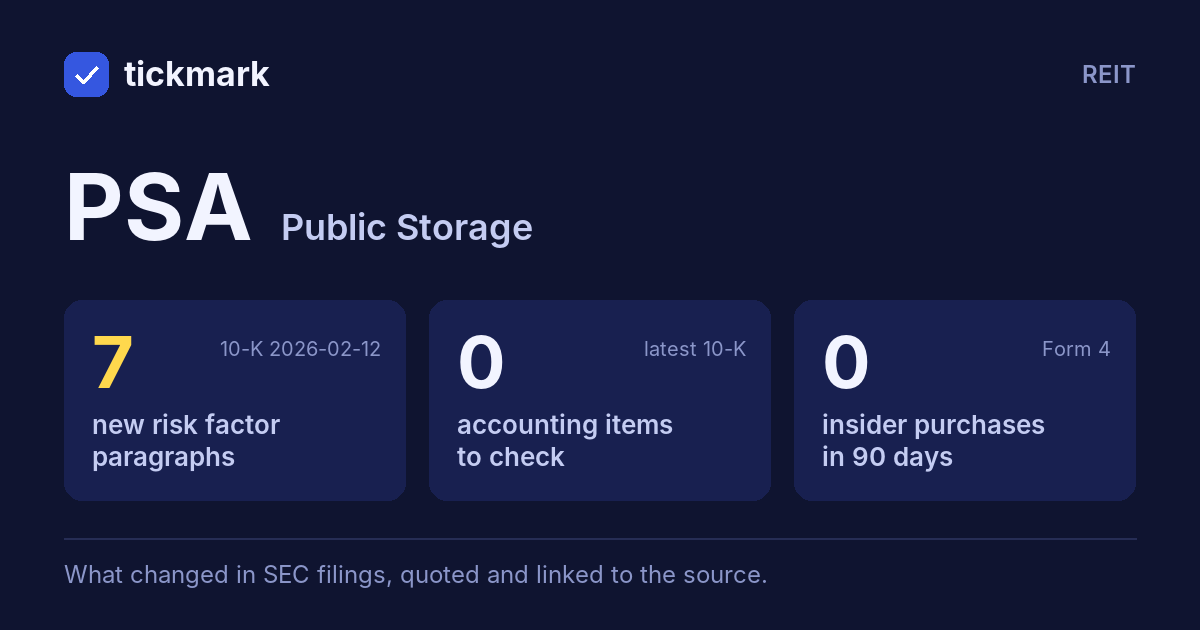
PSAPublic Storage

Compare with peers → Embed
The 10-K against last year's

132 changes: 17 added, 25 removed, 87 reworded, 3 quiet changes

10-K Feb 12, 2026 vs Feb 24, 2025
Risk FactorsRedline ↓
9.5%
of the text changed · 7,497 words now
22.4%
of the text changed · 9,300 words now
Legal ProceedingsRedline ↓
25.3%
of the text changed · 355 words now
Accounting PoliciesRedline ↓
8.9%
of the text changed · 3,273 words now

10-K 0001628280-26-007696 (2026-02-12) vs 10-K 0001393311-25-000036 (2025-02-24)

The redline

The paragraph that changed most in each section

Marked against last year's 10-K: cut words struck through, new words highlighted and underlined.

Accounting Policies 180 words changed in this paragraph; it is 36% similar to last year's version.
In November 2024, September 2025, the FASB issued ASU 2024-03, Income Statement 2025-06, Intangibles - Reporting Comprehensive Income Goodwill and Other - Expense Disaggregation Disclosures Internal-Use Software (Subtopic 220-40) that requires 350-40), to amend the disclosure criteria for capitalizing internal-use software costs. This update is intended to modernize the accounting for software costs by replacing the legacy guidance under which capitalization is based on the nature of additional information related to certain costs and expenses, including amounts of inventory purchases, employee compensation, the project development stage. This update requires software capitalization to begin when (1) management has authorized and depreciation committed funding to the software project and amortization included in each income statement line item. The guidance also requires disclosure of (2) it is probable that the total amount of selling expenses project will be completed and the entity’s definition selling expenses. software will be used to perform the function intended. The guidance is effective for annual periods beginning after December 15, 2026 2027 and interim periods within fiscal years beginning after December 15, 2027. those annual reporting periods. The guidance may be applied prospectively prospectively, retrospectively, or retrospectively. via a modified prospective approach. Early adoption is permitted. We are currently evaluating The company adopted these amendments effective January 1, 2026. The adoption did not have a material impact on the impact of this ASU on our Consolidated Financial Statements and related disclosures. Company’s consolidated financial statements.

Source: 10-K text, Note 2 – Basis of Presentation and Summary of Significant Accounting Policies, 10-K 0001628280-26-007696 vs 10-K text, Note 2 – Basis of Presentation and Summary of Significant Accounting Policies, 10-K 0001393311-25-000036

Risk Factors 133 words changed in this paragraph; it is 47% similar to last year's version.
Our use of or inability to safely and effectively adopt and deliver new technological capabilities and enhancements in line with strategic objectives, including artificial intelligence and machine learning, may put us at a competitive disadvantage; cause us to miss opportunities to innovate, achieve efficiencies, or improve the customer experience; or adversely impact our business, reputation, results of operations, and financial condition. Legislative activity in the privacy area may also result in new laws that are applicable For example, we have begun to us and that may hinder our business, including by restricting our use of customer data or otherwise regulating the use of algorithms and automated processing in ways that could materially affect our business or lead to significant increases in the cost of compliance. In addition, the use of emerging technologies, including artificial intelligence, entails risks including risks relating to the possibility of intellectual property infringement or misappropriation; data privacy; new or enhanced governmental or regulatory scrutiny, requirements, litigation, or other liability; ethical concerns; negative consumer perceptions as to automation and artificial intelligence; or other complications or liabilities that could adversely affect our business, reputation, results of operations, or financial results.

Source: Item 1A, 10-K 0001628280-26-007696 vs Item 1A, 10-K 0001393311-25-000036

MD&A 127 words changed in this paragraph; it is 73% similar to last year's version.
Allocating Purchase Price for Acquired Real Estate Facilities: We estimate the fair values of the assets and liabilities of acquired real estate facilities, which consist principally of land, buildings and acquired customers in place, for purposes of allocating the aggregate purchase price of acquired real estate facilities. We estimate the fair value of land based upon price per square foot derived from observable transactions involving comparable land in similar locations as adjusted for location quality, parcel size, and date of sale associated with the acquired facilities. The fair value estimate of land is sensitive to the adjustments made to the land market transactions used in the estimate, particularly when there is a lack of recent comparable land market data. We estimate the fair value of buildings primarily using the income approach by estimating the fair value of hypothetical vacant acquired facilities and adjusting for the estimated fair value of land. The fair value estimate of buildings is sensitive to assumptions, such as lease-up period, future stabilized operating cash flows, capitalization rate and discount rate. We estimate the fair value of acquired customers in place using the income approach by estimating the foregone rent over the presumed period of time to absorb the occupied spaces as if they were vacant at the time of acquisition. The fair value estimate of the acquired customers in place is sensitive to the assumptions used in the income approach, such as market rent, lease-up period and discount rate. Others could come to materially different conclusions as to the estimated fair values of land, buildings and acquired customers in place, which would result in different depreciation and amortization expense, gains and losses on sale of real estate assets, as well as the level of land and buildings on our consolidated balance sheet.

Source: Item 7, 10-K 0001628280-26-007696 vs Item 7, 10-K 0001393311-25-000036

Legal Proceedings 24 words changed in this paragraph; it is 68% similar to last year's version.
We have an unfunded loan commitment capital commitments related to our private equity investments totaling $ 12.5 48.2 million at December 31, 2024. 2025. We have unfunded loan commitments totaling $ 43.9 million at December 31, 2025. We expect to fund the loan loans in 2025 2026, subject to the satisfaction of certain conditions.

Source: Item 3, via Note 16 – Commitments and Contingencies, 10-K 0001628280-26-007696 vs Item 3, via Note 14 – Commitments and Contingencies, 10-K 0001393311-25-000036

Every change, by type

Sentences and paragraphs added, removed or reworded

Sentences and paragraphs of PSA's Risk Factors and MD&A, 10-K 2026-02-12 against 10-K 2025-02-24. Each links to the text at sec.gov.

RemovedRisk Factors
We are subject to risks from the consequences of climate change, including severe weather events and the adverse impact of other steps that may be taken to prevent or mitigate climate change.

Read it in 10-K 2025-02-24 at sec.gov ↗

RemovedRisk Factors
Our self-storage facilities are located in areas that may be subject to the direct impacts of climate change, such as increased destructive weather events like floods, fires, drought, and prolonged periods of extreme temperature or other extreme weather, which could result in significant damage to our facilities, increased capital expenditures, increased expenses, reduced revenues, or reduced demand for our facilities. Indirect impacts of climate change could also adversely impact our business, including through increased costs, such as insurance costs or regulatory compliance costs. In addition, government and private efforts to transition to a low-carbon economy present certain risks for us and our customers, including increased energy costs and macroeconomic risks related to high energy costs and energy shortages, among other things. Governmental, political, and societal pressures, including expectations of institutional and activist investors and other interest groups, could require us to implement or accelerate emissions initiatives and, with it, the costs of their implementation. These same potential governmental, political, and social pressures could in the future result in, among other things, (i) costly changes to newly developed facilities or retrofits of our existing facilities to reduce carbon emissions through multiple avenues, including changes to insulation, space configuration, lighting, heating, and air conditioning and (ii) increased energy costs as a result of transitioning to less carbon-intensive, but more expensive, sources of energy to operate our facilities. For example, beginning in 2026, we expect to be required to disclose our Scope 1, 2, and 3 emissions data and certain climate-related risk matters under California SB 253 and SB 261, which we expect to result in increased compliance costs. In addition, our reputation and investor relationships could be damaged as a result of our involvement with activities perceived to be causing or exacerbating climate change, as well as any decisions we make to continue to conduct or change our activities in response to considerations relating to climate change.

Read it in 10-K 2025-02-24 at sec.gov ↗

RemovedRisk Factors
We own approximately 35% of the common shares of Shurgard, and this investment has a $382.5 million book value and a $1.3 billion market value (based upon the closing trading price of Shurgard’s common stock) at December 31, 2024. We recognized $19.8 million in equity in earnings and received $22.8 million in dividends in 2024 with respect to Shurgard.

Read it in 10-K 2025-02-24 at sec.gov ↗

RemovedRisk Factors
We have been and may in the future be adversely impacted by emergency regulations adopted in response to significant events, such as natural disasters or public health crises, that could adversely impact our operations.

Read it in 10-K 2025-02-24 at sec.gov ↗

RemovedRisk Factors
In addition, through exercising their authority to regulate our activities, governmental agencies can otherwise negatively impact our business by increasing costs or decreasing revenues, including through restrictions on rent increases or fees.

Read it in 10-K 2025-02-24 at sec.gov ↗

RemovedRisk Factors
Ineffective succession planning for our CEO and executive management, as well as for our other key employees, may impact the execution of our strategic plan.

Read it in 10-K 2025-02-24 at sec.gov ↗

RemovedRisk Factors
We may not effectively or appropriately identify ready-now succession candidates for our CEO and executive management team, which may negatively impact our ability to meet key strategic goals. Failure to implement succession plans for other key employees may leave us vulnerable to retirements and turnover.

Read it in 10-K 2025-02-24 at sec.gov ↗

RemovedMD&A
We have experienced recent inflationary impacts on our cost of operations including labor, utilities, and repairs and maintenance, and costs of development and expansion activities, and we expect to experience such impacts in the future. We have implemented various initiatives to manage the adverse impacts, such as enhancements in operational processes and investments in technology to reduce payroll hours, achievement of economies of scale from recent acquisitions with supervisory payroll and centralized management costs allocated over a broader number of self-storage facilities, and investments in solar power and LED lights to lower utility usage.

Read it in 10-K 2025-02-24 at sec.gov ↗

Show the other 11
RemovedMD&A
During 2024, we repurchased 726,865 of our common shares under our previously announced share repurchase program on the open market for a total cost of $200.0 million, driven by our expected improvement in operating fundamentals and growth.

Read it in 10-K 2025-02-24 at sec.gov ↗

RemovedMD&A
In early 2025, multiple wildfires erupted in southern California and caused significant destruction of business and residential structures. We did not incur any direct property damage in the affected areas. In response to the devastation, a “State of Emergency” has been declared for Los Angeles County and Ventura County, under which a temporary governmental pricing limitation is in place for our self-storage facilities located in these counties. These self-storage facilities generated approximately 10% of revenues earned by our Same Store Facilities in 2024. We anticipate a potentially significant negative impact on the revenue growth from these self-storage facilities, the extent of which depends largely on the duration of the State of Emergency order and other future actions by government authorities, among other factors.

Read it in 10-K 2025-02-24 at sec.gov ↗

RemovedMD&A
Real estate-related depreciation allocated to noncontrolling interests and restricted share unitholders and unvested LTIP unitholders (7,167) (6,635) (6,635) (6,622)

Read it in 10-K 2025-02-24 at sec.gov ↗

RemovedMD&A
Industry-wide demand was weaker in 2024 compared to 2023 partially due to lower home-moving activities offset by increases in customers who sought storage space for other reasons. Demand fluctuates due to various local and regional factors, including the overall economy, as well as new supply of self-storage space and alternatives to self-storage.

Read it in 10-K 2025-02-24 at sec.gov ↗

RemovedMD&A
We expect industry-wide demand from new customers in 2025 to be similar to 2024. However, following the recent wildfires in southern California in early 2025, we anticipate a potentially significant negative impact on the revenue growth from the self-storage facilities located in Los Angeles County and Ventura County, where a temporary governmental pricing limitation is in place under the “State of Emergency” declarations. These self-storage facilities generated approximately 10% of revenues earned by our Same Store Facilities in 2024. As a result, we expect Same Store Facilities revenues in 2025 to be similar to those earned in 2024.

Read it in 10-K 2025-02-24 at sec.gov ↗

Next Related parties →