Added10-Q Nov 13, 2026 vs 10-K Feb 27, 2026
Our rebranding initiatives may not achieve their intended benefits and could adversely affect our business.
Each branch is a paragraph in Risk Factors with nothing like it in the 10-K filed Mar 4, 2025. A box jumps to the paragraph as filed, below.
93 paragraphs in Risk Factors of the 10-K filed Feb 27, 2026 with nothing like them in the 10-K filed Mar 4, 2025. Quoted exactly. Paragraphs that were only edited are under 10-K change.
An inability to obtain the products that we distribute could result in lost revenues and reduced margins and damage relationships with customers.
We distribute roofing materials and other complementary building products, such as siding and waterproofing, that are manufactured by a number of major suppliers. Disruptions in our sources of supply may occur as a result of various reasons, including unanticipated demand, production or delivery difficulties, the loss of key supplier arrangements, or broad disruptive events (whether globally, in the U.S., or abroad), such as wars, terrorist actions, cybersecurity attacks or other technological disruptions with respect to manufacturers or the material vendors we rely on, trade disputes, labor disputes, changes in regulation, macroeconomic events, government shutdowns, natural disasters, including those that may be linked to climate change, and/or a pandemic.
When shortages occur, building material suppliers often allocate products among distributors, and sourcing materials from a limited number of suppliers can increase our risk. During the year ended December 31, 2025, we had three suppliers that each contributed 10% or more of total purchases and, in total, represented nearly 35% of total purchases. Although we believe that our relationships with our suppliers are strong and that we would have access to similar products from competing suppliers should products be unavailable from current sources, any supply shortage, particularly of the most commonly sold items, could result in a loss of revenues and reduced margins and damage our reputation and relationships with customers.
A change in supplier pricing and demand could adversely affect our income and gross margins.
Many of the products that we distribute are subject to price changes based upon manufacturers’ raw material costs, energy costs, labor costs, and tariffs as well as other manufacturer pricing decisions. For example, as a distributor of residential roofing supplies, our business is sensitive to asphalt prices, which are highly volatile and often linked to oil prices, as oil is a significant input in asphalt production. Shingle prices have been volatile in recent years, partly due to volatility in asphalt prices. Other products we distribute, such as plywood and OSB, experienced price volatility largely due to supply and demand imbalances in recent years. In addition to the rising costs of commodities and raw materials, supplier pricing and demand can also be affected by inflationary pressures and other conditions that make it more costly for our suppliers to distribute their products to us, such as fuel shortages, fuel cost increases, or labor shortages.
We may also experience price volatility related to the implementation of tariffs on imported steel or other products. For example, certain of our vendors use steel as a product input, and they may increase prices as a result of tariffs incurred or the overall impact of tariffs on domestic steel prices.
Historically, we have generally been able to pass increases in prices on to our customers. Although we often are able to pass on manufacturers’ price increases, our ability to pass on increases in costs in a timely fashion depends on the competitiveness of pricing environments and other market conditions.
By contrast, the inability to pass along cost increases or a delay in doing so could result in lower operating margins. In addition, higher prices could impact demand for these products, resulting in lower sales volumes.
The terms on which we purchase products from many of our vendors entitle us to receive a rebate based on the volume of our purchases. These rebates effectively reduce our costs for products. Vendors may adversely change the terms of some or all of these programs for a variety of reasons, including if market conditions change. Although these changes would not affect the net recorded costs of product already purchased, it may lower our gross margins on products we sell and therefore the income we realize on such sales in future periods.
We may not be able to identify potential acquisition targets or successfully complete acquisitions on acceptable terms, which could slow our inorganic growth rate.
If we cannot complete acquisitions that we identify on acceptable terms, our inorganic growth rate may decline. In addition, our current and potential competitors have made and may continue to make acquisitions that include acquisition candidates in which we were, or would have been, interested in pursuing and such competitors may establish cooperative relationships among themselves or with third parties. In the event that our inorganic growth does not keep pace with any significant consolidation among businesses in the building products distribution industry, our competitive position could be adversely affected.
We may not be able to effectively integrate newly acquired businesses into our operations or achieve expected cost savings or profitability from our acquisitions.
•unforeseen difficulties or disruptions in integrating operations, technologies, services, accounting, and employees;
•unforeseen difficulties related to entering geographic regions where we do not have prior experience;
•unforeseen cybersecurity risks related to the businesses acquired or to the manufacturers and vendors the acquired businesses rely on;
•inability to generate sufficient revenue or realize sufficient cost savings to offset acquisition or investment costs.
As a result, if we fail to evaluate, execute, and integrate acquisitions properly, we might not achieve the anticipated benefits of such acquisitions and we may incur costs in excess of what we anticipate.
The implementation of our cost and revenue initiatives to enhance efficiencies and drive organic growth may not be effective and may not improve our results of operations or cash flow from operations as planned.
Our organic growth strategy involves the implementation of a number of cost and revenue initiatives to further increase efficiency and drive growth, including advanced pricing analytics, demand and supply planning tools, financial management tools, and further back-office optimization. The implementation of these initiatives requires investments in management, operational and financial resources, and although we believe these strategies will drive revenue growth, margin and free cash flow, we can make no assurances that these initiatives will generate sufficient revenue or cost savings to recoup the costs of such investments. Further, if we are not able to successfully implement these cost reduction and revenue generating initiatives, our future financial results may suffer.
Cyclicality in our business and general economic conditions could result in lower revenues and reduced profitability.
A portion of the products we sell are for residential and non-residential construction. The strength of these markets depends on new housing starts and business investment, which are a function of many factors beyond our control, including credit and capital availability, interest rates, foreclosure rates, housing inventory levels and occupancy, changes in the tax laws, employment levels, consumer confidence, and the health of the U.S. economy and mortgage markets. Economic downturns in the regions and markets we serve could result in lower net sales and, since many of our expenses are fixed, lower profitability. Unfavorable changes in demographics, credit markets, consumer confidence, housing affordability, or housing inventory levels and occupancy, or a weakening of the U.S. economy or of any regional or local economy in which we operate, could adversely affect consumer spending, resulting in decreased demand for our products, and adversely affecting our business. In addition, instability in the economy and financial markets, including as a result of terrorism or civil or political unrest, may result in a decrease in housing starts or business investment, which would adversely affect our business.
Seasonality, weather-related conditions, and natural disasters may have a significant impact on our financial results.
The demand for building materials is heavily correlated to both seasonal changes and unpredictable weather patterns. Seasonal demand fluctuations are expected, such as in quarters ending March 31, when winter construction cycles and cold weather patterns typically have an adverse impact on new construction and re-roofing activity. The timing of weather patterns (unseasonable temperatures) and severe weather events (hurricanes, hailstorms, and protracted rain) may impact our financial results within a given period either positively or negatively, making it difficult to accurately forecast demand or results of operations. We expect that these seasonal and weather-related variations will continue in the future.
Certain extreme weather events and natural disasters, such as hurricanes, tornadoes, earthquakes, tropical storms, floods, droughts, and wildfires, may adversely impact us in several ways, including interfering with our ability to deliver our products, impeding our receipt of product from our vendors, disrupting branch staffing, reducing demand for our products, impairing our customers’ ability to pay accounts receivable, and damaging our facilities and inventory, although some of these adverse impacts may be offset by increased demand relating to damage from these weather events and natural disasters. Some of the areas in which we operate, including California, Florida, Louisiana, North Carolina, Texas and other coastal areas, have experienced recent natural disasters and have increased risks of adverse weather or natural disasters. The physical effects of climate change may increase the frequency or severity of natural disasters and other extreme weather events in the future, which could increase our exposure to these risks.
If we encounter interruptions in the proper functioning of our information technology systems, including from cybersecurity threats, we could experience material problems with our operations, including inventory, collections, customer service, cost control, and business plan execution that could have a material adverse effect on our financial results, including unanticipated increases in costs or decreases in net sales.
Our information technology systems (“IT systems” or “systems”), which include information technology networks, hardware, applications, and the data related thereto, are integral to the operation of our business. We use our IT systems to, among other things, provide complete integration of purchasing, receiving, order processing, shipping, inventory management, delivery routing, sales analysis, cash management, and accounting, as well as to process, transmit, protect, store, and delete sensitive and confidential electronic data, including, but not limited to, employee, supplier, and customer data (“Data”). Our IT systems include third-party applications and proprietary applications developed and maintained by us. We rely heavily on information technology both in serving our customers and in our enterprise infrastructure to achieve our objectives. In certain instances, we also rely on the systems of third parties to assist with conducting our business, which includes, among other things, marketing and distributing products, developing new products and services, operating our website, hosting and managing our services, securely storing Data, processing transactions, purchasing and receiving, billing and accounts receivable management, responding to customer inquiries, managing inventory and our supply chain, and managing our human resources processes and services. As a result, the secure and reliable operation of our IT systems (including its function of securing Data), and those of third parties upon whom we depend, are critical to the successful operation of our business. Any failure or interruption of our IT systems, including the systems of third parties upon whom we depend, could have a material adverse effect on our business, financial results, and reputation.
Although our IT systems and Data are protected through security measures and business continuity plans, our systems and those of third parties upon whom we depend may be vulnerable to: natural disasters; power outages; telecommunication or utility failures; terrorist acts; breaches due to employee error or malfeasance or other insider threats; disruptions during the process of upgrading or replacing computer software or hardware; terminations of business relationships by us or third-party service providers; and disinformation campaigns, damage or intrusion from a variety of deliberate cyber-attacks carried out by insiders or third parties, which are becoming more sophisticated and include computer viruses, worms, gaining unauthorized access to systems for purposes of misappropriating assets or sensitive information either directly or through our vendors and customers, denial of service attacks, ransomware, supply chain attacks, data corruption, malicious distribution of inaccurate information or other malicious software programs that may impact such systems and cause operational disruption. For these IT systems and related business processes to operate effectively, we or our service providers must continually maintain and update them. Delays in the maintenance, updates, upgrading, or patching of these systems and related business processes could impair their effectiveness or expose us to security risks. In addition, if IT systems are damaged, restoration or recovery of those systems may not be achievable in a timely manner.
Even with our policies, procedures, and programs designed to ensure the integrity of our IT systems and the security of Data, we may not be effective in identifying and mitigating every risk to which we are exposed. In some instances, we may have no current capability to detect certain vulnerabilities, which may allow them to persist in the environment over long periods of time.
Additionally, existing and future artificial intelligence (“AI”) capabilities present a growing threat by aiding experienced and inexperienced threat actors in identifying vulnerabilities and crafting increasingly sophisticated and targeted cybersecurity attacks. Vulnerabilities may also be introduced from the use of AI by us, our customers or suppliers. Use of AI by us or such third parties, whether authorized or unauthorized, increases the risk that our proprietary information or intellectual property will be unintentionally disclosed, and may introduce new risks such as inaccurate output.
Despite the precautions we take to mitigate the risks of such events, any attack on our IT systems or breach of our Data, or the IT systems and Data of third parties upon whom we depend, could result in, but are not limited to, the following: business disruption, misstated or misappropriated financial data, product shortages and/or an increase in accounts receivable aging, an adverse impact on our ability to attract and serve customers, delays in the execution of our business plan, theft of our intellectual property or other non-public confidential information and Data, including that of our customers, suppliers, and employees, liability for stolen assets or information, and higher operating costs including increased cybersecurity protection costs. Such events could harm our reputation and have an adverse impact on our financial results, including the impact of related legal, regulatory, and remediation costs. In addition, if any information about our customers, including payment information, were the subject of a successful cybersecurity attack against us, we could be subject to litigation or other claims by the affected customers. Further, regulatory authorities have increased their focus on how companies collect, process, use, store, share, and transmit personal data. Privacy security laws and regulations, including federal and state laws in the U.S. and federal and provincial laws in Canada, pose increasingly complex compliance challenges, which may increase compliance costs, and any failure to comply with data privacy laws and regulations could result in litigation, significant sanctions, monetary costs, or other harm to us.
Our business may be harmed if we are unable to effectively develop, implement, maintain, enhance, protect and upgrade information technology systems, including those systems of any businesses we acquire.
Our business may be harmed if we are unable to effectively implement our digital transformation initiatives and successfully integrate acquired companies’ IT systems with our own. We expect our customers to continue to demand more sophisticated, fully integrated technology. To keep pace with changing technologies and customer demands, we must correctly address market trends and enhance the features and functionality of our IT systems in response to these trends, which may lead to significant ongoing software development costs. Any failure to respond to these trends in a timely or cost-effective manner could result in decreased demand for our services and a corresponding decrease in revenues.
In addition, we have made and expect to continue to make significant investments in AI and other emerging technologies to remain competitive, but there can be no assurance that our efforts will be successful or that we will be able to recoup the costs of such investments. If we are unable or slow to develop or deploy such emerging technologies in our business, our competitiveness will suffer.
The companies we acquire will need to be integrated with our IT systems, which may cause additional costs, delays or disruption. We may acquire companies with less sophisticated IT systems or cybersecurity practices, which could expose us to increased cybersecurity risks and vulnerabilities. Further, our IT systems need to be sufficiently scalable to support the future growth of our business and may require modifications or upgrades that expose us to additional risks of damage or disruption. Any material delay, disruption, malfunction or similar challenges with our IT systems or those of the companies we acquire could have a material adverse effect on our financial condition, results of operations and cash flows.
Loss of key talent or our inability to attract and retain new qualified talent could hurt our ability to operate and grow successfully.
Our success will continue to depend to a significant extent on our executive officers and key management personnel, including branch managers. We may not be able to retain our executive officers and key personnel or recruit and attract additional qualified management. The loss of any of our current executive officers or other key management employees, or a delay in recruiting or our inability to recruit and retain qualified employees could adversely affect our ability to operate and make it difficult to execute our strategies to drive growth, scale our operations, enhance customer service, and expand our footprint in key markets. In addition, our operating results could be adversely affected by increased competition for employees, shortages of qualified workers, or higher employee turnover, all of which could have adverse effects on levels of customer service or result in increased employee compensation or benefit costs.
Our business may be adversely affected by work stoppages, union negotiations, labor disputes and other matters associated with our labor force or the labor force of our suppliers or customers.
Any labor disputes, work stoppages, or unionization efforts could result in significant increases in our cost of labor. While we believe that our relations with employees generally and the labor unions that represent our employees (which as of December 31, 2025 was approximately 4.1% of our workforce) are generally good and we have experienced no material strikes or work stoppages recently (and there are no material outstanding labor disputes currently), in the future we could experience these and other types of conflicts with labor unions, other groups representing employees, with the employees of the companies we acquire, or with our employees in general.
Installation, replacement and repair of roofing is a labor-intensive business. Demand for our products may be impacted by our customers’ ability to attract, train, and retain workers. Changes in immigration laws and regulations, trends in labor migration, and increases in our customers’ personnel costs or the inability of our customers to hire sufficient personnel, which may be amplified in tight labor market conditions, could adversely impact our business, financial position, results of operations, and cash flows.
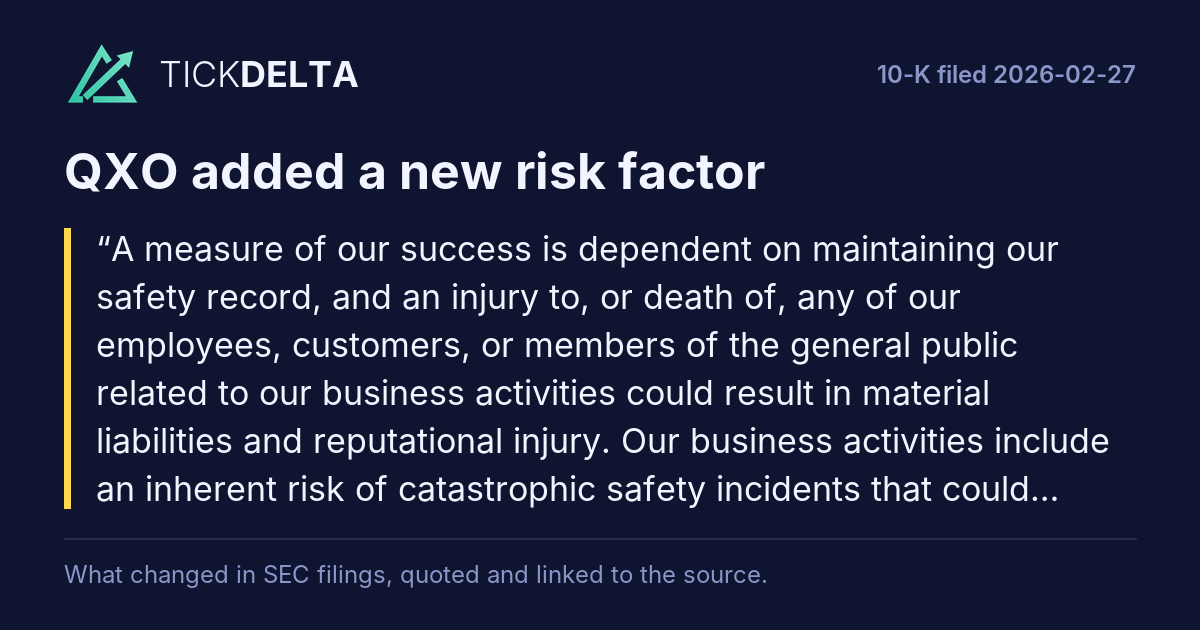
A measure of our success is dependent on maintaining our safety record, and an injury to, or death of, any of our employees, customers, or members of the general public related to our business activities could result in material liabilities and reputational injury.
Our business activities include an inherent risk of catastrophic safety incidents that could result in injuries and deaths. The activities we conduct at our customers’ designated delivery locations — which include construction and residential job sites — present a risk of injury or death to our employees, customers, or visitors, notwithstanding our compliance with safety regulations. We may be unable to avoid material liabilities for an injury or death, and our workers’ compensation and other insurance policies may not be adequate or may not continue to be available on terms acceptable to us, or at all, which could result in material liabilities to us.
Further, as a wholesale distributor of roofing materials and other complementary building products, we lease and operate a fleet of commercial motor vehicles, including semi-tractor trailer trucks, flatbed trucks, and forklifts. Accordingly, a safety incident involving our commercial fleet could result in material economic damages, as well as injuries and/or death, for our employees and any other parties involved. Although we believe our aggregate insurance limits should be sufficient to cover our historic claims amounts, participants in commercial distribution and transportation activities (i.e., trucking and transportation) have experienced large verdicts, including some instances in which juries have awarded significant amounts.
In addition, our brand’s reputation is an important asset to our business; as a result, anything that damages our brand’s reputation could materially harm our business, results of operations, and financial condition. For example, negative media reports, whether or not accurate, can materially and adversely affect our reputation.
Moreover, social media has dramatically increased the rate at which negative publicity can be disseminated before there is any meaningful opportunity to respond to or address an issue to protect our reputation.
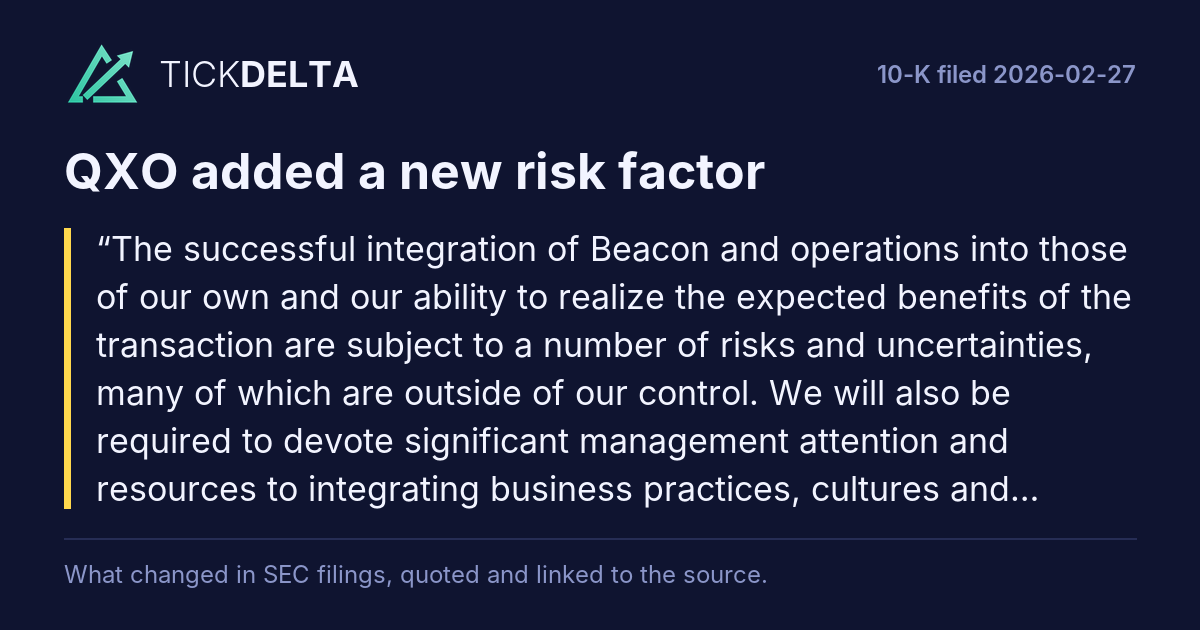
The successful integration of Beacon and operations into those of our own and our ability to realize the expected benefits of the transaction are subject to a number of risks and uncertainties, many of which are outside of our control. We will also be required to devote significant management attention and resources to integrating business practices, cultures and operations of each business. The risks and uncertainties relating to integrating the two businesses include, among other things:
•the challenge of integrating complex organizations, systems, operating procedures, compliance programs, technology, networks and other assets of Beacon;
•the difficulties harmonizing differences in the business cultures of QXO and Beacon;
•the inability to successfully integrate our respective businesses in a manner that permits us to achieve the cost savings and other anticipated benefits from the Beacon Acquisition;
•the inability to minimize the diversion of management attention from ongoing business concerns during the process of integrating Beacon into our businesses;
•the inability to resolve potential conflicts that may arise relating to customer, supplier and other important relationships of our business and Beacon;
•the challenge of managing the expanded operations of a significantly larger and more complex company and coordinating geographically separate organizations.
As a result of the Beacon Acquisition, we expect to realize certain synergies and cost savings. Any synergies and cost savings that we realize may differ materially from our estimates and involve risks, uncertainties, assumptions and other factors that may cause our actual results, performance or achievements to be materially different from any future results, performance or achievements expressed or implied by such estimates. This information is speculative in nature, and some or all of the assumptions underlying the estimated synergies and cost savings may not materialize or may vary from actual results. Our ability to realize these anticipated synergies and savings is subject to significant uncertainties and you should not place undue reliance on the adjustments in evaluating our anticipated results.
We have incurred substantial expenses to consummate the Beacon Acquisition but may not realize the anticipated benefits. In addition, even if we are able to integrate Beacon successfully, the anticipated benefits of the Beacon Acquisition may not be realized fully, or at all, or may take longer to realize than expected. Given the size and significance of the Beacon Acquisition, we may encounter difficulties in the integration of the operations of Beacon and may fail to realize the full benefits and synergies of the Beacon Acquisition, which could adversely impact our business, results of operation and financial condition.
Beacon may have liabilities that we failed, or were unable, to discover in the course of performing our due diligence investigations of Beacon. We cannot assure you that the indemnification available to us under the Agreement and Plan of Merger dated as of March 20, 2025 (the “Merger Agreement”) in respect of the Beacon Acquisition will be sufficient in amount, scope or duration to fully offset the possible liabilities associated with the business of Beacon or property that we assumed upon consummation of the Beacon Acquisition. We may learn additional information about Beacon that materially adversely affects us, such as unknown or contingent liabilities and liabilities related to compliance with applicable laws. Any such liabilities, individually or in the aggregate, could have a material adverse effect on our business, financial condition and results of operations.
We incurred, through our wholly owned subsidiary QXO Building Products, Inc. (formerly known as Beacon Roofing Supply, Inc.) and its subsidiaries (the “Credit Parties”), substantial indebtedness in connection with the Beacon Acquisition. As of December 31, 2025, we had $3.10 billion of outstanding indebtedness, consisting of $2.25 billion of our Notes (as defined herein) and $850.0 million under our Term Loan Facility (as defined herein). In addition, as of December 31, 2025, we had approximately $1.97 billion available for additional borrowing under our ABL Facility (as defined herein) (subject to a borrowing base and excluding approximately $21.2 million in letters of credit outstanding thereunder). See “Liquidity and Capital Resources” under Item 7 of Part II, “Management’s Discussion and Analysis of Analysis of Financial Condition and Results of Operations” for additional details regarding such indebtedness.
•making it more difficult for us to satisfy our obligations with respect to our debt and any failure to comply with the obligations of any of our debt instruments, including restrictive covenants and borrowing conditions, could result in an event of default under the agreements governing other indebtedness;
•requiring us to dedicate a substantial portion of our cash flow from operations to the payment of interest and the repayment of our indebtedness, thereby reducing funds available to us for other purposes;
•limiting our ability to obtain additional financing to fund future working capital, capital expenditures, business development or other general corporate requirements, including dividends, if and when declared by our Board;
•increasing our vulnerability to general adverse economic and industry conditions;
•making us more highly leveraged than some of our competitors, which may place us at a competitive disadvantage;
•restricting us from making strategic acquisitions, engaging in development activities or exploiting business opportunities;
•exposing us to the risk of increased interest rates as certain of our borrowings are and may in the future be at variable rates of interest;
•limiting our flexibility in planning for and reacting to changes in our industry;
In addition, the credit agreements governing the Credit Facilities and the Indenture contain restrictive covenants that limit the ability of the Credit Parties to engage in activities that may be in our long-term best interest. Our failure to comply with those covenants could result in an event of default which, if not cured or waived, could result in the acceleration of substantially all of our indebtedness.
We may not be able to generate sufficient cash to service all of our indebtedness and may be forced to take other actions to satisfy the obligations of the Credit Parties under our indebtedness, which may not be successful.
Our ability to make scheduled payments on or refinance the debt obligations of the Credit Parties depends on our financial condition and operating performance, which are subject to prevailing economic and competitive conditions and to certain financial, business, legislative, regulatory and other factors beyond our control. We may be unable to maintain a level of cash flows from operating activities sufficient to permit the Credit Parties to pay the principal and interest on our indebtedness.
If our cash flows and capital resources are insufficient to fund the debt service obligations, we could face substantial liquidity problems and could be forced to reduce or delay investments and capital expenditures, or to dispose of material assets or operations, alter our dividend policy, seek additional debt or equity capital or restructure or refinance our indebtedness. We may not be able to effect any such alternative measures on commercially reasonable terms or at all and, even if successful, those alternative actions may not allow us to meet the scheduled debt service obligations. The instruments governing our indebtedness restrict our ability to dispose of assets and restrict the use of proceeds from those dispositions and also restrict our ability to raise debt or equity capital to be used to repay other indebtedness when it becomes due. We may not be able to consummate those dispositions or to obtain proceeds in an amount sufficient to meet any debt service obligations when due.
Our inability to generate sufficient cash flows to satisfy the debt obligations, or to refinance our indebtedness on commercially reasonable terms or at all, may materially adversely affect our business, financial condition and results of operations and our ability to satisfy our obligations under our indebtedness or pay dividends on our common stock.
Our debt agreements contain restrictions that limit our flexibility in operating our business.
The credit agreements that govern the Credit Facilities and the Indenture contain, and any other existing or future indebtedness of ours would likely contain, a number of covenants that impose significant operating and financial restrictions on us, through the Credit Parties, including restrictions on the ability of the Credit Parties to, among other things:
•incur additional debt, guarantee indebtedness or issue certain preferred shares;
•pay dividends on or make distributions in respect of, or repurchase or redeem, our capital stock or make other restricted payments;
•consolidate, merge, sell or otherwise dispose of all or substantially all of our assets;
•enter into agreements restricting our subsidiaries’ ability to pay dividends; and
As a result of these covenants, we are limited in the manner in which we conduct our business, and may be unable to engage in favorable business activities or finance future operations or capital needs.
A failure to comply with the covenants under the Credit Facilities, the Indenture or any of our other existing or future indebtedness could result in an event of default, which, if not cured or waived, could have a material adverse effect on our business, financial condition and results of operations. In the event of an event of default under the Credit Facilities, the lenders:
•could elect to declare all borrowings outstanding, together with accrued and unpaid interest and fees, to be due and payable and terminate all commitments to extend further credit;
•could require us to apply all of our available cash to repay these borrowings; or
•could effectively prevent us from making debt service payments (due to a cash sweep feature).
Such actions by the lenders could cause cross defaults under our other indebtedness. If we were unable to repay those amounts, the holders of the Notes, the lenders under the Credit Facilities and any of our other existing or future secured indebtedness could proceed against the collateral granted to them to secure the Notes, the Credit Facilities or such other indebtedness. We pledged a significant portion of our assets as collateral under the Notes and the Credit Facilities.
Our activities and operations are subject to numerous laws and regulations and we could become subject to newly enacted laws and regulations, compliance with which could increase our general and administrative costs. If we violate such laws or regulations, we could face penalties and fines or be required to curtail operations.
We are subject to various federal, state, provincial, local and other laws and regulations, including, among other things, environmental, climate, transportation, health and safety laws and regulations, tax laws and regulations, and potential tariffs on imported products. Some of the regulations to which we are subject include:
•transportation regulations promulgated by the U.S. Department of Transportation;
•work safety regulations promulgated by the Occupational Safety and Health Administration;
•employment regulations promulgated by the U.S. Equal Employment Opportunity Commission and the U.S. Department of Labor;
•environmental regulations promulgated by the Environmental Protection Agency; and
Concern over climate change has led to, and may in the future lead to, new or increased legal and regulatory requirements designed to reduce or mitigate the effects of climate change, which could increase our operating or capital expenses and compliance burdens.
Applicable laws and regulations require us to obtain and maintain permits and approvals and implement programs and procedures to control risks associated with our operations. Compliance in these or other areas may increase our general and administrative costs and adversely affect our financial condition, operating results, and cash flows. Moreover, failure to comply with the regulatory requirements applicable to our business could expose us to investigation, enforcement actions, litigation, and substantial fines and penalties that could adversely affect our financial condition, results of operations, and cash flows.
These laws, regulations, or rules and their interpretation and application may also change from time to time and those changes could be substantial and have a material adverse effect on our business, financial condition, results of operations, and cash flows. We cannot predict the nature and timing of future developments in law and regulations and whether we will be successful in meeting future demands of regulatory bodies in a manner which will not materially adversely affect us.
The Mandatory Convertible Preferred Stock, the Depositary Shares and, if issued, the Series C Preferred Stock may adversely affect the market price of our common stock.
The market price of our common stock is likely influenced by our outstanding depositary shares (“Depositary Shares”), each representing a 1/20th interest in a share of 5.50% Series B Mandatory Convertible Preferred Stock, par value $0.001 per share (“Mandatory Convertible Preferred Stock”) and the anticipated issuance of the Series C Preferred Stock. The market price of our common stock could become more volatile and could be depressed by: (i) investors’ anticipation of the potential resale in the market of a substantial number of additional shares of common stock received upon conversion of the Mandatory Convertible Preferred Stock (and, correspondingly, the Depositary Shares) and, if issued, the Series C Preferred Stock; (ii) possible sales of our common stock by investors who view the Depositary Shares as a more attractive means of equity participation in us than owning shares of common stock; and (iii) hedging or arbitrage trading activity that we expect to develop involving the Depositary Shares, our common stock and, if issued, the Series C Preferred Stock.
Our common stock ranks junior to our Convertible Perpetual Preferred Stock, our Mandatory Convertible Preferred Stock and, if issued, our Series C Preferred Stock with respect to dividends and amounts payable in the event of our liquidation, winding-up or dissolution.
Our common stock ranks junior to both our Convertible Perpetual Preferred Stock and our Mandatory Convertible Preferred Stock and, if issued, will rank junior to the Series C Preferred Stock with respect to the payment of dividends and amounts payable in the event of our liquidation, winding-up or dissolution. This means that, unless accumulated dividends have been paid or set aside for payment on all our outstanding Convertible Perpetual Preferred Stock, Mandatory Convertible Preferred Stock and, if issued, any Series C Preferred Stock through the most recently completed dividend period, no dividends may be declared or paid on our common stock subject to limited exceptions. Likewise, in the event of our voluntary or involuntary liquidation, winding-up or dissolution, no distribution of our assets may be made to holders of our common stock until we have paid to holders of our Convertible Perpetual Preferred Stock and Mandatory Convertible Preferred Stock a liquidation preference equal to $1,000 per share (plus accumulated and unpaid dividends) and, if the Series C Preferred Stock is issued, a liquidation preference equal to $10,000 per share (plus accumulated and unpaid dividends) to such stockholders.
New in the latest 10-Q
42 paragraphs in the 10-Q filed Nov 13, 2026 with nothing like them in the 10-Q filed Aug 14, 2026 (at least half the words must differ; new numbers alone do not count). Quoted exactly, grouped by the item heading above them. This is text that changed, not a judgement of how serious it is.
• the possibility of an impairment of goodwill or other intangible assets, which represent a substantial portion of our total assets as a result of our acquisitions;
Read in the 10-Q
The acquisitions of Beacon, Kodiak and TopBuild have expanded the Company’s scale, product and service offerings, geographic reach and customer base. In North America, QXO is the largest distributor and installer of insulation, the second-largest distributor of roofing products, the second-largest publicly traded distributor of lumber and building materials, and the largest distributor of waterproofing products. The Company serves customers in all 50 states throughout the United States (the “U.S.”) and seven provinces in Canada, including residential, commercial, and industrial general contractors, subcontractors of all types including roofing, insulation, and framing, as well as local, regional, and production homebuilders.
Read in the 10-Q
The following table provides a reconciliation of cash, cash equivalents and restricted cash. Restricted cash as of September 30, 2026 primarily represents cash collateral for TopBuild’s outstanding letters of credit that were previously secured under TopBuild’s revolving credit facility, which was terminated in connection with the TopBuild Acquisition. Additionally, as a result of the TopBuild Acquisition, the Company acquired a captive insurance subsidiary that maintains cash balances to manage certain operational risks.
Read in the 10-Q
The Company’s inventories primarily represent finished goods, consisting of products available for sale. Inventories acquired in connection with acquisitions are recorded at fair value as of the date of the acquisition. For inventories not acquired in connection with acquisitions, cost is determined using the weighted-average cost method for the legacy Beacon and Kodiak businesses and the first-in, first-out cost method for the legacy TopBuild business. All inventories are stated at the lower of cost or net realizable value.
Read in the 10-Q
Inventory costs consist of product and inbound shipping and handling costs. Inventory valuation requires the Company to make judgments, based on currently available information, about the likely method of disposition, such as through sales to individual customers or returns to product vendors.
Read in the 10-Q
For the three and nine months ended September 30, 2026, depreciation expense was $ 83 million and $ 188 million, of which $ 17 million and $ 19 million was included in cost of sales, respectively. For the three and nine months ended September 30, 2025, depreciation expense was $ 40 million and $ 67 million, respectively.
Read in the 10-Q
Net service sales, which are comprised of the Company’s installation service contracts, are recognized over time as the related performance obligation is satisfied. Progress toward complete satisfaction of the performance obligation is measured using a cost-to-cost measure of progress method. The cost input is based on the amount of material installed at that customer’s location and the associated labor costs, as compared to the total expected cost for the particular order. The total expected cost is an estimate in the revenue recognition process, which requires judgment, and is subject to variability throughout the duration of the contract as a result of contract modifications and other circumstances impacting job completion. Generally, this results in revenue being recognized as the customer is able to receive and utilize the benefits provided by the Company’s services. Each contract contains one or more individual orders, which are based on services delivered. When product and installation services are bundled in a contract, the Company combines them into one performance obligation as the overall promise is to transfer the combined item.
Read in the 10-Q
The Company records a contract asset when the Company has satisfied its performance obligation prior to billing and a contract liability when a customer payment is received prior to the satisfaction of the Company’s performance obligation. The difference between the beginning and ending balances of the Company’s contract assets and liabilities primarily results from the timing of the Company’s performance and the customer’s payment. See Note 4 for additional information.
Read in the 10-Q
As of (in millions) September 30, 2026 December 31, 2025 Contract Assets: Receivables, unbilled(1) $106 $ — Contract Liabilities: Deferred revenue(1)(2) $81 $ 20 (1) Contract assets are included within accounts receivable, net on the condensed consolidated balance sheets, and contract liabilities are included within accrued expenses on the condensed consolidated balance sheets. (2) The Company’s contract liabilities are primarily recognized into revenue in the immediately subsequent reporting period.
Read in the 10-Q
The aggregate amount remaining on uncompleted performance obligations was $ 794 million as of September 30, 2026, with $ 689 million resulting from the TopBuild Acquisition. The Company expects to satisfy the performance obligations and recognize revenue on substantially all of these uncompleted contracts over the next 18 months.
Read in the 10-Q
For certain of the Company’s long-term contracts, a percentage of the total project cost is withheld and not invoiced to the customer and collected until satisfactory completion of the customer’s project, typically within 18 months. This amount is referred to as retainage and is common practice in the construction industry. Retainage receivables are classified as a component of accounts receivable, net on the condensed consolidated balance sheets. As of September 30, 2026, retainage receivables were $ 74 million, of which $ 63 million were attributable to the TopBuild Acquisition.
Read in the 10-Q
Subsequent to the close of the quarter ended September 30, 2026, the Company’s board of directors authorized a common share repurchase program of $ 500 million with no expiration date. The authorization to repurchase common shares will be used at the Company’s discretion, and the amount and timing of common share repurchases under the authorization will be subject to various factors. The program does not obligate the Company to repurchase any shares and may be suspended or discontinued at any time.
Read in the 10-Q
In connection with the closing of the TopBuild Acquisition, the Company paid a commitment fee of $ 15 million related to an unused bridge loan facility, which was recognized in interest expense, net on the condensed consolidated financial statements during the three months ended September 30, 2026 and is included in payment of debt issuance costs and other financing fees as a financing cash outflow on the condensed consolidated statements of cash flows.
Read in the 10-Q
The following table presents annual principal payments for all financing arrangements outstanding as of September 30, 2026:
Read in the 10-Q
Our acquisitions of Beacon, Kodiak and TopBuild have expanded our scale, product and service offerings, geographic reach and customer base. In North America, we are the largest distributor and installer of insulation, the second-largest distributor of roofing products, the second-largest publicly traded distributor of lumber and building materials, and the largest distributor of waterproofing products.
Read in the 10-Q
Our 28,000 employees serve approximately 194,000 customers, through a network of 1,150 branches in all 50 states throughout the United States (the “U.S.”) and seven provinces in Canada, including residential, commercial, and industrial general contractors, subcontractors of all types including roofing, insulation, and framing, as well as local, regional, and production homebuilders.
Read in the 10-Q
We plan to become the tech-enabled leader in the $800 billion building products distribution and installation industry and are targeting $50 billion in annual revenues within the next decade through accretive acquisitions, including tuck-in acquisitions with the potential for significant bottom-line contributions, and organic growth initiatives. Our growth initiatives are focused on pricing and procurement, cross-selling, private label expansion, branch operations and technology and digital capabilities.
Read in the 10-Q
We believe stronger pricing, increased cross-selling, greater customer engagement and improved service execution are driving accelerating sales trends and profitable market share gains. Our organic daily revenue trends have improved for the second consecutive quarter. Our goal is to grow Adjusted EBITDA (as defined below) to $4 billion by 2030, before additional acquisitions, reflecting market growth, share gains, productivity improvements and synergies as we integrate Kodiak and TopBuild. In addition, we believe there will continue to be opportunities to purchase small businesses on accretive terms. Between now and 2030, acquisitions that we can fund with our internally generated cash flow could contribute up to approximately $1.5 billion of additional Adjusted EBITDA, taking the total Adjusted EBITDA opportunity to approximately $5.5 billion by 2030. Our operations are highly cash-generative, with no significant debt maturities prior to 2031, a capital structure with limited financial maintenance covenants and over $2 billion of available liquidity, and more than half of our debt is fixed rate. We have substantial flexibility to invest in organic growth and pursue attractive acquisitions.
Read in the 10-Q
Pricing and Procurement. Our pricing to customers is a major lever for us. We are strengthening pricing discipline through enhanced tools, management oversight and incentives, including tighter controls over excessive price overrides. Our goal is to price intelligently and consistently, in a way that is fair to our customers and to QXO. We believe improved pricing realization is supported by broader product offerings, greater product availability, faster and better customer service and more reliable deliveries, while more consistent pricing practices help us achieve appropriate returns. We generated significant improvements in year-over-year pricing in the third quarter despite the current soft environment. Further opportunities include improving commercial-deal pricing, updating customer-specific prices and linking quoting decisions more closely to customer profitability. We are also extending sophisticated pricing analytics into the acquired businesses.
Read in the 10-Q
Procurement is another major lever for us. Across Beacon, Kodiak and TopBuild, our current purchasing represents approximately $12 billion of spend, including approximately $11 billion in direct products and materials and more than $1.1 billion in indirect goods and services. We have largely centralized procurement and established centralized category leadership, and are bringing that purchasing scale together across the businesses. We have approximately $7.6 billion of spend with suppliers serving at least two of our three acquired businesses, including over 1,000 direct suppliers and approximately 200 indirect suppliers. Within that overlap, approximately $5.1 billion is with suppliers serving all three acquired businesses. These existing relationships create opportunities to align pricing, rebates and contract terms and negotiate using our combined purchasing volume. We are pursuing purchasing efficiencies by consolidating our supplier base around strategic partners that provide value to our customers and support our growth,
Read in the 10-Q
as well as through coordinated negotiations, stronger rebate capture and wider adoption of common purchasing agreements. Our goal is to reward strategic supplier partners with more of our purchases, allowing them to rapidly grow with us and helping us improve cost, product availability and service, increasing the value we can add to customers. We have already realized procurement synergies across a number of indirect categories, including fleet, technology and waste disposal. Internal sourcing is also creating value by enabling our businesses to purchase products from one another, reducing reliance on third-party suppliers and retaining more margin within the Company.
Read in the 10-Q
Cross-selling. Cross-selling is a key focus as we continue to integrate the three companies we acquired. We have approximately 194,000 unique customers, and almost none of them buy our full product offering. We already have relationships with these customers and, in many cases, we are already on their job sites. We have an opportunity to earn a much larger share of their business and create substantial organic growth. Our objective is to reduce customers’ total construction costs while increasing our share of their spending. A production homebuilder, custom builder or general contractor purchasing multiple categories of building materials has a compelling reason to consolidate suppliers and reduce complexity. By combining traditional building supplies with engineered components, including trusses and wall panels, installation services and field management capabilities, we are able to help customers address labor shortages, simplify procurement, improve project coordination and reduce delays. In addition, our relationships with production homebuilders, supported by our truss and wall panel capabilities, provide opportunities to expand sales across our product and service offerings. This integrated offering helps customers complete projects faster and at lower cost while driving growth. Coordinating crews and services can eliminate duplicate trips, reduce material handling, improve scheduling and shorten construction cycles, such as by combining garage door and interior trim installation visits or using an employee already on site to complete work that would otherwise require more personnel.
Read in the 10-Q
We are also pursuing opportunities to expand cross-selling to commercial and industrial customers and to reactivate acquired dormant customer accounts through superior service reliability and product availability. Our insulation business posted accelerating top-line trends in the third quarter of 2026. Across the businesses we acquired, there is a significant base of dormant customers with substantial aggregate purchasing power, including a number of large customers who together used to do nearly half a billion dollars of business with us. Our improvements in product availability, on-time and in-full delivery, and invoice accuracy give us a stronger value proposition with these customers.
Read in the 10-Q
Private Label Expansion. We are expanding our private label offerings, which provide a high-quality and superior-value alternative for our customers while delivering higher margins and brand exclusivity in the marketplace. Private label’s gross margin is substantially higher than the margin on similar branded products. Trailing 12-month TRI-BUILT sales were $943 million, all at legacy Beacon, and our target is to grow TRI-BUILT to more than $2 billion in sales over the next three years. Our initiatives to expand TRI-BUILT sales include developing additional product categories, increasing penetration in low-slope roofing, strengthening sales incentives and introducing private label products across the legacy Kodiak and TopBuild businesses.
Read in the 10-Q
Branch Operations. We are deploying experienced operators to low-performing branches, focusing on increased customer contact, disciplined pricing, appropriate staffing and agile inventory management. These address the fundamentals that determine whether a branch serves customers well and earns an appropriate return. Legacy TopBuild has used this special operations approach effectively in its lower-performing locations, and we are transplanting that process to other parts of QXO. One of the benefits of owning these businesses together is the ability to take a proven operating practice and apply it more broadly. The TopBuild Acquisition gave us additional commercial exposure, including data centers, and a presence at approximately 22,000 job sites daily. This creates substantial opportunities to deepen customer relationships, cross-sell products and services and capture a greater share of construction spending. We are applying best-in-class operating practices across the combined Company and establishing common operating metrics to identify opportunities for greater efficiency across our branch network. Gross margin on our roofing and waterproofing products increased year over year in the third quarter of 2026. Within our installation operations, we are supplementing our highly experienced installers’ technical expertise, including their ability to complete a job efficiently and pass inspection, with enhanced sales management, training for new hires and technology to increase productivity and enable employees to devote more time to their core responsibilities.
Read in the 10-Q
Technology and Digital Capabilities. We have made meaningful investments in our technology and digital capabilities to transform all aspects of our business, from providing a world-class customer experience to revolutionizing the way we do business. We believe technology will help us accelerate many of these improvements in the coming months.
Read in the 10-Q
We are connecting a new enterprise resource planning system, a proprietary point-of-sale system, an upgraded customer relationship management platform with advanced artificial intelligence (“AI”) capabilities, and a warehouse management system. We are also integrating capabilities for pricing, procurement, fleet management, e-commerce, human resources, and internal communications. Our goal is for employees to get their work done in one connected, AI-enabled environment, reducing time spent entering information into different systems or tracking down information that should be readily available, and giving our people more time to serve customers and manage the business. We are testing the system in a number of locations in real operating conditions, training employees and identifying improvements in preparation to rapidly expand the rollout. We expect these new platforms to support the vast majority of revenue across the three acquired businesses by the end of 2027. These investments are intended to reduce manual processes and duplicate data entry, accelerate quoting, provide real-time inventory and order visibility, and automate warehouse activities, including inventory scanning, slotting and picking.
Read in the 10-Q
We also expect improvements in routing, load planning, and replenishment to reduce transportation costs and working capital requirements while maintaining customer fulfillment. We are also improving our e-commerce capabilities so customers can check inventory, get accurate quotes, place orders and track deliveries online. The goal is to make it easier and faster for customers to do business with QXO, while making us a more valuable partner and earning a greater share of their spending.
Read in the 10-Q
Some basic improvements are already in use; for example, salespeople can dictate their customer relationship management notes instead of typing them. We are identifying repetitive tasks across the Company that AI can help employees complete faster, freeing more time for customer service and selling. More broadly, we see the potential to significantly boost productivity in a number of workflows. Our customer relationship management platform will support AI-enabled customer engagement, helping salespeople identify where to focus their attention across our approximately 194,000 customers, including cross-selling and reactivating dormant accounts.
Read in the 10-Q
Net sales in our roofing and waterproofing products also benefited from service and execution improvements during the third quarter of 2026, which resulted in a 650-basis-point increase in on-time delivery, a reduction of more than 25% in key-product out-of-stocks, and an increase in invoice accuracy from the low 90% range at the beginning of the year to the high 90% range. A third of our regions have exceeded our 95% on-time delivery target, demonstrating the opportunity to replicate these improvements across the network.
Read in the 10-Q
During the three months ended September 30, 2026, net sales in our mechanical insulation product sales, which was acquired as part of the TopBuild Acquisition on July 1, 2026 and is a component of our insulation and services line of business, increased approximately 16% compared with the corresponding pre-acquisition period in 2025 as it continues to benefit from its exposure to data centers.
Read in the 10-Q
Following the end of the quarter, sales momentum accelerated into October 2026, with daily sales increasing 5% year over year across the Company, and sales within our roofing and complementary building products lines of businesses, which we have owned the longest, growing 9%.
Read in the 10-Q
The increases in gross profit margin in both comparative periods also reflect pricing improvements. During the three months ended September 30, 2026, pricing increased 2.2% year over year, with nine of our 11 geographic areas reporting positive pricing. Year-over-year monthly pricing improved 400 basis points from negative 1.7% in April 2026 to positive 2.3% in September 2026. Pricing in our roofing products line of business and in our waterproofing products, which is a component of the complementary building products line of business, improved to a greater extent, increasing from negative 1.1% in April 2026 to positive 4.1% in September 2026. Pricing turned positive during the second quarter of 2026 and strengthened in each subsequent month of the third quarter. We believe this progress demonstrates our ability to improve selling prices during the current soft environment.
Read in the 10-Q
We use performance bonds to ensure completion of our work on certain larger customer contracts that can span multiple accounting periods. Performance bonds generally do not have stated expiration dates; rather, we are released from the bonds as the contractual performance is completed. We also have bonds outstanding for license and insurance. The acquisition of TopBuild accounts for $369 million of the increase in outstanding bonds as of September 30, 2026 compared to December 31, 2025.
Read in the 10-Q
The following table summarizes our outstanding performance, licensing, insurance, and other bonds:
Read in the 10-Q
2026 2025 Outstanding bonds: Performance bonds $ 334 $1 Licensing, insurance, and other bonds 40 2 Total bonds $ 374 $3
Read in the 10-Q
annually, in arrears, on April 30 and October 30 of each year, beginning October 30, 2025. Proceeds from the 2032 Notes were used to partially fund the Beacon Acquisition and related transaction expenses.
Read in the 10-Q
In connection with the closing of the TopBuild Acquisition, the Company paid a commitment fee of $15 million related to an unused bridge loan facility, which was recognized in interest expense, net on the condensed consolidated financial statements during the three months ended September 30, 2026 and is included in payment of debt issuance costs and other financing fees as a financing cash outflow on the condensed consolidated statements of cash flows.
Read in the 10-Q
During the three months ended September 30, 2026, we incurred the 2033 Term Loan Facility under the Term Loan Credit Agreement in an aggregate principal amount of $3.0 billion. Borrowings under the 2033 Term Loan Facility, 2032 Term Loan Facility, and ABL Facility incur interest on a floating rate basis while borrowings represented by our Notes incur interest on a fixed rate basis. As of September 30, 2026, we had no outstanding borrowings under our asset-based revolving lines of credit and outstanding borrowings, net of unamortized debt issuance costs, of $830 million under our 2032 Term Loan Facility and $2.95 billion under our 2033 Term Loan Facility. As of September 30, 2026, our weighted-average effective interest rate on debt instruments with variable rates was 5.90%. A 10% increase or decrease in interest rates would result in an increase or decrease to our annualized interest expense of approximately $23 million.
Read in the 10-Q
An impairment of goodwill and/or other intangible assets could adversely affect our results of operations and financial condition.
Read in the 10-Q
Acquisitions frequently result in the recording of goodwill and other intangible assets. As a result of our acquisitions of Beacon, Kodiak and TopBuild, goodwill and other intangible assets represent a substantial portion of our total assets. Goodwill is not amortized for financial reporting purposes and is subject to impairment testing at least annually using a fair-value based approach. The identification and measurement of goodwill impairment involves the estimation of the fair value of our reporting units. Our accounting for impairment contains uncertainty because management must use judgment in determining appropriate assumptions to be used in the measurement of fair value. In performing our annual impairment test, we may first assess qualitative factors to determine whether it is more likely than not that the fair value of a reporting unit is less than its carrying amount, in which case we perform a quantitative impairment test.
Read in the 10-Q
We evaluate the recoverability of goodwill for impairment in between our annual tests when events or changes in circumstances, including a sustained decline in our market capitalization, adverse changes in market or industry conditions or lower than expected operating results, indicate that the carrying amount of goodwill may not be recoverable. We also perform an annual qualitative assessment to evaluate whether evidence exists that would indicate our indefinite-lived intangibles are impaired. In addition, we review for triggering events that could indicate a need for an impairment test for finite-lived intangible assets. Any impairment of goodwill or indefinite- or finite-lived intangibles would result in a non-cash charge that would reduce net income and stockholders’ equity in the period in which the impairment is recognized, and any such charge could be material.
Read in the 10-Q
Item 1A of the 10-Q filed Nov 13, 2026 against Item 1A of the 10-K filed Feb 27, 2026.
A 10-Q repeats only the risks that changed, so a 10-K paragraph that is missing from it is not counted as removed.
Added is a paragraph with nothing like it in the 10-K, Reworded a sentence that is in both with several words changed,
Quiet changes a sentence in both where one to four words changed and one is a hedge or a modal
(cut words struck through, new words highlighted).
Text on the page, not a score; each links to the filing at sec.gov.
What the 10-Q itself says about its risk factors:We believe there are no changes that constitute material changes from the risk factors previously disclosed in our Annual Report on Form 10-K for the year ended December 31, 2025, filed with the SEC on February 27, 2026, other than as set forth below.
Read in the 10-Q
The first 24 of 43 are shown (at most 12 of each type).
Two-word phrases in Risk Factors of the 10-K filed Feb 27, 2026 that are in none of the 1 earlier 10-Ks stored, back to Mar 4, 2025
Used at least twice, small words left out. Counted, not picked: a phrase can be new because the company renamed something.
41 paragraphs of last year's Risk Factors with nothing like them now. The longest are quoted.
Item 1A of each 10-K and 10-Q on EDGAR, quoted exactly. Each paragraph links to the filing at sec.gov.
10-K change: what was reworded or cut, section by section.
Excel workbook · CSV. Google Sheet that stays up to date: paste =IMPORTDATA("https://tickdelta.com/company/QXO/export.csv") into a cell.