Rexford Industrial Realty, Inc. REXR
New risk paragraphs, branching off last year
Each branch is a paragraph in Risk Factors with nothing like it in the 10-K filed Feb 10, 2025. A box jumps to the paragraph as filed, below.
Paragraphs with nothing like them in last year's 10-K
6 paragraphs in Risk Factors of the 10-K filed Feb 11, 2026 with nothing like them in the 10-K filed Feb 10, 2025. Quoted exactly. Paragraphs that were only edited are under 10-K change.
•cost to achieve commitments to achieve sustainability goals, including net-zero commitments.
cash flows as less stable, which may increase our cost of capital, limit our financing options or adversely affect the trading price of our common stock.
unable to pay claims due to their financial instability. Additionally, natural disasters, including earthquakes, may cause future earthquake insurance costs to increase significantly, which may impact the operating costs and net cash flow of our properties.
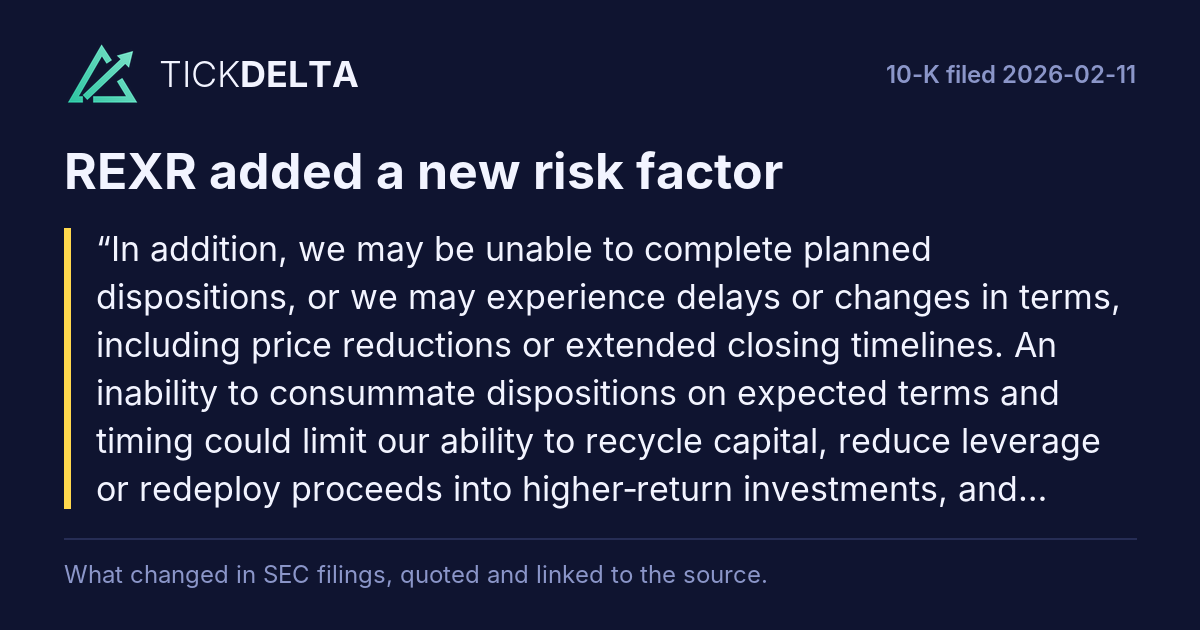
In addition, we may be unable to complete planned dispositions, or we may experience delays or changes in terms, including price reductions or extended closing timelines. An inability to consummate dispositions on expected terms and timing could limit our ability to recycle capital, reduce leverage or redeploy proceeds into higher‑return investments, and could adversely affect our results of operations, financial condition and cash flows. Market conditions, buyer financing availability, due‑diligence or regulatory findings, title or entitlement matters, and required third‑party approvals may each contribute to disposition execution risk.
Stockholder activism and related public campaigns could be disruptive and may adversely affect us.
Stockholder activism and related public campaigns could divert the attention of our board of directors and management, generate costs, and create concern among tenants, lenders, and employees. Activist efforts (including stockholder proposals, director nominations, public campaigns or proxy contests) could pressure us to pursue transactions or strategic or governance changes that may not align with our long‑term plan, and there is no assurance any such actions would be accretive or achievable on acceptable terms. Responding to such activities may require significant time and expense and could adversely affect our results of operations or financial condition, as well as increase stock price volatility.
Paragraphs in the 10-Q filed Oct 27, 2026 that were not in the one before
New in the latest 10-Q
24 paragraphs in the 10-Q filed Oct 27, 2026 with nothing like them in the 10-Q filed Jul 28, 2026 (at least half the words must differ; new numbers alone do not count). Quoted exactly, grouped by the item heading above them. This is text that changed, not a judgement of how serious it is.
Financial statements and notes
Adjustments to reconcile net (loss) income to net cash provided by operating activities:
Read in the 10-Q
Amortization of net (below) above market lease intangibles and other deferred rent on certain other below-market leases (11,890) (20,228)
Read in the 10-Q
Amortization related to termination/settlement of interest rate derivatives 233 232
Read in the 10-Q
Cash paid for interest (net of capitalized interest of $19,662 and $26,534 for the nine months ended September 30, 2026 and 2025, respectively) $ 84,305 $ 82,232
Read in the 10-Q
Operating lease right-of-use assets obtained in exchange for lease liabilities $ 3,059 $ —
Read in the 10-Q
Show the other 19
(2) Represents the sale of 22 industrial properties pursuant to a single portfolio transaction with an affiliate of EQT Real Estate.
Read in the 10-Q
September 30, 2026 December 31, 2025 Margin Above SOFR Interest Rate(1) Contractual
Read in the 10-Q
(3) On September 17, 2026, we repaid in full the outstanding principal balance on this loan. Prior to repayment, the loan bore interest at 1-month term SOFR (“Term SOFR”) plus an applicable margin of 0.80 % per annum, less a sustainability-related interest rate adjustment of 0.04 %. Term SOFR had been swapped to a fixed rate of 2.81725 %, resulting in an all-in fixed rate of 3.57725 %. In connection with the repayment, we terminated the related interest rate swaps. See “Note 8 - Interest Rate Derivatives” for additional information.
Read in the 10-Q
In connection with the repayment of the $ 60.0 million term loan facility, $ 300.0 million unsecured term loan facility and $ 125.0 million unsecured guaranteed senior notes, we wrote off $ 0.2 million of unamortized debt issuance costs, which is included in “Loss on extinguishment of debt” in the accompanying consolidated statements of operations.
Read in the 10-Q
(3) Represents interest rate swaps terminated on September 17, 2026 in connection with the repayment of the $300 Million Term Loan.
Read in the 10-Q
On September 17, 2026, in connection with the repayment of the $ 300 Million Term Loan, we terminated five interest rate swaps with a combined notional amount of $ 300.0 million and a maturity date of May 26, 2027. We received $ 2.9 million upon termination, representing the unrealized gain recorded in AOCI at the time of termination. As the related hedged forecasted transactions were no longer expected to occur following the repayment of the $300 Million Term Loan, the unrealized gain was reclassified from AOCI into earnings under “Interest expense” on the date of termination.
Read in the 10-Q
(1) During the nine months ended September 30, 2026, 27 properties with an aggregate carrying value of $ 1.983 billion were written down to an aggregate fair value of $ 1.336 billion. We also recognized $ 45.6 million of additional impairment charges to reflect costs to sell, resulting in aggregate impairment charges of $ 692.4 million. In addition, we recognized $ 11.0 million of impairment charges related to the seven properties that were impaired in 2025 and sold during 2026 to reflect costs to sell.
Read in the 10-Q
(2) During the fourth quarter 2025, seven properties with an aggregate carrying value of approximately $ 239.1 million were written down to an aggregate fair value of $ 150.0 million, resulting in aggregate impairment charges of $ 89.1 million.
Read in the 10-Q
Unvested Awards Restricted Common Stock LTIP Units Number of Shares Weighted-Average Grant Date Fair Value per Share Number of Units Weighted-Average Grant Date Fair Value per Unit Balance at January 1, 2026 1,623,077 $42.12 325,395 $41.37 Granted 336,560 $40.43 147,306 $37.78 Forfeited (56,289) $43.27 — $— Vested(1) (1,300,144) $41.41 (287,416) $40.96 Balance at September 30, 2026 603,204 $42.60 185,285 $39.14
Read in the 10-Q
• the general level of interest rates including elevated U.S. Treasury yields, and their effect on our cost of capital, the terms on which we may refinance our indebtedness and the ability of potential buyers to finance acquisitions of our properties;
Read in the 10-Q
• risks related to our stock repurchase program, including that repurchases may not be made at the times, prices or amounts anticipated, may reduce our liquidity or may not enhance long-term stockholder value;
Read in the 10-Q
• In July 2026, we repaid in full the $60.0 million term loan facility (the “$60 Million Term Loan”) in advance of its October 27, 2026 maturity date.
Read in the 10-Q
• In September 2026, we repaid in full the $300.0 million unsecured term loan facility (the “$300 Million Term Loan”) and the $125.0 million unsecured guaranteed senior notes (the “$125 Million Notes”) in advance of their May 26, 2027 and July 13, 2027 maturity dates, respectively. In connection with the repayment of the $300 Million Term Loan, we terminated the related interest rate swaps.
Read in the 10-Q
Our strategy is centered on creating long-term shareholder value and per-share FFO and net asset value growth through disciplined capital allocation, targeted investment in infill Southern California industrial real estate and value-add execution across our portfolio that meet our risk-adjusted return requirements, as well as strategic capital recycling.
Read in the 10-Q
(4) During the third quarter of 2026, leases were executed at 9615 Norwalk Blvd, 3680-3880 Voyager Street, and 24935-24955 Avenue Kearny, bringing these properties to 100% leased. The leases are expected to commence in the fourth quarter of 2026.
Read in the 10-Q
Dispositions are an ongoing component of our capital allocation strategy. We evaluate properties for potential disposition based on their long-term expected growth and risk-adjusted return relative to alternative uses of capital, considering among other factors, local market conditions and lease rates, competitive supply, asset type and location, potential uses of proceeds and tax considerations.
Read in the 10-Q
During the nine months ended September 30, 2026, as part of our portfolio realignment, we completed the sale of 37 properties for an aggregate gross sales price of $1.53 billion and net cash proceeds of $1.46 billion, including the sale of a property portfolio to an affiliate of EQT Real Estate. We have used and intend to continue to use these proceeds to repay outstanding indebtedness, including $485.0 million of debt repaid during the third quarter of 2026 and the planned repayment of our $575.0 million 2027 Exchangeable Notes at maturity, to repurchase shares of our common stock and to fund value-add repositioning and select development within our existing portfolio. We currently anticipate gross disposition proceeds of approximately $1.7 billion to $2.0 billion for 2026.
Read in the 10-Q
Our capital allocation priorities are focused on strengthening our balance sheet and enhancing financial flexibility while pursuing opportunities that we believe offer attractive risk-adjusted returns. The timing and volume of future dispositions will depend on market conditions, pricing, asset-specific circumstances, our capital needs and other capital allocation considerations. Our ability to dispose of properties on advantageous terms, or at all, depends on a number of factors, including the availability and cost of credit to potential buyers. To the extent pricing does not reflect what we believe to be the value of an asset, we may elect to retain it.
Read in the 10-Q
We may, when appropriate, structure dispositions as tax-deferred like-kind exchanges under Section 1031 of the Code (“1031 Exchanges”). We did not pursue 1031 Exchanges in connection with dispositions completed during the nine months ended September 30, 2026. A 1031 Exchange generally requires the identification of a replacement property within 45 days and completion of the exchange within 180 days of the sale date.
Read in the 10-Q
The 10-Q's risk factors against the 10-K
Item 1A of the 10-Q filed Oct 27, 2026 against Item 1A of the 10-K filed Feb 11, 2026.
A 10-Q repeats only the risks that changed, so a 10-K paragraph that is missing from it is not counted as removed.
Added is a paragraph with nothing like it in the 10-K, Reworded a sentence that is in both with several words changed,
Quiet changes a sentence in both where one to four words changed and one is a hedge or a modal
(cut words struck through, new words highlighted).
Text on the page, not a score; each links to the filing at sec.gov.
What the 10-Q itself says about its risk factors:Please refer to our Risk Factors as set forth in Item 1A of our Annual Report on Form 10-K for the year ended December 31, 2025. There have been no material changes to the risk factors as set forth in that document.
Read in the 10-Q
1 paragraph in the 10-Q's Item 1A, and none of them adds, rewords or quietly edits a paragraph of the 10-K's.
Phrases used for the first time
Two-word phrases in Risk Factors of the 10-K filed Feb 11, 2026 that are in none of the 1 earlier 10-Ks stored, back to Feb 10, 2025
Where each one is used
- repositioning development: An increase in interest rates would increase our interest costs on variable rate debt and new debt and could adversely affect our ability to refinance existing debt, conduct repositioning, development, and acquisition activity, recycling of capital and leasing activity.
- public campaigns: Stockholder activism and related public campaigns could be disruptive and may adversely affect us.
- reduce rates: From 2024 through 2025, following a rapid series of rate increases in 2022 and 2023 to curb inflation, the Federal Reserve Board began easing policy and lowered interest rates from their July 2023 peak. Although the Federal Reserve Board may further reduce rates in 2026, future decisions to decrease, hold steady or...
- decisions remain: From 2024 through 2025, following a rapid series of rate increases in 2022 and 2023 to curb inflation, the Federal Reserve Board began easing policy and lowered interest rates from their July 2023 peak. Although the Federal Reserve Board may further reduce rates in 2026, future decisions to decrease, hold steady or...
- construction development: •construction, development and repositioning may be unsuccessful and/or costs of a project may exceed original estimates (including as a result of the imposition of tariffs), possibly making the project less profitable than originally estimated, or unprofitable;
- year less: In order to qualify and maintain our qualification as a REIT, we are required under the Code, among other things, to distribute annually at least 90% of our REIT taxable income, determined without regard to the dividends paid deduction and excluding any net capital gain. In addition, we will be subject to federal...
- expected holding: We review the carrying value of our properties when circumstances, such as adverse market conditions, indicate a potential impairment may exist. We base our review on an estimate of the future cash flows (excluding interest charges) expected to result from the property’s use and eventual disposition on an...
- stockholder activism: Stockholder activism and related public campaigns could be disruptive and may adversely affect us.
Used at least twice, small words left out. Counted, not picked: a phrase can be new because the company renamed something.
What was taken out
10 paragraphs of last year's Risk Factors with nothing like them now. The longest are quoted.
Sources
Item 1A of each 10-K and 10-Q on EDGAR, quoted exactly. Each paragraph links to the filing at sec.gov.
Also
10-K change: what was reworded or cut, section by section.
Work with it
Excel workbook · CSV. Google Sheet that stays up to date: paste =IMPORTDATA("https://tickdelta.com/company/REXR/export.csv") into a cell.