Rocket Lab Corp RKLB
New risk paragraphs, branching off last year
Each branch is a paragraph in Risk Factors with nothing like it in the 10-K filed Feb 27, 2025. A box jumps to the paragraph as filed, below.
Paragraphs with nothing like them in last year's 10-K
11 paragraphs in Risk Factors of the 10-K filed Feb 26, 2026 with nothing like them in the 10-K filed Feb 27, 2025. Quoted exactly. Paragraphs that were only edited are under 10-K change.
•U.S. State Department delays impacting our ability to timely obtain the necessary licenses to support launches for foreign customers as well as the delay in processing of U.S. visa application for our foreign personnel;
•reduced government support for U.S. missions and programs, including the furlough of civilian employees, which have reduced communication and increased response times; and
•reduction of workforce at critical mission sites such as at our Wallops facility.
Our contracts may include performance-based payment terms that expose us to financial risks.
Certain contracts we enter into include payment structures that are contingent on the ongoing performance of the delivered product or service over an extended period of time. These payment terms may require us to meet specific performance criteria, and failure to do so could result in reduced payments, the cessation of payments, or the obligation to refund amounts previously received. Such performance-based payment terms may expose us to financial risks, including unexpected charges or losses, if the product or service does not perform as expected.
Delays in project completion or failure to meet certain requirements could also result in liability for costs incurred by customers, including penalties, liquidated damages, or obligations to address deficiencies in order to meet contractual requirements. These risks may adversely affect our financial performance and reputation.
Changes in trade policies, including tariffs, could cause adverse impacts to our business.
Beginning in April 2025, we observed a significant shift in U.S. trade policy, with increased tariffs and the imposition of new tariffs that could impact our supply chain and our business. Even though our suppliers are primarily domestic, we rely on some imported materials, components, or finished goods, and if tariffs increase, our supply chain costs may rise, adversely affecting our business, results of operations and cash flows. We also operate businesses in Canada and New Zealand, which support our domestic business, which increases our potential exposure to the impact of any tariff and any retaliatory measures that may be levied against U.S.-origin goods.
While certain of such tariffs have been temporarily paused as currently articulated by the U.S. government, any further changes in trade policies, such as new tariffs, increases in tariffs, imposition of previously paused tariffs or reactionary measures including retaliatory tariffs, legal challenges, or currency manipulation, could adversely impact us. Additionally, retaliatory measures, or prolonged uncertainty in trade relationships could result in supply chain disruptions, delayed shipments, or increased operational complexity, which could also adversely affect our business, results of operations and cash flows. The legality of some tariffs is being challenged in U.S. courts, leaving an open question as to whether such tariffs will continue to be enforced. Political tensions resulting from changes in trade policies could reduce trade volume, investment, technological exchange and other economic activities between major international economies, resulting in a material adverse effect on global economic conditions and the stability of global financial markets. If further tariffs are imposed on a broader range of imports, or if further retaliatory trade measures are taken by impacted foreign countries in response to additional tariffs, our results of operations could be negatively affected. While we intend to take steps to mitigate any impacts of tariffs or other impacts resulting from changes in trade policy, our ability to do so may be limited by operational and supply chain constraints, especially in the short term.
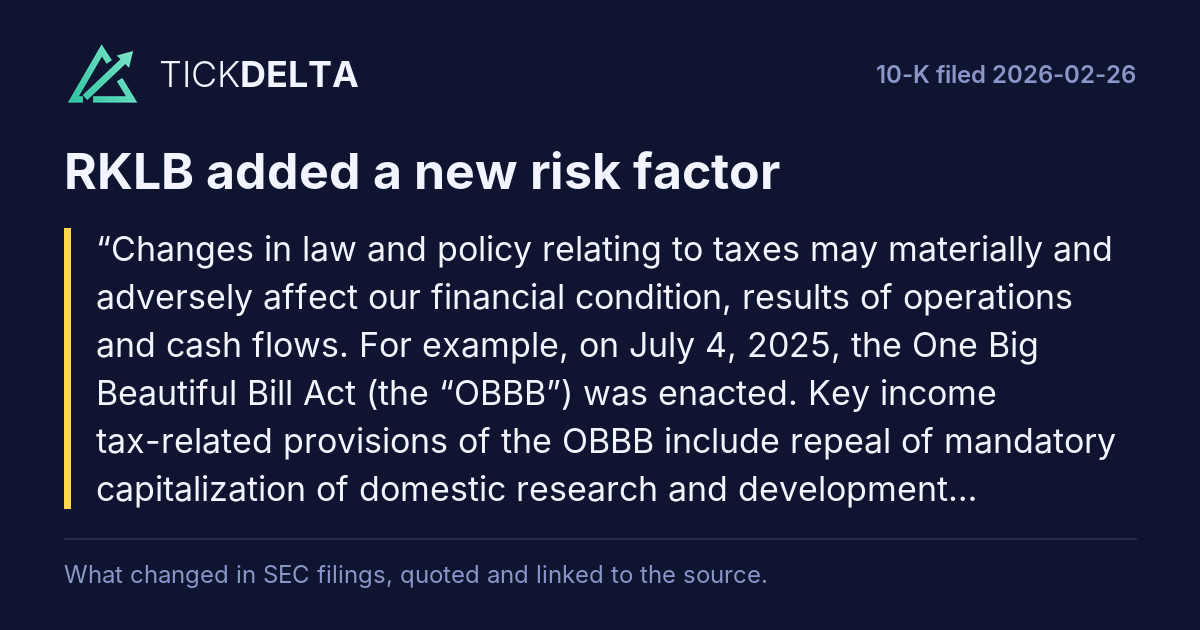
Changes in law and policy relating to taxes may materially and adversely affect our financial condition, results of operations and cash flows. For example, on July 4, 2025, the One Big Beautiful Bill Act (the “OBBB”) was enacted. Key income tax-related provisions of the OBBB include repeal of mandatory capitalization of domestic research and development expenditures under Internal Revenue Code Section 174 (reinstating full expensing beginning in 2025) and revisions to international tax regimes, among other provisions. The OBBB does not significantly impact the Company’s provision for income taxes.
Changes in U.S. and foreign tax laws, regulations and policies may materially and adversely affect our financial condition, results of operations and cash flows. Tax laws are subject to change, and future legislative, regulatory or administrative developments could increase our tax obligations, reduce available tax benefits or otherwise affect the manner in which we conduct our business. We cannot predict whether or when any such changes may occur or the impact they may have on us.
Paragraphs in the 10-Q filed Nov 9, 2026 that were not in the one before
New in the latest 10-Q
15 paragraphs in the 10-Q filed Nov 9, 2026 with nothing like them in the 10-Q filed Aug 10, 2026 (at least half the words must differ; new numbers alone do not count). Quoted exactly, grouped by the item heading above them. This is text that changed, not a judgement of how serious it is.
Financial statements and notes
Several closing conditions have been satisfied. On August 12, 2026, the HSR waiting period expired. On August 26, 2026, the Form S-4 registration statement was declared effective by the Securities and Exchange Commission (the “SEC”). On September 24, 2026, Iridium’s stockholders approved the Iridium Merger Agreement at a special meeting. The Iridium Transaction remains subject to the receipt of required regulatory approvals, including consent from the Federal Communications Commission, and certain foreign regulatory approvals, as well as other customary closing conditions. The Iridium Transaction is expected to close in 2027.
Read in the 10-Q
The Bridge Loan commitment was formally terminated in full on September 15, 2026, prior to any borrowings being drawn. In connection with the termination, the Company recognized a loss on extinguishment of debt of $ 27,259 for the three and nine months ended September 30, 2026, representing debt issuance costs and additional fees paid upon termination.
Read in the 10-Q
On September 15, 2026, Iridium and its lenders entered into an amendment to Iridium’s existing credit agreement, which provides that the Iridium Transaction will not constitute a “change of control” under the amended credit agreement and permits the approximately $ 1,775,000 of term loans outstanding to remain outstanding after closing of the Iridium Transaction. Upon closing of the Iridium Transaction, Rocket Lab USA, Inc., the Company’s primary operating subsidiary, will provide a downstream guarantee of the obligations under Iridium’s amended credit agreement. In connection with the amendment, the Company incurred transaction costs of $ 9,403, which are included in selling, general and administrative expenses for the three and nine months ended September 30, 2026.
Read in the 10-Q
In September 2026, the Company executed prepayment requests for all collared forward transactions. The Company issued 7,451,200 shares of common stock to the forward counterparties as pledged collateral held in accounts registered in the Company’s name and received proceeds of $ 437,853, representing the present value of the minimum expected proceeds, discounted to reflect early payment. The pledged shares are treated as issued and outstanding for financial statement purposes under GAAP.
Read in the 10-Q
The collared forward transactions remain outstanding until the April 2028 maturity dates. Upon settlement, the Company could receive additional cash proceeds of up to approximately $168,000, depending on the settlement price of the Company’s common stock relative to the average forward floor price of $63.61 per share and average forward cap price of $86.11 per share.
Read in the 10-Q
Show the other 10
In October 2026, during manufacturing of first-stage composite structures, we identified a manufacturing process issue that resulted in voids within portions of a composite propellant tank dome. Following investigation and testing, we implemented process refinements and obtained encouraging results from subsequent testing and manufacturing activities. As a result of the time required to investigate, resolve, and validate the manufacturing process, as well as manufacture a replacement forward dome, we now expect Neutron’s inaugural launch to occur in 2027.
Read in the 10-Q
We continue to balance the schedule of the first launch with entering Neutron into service as a system designed for full-scale production and high-cadence launch beyond flight one. Remaining first-stage activities include manufacture and inspection of a replacement forward dome, assembly of the first stage tank structure, and completion of hydrostatic and cryogenic test campaigns. We expect to provide a more specific launch timeline following completion of these activities.
Read in the 10-Q
Loss on extinguishment of debt relates to the termination of the Bridge Loan commitment related to the Iridium Transaction.
Read in the 10-Q
Loss on extinguishment of debt increased by $27.3 million for the nine months ended September 30, 2026 as compared to the nine months ended September 30, 2025, as a result of the termination of the Bridge Loan commitment related to the Iridium Transaction, which resulted in the write-off of debt issuance costs and termination fees.
Read in the 10-Q
On September 15, 2026, Iridium and Iridium’s lenders entered into an amendment to Iridium’s existing credit agreement, which provides that the Iridium Transaction will not constitute a “change of control” under the amended credit agreement and permits the approximately $1.8 billion of term loans outstanding, which mature in September 2030, to remain outstanding after closing of the Iridium Transaction, eliminating the need to repay or refinance this indebtedness. Upon closing of the Iridium Transaction, Rocket Lab USA, Inc., our primary operating subsidiary, will provide a downstream guarantee of the obligations under Iridium’s amended credit agreement. In connection with the amendment, we incurred transaction costs of $9.4 million, which are included in selling, general and administrative expenses for the three and nine months ended September 30, 2026. The transaction is expected to close in 2027, subject to customary closing conditions, including regulatory approval.
Read in the 10-Q
Risk Factors
Our future revenue and operating results are dependent on our ability to generate a sustainable order rate for our products and services and develop new technologies to meet the needs of our customers or potential new customers.
Read in the 10-Q
Our financial performance is dependent on our ability to generate a sustainable order rate for our products and services as well as our ability to monetize products still in development. This can be challenging and may fluctuate on an annual basis as the number of contracts awarded varies. If we are unable to win new awards or execute existing contracts as expected, our business, results of operations, and financial position could be further adversely affected. Furthermore, if our customers experience delays or technical challenges with their products or services or exercise delay or termination rights under new or existing contracts, our ability to recognize the full potential value of such contracts could also adversely affect our business, results of operations and financial position.
Read in the 10-Q
The cyclical nature of the rocket launch services, mission services, spacecraft and spacecraft component markets could negatively impact our ability to accurately forecast customer demand. The markets that we serve may not grow in the future and we may not be able to maintain adequate gross margins or profits in these markets. Our growth is dependent on the growth in the sales of services provided by our customers, our customers’ ability to anticipate market trends, and our ability to anticipate changes in the businesses of our customers and to successfully identify and enter new markets. If we fail to anticipate such changes in demand, or such demand does not materialize to the extent we expected or at all, our business, results of operations, and financial position could be adversely affected.
Read in the 10-Q
The rocket launch services, mission services, spacecraft and spacecraft component industries are each characterized by development of technologies to meet changing customer demand for complex and reliable products and services. Our current development projects include spacecraft capabilities; new reaction wheel sizes; and a new medium-lift rocket, called Neutron, for constellation deployment, interplanetary missions and potentially human spaceflight. Our products and services embody complex technology and may not always be compatible with current and evolving technical standards and systems developed by others. Failure or delays to meet the requisite and evolving industry or user standards could have a material adverse effect on our business, results of operations, and financial condition. Failure of suppliers to deliver against end customer requirements could lead to a material adverse effect on our financial results.
Read in the 10-Q
We have previously experienced, and may experience in the future, delays or other complications in the design, manufacture and commercialization of new rocket launch services, including the development and launch of our Neutron launch vehicle, mission services, spacecraft, spacecraft components and related technology. For example, we experienced a qualification testing failure of the Neutron Stage 1 tank on January 21, 2026 which ruptured the tank during a hydrostatic pressure trial resulting in an impact to Neutron’s launch schedule. In addition, during the fourth quarter of 2026, we identified a manufacturing process issue affecting first-stage composite structures that resulted in a further delay to the expected timing of Neutron’s inaugural launch. If we fail to develop and successfully commercialize new technologies, if we fail to develop such technologies before our competitors, or if such technologies fail to perform as expected, or are inferior to those of our competitors, our business, financial condition and results of operations could be materially and adversely impacted.
Read in the 10-Q
The 10-Q's risk factors against the 10-K
Item 1A of the 10-Q filed Nov 9, 2026 against Item 1A of the 10-K filed Feb 26, 2026.
A 10-Q repeats only the risks that changed, so a 10-K paragraph that is missing from it is not counted as removed.
Added is a paragraph with nothing like it in the 10-K, Reworded a sentence that is in both with several words changed,
Quiet changes a sentence in both where one to four words changed and one is a hedge or a modal
(cut words struck through, new words highlighted).
Text on the page, not a score; each links to the filing at sec.gov.
What the 10-Q itself says about its risk factors:Other than as set forth below, there have been no material changes from the risk factors previously disclosed in Part I, Item 1A of our Annual Report on Form 10-K, as filed with the SEC on February 26, 2026 and Part II, Item 1A of our Quarterly Report on Form 10-Q, as filed with the SEC on August 10, 2026.
Read in the 10-Q
6 paragraphs in the 10-Q's Item 1A, and none of them adds, rewords or quietly edits a paragraph of the 10-K's.
Phrases used for the first time
Two-word phrases in Risk Factors of the 10-K filed Feb 26, 2026 that are in none of the 1 earlier 10-Ks stored, back to Feb 27, 2025
Where each one is used
- retaliatory measures: •Changes in laws and regulations. It is possible that the laws and regulations governing our business and operations will change in the future. A substantial portion of our revenue is generated from customers outside of the U.S. There may be a material adverse effect on our financial condition and results of...
- trade policies: Changes in trade policies, including tariffs, could cause adverse impacts to our business.
- performance-based payment: Our contracts may include performance-based payment terms that expose us to financial risks.
- rare earth: Disruptions in the supply of key raw materials or components, including restrictions on our ability to obtain rare earth minerals, and difficulties in the supplier qualification process, as well as increases in prices of raw materials, could adversely impact us.
- earth minerals: Disruptions in the supply of key raw materials or components, including restrictions on our ability to obtain rare earth minerals, and difficulties in the supplier qualification process, as well as increases in prices of raw materials, could adversely impact us.
- sir peter: We are highly dependent on the services of Sir Peter Beck, our President, Chief Executive Officer and Chairman, and if we are unable to retain Mr. Beck, our ability to compete could be harmed.
- origin goods: •Changes in laws and regulations. It is possible that the laws and regulations governing our business and operations will change in the future. A substantial portion of our revenue is generated from customers outside of the U.S. There may be a material adverse effect on our financial condition and results of...
- trade policy: Beginning in April 2025, we observed a significant shift in U.S. trade policy, with increased tariffs and the imposition of new tariffs that could impact our supply chain and our business. Even though our suppliers are primarily domestic, we rely on some imported materials, components, or finished goods, and if...
Used at least twice, small words left out. Counted, not picked: a phrase can be new because the company renamed something.
What was taken out
8 paragraphs of last year's Risk Factors with nothing like them now. The longest are quoted.
Sources
Item 1A of each 10-K and 10-Q on EDGAR, quoted exactly. Each paragraph links to the filing at sec.gov.
Also
10-K change: what was reworded or cut, section by section.
Work with it
Excel workbook · CSV. Google Sheet that stays up to date: paste =IMPORTDATA("https://tickdelta.com/company/RKLB/export.csv") into a cell.