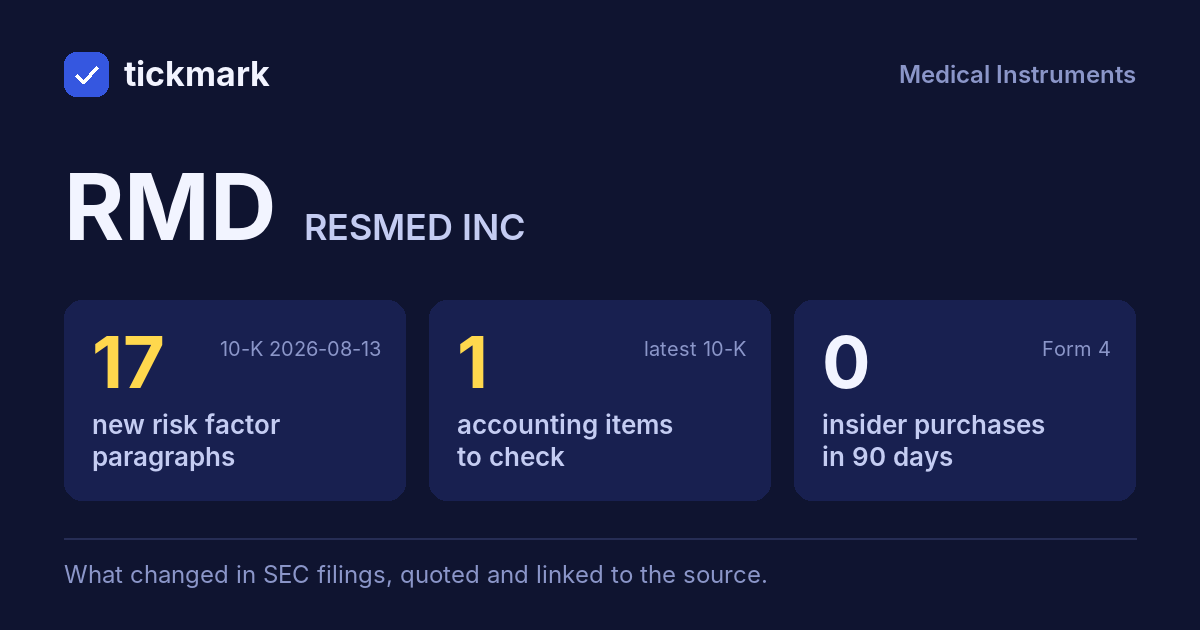
Sentences and paragraphs of RMD's Risk Factors and MD&A, 10-K 2026-08-13 against 10-K 2025-08-08.
Each links to the text at sec.gov.
AddedRisk Factors
•Failure to identify, execute, and integrate acquired businesses into our operations successfully, or challenges related to the Company's strategic initiatives, including divestitures.
Read it in 10-K 2026-08-13 at sec.gov ↗
AddedRisk Factors
•Our use of artificial intelligence in certain products, software solutions and business operations may expose us to operational, regulatory and reputational risks that could adversely affect our business, financial condition and results of operations.
Read it in 10-K 2026-08-13 at sec.gov ↗
AddedRisk Factors
We are subject to new areas of direct healthcare oversight by federal government agencies due to our acquisitions of VirtuOx and Noctrix. In 2025, we acquired VirtuOx, a software-enabled independent diagnostic testing facility, or IDTF, and provider of technology solutions to facilitate in-home and remote testing services for sleep, respiratory, cardiac, and other health conditions across the U.S. Additionally, in June 2026, we acquired Noctrix, a DME supplier and manufacturer of a neurostimulation FDA-cleared device to treat restless legs syndrome. As a Medicare-enrolled IDTF, VirtuOx, and as a
Read it in 10-K 2026-08-13 at sec.gov ↗
AddedRisk Factors
Failure to identify, execute, and integrate acquired businesses into our operations successfully, or challenges related to the Company's strategic initiatives, including divestitures. As part of our strategy to develop and identify new solutions and technologies and optimize our portfolio of products, we have completed several acquisitions and investments and may make additional acquisitions, investments, or divestitures in the future. Our integration of the operations of acquired businesses, or a divestiture of part of our existing businesses, including the separation of our MatrixCare business, requires significant efforts, including the coordination of information technologies, research and development, sales and marketing, operations, manufacturing, and finance. These efforts result in additional expenses, and our management may have attention diverted while trying to integrate acquisitions. In addition, the cumulative effect of simultaneously executing multiple transactions may increase operational complexity and heighten execution and timing risks. Our ability to realize the anticipated benefits of acquisitions depends not only on the successful integration of acquired businesses, but also on our ability to identify appropriate acquisition targets, evaluate their strategic fit and long‑term value, accurately assess risks and liabilities, and negotiate and complete transactions on acceptable terms. Our acquisitions may involve the undertaking of additional risk areas and the investment of additional resources and personnel to manage that risk. In addition, we cannot be certain that the businesses we acquire will become profitable or remain profitable. We also could experience negative effects on our business, results of operations, financial condition, and cash flows from acquisition-related charges, and amortization of intangible assets. Moreover, we have recorded intangible assets, including goodwill, in connection with our acquisitions. We evaluate goodwill for impairment annually and other acquired intangible assets whenever events or changes in circumstances indicate that their carrying values may not be recoverable. Our impairment assessments require significant judgments and assumptions, including those related to macroeconomic conditions, industry and market trends, projected revenues and cash flows, and discount rates. If actual results differ from these assumptions or market conditions change, we may be required to record material impairment charges that could adversely affect our results of operations. These effects, combined with transaction costs, retention or separation‑related expenses, and potential delays in realizing anticipated synergies or strategic benefits, may place pressure on earnings or cash flows.
Read it in 10-K 2026-08-13 at sec.gov ↗
AddedRisk Factors
In addition, expected strategic benefits from any planned or completed divestiture, including the separation of our MatrixCare business, may not be realized or may take longer to realize than expected, and there can be no assurance that disputes will not arise under transition service, or other agreements that have or may be executed as part of a divestiture. Challenges associated with executing these transactions may materially adversely affect our business, results of operations, financial condition, and cash flows.
Read it in 10-K 2026-08-13 at sec.gov ↗
AddedRisk Factors
Further, if we fail to innovate or adequately invest in new technologies, we could lose our competitive position in the markets that we serve. To the extent that we fail to introduce new and innovative products, or such products are not accepted or suffer significant delays in development, our financial results may suffer. An inability, for technological or other reasons, to successfully develop and introduce new products on a timely basis could reduce our growth rate or otherwise have an adverse effect on our business.
Read it in 10-K 2026-08-13 at sec.gov ↗
AddedRisk Factors
On June 9, 2025, CMS finalized a National Coverage Determination (NCD) entitled “Noninvasive Positive Pressure Ventilation (NIPPV) in the Home for the Treatment of Chronic Respiratory Failure (CRF) Consequent to Chronic Obstructive Pulmonary Disease (COPD).” The NCD establishes a uniform national coverage criteria for Respiratory Assist Devices (RADs) with bi-level capacity, with or without a backup rate feature, and for the first time, Home Mechanical Ventilators (HMVs) for patients with chronic respiratory failure (CRF) consequent to COPD. CMS subsequently issued implementation guidance on August 21, 2025 instructing Medicare contractors to process claims under the NCD effective June 9, 2025. Although the NCD establishes national coverage criteria that may reduce reimbursement uncertainty and replace previously applicable local coverage determination (LCD) policies for this indication, it also imposes specific clinical qualification, documentation, and ongoing patient monitoring requirements. The extent to which these national coverage criteria and associated operational requirements will affect providers, suppliers, utilization of these products, or reimbursement by other third-party payors remains uncertain.
Read it in 10-K 2026-08-13 at sec.gov ↗
AddedRisk Factors
On July 4, 2025, President Trump signed the budget reconciliation bill (entitled “One Big Beautiful Bill Act”, referred to herein as the “Bill”) to meet spending targets aimed at funding the Trump Administration’s domestic priorities that includes significant changes to the Medicaid program. Among other things, the Bill includes changes to Medicaid eligibility and enrollment requirements, provider taxes, and state-directed payment policies that are intended to reduce federal Medicaid spending over time. According to the Congressional Budget Office (CBO), the Bill is projected to reduce
Read it in 10-K 2026-08-13 at sec.gov ↗
Show the other 10
AddedRisk Factors
federal spending on Medicaid and Marketplace coverage by approximately $1.1 trillion over the 2025-2034 period, increase the federal deficit by approximately $3.4 trillion on a conventional scoring basis over the same period, and result in approximately 10 million additional uninsured individuals by 2034. CBO has also estimated that, after accounting for macroeconomic effects, the Bill could increase federal deficits by approximately $4. trillion over the budget window.
Read it in 10-K 2026-08-13 at sec.gov ↗
AddedRisk Factors
In February 2026, the CBO projected that federal health programs will cost over $26 trillion through 2036, projected to grow in size from less than $2 trillion today to over $3 trillion by 2036. Medicare spending is projected to nearly double over the next decade, while the cost of Medicaid and the Children’s Health Insurance Program (CHIP) will grow a projected 36% and ACA subsidies by 33%. Finally, Medicare’s Hospital Insurance Trust Fund is projected to become insolvent in 2040, highlighting the continuing fiscal pressures facing the Medicare program. Future legislative and other governmental actions to curb this projected spending could include stricter eligibility requirements and more restrictive Medicaid programs at the state level, leaving fewer individuals eligible for coverage, which could have an adverse impact on the number of individuals who seek to use our products and services.
Read it in 10-K 2026-08-13 at sec.gov ↗
AddedRisk Factors
With respect to our recent acquisition of Noctrix, we may realize reductions in both reimbursement rates and coverage for the restless legs syndrome device, due to Noctrix not yet having a national or local coverage determination. To the extent that any Medicare administrative contractor decides that the restless legs syndrome product is not medically necessary or has not met applicable coverage criteria, claims for products could be denied and overpayments could be assessed. Further, any future coverage determination could implement more restrictive coverage requirements, including potential noncoverage entirely. As a new product, we cannot predict how the Medicare Program and its contractors will view the Noctrix device and its efficacy in the treatment of restless legs syndrome. If more restrictive coverage is implemented, our Noctrix revenues could be reduced.
Read it in 10-K 2026-08-13 at sec.gov ↗
AddedRisk Factors
participation in Federal healthcare programs. Violations of the Federal Anti-Kickback Statute can also result in significant criminal penalties and imprisonment;
Read it in 10-K 2026-08-13 at sec.gov ↗
AddedMD&A
We are a global leader in digital health and cloud-connected medical devices. We design innovative technology with the intention to empower people to live happier, healthier lives. Our artificial intelligence, or AI, powered digital health solutions, cloud-connected devices and intelligent software are designed to make home healthcare more personalized, accessible and effective. By enabling better care, our products seek to improve quality of life, reduce the impact of chronic disease, and lower costs for consumers and healthcare systems.
Read it in 10-K 2026-08-13 at sec.gov ↗
AddedMD&A
In June 2026, we acquired Noctrix Health, LLC, or Noctrix, a company with an FDA De Novo classified medical device that treats restless legs syndrome. The acquisition expands our clinical sleep health portfolio into an adjacent area of unmet need. Noctrix will operate as a wholly owned subsidiary of Resmed.
Read it in 10-K 2026-08-13 at sec.gov ↗
AddedMD&A
On June 30, 2026, we entered into a definitive agreement to sell our MatrixCare business for $490 million in an all-cash transaction, subject to certain closing adjustments. The transaction includes MatrixCare and related software offerings historically sold under the MatrixCare brand, including Healthcare First, Citus, and home health and hospice solutions, collectively defined as the "MatrixCare business”. The transaction is expected to close in the first quarter of fiscal year 2027. During fiscal year 2026, the MatrixCare business represented approximately $220 million of revenue and approximately $28 million of operating profit, which included approximately $28 million of amortization from acquired intangibles. As of June 30, 2026, we determined that the MatrixCare business meets the criteria to be classified as held for sale. The results of operations of the MatrixCare business are included in continuing operations for all periods presented, as the disposition does not represent a strategic shift that will have a major effect on our operations or financial results and therefore does not meet the criteria to be classified as discontinued operations. Additional information regarding the sale of the MatrixCare business and the acquisition of Noctrix is included in Note 18 – Business Combinations and Divestitures of the Notes to Consolidated Financial Statements (Part II, Item 8).
Read it in 10-K 2026-08-13 at sec.gov ↗
AddedMD&A
(B) Historically we have presented our geographical split of revenue as “U.S., Canada, and Latin America” and “Combined Europe, Asia, and other markets”. Effective this quarter, this presentation has been renamed to Americas (formerly U.S., Canada, and Latin America) and Rest of World (formerly Combined Europe, Asia, and other markets). The methodology for attributing revenue to these geographies remains unchanged. Revenue from prior periods is consistent and comparable to previous reporting.
Read it in 10-K 2026-08-13 at sec.gov ↗
AddedMD&A
For both the years ended June 30, 2026 and 2025, amortization of acquired intangible assets was $45 million.
Read it in 10-K 2026-08-13 at sec.gov ↗
AddedMD&A
When a portion of a reporting unit is classified as held for sale, goodwill is allocated to the disposal group based on the relative fair values of the disposal group and the portion of the reporting unit that will be retained. The goodwill allocated to the disposal group is included in the carrying amount of the disposal group for purposes of measuring any gain or loss on sale and is no longer subject to separate annual or interim impairment testing. See Note 18 – Business Combinations and Divestitures of the Notes to Consolidated Financial Statements (Part II, Item 8) for further information.
Read it in 10-K 2026-08-13 at sec.gov ↗