Screener / SEC EDGAR /CIK 0000912562 /10-K filed Feb 26, 2026, compared with Feb 19, 2025 /Numbers from the XBRL of the 10-Ks
Nasdaq Materials · Steel Works, Blast Furnaces & Rolling & Finishing Mills

Gibraltar Industries, Inc. ROCK

Compare with peers Embed
New in the 10-K 40 paragraphs with nothing like them in the 10-K filed Feb 19, 2025 New in the 10-Q 8 paragraphs not in the 10-Q filed Aug 5, 2026 10-Q against the 10-K 1 risk factor paragraphs and sentences added or reworded

New risk paragraphs, branching off last year

Each branch is a paragraph in Risk Factors with nothing like it in the 10-K filed Feb 19, 2025. A box jumps to the paragraph as filed, below.

40 new

Paragraphs with nothing like them in last year's 10-K

Quoted exactly

40 paragraphs in Risk Factors of the 10-K filed Feb 26, 2026 with nothing like them in the 10-K filed Feb 19, 2025. Quoted exactly. Paragraphs that were only edited are under 10-K change.

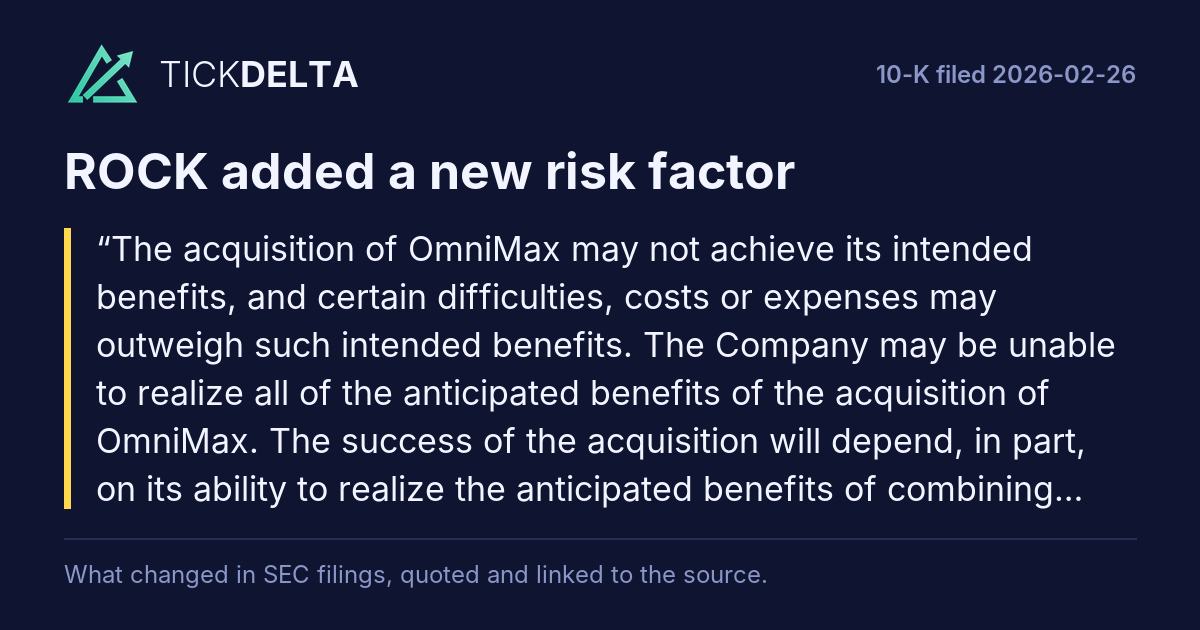
The acquisition of OmniMax may not achieve its intended benefits, and certain difficulties, costs or expenses may outweigh such intended benefits.

The Company may be unable to realize all of the anticipated benefits of the acquisition of OmniMax. The success of the acquisition will depend, in part, on its ability to realize the anticipated benefits of combining the Company’s residential business with the OmniMax business, including cost and revenue synergies. The anticipated benefits and synergies of the Company’s acquisition of OmniMax may not be realized fully or at all, may take longer to realize than expected or could have other adverse effects that the Company does not currently foresee.

Some of the assumptions that the Company has made, such as the achievement of operating synergies, may not be realized. It is possible that the integration process could result in the loss of key Company or OmniMax employees, the loss of customers, the disruption of the Company’s or OmniMax’s ongoing businesses, inconsistencies in standards, controls, procedures and policies, unexpected integration issues, higher than expected integration costs and an overall post-completion integration process that takes longer than originally anticipated. There could be potential unknown liabilities and unforeseen expenses associated with the acquisition of OmniMax that were not discovered in the course of performing due diligence or that arise from the combination of the businesses. Specifically, the following issues, among others, must be addressed in integrating the operations of OmniMax into the Company to realize the anticipated benefits of the acquisition of OmniMax so the Company performs as expected and realizes its anticipated cost and revenue synergy opportunities:

•combining the existing businesses of the Company with that of OmniMax and meeting the capital requirements of the Company following the acquisition, in a manner that permits the Company to achieve cost savings and revenue synergies anticipated to result from the acquisition, the failure of which would result in the anticipated benefits of the acquisition not being realized in the time frame currently anticipated or at all;

•identifying and eliminating redundant and underperforming functions and assets;

•harmonizing operating practices, employee development and compensation programs, internal controls and other policies, procedures and processes;

•maintaining existing agreements with customers, providers and vendors and avoiding delays in entering into new agreements with prospective customers, providers and vendors;

•addressing possible differences in business backgrounds, corporate cultures and management philosophies;

•consolidating the companies’ administrative and information technology infrastructure;

In addition, at times the attention of members of the Company’s management and resources may be focused on the integration of the OmniMax business and diverted from day-to-day business operations or other opportunities that may have been beneficial to the Company, which may disrupt the Company’s business.

The Company has incurred and will incur significant transaction and integration costs in connection with the acquisition of OmniMax.

The Company has incurred a number of non-recurring costs associated with integrating the operations of OmniMax, as well as transaction fees and other costs related to the acquisition of OmniMax. These costs and expenses include fees paid to financial, legal and accounting advisors, and other related charges.

The Company will continue to incur integration costs as there are a large number of processes, policies, procedures, operations, technologies, facilities and systems that must be integrated. Although the Company expects that the elimination of duplicative costs, strategic benefits, additional income as well as the realization of other efficiencies related to the integration of the businesses may offset incremental transaction, acquisition-related and integration costs over time, any net benefit may not be achieved in the near term or at all. While the Company

assumed that certain expenses would be incurred in connection with the acquisition of OmniMax, there are many factors beyond the Company’s control that could affect the total amount or the timing of the integration and implementation expenses.

Prior to the acquisition of OmniMax, OmniMax was a privately-held company and its new obligations of being a part of a public company may require significant resources and management attention.

Upon the closing of the acquisition of OmniMax, OmniMax and its subsidiaries became subsidiaries of the Company, and now need to comply with the Sarbanes-Oxley Act of 2002, as amended (“Sarbanes-Oxley”) and the rules and regulations subsequently implemented by the SEC and other regulatory bodies. As a private company, OmniMax’s internal controls were not designed to be in compliance with Sarbanes-Oxley or any other public company requirements. The Company will need to ensure that OmniMax establishes and maintains effective disclosure controls as well as internal controls and procedures for financial reporting, and such compliance efforts may be costly and may divert the attention of management. If the Company fails to create and maintain effective internal controls at OmniMax and its subsidiaries after the acquisition, the Company could report material weaknesses in the future, which would indicate that there is a reasonable possibility that the Company’s financial statements do not accurately reflect the Company’s financial condition.

In the course of the due diligence review of OmniMax that the Company conducted prior to the acquisition of OmniMax, the Company may have been unable to quantify undisclosed liabilities of OmniMax and its subsidiaries, if any, and the Company will not be indemnified for any of these liabilities. If OmniMax has undisclosed liabilities, the Company, as a successor owner, will be responsible for such undisclosed liabilities. Such undisclosed liabilities could have an adverse effect on the business, results of operations, financial condition and cash flows of the Company.

Acquisition accounting adjustments could adversely affect the Company’s financial results.

The Company will account for the completion of the acquisition of OmniMax using the acquisition method of accounting. The Company will allocate the total estimated purchase price to net tangible assets, amortizable intangible assets and indefinite-lived intangible assets, and based on their fair values as of the date of completion of the acquisition of OmniMax record the excess, if any, of the purchase price over those fair values as goodwill. Differences between preliminary estimates and the final acquisition accounting may occur, and these differences could have a material impact on the consolidated financial statements and the combined company’s future results of operations and financial position.

The Company incurred substantial indebtedness in connection with the acquisition of OmniMax.

The Company incurred substantial indebtedness in connection with the acquisition of OmniMax. As of the closing of the acquisition, on a consolidated basis, the Company had approximately $1.3 billion in gross indebtedness outstanding under the Company’s Credit Agreement including (a) the Term Loan A Facility in an initial aggregate principal amount of $650 million, (b) the Term Loan B Facility in an initial aggregate principal amount of $650 million and (c) the Revolving Credit Facility in an initial aggregate commitment amount of $500 million, with the Term Loan A Facility and Term Loan B Facility fully drawn and approximately $482 million remaining available under the Revolving Credit Facility.

•making it more difficult for the Company to satisfy its obligations with respect to its debt;

•requiring the Company to dedicate a substantial portion of its cash flow from operations to the payment of interest and the repayment of the Company’s indebtedness, thereby reducing funds available to it for other purposes;

•limiting the Company’s ability to obtain additional financing to fund future working capital, capital expenditures, business development or other general corporate requirements, including dividends, if and when declared by the board of directors;

•increasing the Company’s vulnerability to general adverse economic and industry conditions;

•making the Company more highly leveraged than some of its competitors, which may place its at a competitive disadvantage;

•restricting the Company from making strategic acquisitions, engaging in development activities or exploiting business opportunities;

•exposing the Company to the risk of increased interest rates as certain of the Company’s borrowings are and may in the future be at variable rates of interest;

•limiting the Company’s flexibility in planning for and reacting to changes in its industry; and

While the Company aims to deleverage its capital structure over the next few years, the methods the Company may pursue and the timing, extent and impact of any actions in furtherance of this goal may vary and evolve and there can be no assurance the Company will be successful in its efforts to deleverage.

Servicing the Company’s debt requires a significant amount of cash, and the Company may not have sufficient cash flow from its business to pay its substantial debt.

The Company’s ability to make scheduled payments of the principal of, to pay interest on, and to refinance its debt, depends on its future performance, which is subject to economic, financial, competitive and other factors. The Company’s business may not continue to generate cash flow from operations in the future sufficient to satisfy its obligations under its current indebtedness and any future indebtedness the Company may incur and to make necessary capital expenditures. If the Company is unable to generate such cash flow, it may be required to adopt one or more alternatives, such as reducing or delaying investments or capital expenditures, selling assets, refinancing or obtaining additional equity capital on terms that may be onerous or highly dilutive. The Company’s ability to refinance its outstanding indebtedness or future indebtedness will depend on the capital markets and its financial condition at such time. The Company may not be able to engage in any of these activities or engage in these activities on desirable terms when needed, which could result in a default on its indebtedness.

The Company’s debt agreements contain restrictions that limit its flexibility in operating its business.

The Credit Agreement contains, and any other existing or future indebtedness of the Company would likely contain, covenants that impose significant operating and financial restrictions on the Company, including restrictions on the ability of the Company and its subsidiaries to, among other things:

•incur additional debt, guarantee indebtedness or issue certain preferred shares;

•pay dividends on or make distributions in respect of, or repurchase or redeem, capital stock or make other restricted payments;

•consolidate, merge, sell or otherwise dispose of all or substantially all of its assets;

As a result of these covenants, the Company is limited in the manner in which it conducts its business, and may be unable to engage in favorable business activities or finance future operations or capital needs.
Read in the 10-K

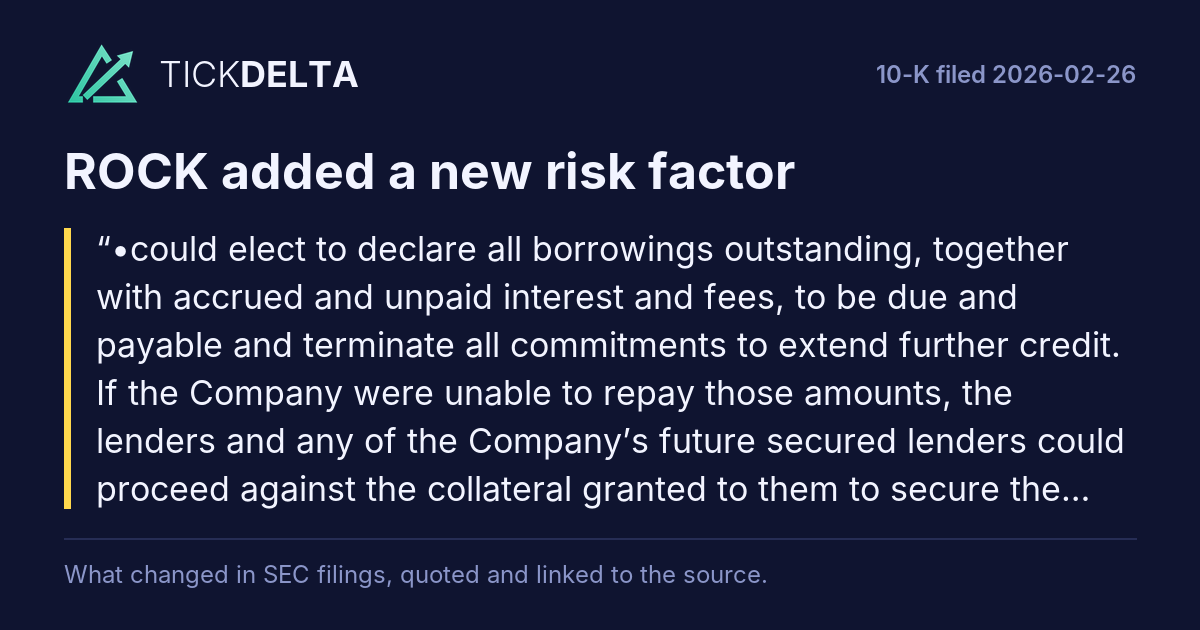
•could elect to declare all borrowings outstanding, together with accrued and unpaid interest and fees, to be due and payable and terminate all commitments to extend further credit.

If the Company were unable to repay those amounts, the lenders and any of the Company’s future secured lenders could proceed against the collateral granted to them to secure the indebtedness under the Credit Agreement or such other indebtedness.

Read in the 10-K

Paragraphs in the 10-Q filed Nov 5, 2026 that were not in the one before

New in the latest 10-Q

8 paragraphs in the 10-Q filed Nov 5, 2026 with nothing like them in the 10-Q filed Aug 5, 2026 (at least half the words must differ; new numbers alone do not count). Quoted exactly, grouped by the item heading above them. This is text that changed, not a judgement of how serious it is.

Financial statements and notes

In October 2026, the Company committed to a plan to sell its Infrastructure business, which consists solely of The D.S. Brown Company (“DSB”) and represents a strategic shift in the Company's operations. The planned divestiture is consistent with the Company's ongoing portfolio optimization strategy to simplify its business and further sharpens its strategic focus and resource allocation on its Residential and Agtech segments.

Read in the 10-Q

On October 14, 2026, the Company entered into a Securities Purchase Agreement with GCP Applied Technologies Inc. ("GCP") for the sale of all of the issued and capital stock of DSB. Under the terms of the agreement, GCP has agreed to pay cash consideration of $ 208.0 million, subject to customary closing conditions and post-closing adjustments.

Read in the 10-Q

The Company's commitment to sell its Infrastructure business and execution of the related agreement occurred after September 30, 2026 and therefore represent a nonrecognized subsequent event. Accordingly, the Infrastructure business was not classified as held for sale or presented as discontinued operations under ASC 205-20 in the accompanying consolidated financial statements. Beginning in the fourth quarter of fiscal 2026, the Company expects to classify the Infrastructure business as held for sale and present the results of the Infrastructure business as discontinued operations, including recasting prior-period results to reflect the Infrastructure business as discontinued operations.

Read in the 10-Q

On October 14, 2026, the Company entered into an agreement to sell its Infrastructure business. The sale furthers the simplification of the Company's portfolio and sharpens its strategic focus and resource allocation on its Residential and Agtech segments.

Read in the 10-Q

On October 14 2026, Gibraltar entered into a Securities Purchase Agreement with GCP Applied Technologies Inc. for the sale of all of the issued and capital stock of DSB. Under the terms of the agreement, GCP has agreed to pay cash consideration of $208 million, subject to customary closing conditions and post-closing adjustments. DSB is the sole business reported under the Company's Infrastructure segment.

Read in the 10-Q
Show the other 3

The Company believes that the planned sale of DSB represents an important step in the continued simplification of its portfolio and further sharpens its strategic focus and resource allocation toward its Residential and Agtech segments. Subject to completion of the transaction, the Company currently expects the transaction to be highly tax-efficient, which is anticipated to maximize net proceeds available to support debt reduction and strengthen the Company's balance sheet. The transaction remains subject to customary closing conditions, and there can be no assurance that the transaction will be completed on the currently contemplated terms or timeframe.

Read in the 10-Q

Legal proceedings

There were no material legal proceeding terminated, settled, or otherwise resolved during the quarter ended September 30, 2026.

Read in the 10-Q

Item 6

104 Cover Page Interactive Data File (formatted as Inline XBRL and contained in Exhibit 101)

Read in the 10-Q

The 10-Q's risk factors against the 10-K

Item 1A of the 10-Q filed Nov 5, 2026 against Item 1A of the 10-K filed Feb 26, 2026. A 10-Q repeats only the risks that changed, so a 10-K paragraph that is missing from it is not counted as removed. Added is a paragraph with nothing like it in the 10-K, Reworded a sentence that is in both with several words changed, Quiet changes a sentence in both where one to four words changed and one is a hedge or a modal (cut words struck through, new words highlighted). Text on the page, not a score; each links to the filing at sec.gov.

Added10-Q Nov 5, 2026 vs 10-K Feb 26, 2026
In addition to the other information set forth in this report, you should carefully consider the risks discussed in “Part I, Item 1A. Risk Factors” in the Company's Annual Report on Form 10-K for the fiscal year ended December 31, 2025 and in our Form 10-Q for the quarterly report ended June 30, 2026, respectively. These risks and uncertainties have the potential to materially affect the Company's business, financial condition, results of operation, cash flows, and future prospects. Additional risks and uncertainties not currently known to the Company or that the Company currently deems immaterial may materially adversely impact the Company's business, financial condition, or operating results. We believe there have been no material changes from the risk factors previously disclosed in the Company's Annual Report on Form 10-K for the fiscal year ended December 31, 2025 and Form 10Q for the quarterly period ended June 30, 2026, respectively.

Read it in the 10-Q at sec.gov

Phrases used for the first time

Two-word phrases in Risk Factors of the 10-K filed Feb 26, 2026 that are in none of the 1 earlier 10-Ks stored, back to Feb 19, 2025

anticipated benefits ×5integration costs ×4undisclosed liabilities ×4term loan ×4loan facility ×4initial aggregate ×3terrorist activities ×2intended benefits ×2revenue synergies ×2integration process ×2due diligence ×2policies procedures ×2customers providers ×2omnimax omnimax ×2acquisition accounting ×2purchase price ×2
Where each one is used
  • anticipated benefits: The Company may be unable to realize all of the anticipated benefits of the acquisition of OmniMax. The success of the acquisition will depend, in part, on its ability to realize the anticipated benefits of combining the Company’s residential business with the OmniMax business, including cost and revenue synergies....
  • integration costs: Some of the assumptions that the Company has made, such as the achievement of operating synergies, may not be realized. It is possible that the integration process could result in the loss of key Company or OmniMax employees, the loss of customers, the disruption of the Company’s or OmniMax’s ongoing businesses,...
  • undisclosed liabilities: In the course of the due diligence review of OmniMax that the Company conducted prior to the acquisition of OmniMax, the Company may have been unable to quantify undisclosed liabilities of OmniMax and its subsidiaries, if any, and the Company will not be indemnified for any of these liabilities. If OmniMax has...
  • term loan: The Company incurred substantial indebtedness in connection with the acquisition of OmniMax. As of the closing of the acquisition, on a consolidated basis, the Company had approximately $1.3 billion in gross indebtedness outstanding under the Company’s Credit Agreement including (a) the Term Loan A Facility in an...
  • loan facility: The Company incurred substantial indebtedness in connection with the acquisition of OmniMax. As of the closing of the acquisition, on a consolidated basis, the Company had approximately $1.3 billion in gross indebtedness outstanding under the Company’s Credit Agreement including (a) the Term Loan A Facility in an...
  • initial aggregate: The Company incurred substantial indebtedness in connection with the acquisition of OmniMax. As of the closing of the acquisition, on a consolidated basis, the Company had approximately $1.3 billion in gross indebtedness outstanding under the Company’s Credit Agreement including (a) the Term Loan A Facility in an...
  • terrorist activities: Terrorist activities, armed conflict, civil disturbances, natural or man-made disasters, including those that may increase in frequency or severity due to climate change, or other catastrophic events or public health crises could result in material damage to the Company's facilities, economic instability,...
  • intended benefits: The acquisition of OmniMax may not achieve its intended benefits, and certain difficulties, costs or expenses may outweigh such intended benefits.

The 10-K at sec.gov

Used at least twice, small words left out. Counted, not picked: a phrase can be new because the company renamed something.

What was taken out

11 paragraphs of last year's Risk Factors with nothing like them now. The longest are quoted.

Across all companies
As of December 31, 2024, the Company had no outstanding indebtedness, but has $395.1 million available for borrowing under its revolving credit facility. The Company's ability to make scheduled payments on, or refinance, its future debt obligations depend on the Company's financial condition and operating performance, which are subject to prevailing economic, industry and competitive conditions and to certain financial, business, legislative, regulatory and other factors beyond the Company's control. The Company may need to incur debt in the future to fund strategic acquisitions,...
In the 10-K filed Feb 19, 2025
Demand for products in the Company’s Residential segment depends primarily on the level of repair and remodel activity and, to a lesser extent, new construction activity, which are in turn impacted by interest rates and inflation. The combination of high interest rates and high inflation in recent years has reduced the affordability of mortgages and increased the cost of home improvement projects. These trends could and may have resulted in reduced levels of repair and remodel as well as new construction activity and demand for the Company’s products, and, while inflation levels have...
In the 10-K filed Feb 19, 2025
The Company provides various warranties on its products and services, depending on the product and service and subject to various limitations. Management estimates warranty reserves, based on factors such as historical warranty costs and short- and long-term warranty trends by product, as a proportion of sales by product. Management also considers various relevant factors, including, but not limited to, the Company’s stated warranty policies and procedures, as part of the evaluation of the Company’s warranty liability. Because warranty issues may surface later in the life cycle of a...
In the 10-K filed Feb 19, 2025
Tariffs placed on imported products used by the Company's customers, such as solar modules, have and could continue to affect cost and availability of these products to the Company's customers which could impact the demand for the Company's products or services. Furthermore, while the Company does not sell or import solar modules, the goods and services the Company provides for its customers in the Renewables segment depends upon the supply of solar modules for which such shortages or import challenges have resulted in project delays over the past three years. The supply has been primarily...
In the 10-K filed Feb 19, 2025

Sources

Item 1A of each 10-K and 10-Q on EDGAR, quoted exactly. Each paragraph links to the filing at sec.gov.

Also

10-K change: what was reworded or cut, section by section.

Work with it

Excel workbook · CSV. Google Sheet that stays up to date: paste =IMPORTDATA("https://tickdelta.com/company/ROCK/export.csv") into a cell.

Next:10-K change
Esc

Type a ticker such as AAPL, a name, an investor such as Buffett, or a topic such as tariffs. ↑ ↓ to move, Enter to open.