Screener / SEC EDGAR /CIK 0001788882 /10-K filed Feb 25, 2026, compared with Feb 26, 2025 /Numbers from the XBRL of the 10-Ks
Nasdaq Financials · Property & Casualty Insurance

Root, Inc. ROOT

Compare with peers Embed
New in the 10-K 10 paragraphs with nothing like them in the 10-K filed Feb 26, 2025 New in the 10-Q 15 paragraphs not in the 10-Q filed Aug 5, 2026 10-Q against the 10-K 2 risk factor paragraphs and sentences added or reworded

New risk paragraphs, branching off last year

Each branch is a paragraph in Risk Factors with nothing like it in the 10-K filed Feb 26, 2025. A box jumps to the paragraph as filed, below.

10 new

Paragraphs with nothing like them in last year's 10-K

Quoted exactly

10 paragraphs in Risk Factors of the 10-K filed Feb 25, 2026 with nothing like them in the 10-K filed Feb 26, 2025. Quoted exactly. Paragraphs that were only edited are under 10-K change.

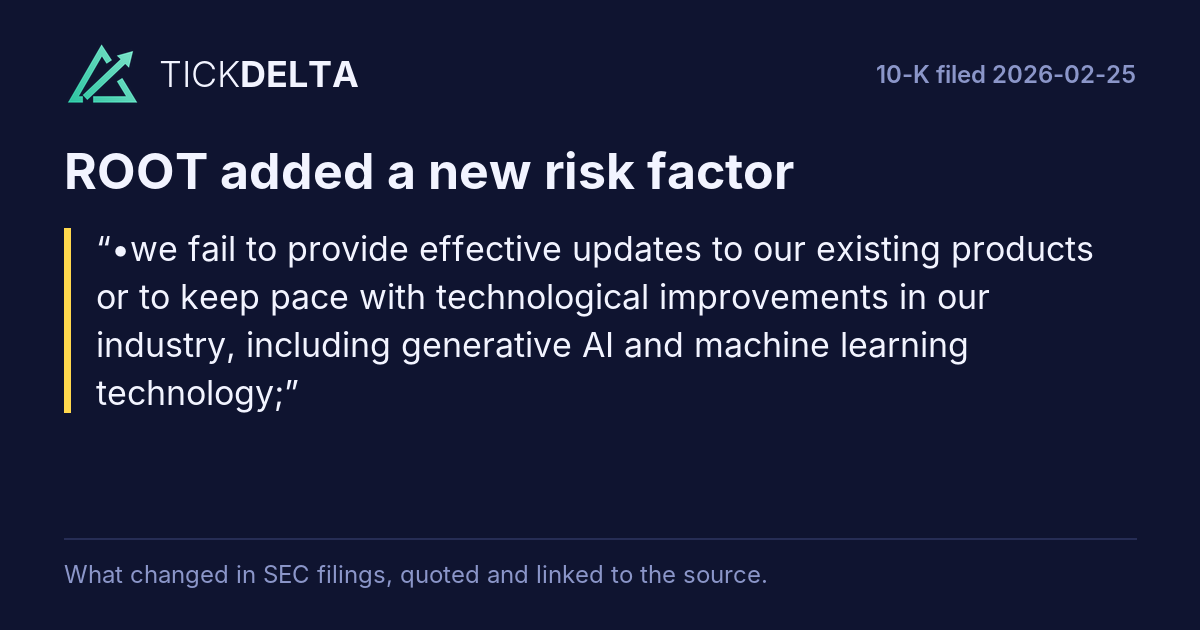
•we fail to provide effective updates to our existing products or to keep pace with technological improvements in our industry, including generative AI and machine learning technology;

Read in the 10-K

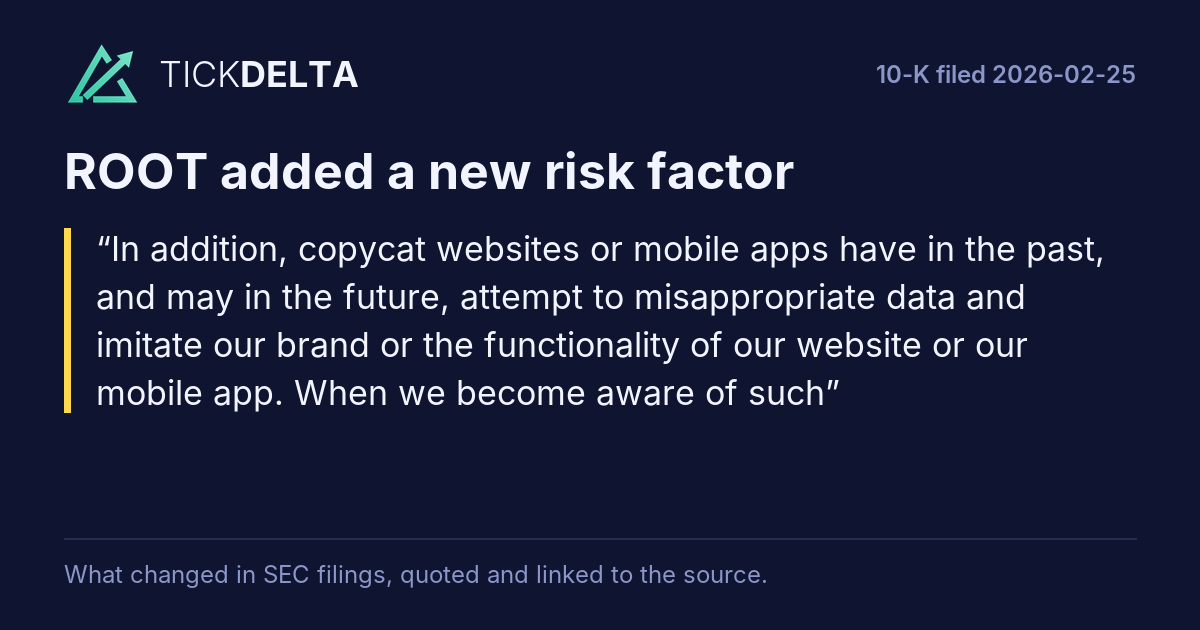
In addition, copycat websites or mobile apps have in the past, and may in the future, attempt to misappropriate data and imitate our brand or the functionality of our website or our mobile app. When we become aware of such

Read in the 10-K

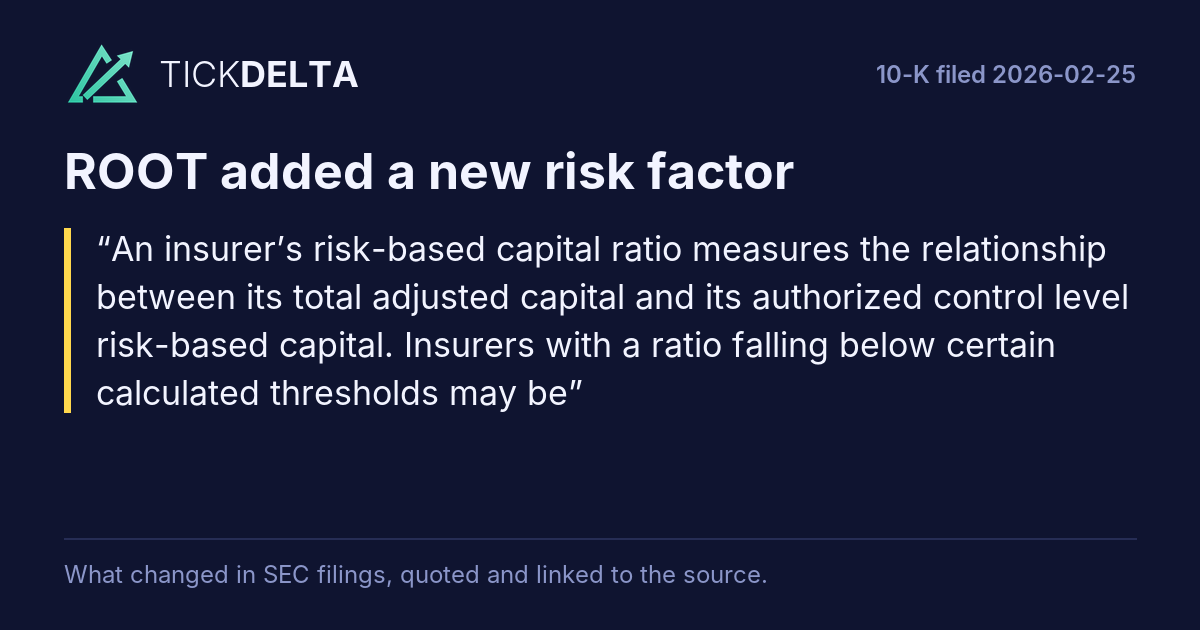
An insurer’s risk-based capital ratio measures the relationship between its total adjusted capital and its authorized control level risk-based capital. Insurers with a ratio falling below certain calculated thresholds may be

Read in the 10-K

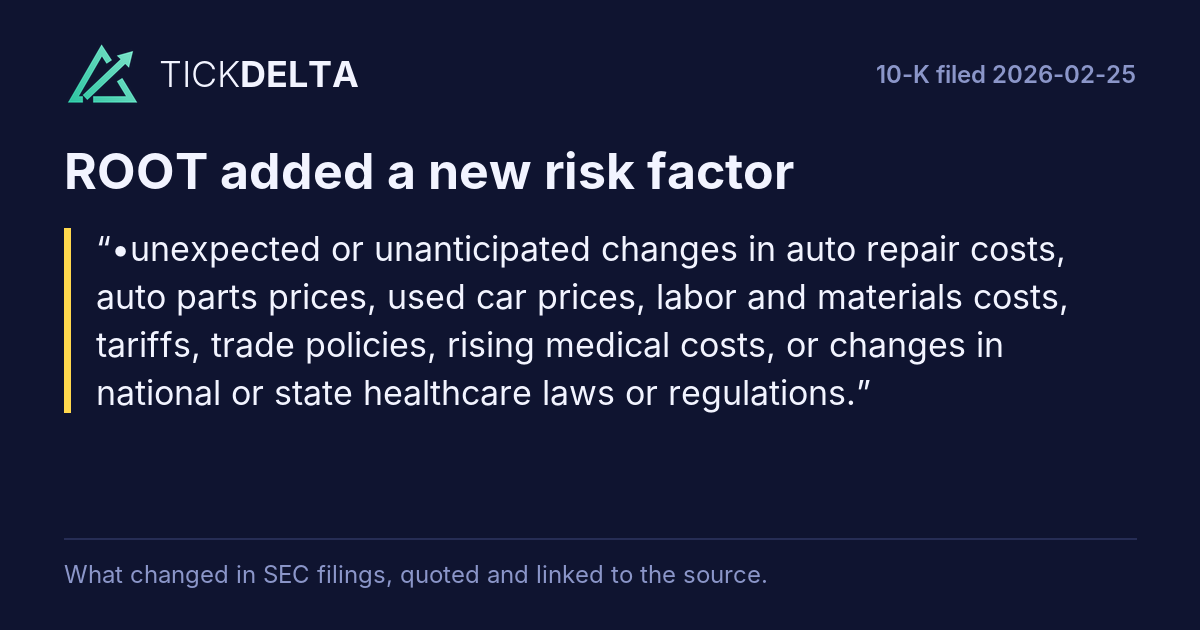
•unexpected or unanticipated changes in auto repair costs, auto parts prices, used car prices, labor and materials costs, tariffs, trade policies, rising medical costs, or changes in national or state healthcare laws or regulations.

Read in the 10-K

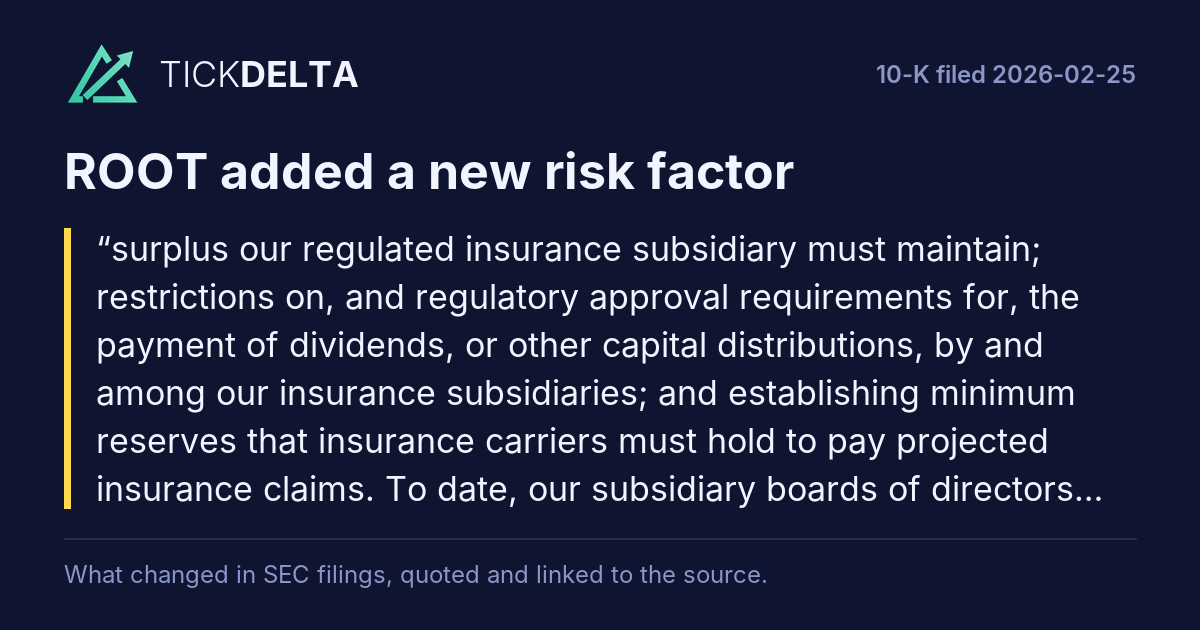
surplus our regulated insurance subsidiary must maintain; restrictions on, and regulatory approval requirements for, the payment of dividends, or other capital distributions, by and among our insurance subsidiaries; and establishing minimum reserves that insurance carriers must hold to pay projected insurance claims. To date, our subsidiary boards of directors have declared dividends on an intercompany basis only, in the exercise of their respective discretion and subject to regulatory approval, after considering a variety of factors, including our results of operations, capital and liquidity needs, and applicable regulatory requirements.

Read in the 10-K
Show the other 4

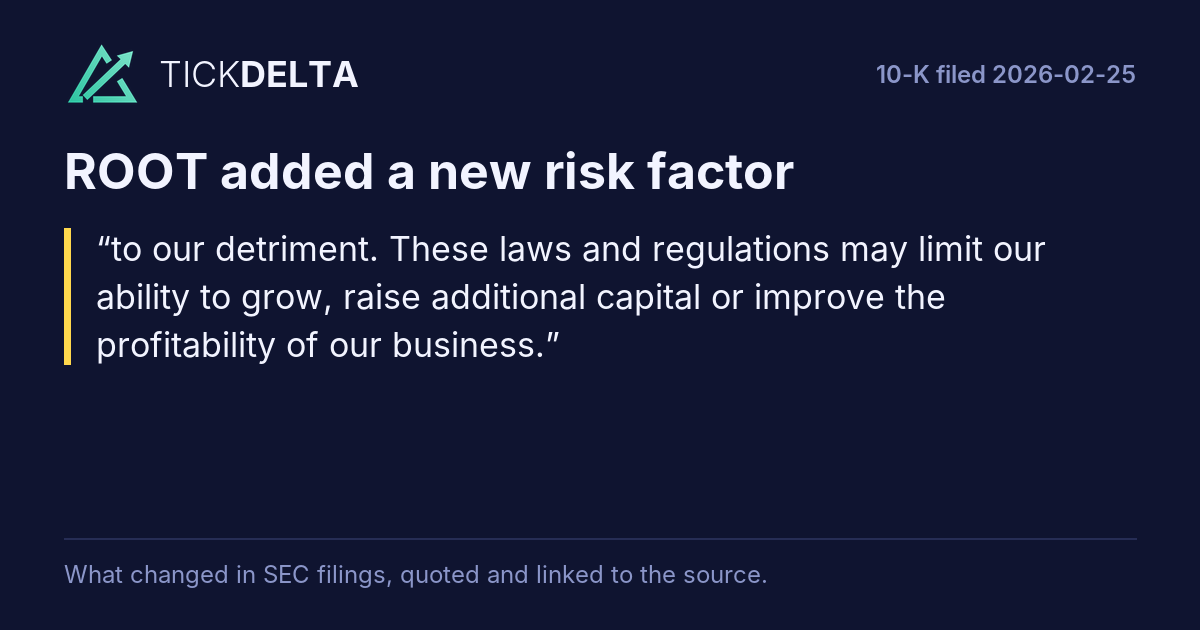
to our detriment. These laws and regulations may limit our ability to grow, raise additional capital or improve the profitability of our business.

Read in the 10-K

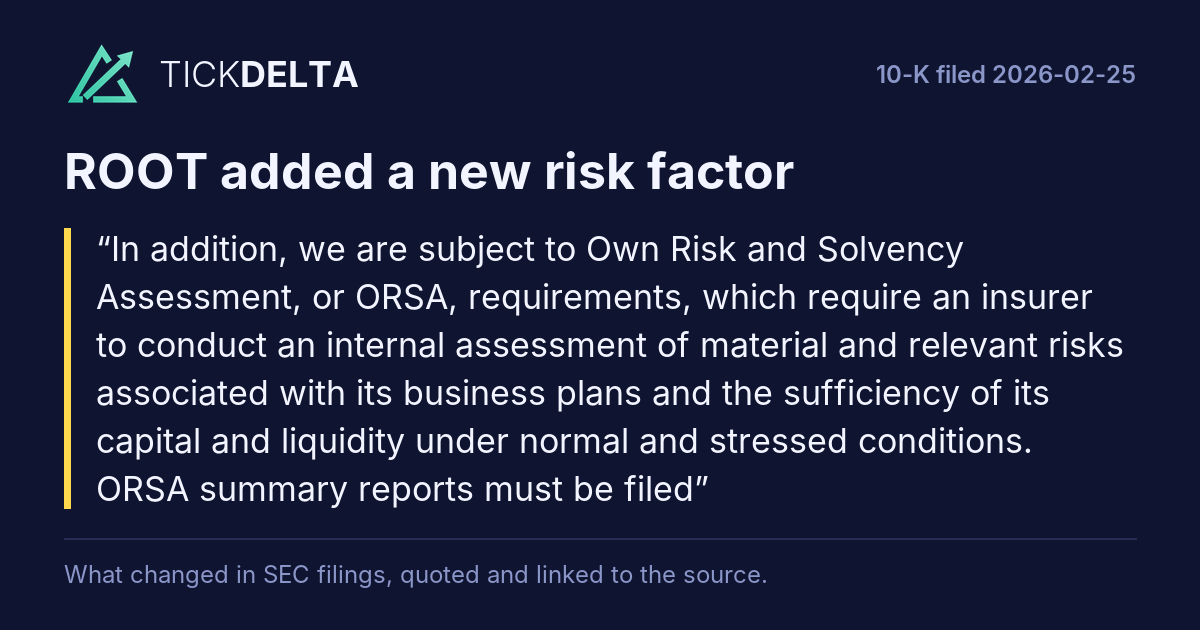
In addition, we are subject to Own Risk and Solvency Assessment, or ORSA, requirements, which require an insurer to conduct an internal assessment of material and relevant risks associated with its business plans and the sufficiency of its capital and liquidity under normal and stressed conditions. ORSA summary reports must be filed

Read in the 10-K

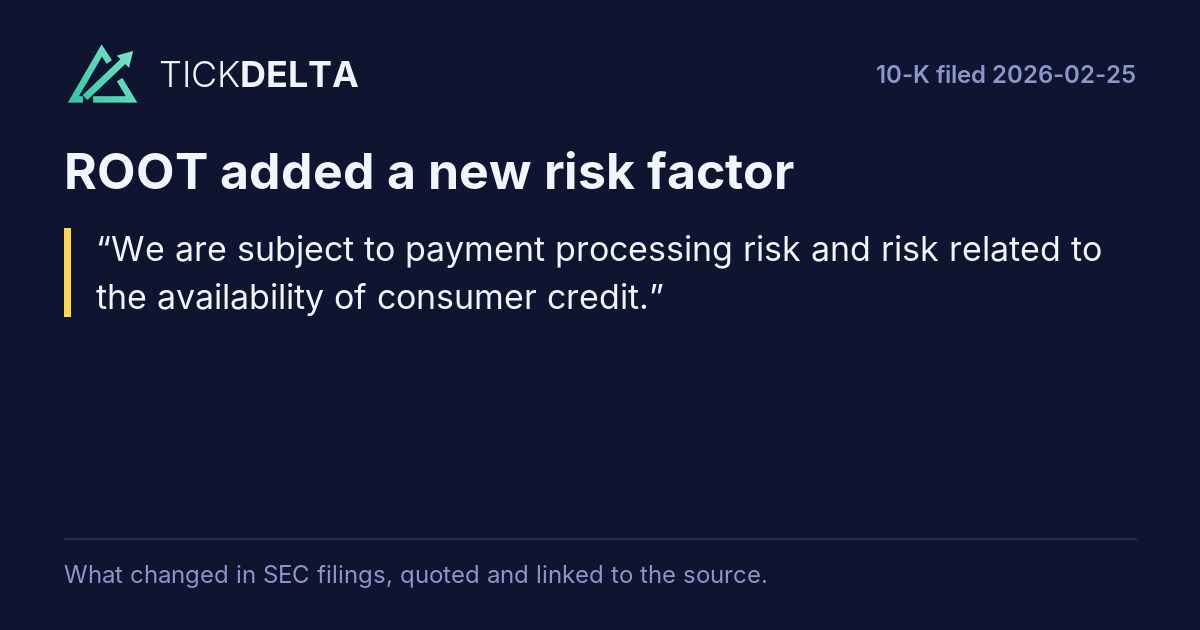
We are subject to payment processing risk and risk related to the availability of consumer credit.

Read in the 10-K

An economic downturn and economic uncertainty may adversely affect demand for our products.

There are indications of increased economic uncertainty in the United States, including the potential for an economic recession. Impacts of such general economic weakness include, without limitation: reduced credit availability; reduced liquidity; volatility in credit and equity markets; contentious trade markets, including changes to tariffs and trade policy; increasing job losses, bankruptcies and rising interest rates. In recent years, there have been instances of Congress and the President failing to reach agreement on federal budgetary and spending matters. A government shutdown, a default by the United States government on its debt obligations, credit-rating downgrades or a weakened dollar relative to other currencies could also have adverse effects on the broader global economy and contribute to, or worsen, an economic recession or create recessionary conditions. In addition, certain regulators may institute moratoriums that prohibit or limit an insurer’s ability to cancel or non-renew an insurance policy or require an insurer to defer the collection of past-due premiums to the end of the moratorium period. These moratoriums may lead to an increase in earned, but not collected premium, thereby adversely impacting the insurer. Certain of the jurisdictions in which we operate instituted moratoriums during the COVID-19 pandemic, and could do so again in adverse economic conditions. In addition, adverse economic conditions have included or resulted in, and could continue to include or result in, a significant increase in inflation. We may not be able to respond effectively to these challenges, which could have a material effect on our business, results of operations, financial condition and prospects.

Read in the 10-K

Paragraphs in the 10-Q filed Nov 4, 2026 that were not in the one before

New in the latest 10-Q

15 paragraphs in the 10-Q filed Nov 4, 2026 with nothing like them in the 10-Q filed Aug 5, 2026 (at least half the words must differ; new numbers alone do not count). Quoted exactly, grouped by the item heading above them. This is text that changed, not a judgement of how serious it is.

Financial statements and notes

Warrant Compensation - In October 2021, we closed the investment agreement with Carvana Group, LLC, or Investment Agreement, that included the issuance of 14.1 million shares of redeemable convertible preferred stock designated as the Series A Convertible Preferred Stock and the issuance of eight tranches of warrants to purchase shares of the Company’s Class A common stock, of which three tranches expired unexercised in 2025. As part of the Investment Agreement, we and Carvana also entered into a five-year commercial agreement whereby our auto insurance products are embedded into the integrated automobile insurance solution for Carvana’s online buying platform, or Integrated Platform. The commercial agreement provides for agent commissions payable to Carvana for policy origination.

Read in the 10-Q

On August 31, 2026, we extended the commercial agreement, cancelled the outstanding long-term warrants previously issued to Carvana, and concurrently issued Carvana five replacement warrant tranches, or Replacement Warrants, with the opportunity to purchase a maximum of approximately 1.5 million shares of Class A common stock. The Replacement Warrants expire on August 31, 2028. We accounted for the cancellation and concurrent issuance of the Replacement Warrants as a modification of equity classified non-employee share-based payment awards under ASC 718, Stock Compensation.

Read in the 10-Q

Compensation expense associated with the Carvana warrants is recognized based on the applicable fair value of the awards and our assessment of the probability of achieving the related performance conditions. The fair value of the warrants is estimated using a Black-Scholes-Merton model, or BSM. The BSM estimates the fair value per warrant for each tranche based on the underlying stock price, exercise price, expected term, volatility (based on historical volatility of our common stock over a period commensurate with the expected term), risk-free interest rate (based on U.S. Constant Maturity Yield Curve over a similar term), and expected dividend yield. For modifications of the warrants, we recognize the incremental compensation cost over the original award, which is measured as the excess, if any, of the fair value of the modified award over the fair value of the original award immediately before the modification. For those warrant tranches that were probable of vesting immediately before the modification, we continue recognizing that compensation cost as long as the original milestone continues to be probable of vesting.

Read in the 10-Q

These warrants vest upon achievement of certain performance milestones related to insurance sales through the Integrated Platform. The associated compensation expense is dependent on our periodic assessment of the probability of the milestones being achieved. If deemed probable, we recognize compensation expense on a pro-rata basis considering progress toward achieving the milestones. If a performance condition is no longer probable of achievement, any previously recognized compensation expense is reversed and no subsequent compensation expense is recognized until achievement is once again probable, at which point a cumulative catch-up is recognized.

Read in the 10-Q

1) Certain investments are not rated by a nationally recognized statistical rating organization, or NRSRO. The absence of an NRSRO rating does not, by itself, indicate elevated credit risk.

Read in the 10-Q
Show the other 10

The fair values of the Original Warrants and Replacement Warrants were estimated immediately before and after the modification date, respectively, using a BSM. Incremental compensation costs resulting from the modification were measured as the excess of the fair value of the Replacement Warrants over the fair value of the Original Warrants immediately before modification. The BSM uses certain inputs, assumptions and estimates, as follows:

Read in the 10-Q

Original Warrants Replacement Warrants Expected term (years) 1.00 2.00 Risk-free interest rate 4.2% 4.3% Dividend rate — — Volatility 67.9% 84.7%

Read in the 10-Q

For the three months ended September 30, 2025, we operated at a loss and therefore, the conversion of common stock equivalents would increase the denominator of the diluted EPS calculation and create a lower loss per share. Therefore, these common stock equivalents are considered anti-dilutive and diluted EPS is equal to basic EPS. Net losses are not allocated to participating securities, as the holders of such securities are not contractually obligated to share in the Company’s losses. For the three months ended September 30, 2025, net income (loss) attributable to common shareholders is equal to net income (loss).

Read in the 10-Q

of directors. The timing and amount of any repurchases under the Repurchase Program will depend upon several factors, including market and business factors.

Read in the 10-Q

Risk Factors

We may fail to maintain an effective partnership channel offering, including our embedded insurance product and our independent agent platform, and/or fail to perform under the associated commercial arrangements.

Read in the 10-Q

We entered into a commercial agreement with Carvana on October 1, 2021, in which the parties agreed to develop an integrated automobile insurance solution for Carvana’s online car buying platform, and we pay commissions to Carvana for insurance policies purchased by Carvana customers. The commercial agreement includes certain exclusivity rights and obligations of the parties. The commercial agreement, as amended, is set to expire on August 31, 2028. In addition, we are a party to and are pursuing commercial arrangements with other potential partners with varying levels of integration, including utilization of an embedded insurance offering. If we or our commercial counterparties, including Carvana, are unable to satisfy obligations under commercial arrangements, if we are unable to maintain effective partnership arrangements, including an embedded insurance product and our independent agent platform, if we are unable to renew or extend the term of any of our commercial agreements on terms attractive to us or at all, if we are unable to contract with additional partners to utilize these products, or if our partners experience difficulty with their businesses or if they or we are unable to attract insurance customers, that could have a material and adverse effect on our business, results of operations, financial condition and prospects.

Read in the 10-Q

Other information

On August 14, 2026, Jonathan Allison, the Company’s Chief Administrative Officer, entered into a trading plan intended to satisfy the affirmative defense conditions of Rule 10b5-1(c) under the Exchange Act (a “10b5-1 Plan”). Mr. Allison’s 10b5-1 Plan provides for the potential sale of up to 51,610 shares of Class A common stock and terminates no later than November 10, 2027.

Read in the 10-Q

On August 18, 2026, Megan Binkley, the Company’s Chief Financial Officer, modified a 10b5-1 Plan. Ms. Binkley’s 10b5-1 Plan provides for the potential sale of up to 22,500 shares of Class A common stock and terminates no later than November 30, 2027.

Read in the 10-Q

On August 19, 2026, Julie Szudarek, a member of the Company’s Board of Directors, entered into a 10b5-1 Plan. Ms. Szudarek’s 10b5-1 Plan provides for the potential sale of up to 5,500 shares of Class A common stock and terminates no later than November 17, 2027.

Read in the 10-Q

On August 21, 2026, Alexander Timm, the Company’s Chairman of the Board and Chief Executive Officer, modified a 10b5-1 Plan. Mr. Timm’s 10b5-1 Plan provides for the potential sale of up to 107,000 shares of Class A common stock and terminates no later than November 24, 2027.

Read in the 10-Q

The 10-Q's risk factors against the 10-K

Item 1A of the 10-Q filed Nov 4, 2026 against Item 1A of the 10-K filed Feb 25, 2026. A 10-Q repeats only the risks that changed, so a 10-K paragraph that is missing from it is not counted as removed. Added is a paragraph with nothing like it in the 10-K, Reworded a sentence that is in both with several words changed, Quiet changes a sentence in both where one to four words changed and one is a hedge or a modal (cut words struck through, new words highlighted). Text on the page, not a score; each links to the filing at sec.gov.

Added10-Q Nov 4, 2026 vs 10-K Feb 25, 2026
Except as discussed below, there have been no material changes in our risk factors from those disclosed in the 2025 10-K. In addition to the other information set forth in this Quarterly Report on Form 10-Q, you should carefully consider the risk factors discussed in Part I, Item 1A. “Risk Factors,” in the 2025 10-K.

Read it in the 10-Q at sec.gov

Phrases used for the first time

Two-word phrases in Risk Factors of the 10-K filed Feb 25, 2026 that are in none of the 1 earlier 10-Ks stored, back to Feb 26, 2025

united states ×23georgia florida ×4trade policies ×3contract counterparties ×3operate consistent ×2consistent telematics ×2telematics program ×2florida oir ×2cybersecurity risks ×2states federal ×2tariffs trade ×2contractors contract ×2states department ×2consumer credit ×2states government ×2economic uncertainty ×2
Where each one is used
  • united states: Our expansion within the United States will subject us to additional regulatory approvals and costs and risks, and our plans may not be successful.
  • georgia florida: Our exposure to loss activity and regulation may be greater in states where we currently have most of our customers, including Texas, Georgia, Florida, and California.
  • trade policies: While actuarial models for pricing and reserving typically include an expected level of inflation (including social inflation), unanticipated increases in claim severity can arise from events that are inherently difficult to predict, such as inflationary shocks or surges in health care costs. Implementation of...
  • contract counterparties: In addition to registered intellectual property rights such as trademark registrations, we rely on non-registered proprietary information and technology, such as trade secrets, confidential information, know-how and technical information. Certain information or technology that we endeavor to protect as trade...
  • operate consistent: Due to Proposition 103 in California, we are currently limited in our ability to use telematics data beyond miles driven to underwrite insurance. Additionally, restrictions in Maryland are currently limiting our ability to operate a consistent telematics program across jurisdictions. These constraints hinder our...
  • consistent telematics: Due to Proposition 103 in California, we are currently limited in our ability to use telematics data beyond miles driven to underwrite insurance. Additionally, restrictions in Maryland are currently limiting our ability to operate a consistent telematics program across jurisdictions. These constraints hinder our...
  • telematics program: Due to Proposition 103 in California, we are currently limited in our ability to use telematics data beyond miles driven to underwrite insurance. Additionally, restrictions in Maryland are currently limiting our ability to operate a consistent telematics program across jurisdictions. These constraints hinder our...
  • florida oir: State insurance regulators perform examinations of insurance companies under their jurisdiction to assess compliance with applicable laws and regulations, financial condition and the conduct of regulated activities at least every three to five years. Root Insurance Company is Ohio-domiciled and has completed...

The 10-K at sec.gov

Used at least twice, small words left out. Counted, not picked: a phrase can be new because the company renamed something.

What was taken out

7 paragraphs of last year's Risk Factors with nothing like them now. The longest are quoted.

Across all companies
Our business was impacted by the effects of the outbreak of the novel strain of coronavirus, or COVID-19, which was declared a global pandemic in March 2020. Pandemics and governmental responses thereto could impact the economies of affected countries, including creating or exacerbating supply chain disruptions and inflation and negatively impacting economic growth, the proper functioning of financial and capital markets, foreign currency exchange rates, and interest rates. It is possible that a pandemic and governmental responses thereto will cause increased inflation, an economic...
In the 10-K filed Feb 26, 2025
Further, we are subject to the terms of our privacy policies, privacy-related disclosures, and contractual and other privacy-related obligations to our customers and other third parties. We have in the past experienced cybersecurity attacks that have resulted in threat actors obtaining customer personal information and some of these
In the 10-K filed Feb 26, 2025
and storage of biometric data such as fingerprints in the insurance industry and requires the informed written consent from policyholders if the insurance company intends to collect or disclose their personal biometric identifiers.
In the 10-K filed Feb 26, 2025
Many of our competitors have brands that are well-recognized. As a newer entrant into the insurance market, we have spent, and expect that we will for the foreseeable future continue to spend, considerable amounts of money and
In the 10-K filed Feb 26, 2025

Sources

Item 1A of each 10-K and 10-Q on EDGAR, quoted exactly. Each paragraph links to the filing at sec.gov.

Also

10-K change: what was reworded or cut, section by section.

Work with it

Excel workbook · CSV. Google Sheet that stays up to date: paste =IMPORTDATA("https://tickdelta.com/company/ROOT/export.csv") into a cell.

Next:10-K change
Esc

Type a ticker such as AAPL, a name, an investor such as Buffett, or a topic such as tariffs. ↑ ↓ to move, Enter to open.